Month: September 2010

  • US President Obama condemns plans to burn the Koran

    US President Obama condemns plans to burn the Koran

    US President Barack Obama says plans by a small church to burn copies of the Koran on the anniversary of 9/11 are a “recruitment bonanza” for al-Qaeda.

    Mr Obama said if the burning went ahead in Gainesville, Florida, it could endanger US military personnel serving in Pakistan and Afghanistan.

    The plan has drawn widespread international condemnation.

    Interpol has issued a global alert, warning the burning could provoke “violent attacks on innocent people”.

    The US State Department has advised American citizens abroad to be on the alert for possible attacks and to avoid areas where demonstrations might take place.

    Terry Jones, the pastor behind the threat, leads a congregation of 50 followers in the city of Gainesville.

    He has said the burning would be a way to stand up to terrorism.

    In an interview with ABC television, Mr Obama said he hoped Mr Jones “understands that what he’s proposing to do is completely contrary to our values as Americans, that this country has been built on the notion of freedom and religious tolerance”.

    “And as a very practical matter, I just want him to understand that this stunt that he is talking about pulling could greatly endanger our young men and women who are in uniform,” the president said.

    “Look, this is a recruitment bonanza for al-Qaeda. You could have serious violence in places like Pakistan and Afghanistan. This could increase the recruitment of individuals who’d be willing to blow themselves up in American cities, or European cities,” he said.

    “I hope he listens to those better angels and understands that this is a destructive act that he’s engaging in,” the president said.

    Later on Thursday, US officials said they was considering contacting Mr Jones directly to urge him to reconsider his plans.

    Mr Jones had told USA Today he could potentially cancel his plans if officials spoke to him directly.

    Defence Secretary Robert Gates was considering “taking this unusual measure of calling this pastor and trying to convince him that it is not the right thing to proceed with,” said Pentagon press secretary Geoff Morrell.

    ‘Diseased mind’

    Mr Jones said on Wednesday that his plan to burn the Islamic holy book was intended to draw attention to his belief that “something’s wrong”.

    “It is possibly time for us in a new way to actually stand up, confront terrorism,” Mr Jones told reporters outside his church.

    US officials say they cannot intervene as the church’s actions would probably be protected by the US constitution’s guarantee of freedom of speech.

    Interpol, the international police organisation, has issued an alert to all of its 188 member states, warning of “a significant threat to public safety”.

    “If the proposed Koran burning by a pastor in the US goes ahead as planned, there is a strong likelihood that violent attacks on innocent people would follow,” it said.

    The agency said it was acting partly in response to a request from the Pakistani Interior Minister, Rehman Malik.

    Earlier, Pakistan’s President Asif Ali Zardari said in a statement that “anyone who even thought of such a despicable act must be suffering from a diseased mind and a sickly soul”.

    “It will inflame sentiments among Muslims throughout the world and cause irreparable damage to interfaith harmony and also to world peace,” he said.

    Interpol concern

    Mr Zardari’s comments echoed a chorus of condemnation from both Muslim and non-Muslim countries.

    Malaysia called it a heinous crime, while Indonesia said it would damage relations between Islam and the West.

    In the UK, Downing Street said it would not condone the burning of any book.

    “We would strongly oppose any attempt to offend any member of any religious or ethnic group. We are committed to religious tolerance,” said a spokesman for Prime Minister David Cameron.

    The plan has also sparked condemnation from Iran, the Vatican, Nato and the top US Afghan commander.

    US Secretary of State Hillary Clinton called it “disgraceful” while the Organisation of the Islamic Conference (OIC), which represents more than 50 states and promotes Muslim solidarity, said Mr Jones was following an “outrageous path of hatred”.

    “The culture of peaceful co-existence and intercommunal and inter-religious tolerance that the international community is trying to achieve is under threat from marginal and extremist fanatics,” said OIC secretary general Ekmeleddin Ihsanoglu.

    On Monday Gen David Petraeus, the top US commander in Afghanistan, warned troops’ lives would be in danger if the church went ahead with its bonfire.

    The website of Mr Jones’ church was no longer accessible on Thursday, after the company hosting it withdrew it from the internet.

    Rackspace told the AFP news agency the site had “violated the Offensive Content section of its Acceptable Use policy”.

    Muslims consider the Koran to be the word of God and insist it be treated with the utmost respect. Any intentional damage or show of disrespect to the holy book is deeply offensive to them.

    BBC
  • Merkel honours Danish Muhammad cartoonist Westergaard

    Merkel honours Danish Muhammad cartoonist Westergaard

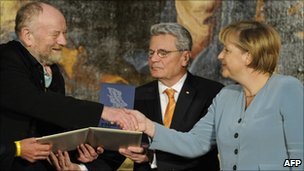
    German Chancellor Angela Merkel has defended Danish cartoonist Kurt Westergaard, whose cartoons of the Prophet Muhammad caused anger in 2006.

    A depiction of Muhammad’s turban as a fused bomb sparked global outrage when it was published in Denmark.

    Kurt Westergaard (left) with Chancellor Merkel and German politician Joachim Gauck (centre)

    Presenting him with a press freedom award, Mrs Merkel said Mr Westergaard was entitled to draw his caricatures.

    “Europe is a place where a cartoonist is allowed to draw something like this,” she said.

    “We are talking here about the freedom of opinion and the freedom of the press,” Ms Merkel said at the ceremony in the German city of Potsdam.

    The offending cartoon – which led to a groundswell of Muslim anger in many countries around the world – was one of 12 first published by Danish newspaper Jyllands-Posten in 2005.

    ‘Place of freedom’

    Mrs Merkel, who grew up in communist East Germany, added that German people clearly remembered the implications of a lack of freedom and should therefore cherish it.

    “It’s about whether in a Western society with its values he [Mr Westergaard] is allowed to publish his Muhammad cartoons, or not. Is he allowed to do it? Yes he is,” Ms Merkel said.

    She described Europe as a place that respects and values the freedom of belief and religion.

    Dozens of people died in violence that broke out in early 2006, months after Jyllands-Posten published the cartoons showing Muhammad in a variety of humorous or satirical situations. Muslims regard the depiction of the prophet as blasphemy.

    The M100 media prize committee praised Kurt Westergaard for what it said was his “courage” to defend democratic values despite threats of violence and death.

    Security was tight at Sanssouci palace in Potsdam where the cartoonist told reporters: “Maybe they will try to kill me and maybe they will have success, but they cannot kill the cartoon.”

    Speaking at the award ceremony Ms Merkel also described as “abhorrent” a plan by US pastor Terry Jones to burn copies of the Koran on Saturday, the ninth anniversary of the 11 September terror attacks.

    She said she found the idea disrespectful and “simply wrong”.

    ‘Risky decision’

    A police sniper near Sanssouci palace in Potsdam, 8 September 2010

    Mrs Merkel’s decision to speak at the event about press freedom has caused some surprise in Germany.

    One newspaper said she was taking “a huge risk”.

    Frankfurter Allgemeine Zeitung said that the effect of having a photograph taken with Kurt Westergaard was incalculable, describing it as “probably be the most explosive appointment of her chancellorship so far”.

    Germany’s Central Muslim Council (ZMD) criticised Ms Merkel for attending the award ceremony.

    A ZMD spokesman, Aiman Mazyek, told public broadcaster Deutschlandradio that the Chancellor was honouring someone “who in our eyes kicked our prophet, and therefore kicked all Muslims”.

    He said giving Mr Westergaard the prize in a “highly charged and heated time” was “highly problematic”.

    In recent weeks Germany has seen a highly charged debate over immigration, partly set off by the publication of a book by a board member of the German central bank, Thilo Sarrazin.

    In the book Mr Sarrazin, who is also a member of the Social Democratic Party (SPD) attacked what he describes as a failure of Muslims living in the Germany to integrate.

    BBC

  • As The New World Order Falters

    As The New World Order Falters

    With U.S. Primacy In Decline, Nationalism Reshaping Balance Of Global Power

    By VICTOR DAVIS HANSON
    September 5, 2010

    The post-Cold War new world order is rapidly breaking apart. Nations are returning to the ancient passions, rivalries and differences of past centuries.

    Take Europe. The decades-old vision of a united pan-continental Europe without borders is dissolving. The cradle-to-grave welfare dream proved too expensive for Europe’s shrinking and aging population.

    Cultural, linguistic and economic divides between Germany and Greece, or Holland and Bulgaria, remain too wide to be bridged by fumbling bureaucrats in Brussels. NATO has devolved into a euphemism for American expeditionary forces.

    Nationalism is returning, based on stronger common ties of language, history, religion and culture. We are even seeing the return of a two-century-old European “problem”: a powerful Germany that logically seeks greater political influence commensurate with its undeniable economic superiority.


    The tired Israeli-Palestinian fight over the future of the West Bank is no longer the nexus of Middle East tensions. The Muslim Arab world is now more terrified by the re-emergence of a bloc of old familiar non-Arabic, Islamic fundamentalist rivals.

    With nuclear weapons, theocratic Iran wants to offer strategic protection to radical allies such as Syria, Hezbollah and Hamas, and at the same time restore Persian glory. While diverse, this rogue bunch shares contempt for the squabbling Sunni Arab world of rich but defenseless Gulf petro-sheikdoms and geriatric state authoritarians.

    Japan’s economy is still stalled. Its affluent population is shrinking and aging. Elsewhere in the region, the Japanese see an expanding China and a lunatic nuclear North Korea. Yet Japan is not sure whether the inward-looking United States is still credible in its old promise of protection against any and all enemies.

    One of two rather bleak Asian futures seems likely. Either an ascendant China will dictate the foreign policies of Japan, South Korea and Taiwan, or lots of new free-lancing nuclear powers will appear to deter China since it cannot count on an insolvent U.S. for protection.

    Oil-rich Russia — deprived of its communist-era empire — seems to find lost imperial prestige and influence by being for everything that the U.S. is against. That translates into selling nuclear expertise and material to Iran, providing weapons to provocative states such as Hugo Chavez’s Venezuela, and bullying neighbors over energy supplies.

    Closer to home, Mexico has become a strange sort of friend. It devolves daily into a more corrupt and violent place than Iraq or Pakistan. The fossilized leadership in Mexico City shows no interest in reforming, either by opening its economy or liberalizing its political institutions.

    Instead, Mexico’s very survival for now rests on cynically exporting annually a million of its impoverished and unhappy citizens to America. More interested in money than its own people, the Mexican government counts on the more than $20 billion in remittances that return to the country each year.

    But American citizens are tired of picking up the tab to subsidize nearly 15 million poor illegal aliens. The growing hostility between the two countries is reminiscent of 19th-century tensions across the Rio Grande.

    How is America reacting to these back-to-the-future changes?

    Politically divided, committed to two wars, in a deep recession, insolvent and still stunned by the financial meltdown of 2008, our government seems paralyzed. As European socialism implodes, for some reason a new statist U.S. government wants to copy failure by taking over ever more of the economy and borrowing trillions more dollars to provide additional entitlements.

    As panicky old allies look for American protection, we talk of slashing our defense budget. In apologetic fashion, we spend more time appeasing confident enemies than buttressing worried friends.

    Instead of finishing our border fence and closing the southern border, we are suing a state that is trying to enforce immigration laws that the federal government will not apply. And as sectarianism spreads abroad, we at home still pursue the failed salad bowl and caricature the once-successful American melting pot.

    But just as old problems return, so do equally old solutions. Once-stodgy ideas like a free-market economy, strong defense, secure borders and national unity are suddenly appearing fresh and wise.

    Victor Davis Hanson is a classicist and historian at the Hoover Institution at Stanford University. This was distributed by Tribune Media Services.

  • Admiral Mullen Discusses Critical Military Engagement in Turkey

    Admiral Mullen Discusses Critical Military Engagement in Turkey

    Admiral Mullen Discusses Critical Military Engagement in Turkey

    Publication: Eurasia Daily Monitor Volume: 7 Issue: 160

    September 8, 2010

    By Saban Kardas

    Admiral Mike Mullen, the Chairman of the US Joint Chiefs of Staff, visited Turkey last week. Although the official purpose of Mullen’s visit was to congratulate his Turkish counterpart General Isik Kosaner, recently appointed as the Chief of the General Staff, this introductory visit had no fixed agenda. Mullen had a chance to gauge Turkey’s position on many of US policies in the surrounding regions. In his meetings with Turkish military and civilian leaders, Mullen exchanged opinions on US withdrawal from Iraq, the Iranian nuclear issue and the international military presence in Afghanistan, as well as reiterating US support for Turkey on various issues such as its struggle against the Kurdistan Workers’ Party (PKK) and sales of military equipment for the Turkish armed forces (Hurriyet, Cumhuriyet, Radikal, September 5).

    On the issue of Iran, Mullen downplayed recent disagreements, arguing that both Turkey and the US share the common objective of preventing Iran from acquiring a nuclear weapons capability. However, as Ankara’s earlier diplomacy on the Iranian nuclear standoff attested, such blanket mutual understanding was not enough to eliminate major differences of opinion over how best to deal with Iran (EDM, June 1). Ankara’s objections to a tougher US position and insistence on a diplomatic solution culminated in Turkey’s vote against a US-brokered UN Security Council resolution authorizing a new round of sanctions in June. Coupled with other crises, such as the problems encountered in Turkish-Israeli relations, this development further strained bilateral relations, prompting many US politicians and interest groups to question the strategic partnership with Turkey. In this tense environment, in August the Republicans blocked President Barack Obama’s nominee for the next Ambassador to Turkey, Frank Ricciardione. The vacant post highlighted how tenuous Obama’s Turkey policy remained, as well as the impact of Ankara’s recent policies on US domestic politics.

    While for Washington a combination of diplomatic efforts and punitive sanctions is needed to deal with Iran, Ankara still believes that constructive diplomacy must be prioritized. Earlier in August, Mullen had raised tensions in the region, following his statement that military options against Iran remain on the table, which invited a harsh reaction from Iran, placing Turkey in a difficult diplomatic position (AFP, August 3).

    In this context, Mullen adopted a rather balanced tone in Ankara and said that he had no plan to question Turkey over the Security Council vote and emphasized that he welcomed Turkish leaders’ statements that they would comply with UN sanctions against Iran. Nonetheless, this last point underscored continued differences over Iran. The Turkish government has reiterated on many occasions that it would implement only sanctions authorized by the UN, not the stricter set of measures being introduced by the US and the European countries.

    Mullen also referred to ongoing discussions within NATO pertaining to the formation of a missile defense system against Iran, which will be part of the agenda of the upcoming NATO summit in November. Turkey is one of the possible locations for radars and interceptors. However, the Turkish position on this issue remains unclear, and it is unlikely to welcome such a proposal considering Ankara’s sensitivity to Tehran’s concerns.

    Turkey’s contribution to the international military effort in Afghanistan was also discussed. Praising Turkey’s critical role in ensuring Afghanistan’s security through its provision of troops and training to Afghan security personnel, Mullen requested that Turkey maintains its military contribution after its command over international troops in Kabul and the surrounding area expires in October. Turkey has contributed to the NATO-led International Security Assistance Force (ISAF) since its inception immediately after the US invasion of the country in 2001, and has assumed the command of ISAF on many occasions. Although the US has pressured Turkey to increase its troop levels, Ankara has refused to do so, on the grounds that non-military means should be used to address the root causes of the conflict. Washington has come to acknowledge Ankara’s concerns on this issue, but wants to ensure that Turkey maintains at least its current level of commitment to ISAF.

    An additional area discussed during the bilateral talks was Turkey’s specific role in US withdrawal plans from Iraq. Ever since the Obama administration announced its withdrawal plans, there has been speculation that Turkey would serve as one of the exit routes for US troops and military equipment (EDM, March 9, 2009). Denying such reports, Mullen stressed that he was not in Ankara to negotiate the terms of the US military exit from Iraq through Turkey. Since the transfer of military units will require authorization from the Turkish parliament, it is unlikely that Washington will seriously consider this option. Indeed, a recent statement from the Turkish foreign ministry also ruled out such an option, though welcoming the possibility of moving non-combat elements through the country. If an agreement is reached, Turkey would be ready to create a safe zone for the transfer of technical equipment (Sabah, September 3).

    The visit by Mullen underscores the extent to which US-Turkish relations are characterized by military-strategic issues, and how the United States needs Turkey’s cooperation at best and at the very least its acquiescence for the successful execution of its military engagements in the regions surrounding Turkey. Therefore, Turkey is a key part of discussions on major US military campaigns, which serves as a constraint on Washington and prevents it from severing ties with this critical ally over its independent policies. Turkey, in contrast, relies on US assistance and the transfer of military technology, which curbs any tendency on its part to pursue unilateral policies. Aware of this mutual interdependence in military-security affairs, civilian and military bureaucrats from both sides have intensified their efforts to maintain the pace of cooperation. Recently, Turkish foreign ministry officials visited Washington to reiterate Ankara’s determination to maintain strategic ties with the US. This message will perhaps be repeated during the visit to the US later this month by Turkish President, Abdullah Gul, and Foreign Minister, Ahmet Davutoglu, as part of the UN General Assembly.

    https://jamestown.org/program/admiral-mullen-discusses-critical-military-engagement-in-turkey/

  • Countering Ankara’s Strategic Drift

    Countering Ankara’s Strategic Drift


    Overcoming Turbulence in U.S.-Turkish Relations
    and Countering Ankara’s Strategic Drift
    Speakers:
    Ariel Cohen, Ph.D.
    Senior Research Fellow,
    Kathryn and Shelby Cullom Davis Institute
    for International Studies, The Heritage Foundation
    Sally McNamara
    Senior Policy Analyst, European Affairs,
    The Margaret Thatcher Center for Freedom,
    The Heritage Foundation

    James Phillips

    Senior Research Fellow for Middle Eastern Affairs,
    Douglas and Sarah Allison Center for Foreign Policy Studies,
    The Heritage Foundation
    Host:
    Ted Bromund, Ph.D.

    Senior Research Fellow,
    The Margaret Thatcher Center for Freedom,
    The Heritage Foundation

    Date: Tuesday, September 21, 2010
    Time: 10:30 AM – 12:00 PM
    Location: The Heritage Foundation’s Allison Auditorium

    or call (202) 675-1752

    News media inquiries, please call (202) 675-1761

    All events can be viewed live at heritage.org.
    Guests are subject to Terms and Conditions of Attendance,
    which can be read at heritage.org/Events/Terms-and-Conditions-of-Attendance.
    Turkey has long been a key NATO partner and a strategic ally of Europe and the United States. However, Turkish and U.S. interests in the Middle East, especially Iran, as well as Central Asia, the Caucasus, and the Persian Gulf, have recently diverged. On critical issues, including the Iranian nuclear program and Israeli-Palestinian relations, Turkey currently stands at odds with the United States. Ankara even voted against the United Nations Security Council’s fourth round of sanctions against Iran.

    Leading U.S. policymakers blame Turkey’s strategic drift on the European Union’s failure to negotiate accession in good faith. On its current trajectory, Turkey’s relationship with the West could well devolve into a looser affiliation, while Ankara enters into a closer alliance with Iran and other Middle Eastern powers hostile to U.S. global leadership.

    Join us as our panelists examine recent trends in U.S.-European-Turkish relations and look at ways for the United States and Europe to address these emerging differences.


    214 Massachusetts Avenue, NE
    Washington, D.C. 20002-4999
    ph 202 546 4400 | fax 202 546 8328
    heritage.org
    Yahoo! Groups

    Switch to: Text-Only, Daily Digest • Unsubscribe • Terms of Use
    .

    __,_._,___

  • Blair postpones book party at Tate Modern

    Blair postpones book party at Tate Modern

    (Reuters) – Former premier Tony Blair has postponed a party at the Tate Modern art gallery celebrating the launch of his autobiography because of threats from protesters, his office said on Wednesday.

    Anti-war demonstrators had planned to disrupt the reception on Wednesday evening and a group of celebrated artists including Tracey Emin and Vivienne Westwood had called on the gallery to cancel the “disgraceful” event.

    Blair has also been forced to cancel a signing session for “A Journey” at a bookstore in central London.

    “It has been postponed for the same reason as the book signing,” a spokesman for Blair said.

    “We don’t want to put our guests through the unpleasant consequences of the actions of demonstrators.”

    At the weekend, protestors hurled eggs and shoes at the former prime minister during a promotional event in Dublin.

    Blair, prime minister for Labour between 1997 and 2007, led Britain into wars in Iraq and Afghanistan. In particular, the occupation of Iraq by Western coalition forces was widely opposed and contributed to a dive in Blair’s popularity.

    Emin, Westwood and musician Brian Eno, were among figures from the arts world who wrote a letter to the Guardian newspaper on Wednesday to voice their concern about the Tate Modern event.

    “It is disgraceful that the Tate is being used for this purpose,” they said.

    (Reporting by Matt Falloon; Editing by Steve Addison)

    The Reuters