Adabank is to be sold, in a tender [offer], on October 19 by Savings Deposit Insurance Fund.
Bank Hapolaim of Israel, who owns the majority of the shares of Turkey’s Bank Pozitif, was announced his interest to buy Adabank.
Since Iranians entered the negotiations for Adabank, Mossad and CIA started to follow the deal.
The main concern of the Americans and Israelis is if Iran Government buys a bank in Turkey, they might launder money for their nuclear targets through an internationally recognized bank.
Azerbaijani state companies are planning to invest some $5bn in Turkey in the next two to three years, a minister has said.
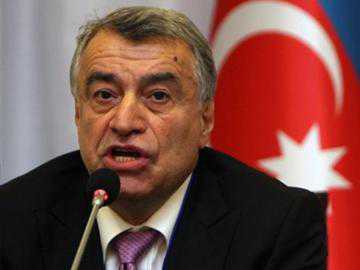
“The investments of Azerbaijani state companies in Turkey top $3bn today. In the coming two to three years our state companies are planning investments of $5bn in the Turkish economy, not to mention investment from the private sector,” Azerbaijan’s minister of industry and energy, Natig Aliyev, told a conference in Baku today.
Azerbaijan invests in Turkish energy projects in particular, with state oil company SOCAR holding the majority of shares in Turkey’s petrochemical giant, Petkim
Natig Aliyev told the international conference, entitled the Azerbaijani Model of Economic Development, that Azerbaijani companies were actively investing in Georgia too. He said that Azerbaijan met 90% of Georgia’s needs for gas and Azerbaijan’s state company, SOCAR, was modernizing the gas distribution network in Georgia.
Natig Aliyev also said that Azerbaijan was working to increase oil and gas production.
Economic Development Minister Shahin Mustafayev told the conference that Azerbaijan had become the region’s economic power house, accounting for 75% of the total gross domestic product (GDP) of the three South Caucasus states.
“In Azerbaijan, the years of reform by late President Heydar Aliyev and current President Ilham Aliyev have created a liberal and independent economy, relying on its own resources and integrated into the global economy,” Mustafayev said.
He said that Azerbaijan’s status was reflected in the country’s international credit rating and in global assessments on the ease of doing business.
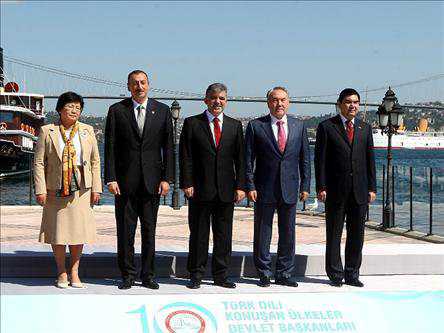
The 10th Summit of Heads of State of Turkish Speaking Countries in Istanbul ended after signing of a declaration.
The 10th Summit of Heads of State of Turkish Speaking Countries in Istanbul ended after signing of a declaration.
President Ilham Aliyev of Azerbaijan, President Nursultan Nazarbayev of Kazakhstan, Kyrgyzstan’s interim President Roza Otunbaeva and Turkmenistan’s President Gurbanguli Berdimuhammedov were in attendance at the summit hosted by Turkish President Abdullah Gul.
During the summit, the leaders agreed to appoint Turkish diplomat Halil Akinci as the first Secretary-General of the Secretariat who would officially assume his responsibilities following the entering into force of the Nakhchivan Agreement.
During last year’s summit in Nakhchivan on October 3, 2009, the leaders signed an agreement about establishment of the Council of Cooperation of Turkish Speaking States.
The headquarters of the Council will take place in Istanbul.
The leaders also decided to celebrate the signing day (3 October) of the Nakhchivan agreement as the Turkish Speaking States Cooperation Day.
They confirmed the importance of putting into practice the initiative aiming at establishment of a special foundation for support of Turkish culture and preservation of Turkish heritage in Baku in order to preserve the rich Turkish cultural heritage.
The leaders stated that they would promote the establishment of a union among universities to support the studies of the Turkish Academy in Astana.
They decided to celebrate the 20th anniversary of the independence of Azerbaijan, Kazakhstan, Kyrgyzstan, Uzbekistan and Turkmenistan in 2011 through joint activities.
Accordingly, they welcomed the proposal of Turkmenistan to organize a Turkish Speaking States cultural festival in Ashkhabad in 2011.
The leaders also expressed their satisfaction about the successful completion of the referendum in Kyrgyzstan on June 27, 2010. Highlighting importance of the parliamentary elections on October 10 for regional peace and stability, they confirmed that they would continue to support Kyrgyzstan during this transitional period.
The leaders invited international community to actively participate in the International Donor Conference for assistance to Kyrgyzstan to be organized by Kazakhstan in Almaty.
They expressed their deep regret over the raid of Israel to the humanitarian aid convoy sailing in international waters on May 31, 2010, causing the death of nine innocent civilians.
The leaders emphasized the importance of the settlement of the disagreement concerning the nuclear programme of Iran through dialogue and diplomacy for regional and global peace and stability.
The leaders also agreed to establish Turkish Speaking States Business Council in order to foster economic cooperation and decided to explore the possibility of the establishment of the ‘Turkic Speaking States’ Development Bank’ in Istanbul and a joint Insurance Company in order to support development of non-oil sectors and create new opportunities for private sector.
The first summit of Turkish Speaking Countries Cooperation Council will be held in Kazakhstan in 2011 and Kyrgyzistan will host the second summit in 2012.
Turkey’s ruling Justice and Development Party (AKP) is in talks with Kurdish militant group the Kurdistan Workers’ Party (PKK) and its patron, Iraq’s Kurdistan Regional Government, to ensure that violence does not erupt after the scheduled Sept. 20 expiration of the PKK’s unilaterally declared cease-fire. The AKP appears to be gaining ground on that front, as Iraqi Kurdish support for a recent Turkish referendum indicates. However, a Sept. 16 attack on a Turkish civilian minibus is a reminder of the spoiler potential attached to Turkey’s Kurdish strategy.
Analysis
The Kurdistan Workers’ Party (PKK), a Kurdish militant group operating in Turkey, denied having any connection with a Sept. 16 explosion on a minibus near the city of Hakkari on Turkey’s border with Iran and Iraq.
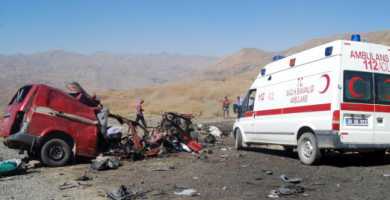
The attack, which killed nine civilians, risks undermining a cease-fire unilaterally declared by the PKK that is set to expire Sept. 20. Already, a meeting between the Kurdish Peace and Democracy Party (BDP) and Turkish Deputy Prime Minister Cemil Cicek has been called off due to the attack.
Though the ruling Justice and Development Party (AKP) faces a significant challenge in quelling Kurdish militancy in the lead-up to October 2011 elections, the government appears to be making some progress in sowing divisions between the Kurdish militant camp and its main external patron, Iraq’s Kurdistan Regional Government (KRG) — a critical element to Ankara’s broader Kurdish strategy.
People stand near a damaged vehicle after a landmine blew up a minibus in Turkey’s Hakkari province Sept. 16 STR/AFP/Getty Images
The perpetrator of the attack remains unclear. Bombings in Turkey are usually linked to the PKK, making the group the most obvious suspect, though the PKK typically focuses its attacks on military targets. This attack on mostly Kurdish civilians risks significant backlash for the group, but it could also be the work of a more radical Kurdish militant strand upset with the PKK’s negotiations with the AKP. Less discussed but on many minds, including that of Kurdish political leader Selahattin Demirtas of the Kurdish Democratic Society Party, is the potential for “deep state” elements in the Turkish military to instigate such attacks in hopes of undermining AKP-PKK cease-fire talks as part of their tumultuous power struggle with Turkey’s AKP-led religiously conservative faction.
Turkey’s Kurdish Strategy at Home
The AKP on Sept. 12 secured a critical referendum vote that strongly asserted the party’s clout while undermining that of the staunchly secularist military and judicial establishment. The AKP owes that victory in no small part to a sizable number of Kurdish voters in Turkey’s southeast that defied calls by the PKK and the mainstream Kurdish political faction, the BDP, to boycott the vote. The Turkish military, now clearly on the defensive, can be expected to exploit acts (or at least suspected acts) of PKK terrorism to try to undermine the AKP’s Kurdish policy, including the party’s shaky cease-fire negotiations with the PKK. The AKP, however, is attempting to stay two steps ahead of its political rivals in dealing with the Kurdish issue.
Turkey, a rising regional player, is keen to use the United States’ withdrawal from Iraq as an opportunity to not only fill a power vacuum in Mesopotamia but also use Iraq as a launch pad to extend Turkish influence into the Persian Gulf. The first step of that strategy entails seeking some resolution to Turkey’s daunting Kurdish problem. The AKP has taken steps at home to try to rally Turkey’s Kurdish population by promoting a more pluralistic political system that asserts civilian authority over the military (this idea was ensconced in the recently approved constitutional amendments). Parallel to this strategy, the AKP, in coordination with Turkey’s National Intelligence Organization, has quietly established direct communication with the PKK leadership in hopes of maintaining a cease-fire. Many Kurds in Turkey remain deeply distrustful of the AKP’s intentions toward them but also see the party as a lesser rival than the military. The AKP has used this opening to try to come to an understanding with Kurdish politicians, civilians and militants in Turkey. However, the AKP also has to be careful not to alienate Turkish nationalist votes by appearing too accommodating to the Kurds, especially if attacks continue to take place. The complications involved in this delicate balancing act have caused the AKP to stumble early on in trying to pursue its Kurdish policy, but the stronger the party becomes at home, the more effort it will put into seeing this policy through.
Turkey’s Kurdish Strategy Abroad
For the AKP to address its Kurdish problem at home, it must also deal across the border with Iraqi Kurdish political leaders. The PKK’s survival in many ways depends on the group maintaining a sanctuary in the mountainous borderland between Iraq and Turkey, particularly the PKK hideout at Mount Qandil. The KRG’s hospitality toward the PKK, however, may be waning.
The KRG is in an unusual spot. On one hand, Iraq’s Kurdish faction is confident it can play kingmaker in Iraq’s arduous coalition-building process, since it has a sufficient number of votes to cap off any assortment of coalition partners to form a majority. On the other hand, the Iraqi Kurds know what trouble could lie ahead once the United States, the KRG’s security guarantor, withdraws from Iraq and the Kurds are left to fend for themselves against their Sunni and Shiite Arab rivals in everything from oil production rights to defense integration. At the same time, the KRG will be facing an assertive Turkey with every intention of keeping any bids for Kurdish autonomy tightly contained.
Sensing the KRG’s vulnerabilities, Turkey has an opening to present itself as the KRG’s new security guarantor. While seemingly ironic, this would not be the first time Iraq’s Kurds have been drawn into alliances with their enemies. The region’s jagged landscape provides the Kurds with mountainous refuge from a host of adversaries but also encourages deep-seated divisions within the Kurdish camp itself. For example, when current KRG President Massoud Barzani’s Kurdistan Democratic Party (KDP) and current Iraqi President Jalal Talabani’s Patriotic Union of Kurdistan (PUK) were in a full-blown civil war in the 1990s, the PUK sought help from Iran, while Turkey and then-Iraqi leader Saddam Hussein lent the KDP a helping hand. For each of these larger powers, the primary interest lay in exploiting inter-Kurdish rivalries to compete against each other while keeping the Kurds sufficiently divided to dislodge the threat of an independent Kurdistan to their territorial integrity.
With the PUK and KDP currently more united than ever, Turkey’s AKP sees greater utility in incentivizing the KRG into cooperation, as opposed to dealing with its broader Kurdish problem with an iron fist. The AKP has done so by encouraging high levels of Turkish investment across Iraqi Kurdistan and by making clear to the KRG leadership that their economic security depends wholly on Turkey’s good graces since Turkey is the KRG’s main export route. In other words, Turkey can help KRG prosper, but the KRG will need to play by Turkey’s rules in curbing talk of Kurdish independence and in clamping down on militancy across the border.
Making Headway?
The AKP’s agenda for the KRG appears to be gaining traction, as evidenced most visibly by the KRG’s recent praise for the AKP’s referendum victory as a move toward democratic reform. In the lead-up to the referendum, Turkish officials made a point to hold high-level meetings with Barzani, Talabani and Kurdistan Islamic Union leader Salahadin Bahadin. STRATFOR sources have said Turkey prefers dealing with former KRG prime minister and KDP senior official Nechirvan Barzani, who prioritizes the KRG’s economic sustainability and has shares in several large Turkish companies. Though KDP leader Massoud Barzani has been more nationalist in his views and has long had a tense relationship with the Turks, the AKP understands that he is also a key player to deal with in the Iraqi Kurdish political spectrum. Not only is Massoud Barzani in a more secure political position than Talabani in the KRG and can thus exert more influence in this issue, but Talabani is also considered too friendly toward Iran for the AKP’s taste. The AKP also has a strong relationship with Bahadin, who benefits from staying outside the KDP-PUK rivalry and can thus negotiate more easily with the AKP.
In these meetings, the AKP sought help from the KRG to use its influence over Kurdish political and militant factions in Turkey to participate in and support the referendum process. Though the BDP attempted to boycott the vote and is calling its boycott a success, about 35 percent of the population in Diyarbakir — Turkey’s most Kurdish-populated province in the southeast — still came out to vote and most of them voted yes.
According to STRATFOR sources in the region, the KRG also appears to have sent a strong signal to the PKK that the group’s sanctuary in Mount Qandil can be threatened if the PKK does not cooperate with the cease-fire order. One Kurdish source in the area claims that KRG forces are blocking the paths leading to Qandil, though this information has not been fully verified. In return for the KRG exercising its leverage over Turkey’s Kurdish factions, the AKP has promised greater investment in northern Iraq and a hold on military incursions into northern Iraq. The more the PKK feels hedged in, the more likely (the AKP hopes) the appeal of the militancy option will wane and the more pragmatic leaders in the group will be pressured into substantial negotiations with the Turkish government.
The AKP appears to be making some headway in its Kurdish strategy, but STRATFOR remains cautious in this assessment. The KRG understands the utility of holding on to the PKK as its only real leverage against the Turks, and Kurds on both sides of the border will want to see more concrete concessions from the AKP on Kurdish rights in Turkey before they commit to any broader understanding. At the same time, negotiations between the AKP and these Kurdish factions can be expected to strain these groups greatly, producing splinter factions that can act to undermine any tacit agreements with the Turkish government.
Finally, elements within Turkey’s security apparatus that feel the secularists are facing an existential threat as the AKP consolidates power could find ways to exploit the PKK threat to undermine the government’s Kurdish initiative. The AKP thus has a lot riding on the Sept. 20 expiration date of its cease-fire agreement with the PKK. While there is still much more to be done before the party can realistically attempt a more enduring understanding with Turkey’s political and militant factions, the AKP has taken notable steps in establishing the right communication channels to pursue a more serious dialogue on the Kurdish issue.
Herde of migrating birds fly over the Blue Mosque and St. SophiaBasilica silhouetted during an autumn sunset in the old cityoverlooking the Bosphorus straits in Istanbul, Credit: Reuters/Fatih Saribas/Files
By Ayla Jean Yackley
ISTANBUL | Thu Sep 16, 2010 8:25pm IST
ISTANBUL (Reuters) – About 200 Greek Orthodox Christians want to travel to Istanbul to try to hold mass at the former basilica of Hagia Sophia, defying Turkish law that bars religious services in what is now a museum.
A Turkish Foreign Ministry official said Ankara could stop the group from entering Turkey if they pose a security threat.
Prime Minister Tayyip Erdogan’s government has lifted curbs on Christian worship at other sites under a EU-inspired drive to improve human rights. It has ruled out services at Hagia Sophia.
Turkish law from the 1930s has prevented both Muslims and Christians from formal worship at the monument, the greatest cathedral in Christendom for a millennium before invading Ottomans converted it into a mosque in the 15th century.
The U.S.-based group behind the attempt said it was on a mission to “re-establish Hagia Sophia as the holy house of prayer for all Christians of the world and the seat of Orthodoxy before the conquest of Constantinople by the Ottoman Turks in 1453”.
Istanbul, formerly known as Constantinople, was the seat of the Greek Byzantine Empire until 1453. Hagia Sophia became a museum after the formation of modern secular Turkey in 1923.
Members are due to arrive in Istanbul on Friday.
The Foreign Ministry official said on condition of anonymity: “If an individual is known to pose a security problem, it’s not possible for him to enter Turkey.”
Culture Minister Ertugrul Gunay ruled out permission and said the group lacked good intentions. “Anyone can pray silently in this place but a group activity would pave the way for similar activities by members of other religions,” Gunay said.
Turkey’s population of 72 million is 99.9 percent Muslim.
In a letter to Erdogan, Chris Spirou, head of the group making the visit, said the issue was about religious freedom.
An official at the Greek Orthodox Patriarchate had said the group led by Spirou did not have its backing and said the event could make things harder for the patriarchate.
Turkey allowed Greek Orthodox Ecumenical Patriarch Bartholomew, spiritual leader of the world’s 250 million Orthodox, to celebrate mass at a former monastery on the Black Sea coast last month for the first time since Greeks were expelled from most of Turkey in 1923.
(Additional reporting by Tulay Karadeniz in Ankara)
Bulgarian Diaspora Minister Dimitrov has boasted a doubling of the number of the Bulgarian schools abroad. Photo by BGNES
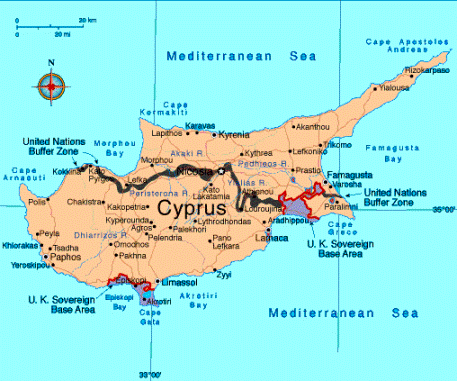
Bulgaria’s government is currently perplexed as to how to go about the opening of a Bulgarian school in the unrecognized Turkish Republic of Northern Cyprus.
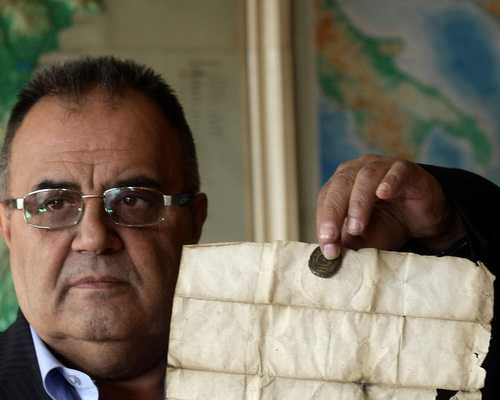
This has been announced by Diaspora MinisterBozhidar Dimitrov, who spoke at a public discussion in Sofia organized by the “PR Thursday” club of M3 College where he was the special guest.
“We have been really surprised to find out that there are about 9 000-10 000 Bulgarian expats of ethnic Turkish origin residing in Northern Cyprus, who have asked for the opening of a Bulgarian school so that their kids can attend it,” Dimitrov said.
He explained that the expats in question are from those Bulgarian Turks who left Bulgaria in the late 1980s fleeing from the so called “Revival” or “Regeneration Process”, an assimilation campaign of the Bulgarian communist regime forcing Muslims, Bulgarians and Turks alike, to adopt Slavic-Christian names. Estimates say some 200 000-300 000 Bulgarian Turks and Muslims left the country then even though about half are believed to have come back after the regime collapsed in 1989.
“What is particularly bewildering for us in this case is the fact that Bulgaria has not recognized the independence of the Turkish Republic of Northern Cyprus, and therefore the Bulgarian government has no way of sponsoring a Bulgarian school there. If we open a Bulgarian school there, this will mean the recognition of this quasi-state. So we are stuck at the moment. But we will definitely find some form under which we can do it, in one way or another,” Dimitrov said.
He pointed out that a similar community of expat Bulgarian Turks living in Turkey’s Edirne, right to the southeast of the Bulgarian border had asked the Bulgarian government for a Bulgarian school, which is currently attended by 53 children.
The Diaspora Minister boasted an increase of the Bulgarian schools abroad to 136 since he took office a year ago, up from about 50.
The Turkish Republic of Northern Cyprus was proclaimed in 1983 and has been recognized only by Turkey.
 ISRAEL – IRAN FIGHT OVER TURKEY’S ADABANK