MICROSCOPES are invaluable tools to identify blood and other cells when screening for diseases like anemia, tuberculosis and malaria. But they are also bulky and expensive.
Skip to next paragraph
Ozcan Research Group at U.C.L.A.
An engineer at U.C.L.A. has adapted cellphones to do the work of microscopes in screening for diseases.
Ozcan Research Group at U.C.L.A.
The process creates holograms that can show, for example, a stained white blood cell.
Now an engineer, using software that he developed and about $10 worth of off-the-shelf hardware, has adapted cellphones to substitute for microscopes.
“We convert cellphones into devices that diagnose diseases,” said Aydogan Ozcan, an assistant professor of electrical engineering and member of the California NanoSystems Institute at the University of California, Los Angeles, who created the devices. He has formed a company, Microskia, to commercialize the technology.
The adapted phones may be used for screening in places far from hospitals, technicians or diagnostic laboratories, Dr. Ozcan said.
In one prototype, a slide holding a finger prick of blood can be inserted over the phone’s camera sensor. The sensor detects the slide’s contents and sends the information wirelessly to a hospital or regional health center. For instance, the phones can detect the asymmetric shape of diseased blood cells or other abnormal cells, or note an increase of white blood cells, a sign of infection, he said.
Dr. Ozcan’s devices provide a simple solution to a complex problem, said Ahmet Yildiz, an assistant professor of physics and molecular cell biology at the University of California, Berkeley.
“This is an inexpensive way to eliminate a microscope and sample biological images with a basic cellphone camera instead,” he said. “If you are in a place where getting to a microscope or medical facility is not straightforward, this is a really smart solution.”
Neven Karlovac, the chief executive of Microskia in Los Angeles, said that some of the company’s products would be adaptations of regular cellphones. For phones without cameras, or phones too compact to modify, the company has different designs, including a simple box with a sensing chip that can be plugged into a cellphone or laptop with a USB cord, he said.
“The idea is to commercialize this low-cost cell imaging and diagnostic platform and apply it to a number of different products,” Dr. Karlovac said. The price of the devices has not been set.
Dr. Ozcan’s devices are compact in part because they have eliminated the central element in a microscope — its lenses — said David J. Brady, a professor of electrical and computer engineering at Duke University and director of its Imaging and Spectroscopy Program.
“There’s no need for lenses in these devices because the magnification can be done electronically,” he said. “You don’t need optics at all.”
For this electronic system of magnification, inexpensive light-emitting diodes added to the basic cellphone shine their light on a sample slide placed over the phone’s camera chip. Some of the light waves hit the cells suspended in the sample, scattering off the cells and interfering with the other light waves.
“When the waves interfere,” Dr. Brady said, “they create a pattern called a hologram.” The detector in the camera records that hologram or interference pattern as a series of pixels.
The holograms are rich in information, Dr. Ozcan said. “We can learn a lot in seconds,” he said. “We can process the information mathematically and reconstruct images like those you would see with a microscope.”
Dr. Ozcan’s system may someday lead to a rapid way to process blood and other samples, said Bahram Jalali, an applied physicist and professor of electrical engineering at U.C.L.A. “It is potentially much faster than a microscope,” he said. “You don’t have to scan mechanically” as people must with a microscope with its small field of view.
“Instead you capture holograms of all the cells on the slide digitally at the same time,” he said, so that it’s possible, for example, to see immediately the pathogens among a vast population of healthy cells. “It’s a way of looking quickly for a needle in a haystack,” he said.
THE cellphone systems may be particularly helpful in screening for malaria, said Yvonne Bryson, a professor and chief of the pediatric infectious diseases division at the David Geffen School of Medicine at U.C.L.A. She has collaborated with Dr. Ozcan on several grants. “Right now you need a microscope, and you need trained people,” Dr. Bryson said. “But this device would allow you to work without either in a remote area.”
M. Fatih Yanik, an assistant professor of electrical engineering and computer science at the Massachusetts Institute of Technology, said, “This makes it possible for ordinary people to gather medical information in the field just by
TBILISI (VOA)—Republican US Senator John McCain, in a recent interview with the Georgian service of Voice of America said he believed “ample documentation” exists proving that “Genocide had been committed against the Armenian people.”
“I believe that a genocide was committed against Armenians, and I think there is ample documentation of that,” McCain was quoted as saying. “The Turkish and Armenian people and states cannot forget the past. Especially Armenians cannot.”
“Because of that,” McCain said, he understood and agreed with Armenia’s efforts to normalize relations with Turkey on a step-by-step basis. “I support that view,” he said.
“We are witnessing significant progress in the relations between Turkey and Armenia,” McCain added. For the first time, parties are making steps towards the same direction.”
McCain dodged the issue during his presidential campaign in 2008, failing to properly characterize the crime as Genocide. The Arizona Senator is running for re-election in the 2010 Senate race.
During the US Presidential Campaign, Senator McCain formally asked for the support of Armenian American voters in an open letter. The Arizona Senator praised the Armenian American contribution to American society, and Armenia’s contribution to Coalition operations in Iraq and NATO peacekeeping in Kosovo, but failed to outline his stands on core Armenian American issues.
At the time, McCain remained silent on Nagorno Karabagh, the Turkish and Azerbaijani blockades, U.S. aid to Armenia, and the broader issue of U.S.-Armenia relations. He did, as he has done over the years, echo the Bush Administration’s practice of employing euphemistic language such as “terrible tragedy” to avoid mentioning the Armenian Genocide by its proper name.
Senator McCain has, throughout his tenure in the Congress, largely opposed or was passively indifferent to a broad array of Armenian American issues. In October 2007, Senator McCain publicly opposed Congressional recognition of the Armenian Genocide. In 1999, he voted against restricting U.S. aid to Azerbaijan over its blockades and other offensive uses of force against Armenia and Nagorno Karabagh. He voted against Senator Bob Dole’s Armenian Genocide Resolution in 1990.
At everything’s for sale: sex, booze, tattoos—and maybe some revolutionary fervor.
by Peter Savodnik
The Tijuana of the Caspian
At 8:45 a.m., the Azerbaijani cabbies were clustered in the courtyard next to the customs terminal, waiting for the Iranians to walk through a narrow, rusted door. They do this every morning in the town of Astara, which dates back 6,000 years and today sits on the border between the post-Soviet Republic of Azerbaijan and the Islamic Republic of Iran. It can be hard for the uninitiated to distinguish Azerbaijani Azeris from Iranian Azeris, but the drivers know their clientele.
“The Iranian girls are fairer, and they always have their heads down and their head scarves on,” said Misha Mamedli, a tall, slouching man with a gold front tooth and a stash of self-rolled cigarettes in his breast pocket. But the Iranian men, who have the cash and do the negotiating, drew the most attention from the cabbies. Decked in tight jeans and T-shirts with Italian print, they emitted a cool, confident brusqueness as they marched through the rusted door: their gateway to pork products, alcohol, and easy sex.
“Here, it’s open,” Misha said. “No one cares what you do.”
This makes the mullahs in Tehran very nervous. Books, DVDs, fashions, and—most important—ideas that are inaccessible in Iran are ubiquitous in Azerbaijan. Iranians line up daily to cross the Astara River to buy and sell jeans, chickens, bras, laptops—and often sex and schnapps and heroin. This commerce, combined with cultural curiosity and shared Azeri bloodlines, has transformed Astara into the Tijuana of the Caspian.
Astara doesn’t scream so much as strongly hint at the possibility of sin. Next to the customs terminal’s courtyard and above the row of babushkas selling tea and beef kebabs, there’s a convenient motel (“Ideal for bringing the girls back to,” one Iranian told me). The fluorescent-lit cafés on Aliyarbeyov Street are stocked with Russian vodka and French cognac, and the Turkish Salon, on Fountain Square, offers, among other things, tattoos, piercings, astrological forecasts, and “full-body massage.”
All of this is made possible by the Azerbaijanis’ somewhat attenuated relationship with God, the product of seven decades of Communist rule and a steady influx of Westerners after oil was discovered in the mid-1800s. Iranians find the Azerbaijanis’ mildly ironic attitude toward Islam a welcome relief from the stern theocracy of the ayatollahs. During Ramadan many Azerbaijanis do not fast, and the cafés in Astara do a bustling lunch business, serving lamb shashlik, or barbecue, to visiting Iranians. Manana Shafieva, a stylist at the Turkish Salon, said many Iranian men bring in their wives to be spruced up. “They say, ‘I know she can be beautiful. Can you make her beautiful?’ They know we know about hair and what it means to have a modern image.”
But the Iranian mullahs are not merely concerned about the affectations of modernity. Mamedli, the cab driver, said that the crowds lining up for entry to Astara have surged since June, when hundreds of thousands of Iranians protested the allegedly rigged reelection of President Mahmoud Ahmadinejad. This has worrisome implications: the potential for political upheaval is acute in Iran’s north, where the bulk of the country’s university students live, along with most of its 15 million to 30 million ethnic Azeris (out of a total population of about 73 million). Prominent ethnic Azeris in Iran include Ahmadinejad’s presidential rival, Mir-Hossein Moussavi, the poet Mohammad Hossein Shahriar, and the filmmaker Kamal Tabrizi. Even the supreme leader of Iran, Ayatollah Ali Khamenei, is part Azeri. Many Azeris are so swollen with ethnic pride that Iranian officials suspect them of dual loyalty.
As a result, an Azerbaijani Ministry of Foreign Affairs official told me, “it’s common knowledge that the Iranians want the border shut down.”
At night, the courtyard next to the customs terminal was empty except for a few malnourished cats. On the Iranian side of the border, an imam and his flock were praying. Their voices drifted across the river and through the mesh of walls and fences. On Fountain Square, kids blasted Israeli pop music. A guard stopped me as I navigated the darkened market stalls, redolent of tea and rotting nectarines.
“The border is closed until morning,” he said. Then he nodded at the motel. “You want a room? It’s very nice, with a television and a girl.”
I said I was staying near the square and just taking a stroll.
“Only 10 manats,” he persisted. “I can get you this. Anything you want.” I laughed, and he lit a cigarette. “Come on,” he said, “don’t be a Muslim.”
LIVE TALK WITH MR. ADNAN OKTAR AND RABBI MENACHEM FROMAN
(from the TV program on Kanal Urfa TV, Adıyaman TV and Kral Karadeniz TV, November 10th, 2009)
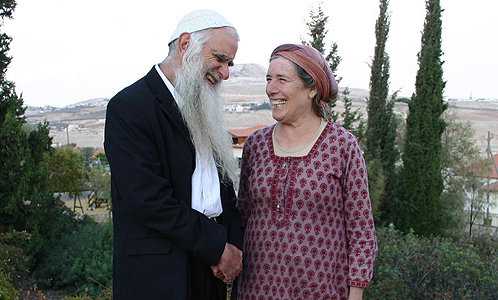
Rabbi Froman with his wife Hadasah
PRESENTER: Today we have very important guests. A very well known rabbi and his dear wife. Mrs. Hadassa and Mr. Froman are with us. First of all, wellcome. Wellcome to the studio.
RABBI FROMAN: Thank you.
ADNAN OKTAR: Masha’Allah. Yes Mr. Froman is such a person who is compassionate, loving the Turkish, seeking peace, seeking beauty between countries. A very precious person. Now you can translate what I said. Mrs. Hadassa is also very precious. They love each other so much insha’Allah. They’ve been married for years now. His wife is also Jewish. She is full of love for Turkey. And we love them so much. Untill the Last Day, both Israel and Turkey will live in friendship and brotherhood insha’Allah. Look, it mentions the courage of Salahaddin Ayyubi, who is Kurdish you know, Salahaddin Ayyubi. Kurdish, Turkish, Circassians, Laz, we are all brothers. Jews are also our flesh and blood insha’Allah. Christians are also our brothers, our flesh and blood. Our Muslim nation is already our soul insha’Allah. Together we will have a brotherly, happy, carefree, troublefree, thornless, beautiful life until the Doomsday. They are entrusted to us from the Prophet Moses (pbuh), the Prophet Abraham (pbuh). Insha’Allah we don’t let anybody touch even their single hair, by the leave of Allah. They will live so comfortably, in tranquility and security, insha’Allah. In Israel, they will also be in peace and calm. We will demolish those walls. Those protective walls in Israel. There will no more be anarchy and terror. They will live in such joy in the Turkish Islamic Union. Isha’Allah Rabbi Froman will come here, they will travel in composure, we do not accept any kind of danger for them. Our Palestinian brothers will also be at ease, Syria will also be at ease, Iraq will also be at ease, Armenia will also be at ease. Insha’Allah they will live peacefully in the compassion and mercy of the Turkish Islamic Union. There will be full freedom for worship, they will worship as they wish insha’Allah.
RABBI FROMAN: First of all we have to thank Allah. That’s the beginning of everything, Bismillah. I want to thank Allah that brought me here from Jerusalem to Istanbul this afternoon. And I have no words how to express my obligation to Allah that gave me such a great grace to come here.
ADNAN OKTAR: Masha’Allah, Masha’Allah.
RABBI FROMAN: Then after we thank the messengers, the messengers of God Who brought, Who brings His grace to us and now I want to thank Harun Yahya for bringing me from Jerusalem to Istanbul and hosted me in such, me and my wife, in such a generous and nice way and I have no else way of how to again thank him for such an expression of the grace, of course. I thank God that we met. I thank God that He decided to bring me here. And I am obliged to this world of grace to continue the channel of grace that Harun Yahya began.
ADNAN OKTAR: Masha’Allah.
RABBI FROMAN: This invitation is a proof, is against satan against iblis. Satan, iblis tries to convince everybody in the world that Islam is a religion of hatred that the more you are Muslim the more you hate Jews, Americans, Europeans. And we have to stone iblis, we have to stone satan, to throw stones against him. And this invitation, a kind invitation of Harun Yahya is a very concrete stone against satan. Another lie of satan is that necessarily there is hatred between Jews and Palestinians in the Holy City. Harun Yahya have not invited only me, he invited with me a friend of mine, a dear friend of mine, and my family, my wife, Sheikh Bukhari who is going to come in a few minutes. Perhaps he is now in the airport I don’t know. And we are going to be here together as two men from Jerusalem, two men from the Holy Land. One Jew and the other is Palestinian. One is Rabbi, the other is a Sheikh, as good friends, and as together, by the grace of God Who sent us Harun Yahya. We want to, again, stone satan that lies that necessarily that there’s hatred between Jews and Palestinians in the Holy Land.
ADNAN OKTAR: By Allah’s leave, it will be like this until the Last Day, insha’Allah. In any case, we will never let anyone do any harm to the Children of the Prophet Abraham (pbuh), to the Children of the Prophet Moses (pbuh). One is the Children of the Prophet Jacob (pbuh) and the other is the Children of the Prophet Ishmael (pbuh). As you know Arabs, the Palestinians are the Children of the Prophet Ishmael (pbuh). And these beautiful beings are the Children of the Prophet Jacob (pbuh). Both are the Children of the Prophet Abraham (pbuh). By Allah’s leave, we will never let anyone touch even their single hair. No country can harm Palestine nor Israel, no one can harm Jerusalem. From now on, an age of peace will prevail. This century is the century when the Turkish Islamic Union will form. A century, which everyone will live in peace. For instance, Israel will be a national state, Iran will be a national state, Turkey will be a national state but the Turkish Islamic Union will be formed. This will be a union of hearts, love and affection. We will make peace prevail in the whole region, insha’Allah with the emergence of Hazrat Mahdi (pbuh). This will be consolidated by the emergence of the Messiah (pbuh).
RABBI FROMAN: I want to say something, personal, little personal. For years I thought that Turkiye has the historical task to bring peace to the region. I think that we have to, three years I thought, that we have to reestablish the Ottoman Empire not of course the Empire of army, of conquering but empire of love, empire of Islam, empire of salam. Because Islam is from salam, it is the same word. By inviting me and other Jews, other Rabbis Harun Yahya represents the whole Turkish nation. I remember after years of thinking that Turkiye is the fact of, is the state that can bring us peace. “Us”, I mean the Palestinians and the Israelis, the Jews and the Arabs. I was in the middle of one of my lectures I said. We’ve many students together and I forgot to lock my mobile and then in the middle of the lecture I have a call. I asked, “Who is speaking?,” “Seda Aral from Istanbul” and she invited me to come to Istanbul and to meet her teacher and to begin a period of peace. For me it is like a miracle. It is like a great grace of God that I was thinking. What I was thinking about the task of the Turkish Nation and God sent me the telephone from Istanbul in the middle of my lecture, in the middle of my speaking to my students and invited me to come and to begin a period of peace.
ADNAN OKTAR: Masha’Allah.
RABBI FROMAN: I want to add something more.
ADNAN OKTAR: Masha’Allah.
RABBI FROMAN: A few months ago I was invited by the special messenger of President Obama to Washington by George Mitchell. He invited me to meet him and to think together how to bring peace to the Holy Land. I came again with an Arab friend with a Palestinian friend – a Sheikh, Sheikh Manasra his name. Together we came to Washington and we sat with George Mitchell and his coop and we spoke about the ways of how to bring peace to the Holy Land. Half of the time of the long meeting that we had, we talked, I and my Palestine friend, about Turkiye. About the task of Turkiye. We tried to explain to Mr. Mitchell, to Senator Mitchell that the power that can bring peace to the Holy Land is the Turkish-Union. And he was so moved. When he was departing he said that in the end of the conversation: “I am very moved from what you say, Rabbi Froman.” And I got a very clear impression that the result of the conversation will be a visit of President Obama in Ankara in Turkiye. There after I came here as the guest of Harun Yahya and I was interviewed by many Turkish journalists and I said, “Look here I see that very soon President Obama will come here.” They looked at me like, I don’t know, lunatic. It was in the quite in the beginning of the period of Obama. After 3 weeks I think or 4 weeks, I heard in the radio President Obama chose Turkiye as the first country in the Middle East that he is visiting. It was I think 3 months after he was elected. I think that the task of Turkiye to make peace in the whole region and especially in the Holy Land will be recognized very soon by the whole world. If the Turkish nation will work for this historical task, national task that they have, the whole world will honor the whole of Turkiye in the region in the whole world.
ADNAN OKTAR: Masha’Allah, Alhamdulillah.
RABBI FROMAN: I want to add something, perhaps for the end of the program. From history of this evening, in this evening after being hosted so kindly, so generously by your students, by your followers, I wanted to pray. We, the Jews pray to the direction of Jerusalem. So I asked Ali and Emre, I wanted to know what is the direction of Jerusalem in my apartment. One of them perhaps Ali, one of your students said, “You know that Istanbul is a place perhaps the only place in the world, the direction of Jerusalem and the direction of Mecca, the kiblah is the same direction, exactly the same direction. From Istanbul if you pray to God, you pray to God in Jerusalem, in the temple in Jerusalem, you pray to God in the mosque of Mecca.” So that gives this place Istanbul a very significant importance, very significant importance in the whole world. I hope that the Turkish nation led by Harun Yahya will fulfill this historical task.
ADNAN OKTAR: Masha’Allah, Masha’Allah. My leadership can be such that it only can be an intellectual leadership. It cannot be physical leadership. It does not mean a political leadership. It is an intellectual leadership, leadership of hearts. May Allah let me be a means in this task, insha’Allah. Masha’Allah. Israel and Israelis as a whole, are entrusted to us by Allah. Children of Ishmael (pbuh) are entrusted to us by Allah, Children of Jacob (pbuh) are also entrusted to us by Allah. Turks will fulfill the task of leadership perfectly with their beautiful souls full of love, full of kindness and full of compassion. This is destiny insha’Allah. Allah created it as it is in the destiny, the whole world will see it. Turkish nation will bring ease, abundance, wealth and peace not only to a certain region but to the whole world, insha’Allah. Allah will make this nation a means to fulfill this task as a leader insha’Allah. Masha’Allah.
RABBI FROMAN: And in the end perhaps we should finish with the beginning of the program Kemal Ataturk. One of the lies of the satan is that you can oppose God. But Allahu Akbar, everything that is happening in the world, in the end helps, supports the word of God. I am not surprised from what you read from Kemal Ataturk. Every positive man, every positive party is the deed of God and for me if Kemal Ataturk is a positive figure, then he is supporting religion and not against religion. That’s what I mean what I say, when I say several times a day “Allahu Akbar”. Allahu Akbar means that even those factors that in our eyes, in the first time are seen to be against the power of Allah, in the end it is very clear that they support the word of Allah. With this perhaps we can be sure that the victory of Allah, Whose one of the nicest names is “Salam” is “peace.” You can be sure that “Allahu Akbar” means peace will win victory, peace will win victory. Allahu Akbar.
ADNAN OKTAR: Masha’Allah, Masha’Allah. Masha’Allah. Our Ataturk, our pride. If it wasn’t Ataturk, Allah forbid I can’t even imagine what could happen. He granted this holy, this beautiful country to us to completely protect it, isn’t it? We are free, democrat, republican, we have the freedom of thought, we speak as we like, we perform our prayers as we like. We live in a modern country. It is a great blessing for everyone to express his ideas. There is no bigotry, no fanaticism. Ataturk didn’t allow communism, he also didn’t allow fascism, of course. He said: “Gentlemen, not to forget, the biggest foe of the Turkish nation is communism. In every condition it should be crashed wherever it is seen.” he says. He never allowed. At his time they made so much pressure, yet he never allowed anyone. He never allowed the fascists, he never allowed the communists. In his ideal there was always the Turkish Islamic Union. One day the Turkic nations will unite, the Islamic world will unite. It will bring peace to the whole region. His wonderful ideal is about to be realized. There is too little left insha’Allah. Turkey is insha’Allah in duty as a nation to make the world live in peace, with love, friendship, brotherhood, modernity, republicanism, democracy, humanity and beauty; and to encourage and protect it. Our heroic army and our heroic nation has this excellent mission insha’Allah. It should not be forgotten that in every condition communism should be crashed wherever it is. So he did not allow communism and fascism. I will recite you a verse from the Qur’an. Surat az-Zumar, 41: “We have sent down to you the Book for mankind with truth. So whoever is guided is guided to his own good and whoever is misguided, it is to his detriment. You are not set over them as a guardian.” There are very beautiful words in the Torah compatible with the Qur’an. Some of which are unchanged words, Allah knows the truth. For example from the Proverbs: “Listen, my son, and be wise, and keep your heart on the right path.”Look how beautiful, for example it says: “for drunkards and gluttons become poor, and drowsiness clothes them in rags.” For example, it says: “Do not gaze at wine when it is red, when it sparkles in the cup, when it goes down smoothly! In the end it bites like a snake and poisons like a viper. Your eyes will see strange sights and your mind imagine confusing things. You will be like one sleeping on the high seas, lying on top of the rigging. “They hit me,” you will say, “but I’m not hurt! They beat me, but I don’t feel it! When will I wake up so I can find another drink?” It says “Wisdom is too high for a fool”. (It says that the wisdom is unreachable for a fool. It says for example that “He who plots evil will be known as a schemer.” It says, “The schemes of folly are sin”, that is, scheming, the schemes of folly are sin. It says, “men detest a mocker”. Mocking is not a good thing. Everybody hates a mocker. Insha’Allah.
RABBI FROMAN: So your teacher read the Holy Qur’an and read the Wisdom of Solomon and this is no wonder that the words of Qur’an and the words of Solomon are going in the same direction. Because these Books are the words of God, those Books are the words of One God. So that’s exactly the direction that we have to go, in the direction of your teacher to find the word of God in Turkish, in Arabic, in English, in Hebrew, in every language in this Book, in this Book, in all the books of God, all the Books that God has given us in order to guide us to the right direction which is of course the way to Him, to Himself. His name again and again I remember, that in Arabic and in Hebrew the very name of God is Salam or Shalom. And he works for God, he works for Shalom.
ADNAN OKTAR: Of course Judaism and Islam are particularly very much alike. We believe in One Allah, we believe in all the Prophets, we believe in the angels, we believe in the Hereafter, our belief in the Hereafter is the same. There’s also daily prayer (salat) in Judaism, the Jews also take ablution and pray. There are video shootings about that. They fast as well. The adultery is forbidden, the theft, killing of innocent people are forbidden as well. Loving your neighbors, protecting them are also ordered (fardh) in the Torah.
Baku – APA. European Azerbaijanis Congress and Azerbaijani-Turkish Diaspora Organizations Coordination Council will hold joint meeting on November 21-22, 2009 in Frankfurt, Germany, press service of the State Committee for Diaspora Activities told APA. The committee put forward this initiative because of addresses of the European Azerbaijanis Congress and Turkish communities of European countries. Series of important events in the region in 2009, particularly signing of Turkish-Armenian protocols about establishment of diplomatic relations and development of bilateral relations caused serious concern and protest of the Azerbaijani and Turkish Diasporas, said the addresses. The Diaspora organizations said the opening of Turkish-Armenian borders without solution of Nagorno Karabakh problem was unacceptable and they supported the position of Azerbaijan Republic.
Government officials and parliamentarians of Azerbaijan and members of the European Azerbaijanis Congress and Azerbaijani-Turkish Diaspora Organizations Coordination Council will attend the two-day meeting supported by the State Committee for Diaspora Activities, which considers it necessary to widely express the position of Azerbaijani and Turkish Diasporas on the regional processes.
European Azerbaijani Information Center will be presented at the meeting. The project of this center was proposed by Benelux Azerbaijanis Congress.
Baku – APA. European Azerbaijanis Congress and Azerbaijani-Turkish Diaspora Organizations Coordination Council will hold joint meeting on November 21-22, 2009 in Frankfurt, Germany, press service of the State Committee for Diaspora Activities told APA. The committee put forward this initiative because of addresses of the European Azerbaijanis Congress and Turkish communities of European countries. Series of important events in the region in 2009, particularly signing of Turkish-Armenian protocols about establishment of diplomatic relations and development of bilateral relations caused serious concern and protest of the Azerbaijani and Turkish Diasporas, said the addresses. The Diaspora organizations said the opening of Turkish-Armenian borders without solution of Nagorno Karabakh problem was unacceptable and they supported the position of Azerbaijan Republic.
Government officials and parliamentarians of Azerbaijan and members of the European Azerbaijanis Congress and Azerbaijani-Turkish Diaspora Organizations Coordination Council will attend the two-day meeting supported by the State Committee for Diaspora Activities, which considers it necessary to widely express the position of Azerbaijani and Turkish Diasporas on the regional processes.
European Azerbaijani Information Center will be presented at the meeting. The project of this center was proposed by Benelux Azerbaijanis Congress.
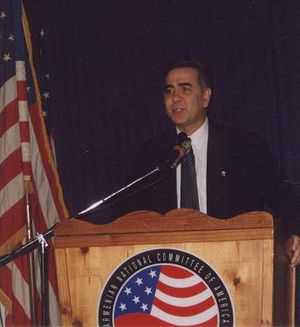
At its annual banquet on November 8, the Armenian National Committee (Western U.S.), honored California Attorney General Jerry Brown, former governor and current gubernatorial candidate, with the Freedom Award; California State Senator Mark Wyland, and California State Assembly Assistant Majority Leader and candidate for L.A. City Council Paul Krekorian as Legislators of the Year; and Harut Sassounian, Publisher of the California Courier, with the Legacy Award. California State Assemblyman Anthony Protantino was master of ceremonies. More than 700 guests attended the event held at the Pasadena Convention Center.
The honorees received special commendations from members of Congress, State Senators and the L.A. City Council. Cong. Brad Sherman presented Harut Sassounian with a flag flown over the U.S. Capitol. Among the many congratulatory letters received by ANC was a message from Mr. Kirk Kerkorian: “I have known Harut for many years, and I am proud of the good work he has done for Armenia and on behalf of the Armenian community worldwide. I congratulate the ANC for honoring him.”
In introducing this columnist, ANC Board Member Pattyl Aposhian-Kasparian stated:
“What is it about Harut Sassounian that draws such a large number of admirers from all walks of life to follow the stroke of his pen? The word activist or visionary hardly explains it. Tireless leader and devoted teacher to generations of Armenian-Americans start to scratch the surface. The attraction to Harut lies in his passion with a direct magnetic draw to his courage, exuberance and resolve.
“Harut is a highly respected name in many circles. He has helped define the political fabric of our time, championed free speech and fought on local, national and international grounds for justice. His persistence has received national media attention and has gently pushed open the gates of reform.
“His first major activism proved successful at the U.N. in the 1970’s. From that day forward, Harut has served as a timeless moral voice — an author, publisher, speaker, community activist and leader.
“Through his columns, Harut is one of the first to diagnose a problem and write a prescription. Countless examples come to mind: The campaign against the L.A. Times and its Managing Editor Douglas Frantz; lobbying against Time magazine for inserting a Turkish denialist DVD; blocking the nomination of Amb. Hoagland after the dismissal of Amb. Evans; initiating a letter writing campaign to counter the denial of the Armenian Genocide by the British Ambassador to Armenia; and opposing plans by PBS stations to air a panel discussion with denialists of the Armenian Genocide. And the list goes on to cover more than 30 years of activism.”
In accepting the award, I made the following remarks:
“Our collective efforts on behalf of the Armenian Cause stem from the tragic fact that a terrible injustice was committed against our people more than 90 years ago.
“The Genocide and the loss of our homeland went unnoticed by the international community for many decades, until our people, led by our political organizations, rose from the ashes of decimation and defeat, and struggled to regain their rights. As a result, the Armenian Genocide is universally recognized, and is no longer a forgotten episode.
“Nevertheless, today’s Turkish Government, the successor of the regime that committed the Genocide, continues to deny this massive crime, benefiting to this day from our looted assets and properties.
“This injustice cannot and must not go on! We need to do everything in our power to restore justice! We demand the return of the stolen properties and occupied territories to their proper owners — the Armenian nation!
“To accomplish this monumental task, we need the participation of every Armenian, as well as the support of all those who side with truth and justice.
“As we have seen in recent months, Armenia’s leaders are under tremendous international pressure to make major concessions to both Turkey and Azerbaijan. Armenia is too small and too weak to be able to withstand such powerful pressures all by itself! Diaspora-Armenians on the other hand, are under no such constraints.
“It is incumbent on all of us to lend a helping hand to reduce the pressures on Armenia. Armenians in all countries, particularly those in the United States, Russia and Europe, should lobby their respective governments to counter their unjust and one-sided support for Turkey and Azerbaijan.
“We should make this effort, regardless of whether our help is requested or even appreciated by the Armenian government.
“Of course, our lobbying efforts would be much more effective, if carried out in a cooperative and coordinated manner both within the Diaspora and between the Diaspora and Armenia.
“We should also not hold back any political, economic or humanitarian assistance from our people in the homeland, because of disagreements with Armenia’s leadership.
“Regimes and leaders come and go, but the nation is eternal!
“Let us remain vigilant, engaged and united in our purpose. Let us carry on the torch of our Cause, until justice is restored to our long-suffering nation.”