Month: November 2009

  • The Rise and Rise of Turkey

    The Rise and Rise of Turkey

    By PATRICK SEALE
    Published: November 4, 2009

    It is generally accepted that America’s destruction of Iraq overturned the balance of power in the Gulf, opening the way for the Islamic Republic of Iran to emerge as a major regional power, able to challenge the dominance of Sunni Arab states and pose as a rival to both Israel and the United States.

    Its influence has spread to Iraq itself — now under Shiite leadership — and beyond to Syria, Lebanon, Palestine and even perhaps to Zaidi rebels in northern Yemen fighting the central government in Sana‘a, a development that has aroused understandable anxiety in Saudi Arabia.

    However, the Iraq war has had another important consequence that is also attracting serious notice. America’s failure in Iraq — and its equal failure to tame Israel’s excesses — has encouraged Turkey to emerge from its pro-American straitjacket and assert itself as a powerful independent actor at the heart of a vast region that extends from the Middle East to the Balkans, the Caucasus and Central Asia.

    The Turks like to say that whereas Iran and Israel are revisionist powers, arousing anxiety and even fear by their expansionism and their challenge to existing power structures, Turkey is a stabilizing power, intent on spreading peace and security far and wide.

    Turkey is extending its influence by diplomacy rather than force. It is also forging economic ties with its neighbors, and has offered to mediate in several persistent regional conflicts. It has, however, not hesitated to use force to quell the guerrillas of the PKK, a rebel movement fighting for Kurdish independence.

    But even here, Turkey is now using a softer approach. The rebels have been offered an amnesty and Turkey’s influential foreign minister, Ahmet Davutoglu, has this past week paid a visit — the first of its kind — to the Kurdish Regional Government in northern Iraq. There is even talk of Turkey opening a consulate in Erbil.

    In recent years, Turkey’s diplomacy has scored many successes, winning great popularity in the Arab world and strengthening Turkey’s hand in its bid to join the European Union. Some people would go so far as to argue that there is no future for Turkey without the E.U., and no future for the E.U. without Turkey.

    Turkey’s dynamic multi-directional foreign policy started to take shape when the Justice and Development party, or AKP, came to power in 2002 under Prime Minister Recep Tayyip Erdogan and Abdullah Gul, now president of the Turkish Republic. These men are rightly considered to be conservative and moderately Islamic — their wives wear headscarves — but they are careful to stress that they have no ambition to create an Islamic state. Turkey’s population may be largely Muslim, but the state itself is secular, democratic, capitalist and close to both the West and the Arab and Muslim world. Indeed, Turkey sees itself as a bridge, vital to both.

    Ahmet Davutoglu is credited with providing the theoretical framework for Turkey’s new foreign policy. He was Mr. Erdogan’s principal adviser before being promoted foreign minister.

    Two visits in October illustrate Turkey’s activisim. Prime Minister Erdogan, accompanied by nine ministers and an Airbus full of businessmen, visited Baghdad, where he held a session with the Iraq government and signed no fewer than 48 memoranda in the fields of commerce, energy, water, security, the environment and so forth.

    At much the same time, Foreign Minister Davutoglu was in Aleppo, where he signed agreements with Syria’s foreign minister, Walid al-Muallim, of which perhaps the most important was the removal of visas, allowing for a free flow of people across their common border.

    Turkey also broke new ground in October by signing two protocols with Armenia, providing for the restoration of diplomatic relations and the opening of the border between them. Not surprisingly, Turkey’s ally Azerbaijan has strongly objected to this development, since it is locked in conflict with Armenia over Nagorno-Karabakh, an Armenian-populated pocket of Azerbaijan occupied by Armenian forces.

    Indeed, Turkey’s protocols with Armenia are unlikely to be fully implemented until Armenia withdraws from at least some of the districts surrounding Karabakh — but, at the very least, a historic start has been made toward Turkish-Armenian reconciliation.

    From the Arab point of view, the most dramatic development has undoubtedly been the cooling of Turkey’s relations with Israel. The relationship has been damaged by the outrage felt by many Turks at Israel’s cruel oppression of the Palestinians, which reached its peak with the Gaza War.

    Even before the assault on Gaza, Prime Minister Erdogan — a strong supporter of the Palestine cause — did not hesitate to describe some of Israel’s brutal actions as “state terrorism.” A total breach between the two countries is unlikely, but relations are unlikely to recover their earlier warmth so long as Israel’s hard-line prime minister, Benjamin Netanyahu, and his foreign minister, Avigdor Lieberman, remain in power.

    Underpinning Turkey’s diplomacy is its central role as an energy hub linking oil and gas producers in Russia and Central Asia with energy-hungry markets in Europe.

    One way and another, a resurgent Turkey is rewriting the rules of the power game in the Middle East in a positive and non-confrontational manner. This is one of the few bright spots in a turbulent and highly inflammable Middle East.
    Patrick Seale is the author of “The Struggle for Syria,” “Asad of Syria: The Struggle for the Middle East” and “Abu Nidal: A Gun for Hire.” Agence Global

  • Apigian-Kessel: Armenians and Greeks Band to Support Rep. Gary Peters

    Apigian-Kessel: Armenians and Greeks Band to Support Rep. Gary Peters


    By Betty Apigian-Kessel on October 30, 2009

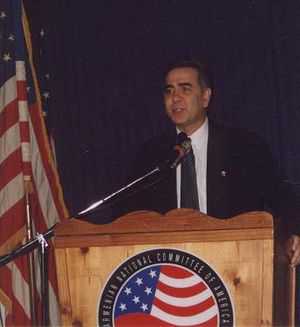
    Congressman Gary Peters (D) of Michigan‘s 9th District in the U.S. House of Representatives was the guest of honor at a highly successful fundraiser dinner on Sept. 28 at Ginopolis’s Restaurant in Farmington Hills, Mich. The event was jointly sponsored by the Armenian National Committee (ANC) of Michigan and members of the area’s substantial Greek American community. It was an opportunity to get to know Peters, who will be making another run for Congress next year.

    Peters, 50, a life-long Oakland County resident, has accrued an admirable record of accomplishment since earning his B.A. in political science from Michigan’s Alma College (Magna Cum Laude, Phi Beta Kappa), his MBA from the University of Detroit, and a law degree from Wayne State University.

    The married father of three children has been a political science professor and a highly successful financial adviser, has served in the Michigan Senate, appointed by Gov. Jennifer Granholm as Michigan Lottery commissioner, and adding to his illustrious list of accomplishments is the fact that he served in the United States Navy from 1993 to 2000, and 2001-05 as lieutenant commander.

    That evening, Peters’ introduction was by his mentor Paul Jingozian, a noted area financial investment adviser, presently serving as branch manager of Morgan Stanley in Birmingham. Jingozian brought the audience up to date on how he first met Peters: “In 1980, I had a mandate to go out and hire the brightest students for Merrill Lynch, and academically Gary was at the top of the list. I hired him immediately. He started out in the Rochester office working from the basement. He was studying law at the same time and beginning to gain an interest in politics. “ According to Jongozian, clients loved the hard working, customer-oriented Peters who had a passion for helping people, and he soon rose to the position of manager.

    Jongozian’s mentoring included introducing Peters to the Armenian community by way of the annual golf outing sponsored by the Armenian General Benevolent Union (AGBU).

    According to Jingozian, Peters told him, “I’m not about making a lot of money,” and soon parlayed his interest in politics into a successful run for the Michigan Senate and eventually the U.S. Congress.

    Peters grabbed the headlines in a hard-fought race in 2008 when he defeated long-time Republican Congressman Joe Knollenberg for the 9th District Congressional seat in wealthy Oakland County northwest of Detroit, which began shifting from a predominately Republican stronghold to a Democratic one.

    ANC chairman Ned Apigian also took part in the evening’s introductions by presenting Peters with best-selling author Peter Balakian’s book The Burning Tigris, “making the Armenian case known to the world.”

    Apigian was good naturedly chided by Greek community leader and attorney Ted Andris, who rose to add levity to the evening, much to the amusement of the guests, by declaring the strong presence of Greeks as well as Armenians, although they “did not come bearing gifts.”

    Author Bob Koolakian also presented Peters with his book, Struggle for Justice.

    An item of great importance was the announcement that Peters had joined the Armenian and Greek Caucus. Attorney Basil Simon rose to commend Peters for his support of Greek interests concerning the illegal Turkish occupation of Cyprus. Much work remains in getting the U.S. to acknowledge the grievances of the Greek and Armenian American communities against the present Turkish government.

    There is strength in numbers and Assyrians should not be left out of inclusion in these grievances, as they too were part of the genocide committed by the Ottoman Turks.

    Peters was introduced to the guests as they arrived and immediately impressed them with his friendliness. Everyone wanted to get to know this new congressman and what his views were on the many pressing problems facing this great land which gave our immigrant generation refuge.

    He answered questions intelligently, unfalteringly. He is a convincing speaker. “We have huge challenges ahead of us. Please discuss any issues you want,” he said. “As a member of the Financial Services Committee, we are working on Wall Street regulations. It was unfathomable about what happened in the auto industry, job losses, and our economy in Michigan. We have to get the economy going here.”

    Peters is a member of the Science and Technology Committee. “We have incredible engineering brain power here. We have more engineers in southeast Michigan than any other part of the country. I introduced a bill for Advance Vehicle Technology Plan with over 315 votes supporting the bill. We are in a race with the Koreans, Chinese, and Japanese right now,” he said.

    The congressman answered questions about Social Security, Obama’s healthcare plan with public option, and what is fact, what is reality. He commented that we have under-invested in science and engineering especially with regard to young women, and that was a major concern he wanted to work to reverse.

    Twelve thousand dollars was raised to fund Peters’ run for re-election next year, an indication that he has garnered strong support from his constituents. There was an overall feeling that a mutually beneficial working relationship between Peters and the Greek and Armenian communities has been established. We wish him well.

    One burning question remains. What if Peters runs for president in the future? He seems to have the qualities we want in a leader. Will he then honor the memory of our Armenian ancestors, who helped make America the great nation it is, by unequivocally stating that a genocide was committed against the Armenian nation? Then he will truly be deserved to be called a man of his word.

  • Akcam Lectures on the Armenian Genocide at La Salle University

    Akcam Lectures on the Armenian Genocide at La Salle University

    By Asbarez Staff on Nov 3rd, 2009 and filed under Community, News.


    PHILADELPHIA—Before a standing-room only audience at La Salle University, Dr. Taner Akcam, the first scholar of Turkish origin to publish on the heretofore-taboo topic of the Armenian Genocide, explained the historical background and causes of the genocide.

    Speaking at the university’s Diplomat-in-Residence program (DRP), Akcam discussed how concerns about Armenian independence and the intervention of foreign powers on behalf of the Christian minorities of the Ottoman Empire led the Young Turks to plan and proceed with the elimination of Armenians and other Ottoman Christians. He also explained that Turkey’s denial of the genocide is the result of the role played in it by the founders of the Turkish republic.

    Dr. Cornelia Tsakiridou, director of La Salle’s DRP program and an associate professor of philosophy at the university, explained that “the idea of bringing Dr. Akcam here was to expose students to the historical arguments of the case and do so by inviting a prominent historian who has specialized on this subject.”

    “Professor Akcam brings to the study of the destruction of Turkey’s Armenian minority his expertise as a historian, a number of highly praised books, but also his Turkish background—a combination that has made him unpopular in Turkey, where the use of the term ‘genocide’ to describe the destruction is subject to prosecution for insulting Turkish identity,” said Tsakiridou.

    The program was planned with Vince Kling of La Salle’s foreign language department, who is teaching a course on memoirs and using Peter Balakian’s autobiography Black Dog of Fate, the story of an American of Armenian descent who comes to terms with the genocide that affected his family.

    Akcam is an associate professor of history at Clark University in Worcester, Mass. Since 1990, he has focused his research on Turkish nationalism and the Armenian Genocide, with 11 books and numerous articles to his credit, starting with his first book, Turk Ulusal Kimligi ve Ermeni Sorunu (The Armenian Question and Turkish National Identity), published in 1992. Three years later, at the International Genocide Conference in Yerevan, Armenia, Akcam’s presentation on Turkish nationalism and the Armenian Genocide marked the first public acknowledgment of the Armenian Genocide by a Turkish scholar.

    Akcam’s life and work have been featured in four critically acclaimed documentary films. In 2007, the Armenian Bar Association honored him with the Hrant Dink Freedom Award, calling him “a champion of historical truth about the Armenian Genocide.” He has also been honored by the Harvard University Foundation for Intercultural and Race Relations and the Massachusetts State Legislature. He serves on the editorial board of “Genocide Studies & Prevention,” the official journal of the International Association of Genocide Scholars (IAGS).

    ———- Forwarded message ———-
    From: Ozer Aksoy
    Date: Wed, Nov 4, 2009 at 12:54 PM
    Subject:  Akcam lecture (see inside)
    To:


    ———- Forwarded message ———-
    From: Metin Mangir
    Date: Wed, Nov 4, 2009 at 12:37 PM
    Subject:  Akcam lecture (see inside)
    To: [email protected]

    Actually this article clearly details how the people responsible was
    tried and sentenced by the Ottoman government, which supposedly ordered
    the annihilation of Ottoman Armenians. If indeed Ottoman government had
    such an intention, why would it try these people.  We can use it to our
    advantage.

    At the end of the article it makes an unsubstantiated declaration
    without giving any names so that they can accuse Ataturk and  Turkish
    Republic :
    /”Most of the officials found guilty during the trials, however, became
    associates of Kemal Ataturk, who set up a rebel government in Ankara and
    expelled the allies from Anatolia. After the establishment of the
    Republic of Turkey in 1923, these criminals were given important
    positions in the Turkish military and state.”

    Metin
    /
    Javid Huseynov wrote:
    >
    >
    >
    >
    >
    > <>
    >
    >
    >
    > *Asbarez Post
    > *     Tuesday November 03, 2009
    >
    >
    >
    >   Forward this email to a Friend
    > <http://ui.constantcontact.com/sa/fwtf.jsp?m=1102083584005&a=1102805029147&ea=arzu300%40yahoo.com>
    >      <https://visitor.r20.constantcontact.com/manage/optin/ea?v=001GfcdKfB8aovLbFENedWMuxD0XQcuKFGQRNI-A1kom_1OjP-0x9djU7YVy7BEGnZbSLnq2sG5PL8dDfMwrXaLzZHH3a3FOZE0HmdQPj3fqq0%3D>
    >
    > <>
    >
    > <>
    >
    > <>
    >
    >

  • Aznavour Demands Western Armenian Lands

    Aznavour Demands Western Armenian Lands


    By Asbarez Staff on Nov 3rd, 2009

    YEREVAN (Yerkir)—Western Armenian lands must be returned to Armenia, said Armenia’s Ambasador to Switzerland, famous singer Charles Aznavour in an interview with Italy’s RIA3 television channel.
    “When I was born, in 1924, [they] promised Armenia the return of lands. I am 85 years old and I cannot wait much longer,” said Aznavour.
    “In 1924, Stalin promised Armenia the return of Erzeroum, Erzngan, Sebastia, Kharpert, Dikranagert, Bitlis, Van, Moush… The ‘Wilsonian Armenia’ also included regions of Trabizon, Erzeroum, Van and Bitlis,” said Aznavour while welcoming the prospects for establishment of diplomatic relations between Armenia and Turkey.
    “It would be pleasant to see open borders in the last part of my life,” added Aznavour.
  • Internal Documents Reveal..

    Internal Documents Reveal..

    UK Officials Misled Parliament on Armenian Genocide
    SASSUN-2
    A prominent legal expert, Mr. Geoffrey Robertson, exposed this week the false and inaccurate statements on the Armenian Genocide made by the British Foreign and Commonwealth Office (FCO). The international jurist revealed that for many years the FCO (Foreign Ministry) had misled the British Parliament on the facts of the Armenian Genocide in order to curry favor with the Turkish government.
    The 40-page meticulously-researched report, commissioned by the Armenian Centre of London, is based on hitherto secret documents obtained from the Foreign Office through the Freedom of Information Act. Mr. Robertson, the author of a report titled, “Was there an Armenian Genocide?” served as first President of the UN War Crimes Court in Sierra Leone.
    Mr. Robertson had to make repeated requests over several months to the British government in order to obtain internal documents that the Foreign Office was legally obligated to release. According to the FCO, some of the documents were not released at all, while those eventually made public were partially blacked out, in order not to damage Britain’s relations with Turkey.
    In his report, Mr. Robertson explains that the Armenian Centre had asked him “to consider the attitude of the British government in refusing to accept that the massacres of Armenians in 1915-16 amounted to genocide, and whether its reasons for taking this position are valid and sustainable in international law.”
    Regrettably, today’s British officials have forgotten their government’s declaration, issued jointly with France and Russia on May 28, 1915, warning that “in view of the crimes of Turkey against humanity and civilization,” the three great powers would hold responsible “all members of the Ottoman government” who are implicated in the Armenian massacres.
    The recently obtained internal documents reveal the Foreign Office’s misleading, false and sinister intent. In a 1999 memorandum, addressed to Minister of State for Europe Joyce Quin and others, the FCO stated that it is not the British government’s obligation to decide what constitutes genocide: “Investigating, analyzing and interpreting history is a matter for historians.” In contrast, Attorney Robertson points out the government’s “basic error” in relying “on historians to decide a legal issue.” He explains that “deciding what amounts to genocide is a matter for judgment according to international law, and not al all is a matter for historians. Historians establish facts: lawyers must judge whether those facts amount to a breach of international law.”
    In the same memorandum, the Foreign Office states that there is no documentary evidence proving that the mass killings of Armenians were a result of deliberate state policy. Mr. Robertson calls this statement “another canard — that appears routinely and repeatedly” in internal FCO communications — “the notion that there must be some written document that records a government or leadership decision to exterminate the Armenian people.” Mr. Robertson points out that “no such document, of course, exists in relation to the Nazi Holocaust.”
    Clearly, the Foreign Office is more concerned about the domestic and overseas ramifications of acknowledging the Armenian Genocide than the crime of genocide itself. Mr. Robertson points out: “the memorandum goes on rather cynically to consider the clout of the campaign to recognise the genocide and notes that ‘the campaign does not appear at this stage to have enough support or direction to seriously embarrass HMG [Her Majesty’s Government].’”
    The Foreign Office also places a higher premium on appeasing Turkey than on the moral issues arising from the attempted extermination of an entire nation. “HMG is open to criticism in terms of the ethical dimension,” the FCO readily admits. “But given the importance of our relations (political, strategic and commercial) with Turkey, and that recognising the genocide would provide no practical benefit to the UK or the few survivors of the killings still alive today, nor would it help a rapprochement between Armenia and Turkey, the current line is the only feasible option.” Mr. Robertson sarcastically, yet sadly, remarks: “This particular genocide could not be recognised — not because it had not taken place, but because it was politically and commercially inconvenient to do so.”
    Another false argument advanced by the Foreign Office in several memoranda is the contention that the UN Genocide Convention of 1948 has no retroactive effect and therefore, does not apply to the Armenian Genocide. Mr. Robertson, a top expert in the field of international law, quickly quashes this “bad point,” because “the rule against retroactivity applies to criminal charges, made against individuals, of offences which were not against the law at the time they were allegedly committed. Nobody is suggesting that criminal charges should be brought now against long dead individuals — the question is whether the massacre of the Armenians is correctly described as ‘genocide,’ according to the definition adopted by the UN Convention in 1948.”
    British Minister of State for Europe, Joyce Quin, was so incensed by her government’s extremism in “genocide denial,” and its allegation that there was no evidence of a Turkish intent to commit genocide that, in an April 13, 1999 memorandum to the Foreign Office, she pointed out that the issue of intent had never been examined by government officials.
    Mr. Robertson’s report then relates the diplomatic scandal involving Thorda Abott-Watt, the British Ambassador to Armenia, who shamelessly questioned the veracity of the Armenian Genocide during a 2004 interview in Yerevan. She stated that the evidence regarding the Armenian Genocide “was not sufficiently unequivocal” to be categorized as genocide under the UN Genocide Convention. In response to several columns I wrote at that time, thousands of readers worldwide inundated the British Foreign Office and the Armenian Foreign Ministry with letters of complaint. The Armenian government finally delivered a “Note verbale” (protest note) to the British government. Mr. Robertson uncovered an internal FCO memorandum written during that controversy, suggesting that the British government maintain its denialist policy, since Turkey “devotes major diplomatic resources to heading off any possible recognition. Turkey would react very strongly indeed to any suggestion of recognition by the UK.”
    In his examination of the hundreds of pages of recently released documents, Mr. Robertson came across “only one obscure and dismissive reference” by the Foreign Office to the “one credible international inquiry” that classified the Armenian mass killings as Genocide. This unique study was carried out in 1985 by the British Special Rapporteur, Benjamin Whitaker, at the request of the UN Sub-Commission on the Prevention of Discrimination and Protection of Minorities. To his chagrin, Mr. Robertson found out that the Foreign Office had issued a memorandum advising government ministers to dismiss the UN 1985 report by stating that “since then, we are not aware of it being mentioned in any UN document or forum.”
    Even after several European countries had recognized the Armenian Genocide, the Foreign Office continued to stubbornly cling to its denialist policy by advising Minister of State for Europe, Geoff Hoon, that “Turkey is neuralgic and defensive about the charge of genocide despite the fact that the events occurred at the time of the Ottoman Empire as opposed to modern day Turkey. There were many Turks who lost their lives in the war and there may also be an element of concern over compensation claims should they accept the charge of genocide. This defensiveness has meant that Turkey has historically stifled debate at home and devoted considerable diplomatic effort to dissuading any further recognition.”
    Finally, in October 2007, when the U.S. House Foreign Affairs Committee adopted a resolution acknowledging the Armenian Genocide, the Foreign Office wrote an alarming memorandum, expressing concern that “the Armenian diaspora worldwide lobbying machine” would now “go into overdrive!”
    Mr. Robertson, based on his examination of the released internal documents written over a 10-year period, concludes that the advice given by the British Foreign Office to government ministers “reflects neither the law of genocide nor the demonstrable facts of the massacres in 1915-16, and has been calculated to mislead parliament into believing that there has been an assessment of evidence and an exercise of judgment on that evidence.”
    Mr. Robertson further establishes that the “parliament has been routinely misinformed, by ministers who have recited FCO briefs without questioning their accuracy. HMG’s [Her Majesty’s Government] real and only policy has been to evade truthful answers to questions about the Armenian genocide, because the truth would discomfort the Turkish government!”
    In view of revelations of such misconduct and misrepresentation, the British Parliament should hold formal hearings and investigate the conduct of all officials who provided false and misleading information to Parliament members for well over a decade. Those found to be either negligent in carrying out their duties or complicit in providing outright falsehoods, should have charges filed against them or dismissed from their governmental posts.
    In addition, Mr. Robertson, a pre-eminent international jurist, should be asked to file legal action against the Turkish government in British courts, and more importantly, in the European Court of Human Rights.
    This extremely valuable report should be translated into several major languages and disseminated worldwide.

  • Seven shot dead at US army base

    Seven shot dead at US army base

    Seven people have been killed and at least 20 injured in a pair of shootings at the Fort Hood military base in Texas, the US Army has confirmed.

    One person has been arrested and at least one more is on the run, reports say. The base has been locked down.

    NBC News network said the two suspects were in military uniform and that the shooter-at-large was believed to have a high-powered sniper rifle.

    Fort Hood, near the town of Killeen, is the largest US base in the world.

    Home to about 40,000 US troops, the base lies between Austin and Waco, about 60 miles (97 km) from each city.

    It is not yet clear whether those reported killed and injured are civilians or military personnel.

    White House spokesman Robert Gibbs said President Barack Obama had been briefed on the incident.

    Army spokesman Lt Col Nathan Banks at the Pentagon told the Associated Press news agency the shootings had begun at about 1330 (1930 GMT) on Thursday at a personnel and medical processing centre at Fort Hood.

    He said two shooters had been involved.

    The second incident took place at a theatre on the base, he said.

    NBC reports that the suspect in custody is in his 20s.

    At this point all those involved are believed to be military personnel, ABC reports. It says there are conflicting reports about whether there is a third shooter.

    A soldier stationed at Fort Hood told the BBC: “We’re on lockdown. I heard the emergency announcement over the speakers outside and saw people rushing to get indoors.

    “In our office we’re okay but we’re hearing about the deaths. It’s horrible and very shocking.”

    Senator Kay Bailey Hutchinson, talking on CNN, said she had spoken to one of the generals at Fort Hood minutes ago, and he had suggested 30 people were wounded.

    Local congressman John Carter, speaking to NBC News, said gunfire had erupted during a graduation ceremony.

    The BBC’s Adam Brookes in Washington says there are military police and Swat teams on the scene, and the FBI is on the way from Austin and Waco. Schools in the area have also been locked down.

    The units at the base will be deployed in Iraq and Afghanistan, and some will have returned from there, our correspondent says.

    The base is essentially like a small town, he adds. There is a centre there that deals with combat stress.

    BBC