Month: November 2009

  • Nagorno Karabakh is Armenian land, claims Turkish journalist

    Nagorno Karabakh is Armenian land, claims Turkish journalist

    [ 16 Nov 2009 15:34 ]
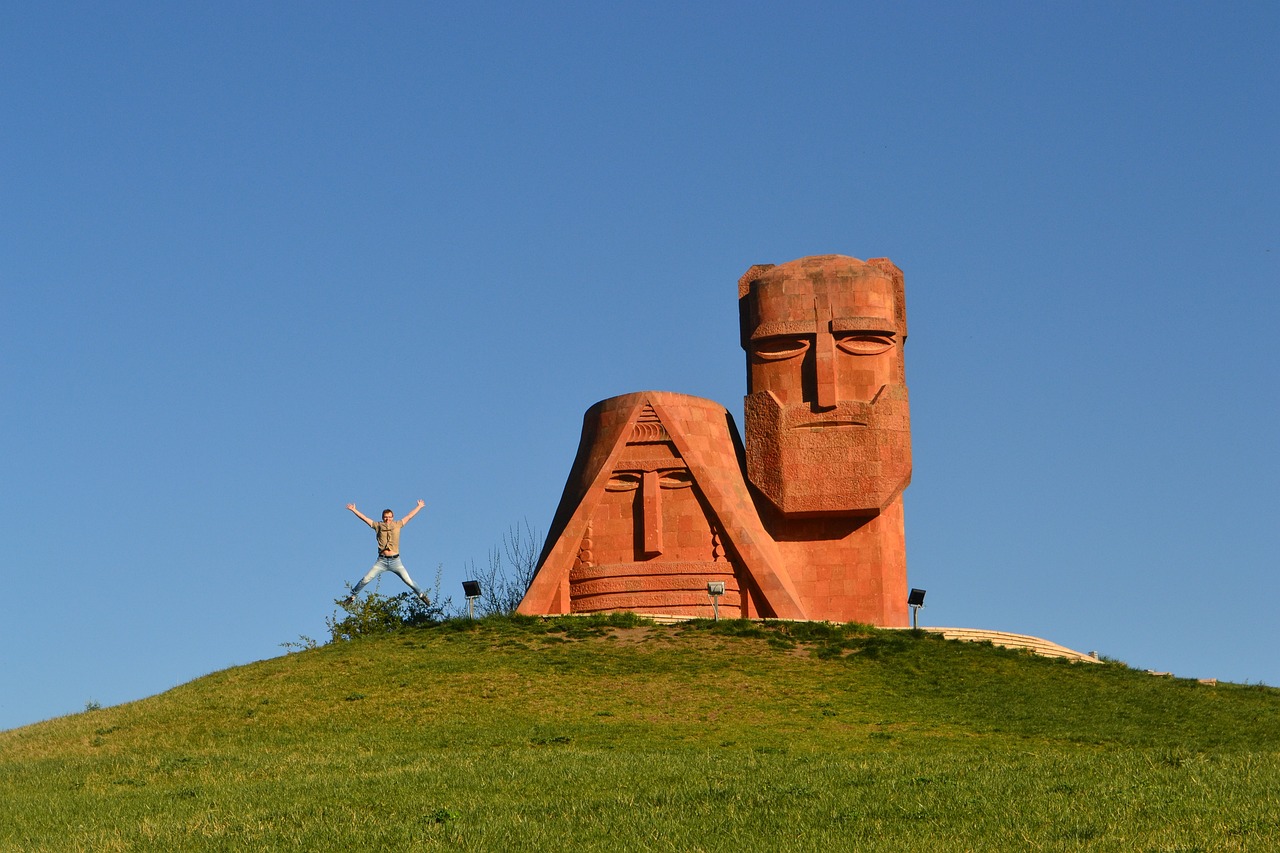
    Yerevan – APA. Correspondent of the Aksam newspaper of Turkey Nagehan Alci visited Nagorno Karabakh, the occupied territory of Azerbaijan, APA reports.

    Nagehan Alci, who visited Nagorno Karabakh through Armenia, claimed that these territories are Armenian lands. Giving interview to Armenia’s Public Television the journalist said:
    “We, people living in Turkey, made a mistake. Karabakh is one hundred percent the Armenian territory and we have understood that you are persistent enough in not ceding these lands,” he said.

    The journalist said he intended to see Nagorno Karabakh his own eyes and make a report about the life of “Karabakh people”.
    “I offered the editor-in-chief to send me to Karabakh and received a positive reply. Turkey is also interested in the territorial dispute around Nagorno Karabakh. What I saw here dispelled my doubts about the past and future of Karabakh. Stepanakert made a great impression on us and we intend to come here again,” he said.

    Commenting on Turkey-Armenia relations, Nagehan Alci said they want the borders to open.
    “But Nagorno Karabakh problem is one of the major obstacles for the this process. Our government has stated that the borders will not be opened, unless Karabakh conflict is solved. Time will show,” he said.

    Asked whether his visit to Nagorno Karabakh will cause dissatisfaction in Azerbaijan, Nagehan Alci said he supposes so.
    “We try to be unbiased, characterize the region and write about the real situation. Maybe, we will be announced persona non grata, but I do not want to hurt anybody in Azerbaijan. This is my work, I am a journalist and my profession requires being everywhere,” he said.
    Nagehan Alci said he will also visit Shusha and make a report there.

    Spokesman for Foreign Ministry Elkhan Polukhov told APA that Azerbaijani embassy in Turkey is carrying out investigation concerning the visit of the Aksam correspondent to the occupied territories.

  • Is Turkey Leaving the West?

    Is Turkey Leaving the West?

    Summary —

    Under the leadership of the Justice and Development Party (AKP), Turkey’s foreign policy is becoming more Islamist. Can the country’s history of cooperation with the West survive?

    SONER CAGAPTAY is a Senior Fellow and Director of the Turkish Research Program at the Washington Institute for Near East Policy. He is the author of Islam, Secularism, and Nationalism in Modern Turkey: Who Is a Turk?

    Turkey’s Transformers
    Morton Abramowitz and Henri J. Barkey

    Turkey hopes to be a global power, but it has not yet become even the regional player that the ruling AKP declares it to be. Can the AKP do better, or will it be held back by its Islamist past and the conservative inclinations of its core constituents?

    Read

    Turkey is still a staunch NATO ally, it is as well a strong democracy and a regional emerging economic powerhouse.

    In early October, Turkey disinvited Israel from Anatolian Eagle, an annual Turkish air force exercise that it had held with Israel, NATO, and the United States since the mid-1990s. It marked the first time Turkey’s governing Justice and Development Party (AKP) let its increasingly anti-Western rhetoric spill into its foreign policy strategy, and the move may suggest that Turkey’s continued cooperation with the West is far from guaranteed.

    Recep Tayyip Erdogan, Turkey’s prime minister and the leader of the AKP, justified the decision by calling Israel a “persecutor.” But only a day after it dismissed Israel, Turkey invited Syria — a known abuser of human rights — to joint military exercises and announced the creation of a Strategic Cooperation Council with the Syrian regime. A mountain is moving in Turkish foreign policy, and the foundation of Turkey’s 60-year-old military and political cooperation with the West may be eroding.

    Starting in 1946, when Turkey chose to ally itself with the West in the Cold War — later sending troops to Korea and joining NATO — successive Turkish governments have pursued close cooperation with the United States and Europe. Turkey viewed the Middle East and global politics through the lens of their own national security interests. This made cooperation possible, even with Israel, a state Turkey viewed as a democratic ally in a volatile region. The two countries shared similar security concerns, such as Syria’s support for terror groups abroad — radical Palestinian organizations in the case of Israel, and the Kurdistan Workers’ Party (PKK) in Turkey. In 1998, when Ankara confronted Damascus over its support for the PKK, Turkish newspapers wrote headlines championing the Turkish-Israeli alliance: “We will say ‘shalom’ to the Israelis on the Golan Heights,” one read.

    The AKP, however, viewed Turkey’s interests through a different lens — one colored by a politicized take on religion, namely Islamism. Senior AKP officials called the 2004 U.S. offensive in Fallujah, Iraq, a “genocide,” and in February 2009, Erdogan compared Gaza to a “concentration camp.”

    The foundation of Turkey’s 60-year-old military and political cooperation with the West may be eroding.

    But the AKP’s foreign policy has not promoted sympathy toward all Muslim states. Rather, the party has promoted solidarity with Islamist, anti-Western regimes (Qatar and Sudan, for example) while dismissing secular, pro-Western Muslim governments (Egypt, Jordan, and Tunisia). This two-pronged strategy is especially apparent in the Palestinian territories: at the same time that the AKP government has called on Western countries to “recognize Hamas as the legitimate government of the Palestinian people,” AKP officials have labeled Palestinian Authority President Mahmoud Abbas the “head of an illegitimate government.” According to diplomats, Abbas’ last visit to Ankara in July 2009 went terribly — now, these diplomatic sources say, Abbas does not trust the AKP any more than he trusts Hamas.

    As the cancelled military exercises with Israel show, the AKP’s moralistic foreign policy is not without inherent hypocrisies. An earlier example came last January, when, a day after Erdogan harangued Israeli President Shimon Peres, as well as Jews and Israelis, at the World Economic Forum for knowing “well how to kill people,” Turkey hosted the Sudanese Vice President Ali Osman Taha in Ankara. This is a dangerous position because it suggests — especially to the generation coming of age under the AKP — that Islamist regimes alone have the right to attack their own people or even other states. In September, Erdogan defended Iran’s nuclear program, arguing that the problem in the Middle East is Israel’s nuclear arsenal.

    Some analysts have dismissed such rhetoric as domestic politicking or simply an instance of Erdogan losing his temper. But Erdogan is an astute politician, and he is now reacting to changes in Turkish society. After seven years of the AKP’s Islamist rhetoric, public opinion has shifted to embrace the idea of a politically united “Muslim world.” According to independent polling in Turkey, the number of people identifying themselves as Muslim increased by ten percent between 2002 and 2007; in addition, almost half of those surveyed describe themselves as Islamist.

    The AKP’s foreign policy now has a welcome audience at home, making it more likely to become entrenched. After Erdogan stormed out of his session at the World Economic Forum, thousands gathered to greet his plane as it arrived back home in what appeared to be an orchestrated welcome. (Banners with Turkish and Hamas flags stitched together appeared from nowhere in a matter of hours.)

    The transformation of Turkish identity under the AKP has potentially massive ramifications. Guided by an Islamist worldview, it will become more and more impossible for Turkey to support Western foreign policy, even when doing so is in its national interest. Turkish-Israeli ties — long a model for how a Muslim country can pursue a rational, cooperative relationship with the Jewish state — will continue to unravel. Such a development will be greeted only with approval by the Turkish public, further bolstering the AKP’s popularity. Thus, the party will be able to kill two birds with one stone: distancing the country from its former ally and shoring up its own power base.

  • Turkey’s Transformers

    Turkey’s Transformers


    The AKP Sees Big

    Summary —

    Turkey hopes to be a global power, but it has not yet become even the regional player that the ruling AKP declares it to be. Can the AKP do better, or will it be held back by its Islamist past and the conservative inclinations of its core constituents?

    MORTON ABRAMOWITZ, a Senior Fellow at the Century Foundation, was U.S. Ambassador to Turkey in 1989-91. HENRI J. BARKEY is a nonresident Senior Associate at the Carnegie Endowment for International Peace and Professor of International Relations at Lehigh University.

    Snapshot Is Turkey Leaving the West? Soner Cagaptay

    Under the leadership of the Justice and Development Party (AKP), Turkey’s foreign policy is becoming more Islamist. Can the country’s history of cooperation with the West survive?


    In recent years, Turkey has earned kudos from the international community for its economic dynamism, its energetic and confident diplomacy, and its attempts to confront some of its deepest foreign policy problems, such as in northern Iraq and Cyprus. Secretary of State Hillary Clinton has said that Turkey is one of seven rising powers with which the United States will actively collaborate to resolve global problems. But Turkey has not yet become the global, or even regional, player that its government declares it to be. These days, as always, daunting domestic issues are bedeviling Turkey’s progress. Increasingly polarized views about the leadership of the ruling Justice and Development Party (known as the AKP) have undermined the government’s ability to spearhead profound political change. Even some of the AKP’s traditional supporters have begun to question whether the party will follow through on its goals, including that of getting Turkey to join the European Union.

    There are two camps. The first, and largest, group, which includes center-right politicians, liberals, and the religious, fully supports the AKP. It sees the party as fighting the dead hand of the past to free Turkish politics from subjugation by the military and the judiciary. To most AKP supporters, the party is genuinely committed to instituting a much greater measure of democracy and tackling Turkey’s most difficult issue: recognizing the democratic rights of its large Kurdish population. According to them, the party is serious about meeting the difficult requirements for EU accession and about launching fresh and constructive diplomatic initiatives in the Middle East, Central Asia, and the Caucasus. And they interpret the widespread claims that the AKP wants to establish a religious state as both fanciful and retrograde.

    https://www.foreignaffairs.com/articles/turkey/2009-11-01/turkeys-transformers

  • Take Me Back to Constantinople

    Take Me Back to Constantinople

    How Byzantium, not Rome, can help preserve Pax Americana.

    BY EDWARD LUTTWAK | NOVEMBER/DECEMBER 2009

    AyaSofyaEconomic crisis, mounting national debt, excessive foreign commitments — this is no way to run an empire. America needs serious strategic counseling. And fast. It has never been Rome, and to adopt its strategies no — its ruthless expansion of empire, domination of foreign peoples, and bone-crushing brand of total war — would only hasten America’s decline. Better instead to look to the empire’s eastern incarnation: Byzantium, which outlasted its Roman predecessor by eight centuries. It is the lessons of Byzantine grand strategy that America must rediscover today.

    Fortunately, the Byzantines are far easier to learn from than the Romans, who left virtually no written legacy of their strategy and tactics, just textual fragments and one bookish compilation by Vegetius, who knew little about statecraft or war. The Byzantines, however, wrote it all down — their techniques of persuasion, intelligence gathering, strategic thinking, tactical doctrines, and operational methods. All of this is laid out clearly in a series of surviving Byzantine military manuals and a major guidebook on statecraft.

    I’ve spent the past two decades poring over these texts to compile a study of Byzantine grand strategy. The United States would do well to heed the following seven lessons if it wishes to remain a great power:

    I. Avoid war by every possible means, in all possible circumstances, but always act as if war might start at any time. Train intensively and be ready for battle at all times — but do not be eager to fight. The highest purpose of combat readiness is to reduce the probability of having to fight.

    II. Gather intelligence on the enemy and his mentality, and monitor his actions continuously. Efforts to do so by all possible means might not be very productive, but they are seldom wasted.

    III. Campaign vigorously, both offensively and defensively, but avoid battles, especially large-scale battles, except in very favorable circumstances. Don’t think like the Romans, who viewed persuasion as just an adjunct to force. Instead, employ force in the smallest possible doses to help persuade the persuadable and harm those not yet amenable to persuasion.

    IV. Replace the battle of attrition and occupation of countries with maneuver warfare — lightning strikes and offensive raids to disrupt enemies, followed by rapid withdrawals. The object is not to destroy your enemies, because they can become tomorrow’s allies. A multiplicity of enemies can be less of a threat than just one, so long as they can be persuaded to attack one another.

    V. Strive to end wars successfully by recruiting allies to change the balance of power. Diplomacy is even more important during war than peace. Reject, as the Byzantines did, the foolish aphorism that when the guns speak, diplomats fall silent. The most useful allies are those nearest to the enemy, for they know how best to fight his forces.

    VI. Subversion is the cheapest path to victory. So cheap, in fact, as compared with the costs and risks of battle, that it must always be attempted, even with the most seemingly irreconcilable enemies. Remember: Even religious fanatics can be bribed, as the Byzantines were some of the first to discover, because zealots can be quite creative in inventing religious justifications for betraying their own cause (“since the ultimate victory of Islam is inevitable anyway …”).

    VII. When diplomacy and subversion are not enough and fighting is unavoidable, use methods and tactics that exploit enemy weaknesses, avoid consuming combat forces, and patiently whittle down the enemy’s strength. This might require much time. But there is no urgency because as soon as one enemy is no more, another will surely take his place. All is constantly changing as rulers and nations rise and fall. Only the empire is eternal — if, that is, it does not exhaust itself.

    Edward Luttwak is a senior associate at the Center for Strategic and International Studies and author of The Grand Strategy of the Byzantine Empire.

    Source: www.foreignpolicy.com, NOVEMBER/DECEMBER 2009
  • AAA welcomes John MacCain’s support

    AAA welcomes John MacCain’s support

    of Armenia’s approach to normalize relations with Turkey
    13.11.2009 10:51 GMT+04:00

    /PanARMENIAN.Net/ In a letter sent today, the Armenian Assembly of America (Assembly) thanked Senator John McCain for affirming the historical truth regarding the Armenian Genocide and for his support of a new chapter in Armenia-Turkey relations.

    During Senator McCain’s interview with Voice of America’s Georgian service, Senator McCain acknowledged the Armenian Genocide and also expressed his support for the Armenia-Turkish rapprochement.

    “We strongly believe that U.S. affirmation of the Armenian Genocide should not be held hostage to the normalization process and as such welcome Senator McCain’s remarks,” stated Assembly Executive Director Bryan Ardouny. “The Assembly has also consistently expressed its support for normalization of relations between Armenia and Turkey without preconditions,” added Ardouny.

    In the Assembly’s letter to Senator McCain, Ardouny highlighted the need to redouble America’s efforts to reaffirm the Armenian Genocide in the face of continued campaign to deny its very occurrence and quoted Archbishop Desmond Tutu who has stated: “It is sadly true what a cynic has said, that we learn from history that we do not learn from history. And yet it is possible that if the world had been conscious of the genocide that was committed by the Ottoman Turks against the Armenians, the first genocide of the twentieth century, then perhaps humanity might have been more alert to the warning signs that were being given before Hitler’s madness was unleashed on an unbelieving world.”

    The Assembly letter also urged McCain to cosponsor S. Res. 316, the Armenian Genocide Resolution introduced by Senators Robert Menendez and John Ensign.

  • Turkey warm to storing Iranian uranium

    Turkey warm to storing Iranian uranium

    Turkish Energy Minister Taner Yildiz said on Friday that if asked, his country would be willing to temporarily store Iran’s enriched uranium to help defuse a standoff over Western suspicions that Teheran is trying to build an atomic bomb.

    Yildiz stated that storing low-level enriched uranium in Turkey would not pose a problem, adding that although such a request had not been made, the issue was still being discussed.

    If asked, he concluded, “we would not say no.”

    The idea that Turkey could play a role in the crisis was raised in an American television interview by IAEA head Mohamed ElBaradei, who noted that Turkey, a Muslim country and a NATO member, has good relations with both neighboring Iran and the US.


    Iranian President Mahmoud Ahmadinejad after a press conference in Istanbul, Monday.
    Photo: AP

    Iranian Chief of Staff Hassan Firouzabadi spoke later on Friday in support of the proposals to ship most of Teheran’s low-enriched uranium stockpile abroad for further processing, AFP reported, quoting the Mehr news agency.

    The initiative will prove that the country’s “peaceful nuclear activities” are “bona fide,” Firouzabadi was quoted as saying.

    Iran’s chief of staff also urged Russia to ship the S-300 surface-air missile system to Teheran in accordance with a contract signed between the two countries months ago, PressTV reported.

    According to the report, Firouzabadi expressed confusion over Moscow’s six-month delay. “Don’t Russian strategists realize Iran’s geopolitical importance to their security?” the general was quoted as saying.

    The system would significantly boost Iran’s defense capabilities, especially against aircraft.