Month: November 2009

  • How to win the Nobel Peace Prize

    How to win the Nobel Peace Prize

    The Answer to the Burning Question du jour: Why was President Obama Gifted the Nobel Peace Prize?

    Zahir Ebrahim
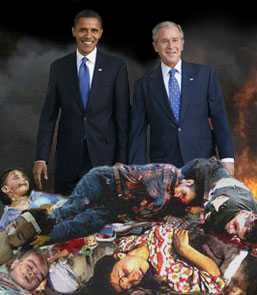
    obama_war_criminalIn complete realization of the ‘change’ mantra:

    “We are gonna spread happiness,

    we are gonna spread freeeeedom,

    Obama’s gonna change it,

    Obama’s gonna leeeeead em,

    we’re gonna change it,

    and re-arrange it,

    we are gonna change the world!” ( The Obama Kids Song )

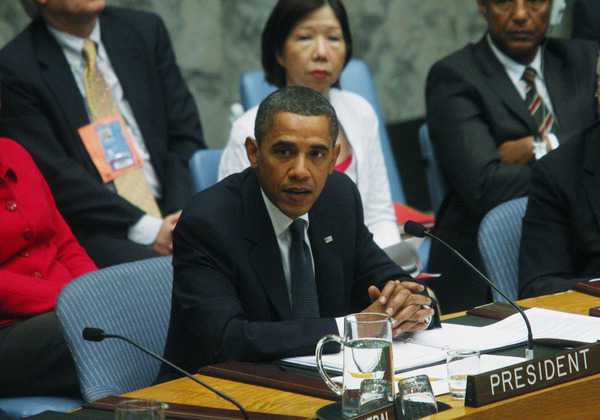
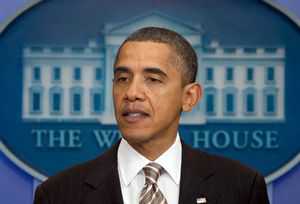
    President Barack Obama has just been awarded the Nobel Peace Prize. The President is delighted and “Says He’s ‘Surprised’ and ‘Humbled’” according to the New York Times.

    When I first penned “How to Win the Nobel Peace Prize” in great anguish in April 2003, in Chapter 2 of Prisoners of the Cave as the “shock and awe” of Iraq was under way, I hadn’t the full prescience of all the future players at the time for I grossly omitted the new name. My apologies to the harbingers of ‘change’. Their mantra, and the $2 billion spent creating it, has obviously been very effective. After the “peace maker” moniker, anointment as the “Messiah” really can’t be that far behind. This Machiavellian fabrication of a ‘savior’ was already examined in Mr. Obama – The Post Modern Coup in November 2008.

    It is astonishing to me how simplistic the most lauded dissent-chiefs and most profound intellectuals are in the West. Even when they critique absurdities and war-mongering as per their good conscience, they tread remarkably gently. Look at historian Howard Zinn’s comment in the UK Guardian. He is once again simplistic in his vocal dissent piece – just as he has been all along on 911 – by deliberately not seeing the Orwellian propaganda agenda behind the Peace Prize:

      “I was dismayed when I heard Barack Obama was given the Nobel peace prize. A shock, really, to think that a president carrying on two wars would be given a peace prize. Until I recalled that Woodrow Wilson, Theodore Roosevelt, and Henry Kissinger had all received Nobel peace prizes. The Nobel committee is famous for its superficial estimates, won over by rhetoric and by empty gestures, and ignoring blatant violations of world peace.” (emphasis added)

    No, No, NO! Never ‘superficial estimates’ and never ’empty gestures’. Rather, laying the seeds of masterful propaganda towards Orwellian social engineering.

    Thus, Professor Zinn’s concluding prescription: “The Nobel peace committee should retire, and turn over its huge funds to some international peace organization which is not awed by stardom and rhetoric, and which has some understanding of history”, which, since he diagnosed the disease incorrectly, is a cure, I am sure, to the problem that he has posited in his own mind, but one that has no forensic bearing to the modernity plaguing mankind. Indeed, this “modernity” is itself “as old as mankind”. So while Howard Zinn does conscionably lament the bizarre awarding of peace prizes to murderous trigger pullers, he very carefully does not mention the prime-movers whom they work for:

      “Oh yes, the committee saw fit to give a peace prize to Henry Kissinger, because he signed the final peace agreement ending the war in Vietnam, of which he had been one of the architects. Kissinger, who obsequiously went along with Nixon’s expansion of the war, with the bombing of peasant villages in Vietnam, Laos and Cambodia. Kissinger, who matches the definition of a war criminal very accurately, is given a peace prize!”

    Ever since hectoring hegemons have existed, ever since oligarchs have existed wielding power from behind the scenes through their ‘errand boys’, ever since they discovered social engineering, and especially ever since Edward Bernays discovered and employed Public Relations which coincided approximately with the time that Nobel peace prizes started to be awarded, these accolades from the high and mighty serve the oligarchic agendas as needed.

    Since Professor Howard Zinn, as a profound historian who would like us to learn from history, is berating the Nobel Peace Committee on their lacking “some understanding of history”, watch the BBC documentary Century of Self to observe how Edward Bernays himself fabricated President Woodrow Wilson’s aura as the European ‘savior’ right after the “he kept us out of the war” devil had taken America to World War I at the behest of his handlers Bernard Baruch and Col. Edward Mandell House, both of whom represented the international bankers. House even penned the rationale for having ‘errand boys’ and controlling them in a fictional narrative based upon his own role during Woodrow Wilson’s presidency. Who is channeling President Obama’s energies such that despite all his election promises to the contrary, he is very predictably maintaining the same overarching policy axioms as his predecessor from his day one in office?

    These prizes are anything but “empty gestures”. It is both a payoff to tickle the ego of the ‘errand boy’, and a propaganda seed. In the expert hands of the Mighty Wurlitzer, such a gift can convince the masses of the most ridiculous absurdities, like the War on Terror already has. The proof of these statements of fact is both empirical, and historical. Watch Barack Obama crafted into a fine new global ‘savior’ at the expense of the ‘untermenschen’. That’s why the United States President, ceremoniously presiding over the most militarized superpower in the world which has just devastated two civilizations to smithereens, was awarded the Nobel Peace Prize while he rapidly accelerates his war prosecution to bring “peace” in a one-world government.

    Here is the excerpt from Chapter 2 of Prisoners of the Cave.

    How to win the Nobel Peace Prize

    President Jimmy Carter, known as the conscionable president, refused to bomb Tehran despite recommendations from his wife and advisors, as noted by a speaker recently, builds homes for Habitat for Humanity with his own bare hands, and is the winner of the Nobel Peace Prize. His own National Security Advisor (ZB) took credit for handing the Soviets their Vietnam in Afghanistan, leading to the destruction of an entire civilization and loss of multiple of its generations to multiple civil wars and poverty, eventually leading to 911 – if one is to believe the facile version of 911 put forth by the American Government. Whether or not Bin Laden was involved in 911, the facts of history attest to the machinations of the United States of America in the exercise of its military and economic power since the end of World War II as forcefully articulated by George Kennan in 1948:

      “… We should cease to talk about vague and – for the Far East – unreal objectives such as human rights, the raising of living standards, and democratization. The day is not far off when we are going to have to deal in straight power concepts.”*8

    ZB’s own confessions to this end are highly instructive. The 1998 ZB interview to “Le Nouvel Observateur”, translated from the original French by author and historian Bill Blum, is reproduced below. The translator notes that: “*There are at least two editions of this magazine; with the perhaps sole exception of the Library of Congress, the version sent to the United States is shorter than the French version, and the Brzezinski interview was not included in the shorter version.”

      Question: The former director of the CIA, Robert Gates, stated in his memoirs [“From the Shadows”], that American intelligence services began to aid the Mujahadeen in Afghanistan 6 months before the Soviet intervention. In this period you were the national security adviser to President Carter. You therefore played a role in this affair. Is that correct?

      Brzezinski: Yes. According to the official version of history, CIA aid to the Mujahadeen began during 1980, that is to say, after the Soviet army invaded Afghanistan, 24 Dec 1979. But the reality, secretly guarded until now, is completely otherwise Indeed, it was July 3, 1979 that President Carter signed the first directive for secret aid to the opponents of the pro-Soviet regime in Kabul. And that very day, I wrote a note to the president in which I explained to him that in my opinion this aid was going to induce a Soviet military intervention.

      Question: Despite this risk, you were an advocate of this covert action. But perhaps you yourself desired this Soviet entry into war and looked to provoke it?

      Brzezinski: It isn’t quite that. We didn’t push the Russians to intervene, but we knowingly increased the probability that they would.

      Question: When the Soviets justified their intervention by asserting that they intended to fight against a secret involvement of the United States in Afghanistan, people didn’t believe them. However, there was a basis of truth. You don’t regret anything today?

      Brzezinski: Regret what? That secret operation was an excellent idea. It had the effect of drawing the Russians into the Afghan trap and you want me to regret it? The day that the Soviets officially crossed the border, I wrote to President Carter. We now have the opportunity of giving to the USSR its Vietnam war. Indeed, for almost 10 years, Moscow had to carry on a war unsupportable by the government, a conflict that brought about the demoralization and finally the breakup of the Soviet empire.

      Question: And neither do you regret having supported the Islamic fundamentalism, having given arms and advice to future terrorists?

      Brzezinski: What is most important to the history of the world? The Taliban or the collapse of the Soviet empire? Some stirred-up Moslems or the liberation of Central Europe and the end of the cold war?

      Question: Some stirred-up Moslems? But it has been said and repeated Islamic fundamentalism represents a world menace today.

      Brzezinski: Nonsense! It is said that the West had a global policy in regard to Islam. That is stupid. There isn’t a global Islam. Look at Islam in a rational manner and without demagoguery or emotion. It is the leading religion of the world with 1.5 billion followers. But what is there in common among Saudi Arabian fundamentalism, moderate Morocco, Pakistan militarism, Egyptian pro-Western or Central Asian secularism? Nothing more than what unites the Christian countries.*9

    Frighteningly amoral execution of George Kennan’s policy articulation from 1948 of “going to have to deal in straight power concepts”. Wouldn’t you say that all American Presidents have been doing exactly that?

    I had also personally witnessed on television, President Carter in 1978 toasting to the health of the King of Persia, Raza Shah, with approximately the following words: ~“To your majesty, to the love that your people have for you.” This to a tyrant responsible for brutally suppressing his own people with American supplied weapons, and while Carter is toasting his host inside the Palace, outside the streets are filled with people protesting their king. When the revolution proceeds a few month later, instead of a mea culpa, a reign of vilification, long war, and sanctions is imposed on the people of Iran. And for what crime? For wanting their freedom from American-CIA imposed tyranny at the hands of one of their own elite? The Iran Hostage Crisis, covered on ABC Nightline daily, which I would occasionally catch while eating dinner in the late night cafeteria at MIT, as I recall was quite devoid of any significant history or accurate analysis of the past 26 years leading up to the crisis. I subsequently saw a shredded memo painstakingly put together and freely available in the streets of most countries in the region about some of the imperial work being done by the American staff in the US embassy in Teheran, whom the hostage takers were calling CIA spies. The taking of these hostages, many of them civilians, was probably the biggest blunder the Iranians made after their revolution, and were paid for in spades by America with the war imposed on them through Iraq. If Jimmy Carter had deserved any Peace Prize, it would have been to avert the crisis with Tehran and successfully bring back the hostages, made amends with Iran for its people finally exercising their will and set the stage for friendship between the two countries, leaving a legacy of peace and prosperity for the region and appreciated the world over. He did not do that.

    What is the prize for?

    You might say Camp David and Egypt-Israel peace accord over a desert that was militarily occupied in a war? When his own people call Anwar Sadaat a traitor for making his private and separate peace with Israel and breaking up the Arab stance on Palestine which is what Israel wanted all along; and he is also a despised dictator of his own people hated and killed by them for his oppressive policies only to be replaced by another brutish dictator who is also continually kept in power by being the second largest US aid recipient in the world after Israel – is that a peace at the barrel of a gun or an enduring peace with justice?

    Brokering a “peace accord” that was only a new manifestation of an old “divide and conquer” plan that the peoples at least on one side of it did not want, and which only allowed Israel a freer hand to continue suppressing the Palestinians and incrementally continue to swallow up their lands without interference from its Arab neighbors, instead of one in which all could have lived in justice and peace with full rights of return for those displaced, is an imperial farce forced upon a beleaguered peoples. And the impact of precisely this “peace accord” for which Carter got the “peace” prize are visible to all and sundry in Palestine – an amazing case study in faits accomplis that become “irreversible” – a modern day genocidal resettlement of another’s land right before the very eyes of the silently bespectating world!

    What about Menachem Begin? He certainly also had all the qualifications for the Nobel Peace Prize, having blown up the King David Hotel in 1948 as part of the terrorist Stern-Irgun gangs and was once the most wanted criminal in Britain.*9A

    Let’s see who might be in line next? Ariel Sharon and George Bush Jr. and Sr., as well as Bin Laden and Zbigniew Brzezinski, because after all, they did defeat the Soviet Union and bring an end to the four decade long Cold War. They all appear to have the right pedigree of “blood-experience” for the Nobel Peace Prize!

    So pardon me if I am not tripping all over myself congratulating the “peace prize” winners!

    -###-

    By Zahir Ebrahim Link: http://print-humanbeingsfirst.blogspot.com/2009/10/how-to-win-nobel-peace-prize.html | PDF | Read the rest of chapter 2 in full context here | Print | Announcement = Project Humanbeingsfirst Ebook 2009

    Source:  www.thepeoplesvoice.org, October 12th, 2009
  • Is Turkey turning East?

    Is Turkey turning East?

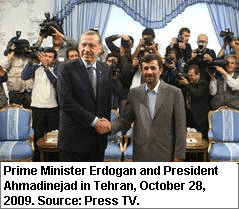
    turkey-iranFor some time, there have been fears that Turkey has begun moving away from its traditional Euro-Atlantic orientation, towards the Middle East and the Muslim world. Turkey’s condemnation of Israel’s attack on Gaza in January was followed by Prime Minister Recep Tayyip Erdogan’s walk-out during a debate with Israeli President Shimon Peres at the World Economic Forum.

    In early October, Turkey vetoed Israel’s participation in a joint air-force exercise, again citing its conduct in Gaza. In the same week Turkish TV aired a show portraying Israeli soldiers as child- killers, provoking fury in Tel Aviv.

    On a recent visit to Iran, the Turkish premier signed a gas deal and several economic cooperation agreements (Press TV, October 28). Before the visit, Mr Erdogan defended Iran’s right to nuclear energy and accused those countries which oppose Tehran’s atomic program of hypocrisy (Guardian, October 26). Iran’s President Mahmoud Ahmadinejad was understandably delighted, and pundits in the West were understandably shaken.

    The New York Times argued that lack of progress on EU membership was driving Turkey away (NY Times, October 27). The Christian Science Monitor called it ‘worrisome’ (Christian Science Monitor, October 29). Overall, the assumption seems to be that Turkey’s growing clout, and disillusionment with its EU membership talks, is leading it towards a closer relationship with autocratic Middle Eastern states like Iran and Syria.

    So are Europe and America ‘losing’ Turkey? Probably not. The evidence in support of this theory is disjointed and selective, and ignores other key facts. On Israel, for instance, this argument assumes that Turkey’s fury over Gaza is in some way manufactured, that it is designed entirely to win support on the ‘Arab street’ (and indeed the Persian street).

    Although Turkey’s leaders are not blind to the credit that this will earn them in the Muslim world (also, within Turkey itself), there is little doubt that their anger is genuine. Turkey has been attempting to encourage progress on the Arab-Israeli peace process for years, and saw its fragile gains destroyed during Operation Cast Lead. Rightly or wrongly, Ankara sees Israel as mainly responsible. As for the TV program, it would be absurd to assume that the Turkish government was responsible for the content and the timing.

    It is also odd to link Turkish anger at Israel with turning away from the EU. For all its links with Brussels and Washington, the Jewish state is not an integral part of ‘the West’, geographically or politically. Ankara is quite capable of opposing Israel’s actions without abandoning its EU membership application. And although the reputation of that process is heavily tarnished, and there is significant frustration amongst ordinary Turks over European hostility to Turkish membership, EU integration remains a priority of the AKP Government.

    Senior Turkish officials have made this plain in recent days. They also poured cold water on the whole idea that Turkey is turning East – “Is it so easy to change direction?” asked President Abdullah Gul rhetorically (Today’s Zaman, October 30).

    This statement hints at the heart of the matter. Complex states do not have a single geopolitical ‘direction’. President Gul visited Serbia on October 26th, but this hardly means that Ankara is seeking to re-establish Ottoman influence in the Balkans, as some seem to believe it is doing in the Middle East. To take another parallel, no-one would seriously believe that increased US diplomacy towards China would be a sign of abandoning NATO and Europe.

    Ankara’s foreign policy, now more than ever, is famously focused on ‘zero problems with neighbours’(RFE/RL, October 30). Given Turkey’s unique position at the confluence of so many different regions, this policy is bound to involve dealing with states whom the West distrusts – Iran, Russia, and Syria, for instance.

    Expecting Turkey to suspend cooperation with Tehran is an easy judgement to make in Washington or Brussels, but not so in Ankara. An otherwise hostile Wall Street Journal acknowledged this on October 30, recognising that “nations do not have the luxury of picking their neighbours” (Wall Street Journal, October 30). Turkey needs Iran to cooperate: on energy, trade, and on containing Kurdish militants.

    In any case, Turkey has absolutely no interest in a nuclear Iran. What most commentaries fearing a Turkish-Iranian alliance ignore is that, just a few weeks ago, Ankara ordered advanced Patriot missile batteries from the US (Eurasia Daily Monitor, September 16). It was keen to insist that this was not due to any threat, but the move is obviously in response to Iran’s strategic missile programme. Mr Erdogan’s praise of President Ahmadinejad was, given this context, simple diplomacy, made before a visit in which he hoped to secure extensive trade and energy deals. It would have been surprising, and contrary to Turkey’s foreign policy, to have prepared for his visit by thundering against the country’s nuclear program.

    The ‘losing Turkey’ argument – which assumes that, given the AK Party’s Islamist past, Turkey is also becoming more Islamic in nature – also ignores moves such as the thaw with Christian Armenia. This was also undertaken in the framework of the same “zero problems” concept.

    Assuming that Turkey is somehow moving away from the West, towards the Middle East, or towards some kind of pact with Iran, is a narrow view. It ignores historic rivalry between them, fails to recognise Turkish fears of an Iranian nuclear weapon (whatever Mr Erdogan might say in public), and conflates Israel with the EU or NATO. Most importantly, it underestimates Ankara’s foreign policy. Turkey is smart enough to be able to look East and West at the same time.

    Source:  cria-online.org, CU Issue 53, November 2, 2009

  • ‘Turkey’s Kissinger’ Leads Foreign-Policy Balancing Act

    ‘Turkey’s Kissinger’ Leads Foreign-Policy Balancing Act

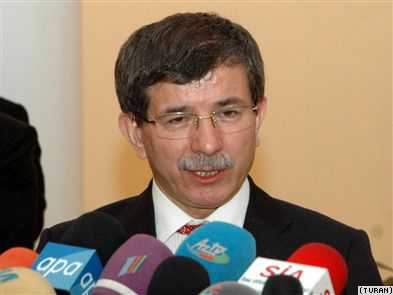
    Ahmet Davutoglu

    Ahmet Davutoglu

    By Abbas Djavadi

    During a recent televised discussion on foreign policy, six former Turkish foreign ministers recently gave Foreign Minister Ahmet Davutoglu’s performance eight out of a maximum of 10 points. The six included some harsh Social Democrat critics of the current Justice and Development (AK) party government.

    Even before his promotion from Prime Minister Recep Tayyip Erdogan’s special adviser to foreign minister in April, Davutoglu was regarded as the eminence grise behind Turkish foreign policy, and was occasionally even referred to as “Turkey’s Kissinger.” The Turks love to see their personalities, cities, and performances positively compared with the world’s most famous, but Davutoglu doesn’t like the comparison.

    Still, the 51-year old professor of political science is considered the architect of the new active foreign policy that the AK party has been pursuing since coming to power in 2002: “zero problems” with the neighbors while continuing to maintain traditionally good relations with the West.

    The West, Russia, and most members of the international community were pleased when Turkey and Armenia on October 10 signed accords, still to be ratified by the two countries’ parliaments, to restore diplomatic ties and open borders after almost a century of enmity. The accords were widely attributed to Davutoglu’s personal planning and implementation.

    In 2008, he mediated similar indirect talks between Israel and Syria in an effort to take first steps towards a Middle East peace. The effort was met with skepticism by the Bush administration and produced no tangible results, for reasons beyond Ankara’s control.

    Meanwhile, Turkey’s increasingly good relations with Russia and Iran have raised some eyebrows in the West. At the same time, Prime Minister Erdogan’s occasionally outrageous criticism of the Israeli operation against Gaza last winter, as well as the exclusion of Israel from a NATO air drill in Turkish skies two weeks ago, have led conservatives in Washington and Europe to ask if Ankara is rethinking its traditionally good relations with Israel. Discussing a potential Israeli attack on Iran, U.S. analyst Michael Rubin of the American Enterprise Institute recently affirmed boldly that “Turkey is now on Iran’s side.”

    Rebalancing, Not Shifting

    Since the establishment of the Turkish Republic in 1923, Ankara has leaned increasingly towards the West while maintaining no more than functioning good relations with its neighbors. Davutoglu describes Turkey’s new foreign policy initiative as a Turkish version of the German Ostpolitik of the 1960s. “Turkey is a natural part of the European continent and culture,” he wrote in his book “Strategic Depth,” published 10 years ago.

    Echoing U.S. President Barack Obama, Davutoglu recently said that Ankara and Washington enjoy a “model partnership.” With regard to Turkey’s relations with her neighbors and regional policy, on the other hand, he said “zero-problem-based relations” must be transformed into “maximum mutual-interest-based ones.”

    Both Davutoglu and Erdogan have their roots in Turkey’s traditional, conservative, and Islamic thinking. However, improving relations with neighboring states and playing an increasingly leading role in the region seems to be based on real political influence and economic and energy interests, rather than prestige and nostalgia for the old Ottoman Empire, as some suggest. Erdogan and Davutoglu have attracted billions of dollars in Arab investment into Turkey and plan to make the country a main oil and gas corridor between the East and Europe.

    While Muslim and non-Muslim neighbors view Ankara’s balancing act with both appreciation and suspicion, many in the West suspect that Turkish efforts to promote “mutual interests” between “rogue states” such as Iran and Syria and the West will ultimately end in Turkey’s betrayal of Western values and commitments. Others, including the Turkish opposition, even suggest that the ruling AK is tacitly pursuing that goal.

    But Davutoglu denies that the axis of Turkey’s foreign policy is shifting. A region that is increasingly peaceful, with countries cooperating with one another, is good for the West and the world, he said recently. “This is an exceptional and unique role Turkey could play.”

    Abbas Djavadi is associate director of broadcasting at RFE/RL. The views expressed in this commentary are his own, and do not necessarily reflect those of RFE/RL

    Source: www.rferl.org, October 30, 2009

  • Obama’s Inner Kissinger

    Obama’s Inner Kissinger

    Mickey Edwards
    The Iconoclast

    Mickey Edwards

    The Iconoclast

    58468908

    For more than 200 years, America’s policy makers have wrestled with the complexities of dealing with the world. George Washington, for example, thought America’s best interests were served by keeping the rest of the world at arm’s length (a view later amended more than slightly by James Monroe, who reversed the emphasis by insisting that other countries butt out of our business, the definition of “our business” being extended both north and south to include the entirety of “our” hemisphere.

    John Adams suffered from a foreign policy heartburn brought about by Thomas Jefferson’s stopping just short of declaring that we were all, in our hearts, French. Walter Isaacson, in his biography of Henry Kissinger, traced competing foreign policy perspectives to the idealistic Jefferson (“eternal hostility against any form of tyranny over the mind of man”) and a less sentimental Alexander Hamilton, who saw “safety from external danger” as the principal consideration in determining with whom we would engage and how.

    And so it has gone through the years. John Kennedy, Walter Mondale and Ronald Reagan all drew on John Winthrop and the Bible to declare that America was a “shining city on a hill” sending out its beams to the rest of the planet, Reagan playing the pivotal role in creating a National Endowment for Democracy. Reagan edited George Kennan’s long-standing “containment policy” toward the Soviet Union and replaced it with a “rollback” campaign, which mixed the Hamiltonian pursuit of security with Jefferson’s anti-tyranny crusade. Jimmy Carter pushed for greater international respect for human rights. Even George W. Bush, who was inexplicably cavalier toward civil liberties in the United States, insisted on expanding human rights and democracy in the rest of the world, though perhaps too willing to impose, rather than promote.

    And so now Barack Obama occupies the place of primacy in deciding the shape of America’s international engagement. In a world full of danger, present or emerging, whose form has this new President taken? Henry Kissinger’s.

    This is a bit of a surprise. One element of Obama’s electoral appeal was the clear sense that this was a man of high ideals. There is no question that those ideals existed, and strongly, and that they guided his approach to many of the nation’s most vexing problems. If he had not exactly repeated Robert Kennedy’s “I dream of things that never were and say, ‘why not’”, he had at least given a sense of commitment to the better angels.

    The thing about the presidency, though, is that one invariably finds issues more complicated than they might have appeared from the campaign trail. Here, while one’s heart may echo Jefferson, one’s responsibilities make Washington’s sense of caution more appealing. Henry Kissinger, Richard Nixon’s Secretary of State, is known as the most prominent modern proponent of a “realpolitik” approach toward foreign policy in which, in the end, the most important factor in deciding a national approach to other nations is quite simple: “What is in America’s interest”?

    That alone is a difficult question. It was once thought to be in America’s “interest” to ally itself with some of the worst dictators on the planet: we not only allied ourselves with, but embraced, the Batistas, the Somozas, the Shahs, the Noriegas, and while those short-term alliances may have been of some use in dealing with Soviet expansionism (a real threat at the time), we have clearly paid a long-term price for such narrowness of purpose. But the world is not easy. One wishes for more democracy, more freedom, more protection from abuse in all the places where these rights are in short supply. But there are other considerations and they necessarily impinge on the decisionmaking process. In that intra-cranial showdown, it now appears that it is the “hard” side, the perceived necessity of setting aside one’s empathies, that has captured Barack Obama’s thinking.

    Obama’s “Kissinger” revealed itself first when his Secretary of State, Hillary Clinton went to China and declared that bringing up the unpleasantness of Chinese human rights violations would serve no useful purpose and detract from the importance of finding common ground with Beijing on various international concerns ranging from trade to climate change to North Korean nuclear weaponry (this from a woman who once went to China to protest its discriminatory policies toward women).

    Our hearts may have wanted to protest the suppression of freedoms, say a word for Tibet, complain about the treatment of Uighurs, but the Administration decided it needed China for other things of more immediate concern to us. That has since been followed by a retreat from our previous confrontational approach toward Sudan where Obama now envisions a more positive policy of engagement with a government whose president has been indicted by the International Criminal Court for atrocities in Darfur.

    There is no bottom-line conclusion here: in a presidency that is so young, one cannot know whether the soft line taken toward China, Sudan, Russia, and other violators of human liberties will in the end dominate Mr. Obama’s foreign policy decisions. But neither can the early signs be ignored. For the moment, it appears, Henry Kissinger is back.

    (Photo: Getty Images/Hiroko Masuike)

    Source:  correspondents.theatlantic.com/mickey_edwardsOct 23 2009

  • AMERICAN-TURKISH COUNCIL ELECTS A NEW CHAIRMAN

    AMERICAN-TURKISH COUNCIL ELECTS A NEW CHAIRMAN

    American-Turkish Council
    Press Release
    Thursday, October 29, 2009
    Contact: ATC offices at 202-783-0483

    AMERICAN-TURKISH COUNCIL
    ELECTS A NEW CHAIRMAN

    In recognition of the vital role outstanding leadership plays in the promotion of U.S.-Turkey relations, the Board of Directors of the American-Turkish Council today announced that retiring Chairman Brent Scowcroft will be succeeded as Chairman by Ambassador Richard L. Armitage, President of Armitage International.  Ambassador Armitage will begin his service as Chairman, January 1, 2010.

    With the completion of his current term on December 31, 2009, Brent Scowcroft will have served nine years as Chairman of the Board of the American-Turkish Council.

    The Board of Directors and the Members of the American-Turkish Council take this opportunity to thank General Scowcroft for more than a half-century of personal commitment to a strong U.S.- Turkey relationship and particularly for his highly successful leadership of the American-Turkish Council. He will continue to be an active member of the ATC Board.

    Corporate members of ATC, both American and Turkish, welcome Ambassador Armitage and look forward to working with him to strengthen the business, defense, trade and investment, foreign policy and cultural relations between the United States and Turkey, two proven allies and friends. General Scowcroft and Ambassador Armitage will travel to Turkey November 16-20 for senior-level discussions with Turkey’s government, military and business leadership. This timely visit will assure the smoothest possible transition for ATC.

    BIOGRAPHY OF AMBASSADOR RICHARD L. ARMITAGE

    Richard L. Armitage has been President of Armitage International since 2005, continuing a more than 40-year career of alternating private practice and government service. Previously, he served as the Deputy Secretary of State from March 2001 until 2005.

    From 1993 until March 2001, Mr. Armitage was President of Armitage Associates L.C. In 1992 and 1993, Ambassador Armitage directed U.S. assistance to the Newly Independent States (NIS) of the former Soviet Union. From 1989 until early 1992, Mr. Armitage filled key diplomatic positions as Presidential Special Negotiator for the Philippines Military Bases Agreement and Special Mediator for Water in the Middle East. President George H. W. Bush sent him as a Special Embassy to Jordan’s King Hussein during the 1991 Gulf War. In the Pentagon from June 1983 to May 1989, he served as Assistant Secretary of Defense for International Security Affairs.

    In May 1975, Mr. Armitage came to Washington as a Pentagon consultant and was posted in Tehran, Iran, until November 1976. Following two years in the private sector, he took the position of Administrative Assistant to Senator Robert Dole of Kansas in 1978. In the 1980 Reagan campaign, Mr. Armitage was senior advisor to the Interim Foreign Policy Advisory Board, which prepared the President-Elect for major international policy issues confronting the new administration. From 1981 until June 1983, Mr. Armitage was Deputy Assistant Secretary of Defense for East Asia and Pacific Affairs in the Office of the Secretary of Defense.

    Born in 1945, Ambassador Armitage graduated in 1967 from the U.S. Naval Academy, where he was commissioned an Ensign in the U.S. Navy. He served on a destroyer stationed on the Vietnam gun line and subsequently completed three combat tours with the Mobile Riverine Advisory Forces in Vietnam. Fluent in Vietnamese, Mr. Armitage left active duty in 1973 and joined the U.S. Defense Attaché Office, Saigon. Immediately prior to the fall of Saigon, he organized and led the removal of Vietnamese naval assets and personnel from the country.

    Mr. Armitage currently serves on the Board of Directors of ConocoPhillips, ManTech International Corporation and Transcu Ltd. He is a member of The American Academy of Diplomacy as well as a member of the Board of Trustees of the Center for Strategic and International Studies (CSIS). He was awarded the Department of State Distinguished Service Award, is a four-time recipient of the Department of Defense Medal for Distinguished Public Service, the Secretary of Defense Medal for Outstanding Public Service, the Chairman of the Joint Chiefs Award for Outstanding Public Service, the Presidential Citizens Medal, and the Department of State Distinguished Honor Award. He has received decorations from the governments of Russia, Thailand, Republic of Korea, Bahrain, and Pakistan, and he was awarded a KBE and became a Knight Commander of the Order of St. Michael and St. George in 2005.

    =================================================

    yorum

    From: [email protected]
    To: [email protected]
    Sent: 10/29/2009 5:46:40 P.M. Eastern Daylight Time
    Subj: Fwd: American-Turkish Council Elects A New Chairman ve Cumhuriyet Bayrami

    Welcome to the new page of Imperialism in Turkey. Emperyalizmin Turkiye icin actigi yeni sayfaya hosgeldiniz. Aslinda Dick Cheney’i baskan atamalari gerekirdi ama herhalde yanlislik yapmislar veya Amerikan Turk Is Konseyini destekleyen Turkiye’ye ve dunya ya silah satan sirketler ile petrol sirketlerinin tercihi Armitage’ten yana. Emperyalizmin Turkiye somurusu ATC, ATAA ve Turkish Cultural Foundation uzerinden yogun hiziyla devam edecege benziyor. ARI hareketi gibi emperyalizmin sivil toplum kuruluslari simdilik bir kenara birakildi, yerini eski fakat koklu emperyalist isbirlikcisi aktorler olan ATC, ATAA ve Turkish Cultural Foundation aliyor. Turkiye elcisi Nabi Sensoy’ ise bu olusumda kopru rolunu ustlenmis olmali.Charles Reese’in Emperyalizm ile ilgili sozu belki bize bu surecte bir ipucu verebilir: The truth is that neither British nor American imperialism was or is idealistic. It has always been driven by economic or strategic interests.

    Cumhuriyet bayraminizi kutlamanin bir geregi oldugunu dusunmuyorum, cunku olmayan bagimsizlik kutlanmaz.

    Baris ve ozgurluk dolu gunler dilegimle,

    Tugrul

  • Women Who Dare

    Women Who Dare

    SYNOPSIS

    Women Who Dare explores Turkey and the existence of Eastern/Islamic traditions and Western culture through the lives of its women. This intimate, feauture-length documentary delves into the compelling lives of three women in Istanbul, Belkis, Nur and Banu who juggle Eastern and Western cultures, daily, in her own unique way.

    For centuries, Europeans depicted Istanbul and Turkey as a mysterious and exotic destination because of its meandering cobblestone streets, imposing mosques and secret harems. However, the real city and the country are far more interesting, contradictory, vibrant and mysterious than any of its depictions. In the post 9/11 world, if Islam and Western values, tradition and progress can co-exist, were this phenomenon to be realized, the most likely place for it would be Istanbul, and in turn Turkey, as a whole. This march towards global integration has deeply and visibly affected the female population. Women’s lives have become the arena where the values of Islamic tradition and the Western idea of self-determination are played out. It is against this contradictory backdrop – of tradition and individualism – that the women of this documentary thrive.

    elkis, Nur and Banu contradict the familiar stereotypes of “Muslim Middle Eastern Women”. Courageous, sharp-witted, and often provocative, they are not afraid to weigh in with opinions on religion, politics, men, gender roles and the Western attitude toward the East. All three women continually push the envelope to live authentic lives in a culture where many women are restricted by the demands of tradition. Nur received her MBA from University of Illinois and now works as a feminist activist. Belkis, a textile artist, was a museum curator for years and Banu is studying for her Master’s degree in Psychology. Belkis and Nur have built illustrious careers and overcame the conflict between their Western education, their family traditions and societal demands. In private, Belkis and Nur air their frustrations with the patriarchal traditions and encourage the younger generations of which Banu is a member, to be less burdened by dictates of tradition.

    omen Who Dare is structured in three segments that explore the lives of each women. Through these individual stories, we see the transformation of a society from traditional Islamic patriarchy to a more democratic one where Islamic values can co-exist with democracy and gender equality. The theme of “following one’s dream” is the focus of the film and of these women’s lives. Belkis, Nur, and Banu share the desire of self-discovery and creating a community of their own. Their on-going battle with cultural and societal restrictions helps them to become more confident and compassionate. Much of the drama in Women Who Dare emerges from the loss and suffering and the triumphs of coming into one’s own.

    omen Who Dare aims to reveal the complex issues that are faced by educated Muslim women as they embrace modern global values. Women Who Dare will help the Western audience to understand the enormous challenges of tradition these women have to grapple with, as they try to establish their identities.


    CURRENT STATUS

    omen Who Dare has locked picture and is currently in the sound design phase! We are planning to submit to festivals in August 2009.


    Get a sneak peek at the film by clicking here to view the trailer! During a three week trip to Turkey, the filmmakers conducted most of the final interviews and filmed extraordinary footage throughout the country from Istanbul to Cappadocia, Konya, Bodrum and Izmir. Film production on began in Istanbul in 2003, and since that time, interviews have been conducted with several European and Turkish scholars, artists, politicians, high school students, teachers, housewives, feminist activists and our three main characters, Belkis, Nur and Banu. heck out production photos and the latest updates in the news section. n March 2005, Turkish corporation ESBAS donated a generous production grant to the film. Check out our sponsors.