Month: September 2009

  • McCain Admits Bush Administration Violated International Law

    McCain Admits Bush Administration Violated International Law

    By DAPHNE EVIATAR 8/31/09 10:12 AM

    Sen. John McCain (R-Ariz.) said on “Face the Nation” Sunday that — like most Republicans and even some Democrats, including some in the president’s cabinet — he thinks President Obama was right when he said “we ought to go forward, not back.”

    But then he went on to say, as Glenn Greenwald tweeted yesterday, that “I think the interrogations were in violation of the Geneva Conventions and the Convention Against Torture that we ratified under President Reagan.”

    Now, once you acknowledge that the CIA, at the direction of senior cabinet officials, violated international humanitarian law that requires the United States to prosecute the perpetrators, the only way to justify not investigating is to say that the executive branch of government is above the law — or, put more pragmatically, that it’s politically too messy to investigate senior leaders in the U.S. government.

    Republicans didn’t hesitate to investigate when it involved Democratic President Bill Clinton, however, or to bring charges against him for lying about a personal matter. And Congress didn’t turn its backs on the Iran-Contra scandal during the Reagan administration, which led to 14 senior officials charged with crimes, and 11 convictions. And of course the Watergate affair led to the indictment and conviction of senior Nixon administration officials, and impeachment charges against the president. Congressional investigations of sitting and past administrations are far from unprecedented.

    So how does McCain explain why we ought to forget the whole torture problem — which led to the deaths of a still-unknown number of detainees in custody, some of whom the CIA still can’t account for — even as he acknowledges that it violated international treaties that legally obligate us to prosecute?

    “I think these interrogations helped al-Qaeda recruit,” McCain said yesterday, adding: “the damage that it did to America’s reputation in the world we’re still on the way to repairing.”

    Even setting aside the legal requirements, as a practical matter, a public acknowledgment and investigation would seem to be the only way to repair that damages.

    As McCain put it: “This is an ideological struggle as well as a physical one.”

    Source:  http://washingtonindependent.com/57121/mccain-admits-bush-administration-violated-international-law

  • Turkey says okay to Christian worship in birthplace of St. Paul

    Turkey says okay to Christian worship in birthplace of St. Paul

    stpaulECUMENICAL NEWS INTERNATIONAL
    Sep 1, 2009

    Warsaw
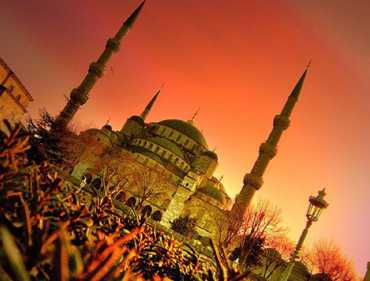
    The government of Turkey has agreed to extend indefinitely permission for Christian worship at an historic church in Tarsus, the birthplace of St. Paul, says the head of the country’s Roman Catholic bishops’ conference.

    “I’m confident the church in Tarsus could soon change from being a museum to a centre of spiritual pilgrimage,” said Bishop Luigi Padovese, after the close of worldwide commemorations to mark the 2,000th anniversary of the birth of St. Paul.

    The Bible records that St. Paul initially persecuted Christians after being raised as a Jew in Tarsus, but he underwent a conversion to Christianity after a vision on the road to Damascus.

    Italian-born Bishop Padovese said that the Turkish government had already indefinitely extended its consent for Christian services in the church. This followed a record influx of 416 Christian groups from 30 countries to Tarsus during the Year of St. Paul, celebrated from June 2008 to June 2009.

    “For the first time, Turkish Muslims have witnessed Christians, not as tourists, but as praying pilgrims, whose devotion has made a lasting impression on the Turkish people,” said the bishop.

    The early-medieval St. Paul’s church, which appears on the U.N. World Heritage list, was confiscated by the Turkish government in 1943 for use as a state museum. At that time it was also used for regular services by fee-paying Christian visitors.

    The 32,000-member Catholic Church in Turkey has requested permanent return of the building from Prime Minister Recep Tayyip Erdogan. The building had been a focus for Christian culture until the regime of Kemal Ataturk in the 1920s.

    Bishop Padovese said he believed the government is now ready to classify the eastern town as a Christian pilgrimage site, but said that European Christians needed to continue demanding a permanent solution.

    “A certain amount of public pressure is helpful, but only if it originates from love for Turkey and a genuine wish for religious freedom to grow in the country,” he stated.

    Christian minorities have frequently complained of discrimination in Turkey, most of whose 70 million inhabitants are Sunni Muslims.

    Source:  www.anglicanjournal.com, Sep 1, 2009

  • Turkey Specifies a Range of New Ships

    Turkey Specifies a Range of New Ships

    The Turkish navy has in a relatively short period of time gone from being a collection of hand-me-down ships to a service that is able to make its presence felt in regional waters with advanced vessels from foreign suppliers and, increasingly, local shipyards.

    The navy is neither the largest nor wealthiest of Turkey’s armed services. Nevertheless, by carefully managing resources and subjecting suppliers to extensive certification tests, it is undertaking an expansion program that will upgrade or replace most of its surface fleet in coming years with a range of ships. It also plans to procure amphibious landing and transport vessels that will enhance force-projection and relief efforts.

    As part of the expansion, the navy seeks more independence from foreign suppliers and, eventually, autonomy when it comes to developing ships, weapons and sensors. Efforts are underway to increase the capabilities of local shipbuilders through cooperative programs with foreign shipyards that call for a lead ship to be built abroad and sister ships built locally under license.

    Turkish shipyards are, as a result, working on increasingly complex designs. Turkey has a robust commercial shipbuilding industry, which supports almost 40 shipyards, supplies a large merchant fleet and sells many vessels abroad. Turkey’s undersecretariat for defense industries wants to qualify 3-5 shipyards for naval vessels, with contracts awarded competitively.
    At stake in the buildup is Turkey’s regional position and economy. The country faces potential threats from many directions: A resurgent Russia that seeks to reestablish spheres of influence in the north; the muddle of Middle Eastern politics and conflicts to the south; an historic rivalry with Greece in the west; and an unpredictable Iran to the east. Ninety percent of Turkey’s trade moves by sea and the navy must guarantee the passage of commercial ships, monitor 8,300 km. (5,157 mi.) of coastline and protect islands it claims in the Aegean.

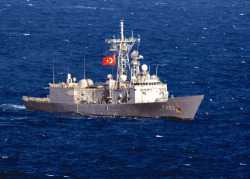
    Turkey’s navy is a 55,000-man force with a number of vessel types. The core surface fleet is made up of 19 frigates. These include German Meko 200 ships and former U.S. Navy Perry- and Knox-class vessels. There are also six corvettes from the French navy. Littoral operations make use of 25 fast-attack missile boats and a dozen patrol boats. The mine warfare force has a number of vessels for inshore, coastal and blue-water operations, most obtained second-hand from the U.S., France and Germany. The amphibious force is small and uses old ships, as do auxiliary and support units. The submarine corps has 14 boats of German design.

    The construction of new vessels nearly matches the modernization of ships in service, which relies on foreign and local technology. The service is standardizing weapon systems, sensors and electronics across the fleet.

    The navy, however, is not willing to take risks in modernization. While it trusts local shipbuilders to meet long-term commitments (the program may last 20 years), it does not do so without extensively testing designs before committing to orders. In submarines, the navy expects to rely on foreign designs due to the technical hurdles associated with their construction. Nevertheless, there is a desire to develop a submarine combat system, heavy torpedo and sensors locally.

    In February, the navy awarded Lockheed Martin a contract to upgrade four Perry-class and the first two Meko 200 IIA frigates. Requirements include installation of the Mk 41 vertical launching system (VLS), which will load Mk 25 quad-pack cells for Raytheon’s ESSM antiair/antimissile system, replacing the Standard SM-1 (supported by Raytheon) on the Perry. The Perry retrofit also involves a combat management system (CMS) based on the Genesis, developed by local manufacturer Havelsan with Raytheon (and initially aimed at the Knox frigates), which is to be installed on new Milgem corvettes. All Perry-class ships will have the Genesis CMS, though not all can receive the Mk 41. Two Knox-class frigates will be retired.

    The navy is moving ahead with the ambitious TF-2000 antiair-warfare (AAW) frigate program (some experts say the vessels are really guided-missile destroyers), whose start has been postponed several times. The 6,000-plus-ton vessels, to be built by Golcuk Naval Shipyard, are a local effort with foreign partner assistance.

    The timetable calls for completing the design by 2011, with a Batch I contract signed for two vessels in 2014, and commissioning in 2021 and 2022. Batch II, with three vessels, will proceed from 2023-28. Few details are known about weapons and sensors, but each ship will have 32 VLS cells, a Mk 41 launcher that fires Standard SM-2 and ESSM antiair missiles, two helicopters, a 127-mm. gun, antiship missiles and antisubmarine-warfare torpedoes.

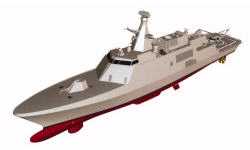
    The most important national program is the Milgem corvettes. The navy wants 12 ships (four on option), and in the process will replace six corvettes. The first-in-class ship, Heybeliada, was launched in September 2008 and will not be commissioned before 2011. The second, Buyukada, will undergo lengthy testing with a different weapon and sensor suite. There will be a gap between the first two corvettes and series production of an additional six and the option vessels. This is part of the navy’s “test before more buying” strategy. Each corvette displaces 2,000 tons, is 99 meters (325 ft.) long and capable of 30 kt. with a combined diesel and gas powerplant. Armaments include a 76-mm. Oto Melara gun, Boeing Harpoon antiship missiles, Raytheon Rolling Airframe Missile launcher, torpedoes and a helicopter.
    The navy’s fast-attack force relies on three Lurssen Kilic 57 boats from Germany and three Tufans (with three more planned), which are built in Turkey. There are also 10 Dogan Type 57 boats and eight former Jaguar boats, both from Germany, which have been rearmed with Penguin antiship missiles from Kongsberg Defense & Aerospace of Norway. Replacement of the Jaguars is underway following the acquisition of 16 patrol boats that will be delivered by local shipbuilder Dearsan starting in 2010. These 400-ton, 55-meter vessels will do 25 kt. The service is evaluating armament for the ships.

    The submarine fleet has a version of the German Type-209 design. Six Atilay boats, Type 209/1200, which were to be refitted, will instead be replaced by six HDW Type 214s with air-independent propulsion systems, in a €2.5-billion ($3.55-billion) program. The 214s will be built locally, with initial delivery expected in 2015, and others at a rate of one every two years. Eight of the more modern Type 209/1400s will stay in service and could be modernized.

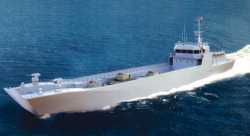
    Turkey wants to expand its amphibious capabilities by acquiring large transport and assault platforms to support a marine brigade, which relies on old, small LSTs (landing ship-tanks) and LCTs (landing craft-tanks). The service wants amphibious craft that also deliver relief supplies. The country is earthquake-prone, and the government has ordered the services to improve relief capabilities. The goal is to acquire one or two LPDs (landing platform-docks), two LSTs and eight LCTs. A contract has been awarded to local builder Adik-Furtrans for the LCTs, which will be 1,200 tons and 80 meters long, capable of 20 kt. and able to carry 320 tons of cargo. The competition for the LSTs is in its final phase, with Adik battling RMK to supply the 5,000-ton, 18-kt. vessels, which will have a 1,200-ton cargo capacity and helicopter deck. LPD plans are moving slower, since the 20,000-ton vessels could be too big for local military shipbuilders. There is a need for a foreign partner to supply design and technical assistance.

    Turkey’s navy needs modern support ships for effective operations in blue water. Plans call for acquiring a 10,000-ton submarine rescue ship, with a contract award planned for 2012, one or two 2,500-3,000-ton rescue and towing ships, with a contract expected next year, two fleet-replenishing ships and a research vessel that will replace or add to current support ships.

    Mine warfare is a specialty of the Turkish navy, but budget priorities have for years forced the service to rely on old or second-hand vessels. This approach was reversed with the decision to acquire five Alanya-class coastal minehunters, with the first-of-class built by Abeking & Rasmussen of Germany. The next four will be constructed in Turkey. Additional minehunters could replace older types in service.

    Credit: ASELSAN CONCEPT

    AVIATION WEEK
  • PIRATES OF THE BLACK SEA

    PIRATES OF THE BLACK SEA

    Nezavisimaya Gazeta
    September 1, 2009

    Backed by Russia, Abkhazia promises to seize Georgian ships
    Author: Yuri Simonjan
    RUSSIA MIGHT FIND ITSELF DRAGGED INTO A CONFLICT BETWEEN
    TBILISI AND SUKHUMI AGAIN

    Backed by Russia, Abkhazia is prepared to challenge Georgia in the
    Black Sea. “They leave us no choice. We will seize Georgian
    ships,” Abkhazian Foreign Minister Sergei Shamba said. Georgia had
    seized and arrested several ships on the run to and from Abkhazia
    last month.
         Tbilisi in its turn only emphasized the resolve to board and
    detain all vessels entering territorial waters of Georgia,
    including the Abkhazian part, without permit.
         Sukhumi turned to Moscow and immediately obtained its promise
    of assistance. Ships navigating territorial waters of Abkhazia
    will be protected by Russian and Abkhazians border guards. “All
    attention was focused on the Abkhazian-Georgian land border. The
    situation at sea requires attention too,” Shamba announced.
         The Georgian Coast Guard detained 23 ships for “violation of
    the entry regulations” this year and nearly 70 over the last four
    years. The ships are almost always Turkish, Ukrainian, Russian,
    and Greek.
         “Seizing ships in neutral waters, Georgia commits acts of
    piracy. Our appeals to the UN and EU remain unanswered which only
    encourages Georgia. Tbilisi must have forgotten that Georgian
    ships pass us by on the way to Ukrainian, Bulgaria, and Greece and
    that we can respond in kind,” Shamba said.
         The minister said that the situation had been more or less
    tolerable until US Vice President Josef Biden’s visit to Georgia
    this spring. “The Georgian authorities must have been given
    assurances of some sort,” Shamba assumed. He announced that
    Georgia’s actions constitute a violation of the settlement
    agreement reached with the European Union’s help.
         Official Tbilisi pays no heed to Sukhumi’s protestations. It
    maintains that sailing into Abkhazian ports without authorization
    from the central government of Georgia is a violation that will
    not be tolerated.
         Georgian Deputy Foreign Minister David Dzhalagania said at
    the press conference this Monday that participation of Russia
    would be a height of cynicism. He added that Russia had already
    assaulted Georgia once.
         “Russia’s attempts to protect trespassers in the Georgian
    territorial waters will be appraised and treated as piracy.
    Freight traffic to Abkhazia without Tbilisi’s permit is a gross
    violation of the Georgian legislation,” State Minister for
    Reintegration Temur Yakobashvili said.
         Military expert Irakly Sesiashvili said that Tbilisi was
    trying to bite more than it could possibly chew. Attempts to
    prevent Russian ships from entering the local waters will lead to
    a dangerous confrontation or Georgia will have to cry uncle.
    Sesiashvili said the international community alone could settle
    the issue.

  • Turkey poised to give Kurds more rights

    Turkey poised to give Kurds more rights

    Published: Monday 31 August 2009   

    Despite an attack by Kurdish militants killing four soldiers, Turkish Prime Minister Recep Tayyip Erdogan voiced determination on Sunday (30 August) to push forward his plan to grant more rights to the country’s largest minority.

    Background:

    The Kurds are ‘a nation without a country’. According to the CIA ‘factbook’, 18% of Turkey’s population of 77 million people are Kurdish. Similarly, 15-20% of Iraq’s population of 30 million are Kurds, and so are 7% of Iran’s 66 million population. Up to two million Kurds are estimated to live in Syria. 

    After the US-led war that brought down the regime of Saddam Hussein, Iraq’s Kurds enjoy a high degree of autonomy, parliamentary democracy and the highest living standards in the country. ‘Iraqi Kurdistan’ is even allowed to have independent foreign relations. 

    Turkey’s Kurdish problem, which has fuelled separatist conflict in the mainly Kurdish southeast, has long been an obstacle to Ankara’s EU membership ambitions. 

    According to the Turkish press, the Kurdish conflict in Turkey has cost the lives of about 40,000 people since 1984, resulted in more than 17,000 unsolved murders, wasted billions of dollars in military expenditure and countless billions more in missed opportunities. 

    The Kurdistan Workers’ Party (PKK), which launched a campaign in 1984 for Kurdish self-rule in the southeast, is believed to number 4,000 fighters. It has been weakened recently by Turkish military operations against bases in northern Iraq. 

    PKK leader Abdullah Öcalan was captured in 1998 and was sentenced to death, before the punishment was converted into life imprisonment. 

    “I see this attack as an attempt to axe, to prevent the democratic opening process,” said Erdogan, adding that those initiatives are doomed to fail. 

    The prime minister added that the army’s struggle against the Kurdistan Workers’ Party (PKK) would continue unabated. PKK is a separatist military organisation recognised as a terrorist group both by the EU and the USA. 

    Last month, Erdogan said his government was preparing a “package” of reforms to boost the rights and freedoms of Turkish Kurds. Although few details are known, the two main opposition parties, the Republican People’s Party (CHP) and the Nationalist Movement Party (MHP), slammed the announced opening. 

    According to the press, the measures include allowing political campaigns in the Kurdish language, providing opportunities for Kurds to learn their mother tongue, allowing the Kurdish language to be spoken in prisons, restoring the former names of thousands of Kurdish towns and villages, and ensuring Kurdish language and literature teaching in two universities – Mardin Artuklu and Diyarbakir Dicle. 

    Plan under fire

    Nationalist Movement Party (MHP) deputy chairman Mehmet Şandir said that granting political freedoms to ethnic groups would turn Turkey into a “hell of minorities,” the Zaman daily wrote. MHP, which has a nationalistic platform, won 14% of the vote in the 2007 elections. 

    “If you grant political freedoms to all the ethnic groups in Turkey, whose number is claimed to be 36 by Prime Minister Recep Tayyip Erdogan, then you will turn Turkey into a hell of minorities. Unfortunately, Turkey is today being dragged to a very dangerous point due to a reckless act by the AK Party,” Şandir reportedly said. 

    The authorities rebuked allegations that the announced plan was a result of US pressure and a ‘secret’ US plan to defuse regional problems affecting Iraq, embraced by the ruling AKP. 

    The Turkish armed forces, which traditionally play the role of ‘guardian of secularism’, indicated there were some “red lines” which must not be crossed. 

    “The Turkish Armed Forces [TSK] will not allow any harm to be done to the nation-state and the unitary state structure,” Chief of General Staff General Ilker Başbug was quoted as saying by a Kudish online website. 

    Government defends its ambition 

    Speaking to editors-in-chief of major newspapers on 28 August, Deputy Prime Minister Bülent Arinç said the process was a national project and emphasised that Turkey needed to solve its issues on its own. 

    Arinç, however, conceded that Washington supported his country’s plan both logistically and psychologically, against a background of US troop withdrawals from Iraq by 2011, looming Iraqi national elections in January and the future prospects of northern Iraq, where Kurds enjoy substantial autonomy. 

    “Maintaining the territorial integrity of Iraq at a time when terror is wreaking havoc among Kurds, Shiite and Sunni Arabs is in the interest of both Turkey and the US,” the deputy prime minister said. 

    Rejecting contacts with Abdullah Öcalan, the jailed leader of the PKK, Arinç however indicated the government’s readiness to work with DTP – the Kurdish Democratic Society Party, which he said should not be considered as a terrorist organisation. 

    “If you consider the DTP a terrorist organisation or an illegal structure, you are putting over two million voters who cast their ballots in favour of this party in the same place as the terrorists,” he stressed. 

    Arinç said he was visiting DTP mayors as parliament speaker, despite objections from Ankara-appointed local governors. He added that he had long suggested that Erdogan meet with DTP leader Ahmet Türk. 

    Positions:

    The Turkish press wrote that the government’s efforts to provide some sort of answer to Turkey’s long-pending Kurdish question had led to a frenzied altercation instead. Columnist Andrew Finkel wrote for the Zaman daily that Erdogan had embarked on a reform process from which he could not withdraw. 

    “His credibility is at stake, and he must either succeed with his overture or step aside. The opposition parties […] are content to pursue policies which divide Turkey into camps,” Finkel writes. 

    Iraqi President Jalal Talabani, a Kurd, called on the Kurdistan Workers Party (PKK) to accept peace with Turkey and lay down their arms, saying the Kurdish people faced a historic opportunity to be accepted into Turkish society. 

    Talabani told Reuters he perceived a “new climate” in Turkey toward the rights of its Kurdish people, and that he supports its leaders in their efforts to end the 25-year conflict with the PKK, whose guerrilla fighters have bases in the Iraqi Kurdistan mountains. 

    “The Kurds are trying to convince the PKK to accept the peace proposals of the Turkish government, then to lay down their arms and go back home to participate in political activities in Turkey,” said Talabani. 

    Azad Aslan, editorialist for the Kurdish Globe website, argues that the governing AK party in Turkey is under pressure from the EU to deliver on the democratisation process in Turkey. He also saw the development in the context of Turkey seeking to acquire regional power status. 

    “It has already joined the G-20 bloc and was given the green light from US Congress to develop nuclear power. Turkey signed the crucial and strategic pipeline project of Nabucco and got strategic positions in energy transport and energy corridors. Due to its geostrategic position, Turkey can play a regional role both in the Middle East and Central Asia. This new regional position necessitates Turkey to resolve its internal affairs and questions – the Kurdish question ranking top among them,” Aslan argues. 

    Mentioning the developments in neighbouring Iraq, Aslan also stresses that “while five million or so Kurds in one part of Kurdistan enjoy collective national-political rights, it would be difficult to grant only individual-cultural rights to more than 10 million Kurds in Turkey”. 

  • EU Parliament Rights Head Calls For Uyghur Inquiry

    EU Parliament Rights Head Calls For Uyghur Inquiry

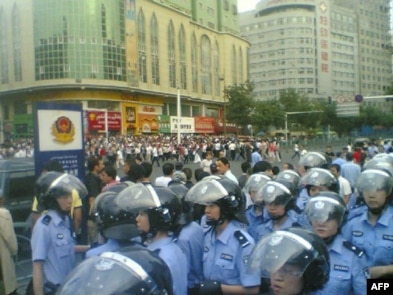
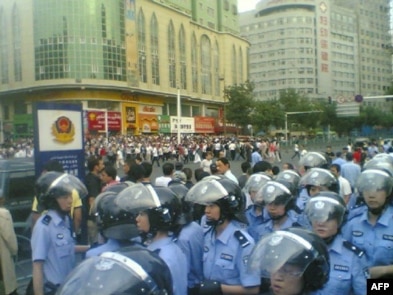
    A U.S.-based Uyghur group issued this photo soon after the Xinxiang violence erupted, showing clashes in Urumqi.

    September 01, 2009

    BRUSSELS (Reuters) — The head of the European Parliament’s human rights committee has backed a call for an independent international inquiry into deadly riots in northwest China’s Xinjiang region in July.

    “We have got some quite worrying information about events of July 5,” Heidi Hautala told a joint news conference with Rebiya Kadeer, exiled leader of China’s largely Muslim Uyghur ethnic group who earlier addressed the parliamentary committee.

    “I believe that there is a case for an independent international investigation so that all human rights violations from all sides can be cleared and investigated,” Hautala said.

    She said such an inquiry should be conducted by the United Nations with the backing of the European Union.

    In Xinjiang’s worst ethnic violence in decades, Uyghur rioters attacked majority Han Chinese in Urumqi on July 5 after taking to the streets to protest against attacks on Uyghur workers at a factory in south China in June in which two Uyghurs died. Han Chinese in Urumqi sought revenge two days later.

    The violence left 197 people dead, mostly Han Chinese, and wounded more than 1,600, according to official figures.

    Uyghurs, a Turkic people who are largely Muslim and share linguistic and cultural bonds with Central Asia, make up almost half of Xinjiang’s 20 million people.

    Kadeer said some 10,000 Uyghurs were missing following the riots and accused the Chinese Communist government of pursuing a policy resembling “cultural genocide” in what Uyghurs call East Turkestan.

    She called in July on the international community to send an independent investigative team to the site of the riots.

    “The arrests and detentions continue,” she told the news conference, adding that most were teenage students who, she said, were being tortured in detention.

    Kadeer accused the Chinese authorities of using the international battle against Islamist militancy and the global economic downturn as pretexts to repress the Uyghur people.

    https://www.rferl.org/a/EU_Parliament_Rights_Head_Calls_For_Uyghur_Inquiry/1812564.html