Month: September 2009

  • Sarkisian Explains Turkey Moves To Armenian Parties

    Sarkisian Explains Turkey Moves To Armenian Parties

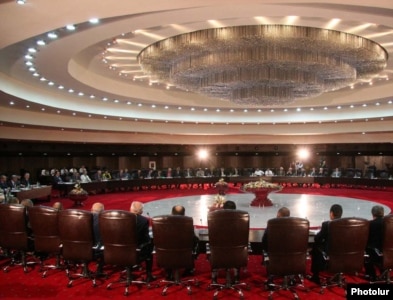
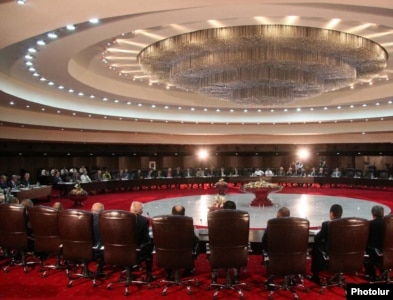
    Armenia — President Serzh Sarkisian and leaders of 52 Armenian parties meet to discuss Turkish-Armenian agreements on September 17, 2009.

    17.09.2009
    Irina Hovannisian

    President Serzh Sarkisian acknowledged that his conciliatory policy toward Turkey is fraught with pitfalls for Armenia on Thursday as he discussed it with leaders of more than 50 Armenian parties mostly loyal to his administration.

    The five-hour meeting, held behind the closed doors and boycotted by the country’s most outspoken opposition forces, was part of “internal political consultations” which the Armenian and Turkish governments have pledged to hold before signing fence-mending agreements next month.

    “I too see risks, I too have concerns,” Sarkisian said in his opening remarks publicized by the presidential press service. He nonetheless defended Armenia’s dramatic rapprochement with Turkey that began shortly after he took office in April last year.
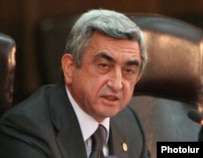
    Armenia — President Serzh Sarkisian briefs Armenian party leaders on his recent agreements with Turkety on September 18, 2009.

    “Let us judge together,” continued Sarkisian. “Are we sacrificing our convictions and our belief in truth with these documents, or we are paving the way for driving them home instead of confining ourselves to secluded purity? Let us understand that together.”

    The president referred to two draft protocols envisaging the establishment of diplomatic relations between Armenia and Turkey and the reopening of their border. Local opposition groups, notably the Armenian Revolutionary Federation (Dashnaktsutyun), strongly object to some of their key provisions such as formal recognition of Armenia’s existing border with Turkey.

    Dashnaktsutyun was represented at the meeting by one of its top leaders, Armen Rustamian. He said he reiterated the nationalist party’s concerns and pressed Sarkisian to clarify whether the protocols can be altered before their signing by the two governments.

    “It emerged that major changes in them could be made only during the [parliamentary] ratification phase,” Rustamian told RFE/RL. “This means that if there are really important and serious views [voiced on the subject,] the negotiating party must take them into consideration but will be free to decide whether or not to back them … This is simply unacceptable to us.”

    Rustamian added that the Dashnaktsutyun concerns were echoed by other party leaders and seemed to have influenced Sarkisian’s thinking. “I think that as a result of the discussions, some changes occurred in the president’s attitudes,” he said. “Thank God, there were also other political forces that had the same concerns and expressed them in one way or another.”

    According to Aram Karapetian, the leader of the opposition Nor Zhamanakner party who also attended the meeting, most participants agreed that the protocols are “flawed.” He said they were also worried that the planned formation of a Turkish-Armenian commission of historians would thwart greater international recognition of the Armenian genocide in the Ottoman Empire. “Serzh Sarkisian looked a different person after the meeting,” claimed Karapetian.

    “He had the same concerns which others had,” said Vazgen Manukian, the veteran leader of the National Democratic Union, a once influential party loyal to Armenia’s current leadership. But, he said, Sarkisian at the same time made a convincing case for the continuation of the Turkish-Armenian dialogue.

    “When you lock yourself in a room, you won’t have any concerns,” Manukian told RFE/RL. “But when you get out, walk the streets and start talking to others, there will always be problems. That’s what makes life interesting.”

    Meanwhile, the opposition Armenian National Congress (HAK) and Zharangutyun party defended their decision to boycott what they see as a meaningless discussion. HAK spokesman Arman Musinian also said that the opposition alliance led by former President Levon Ter-Petrosian will not cooperate with the authorities on any issue until the latter release all of the opposition members arrested following the February 2008 presidential election.

    For his part, Zharangutyun leader Armen Martirosian insisted on the party’s demands for a national referendum on the Turkish-Armenian agreements. “Besides, the foreign minister said in the National Assembly yesterday that nothing will be changed in the finalized protocols,” said Martirosian. “So what are we supposed to discuss?”

    https://www.azatutyun.am/a/1825295.html
  • Poor Richard’s Report

    Poor Richard’s Report

    Poor Richard’s Report                                                                         


                                                                                                    Over 300,150 readers

    My Mission: God has uniquely designed me to seek, write, and speak the truth as I see it. Preservation of one’s wealth while providing needful income is my primary goal in these unsettled times. I have been given the ability to evaluate, study, and interpret world and national events and their influence on the future of the financial markets. This gift allows me to meet the needs of individual and institution clients.  I evaluate situations first on a fundamental basis then try to confirm on a technical basis. In the past it has been fairly successful.

                                 SPECIAL BULLITEN:


                                 Our President is about to be Tested – Big Time


                The Middle East is about to blow sky high. We have now involved the UN Security counsel plus Germany (called P-5+1) to make Iran negotiate their nuclear weapons program. The due date is September 24, 2009.  To make matters worse the President promised Israel that if they did not take military action with Iran, he would deliver crippling sanctions with Iran.

    Big deal. What we withhold, China and Russia will deliver. This is now guts ball diplomacy that will reverberate across the whole world.

                Here is a scary and realistic scenario that could happen while everyone is concerned with what is going on in the kiddy pool of health care reform and economic recovery.

                ISRAEL will never, never allow itself to be at mortal risk. If and when their intelligence concludes the Iranians are close to getting a bomb, diplomacy will end. Russian expansionism has always been in the setting of somebody else’s war. Putin will ignite the match if he ever gets the chance. Imagine. They get Georgia without a contest, and open the door to secure Ukraine, and make trillions of Rubles selling “high test” to Europe after the Iranians close the Straits of Hormuz. It would stir up a real blizzard and they could retake the Baltic region while NATO is off figuring out how to get the gulf oil turned back on.           

     Buy GLD (NYSE-$99+) or CEF (NYSE-$13+) and top off your home fuel tanks.

     Have a strong cash position also.


    Richard C De Graff

    256 Ashford Road

    RER      Eastford Ct 06242     

    860-522-7171 Main Office  

    800-821-6665 Watts

    860-315-7413 Home/Office

    [email protected]


    This report has been prepared from original sources and data which we believe reliable but we make no representation to its accuracy or completeness. Coburn & Meredith Inc. its subsidiaries and or officers may from time to time acquire, hold, sell a position discussed in this publications, and we may act as principal for our own account or as agent for both the buyer and seller.

  • Uyghur Leader: ‘Entire Turkic-Speaking World Rallied To Support Us’

    Uyghur Leader: ‘Entire Turkic-Speaking World Rallied To Support Us’

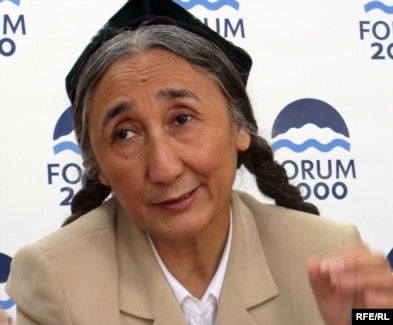
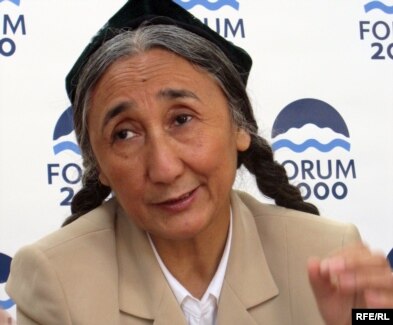
    Rebiya Kadeer said that after the September 11 attacks in the United States, the Chinese government “used this opportunity to label us as terrorists because we are Muslims and [because] we are a Turkic nation.”

    September 17, 2009
    Rebiya Kadeer, the U.S.-based head of the World Uyghur Congress, is a controversial figure in her native land.

    Kadeer was once held up by Chinese authorities as a model for the promotion of interethnic harmony. A woman, a Muslim, and an ethnic Uyghur, she is a member of a nation that has for centuries inhabited the area now called the Xinjiang Uyghur Autonomous Region, part of western China.

    The mother of 11 started a Laundromat in 1976, gradually expanded the business into a department store, then to a huge trade center, and by the mid-1990s was one of the five richest people in China.

    Kadeer was an active philanthropist, helping other Uyghur women start businesses and championing the cause of equality for Uyghurs and other minorities in China.

    Her criticism of Beijing’s handling of riots in the western Xinjiang city of Yining (also called Kuldja) in 1997 sparked her downfall. She lost her place in the National People’s Congress and the Political Consultative Conference and was forbidden to travel abroad.

    In 1999, she attempted to send newspaper articles to her husband, who was living in exile in the United States and promoting Uyghur rights. In August that year, Kadeer was detained as she prepared to meet a U.S. Congressional delegation looking into the situation in Xinjiang.

    She was convicted of divulging state secrets and endangering state security in 2000, and jailed until her early release on medical grounds in March 2005.

    Kadeer was elected president of the Uyghur American Association in May 2006 and president of the World Uyghur Congress (WUC) in November of that year. Shortly afterward two of her sons in China were jailed and a Chinese court imposed a large fine on a third son for tax evasion.

    When rioting erupted between ethnic Uyghurs and Han Chinese in July this year the Chinese government said Kadeer and the WUC instigated the unrest.

    RFE/RL Kyrgyz Service director Tyntchtykbek Tchoroev and Tatar-Bashkir Service correspondent Metin Karismaz spoke with Kadeer while she was in Prague for an international conference on “Peace, Democracy, and Human Rights in Asia” recently.

    Asked about Chinese authorities’ attempts to brand Uyghur nationalists as terrorists, Kadeer said:

    “In a period after the ‘world terrorism’ term was introduced [in the West after September 11, 2001), the word ‘terrorist’ has been given to us as a negative label by the Chinese government. The government used this opportunity to label us as terrorists because we are Muslims and [because] we are a Turkic nation. They are saying that the Eastern Turkestan organization [Eastern Turkestan Liberation Front] is planning to carry out terrorist activities. They use the word as a tool to repress us [all Uyghurs].

    “Regarding the Eastern Turkestan terrorist organization, now even the Western world is studying whether it exists or not. Is there such a terrorist organization or not? America and the rest of the world are checking the information on that.”
    Dressed in traditional Uyghur clothing and with her hair in braids, the energetic and animated 62-year-old grandmother did not look the part of a “terrorist.” Speaking in a medieval cathedral in Prague (the venue for the conference), Kadeer said her goals and those of the WUC remain the same as they have been for years.

    “The World Uyghur Congress is struggling for the freedom of Uyghurs, for freedom, democracy, and human rights of all the Turkic nations in East Turkestan [the historical name of the Xinjiang Uyghur Autonomous Region]. This organization is not terrorist. We are totally against any terrorist activities in the world. We are against any kind of violence.”

    Chinese authorities have labeled the Eastern Turkestan Liberation Front, which is not affiliated with the WUC, as a terrorist organization and made connections between that group and well-known terrorist organizations such as Al-Qaeda. Beijing has hinted that the WUC might be connected to Al-Qaeda also.

    Kadeer dismissed such accusations:

    “How could we have such a ties [with Al-Qaeda and other terrorist organizations]? You see we live in America, and America helps us financially and supports us, and we are sitting here today attending a [respected] international forum. If we had ties with [terrorists], then they would not invite us to this kind of forum.”

    Chinese authorities have blamed Uyghurs for the string of “syringe attacks” that have taken place in Xinjiang since July. Chinese medical officials said this week that none of the victims they treated were infected with any diseases or injected with poisons.

    Kadeer (right) with former President Vaclav Havel (left) and the Dalai Lama in Prague
    Kadeer said the WUC has never promoted such a response to Chinese crackdowns on the Uyghur community in Xinjiang, and that the figures for such attacks are in any event inflated due to opportunists.

    “As far as I have heard, in the event of a needle case, a victim would get 200,000 yuan ($30,000) from the Chinese government. That is why there were some cases when some Chinese pretended to be victims of such an attack. Now, even the Chinese government is itself checking into such claims. But we don’t have any relation to such attacks.”

    Not ‘Uyghuristan’

    Kadeer insisted she only wishes that the traditional lands of Turkic peoples in inner Asia be governed by Turkic peoples again.

    “This land belongs to all the Turkic nations living there. There was West Turkestan and East Turkestan. There had been a [united] Turkestan in the past. East Turkestan is the common land for all of us who are living there.

    “We don’t say that it belongs only to Uyghurs. That is why we are using the term East Turkestan, otherwise we would say only Uyghuristan. We live together with our [historic] relatives. That is why we are for [the people of] East Turkestan to [be able to] live together with our relatives.”

    Kadeer said she understands why governments in neighboring Central Asian states were reluctant to give public support to Uyghurs in China and in some cases have handed over fugitive Uyghurs to the Chinese authorities.

    “I did not think that it was a right decision. However, I don’t blame them because they were led by politics. They did it due to politics. But their people don’t do such thing toward us. Their people, our brothers, don’t do it.

    “Today’s world is where we live now. Kyrgyzstan, Kazakhstan, Uzbekistan, and Tatarstan is tomorrow’s day. If today China is oppressing us, maybe [the same] will come to them tomorrow. Our brothers have to understand this [danger].”

    But Kadeer said Uyghurs, and other Turkic peoples in Xinjiang, have the support of the people in the region once called Western Turkestan.

    “The whole Turkic-speaking world rallied to support us. The Tatar brothers held a demonstration in Crimea. Our brothers in Kazakhstan and Kyrgyzstan held demonstrations or silent pickets supporting us.

    “That is why I feel that I am not alone. We have brothers supporting us. That is why I believe that the Uyghur Turks will not disappear [as a nation from the historic stage].”

    https://www.rferl.org/a/Uyghur_Leader_Entire_TurkicSpeaking_World_Rallied_To_Support_Us/1824878.html

  • Syria, Turkey Sign Strategic Deal, LIFT VISA

    Syria, Turkey Sign Strategic Deal, LIFT VISA

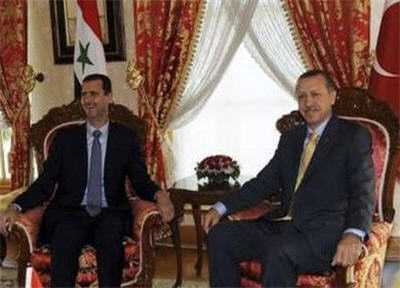
    Asad+ErdoganTurkey and Syria have signed a bilateral cooperation accord under which top ministers from the two countries will meet each year.

    Turkish Foreign Minister Ahmet Davutoglu and his Syrian counterpart Walid Mualem who is currently visiting Turkey along with President Bashar al-Assad, signed the agreement on Wednesday.

    They also said that the two countries would establish a high level strategic cooperation council.

    “We hope to turn our relations into maximum cooperation based on a principle of “zero problem,” the Turkish minister stressed.

    Touching on the meeting to be held among Turkey, Syria, Iraq and Arab League in Istanbul on Thursday to establish a dialogue between Syria and Iraq, Turkish official said that they all believed the meeting would be successful.

    Syrian president Bashar al-Assad held talks with Turkish Prime Minister Tayyip Erdogan in Istanbul on Wednesday and the two countries signed a wide-ranging agreement to improve political, economic and social ties.

    They agreed to abolish visas between the two countries.

    Source:  www.alalam.ir, 17 Sept. 2009

  • World’s new tallest man

    World’s new tallest man

    The world’s new tallest man, measuring two meters 46.5 centimetres (eight feet one inch), Sultan Kosen, 26, is from Mardin, Turkey. He also has the world’s largest hands and largest feet, measuring 27.5 centimeters (10.8 inches) and 36.5 centimeters (14.4 inches) respectively.

    Related News :

  • Turkish Opposition Remains Skeptical of Government’s “Armenian Opening”

    Turkish Opposition Remains Skeptical of Government’s “Armenian Opening”

    Turkish Opposition Remains Skeptical of Government’s “Armenian Opening”

    Publication: Eurasia Daily Monitor Volume: 6 Issue: 169

    September 16, 2009

    By: Saban Kardas

    Foreign Minister Ahmet Davutoglu met the leaders of opposition parties as part of his attempt to brief them about recent developments in Turkish foreign policy, and solicit their support for the government’s “Armenian opening.” On August 31, Turkey and Armenia announced the details of a roadmap for the normalization of bilateral relations. The parties initialed two protocols regulating the steps to be taken toward the resolution of contentious issues. To allay concerns among domestic opposition parties and in Azerbaijan, the Turkish government emphasized that the final decision would rest with parliament and that Baku’s views would be taken into account during the parliamentary approval process (EDM, September 8).

    Since accomplishing the objectives of normalization would require bold steps and political determination on the part of the Justice and Development Party (AKP) government, this new initiative is denoted as the “Armenian opening,” echoing the recent Kurdish opening. Given the necessity of parliamentary approval, the focus of the policy on Armenia has shifted to the domestic political processes.

    Davutoglu, at the urging of Prime Minister of Recep Tayyip Erdogan, has taken time out from his heavy international diplomatic agenda to win over the opposition parties for the normalization policy. Davutoglu met Deniz Baykal, the leader of the main opposition Republican People’s Party (CHP), and the leaders of the Democratic Left Party (DSP) and the Felicity Party (SP) Numan Kurtulmus and Masum Turker respectively. However, the Nationalist Movement Party (MHP) leader Devlet Bahceli, who has been the most outspoken critic of the Armenian opening, refused to meet him. Earlier, Davutoglu met Parliamentary Speaker Mehmet Ali Sahin, and he is scheduled to have additional meetings with the leaders of parties that received at least 1 percent of the popular vote in the July 2007 parliamentary elections. He also met the opposition leaders in May, following his appointment as foreign minister (Today’s Zaman, September 16).

    One common theme emerging from Davutoglu’s contacts is that the opposition leaders unequivocally state that any progress in Turkish-Armenian relations needs to be contingent upon the protection of Azerbaijan’s concerns over Karabakh. In response, Davutoglu sought to reassure them that normalization with Armenia would not come at the expense of harming ties with Azerbaijan, and that Baku was being informed about the progress of Turkish-Armenian talks (Anadolu Ajansi, September 15).

    Another common theme is the skepticism of the opposition parties toward the contents and the form of the Armenian opening, especially the involvement of foreign actors. They continue to view the opening as an agenda imposed upon Turkey by external forces, and believe that the main benefactor of the process will be Armenia.

    For instance, SP’s Kurtulmus maintained that according to popular perceptions, the process seemed to be driven by Armenia, and that Turkey appeared to be only a passive player. He asked Davutoglu to correct this image. He also expressed his reservations about the committee of historians, and maintained that the committee would be unlikely to reach a decision disproving Armenian genocide claims. Kurtulmus also criticized the government’s recognition of Switzerland as the mediator between Turkey and Armenia, arguing that as a country that punishes the denial of the “Armenian genocide” claims, Switzerland could not be considered as impartial in this issue. DSP’s Turker, also shared similar concerns (Cihan, September 15).

    The main opposition leader Baykal raised the most vocal criticisms. During the joint press brief after meeting with Davutoglu, Baykal noted that the CHP considered foreign policy issues as “state policies” that require a national consensus. He added that his party’s decision to meet Davutoglu was meant to make a contribution to state policy, and should not be interpreted as representing “support” for the government’s agenda. He stated his disappointment with the government’s overall approach to this issue, and reiterated his earlier position that the normalization agenda is imposed upon Turkey. “There is a process and a roadmap underway which is beyond the knowledge of the opposition parties. Now, through these contacts, the government is not asking ‘Let us discuss Turkey’s interests, and formulate [the policies] together.’ The government is saying to us. ‘We are given a roadmap. We decided to implement it; come, help us realize this roadmap.’ This is not an effort to formulate a policy. This is an effort to find support for a program that is already formed,” Baykal objected (ANKA, September 15).

    Baykal also characterized the two protocols as “traps.” He argued that although the protocols satisfy Armenian concerns by laying out the details of Turkey’s re-opening of the border, they fall short of meeting Turkish demands regarding Armenia’s recognition of the Kars Treaty on defining the Turkish-Armenian border, or the renunciation of its policy of having its genocide claims recognized worldwide, and ending its occupation of Karabakh. He expressed concern that the protocols offered no safeguards against the possibility that after Turkey opens the border, Armenia might later renege on its promises. Therefore, he demanded that the government must refuse to sign the protocols. Baykal also speculated that the government would sign the protocols with Armenia on October 13 (Hurriyet, September 16).

    Both the Turkish and Armenian governments have to tackle domestic opposition, in addition to the dilemmas of overcoming differences of opinion and building trust in the bilateral talks. Indeed, the Turkish-Armenian declarations recognize the challenges of obtaining broad-based social and political support, and give the parties six weeks to engage in domestic discussions before the protocols are forwarded to parliaments for final ratification.

    Given the strength of nationalistic sentiments in Turkey, one challenge for the AKP government has been to present the Armenian opening as a “national” policy, rather than a parochial agenda promoted by the AKP, or a project externally imposed upon Turkey. The six-week deadline has provided an impetus for each government to stimulate debate on the issue, but as the Turkish case suggests this deadline is too unrealistic to facilitate any meaningful and genuine democratic deliberation on a dispute mired in historical memories and current geopolitical conflicts. Davutoglu’s meetings further show that a new conflict is looming over the AKP’s foreign policy when the Armenian opening comes before parliament.

    https://jamestown.org/program/turkish-opposition-remains-skeptical-of-governments-armenian-opening/