Month: September 2009

  • ERGENEKON – Dangerous Intrigues in Istanbul

    ERGENEKON – Dangerous Intrigues in Istanbul

    Eric Margolis

    Veteran journalist and Author

    Posted: September 15, 2009 03:28 PM
    Read More: Ataturk, Ergenekon, European Union, Istanbul, Istanbul-Floods, Turkey, Turkey Floods, Turkey Trial, Turkish Muslisms, World News

    The name “Ergenekon” may not be familiar to non-Turks, but this murky political affaire has riveted Turkey’s 70 million people.

    Thirty-three members of a neo-fascist group called Ergenekon have been on trial, accused of murder, terrorism, and trying to overthrow the elected government. The trial was temporarily suspended after the courthouse was flooded out during torrential rains that inundated Istanbul last week, leaving 31 dead.

    This fascinating trial has been exposing the workings of the `deep state,’ a powerful cabal of retired and active military officers, security forces, gangsters, government officials, judges, and business oligarchs that has long been the real power in this complex nation.

    Turkey’s military vigorously denies any links to the Ergenekon.

    The `deep state’ advocates extreme Turkish nationalism and revived Pan-Turkism, or Turanism, the unification of all Turkic peoples from Turkey to the Great Wall of China.

    Its extreme right-wing members are bitterly anti-Islamic, and violently oppose any admission of guilt for the mass killing during World War I of many of the Ottoman Empire’s Armenians. Most Turks insist the killings occurred in the chaos of war and insurrection. Armenians call it the 20th century’s first genocide.

    Turkey’s hard right also opposes improving relations with neighbors Armenia and Greece, or making any more concessions to Turkey’s sizable Kurdish minority.

    Ergenekon’s plotters stand accused of plans to assassinate officials of PM Recep Tayyip Erdogan’s ruling Justice and Development Part(AKP), a democratic, modernizing movement advocating Islamic principles of fairer wealth distribution and social welfare.

    While AKP is a moderate, centrist party, Turkey’s secularists, without any serious evidence, claim it is the spearhead of a radical Islamic movement. The real issue is as much about the secularist’s right to protect their long-enjoyed economic and social privileges as it is about religion.

    The plotters reportedly hired hit men to kill leading liberal intellectuals, including acclaimed writer, Orhan Pamuk, and may have murdered a prominent Armenian-Turkish journalist and three Christians. They also oppose Turkey’s entry into the EU as a threat to `Turkishness.’

    What makes this case particularly interesting is that Ergenekon may well be linked to Gladio, a secret, far right underground group created in the 1950s by the US and NATO during the Cold War as a `stay behind’ guerrillas to resist Soviet invasion or Communist takeovers. Gladio had a network of agents and caches of arms across Europe with secret links to NATO intelligence services.

    Gladio staged numerous bombing attacks and assassinations during the 1970s and ’80s in a effort to promote far right coups in Italy, Belgium, and Turkey, where it remains active.
    A cell was even recently uncovered in Switzerland.

    In Italy, Gladio members played a key role in the P2 Masonic Lodge’s plot to overthrow the government. The Vatican’s Banco Ambrosiano, its head, Roberto Calvi, and Italian military intelligence, were also involved this intrigue.

    The Ergenekon plot is one facet of the intense struggle between Erdogan’s Islamist-lite reformists and Turkey’s 510,000-man armed forces which sees itself as defender of the anti-religious, westernized secular state created in the 1930’s by Ataturk, founder of modern Turkey.

    Turkey’s generals are closely allied to the deeply entrenched secularist oligarchy of business barons, judges, university rectors, media groups, and the security services that has made Ataturk’s memory and anti-religious values into a state philosophy.

    Turkey’s right-wing generals have overthrown three governments and ousted a fourth. The Turkish military establishment is traditionally close to the US and Israel, with whom it’s had extensive military, arms and intelligence dealings.

    Until PM Erdogan’s election, the military was Turkey’s real government behind a thin façade of squabbling elected politicians, a fact lost on western observers who used to urge Turkey’s “democratic” political model on the Muslim world.

    An intensifying struggle is under way between the two camps. On the surface, it’s “secularism versus Islamic government.” But that’s just shorthand for the fierce rivalry between the military-industrial-security complex and Erdogan’s supporters, many of whom are recent immigrants to the big cities from rural areas, where Islam remains vital in spite of eight decades of government efforts to stamp it out or tightly control it.

    Right-wing forces recently got allies in the Appeals Court to lay spurious corruption charges against Turkey’s respected President, Abdullah Gul. The Erdogan government struck back by levying a US $2.5 billion tax fine on the powerful Dogan media conglomerate that has been a fierce critic and enemy of the prime minister. Both foolish acts injure Turkey’s image as a modern democracy.

    Erdogan has been Turkey’s best, most popular prime minister. He has enacted important political, social, legal and economic reforms, and has drawn Turks closer to Europe’s laws and values. He stabilized Turkey’s formerly wild finances and brought a spirit of real democracy to Turkey. The EU keeps warning Turkey’s growling generals to keep out of politics.

    After 50 years of trying, Turkey still can’t get into the European Union. Europe clearly wants an obedient Turkey to protect its eastern flank and fend off more troublesome Muslims, but not an equal partner and certainly not a new member, even though Turkey is as qualified for the EU as Bulgaria or Romania.

    Germany’s Chancellor Angela Merkel and France’s Nicholas Sarkozy, both leaders of Europe’s anti-Muslim right, keep saying no to the Turks. The EU wants no more farmers – and productive, lower cost ones at that – and no more Muslims.

    • Turkey
    • European Union
    The name “Ergenekon” may not be familiar to non-Turks, but this murky political affaire has riveted Turkey’s 70 million people. Thirty-three members of a neo-fascist group called Ergenekon have be…
    The name “Ergenekon” may not be familiar to non-Turks, but this murky political affaire has riveted Turkey’s 70 million people. Thirty-three members of a neo-fascist group called Ergenekon have be…

    Related News On Huffington Post:

    Istanbul: Flash Floods Kill At Least 20 After Worst Rain In Decades

    ISTANBUL — The heaviest rainfall in at least eight decades sent flash floods barreling across a major highway and into busy business districts in Turkey’s…
  • Davutoglu’s Visit to Iran Highlights Ankara’s Regional Diplomacy

    Davutoglu’s Visit to Iran Highlights Ankara’s Regional Diplomacy

    Davutoglu’s Visit to Iran Highlights Ankara’s Regional Diplomacy

    Publication: Eurasia Daily Monitor Volume: 6 Issue: 167
    September 14, 2009 04:19 PM Age: 1 days
    By: Saban Kardas
    Turkish Foreign Minister Ahmet Davutoglu paid an official visit to Iran on September 12-13. He met the Iranian President Mahmoud Ahmadinejad, Foreign Minister Manouchehr Mottaki, Parliamentary Speaker Ali Larijani and the Secretary of Iran’s Supreme National Security Council and Iran’s chief nuclear negotiator Saeed Jalili. Following his meeting with Mottaki, Davutoglu and his counterpart stressed the importance they attach to bilateral relations, as well as regional cooperation. Davutoglu noted that the two countries shared deep-rooted historical ties and their neighborly relations are based on the principle of refraining from interfering in each other’s affairs. He outlined many areas where they explored boosting bilateral relations, ranging from economic cooperation to security. Referring to this multi-dimensional partnership, Mottaki described Turkish-Iranian relations as “strategic” (Cihan Haber Ajansi, Anadolu Ajansi, September 12).

    The foreign ministers emphasized that given the centrality of the threat of terrorism facing both countries, they will continue their collaboration in combating this phenomenon, referring to their joint efforts against the Kurdistan Workers’ Party (PKK) and the Party of Free Life of Kurdistan (PJAK). Davutoglu also highlighted the flourishing economic activity between the two countries, noting that the bilateral trade volume has reached $11 billion annually, despite the global economic crisis. In addition to discussing cooperation in various areas, the two main items on Davutoglu’s agenda were the nuclear issue and energy cooperation. Davutoglu’s meeting came in the wake of the announcement by Washington that it will consider holding talks with Tehran, despite the latter’s reluctance to discuss its nuclear program. Iran forwarded a proposal to the major powers expressing its readiness to discuss global nuclear disarmament, as well as other international issues. Although the White House did not find Iran’s proposals as responsive to its concerns about its nuclear program, it nonetheless showed interest in holding direct talks with Iran (Today’s Zaman, September 14).

    Davutoglu reiterated Turkey’s position that the resolution of the nuclear problem should be based on mutual respect. He also conveyed to Jalili Turkey’s readiness to host negotiations between Iran and Western countries (Anadolu Ajansi, September 13). However, this is not the first time that Turkey has proposed to mediate between Iran and the West, and its previous offers failed to produce any practical results. Reportedly, both Washington and Tehran were reluctant to see Ankara play such a role (EDM, March 10). Following the press briefing with Davutoglu, Mottaki thanked his Turkish counterpart for Turkey’s support for Iran’s right to obtain nuclear energy (Anadolu Ajansi, September 12). Although Ankara remains eager to act as a mediator, what leverage it may hold to convince Tehran to compromise on the Western demands remains to be seen.

    Energy was the other key issue on the agenda. Turkey has a major incentive to help solve the diplomatic problems bedeviling Iran’s relations with the West and bring Iran into the orbit of the European energy security discussions, a policy which is also supported by many European countries.

    Turkey seeks to deepen its energy partnership with Iran, especially considering its efforts to become a major energy hub. Indeed, one of the biggest obstacles before the Nabucco project, which Turkey considers as a strategic priority, is finding suppliers, Iran is the most likely alternative, since it possesses the second largest gas reserves in the world. Turkey indeed has been eager to act as a bridge connecting Iranian gas to the European grid through Nabucco. Although Ankara signed a major energy cooperation deal with Iran in 2007, it had to suspend those plans due to American objections. U.S. sanctions toward Iran prevent the development of the Iranian gas sector and the export of its gas to Western markets. Since its fields are underdeveloped and it needs immense transportation infrastructure, Iran has not emerged as a major player in gas markets, and even has been forced to import gas from Turkmenistan to meet its domestic demand. Prior to the signing of the Nabucco inter-governmental agreement in Ankara, Turkish officials, including Prime Minister Recep Tayyip Erdogan emphasized their willingness to tap into Iranian gas, but U.S. officials reiterated their objection to the Iranian option (EDM, July 14). However, Davutoglu said that Turkey would work to help Iran export its gas to European markets.

    Turkey’s Iran policy resonates well with the recent course of its regional diplomacy. Ankara has fostered closer regional dialogue with Iraq, Syria and other Arab countries in order to create a peaceful neighborhood and develop closer economic partnerships, including energy projects (EDM, August 12). Bringing Iran into the same circle is definitely a prime motive driving Ankara’s policies toward Tehran.

    Davutoglu, as the architect of this policy, appreciates the central role that Iran plays in the region and expresses his aversion to any instability that might be caused by the ongoing diplomatic problems, as well as the developments in Iranian domestic politics. This concern, however, results in a status quo policy of supporting the Iranian government. As reflected in Ankara’s acquiescent attitude during the Iranian regime’s harsh crackdown on the protestors following the disputed presidential elections, Turkey was criticized for not being sensitive to domestic developments in Iranian politics (EDM, June 18).

    Another underlying problem in Turkey’s Iran policy concerns the differing interpretations both parties attach to “regional cooperation.” Iran views regional cooperation as a way to limit the involvement of the West and the United States in regional affairs, as well as to exclude Israel. Turkey, in contrast, values its ties to the West and defines its regional policies in complementary terms. Indeed, such differences of opinion were apparent in Ahmadinejad’s statements following his meeting with Davutoglu, which contained strong anti-Western rhetoric. Ahmadinejad claimed that the improvement of Turkish-Iranian relations is an obligation “in a process whereby great and oppressor powers are in decline” (Anadolu Ajansi, September 12).

    A major test for Turkey’s regional diplomacy might perhaps stem from its ability to foster closer cooperation among its neighbors, while also ensuring that it does not present an anti-Western platform.

    https://jamestown.org/program/davutoglus-visit-to-iran-highlights-ankaras-regional-diplomacy/
  • Remarks at House of Commons, Demanding Justice for Armenians

    Remarks at House of Commons, Demanding Justice for Armenians

    sassun-23

    Monday, September 14, 2009

    By Harut Sassounian on May 15th, 2009


    At the invitation of the British-Armenian All-Party Parliamentary Group (BAAPPG), I spoke on May 7 at a special conference on the Armenian Genocide held at the House of Commons, Committee Room 3, the British Parliament, London.

    Dr. Israel Charny, Director of the Institute on the Holocaust and Genocide in Jerusalem, was also invited to speak at this conference. Regrettably, due to a last minute illness, Dr. Charny could not attend. His prepared remarks titled, “Denial of Genocide is not only a political tactic, it is an attack on decent people’s minds and emotions,” was read by Peter Barker, a former broadcaster of BBC Radio.

    The conference was chaired by House of Lords member Baroness Cox, Chairman of BAAPPG. In attendance were: Members of the House of Lords, the Armenian Desk officer of the Foreign Office, representatives from the Embassies of Greece, Kuwait, Serbia, Slovenia, and Syria, non-governmental organizations, scholars, journalists, and other distinguished guests.

    In my remarks titled, “Armenian Genocide and Quest for Justice,” I cited the acknowledgment of the Armenian Genocide by the United Nations, European Parliament, legislatures of more than 20 countries, U.S. House of Representatives, Pres. Reagan, 42 out of 50 U.S. States, and the International Association of Genocide Scholars.

    I concluded that “after so many acknowledgments, the Armenian Genocide has become a universally recognized historical fact.”

    I expressed regret that the United Kingdom remained one of the rare major countries that has yet to acknowledge the Armenian Genocide. I pointed out that”Britain’s siding with a denialist state is not so much due to lack of evidence or conviction, but, sadly, because of sheer political expediency, with the intent of appeasing Turkey.”I urged British officials to heed the cautionary words of Prime Minister Winston Churchill who said: “An appeaser is someone who feeds a crocodile, hoping it will eat him last.”

    I suggested that Armenians no longer needed to convince the world that what took place during the years 1915-23 was “a genocide.”

    Here are excerpts from my May 7 speech:

    “A simple acknowledgment of and a mere apology, however, would not heal the wounds and undo the consequences of the Genocide. Armenians are still waiting for justice to be meted out, restoring their historic rights and returning their confiscated lands and properties.

    “In recent years, Armenian-American lawyers have successfully filed lawsuits in U.S. federal courts, securing millions of dollars from New York Life and French AXA insurance companies for unpaid claims to policy-holders who perished in the Genocide. Several more lawsuits are pending against other insurance companies and German banks to recover funds belonging to victims of the Armenian Genocide.

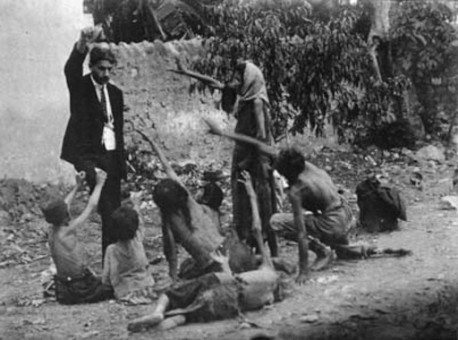
    “In 1915, a centrally planned and executed attempt was made to uproot from its ancestral homeland and decimate an entire nation, depriving the survivors of their cultural heritage as well as their homes, lands, houses of worship, and personal properties.

    “A gross injustice was perpetrated against the Armenian people, which entitles them, as in the case of the Jewish Holocaust, to just compensation for their enormous losses.

    “Restitution can take many forms. As an initial step, the Republic of Turkey could place under the jurisdiction of the Istanbul-based Armenian Patriarchate all of the Armenian churches and religious monuments which were expropriated and converted to mosques and warehouses or outright destroyed.

    “In the absence of any voluntary restitution by the Republic of Turkey, Armenians could resort to litigation, seeking ‘restorative justice.’

    “In considering legal recourse, one should be mindful of the fact that the Armenian Genocide did neither start nor end in 1915.

    “Large-scale genocidal acts were committed starting with Sultan Abdul Hamid’s massacre of 300,000 Armenians from 1894 to 1896; the subsequent killings of 30,000 Armenians in Adana by the Young Turk regime in 1909; culminating in the Genocide of 1.5 million Armenians in 1915 to 1923; and followed by forced Turkification and deportation of tens of thousands of Armenians by the Republic of Turkey.

    “Most of the early leaders of the Turkish Republic were high-ranking Ottoman officials who had participated in perpetrating the Armenian Genocide. This unbroken succession in leadership assured the continuity of the Ottomans’ anti-Armenian policies. The Republic of Turkey, as the continuation of the Ottoman Empire, could therefore be held responsible for the Genocide.

    “An important document, recently discovered in the U.S. archives, provides irrefutable evidence that the Republic of Turkey continued to uproot and exile the remnants of Armenians well into the 1930’s motivated by purely racist reasons. The document in question is a ‘Strictly Confidential’ cable, dated March 2nd, 1934, and sent by U.S. Ambassador Robert P. Skinner from Ankara to the U.S. Secretary of State, reporting the deportation of Armenians.

    “In the 1920’s and 30’s, thousands of Armenian survivors of the Genocide, were forced out of their homes in Cilicia and Western Armenia to locations elsewhere in Turkey or neighboring countries. In the 1940’s, these racist policies were followed by the Varlik Vergisi, the imposition of an exorbitant wealth tax on Armenians, Greeks and Jews. And, during the 1955 Istanbul pogroms, many Greeks as well as Armenians and Jews were killed and their properties destroyed.

    “This continuum of massacres, genocide and deportations highlights the existence of a long-term strategy implemented by successive Turkish regimes from the 1890’s to more recent times, in order to solve the Armenian Question with finality.

    “Consequently, the Republic of Turkey is legally liable for its own crimes against Armenians, as well as those committed by its Ottoman predecessors. “Turkey inherited the assets of the Ottoman Empire; And, therefore, it must have also inherited its liabilities.

    “Finally, since Armenians often refer to their three sequential demands from Turkey: ‘Recognition’ of the Genocide; ‘Reparations’ for their losses; and the ‘Return’ of their lands, Turks have come to believe that once the Genocide is recognized, Armenians will then pursue their next two demands.

    “This is the main reason why Turks adamantly refuse to acknowledge the Armenian Genocide. They fear that acceptance of the Genocide would lead to other demands for restitution. They believe that by denying the first demand, they would be blocking the ones that are sure to follow.

    “The fact is that, commemorative resolutions adopted by legislative bodies of various countries and statements made on the Armenian Genocide by world leaders have no force of law, and therefore, no legal consequence.

    “Armenians, Turks and others involved in this historical, and yet contemporary issue, must realize that recognition of the Armenian Genocide or the lack thereof, will neither enable nor deter its consideration by international legal institutions.

    “Once Turkish officials realize that recognition by itself cannot and would not lead to other demands, they may no longer persist in their obsessive denial of these tragic events.

    “Without waiting for any further recognition, Armenians can pursue their historic rights through proper legal channels, such as the International Court of Justice (where only states have such jurisdiction), the European Court of Human Rights and U.S. Federal Courts.

    “Justice, based on international law, must take its course.”

    Following an extensive question and answer period, Armenia’s Ambassador to Great Britain, Vahe Gabrieliyan, delivered the closing remarks. Based on the speeches of the two speakers, the BAAPPG issued a statement calling on the British Government to acknowledge the Armenian Genocide.

    =======================================

    +++++++++

    Subject: bloody handed savages…coming from an MD

    Aziz Denian, MD. says:

    By:- Aziz Denian, MD.
    Originally from Mardin city / Diar-Bakker.
    Pary or.
    Actually, the Turks and their coalitions? do not and will not recognize what their bloody hands did without shaming or blinking. In contrast and since the first decade after the massacre, they completed occupying our empty??? homeland, and shared our country sides, villages and towns.
    Since the acts of our massacre, we the Armenian nation at the Diaspora, we don’t have too much to loose. But the Turks needs such an agreement a one and a half million time more than we needs it. This agreement is essential for them to get the green light to freely entering the EU before completing its contamination. By assigning such an agreement we will confine our massacre issue and our national question. Additionally we will let our 1.500.000 victims soles disappointed. We don’t need to get broke more than we are already. We the Armenian Nation’s Diaspora people are determined to keep a single light ray shinning toward our hope tract for the justice day, if we give away our national and international rights, then how we will ask God for justice, we left everything and we keeps on following Jesus, and here we are at the Diaspora since a hundred year.
    Practica lly, we the Diaspora Armenian nation have almost no chance to return to our physical homeland, therefore, why to rush for such unfair agreements with such a non-regretted enemy. God’s justice day will come unexpectedly, then we and all our nation victim’s spirits that are observing from above the clouds, we will observe the Turks and their all coalitions bagging for Gods mercy, and for sure they will never achieve it, because God will never accept bloody handed savages at his heaven, this is our believe and we will continue being stacked to it, peacefully.
    I believe that it’s a one and a half million times better for our Armenian nation to live with our wounds than to contaminate it by such unilateral agreements.
    Finally; any agreement should hold a clear pre-confession regarding the 1.5 million Armenians massacred by the Turks and their coalitions, and they should apologies, then they should return back all our homelands villages and towns. Additionally the United Nations (UN) that is always busy in claiming about making peace on earth, should solve all our related national and international rights, before we rush for signing of any agreement, this is impossible, and the otherwise fact that here we are everywhere on the earth standing still, waiting for Jesus Justice he promised
    ++++++++++++++++++
    Subject: ‘Allowing Turkey to join the family of civilized Nations”

    Letter: ADL District Committee of US and Canada Appeals to President Obama

    [The following is an open letter to US President Barack Obama:]
    Dear Mr. President,
    Your election as the leader of world’s most powerful nation on earth restored America’s credibility among nations and placed the country on the path of its Founding Father’s.
    We believe that your vision will be able to bring peace to the world and prosperity at home, because your policies match America’s moral authority to its military strength.
    It was that vision which took all Americans by storm and gave a landslide mandate to your administration.
    The one-million-strong American-Armenian community was also mobilized to join the movement, mostly inspired by your unswerving stand on issues that concern us. Your continued actions as a senator, and later your pledge as a presidential candidate did not leave any doubt that this time around, moral fortitude would prevail over political expediency.
    Most reassuring was specially your statement made on April 12, 2007, which said in particular: “For those who aren’t aware, there was a genocide that did take place against the Armenian people. It is one of these situations where we have seen a constant denial on the part of the Turkish government and others that this occurred.”
    In April 2009, your statement about the Martyrs’ Day Commemoration, unfortunately fell short of your earlier pledges, allowing the Turkish government to pretend a breakthrough in Armenian-Turkish relations and then retract.
    However, we do believe that your other public and private relevant statements in Ankara and your administration’s relentless political actions have brought about a change in the Turkish government’s longstanding intransigence. We believe that those changes must not stand in your way to fulfill your pledge and moreover deny Turkish policymakers a way to find subterfuge in America’s hesitation.
    For many years, the premise that using the word “Genocide” may harm American-Turkish relations has proven wrong. Every time Turkey makes headway in that direction, America’s moral paradigm is compromised. Hiding festering wounds will not help healing.
    Thanks to your leadership, recent protocols were made public by the respective foreign ministries of Armenia, Turkey and Switzerland. Those advances must not pre-empt America’s moral standing, nor the credibility of its foreign policy.
    We urge you at this critical time for the entire Caucasus region to confront Turkish leaders with the historic truth. That will help, in the first place, to heal the deep wounds in the history of the Turkish people, thereby laying the foundations of a true democracy, allowing that country to join the family of civilized nations.
    We believe that will also be consonant with your conscience and with America’s global leadership and will help Armenia regain its place in the world.
    Sincerely,
    Edmond Azadian             Papken Megerian
    Co-chairman                     Co-chairman
    ADL District Committee of US and Canada
    ++++++++++++++

  • Sept. 27 Public Rally to Protest Protocols

    Sept. 27 Public Rally to Protest Protocols

    Asbarez Post Monday, September 14, 2009

    Sept. 27 Public Rally to Protest Protocols

    The public is urged to take part in a rally on Sept. 27 in Glendale to protest the protocols on the establishment and development of Armenia-Turkey relations.

    The rally will take place from 5 to 8 p.m. at Pelanconi Park (on the corner of Glenoaks Blvd. and Grandview Street). Click here for directions The rally stemmed from consultations between political parties and organizations that began after the announcement of the protocols. Over the weekend the Armenian Revolutionary Federation Western US Central Committee met with leaders of the Social Democratic Hunchakian Party and United Young Armenians.

    This meeting further reinforced that the main political forces in the community are opposed to provisions of the protocols, which they believe will endanger Armenia’s national security and violate the nation’s historical rights.

    The United Young Armenians brought together major forces in the community for a televised discussion Sunday that aired on AMGA TV. Taking part in the panel were representatives of the ARF, the Armenian Youth Federation, the Social Democratic Hunchakian Party, Armenian Democratic League (Ramkavar Party), the Armenian National Committee, the Armenian Assembly of America, as well as experts and representatives of youth and student organizations.

    The panel discussion will be broadcast on Horizon TV tonight at 9:00pm. Tune in or watch online at:

    Click Here for Directions to the Rally

    Sarkisian Invites Party Leaders to Discuss Protocols

    President Serzh Sarksian extended an invitation Monday to leaders of political parties in Armenia to discuss the protocols on Armenia-Turkey relations, announced his press secretary Samvel Fermanian.

    The meeting will be part of the protocol-mandated domestic discussion of the documents. A similar effort was kicked off in Turkey Friday, when Foreign Minister Ahmet Davutoglu met with pro-government and opposition parties to discuss the matter.More…

    Davutoglu in Bid to Win Parliament Support for Armenia Talks

    Turkish Foreign Minister Ahmet Davutoglu on Friday launched a round of talks aimed at winning the opposition’s support for the government’s plans to normalize relations with Armenia by opening the mutual border and restoring diplomatic ties.

    Davutoglu met with Parliament Speaker Mehmet Ali Sahin. Opposition Republican People’s Party (CHP) leader Deniz Baykal, skeptical of the rapprochement process with Armenia, accepted a request from Davutoglu to meet to discuss the planned steps. The two will meet next Tuesday. More…

    Withdrawal From Liberated Territories Will Lead to War, Says Karabakh MP

    Azerbaijan will eventually invade and occupy Nagorno-Karabakh if the Karabakh Defense Forces are forced to withdraw from the liberated territories surrounding the Nagorno-Karabakh Republic, a member of the Armenian Revolutionary Federation serving as a deputy in Karabakh’s National Assembly warned on Monday.

    War will break out if If Karabakh loses the territories and is forced to only maintain a narrow corridor to Armenia, Armen Sargsyan told reporters Monday.

    “Azerbaijan will sooner or later attack it to divide this part from Armenia,” he warned.More…

    AGBU Central Board of Directors Issues Statement on Armenia-Turkey protocols

    The Armenian General Benevolent Union’s Central Board of Directors issued an announcement Monday on the protocols for the establishment and development of relations between Armenia and Turkey. More…

    Armenia to Deepen Ties with China, Says Nalbandian

    Armenia is seeking a “comprehensive development” of its friendly relationship with China in all possible fields, Armenian Foreign Minister Eduard Nalbandian said Monday in an interview with the state run Xinhua news service. “During the negotiations in Beijing,

    I had a chance to discuss ways to further strengthen and deepen cooperation in a bilateral format and multilateral frameworks,” said Nalbandian, who was in China for a five-day official visit. More…

    Karabakh Denies Azeri Helicopters Violated Airpsace

    Reports alleging that Azeri military helicopters violated the Nagorno-Karabakh Republic’s airspace on September 11 are false, the Nagorno-Karabakh Defense Ministry said Monday.

    The reports, which came from the “Armenian Times,” paper cited sources in the Karabakh Defense Army who said that 8-10 helicopters crossed the line-of-contact between Karabakh and Azerbaijan and returned after a number of minutes of flying around the area. More…

    Eurovision To Announce Decision On Azerbaijan Investigation

    Eurovision has concluded an investigation into charges that Azerbaijani officials harassed people who voted for the Armenian entry in May’s Eurovision Song Content and will soon decide whether to sanction Azerbaijan, RFE/RL’s Azerbaijani Service reports. Svante Stockselius, the executive supervisor of the Eurovision Song Contest, told RFE/RL on

    Friday that Eurovision’s Reference Group – which consists of eight members – has met in Oslo and made a decision regarding Azerbaijan.
    The decision will be sent to the European

    Broadcasting Union’s Television Committee, which will announce its decision on Azerbaijan in the coming days. More…

    FOR UP TO THE MINUTE REPORTING, FOLLOW US ON TWITTER

    Subscribe to Asbarez Print Edition

    323-284-9222
    [email protected]

    If you would like to be removed from this list, or know someone who would like to be added, please use the safe unsubscribe feature found at the bottom of this email. All comments are welcome and encouraged. This email is a service provided by Asbarez.com. If you would like to receive breaking news from Asbarez.com
    please register at the website.

    Sincerely,
    Asbarez Editorial Staff

    Click below to forward this email to your friends, family or any interested individuals.

  • U.N. commission accuses Israel, Hamas of Gaza war crimes

    U.N. commission accuses Israel, Hamas of Gaza war crimes

    VideoIraq shoe-thrower freed, accuses guards of torture

    McClatchy Newspapers

    AFP/File – Israeli artillery shells explode over the Gaza Strip as seen from Gaza’s Jabalia refugee camp in … By Cliff Churgin, McClatchy Newspapers Cliff Churgin, Mcclatchy Newspapers Tue Sep 15, 7:03 pm ET

    JERUSALEM – After a six-month investigation, the U.N.’s Fact Finding Mission on the Gaza Conflict has concluded there’s evidence that Israeli forces and Palestinian militants committed war crimes during Israel’s recent military operations in Gaza .

    The mission, headed by South African jurist Richard Goldstone , called on the United Nations Security Council to monitor Israeli and Palestinian investigations into these charges and urged that if these aren’t taking place in good faith to refer these cases to the International Criminal Court in The Hague, Netherlands .

    The 554-page report released Tuesday has detailed investigations into 36 incidents, including some that McClatchy reported previously, such as the shooting of civilians with white flags, the firing of white phosphorus shells and charges that Israeli soldiers used Palestinian men as human shields.

    According to the report, these violations weren’t aberrations but rather appeared to be “the result of deliberate guidance issued to soldiers.”

    The commission charged Palestinian groups with indiscriminately firing at southern Israel and causing terror among the civilian population. The mission didn’t find evidence of Israeli charges that Palestinian militants deliberately hid among civilians. Israel has released a number of videos purporting to show Hamas militants using civilians for cover.

    The commission, charged with investigating allegations of war crimes related to Israel’s military operations in Gaza , began its work April 3 . The 22-day military operation, which began last Dec. 27 , cost the lives of more than 1,400 Palestinians and 13 Israelis.

    The four-person mission came under attack almost immediately from Israeli officials, who refused to cooperate. They charged the mission with being one-sided, pointing out that the original mandate authorized an investigation into charges of Israeli war crimes and was altered only by an agreement between Goldstone and the president of the U.N. Human Rights Council .

    Special criticism was reserved for commission member Christine Chinkin , a professor at the London School of Economics and Political Science , when it was discovered that she’d signed a letter last January published in The Sunday Times that accused Israel of war crimes.

    A constant theme of Israeli soldiers’ testimony after the war was that the Israel Defense Forces had made the protection of soldiers’ lives its top priority. The report criticizes this approach, saying, “They must avoid taking undue risks with their soldiers’ lives but neither can they transfer that risk to civilian men, women and children.”

    The mission didn’t confine itself to investigating the operation. The report also refers to Israel’s blockade of Gaza as a “collective punishment” and says “the series of acts that deprive Palestinians in the Gaza Strip of their means of subsistence, employment, housing … could lead a competent court to find the crime of persecution, a crime against humanity, has been committed.”

    Mark Regev , a spokesman for the Israeli prime minister’s office, reacted harshly to the report: “It was born in sin. Countries with atrocious human rights records sit there and criticize Israel . It’s not just Israel that criticized the Human Rights Council . Kofi Annan and Ban Ki-Moon have criticized its obsession with Israel ,” referring to the former and current U.N. secretaries general.

    Israeli human rights groups have issued a statement calling on the government to “conduct an independent and impartial investigation into the suspicions.”

    Avi Bell , a professor of Law at Bar Ilan University , took exception to the report, disagreeing with its legal conclusions and pointing out, “They say they are a fact-finding mission. So how are they coming up with all these legal conclusions, especially wrong ones?”

    The report is due to be presented to the U.N. Human Rights Council on Sept. 29 and the council will then decide whether to refer it to the Security Council . If it’s referred to the Security Council , that council will decide whether to adopt the recommendations.

    According to Bell, if charges are referred to the International Criminal Court, the court will have no jurisdiction, since Israel isn’t a party to the court. “In order for the International Criminal Court to have jurisdiction, the accused has to be a citizen of a state that accepts the court’s jurisdiction,” he said.

    (Churgin is a McClatchy special correspondent.)

    MORE FROM MCCLATCHY

    Israeli military blames civilian deaths on ‘errors’

    Israeli troops killed Gaza children carrying white flag, witnesses say

    Did the Israelis use white phosphorus in populated areas?

    Israeli soldiers in Gaza describe a ‘moral Twilight Zone’

    Follow Mideast news at McClatchy’s Checkpoint Jerusalem

  • Working Collectively to Stop the Protocols

    Working Collectively to Stop the Protocols

    By Ara Khachatourian on Sep 10th, 2009

    Print This |


    Although our collective national shock might not have worn off over last week’s disturbing announcement of protocols for the establishment and development of relations between Armenia and Turkey, it is high time to begin accepting the unacceptable and look ahead, because time is running out.

    Almost two weeks have passed already of the six-week public debate stipulation of the protocols, after which the two countries will have to sign the documents and, based on a more impermissible provision, await the approval by the parliaments of the two countries.

    Last week, it became evident that this so-called public discourse on the protocol was going to be lopsided at best. The authorities and their supporters have already begun a campaign to water down the inherent dangers of the document. Also, as expected, former president Levon Ter-Petrossian and his Armenian National Congress threw their support for the protocols, making one conclude that the dust they’ve been raising for a year and a half was nothing but a self-fulfilling power play by a man whose true national intentions have already been exposed. And now, by parroting the Turkish talking points that Karabakh is not mentioned in the protocols they are well on their way to insulting a nation that is more intelligent and more aware of its national values.

    The time has come for us-the people-to set the tone of the debate and take that opportunity away from an otherwise misguided government, which stood by and did nothing while its Azeri and Turkish counterparts were setting the stage for the ill-fated protocols. A similar effort has already begun on the eve of a scheduled visit by the OSCE Minsk Group co-chairmen who have pledged to introduce a “revised” version of the so-called Madrid principles.

    The machinations of this rapprochement process also clearly demonstrate the Armenian authorities’ deliberate disregard for the Diaspora and the critical-if not organic-role it plays in the Armenian national arena.

    During a meeting late last year at the Armenian Consulate in Los Angeles, the newly crowned Diaspora Minister Hranoush Hakopyan declared that her, and the government’s, mission was to present a united Armenian nation of 10-million strong. Her effort to re-brand Armenians from what she called a “victim” nation to a “strong” collective seems to have hit a brick wall, since we did not see her engaging the Diaspora in any pre-roadmap/protocol debate. In fact, attempts by Diaspora leaders to covey concerns were brushed aside not only by Hakopyan, whose dubious past as an LTP crony made her a questionable candidate for the post she occupies but also by Armenia’s chief diplomat, Eduard Nalbandian.

    It is critical to understand the urgency of the moment that has resulted from the Armenian authorities’ self-righteous approach to this and other national issues and to ensure that our collective national resolve is not ignored in favor of Turkey’s policies.

    In the next four weeks, all Armenians in Armenia and Diaspora-regardless of their political persuasion-must rise up and express their unequivocal opposition to the protocols in the same manner that we have demonstrated our unity around the veracity of the Armenian Genocide and the pivotal relevance of Karabakh. In their current form, the protocols will not only undermine and discredit decades of hard work in advancing the Armenian Cause, they will endanger Armenia’s national security and rob future generation of their national dignity.