Month: August 2009

  • U.S. Hopes For Sarkisian Visit To Turkey

    U.S. Hopes For Sarkisian Visit To Turkey

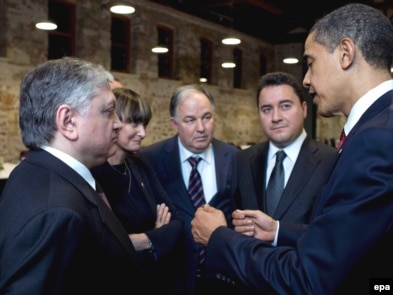
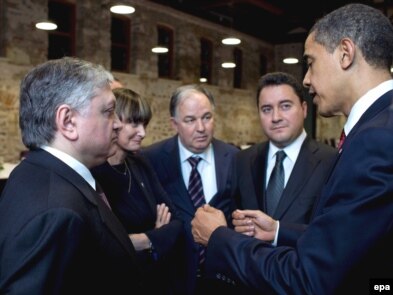
    Turkey – U.S. President Barack Obama (R) meets with foreign ministers of Armenia, Turkey and Switzerland in Istanbul, 06Apr2009

    10.08.2009
    Emil Danielyan

    The United States hopes that President Serzh Sarkisian will visit Turkey in October to continue Yerevan’s fence-mending “football diplomacy” with Ankara, U.S. Deputy Assistant Secretary of State Matthew Bryza said over the weekend.

    Bryza acknowledged at the same time that the U.S.-backed Turkish-Armenian dialogue has stalled of late and that he is now less optimistic about chances for the normalization of relations between the two estranged neighbors.

    “What I had hoped was going to happen did not happen,” he told RFE/RL’s Armenian service. “Sometimes, if I’m asked to make a prediction, the prediction does not come true. I thought that there was a specific step that was about to occur.”

    “There is no reason why those steps still can not happen, and we are working together with the Swiss mediators to try to help the parties think through what it is that they each can do to get the process moving again. I do have some hope that that will happen, but I can’t predict how quickly or what can be agreed,” he added.

    Speaking to RFE/RL on May 28, Bryza insisted that Armenia’s rapprochement with Turkey has not reached an impasse despite Ankara’s renewed linkage between the normalization of bilateral relations and a Nagorno-Karabakh settlement. Visiting Yerevan two weeks later, Philip Gordon, the newly appointed U.S. assistant secretary of state for Europe and Eurasian, likewise sounded upbeat on the normalization prospects.

    Sarkisian has since increasingly expressed his frustration with Ankara’ stance, implicitly accusing the Turks of reneging on agreements reached during year-long negotiations with his government. The Armenian leader made clear last month that he will not accept Turkish President Abdullah Gul’s invitation to watch with him the October 14 return match of the two countries’ national football teams unless Turkey takes “real steps” to reopen its border with Armenia. The two presidents attended the first game played in Yerevan in September last year.

     

    Armenia — U.S. Deputy Assistant Secretary of State Matthew Bryza in Yerevan.

    In Bryza’s words, Sarkisian’s visit to Turkey would be “very good news for America” because it would mean that “two of our friends are coming together.” “We were so pleased when President Gul came to Yerevan and we would be happy if President Sarkisian went to Turkey,” he said.

    Bryza stressed, however, that Washington will not press Sarkisian to accept Gul’s invitation. “It’s important not to conflate or confuse our desire for something to happen with pressure,” he said. “I have seen some absolutely ridiculous accusations by some here in Armenia that the United States is pressuring Armenia to agree to one thing or another.”

    Some Armenian opposition politicians have claimed that Turkey’s preconditions for normalizing relations with Armenia have left Yerevan under stronger pressure from the international community and the U.S. in particular to make more concessions in the Nagorno-Karabakh conflict

    Bryza also insisted that the success of the Turkish-Armenian dialogue does not hinge on a breakthrough in Armenian-Azerbaijani peace talks mediated by the U.S., Russia and France. “These two processes are separate,” he said. “What is true is that, as I’ve said so many times, if there is progress in one process, that will help to generate a more positive mood throughout the entire region and then help to reduce tension and facilitate progress in the other process.”

    https://www.azatutyun.am/a/1796458.html
  • Tatar Children’s Book on Conquest of Kazan in 1552 Outrages Russian

    Tatar Children’s Book on Conquest of Kazan in 1552 Outrages Russian

    Paul Goble

    Vienna, August 9 – A Tatar author’s richly illustrated children’s book on Ivan the Terrible’s conquest of Kazan in 1552 that asserts Tatarstan’s “struggle for the restoration of independence continues in our day” has prompted a Russian activist to demand that Moscow intervene to ban the book for “falsifying history to the detriment of Russia.”
    On the “Svobodnaya pressa” website at the end of last week, Yan Stashkevich says that “children’s literature in Tatarstan is teaching that the Russian state is a mob of marauders, thieves and usurpers” and that the Tatar’s “struggle for the restoration of independence” has never ended (svpressa.ru/issue/news.php?id=12268).
    And the Moscow journalist adds that this case is “not about ignoring the role of the Red Army in the victory over fascism and not about the revision of the results of the Second World War but about a war which ended … 500 years ago,” when the Russian tsar conquered the Kazan khanate.
    Despite the antiquity of these events, Stashkevich continues, debates that “are no joke” have broken out in Tatarstan over these events. Moreover, he says, the Russian president’s commission on historical falsifications has been asked to look into the matter, a potentially disturbing extension of what Dmitry Medvedev said he was creating that body for.
    The current “scandal” broke out following the publication in 5000 copies of a children’s book entitled “The Liberation Struggle of the Tatar People” by Nurulla Garif, a Tatar historian who describes the conquest of Kazan in 1552, the Christianization of the Muslims of the Middle Volga, and “’the five-hundred-year-long war” of the Tatars for independence from Russia.
    According to Garif, Stashkevich says, this period has been one of “unceasing war against Russian ‘occupation,’” the Russian state “a mob of marauders, thieves and usurpers,” and Moscow’s representatives on the scene “’vengeful’” men capable of all sorts of crimes including burying Tatars who resist them alive.
    The Moscow journalist says that at the end of his book, Garif calls on his young readers “not to follow stereotypes” but rather to “think about the lessons of history, in particular over the themes which consider ‘Moscow-Kazan relations.’” But to give them direction, Stashkevich says, Garif illustrates the page on which this appeal is made in a highly suggestive way.
    On that page, Garif’s book shows “a black crow with two heads which reminds one of the state shield of Russia rapaciously attacking the tower of the Tatar queen Syuyumbika, the symbol of Tatarstan independence.” And given that clear message, Stashkevich suggests, it is no surprise that many Russians have been outraged.
    Several weeks ago, one of their number Aleksandr Ovchinnikov, who teaches at a higher educational institution in Kazan, wrote to the Tatarstan republic procuracy asking that Garif’s book be examined by experts to determine whether its content was extremist and thus subject to a ban.
    The republic procuracy immediately sent it to the Mardzhani Institute of History of the Academy of Sciences of Tatarstan, but scholars there, Stashkevich recounts, “shared the views of Nurulla Garif on the national path of the Tatar people and assured the procuracy” that the book in question did not contain any “call to national or religious hostility.”
    Moreover, the Moscow journalist says, the Tatarstan historians accused Ovchinnikov of being engaged “in a provocation of destructive processes, pseudo-patriotism and the exacerbation of inter-ethnic antagonism.” After that, the procuracy dropped the case, and articles attacking Ovchinnikov began to appear “on the pages of the local press.”
    These articles made it clear that “the scholars who had conducted the expert assessment of Garif’s book are his former colleagues with whom he had worked closely in the quite recent past,” Stashkevich reports, something that “casts doubt on ‘the independence’ of their expert assessment.”
    However that may be, Ovchinnikov for his part has raised the possibility of sending Garif’s book to the Russian president’s commission on blocking attempts at the falsification of history and in the mean time “has again turned to the [Tatarstan] procuracy” which has again passed the volume to the same Institute of History, thus “closing the circle.”
    Because Tatarstan’s Institute of History is headed by Rafael Khakimov, a longtime advisor to that republic’s president, Mintimir Shaimiyev, this incident might prove to be little more than yet another Russian probe against the latter, an effort to cast doubt on his loyalty to Moscow by questioning his ability to control his Middle Volga republic.
    But even if that is so, this complaint and the readiness of some like Ovchinnikov to turn to the presidential commission is a disturbing indication of the way in which Moscow’s ostensible effort to deal with discussions of the Soviet role in World War II could rapidly become an attack on any independent thinking on other historical questions as well.
    And because history is ultimately where many struggles about the present and future take place, both the original impulse between Dmitry Medvedev’s commission and the extension of the application of concern about “harm to Russia’s reputation” are a threat to far more than the righting of history: they are a threat to those who would make it as well.

    http://windowoneurasia.blogspot.com/2009/08/window-on-eurasia-tatar-childrens-book_09.html

  • Group Says Power Vertical Threatens Republics

    Group Says Power Vertical Threatens Republics

    06 August 2009

    By Paul Goble / Special to The Moscow Times

    A draft of Russia’s future nationality policy prepared by the Moscow Institute of Ethnology calls for “the systematic destruction of the federal and democratic foundations” of the Russian Federation and contains elements from Soviet practice that could lead to “the disintegration of the country,” Middle Volga activists say.

    The World Kurultay of Bashkirs and the World Congress of Tatars released a joint appeal this week attacking the Moscow proposal in the name of “preserving the constitutional bases of the ethno-cultural diversity of the peoples of the Russian Federation.” Mordvin activists yesterday announced that they support the provisions of this declaration as well.

    And while all three groups have been denounced as radical in the past, the decision of the Turkic Tatars and Bashkirs to issue this statement and the readiness of the Finno-Ugric Mordvins to join them suggest that the issues that the appeal raises reflect the views of many people in that region and perhaps those of others as well.

    The Tatar-Bashkir declaration begins by asserting that “the situation that now exists in the country threatens the existence of the multi-national Russian Federation” because “authoritarian tendencies are increasing … and have begun to penetrate all spheres of sociopolitical and socioeconomic life.”

    “Construction of the so-called ‘power vertical’ has resulted in the systematic destruction of federal and democratic foundations of the new Russian statehood that arose after the destruction of the totalitarian regime of the CPSU,” the appeal continues. The document then focuses on what its authors see as the primary threat.

    “As is well-known, at one time in the USSR, the authorities persistently attempted to create ‘a single Soviet people’ without ethno-national characteristics,” they write. “[Such efforts] generated strong tension in society, especially in the sphere of inter-ethnic relations and, in the final analysis, led to the collapse of the country.”

    Unfortunately, the document continues, not having learned from the past, “certain political forces of Russia today are repeating the very same mistakes by attempting to construct a so-called ‘all-civic Russian nation,’” an effort likely to entail equally “destructive” consequences for the country in the future.

    The latest manifestation of such efforts, the appeal says, is the draft conception of a federal law titled “On the Foundations of Government Nationality Policy in the Russian Federation” and the explanatory supplements that were prepared by the Institute of Ethnology and that have been released with the draft concept paper.

    The Tatar-Bashkir declaration with which the Mordvin group has associated itself points to five problems with the draft legislation. First, the declaration says, the concept “completely ignores the existence of national republics and their priority rights in the conduct of nationality policy in their own republics.”

    As such, the Middle Volga appeal continues, the draft, in calling for “’new approaches to the development of legislation in the sphere of government nationality policy,’ is based on the leveling of all subjects of the Russian Federation, which in practice would mean the gradual liquidation of republics” within the country.

    Second, the appeal notes, in the draft, “the role of the national republics in the resolution of nationality problems is subordinated to federal, regional and local national-cultural autonomies,” another violation of the historic rights of the people involved and a threat to their future existence.

    Third, it continues, the draft conception ignores “the ethnic rights of the peoples of the Russian Federation” by declaring in what the Tatar and Bashkir appeal says are “abstract” and “meaningless” terms that the proposed legislation will promote “the unity of ethno-cultural and linguistic diversity.”

    Fourth, the appeal says, the proposed legislation, while invoking the Declaration of the Right of Peoples to Self-Determination, in fact promotes precisely the “unification” and “centralization” of public sphere “in the sphere of nationality policy” that the Declaration is intended to counter.

    And fifth, the appeal argues, the draft lays heavy stress “on the problems of national and ethnic minorities but at the same time minimizes issues concerning the ethnic development of republic-forming peoples,” yet another indication of the way in which the legislation would work to the detriment of the republics.

    In its concluding section, the Tatar-Bashkir appeal says that in its current form, the draft prepared by the Moscow Institute of Ethnology and Anthropology is directed at the covert revision of the Russian Constitution, “the destruction of the language, culture and history of the indigenous peoples” of the country, and their “assimilation” into “a Russian civic nation.”

    Among the comments left on the Mariuver site after it posted the Tatar-Bashkir declaration were two that are especially intriguing. According to one, the draft legislation shows that “people in the Kremlin are living absolutely in another dimension” and are trying to unite “whole peoples” with “the poor Russians whom the entire world dislikes.”

    And according to the other, “the last sentence of the population of Yugoslavia showed that very people identified as Yugoslavs. After several years, out of this country arose five new states. No one in our century is running to fulfill the inventions of those in power” as the authors of the draft seem to think.

    Instead, the author of the post says, “even the Roma respect their own nation and hardly are likely to identify as [non-ethnic] Russians. That is all the more the case for [ethnic] Russians and Tatars. Besides, it seems that in recent times, [Moscow] has begun to respect the Tatars and Bashkirs — apparently as a result of [their] resistance to Russification.”

  • In Volatile Crimea, Tatars Bang The Drum For Land Return

    In Volatile Crimea, Tatars Bang The Drum For Land Return

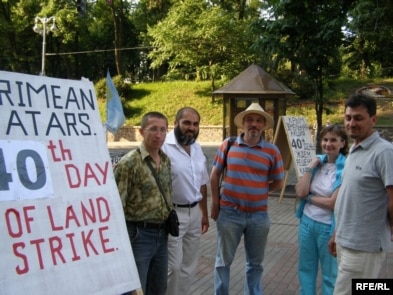
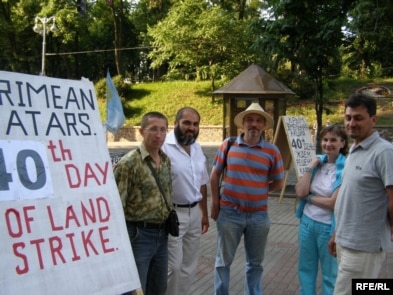
    Crimean Tatars continue to protest in front of the government building in Kyiv, demanding the return of land seized during World War II.

    August 09, 2009
    By Claire Bigg

    For the 88th day in a row, Lyubov Halilova packed her banners and headed to government headquarters in central Kyiv.

    The elderly Halilova has spent the last four months camped outside the building in the Ukrainian capital with some 20 other protesters, banging on drums, sounding horns, and calling on Prime Minister Yulia Tymoshenko to hear their grievances.

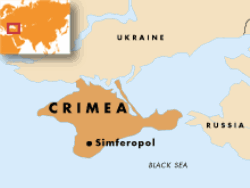
    The protesters are Crimean Tatars, the indigenous people of Crimea, and they are in Kyiv to voice their nation’s longstanding demand: the return of land seized during the World War II deportation of Tatars from the Crimean peninsula, in what is today Ukraine.

    So far, Ukrainian officials have largely ignored the protest on their doorstep.

    “There has been no progress,” sights Halilova. “Nobody is coming out, nobody is taking an interest in us.”

    ‘Please Go Home’

    President Viktor Yushchenko last year set up a committee to settle the dispute. But critics accuse the new working group, which has yet to distribute a single plot of land, of deliberately dragging its feet.

    Volodymyr Haptar, a spokesman for the Environment Ministry which oversees the committee, insists the issue is in capable hands.

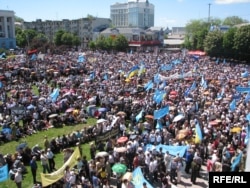
    Crimean Tatars gathered in Simferopol in May to commemorate the 65th anniversary of the mass deportation.

    “We’re doing wearisome, difficult work trying to create a register of people who are to be allotted land. We are trying to determine the state of the land in these regions and to whom it belongs,” he told RFE/RL’s Ukrainian Service. “Crimean Tatars are displaying their strength of will, but not everything can be settled through force and strikes. People, please go home. Sooner or later, this issue will be settled.”

    Soviet dictator Josef Stalin ordered the mass deportation of Crimea’s Turkic, Muslim Tatars in May 1944 on grounds that they had allegedly collaborated with Nazi Germany.

    In a three-day operation, the peninsula’s more than 180,000 Tatars were rounded up and loaded onto cattle trains bound for Central Asia and Siberia.

    An estimated 40 percent of them died during the journey or in the first year of exile.

    Although the Tatars were rehabilitated by the Kremlin and allowed to return in the late 1980s, neither the Soviet regime nor post-Soviet Ukraine has helped them resettle in their historical region.

    Paradise Lost

    Ismet Sheikh-Zade, a well-known Crimean Tatar artist, was born in Uzbekistan.

    His parents had settled down in the Central Asian republic after being deported from Crimea as children, together with their entire families.

    Today, Ismet and his parents are back in their ancestral land. But he says they are treated like intruders.

    “Five Russian families now live in the house in Feodosia where my mother was born and from which she was deported. Six Russian families live in my father’s house in Belogorsk,” he says.

    “We are not asking for these houses, because we know this would create a conflict. We’ll compromise and take empty land instead. But the surrounding population doesn’t understand that Crimean Tatars are making concessions by not demanding the restitution of their property,” Ismet says.

    Some 270,000 Crimean Tatars have returned to the peninsula over the past two decades. Many live in chaotic settlements erected in recent years, sometimes without running water.

    Although they now represent just 12 percent of their homeland’s total population, Crimean Tatars have been extremely vocal in lobbying for land and for recognition of the crimes perpetuated against their people.

    They held the first-ever World Congress of Crimean Tatars this year on May 18, the 65th anniversary of the deportation. Some 20,000 protesters rallied in Crimea’s main city of Simferopol on the congress’ sidelines to renew demands for greater rights.

    The Crimean Tatar community, however, is divided over how to promote its interests.

    Like Mustafa Dzhemilyov, the head of the Crimean Tatars’ Mejlis representative body, some disapprove of the current protest in Kyiv and say Tatars should instead seek to resolve the land dispute through diplomatic channels.

    “We were against it from the start. We formed a commission, and that commission is working,” he says. “There are 47 million people in this country. If everyone came to the ministers’ cabinet and started beating drums, I don’t think problems would get solved in our country.”

    Others, weary of waiting, believe only rallies, hunger strikes, and other protests can draw attention to their plight.

    Mounting Resentment

    In May, Yushchenko ordered the creation of a special unit to investigate the deportation of Crimean Tatars and other minorities from the peninsula.

    But this has done little to soothe feelings of anger and disappointment among Crimean Tatars.

    Many say Yushchenko and his former ally Tymoshenko, whom Crimean Tatars massively supported during the 2004 Orange Revolution, have not made good on promises to improve their fate.

    “They’ve gone to extreme lengths to repatriate in a peaceful manner, but I often wonder about their patience with the amount of resistance that they’ve had to push through,” says Dr. Greta Uehling, a U.S. anthropologist and an expert on Crimean Tatars.

    “I worry about that in terms of the sheer frustration level of having tried so hard for so long and to continue to meet all these barriers and obstacles, to the point where their needs simply aren’t met,” Uehling says.

    The simmering discontent among Crimean Tatars is particularly alarming since it is playing out on the backdrop of souring relations between Moscow and Kyiv.

    Many Ukrainians accuse Moscow of plotting to stoke unrest in Crimea, an increasingly disputed region that is home to Russia’s Black Sea Fleet and growing pro-independence sentiment among its majority ethnic Russian population.

    Russia has reportedly handed passports to thousands of Crimean residents.

    “I think the region is very unstable and very vulnerable to various parties’ attempts to bring it into their sphere of influence,” says Uehling. “On that score, I see things getting worse before they get better, because there is such intense interest and so many factions within Crimea that can be recruited onto various sides.”

    The current protest in Kyiv illustrates how desperate many Crimean Tatars have become in recent years.

    One month into their sit-in, seven of the protesters launched a hunger strike that lasted two weeks and resulted in the hospitalization of three participants.

    The demonstrators have also accused Ukraine of genocide, and have issued a declaration threatening to disrupt the country’s efforts to integrate with the West and ensure the Crimean Tatar question becomes “the main problem” in Ukraine.

    https://www.rferl.org/a/In_Volatile_Crimea_Tatars_Bang_The_Drum_For_Land_Return/1795804.html
  • Kyrgyzstan Uyghur Leaders Detained After Protest

    Kyrgyzstan Uyghur Leaders Detained After Protest

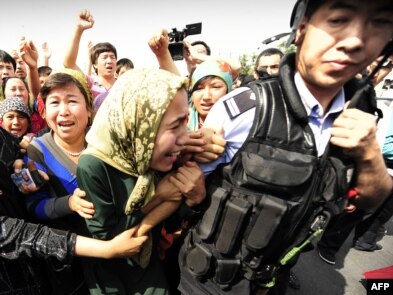
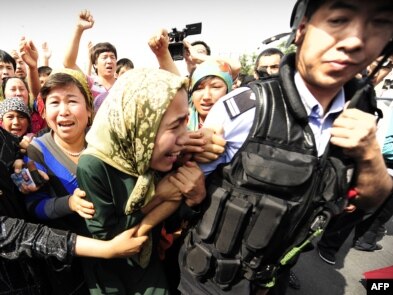
    Ethnic Uyghur women grab at a riot police officer as they protest in Urumqi in China’s far west Xinjiang Province in July

    August 10, 2009

    BISHKEK (Reuters) — Kyrgyzstan police have detained two Uyghur community leaders after they accused China of “state terrorism” at a rally and called for an independent investigation of last month’s clashes in neighboring Xinjiang.

    About 500 Uyghurs gathered at a building on the outskirts of the Kyrgyz capital Bishkek on August 10 with photographs posted to the walls showing what they said was abuse of their kinfolk in China.

    The pictures portrayed people being beaten up and held at gunpoint, as well as depicting unconscious or dead people lying in the streets.

    In Xinjiang’s worst ethnic unrest in decades, Uyghurs staged protests in the regional capital Urumqi on July 5 after two Uyghurs were killed in a clash at a factory in south China in June.

    The violence left 197 people dead and more than 1,600 wounded, mostly Han Chinese who launched revenge attacks in Urumqi days later, according to the Chinese government.

    About 1,000 people, mostly Uyghurs, have been detained in a government crackdown.

    “The Chinese started mass pogroms on June 26, scores of people have been killed, but the Chinese government is concealing those facts,” Dilmurat Akbarov, the head of local Uyghur society Ittipak [Unity], told a meeting.

    “We demand that those responsible are punished.”

    People in the crowd chanted “Freedom to Uyghurs” and banners reading “We accuse China of state terrorism against the Uyghur people” hung on the walls.

    The police did not interfere but detained Akbarov and his deputy Zhamaldin Nasyrov after the protest was over.

    Kyrgyzstan’s ombudsman Tursunbek Akun, who was present at the rally, told reporters Akbarov and Nasyrov were held for staging a rally not sanctioned by the government.

    https://www.rferl.org/a/Kyrgyzstan_Uyghur_Leaders_Detained_After_Protest/1796440.html

  • Turkey’s diplomatic missions will provide services to Azeri citizens

    Turkey’s diplomatic missions will provide services to Azeri citizens

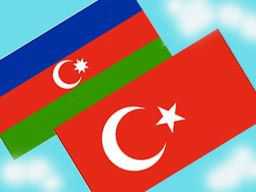
    turk-azerTurkey’s diplomatic missions will provide services to Azeri citizens. Turkey’s Ambassador in Baku, Hulusi Kılıç, said that in countries where Azerbaijan has no diplomatic mission Azeri citizens could receive diplomatic services from Turkish missions. Elhan Poluhov, spokesman for the Azeri Foreign Ministry, said that Turkey’s friendly proposal for providing services to Azeri citizens was  accepted by his ministry.

    Source:  Newspot, No 95, June 2009