Month: August 2009

  • ARMENIA: PUTIN VISIT TO TURKEY SPARKS HOPES AND FEARS IN YEREVAN

    ARMENIA: PUTIN VISIT TO TURKEY SPARKS HOPES AND FEARS IN YEREVAN

    NOTE: Below is Armenian view of Putin’s visit to Turkey. Aram Safarian, a member of the Prosperous Armenia Party, part of Armenia’s government coalition declared that Armenia and Russia are strategic partners. Last year Russian planes used Armenian air fields to attack Georgia, a friend of NATO. Armenia continues to occupy 20% of Azerbaijan territory. Azerbaijan is a U.S. ally

    Bunch of American legislators are circulating letters in congress on behalf of Armenia, an admitted Russian strategic ally against Turkey, a staunch ally of U.S. and member of NATO.

    What is wrong with this picture?

    Eurasia Insight:

    ARMENIA: PUTIN VISIT TO TURKEY SPARKS HOPES AND FEARS IN YEREVAN

    Haroutiun Khachatrian: 8/11/09

    Haroutiun Khachatrian is an editor at Noyan Tapan news service in Yerevan, and a specialist in economic reporting. His reports also appear on EurasiaNet.

    Armenians watched Russian Prime Minister Vladimir Putin’s August 6-7 visit to Turkey with a mixture of hope and suspicion. While many in Yerevan see potential benefits arising out of closer Turkish-Russian ties, worries persist among Armenian leaders and experts that Turkey’s importance in the eyes of the Kremlin may come to outweigh that of Armenia.

    Officially, there was no indication that the issue of Armenian-Turkish relations was discussed in any form during Putin’s trip to Ankara. The visit led to Turkey’s agreement to environmental impact studies relating to the Russian-backed South Stream gas pipeline project, as well as the signing of accords on Russian construction of a nuclear power plant, the country’s first.

    So far, the Armenian government has adopted a neutral tone on the visit. But after more than a year of attempts at normalizing relations with Turkey and reopening the Armenian-Turkish border, the visit nevertheless stirred mixed feelings in Yerevan. [For background see the Eurasia Insight archive].

    “Of course, it is not a pleasant thing to see your strategic partner [Russia] building ambitious programs with countries with which Armenia has problems,” the online magazine new.am quoted MP Aram Safarian, a member of the Prosperous Armenia Party, part of Armenia’s government coalition, as saying.

    Yet in the energy sphere, Armenian and Russian interests can easily coincide with those of Turkey, noted Alexander Iskandarian, director of the Yerevan-based Caucasus Institute. “Russia is a major shareholder in the Armenian energy system and is interested in the possibility of exporting Armenian electricity to Turkey. This indicates that Turkish-Russian contacts are beneficial to Armenia,” he said.

    Electricity exports to Turkey were expected to start in April-May 2009, but so far have not begun. There has been no official explanation for the delay, but, presumably, diplomatic obstacles are to blame.

    One opposition member, though, believes that Russia’s involvement in Turkey may upset the existing balance of power in the South Caucasus, with uncertain results for Armenia.

    “Russia has already somewhat shattered the balance in the region by intensifying its contacts with Turkey and, especially, with Azerbaijan,” said political analyst Styopa Safarian, a MP affiliated with the Heritage Party and member of parliament’s Foreign Affairs Committee. Moscow recently signed an agreement with Baku on gas sales to the Russian republic of Dagestan and named a price for gas purchases from the second phase of the country’s ambitious Shah Deniz project. [For background see the Eurasia Insight archive].

    Other experts are more optimistic, believing that the Kremlin will push officials in Ankara to reopen Turkey’s border with Armenia. Such a development would ease Armenia’s ability to export goods. [For background see the Eurasia Insight archive]. “Russia, in fact, is interested in opening the Turkish-Armenian border, as after the August 2008 war, it lost Georgia as a route to Armenia, its military and economic partner,” observed Iskandarian.

    Whether that interest is sufficiently strong to have prompted Putin to try and decouple the reopening of the border from the Karabakh peace process remains unknown, however. Ankara has insisted that Armenia meet a set of conditions on the conflict before it will reopen its border with Armenia. [For background see the Eurasia Insight archive].

    In late July, President Serzh Sargsyan stated that he would not visit Turkey in October unless the border is open or is close to opening by that time. [For details, see the Eurasia Insight archive].

    Turkey maintains that it is sincere about wanting to see the border with Armenia reopen, although no noticeable progress has been made on this score recently. “Turkey has prospects in the Caucasus both in terms of Turkey-Armenia and Armenia-Azerbaijan relations,” Turkish Foreign Minister Foreign Minister Ahmet Davutoglu said on August 9, the APA news agency reported. “That’s why Turkey is resolute to normalize the relations with Armenia and our contacts on this theme continue.”

    Editor’s Note: Haroutiun Khachatrian is an editor and freelance writer based in Yerevan.
  • Revealing Genocide Documents Found in Ottoman Archives

    Revealing Genocide Documents Found in Ottoman Archives

    By Harut Sassounian
    Publisher, The California Courier

    It is a known fact that numerous documents on the Armenian Genocide were either destroyed or hidden away by the Turkish government. Determined researchers, however, can still discover materials in the Ottoman archives that shed light on important events and personalities of that tragic period.
    In recent years, the Turkish government has selectively published some of the more innocuous Ottoman documents, in order to counter criticism that it was concealing incriminating evidence on the Armenian Genocide. Millions of other documents, however, still remain inaccessible to the general public because researchers have to go to Istanbul and request a particular document by its file number, and pay a processing fee. Even if the documents are obtained, few people within and outside Turkey can read and comprehend them, as they are written in Ottoman Turkish and difficult to decipher Arabic script.
    The California Courier was recently able to obtain from the Ottoman archives important documents regarding the tragic fate of prominent ARF (Dashnak) activist E. Agnouni, who was born around 1865 in Meghri, Armenia. He studied at the University of Geneva and was active in Armenian political movements in Georgia, Russia and France. In 1904, while in Paris, Agnouni supported the efforts of the Young Turk Party to overthrow Sultan Abdul Hamid. After returning to Constantinople (Istanbul), he actively participated in the Young Turk revolution of 1908. He then toured the Armenian communities of Europe and the United States. Agnouni was arrested in Istanbul on April 24, 1915 — along with hundreds of prominent Armenians — and subsequently murdered.
    Prior to his arrest, Agnouni had written a heart-wrenching commentary, published in the April 16, 1915 issue of Asbarez, the Armenian language newspaper in Fresno. The article described disturbing scenes of Armenian soldiers fighting each other in the armies of their respective countries — Russia and the Ottoman Empire. In his article, Agnouni urged Armenian-Americans to come to the aid of their suffering compatriots back home.
    Not surprisingly, the Ottoman government had kept track of Agnouni’s every move. This was evidenced by our recent discovery in the Istanbul archives of the Turkish translation of his 1915 article. The translator was an Armenian official named Artin who worked for the Turkish government as a “Censor of Armenian newspapers.”
    Censor Artin added the following revealing note: “This translated article belongs to E. Agnouni. He is a member of the Dashnak Party. His real name is Khachadour Maloumian. He is a citizen of Russia. He came to Istanbul during the war and until recently did not do any work other than carrying out propaganda for his party. During his residence here, he made one or two trips to Europe. He is part of the last group that was deported and exiled.”
    Bishop Krikoris Balakian, who was among those rounded up by the Turkish government on April 24, 1915, narrated the following bone-chilling episode about Agnouni’s arrest in his monumental two-volume memoir titled, “Hay Koghkota,” (Armenian Golgotha). When Turkish police officers came to his house to arrest him, Agnouni asked in a state of shock: “Does Talat know about this?” Agnouni was completely dumb-founded when the officers showed him Talat’s signature on his arrest warrant. He asked: “I just had lunch with Talat — how come he did not say anything to me?”
    Agnouni was stunned by his arrest because he could not believe that Talat would betray him after he had saved his life during the Young Turk revolution of 1908, by hiding him in his own home at the risk of his own life. According to Balakian, when Agnouni finally realized that he was being led to his death, he told his fellow prisoners: “I don’t regret dying, since I knew that death was inevitable. My only regret is that we were deceived by these Turkish villains.” Balakian expressed his deep regret that Armenians who put their trust in Turks realized their mistake too late – only when they were on their way to their deaths!
    Several new documents just obtained from the Ottoman archives reveal for the first time that the King of Spain made repeated efforts to obtain the release of Agnouni, Daniel Varoujan, Siamanto, and other prominent Armenians. It is not known what prompted the Spanish King to involve himself in such a humanitarian endeavor.
    In two letters dated April 24, 1916, and May 10, 1916, Spain’s Amb. Julian del Arroyo wrote to Turkey’s Foreign Minister Halil Bey, advising him that His Majesty King Alfonso XIII was asking Sultan Mehmed V to spare the lives of the above named Armenian prisoners. Regrettably, unbeknown to the Spanish King, these Armenians had been killed long before his praiseworthy intervention.
    Several recently obtained confidential memos between various Turkish officials indicate that Interior Minister Talat finally made up a fake story about the fate of these prominent Armenians. Talat wrote to Foreign Minister Halil Bey on July 25, 1916, asking him to advise the Spanish Ambassador that the Armenians in question, while being led to the Diyarbekir Military Court, had overcome their guards and escaped to Russia! Talat concealed the fact that the Armenian prisoners had been killed months before the Spanish King’s inquiry. This episode demonstrates that Talat was covering up his crimes as he was committing them!
    Reading these newly discovered memos written by Turkish leaders leaves no doubt that the Armenian Genocide was centrally planned and executed. Minister of Interior Talat ordered the deportation and execution of Armenians and demanded detailed reports on their movements and conditions. In some instances, Talat personally wrote letters inquiring about the whereabouts of several prominent Armenians!
    Despite all attempts to purge incriminating documents, ample evidence of Turkish complicity in the Armenian Genocide still remains in the Ottoman archives!
  • horrors of the Armenian genocide

    horrors of the Armenian genocide

    An uncompromising look at the horrors of the Armenian genocide

    01:00 AM EDT on Sunday, August 2, 2009

    By Michael Janusonis <[email protected]>

    Journal Arts Writer

    Paolo and Vittorio Taviani of The Lark Farm.

    AP / HENNY RAY ABRAMS

    The 13th Rhode Island International Film Festival officially begins its six-day run Tuesday night with a gala at the Providence Performing Arts Center, followed by a series of short films on the giant screen. But it will actually kick off Monday with a couple of special screenings: a 10 a.m. showing of Monsters Vs. Aliens 3-D at Providence Place Cinemas and a 6:30 p.m. screening at the Columbus Theater of Paolo and Vittorio Taviani’s 2007 historical epic The Lark Farm.

    Despite its bucolic name, The Lark Farm is an uncompromising look at the horrors of the Armenian genocide launched by the Turks in 1915, when World War I was going badly for them. The massacre was carried out amidst fears that the substantial Christian Armenian population, who had always been second-class citizens in the Muslim Ottoman Empire, was going to join the Russians who were fighting the Turks in the war.

    During the genocide, which began in 1915, many Armenian men were arrested and killed. The women and children were deported to a desert region near the Syrian border, though many of them perished during the forced marches. In the end, it is estimated that between 1 million and 1.5 million Armenians died in this holocaust. Unnervingly, their story parallels events that began two decades later in Germany when the Nazis attempted to exterminate the Jews of Europe.

    Trying to tell such a broad-based story is a daunting undertaking, except perhaps as a documentary. But the writing-directing Tavianis, who are in their late 70s and whose output over the decades includes the groundbreaking Padre Padrone and Night of the Shooting Stars, made this history very personal by focusing on one family as it struggled to survive in an increasingly bleak and trying situation.

    The Lark Farm revolves around the lives of the prosperous Avankian family, who live in a fine house in the city and have recently restored the big house at their homestead in the countryside, Lark Farm, to its former ornate grandeur. But the war has broken out, threatening the already wobbly Ottoman Empire, and the Avankians are hearing inklings that things will not go well for the Armenians.

    When the family patriarch dies at the start of the film, he warns with his dying breath to flee, but no one pays heed. His son, Aram (Tcheky Karyo), a wealthy businessman, believes things will pretty much continue as they always have with just a few rough spots. His beatific wife, Armineh (Arsinee Khanjian), puts up a brave front, but is not so convinced. His sister, the headstrong Nunik (Paz Vega), has fallen in love with a Turkish officer (Alessandro Preziosi), who plots to leave the army and flee with her across the border because he has heard rumors that bad things might come. “There’s no hope for us here. I’m a Turk and you’re Armenian,” he tells Nunik.

    It seems like a set-up for what will be a Romeo-Juliet romance, but The Lark Farm soon grows much darker even than that classic tale. Soon the resentment toward the Armenians, who are seen by some Turks as a sort of fifth column of traitors and spies, spirals out of control. Plans are afoot to arrest the Armenian leaders quietly, including Aram. But things quickly get out of hand when a hot-headed officer gets involved and events slip away from the control of the colonel who is in charge of this region. A decent man who has befriended the Armenians, he tries to prevent the killing, but is too late.

    The attack on the Avankians and their neighbors, who have arrived at Lark Farm in hopes of finding refuge from the Turks, is horrific and bloody. It sets the tone for the terrors that will follow, which will see most of the men murdered and the women sent off on a long march toward the desert with little food to sustain them. In desperation, some of them turn to selling sexual favors for a loaf of bread. Others are killed outright or left to die at the side of the road. The Lark Farm becomes a study in human cruelty.

    Cinematically, it’s powerful and yet that power is muted somewhat by the melodramatic way events unfold on screen. The Armenians are pictured as innocents and saints; most Turks as soulless monsters. Some scenes and characters are overplayed. At one point, a Turkish soldier who has arrived at the Avankian manse during their dinner, covetously looks at a tureen that’s filled with soup, spilling its contents on the table and making a grab for the tureen with greed in his eyes. There are many such scenes that lack subtlety.

    Nevertheless, the plight of the Avankians, whose brother in Italy desperately attempts to raise money to get them out of Turkey, is emotionally riveting. It expands to include the tale of a Muslim beggar who tries to help the family, which has always been good to him, hatching an elaborate rescue plan. It goes back to focus on Nunik who finds herself in a camp where she falls in love with another Turkish soldier and is involved in a selfless act to save what’s left of her family. Vega gives a poignant performance as Nunik, who has nowhere left to turn. She puts a face on the struggles of the Armenian people during this dark period.

  • Hoover Dam ByPass

    Hoover Dam ByPass

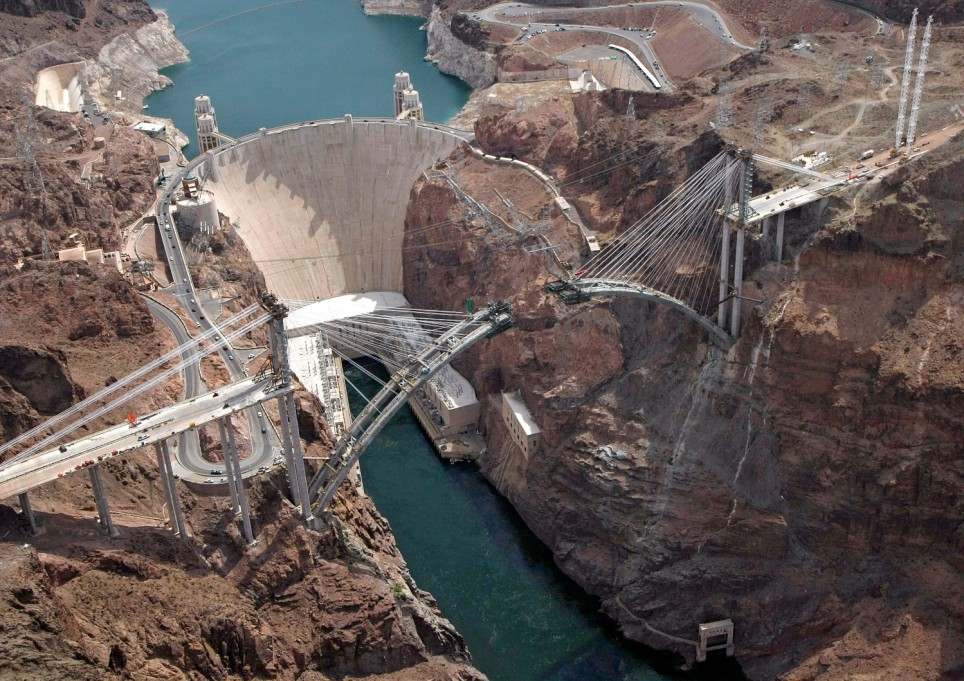
    THE WIDER VIEW: Taking
    shape, the new bridge at the
    Hoover Dam
    Creeping closer inch by inch – 900ft above the mighty Colorado River
    the two sides of a $160 million bridge at the Hoover Dam in America
    slowly take shape.   The bridge will carry a new section of US Route 93
    past the bottleneck of the old road which can be seen twisting and
    winding around and across the dam itself.
    When complete, it will provide a new link between the states of Nevada
    and Arizona . In an incredible feat of engineering, the road will be supported
    on the two massive concrete arches which jut out of the rock face.
    The arches are made up of 53 individual sections – each 24ft long
    which have been cast on-site and are being lifted into place using
    an improvised high-wire crane strung between temporary steel pylons.

    hoover-dam1

    The arches will eventually measure more than 1,000ft across.
    At the moment, the structure looks like a traditional suspension bridge. But once the arches are complete,
    the suspending cables on each side will be removed.
    Extra vertical columns will then be installed on the arches to carry the road.
    The bridge has become known as the Hoover Dam bypass, although it is officially called the Mike O’Callaghan-
    Pat Tillman Memorial Bridge, after a former governor of Nevada and an American Football player from Arizona
    who joined the US Army and was killed in Afghanistan.
    Work on the bridge started in 2005 and should finish next year. An estimated 17,000 cars and trucks will cross it every day.
    The dam was started in 1931 and used enough concrete to build a road from New York to San Francisco .
    The stretch of water it created, Lake Mead , is 110 miles long and took six years to fill.
    The original road was opened at the same time as the famous dam in 1936.
  • Boris Johnson hosts a reception for London’s Turkish community

    Boris Johnson hosts a reception for London’s Turkish community

    Boris Johnson was once the editor of the prestigious conservative political magazine, The Spectator

    HIDDEN NATION

    In this regular feature, James Willsher explores unreported pockets of international London.

    City Hall. Invitation to a reception for London’s Turkish community, hosted by the Mayor, Boris Johnson. Himself with Turkish ancestry, an Ottoman minister for a great-grandfather. We queue for bags and briefcases to be searched at the ground floor check-in desk. The women are large, big-haired, heavily made-up, or younger, slender, with straightened dark hair. The men are uniformly in suits, some lads with ornately cultivated stubble. We make our way to the elevators, up to a large, semi-circular, well-lit reception space with a stunning view of a London winter evening through a curved wall of huge glass panels. A handful of local councillors I recognise from east London, no one else. I go out to the balcony for that view. There’s a familiar, towering, overweight man already out there, who I know from previous such civic events. The director of an umbrella organisation for Turkish community groups, he helped organise tonight. We exchange a few words. Then back into the room.

    An obvious outsider, I am soon approached by a friendly-looking trio, an Azerbaijani newspaper editor, a director of a community centre, and a tall, chiselled Iranian man, who informs me he is in fact an ethnic Azerbaijani. Apparently Turkey and Azerbaijan share culture and (nearly) a language. We all say what an honour it is to be invited here. The Mayor is 25 minutes late, we note, according to the strict schedule on our handsomely-printed invitations. The room is full, there must be 300 people here. Then, a spike of excitement amid the bustle: the blonde emerges from a side door, surrounded by functionaries. He makes slow progress through a thicket of hands outstretched for shaking. He glides infinitesimally to a lectern by the central panel of the curved glass wall.

    Instant hush. He thanks us all for coming, apologises for being late. Of course, he says, he is a descendant of a Turkish immigrant, who came to this country from…er, um, Turkey. This elicits the first of several eruptions of warm laughter from the room. Little digital cameras and phones thrust before him, journalists and preservers for posterity indistinguishable. He tells the room that it is important to meet London’s people, and in particular the Turkish community, which contributes so much to London’s economy and society. He says that his grandfather would be very proud to know that one day his descendant would become Mayor of this great city, London.

    The jovial atmosphere Boris effortlessly propagates is growing while he speaks, from a breathy quiet to a murmur. A few more detonations of laughter and, after a brief speech of barely five minutes, he hands over to a Tory councillor from Enfield. A few questions from the thronged reporters are answered in moments, with forthright waves of the hand. While the councillor loudly declaims and rankles with party political swipes – the room audibly growls at these – the cloud of functionaries around the Mayor buzzes into action, he is departing. Realisation is infectious – the Great Man is leaving us so soon. The murmur becomes a waterfall of concern, confusion, question, complaint. The overweight man’s turn to speak. He struggles against now thunderous eddies of debate concerning the unexpected sudden exit. The assembled descend upon a waiting buffet before he can finish. It is over.

    The reporters are packing away their cameras, notebooks. They’ve got what they need, are polishing off plates of food, ready to leave. The crowd has thinned by more than half. I move to the organiser and commiserate with him on squaring up to a tough crowd. He smiles, but with a sadness. I say goodbye to those I ate and drank with, and make for the lifts.
    .
    Source: www.lucidmagazine.co.uk, 10 August 2009
  • Crimea hosting Kurultai of International Union of Turk Youth

    Crimea hosting Kurultai of International Union of Turk Youth

    KYIV, August 10 /UKRINFORM/. About 200 delegates from Ukraine, Russia, Kazakhstan, Bulgaria, Australia, Macedonia, Romania, Turkey, the Netherlands and other states have registered to participate in the 14th Kurultai (Council) of the International Union of Turk Youth in Yalta (Crimea), the Majlis of Crimean Tatar People reported.

    Majlis head Mustafa Jemilev said the delegates have gathered together to discuss their problems and conjointly find nonviolent methods of their solving. According to him, the major task of the Yalta international forum is promoting friendly mutual relations of Turk nations, cultural integration of youth and mutual support to the members of the single Turk family.

    The forum will stay open till August 14, 2009.