Month: August 2009

  • Turkish Cypriots complain about Greek harassment

    Turkish Cypriots complain about Greek harassment

    REETA PAAKKINEN

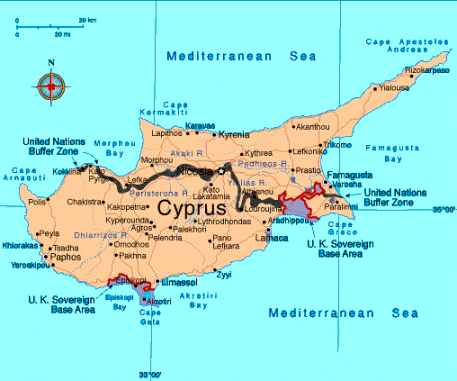
    The Turkish Cypriot tourism sector is considering starting legal proceedings against Greek Cyprus for what they see as harassment of their business partners abroad. The issue reached the Italian parliament in June, when a local MP called the letters from Greek Cypriot representation an ‘intimidation campaign.’

    For harassment of their overseas business partners, the Turkish Cypriot Tourism and Travel Agencies Association, or KITSAB, and the Turkish Cypriot Hoteliers’ Association, or KITOB, are considering starting legal proceedings against the Greek Cypriot government.

    Presenting several letters from Greek Cypriot embassies in European Union countries and Lebanon to local travel companies marketing holidays in northern Cyprus, KITSAB and KITOB presidents said the Greek Cypriot approach contradicts the U.N.-mediated peace talks.

    In late June, the issue reached the Italian parliament. Marco Perduca of the Radical Party said the letter the Greek Cypriot Embassy in Rome sent to Italian tour operators amounted to an “intimidation campaign” in which the Italian government should support Italian entrepreneurs who bring tourists to northern Cyprus.

    Undermining tourism

    “This time we have had enough of the Greek Cypriot campaign to stop tourism to Turkish Cyprus. Germany, the U.K., Lebanon, Romania, Sweden. … Wherever we go, the Greek Cypriot government follows and calls for our business partners not to cooperate with us,” Özbek Dedekorkut, president of KITSAB, told the Hürriyet Daily News & Economic Review.

    A letter from the Greek Cypriot Embassy in Rome to Italian tour operators, seen by the Daily News, conveyed the image that a holiday from Italy to northern Cyprus could lead one into legal trouble by stating, in Italian: “We remind that Tymbou [Ercan] Airport is in the occupied area. In addition, it is operating outside the IATA authority in a way that is outside the law. Arriving in Cyprus through that entry point can lead to fines according to the laws of Republic of Cyprus.”

    Another letter seen by the Daily News was from the Greek Cypriot Embassy in Beirut to a local tour operator in Jounieh, Lebanon, dated June 5. The letter presented the local travel agency the possibility of legal charges in case his company brings tourists to northern Cyprus.

    “It has come to the attention of this Embassy that your travel agency … is currently in the process of establishing a tourist holiday package involving destinations in the Turkish-occupied areas of the Republic of Cyprus. As a consequence we hereby wish to inform you that some of your actions are violating both the legislation of the Republic of Cyprus – a member state of the European Union – and international law in such a way that it may be cause for taking legal action against you and your company. … We also advise you to refrain from launching a sea line with a destination in the occupied areas of the Republic of Cyprus.”

    The letter had an official reference number and was signed by Charge d’Affaires Kyriacos P. Kouros, who could not be reached when the Daily News contacted him about the authenticity of the letter.

    Harming Turkish business

    Although there is no legal basis for stopping people from traveling to northern Cyprus, travel companies abroad become unnecessarily concerned, he said. “Greek Cypriot representatives are trying to scare local businesses abroad, and this harms us. They do not have the right to threaten our business partners like this,” Dedekorkut said.

    “The Greek Cypriot campaign is affecting our marketing, especially in Europe,” said Mehmet Dolmacı, president of KITOB. “Greek Cypriots are making it clear they don’t want to cooperate or share tourism income here. Cyprus is not solely a Greek island – Turkish Cypriots also have the right to live here. Whatever we try to do, they try to stop it. This seems to be their biggest job – not to find a solution but to try to pressure us to leave Cyprus for better income elsewhere.”

    Contradictory

    Maintaining isolation is contradictory to peace talks, according to Maurizio Turco, a member of the Italian Parliament and a colleague of Marco Perduca in the Italian Radical Party. Turco said attempts to hamper the growth of tourism in northern Cyprus are in dire contrast with the ongoing talks. “The Greek Cypriot side is talking with Turkish Cypriots about a comprehensive settlement, yet at the same time their representations are trying to stop tourism to northern Cyprus. This is just not right,” Turco told the Daily News in late July in Kyrenia.

    “We should bring the issue to the world’s attention. [Turkish Cypriot president] Mehmet Ali Talat should also point this out to [Greek Cypriot president] Dimitris Christofias and make it clear this is not right,” Turco added.

    According to Turco, the letters the Greek Cypriot Embassy in Rome sent have been noted in the Italian parliament. “This issue should really be discussed on the EU level,” he said. “Member states should come together to discuss the isolation of northern Cyprus. But because of the veto Greek Cyprus has, this is difficult.”

    It was a mistake to accept Greek Cyprus in the EU after it turned down the Kofi Annan Peace proposal, said Turco, who earlier served in the European Parliament. “There should have been first a peace deal, and only then entry for the whole island into the EU.”
    Hürriyet
  • Geopolitical Diary: Shades of a Second War

    Geopolitical Diary: Shades of a Second War

    August 6, 2009

    One year on from the outbreak of war between Georgia and Russia, events precipitating that conflict bear a striking resemblance to the situation today.
    First, it must be said that things are never quiet in the Caucasus. Russo-Georgian relations are cold in the best of times, and they certainly are not going to warm while the pro-Western government that took power Georgia in the 2003 Rose Revolution remains in place. Under this “Rose” government, Tbilisi has courted the West politically, economically and militarily in order to solidify its independence of Russia, with the goal of joining the NATO alliance – something that Russia has resisted at every turn.
    In 2008, the Russians shifted from resistance to invasion. The reasons are many, but one stands out: 2008 marked the final dissolution of Serbia, with Western institutions recognizing the independence of Kosovo. Serbia was Russia’s last ally in Europe, and the idea that Russia’s protests could not sway the West’s actions in the least was daunting for Moscow. Russia had to prove that not only was it still relevant, but that it could and would move militarily against an American and European ally. The target was Georgia, and the five-day war that followed was as decisive as it was swift.
    Events appear to be moving along a similar track in the early days of August 2009.
    Last month, following a trip to Georgia, U.S. Vice President Joseph Biden gave an interview in which he called Russia out not only for being weak but, to put it bluntly, doomed to collapse. Needless to say, the Russians might be feeling the urge to prove Biden wrong in the court of global opinion. Russian officials are loudly and regularly warning that they stand ready for war, while Vladislav Surkov – a Kremlinite arguably second in power only to Prime Minister Vladimir Putin himself – has spent some personal time of late in South Ossetia, the tiny (Russian-allied) breakaway province of Georgia that was the proximate cause for the 2008 war.
    Biden’s comments are only one possible reason why the war drums are being beaten; there are others.
    The United States appears to be sliding toward conflict with Iran, and Russia has invested no small amount of political capital in bolstering the Iranians against the Americans. In Moscow’s mind, a United States fixated on the Persian Gulf is one that cannot fixate on Russia, and a United States that is at war with Iran is one that cannot stop Russia from adjusting borders in places like Georgia.
    And of course, there is Georgia itself. President Mikhail Saakashvili is no stranger to dramatic performances, and as the leader of a fractured country with next to no military capability (even before Georgia’s defeat in August 2008), he has few means of countering Russia at all. One option is to provoke a crisis with his northern neighbor in the hopes that the West will ride to the rescue. Considering what happened a year ago, this is perhaps not the wisest strategy, but it is not as though Saakashvili – personally or as Georgia’s president – has a wide array of options to peruse.
    War is not a process that Russia would choose carelessly, even if it would be a very, very easy war to win. What simply doesn’t fit in current circumstances is the boldness with which the Russians are acting. They have all but stated that war is imminent, they are backing the Iranians to the hilt, sending top Kremlin strategists to the region to coordinate with allies, and have even resumed nuclear submarine patrols off the east coast of the United States. The Russians have a well-earned reputation for being far more circumspect than this in the shell game that is international relations. It is almost as if all of this is simply noise designed to keep the Americans off balance while something else, something no one is watching, is quietly put into play.
    STRATFOR doesn’t have a good answer for this. All we can say is that the Russians are up to something – and if it is not a war, it is something big enough that a war would seem to make a good distraction. Now that bears some watching.

  • Turkish-Russian Grand Bargain in Energy Cooperation

    Turkish-Russian Grand Bargain in Energy Cooperation

    Turkish-Russian Grand Bargain in Energy Cooperation

    Publication: Eurasia Daily Monitor Volume: 6 Issue: 152
    August 7, 2009
    By: Saban Kardas
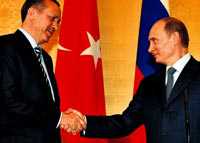
    Russian Prime Minister Vladimir Putin’s August 6 visit to Ankara marked a new era for “enhanced multi-dimensional partnership,” between Ankara and Moscow. Putin and Recep Tayyip Erdogan signed some twenty agreements covering energy, trade and other fields. Italian Prime Minister Silvio Berlusconi also attended part of the talks between Erdogan and Putin, considering the involvement of Italian companies in some of these projects. The most remarkable dimension of the various joint projects concerns energy cooperation, most notably Turkey’s expression of support for Russia’s South Stream project (Anadolu Ajansi, www.cnnturk.com, www.ntvmsnbc.com, August 6).

    In oil transportation, Russia committed to participate in the planned Samsun-Ceyhan pipeline (SCP), connecting the Turkish Black Sea city of Samsun to the Mediterranean terminal Ceyhan. Turkey has solicited Russian participation in the SCP, which will bypass the congested Turkish Straits. Moscow has proven reluctant, and has instead promoted another bypass option through Burgas-Alexandroupolis between Bulgaria and Greece. Meanwhile, Turkey took further steps to make the SCP attractive for the Russian side, by linking this project with the Turkish-Israeli-Indian energy partnership (EDM, November 25, 2008).

    Erdogan expressed his pleasure with the Russian decision to commit its crude. Ankara can consider this development as its greatest success in this grand bargain, given that Turkey has worked to convert Ceyhan, where the Baku-Tbilisi-Ceyhan pipeline also terminates, into a global energy hub. However, Putin did not rule out interest in Burgas-Alexandroupolis, and instead emphasized that the two pipelines might be complementary in meeting the growing demand for export routes. This statement raises questions about how committed Russia will be to the SCP, given that Russian companies own the majority of shares in the other Burgas-Alexandroupolis option.

    In terms of gas cooperation, Turkey will allow Russia to conduct explorations and feasibility studies in the Turkish exclusive economic zone in the Black Sea, as part of Russian plans to construct South Stream. Since this move comes against the background of Turkey’s decision to sign the rival Nabucco pipeline agreement last month, it raises many questions, as to how it will affect Nabucco, which Turkey considers a “strategic priority,” as well as European energy security issues. Despite the questions surrounding its feasibility and high costs, as well as its negative implications for Nabucco, Erdogan maintained that both projects contribute to diversification efforts.

    It appears that the “grand bargain” was between the SCP and Blue Stream. Ahead of the meeting, Yuri Ushakov, the Deputy Head of the Russian Government Staff said that “Turkey made concessions in South Stream and we made concessions in SCP,” but added that he had doubts over the SCP’s feasibility (Anadolu Ajansi, August 5). A statement from Berlusconi’s office also claimed that he had helped broker a rapprochement between both countries on these two issues (Hurriyet Daily News, August 6). However, domestically, there are concerns that in this “exchange” of concessions, Turkey did not gain much. The SCP’s importance was inflated, because it was developed by business interests close to the government (www.turksam.org.tr, August 7). Another gas deal concerned Ankara’s request to renew the contract under which it purchases Russian gas through the Western pipeline via the Balkans. Erdogan announced that the contract (which expires in 2011) will be renewed for 20 years. Turkey had complained about the high prices and the leave-or-pay conditions in its gas deals with Russia. Putin said it was renewed on favorable terms to Turkey, but the contract’s details are unclear.

    Erdogan also said that they discussed the extension of Blue Stream II to transport Russian gas to Israel, Lebanon and even Cyprus. Blue Stream, running underneath the Black Sea, is the second route carrying Russian gas to Turkey. Moscow previously raised the possibility that it could use Blue Stream II in order to transport gas to Europe, but this option was rejected, since it contradicted Nabucco and Russia sought to use Turkey only as a transportation route. Now, Ankara wants to revive it as part of a North-South corridor. Based on the leaders’ statements, it appears that the existing capacity of Blue Stream might be improved and gas could be transferred to the Mediterranean through this pipeline.

    However, although Erdogan praised this development as another major success, there is no guarantee that Russia will grant “re-export rights,” which indicates that if Blue Stream II is implemented, Moscow will continue to view Turkish territory as a mere conduit for its gas, which raises the question: how will Turkey benefit from the agreement? Russian priorities also involve Turkey’s first nuclear power plant tender, which was awarded to a Russian-Turkish consortium. As the original price was too high, the tender has long awaited cabinet approval (EDM, January 26). Meanwhile, the Russian side lowered the price, and offered a compromise. Prior to Putin’s visit, it was expected that with further “bargaining,” a final deal might be reached, but apparently it failed. Nevertheless, Ankara and Moscow signed protocols regarding energy cooperation, including the use of nuclear energy for peaceful purposes, early notification of accidents, exchange of information on facilities, and to continue talks on the nuclear tender.

    The most controversial development is perhaps Ankara’s support for South Stream. Erdogan reiterated his belief that Nabucco and South Stream are complementary, yet turned a blind eye to several Russian officials’ (including Putin) statements to the contrary. It is assumed in Ankara that growing European energy demand will accommodate both projects; but this ignores the competition between both projects over the same downstream markets. Moreover, the Turkish side fails to appreciate the challenges Russia is facing in investing in its domestic gas industry, and acts on the assumption that “Russia has enormous reserves,” while failing to realize that Russia is also planning to tap into the same upstream producers, namely Central Asian and Caspian gas, just as the Nabucco project envisages (www.ntvmsnbc.com, August 6).

    Putin also added that a consensus was reached on Russia building gas storage facilities in the Salt Lake. Taken together with the announced joint investments between Turkish and Russian firms, including Gazprom, it is unclear whether the Turkish government recognizes the consequences of these decisions. Russia has effectively used the practice of co-opting the gas infrastructure of transport and consumer countries, as part of its efforts to monopolize downstream markets. It is unclear how this penetration into the Turkish grid might affect Ankara’s future energy policies.

    https://jamestown.org/program/turkish-russian-grand-bargain-in-energy-cooperation/
  • Turkey is part of Europe. Fear keeps it out of the EU

    Turkey is part of Europe. Fear keeps it out of the EU

    tariq

    Sarkozy’s argument won’t wash. This great nation, a crucial link with the Muslim world, would be a major asset for the union

    Tariq Ramadan

    When on his recent visit to Turkey President Obama called for Turkish entry into the European Union, he put his finger on a strategic and cultural sore spot. The French president, Nicolas Sarkozy, speaking for the majority position in Europe, was quick to respond: Turkey may one day enjoy a privileged relationship with the EU, but full membership is out of the question. Turkey is not European – geographically or culturally.

    Interpretations of the US stance are numerous and contradictory, but they highlight deep tensions within Europe on the issue. Some believe the US is concerned primarily with securing access to the energy reserves of the Caspian basin; others suspect Washington of using Turkish alignment with American policy (by way of Nato) to exert pressure on its European allies; still others see an attempt to weaken Europe by placing a Turkish economic, demographic and cultural millstone around its neck.

    None of these hypotheses is wholly accurate or inaccurate. Nevertheless, they do reveal Europe’s continuing contortions over its identity and its future. The Turkish question rarely figures in the foreground of European debate today, yet its spectre hovers over discussions of “European identity”, “immigration” and the “Muslim question”.

    Political parties that call for an increasingly narrow view of Europe are gaining ground. These parties promote a strictly Judeo-Christian perspective of European history, mistrust of Islam, repressive hardline immigration policies and reject a Turkey they claim is overpopulated and excessively Muslim.

    Europeans have become fearful. Economic crisis has brought with it calls for greater security and for protection of purchasing power, and from “foreigners” and “immigrants”, who are seen as threatening financial stability and cultural homogeneity. Seen from this perspective, the Turkish question reveals both centripetal (a sense of “standing together” against outside threats) and centrifugal (a lack of shared strategic or foreign policy orientations) forces within the EU.

    The arguments that locate Turkey outside European history and geography cannot withstand analysis. For more than four centuries the Ottoman empire shared and shaped the political and strategic future of the continent. During the late 19th and early 20th century, it became the “sick man of Europe”. Even today, Turkey’s historical and economic influence continues to be substantial.

    No one is likely to be fooled by attempts to redraw the geographical boundaries of Europe for ideological or political purposes. If we were to apply the same criteria across the board, Cyprus would not be part of Europe. Such artificial distinctions ignore history, just as they ignore the realities of European society itself, where national origins, memories and cultures have long met and blended. Approximately 40% of Turkey’s population is of European origin; millions of Turks have already acquired the nationality of a European country.

    We must look elsewhere for the real issues, and we must look them in the eye. Instead of being obsessed by the question of culture and religion, European leaders would be better advised to develop a forward-looking strategic vision. Given its close ties with Iran, Syria, Iraq and central Asia, Turkey simply cannot be ignored. Its economic and military clout should be integrated into a European policy based on good-neighbourly relations and stability in Asia and the Middle East.

    On two recent occasions the Turkish government has refused to bow to Washington, demonstrating a distinct capacity for independent action. Europe can hardly fault the US for its unilateral behaviour while failing to develop an autonomous foreign policy of its own. Where there should be a unified European voice, there is a discordant chorus. The US, China and India have no reason to fear European power. Divided, lacking a common policy, Europe succeeds only in working against itself.

    Meanwhile, commercial ties between Turkey and the European countries have continued to expand. Between 1990 and 2003, Turkish imports from Europe grew threefold, while exports quadrupled. Better trade management within the framework of an EU-wide economic policy should make these ties stronger and more competitive. The countries of Europe are facing an acute, long-term manpower shortage. Writing in internal EU publications, some specialists now argue the labour market will require an additional 15 million workers in the next 20 years. Europe needs immigration. Instead of adopting restrictive immigration policies that would criminalise both undocumented and legal immigrants, the EU should be moving toward realistic and responsible regulation. In this light Turkey, with its human resources, would prove a powerful ally.

    It is time for the countries of Europe to overcome their fear of Islam; time for them to stop turning Turkish EU membership into a cultural battleground. The only criteria to membership should be those of Copenhagen (1993) – and a European commission report (2004) mentioned that Turkey is very close to satisfying them. European politicians are ready to ignore their countries’ long-term socioeconomic needs in order to respond to the short-term religious and cultural fears of their constituencies. Millions of women and men are already European and Muslim; Turkish EU membership would be nothing new, and present no dangers. Islam is, de facto, a European religion; culturally, politically and economically, Turkey forms an integral part of its future.

    We need courageous European politicians who will develop a new vision of Turkish-EU relations, who will remind their citizens that Turkey, by virtue of its economic power, geography, history and natural position as go-between with the “Muslim world”, is a major asset for Europe and for its future. Instead of waiting until historical necessity forces the EU to incorporate Turkey, European statesmen should be working together to develop a clear, reasonable policy leading to Turkish membership – one that would respect political principles and recognise cultural and religious diversity. Welcoming Turkey into the EU would mean Europe would have to reconcile itself with its own principles: the principles it has all too often betrayed in practice.

    Source: www.guardian.co.uk, 06.08.2009

  • Turkey and Russia Conclude Energy Deals

    Turkey and Russia Conclude Energy Deals

    Published: August 6, 2009

    ISTANBUL — Russia and Turkey concluded energy agreements on Thursday that will support Turkey’s drive to become a regional hub for fuel transshipments while helping Moscow maintain its monopoly on natural gas shipments from Asia to Europe.

    Turkey granted the Russian natural gas giant Gazprom use of its territorial waters in the Black Sea, under which the company wants to route its so-called South Stream pipeline to gas markets in Eastern and Southern Europe.

    In return, a Russian oil pipeline operator agreed to join a consortium to build a pipeline across the Anatolian Peninsula, from the Black Sea to the Mediterranean, and Gazprom affirmed a commitment to expand an existing Black Sea gas pipeline for possible transshipment across Turkey to Cyprus or Israel.

    Energy companies in both countries agreed to a joint venture to build conventional electric power plants, and the Interfax news agency in Russia reported that Prime MinisterVladimir V. Putin offered to reopen talks on Russian assistance to Turkey in building nuclear power reactors.

    The agreements were signed in Ankara, the Turkish capital, in meetings between Mr. Putin and his Turkish counterpart, Recep Tayyip Erdogan. Italy’s prime minister, Silvio Berlusconi, who has joined Mr. Putin on several energy projects, attended the ceremony. The Italian company Eni broke ground on the trans-Anatolian oil pipeline this year.

    While the offer of specific pipeline deals and nuclear cooperation represented a new tactic by Mr. Putin, the wider struggle for dominance of the Eurasian pipelines is a long-running chess match in which he has often excelled.

    As he has in the past, Mr. Putin traveled to Turkey with his basket of tempting strategic and economic benefits immediately after a similar mission by his opponents. A month ago, European governments signed an agreement in Turkey to support the Western-backed Nabucco pipeline, which would compete directly with the South Stream project.

    By skirting Russian territory, the Nabucco pipeline would undercut Moscow’s monopoly on European natural gas shipments and the pricing power and political clout that come with it. That may explain why Nabucco, which cannot go forward without Turkey’s support, has encountered a variety of obstacles thrown up by the Russian government, including efforts to deny it vital gas supplies in the East and a customer base in the West.

    Turkey and other countries in the path of Nabucco have been eager players in this geopolitical drama, entertaining offers from both sides. Turkish authorities have even tried, without much success, to leverage the pipeline negotiations to further Turkey’s bid to join the European Union, while keeping options with Russia open, too.

    “These countries are more than happy to sign agreements with both parties,” Ana Jelenkovic, an analyst at Eurasia Group, a political risk consultancy, said in a telephone interview from London. “There’s no political benefit to shutting out or ceasing energy relations with Russia.”

    Under the deal Mr. Putin obtained Thursday, Gazprom will be allowed to proceed with seismic and environmental tests in Turkey’s exclusive economic zone, necessary preliminary steps for laying the South Stream pipe, Prime Minister Erdogan said at a news conference.

    After the meeting, Mr. Putin said, “We agreed on every issue.”

    The trans-Anatolian oil pipeline also marginally improves Russia’s position in the region. The pipeline is one of two so-called Bosporus bypass systems circumventing the straits between the Black Sea and the Mediterranean, which are operating at capacity in tanker traffic.

    The preferred Western route is the Baku-Tbilisi-Ceyhan pipeline, which allows companies to ship Caspian Basin crude oil to the West without crossing Russian territory; the pipeline instead crosses the former Soviet republic of Georgia and avoids the crowded straits by cutting across Turkey to the Mediterranean.

    Russia prefers northbound pipelines out of the Caspian region that terminate at tanker terminals on the Black Sea. The success of this plan depends, in turn, on creating additional capacity in the Bosporus bypass routes. Russia is backing two such pipelines.

    Mr. Putin’s offer to move ahead with a Russian-built nuclear power plant in Turkey suggests a sweetening of the overall Russian offer on energy deals with Turkey, while both Western and Russian proposals are on the table.

    The nuclear aspect of the deal drew protests. About a dozen Greenpeace protesters were surrounded by at least 200 armored police officers in central Ankara on Thursday.

    Andrew E. Kramer contributed reporting from Moscow.

    The New York Times
  • Davutoglu Promotes Stability in Lebanon

    Davutoglu Promotes Stability in Lebanon

    Davutoglu Promotes Stability in Lebanon

    Publication: Eurasia Daily Monitor Volume: 6 Issue: 149
    August 4, 2009
    By: Saban Kardas
    On July 30-31, Foreign Minister Ahmet Davutoglu visited Lebanon, where he met the country’s leading politicians, and visited the Turkish contingent serving as part of the U.N. Interim Force in Lebanon (UNIFIL) and the local Turkish-speaking communities. Davutoglu’s agenda highlighted the contours of his new diplomacy, which utilizes Turkish cultural identity and seeks to reconnect with the “external Turks.”

    Before his departure for Lebanon, Davutoglu stated that the main purpose of his trip was to make a contribution to the stalled efforts to form a coalition government, by drawing on the close contacts Turkey enjoys with all political groups (Cihan, July 30).

    Ankara has proven eager to facilitate talks on a coalition government between the two blocs led by the prime minister designate, Saad Hariri, and an opposing group including Hezbollah. In addition to the disagreements between the two groups over a power-sharing arrangement, the meddling of other regional states prevented the formation of a government since the elections in June. Ahead of Davutoglu’s visit, it was announced that the parties had agreed on a government arrangement including the distribution of seats and would work out the technical details and distribution of portfolios (Daily Star, July 30).

    Davutoglu held talks with the Lebanese president, prime minister and other officials as well as the representatives of political parties. Afterwards he highlighted Lebanon’s key role in promoting regional stability, and Turkey’s deep interest in regional peace. He expressed his satisfaction with the “positive progress” achieved in coalition talks. “We support all efforts and plans that could bring peace to the region,” Davutoglu added (Anadolu Ajansi, July 31).

    As part of its policy of creating a peaceful neighborhood, the Turkish government has become actively involved in the resolution of regional issues. In those endeavors, the “cultural identity” of the governing Justice and Development Party has been an important asset, helping it connect with regional leaders. Already during his tenure as the chief foreign advisor to the prime minister, Davutoglu visited the region in order to facilitate talks between various groups and governments, and established an extensive network of personal and professional contacts. In Lebanon, he can claim credit for being able to talk to all groups, including the pro-Western factions and the Iranian-backed Hezbollah.

    More importantly, Davutoglu possesses an asset, perhaps unlike any previous Turkish foreign minister: he can connect with his counterparts and the people of the region by speaking their shared cultural language. One journalist accompanying him, Abdulhamit Bilici, noted: “At times [Davutoglu], when speaking to Lebanese leaders, explains a situation to them through using verses from the holy Quran as well as the Hadith. When necessary he recalls moments in Islamic history, in which his addressees are well versed” (Today’s Zaman, August 1).

    However, it remains to be seen as to whether this will assist in Ankara’s efforts to resolve the perennial conflicts in the region, where many other mediation efforts have failed. The trip also revealed another element in Davutoglu’s recent diplomacy: in his trips abroad, Davutoglu has visited Ottoman-Turkish cultural sites, and met the Turkish-speaking communities in an effort to reconnect with the once-forgotten “external Turks.”

    For instance, during his recent trip to Serbia and Montenegro, Davutoglu visited the Sandzak, a region populated by Bosnians, Serbians, Montenegrins and other groups, including Turks. Davutoglu was the first Turkish minister to visit the region after the Ottoman Empire lost it in 1912. He received a very warm welcome in the city of Novi Pazar, and sought to mediate a feud between two local Bosnian politicians who had not talked to each other for several years. Similarly, he attempted to bridge differences between two muftis (religious leaders), by attending Friday prayers in two different mosques (Milliyet, July 26).

    In Lebanon, Davutoglu visited a centuries-old Mevlevi lodge, currently undergoing restoration at Ankara’s expense, and attended a performance by whirling dervishes. He also visited a Turkmen village near Tripoli which was practically unheard of in Turkey, where he was welcomed cheerfully by the villagers. In another village he attended the opening ceremony of a Turkish-built hospital with a capacity to serve as many as 20,000 patients annually (Radikal, August 1).

    Such policies aimed at reaching out to those communities resonate well with Turkey’s policy of regaining political influence in areas once controlled by various Turkish states in Eurasia, as they can act as important bridges between Turkey and the host countries. However, in some cases, these communities are small and exert no sizeable influence in the national politics of the host nation. Therefore, these efforts play a largely symbolic role: they serve to identify with Turkey’s cultural hinterland, which is one of the pillars of Davutoglu’s foreign policy thinking.

    The Turkish-speaking communities living beyond the borders of modern Turkey were practically forgotten. With the dissolution of the Soviet Union, Anatolian Turks rediscovered their brethren in Eurasia, which led to closer ties between Ankara and the new nations in the post-Soviet space. Davutoglu appears determined to fulfill a “historic responsibility” by reconnecting to these smaller communities. Toward this end, Ankara increased the funds of the Turkish Cooperation and Development Agency (TIKA), originally established in 1992 to coordinate Turkish aid programs in Eurasia, and expanded its geographical coverage. Turkey has initiated several projects to build schools, hospitals and other infrastructure serving the Turkish and host communities, which has served as an important diplomatic tool (www.tika.gov.tr).

    While “external Turks” make a positive contribution to Turkey’s foreign policy, however, they might also become a liability depending on the development of relations between the host nations and the Turkish communities. Although President Abdullah Gul’s visit to Xinjiang during his China trip was greeted positively, it did not prevent the ensuing developments in the region, when China’s violent repression of ethnic violence damaged Ankara’s diplomatic and trade relations with Beijing (EDM, July 8, 15).

    https://jamestown.org/program/davutoglu-promotes-stability-in-lebanon/