Month: July 2009

  • Will Untapped Ottoman Archives Reshape the Armenian Debate?

    Will Untapped Ottoman Archives Reshape the Armenian Debate?

    Turkey, Present and Past

    by Yücel Güçlü
    Middle East Quarterly
    Spring 2009, pp. 35-42

    https://www.meforum.org/2114/ottoman-archives-reshape-armenian-debate

    The debate over what happened to Armenians in World War I-era Ottoman Anatolia continues to polarize historians and politicians. Armenian historians argue that Ottoman forces killed more than one million Armenians in a deliberate act of genocide.[1] Other historians-most famously Bernard Lewis and Guenter Lewy-acknowledge that hundreds of thousands of Armenians died but question whether this was a deliberate act of genocide or rather an outgrowth of fighting and famine.[2] In recent decades, the debate has shifted from academic to legislative grounds. In 2001, the French parliament voted to recognize an Armenian genocide.[3] In 2007, U.S. political leaders narrowly averted an Armenian genocide resolution in the House of Representatives. While Armenian activists lobby politicians to recognize an Armenian genocide formally, which is likely to be a first step toward a demand for collective reparations, and genocide studies scholars seek to close the book on the Armenian narrative, it is ironic that many of the archives that contain documentation from the period remain untapped.

    The Richness of Ottoman Archives
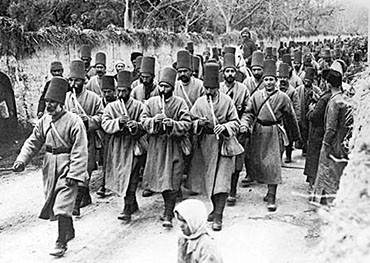
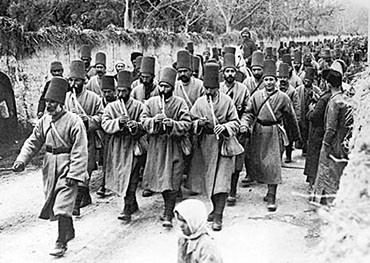
    Ottoman soldiers march through a town. During World War I, Ottoman soldiers fought Russian troops in areas populated largely by Armenians.

    In 1989, the Başbakanlık Osmanlı Arşivleri (the Ottoman Archives division of the Prime Minister’s Office) in Istanbul fully opened its doors to scholars regardless of their nationality or subject of research. The Ottoman Empire’s central state archives originally consisted of two groups of documents: the records of the Imperial Council and of the Grand Vizier’s office. From time to time, the state added other collections, for example, the records of the finance departments and the Cadastral Survey Office. The government registers include copies of the texts of imperial orders and decrees sent to provincial officials and judges and replies to reports from across the empire. They relate to questions of law and order, state revenues, military arrangements, foreign relations, administrative assignments, and other matters submitted for the sultan’s consideration. Survey registers of rural and urban populations and their production convey figures and other information collected for administrative purposes. Likewise, there are specific registers dealing with the non-Muslim peoples of the Ottoman Empire, such as church registers and registers concerning other non-Muslim communities (millets). These run through World War I and contain valuable information on the question of Turkish-Armenian relations.[4]

    There are approximately 150 million documents that span every period and region of the Ottoman realm in the stacks and vaults of the Ottoman Archives. Each day, new collections in these Ottoman archives are opened to researchers. All these extensive records are well preserved and organized.

    The first published catalog of Ottoman archival holdings appeared in 1955 and consisted of ninety pages of archival inventory and commentary.[5] Archivist Attila Çetin followed in 1979 with a more extensive catalog, which is also available in Italian.[6] As the classifying and organizing of the archives continued, the catalog grew. The 1992 edition is 634 pages long. The expanded 1995 compilation provides access to even more documents. Revised editions are to be forthcoming from time to time, as more detailed descriptions become available for the various fonds or individual record groups.[7]

    Ottoman archival documentation constitutes an unequaled trove of information about how people lived from the fifteenth through the early twentieth centuries in a territory now comprised of twenty-two nations. İlber Ortaylı, director of the Topkapı Palace Museum at Istanbul, argues that the history of the Ottoman Empire should not be written without Ottoman sources.[8] He is not alone in this. His position is buttressed by a number of specialists in the study of the Ottoman state and society. Albert Hourani, for example, the late British scholar of Middle Eastern affairs, argued that his best advice to history students considering Middle East specialization would be to “learn Ottoman Turkish well and learn also how to use Ottoman documents, since the exploitation of Ottoman archives, located in Istanbul and in smaller cities and towns, is perhaps the most important task of the next generation.”[9]

    The Archives and the Armenians

    There are few comprehensive sources about Armenian life in Anatolia outside of Ottoman archival sources. Diplomatic records, such as those cited by Armenian historian Vahakn Dadrian, as the basis for discussions among genocide scholars are spotty and intertwined with wartime politics.[10] The Ottoman Ministry of the Interior (Dahiliye Nezareti) was the government department directing and supervising the relocation and resettlement of the Armenian population. The collection of the ministry documents covers the period from 1866 to 1922 and consists of 4,598 registers or notebooks. It is classified according to twenty-one subcollections, according to office of origin. Among the available documents in the Ottoman archives are several dozen registers containing the records of the deliberations and actions of the Council of Ministers, which set policies, received reports, and discussed problems that arose regarding the relocations and other wartime events. The minutes of its meetings, deliberations, resolutions, and decisions are bound in 224 volumes covering the years 1885 through 1922. These registers include each and every decree pertaining to the decision to relocate the Ottoman Armenians away from the war zones during World War I. The Records Office of the Sublime Porte (Babıali Evrak Odası) also contains substantial documentation, including the correspondence between the grand vizier and the ministries, as well as the central government and the provinces that can illuminate the events of 1915.[11]

    It is ironic, therefore, as politicians seek to deliberate on questions of history, that few historians investigating Armenian issues have actually consulted the Ottoman archives. As Australian historian Jeremy Salt has explained,

    The Ottoman archives remain largely unconsulted. When so much is missing from the fundamental source material, no historical narrative can be called complete and no conclusions can be balanced. If the Ottoman sources are properly utilized, the way in which the Armenian question is understood is bound to change.[12]

    There is little explanation as to why more historians do not consult the Ottoman archives. They are open to all scholars. Bernard Lewis, Cleveland Dodge Professor Emeritus of Near Eastern Studies at Princeton University, who has worked extensively in the Ottoman archives since 1949, has argued that “the Ottoman archives are in the care of a competent and devoted staff who are always willing to place their time and knowledge at the disposal of the visiting scholar, with a personal helpfulness and courtesy that will surprise those with purely Western experience. [These records] are open to all who can read them.”[13] The late Stanford Shaw, Professor Emeritus of Turkish and Judeo-Turkish History at the University of California, Los Angeles, also spoke highly of the helpfulness of the archivists.[14] He argued that the sheer amount of new material available removed any excuse for any scholar investigating various nationalist revolts not to spend time examining the new sources.[15]

    Even Taner Akçam of University of Minnesota, one of the most vocal proponents of Armenian genocide claims, noted the improvement in the working conditions of the archives. In a recent article, he thanked the staff and especially the deputy director-general of state archives for their help and openness during his last visit.[16] The archivists are now helpful to all researchers, not only those pursuing research which supports the Turkish government’s line.

    Turkish Military Archives

    The archives of the Turkish General Staff Military History and Strategic Studies Directorate in Ankara (Türkiye Cumhuriyeti Genelkurmay Askeri Tarih ve Stratejik Etüt Başkanlığı Arşivleri) provide a military perspective. Indeed, more than the Ottoman Archives in the Prime Minister’s Office, this repository provides a rich trove of information about internal conditions in the empire, operations of the Ottoman army, and the Special Organization (Teşkilat-ı Mahsusa), somewhat equivalent to the Ottoman special forces, for the period 1914-22.[17]

    The World War I and War of Independence archives alone number over five and a half million documents spread among Turkish General Staff Division reports and War Ministry files. Division 1 (Operations) contains military operations plans and orders, operations and situation reports, maps and overlays, general staff orders, mobilization instructions and orders, organizational orders, training and exercise instructions, spot combat reports. Division 2 (Intelligence) contains intelligence estimates and reports and orders of battle. Divisions 3 and 4 (Logistics) contain files concerning procurement, animals, munitions, transportation, rations, and accounting. The Ministry of War files contain the General Command’s ciphered cables to military units as well as the papers of the infantry, fortress artillery, and other divisions. Vehip Pasha’s Third Army (Erzurum), Jemal Pasha’s Fourth Army (Damascus), and Ali İhsan Pasha’s Sixth Army (Baghdad) are included among the staff files. These also include the Lightning Armies and Caucasian Armies groups.[18]

    The cataloging and microfilming of the military archives repository up to the end of 1922 is complete. Once-secret documents should provide new information on the Armenian issue.[19] In addition to the microfilmed documents, the Turkish General Staff Military History and Strategic Studies Directorate publishes volumes of documents from its collection, including Latin alphabet transliteration of all documents.[20]

    Justin McCarthy, professor of Middle Eastern history and demographer at the University of Louisville/Kentucky, one of the few Western scholars to have done systematic research in the Ottoman archives, has written that the “reports of Ottoman soldiers and officials were not political documents or public relations exercises. They were secret internal reports in which responsible men relayed to their governments what they believed to be true.”[21] Indeed, the military records have already called into question conventional wisdom about the Special Organization, namely, the organization’s involvement in the Armenian relocations. [22]

    Other Ankara Resources

    The Turkish Historical Society (Türk Tarih Kurumu) at Ankara is also open to the public. The society houses private collections relating to strategy and political matters in the twentieth century, which include the papers of World War I-era war minister Enver Pasha together with those of his chief aide-de-camp and brother-in-law, Kazım Orbay. The Enver Pasha collection, donated in 1972 by his daughter Mahpeyker Enver, consists of 789 single, disparate items of handwritten notes, memoranda, reports, military records, cards and invitations, dispatches, letters of appreciation of colleagues and opponents, photographic albums, topographic maps, charts, private correspondence, diaries, and miscellany for the period 1914-22. There are no restrictions on access to these.[23] Because in the early decades of the twentieth century it was customary for officials to keep their papers upon their departure, these remain a relatively rare resource. Orbay’s papers add additional insight because they enable historians to gauge which issues most occupied the Ottoman Empire’s highest ranking military official of the time. Few scholars have used this last collection perhaps because they remain unaware of it.[24]

    The National Library (Milli Kütüphane) at Ankara houses thousands of Muslim court records, most of which were transferred from local museums and offices scattered around Turkey. These records contain a vast array of information concerning imperial administration, city government, the affairs of townspeople and villagers and deal with almost every aspect of the lives of the subjects be it personal status, taxes, loans, sales, price regulations, complaints, flight, or theft. Any matter requiring official resolution, registration, verification, or adjudication was potentially the domain of the Muslim judge (kadı) even when the matters applied to non-Muslims, such as Armenian Christians.[25] Many Turkish historians have employed Muslim court records extensively for Anatolian regional studies, but they remain relatively untapped by Armenian historians.[26]

    Armenian Archives

    Sole reference to Ottoman archives will not and should not satisfy historians; a full study of the Armenians during World War I should consider material from all sides in a conflict. The Armenian community maintains a number of archives. The archives in Watertown, Massachusetts, contain repositories from the Dashnak Party (Dashnaksutiun, the Armenian Revolutionary Federation) and the First Republic of Armenia. Both of the above together with the archives of the Armenian patriarchate in Jerusalem and the Catholicosate, the seat of the supreme religious leader of the Armenian people, in Echmiadzin, Armenia, remain closed to non-Armenian researchers. Tatul Sonentz-Papazian, Dashnakist archivist, for example, denied İnönü University scholar Göknur Akçadağ access to the Watertown archives in a June 20, 2008 letter. Dashnaksutiun archives are also not available to those Armenians who do not tow the party line. Historian Ara Sarafian, director of the Gomidas Institute in London, complained that “some Armenian archives in the diaspora are not open to researchers for a variety of reasons. The most important ones are the Jerusalem Patriarchate archives. I have tried to access them twice and [been] turned away. The other archives are the Zoryan Institute archives, composed of the private papers of Armenian survivors, whose families deposited their records with the Zoryan Institute in the 1980s. As far as I know, these materials are still not cataloged and accessible to scholars.”[27] Beyond the closure of Armenian archives to non-Armenian and even to some Armenian scholars, few of these allow the public to access catalogs detailing their holdings.

    Many scholars writing on the Armenian question utilize Britain’s National Archives (formerly the Public Record Office) in Kew Gardens. While the British government has made available many of their diplomats’ reports for study, much material from the British occupation of Istanbul (1919-22) and elsewhere in Anatolia following World War I remains closed to researchers under the Official Secrets Act and are only partially available in the archives of the government of India in Delhi. British authorities say they remain sealed for national security reasons. Their release should be important to historians as they will include evidence regarding returning Armenian refugees and other related matters. Files of the British Eastern Mediterranean Special Intelligence Bureau also remain closed, perhaps because the British government does not wish to expose those who may have committed espionage on behalf of Britain. These are important because they should enable historians to research British espionage and sabotage, demoralizing propaganda, and attempts to provoke treason and desertion from Ottoman ranks during and immediately after 1914-18. The documents of the Secret Office of War Propaganda, which under the direction of Lord James Bryce and Arnold Toynbee developed propaganda used against the Central Powers during World War I, also remain sealed. Their opening will allow historians to assess whether British officials in the heat of war created or exaggerated accounts of deliberate atrocities.

    An International Historians’ Commission

    History cannot be decided by politicians weighing either constituent concerns or emotions more than evidence. Nor should the debate on history be closed while the existing narrative utilizes only a small portion of the source material. The same holds true not only for Armenian historians but also for their Turkish counterparts and others.

    Rather, historians should work together to consider all source material, both in Armenian and Turkish archives. Each should be open fully. Cherry-picking documents to “prove” preconceived ideas and to ignore documents that undercut theses is poor history and, in a politicized atmosphere, can do far more harm than good.

    On April 10, 2005, Turkish prime minister Recep Tayyip Erdoğan extended an invitation to Armenian president Robert Kocharian to establish a joint commission consisting of historians and other experts to study the developments and events of 1915, not only in the archives of Turkey and Armenia but also in those of relevant third countries such as Russia, Britain, France, Germany, Austria-Hungary, and the United States, and to share their findings with the public.[28] Ninety-seven members of the Council of Europe’s Parliamentary Assembly at Strasbourg signed a declaration calling on Armenia to accept the Turkish proposal.[29] In his annual commemoration message to the Armenian-American community in 2005, President George W. Bush expressed support for Turkey’s proposal, declaring, “We look to a future of freedom, peace, and prosperity in Armenia and Turkey and hope that Prime Minister Erdoğan’s recent proposal for a joint Turkish-Armenian commission can help advance these processes.”[30] Secretary of State Condoleezza Rice reiterated the point two years later, telling Congress,

    I think that these historical circumstances require a very detailed and sober look from historians. And what we’ve encouraged the Turks and the Armenians to do is to have joint historical commissions that can look at this, to have efforts to examine their past, and in examining their past to get over their past.[31]

    It is unfortunate that the Armenian government has failed to accept the joint commission, for without joint consideration of all evidence, the wounds of the past will not heal and, indeed, when an incomplete narrative enters the political realm, the consequences can be grave.

    Yücel Güçlü is first counselor at the Turkish Embassy in Washington, D.C. The views expressed in this article are the author’s own and do not necessarily reflect those of the Ministry of Foreign Affairs of the Republic of Turkey.

    [1] See, for example, Vahakn N. Dadrian, The History of the Armenian Genocide (Providence: Berghahn Books, 1995), p. xviii.
    [2] Bernard Lewis, professor of Near Eastern Studies at Princeton University, to Shaike Weinberg, director of the Holocaust Memorial Museum, Princeton, N.J., Oct. 11, 1991, United States Holocaust Memorial Museum Archives, Director of the Museum: Subject Files of Jeshajahu ‘Shaike’ Weinberg, 1979-1995, Box: 7; Bernard Lewis, Semites and Anti-Semites: An Inquiry into Conflict and Prejudice (New York and London: W.W. Norton and Co., 1986), p. 21; Bernard Lewis, The Middle East: A Brief History of the Last 2,000 Years (New York: Scribner, 1995), pp. 339-40; Guenter Lewy, The Armenian Massacres in Ottoman Turkey: A Disputed Genocide ( Salt Lake City: The University of Utah Press, 2005), pp. ix, xii; Guenter Lewy, “The First Genocide of the 20th Century?” Commentary, Dec. 2005, p. 51; Guenter Lewy, “Revisiting the Armenian Genocide,” Middle East Quarterly, Fall 2005, pp. 3-12.
    [3] BBC News, Jan. 18, 2001.
    [4] Yusuf Sarınay, “Türk Arşivleri ve Ermeni Meselesi,” Belleten, Apr. 2006, pp. 291-310; Metin Coşgel, “Ottoman Tax Registers (Tahrir Defterleri),” Historical Methods, Spring 2004, pp. 87-100.
    [5] Murat Sertoğlu, Muhteva Bakımından Başvekalet Arşivi (Ankara: Ankara Üniversitesi Dil ve Tarih-Coğrafya Fakültesi Yayınları, 1955).
    [6] Attila Çetin, Başbakanlık Arşivi Kılavuzu (Istanbul: Enderun Kitabevi, 1979).
    [7] Yusuf Ihsan Genç et al., Başbakanlık Osmanlı Arşivi Rehberi (Ankara: Başbakanlık Basımevi, 1992); Mustafa Küçük et al., Başbakanlık Osmanlı Arşivi Katalogları Rehberi (Ankara: Başbakanlık Basımevi, 1995); Ilber Ortaylı, “Başbakanlık Arşivinin 1995 Yılı Yayınları Üzerine: Verimli Bir Yılın Değerlendirilmesi,” Türkiye Günlüğü, Jan.-Feb. 1996, pp. 217-21.
    [8] Ilber Ortaylı, Osmanlı Barışı (Istanbul: Timaş Yayınları, 2007), pp. 217-29; idem, Osmanlıyı Yeniden Keşfetmek (Istanbul: Timaş Yayınları, 2006), p. 124.
    [9] Nancy Gallagher, ed., Approaches to the History of the Middle East: Interviews with Leading Middle East Historians (Reading: Ithaca Press, 1994), p. 43.
    [10] Lewy, “Revisiting the Armenian Genocide.”
    [11] Genç, Başbakanlık Osmanlı Arşivi Rehberi, pp. 384, 352.
    [12] Jeremy Salt, “The Narrative Gap in Ottoman Armenian History,” Middle Eastern Studies, Jan. 2003, p. 35.
    [13] Bernard Lewis, “The Ottoman Archives as a Source for the History of the Arab Lands,” Journal of the Royal Asiatic Society, Oct. 1951, pp. 139-55; idem, From Babel to Dragomans: Interpreting the Middle East (Oxford and New York: Oxford University Press, 2004), pp. 418-9.
    [14] Stanford Shaw, Studies in Ottoman and Turkish History (Istanbul: The Isis Press, 2000), p. 600.
    [15] Stanford Shaw, “New Research Opportunities in the Ottoman Archives of Istanbul,” Belleten, Aug. 1994, p. 465.
    [16] Taner Akçam, “Deportation and Massacres in the Cipher Telegrams of the Interior Ministry in the Prime Ministerial Archive (Başbakanlık Arşivi),” Genocide Studies and Prevention, Dec. 2006, pp. 320-1, ftnt. 6.
    [17] Türkiye Cumhuriyeti Genelkurmay Askeri Tarih ve Stratejik Etüt Başkanlığı Arşivleri (ATESE), Genelkurmay Başkanlığı Harp Tarihi Dairesi Tarihçesi (HTDT), 1961, folder: 1, file: 1, no. 1-14.
    [18] Author interview, Colonel Ahmet Tetik, chief of the archives division of the Turkish General Staff Military History and Strategic Studies Directorate, July 11, 2008; ATESE, HTDT, 1961, folder: 1, file: 7, no. 1-15; on the importance of the Ottoman military archival sources, see Edward Erickson, “The Turkish Official Military Histories of the First World War: A Bibliographic Essay,” Middle Eastern Studies, July 2003, pp. 190-8.
    [19] Türkiye Cumhuriyeti Genelkurmay ATESE ve Denetleme Başkanlığı Yayın Kataloğu (Ankara: Genelkurmay Basımevi, 2005).
    [20] See, among others, Arşiv Belgeleriyle Ermeni Faaliyetleri, 1914-1918, vols. 1-8 (Ankara: Genelkurmay Basımevi, 2005-2008).
    [21] Justin McCarthy, Conference on the Reality of the Armenian Question (Ankara: Türkiye Büyük Millet Meclisi Basımevi, 2005), p. 57.
    [22] Edward Erickson, “Armenian Massacres: New Records Undercut Old Blame,” Middle East Quarterly, Summer 2006, pp. 67-75; Tuncay Öğün, Kafkas Cephesinin Birinci Dünya Savaşındaki Lojistik Desteği (Ankara: Atatürk Araştırma Merkezi, 1999).
    [23] “1972 Yılı Çalışma Raporu,” Belleten, July 1973, p. 425.
    [24] Uluğ Iğdemir, Cumhuriyetin 50. Yılında Türk Tarih Kurumu (Ankara: Türk Tarih Kurumu Basımevi, 1973), p. 51; Fahri Çoker, Türk Tarih Kurumu: Kuruluş Amacı ve Çalışmaları (Ankara: Türk Tarih Kurumu Basımevi, 1983), p. 143.
    [25] Mahmut Şakiroğlu, “La bibliothèque nationale d’Ankara,” Turcica, 20 (1988): 243-6. The best descriptions of the contents of Turkish Muslim court records series and its various uses for historiography thus far to appear have been Ahmet Akgündüz’s Şer’iye Sicilleri: Mahiyeti, Toplu Kataloğu ve Seçme Hükümler, 3 vols. (Istanbul: Türk Dünyası Araştırmaları Vakfı Yayınları, 1988); Amy Singer, “Tapu Tahrir Defterleri ve Kadı Sicilleri: A Happy Marriage of Sources,” Tarih, 1(1990): 95-125.
    [26] For insightful discussions on the importance of Muslim court records see Halil Inalcık, “Ottoman Archival Materials on Millets,” in Benjamin Braude and Bernard Lewis, eds., Christians and Jews in the Ottoman Empire: The Functioning of a Plural Society, vol. 1 (New York and London: Holmes and Meier, 1982), pp. 437-49; Cahid Baltacı, “Şer’iye Sicillerinin Tarihsel ve Kültürel Önemi,” Osmanlı Arşivleri ve Osmanlı Araştırmaları Sempozyumu 17 Mayıs 1985 (Istanbul: Türk-Arap Ilişkileri Incelemeleri Vakfı, 1985), pp. 127-32; Jon Mandaville, “The Jerusalem Shari’a Court Records: A Supplement and Complement to the Central Ottoman Archives,” in Moshe Maoz, ed., Studies on Palestine during the Ottoman Period (Jerusalem: The Magnes Press, the Hebrew University, and Yad Izhak Ben-Zvi, 1975), pp. 517-24; Amy Singer, Palestinian Peasants and Ottoman Officials Rural Administration around Sixteenth-Century Jerusalem (Cambridge and New York: Cambridge University Press, 1994), pp. 20-1.
    [27] Ara Sarafian, “Génocide arménien et la Turquie,” Nouvelles d’Arménie, Sept. 2008, p. 1.
    [28] Anatolian News Agency, Apr. 11, 2005.
    [29] For an appraisal on the subject, see “Turkey and Armenia: When History Hurts,” The Economist, Aug. 6-12, 2005, p. 26.
    [30] “President’s Statement on Armenian Remembrance Day,” The White House, Office of the Press Secretary, Apr. 24, 2005.
    [31] Congressional transcripts, United States House of Representatives, Appropriations Subcommittee on State-Foreign Operations, Mar. 21, 2007; Associated Press, Mar. 21, 2007; United Press International, Mar. 21, 2007.
  • MANY SCHOLARS CHALLENGE THE ALLEGATIONS OF GENOCIDE:  PART V

    MANY SCHOLARS CHALLENGE THE ALLEGATIONS OF GENOCIDE: PART V

    I find it important to mirror this work here to help truth-seekers gain one more access the information which is denied them by aggressive Armenian falsifiers, their usually anti-Turkish sympathizers, and other thinly veiled Turk-haters. Hate-based-propaganda and intimidation should not be allowed to replace honest scholarship and reasoned debate. Nothing less than the freedom of speech of those who hold contra-genocide views are at stake. Tools most used to advance censorship of contra-genocide views are hearsay, forgeries, harassment, political resolutions, and concepts like “editorial freedom” and “consensus”, among others—please note that “The Wild West” town papers and lynch mobs of 19th Century had the last two concepts down path and hung anyone who was deemed worthy of hanging.) The key to resolving this controversy, therefore, is more knowledge as in more honest research, more truthful education, and more freedom to debate… not less.
    Those scholars who take Armenian claims at face value today urgently need to ponder these simple questions, as honestly as they possible can:
    1) HOW CAN ONE STUDY A REGION’S OR A COUNTRY’S HISTORY WITHOUT RESEARCHING THAT REGION’S/COUNTRY’S ARCHIVES?
    Can one study Europe’s history, for instance, without using European archives?
    Or America’s history without researching American records?
    Or Russia’s past without using Russian documents?
    Or Ottoman Empire’s past without using Ottoman archives?
    Why were the Ottoman archives almost never used in most current Armenian arguments and claims?
    Are language barriers, bureaucratic hurdles, cost, or other reasons convincing enough excuses in scholarly studies that span a over decades or even centuries?
    Or is it instant gratification that these, so-called, genocide scholars who insist on ignoring Turkish archives really seek, not really the whole truth?

    2) HOW CAN ONE UNDERSTAND A CONTROVERSY IF ONE CONFINES ONE’S VIEWS TO ONLY ONE SIDE?
    Can you argue that only one side of say, the abortion issue, is absolutely correct, flawless, settled, and worthy of knowing, and that the other side should be totally ignored and even censored?
    How about gun control? Can you say one side is it; the other side to be dismissed, ignored, and/or censored?

    Or immigration?

    Taxes?

    Iraq War?

    Gay rights?

    Or many other such controversial issues?

    Can one be restricted, or asked/forced to be confined, in education or research, to only one side of the debate and categorically dismiss forever the other side(s) ?

    Can this discrimination and censorship ever be built into a state’s public education policy, as it is shamefully attempted by the Armenian falsifiers and Turk-haters in Massachusetts and California, vis-a-vis the 1915 Turkish-Armenian conflict ?

    Is the freedom of speech (of Turkish-Americans,), enshrined in the U.S. Constitution, a disposable right or a privilege, that can be trample upon by the Armenian lobby and their racist and dishonest politician friends like Schiff, Radanovich, Menendez, et. al.? (Racist because they only recognize Armenian dead, but ignore Turkish dead , and dishonest because they dismiss the six T’s of the 1915 conflict.)
    If I, as an individual with contra-genocide views, am slandered, intimidated, harassed, and even threatened for my views by some “opinion thugs” and often censored by “consensus mobs” and “hate-editors”, then is this not a blatant attack on and destruction of my constitutional right to freedom of speech?

    Does consensus mean correct? (After all, lynch mobs always had a pretty good consensus, too.)

    Does might make right?
    3) WHY DO THOSE GENOCIDE SCHOLARS SELECTIVELY REACT TO HUMAN TRAGEDY?
    Why do those genocide scholars— most if not all paid by the Armenian lobby and related institutions directly or indirectly— who love to get on their high horses and preach perfect morals to others, fail to scream murder in the face of that terrible human tragedy in Azerbaijan that victimized a million Azeri women and children in Karabagh and western Azerbaijan?
    Is it because the perpetrator of this inhumanity is Armenia, their client state and the Armenian genocide industry, their paymasters?

    4) If the study of genocide is designed to teach humans how to recognize, prevent, and fight back against new genocides, then why do these genocide scholars not take their client, Armenia and Armenians, to task about the genocide in Khodjaly on 19 February 1992? (Since a genocide verdict by a competent tribunal, required by the 1948 UN Convention, does not exist, yet, for consistency, I should call it man’s inhumanity to man and pogrom for now. The question is why did all the genocide study fail to stop Armenia from committing one between 1992-1994? Can you see the heart wrenching irony here?

    ***
    Here then is what honest scholars (not genocide scholars) say about the fraudulent Armenian genocide:
    ***

    ELIZABETH-ANNE WHEAL
    Elizabeth-Anne Wheal was a history scholar at Cambridge University.
    Major Publications
    * The Dictionary of the First World War, St. Martin’s Press, 1996
    * The Dictionary of the Second World War, Pen and Sword, 2004
    * The Green Book, London, Hodder and Stoughton Ltd, 1991.
    Relevant Publication
    * Dictionary of the First World War,Pope, S. and Wheal, E. A. (2003). Barnsley; S. Yorkshire: Pen & Sword Books
    Source: Dictionary of the First World War,Pope, S. and Wheal, E. A. (2003). Barnsley; S. Yorkshire: Pen & Sword Books.

    “Armenian Massacres: Allied term describing the Turkish government’s wartime deportations of Armenians from their homelands in the northeast of the Ottoman Empire. Neutral estimates suggest that between 1 and 1.5 million Armenians were living in Turkey in 1914, with perhaps another million inside Russia. Unlike other large racial minorities within the Empire, including their traditional Kurd enemies, Ottoman Armenians had no officially recognized homeland, but most were scattered near the Russian Caucasian frontiers.

    Despite these drawbacks a militant Armenian nationalist movement had blossomed since the turn of the century, armed and encouraged by the Russians, and several minor coups were repressed by the Young Turk government before 1914. Denied the right to a national congress in October 1914, moderate Armenian politicians fled to Bulgaria, but extreme nationalists crossed the border to form a rebel division with Russian equipment. It invaded in December and slaughtered an estimated 120,000 non-Armenians while the Turkish Army was preoccupied with mobilization and the Caucasian Front offensive towards Sarikamish.

    The Turks began disarming Armenian civilians under Ottoman control after a force of 2,500 rebels took Van in April 1915 and proclaimed a provisional government. An Ottoman order in June required all civilian non-Muslims to take up support duties near the battlefronts, but exemptions spared Greeks and the Catholic Armenian business community in Constantinople, effectively restricting the order to Orthodox and Protestant Armenians, who were subject to a military enforcement operation until late 1916.
    Deportees were often given only hours to prepare, and left without transport or protection on long journeys to infertile, ill-supplied resettlement regions. Many died from starvation or exposure; many more were killed en route by hostile tribesmen (usually Kurds), some of whom colluded with Ottoman officials in search of a ‘final solution’ to the Armenian question.

    Released through Armenian contacts with the Western press, especially strong in the United States, news of the catastrophe prompted the Turkish regime – which never openly associated itself with excesses against Armenians – to blame general supply and transport shortages for an estimated 300,000 deaths. Allied propaganda claimed more than a million had died, but modern consensus puts the figure at around 600,000.

    An uneasy peace was imposed on frontier Armenians by the occupying Russian Army from 1916, but rebel forces resumed control in late 1917, killing perhaps another 50,000 non-Armenians. Subsequent attempts to restore Turkish administration caused sporadic fighting in early 1918, until the Treaty of Batum (26 May 1918) between an exhausted Turkey and a new Armenian Republic brought a period of recovery. Thousands more civilians then died attempting long journeys back to their liberated homes.” P. 34

    ***

    BRIAN G. WILLIAMS
    Associate Professor of Islamic History at the University of Massachusetts at Dartmouth, PhD in Middle Eastern and Islamic Central Asian History. University of Wisconsin, Madison.
    Brian Glyn Williams is Associate Professor of History at the University of Massachusetts, Dartmouth and terrorism analyst at the Jamestown Foundation in Washington, D.C. He formerly lectured in Middle Eastern and Balkan History at the School of Oriental and African Studies, University of London, and in Islamic Central Asian and Medieval Middle Eastern History at the University of Wisconsin, Madison.

    Major Publications
    * The Crimean Tatars: The Diaspora Experience and the Forging of a Nation (2001)
    * The Deportation and Ethnic Cleansing of the Crimean Tatars. In Ethnic Cleansing in Twentieth Century Europe: Edited by Steven Vardy and Hunt Tooley. NY; East European Monographs. 2003
    * Turkey’s Al Qaeda Blowback, Terrorism Monitor, April 23, 2004 See a copy as . . . Appendix 9 . . . Turkey’s Al Qaeda Blowback, Terrorism Monitor . . .
    Source: . . . [See Appendix 8] . . . Letter to the Toronto District School Board . . . , January 31, 2008

    “Having published widely on the issue of genocide in the Ottoman and post-Ottoman Balkans, Caucasus and Middle East, I am also interested in learning how the Armenian genocide will be covered in your program. As someone who has spent considerable time probing the background, surrounding events, and results of this tragedy I find that this case of genocide has all too often been politicized by those who have their own nationalist agendas. I am, for example, dismayed when I encounter Turks who go against global opinion and shrilly argue that nothing happened to Armenians in the Ottoman Empire. Such efforts to erase an internationally recognized slaughter of tens of thousands are as transparent as efforts by Serbs to reject their people’s well known slaughter of Muslims in Bosnia and Kosovo in the 1990s. To deny the killing of the Armenians is to revise history and to fly in the face of global opinion.
    I am equally dismayed when I encounter Armenians who provide a historically context-less version of history which overlooks the fact that their people were engaged in an armed uprising which aimed to ‘cleanse’ (i.e. slaughter) the Turks of eastern Anatolia from a planned ‘Greater Armenia.’ Such Armenian revisionists deliberately downplay their own people’s attacks on Turks which led to the Turkish authorities’ deadly over-reaction in 1915. Armenian nationalist historians also overlook the fact that the Ottoman Balkan provinces (the lands that would eventually become Serbia, Bosnia, Bulgaria and Romania) were ‘cleansed’ of their Turkish Muslim populations in the 19th century in a series of well-documented slaughters. This process–which was not labeled ‘ethnic cleansing’ until the Serbian slaughter of Bosnian Muslims in the 1990s–cost tens of thousands of 19th century Ottoman Muslim their lives. Should your work overlook this crucial historical context it will come off as pro-Armenian propaganda and will have no historical balance.”

    ***
    GILLES VEINSTEIN
    Professor, Turkish and Ottoman History, Collège de France.

    Major Publications
    * Government and Society in Ottoman, XVIe-XVIIIe centuries” (1994)

    Related Publications
    * Trois questions sur un massacre” (1994) L’Histoire, n°187, April 1995 (Three Questions about a Massacre, translated from the original French)
    Source: Veinstein, L’Histoire, n°187, April 1995

    “On June 1, 1915, the Ottoman government ordered the transfer of the Armenians of central and eastern Anatolia towards Syria, still a possession of the Ottomans at that time. It was during these transfer operations that an immense number of Armenians perished. This tragedy was the result of a multiplicity of events which proceeded in various places in 1915 and 1916, and in which the horror took very diverse forms. ”
    “Suffering, malnutrition, poor hygiene, and epidemics caused a large part of the deaths (3), but it is necessary also to take account of massacres, which were crimes against humanity. These happened because of inter-communal settlements of accounts, and in these not only Turks, but also Kurds, were involved. The convoys were attacked and plundered, and some of the soldiers supposed to be supervising the operation were caught up in this. Besides, it is undeniable, in certain cases at least, that the crimes were perpetrated with the open or tacit co-operation of local authorities.”
    “The reality of the massacres, and even their extent, are not questioned by anybody, including commentators in Turkey. The American demographer Justin McCarthy, for example, estimates that the whole of the Armenians of Anatolia did not exceed a million and a half people on the eve of the world-wide conflict, and that, taking into account the figure for survivors, approximately 600,000 Armenians perished in Anatolia in 1915; that is to say, about half of the community (4).”
    “Secondly, there were also very many victims among the Moslems throughout the war, because of combat but also of actions conducted against them by Armenians, in a context of ethnic and national rivalry (5). If there are forgotten victims, it is they, and the Turks of today have the right to denounce the partiality of the Western opinion in this respect. Were they forgotten about because they were only Moslems?”
    “It is true that official involvement is a precondition for us to apply to the Armenian tragedy the term, ‘genocide’, as used in 1944 and defined in the Nuremberg Trials and the U.N. convention of 1948. But we must admit that we do not so far have proof that the government was involved in this way. The documents produced by the Armenians, in which Talat Pasha, Minister of the Interior, and other official top Ottomans explicitly order the slaughter of men, women, and Armenian children, designated as the “Andonian documents,” after the name of their editor, were absolute forgeries, as historical research has shown (6).”

    ***
    MALCOLM YAPP
    Professor Emeritus of the Modern History of Western Asia, University of London.
    Malcolm Yapp is (1995) a professor Emeritus of the modern history of Western Asia at the School of Oriental and African Studies (SOAS) at the University of London.
    Major Publications
    * The making of the modern Near East, 1792-1923 (London; New York: Longman, 1987)
    * The Near East since the First World War: a history to 1995 (London; New York: Longman, 1996)
    * Political Identity in South Asia – edited by David Taylor and Malcolm Yapp (London: Curzon Press; Atlantic Highlands, N.J.: Humanities Press, 1979, c1978)
    * Strategies of British India: Britain, Iran and Afghanistan, 1798-1850 (Oxford: Clarendon Press; New York: Oxford University Press, 1980).
    * War, Technology and Society in the Middle East – edited by V. J. Parry and M. E. Yapp (London; New York: Oxford University Press, 1975)
    Relevant Publications
    * The making of the modern Near East, 1792-1923 (London; New York: Longman, 1987)
    * Review article: The History of the Armenian Genocide: Ethnic Conflict from the Balkans to Anatolia to the Caucasus by Vahakn N. Dadrian, Middle Eastern Studies, Vol. 32, No. 4 (Oct., 1996), pp. 395-397
    Source: The History of the Armenian Genocide: Ethnic Conflict from the Balkans to Anatolia to the Caucasus by Vahakn N. Dadrian, Middle Eastern Studies, Vol. 32, No. 4 (Oct., 1996), pp. 395-397

    “The question is: has Dadrian produced sufficient new evidence to turn the debate decisively in favour of the view that the massacres were planned by the Ottoman government with a view to the extinction of the Ottoman Armenians?
    There was one major difference between eastern Asia Minor and most of the Balkans; in eastern Asia Minor the Armenians were a minority in a Muslim majority region. Moreover among the Armenians only a small minority wished for independence; it’s a weakness of this book that there is no adequate analysis of the very varied Armenian population of the Empire.
    Considering the indiscriminate terrorism of the Hunchaks in Van in 1896 and the Dashnak raid on the Ottoman Bank in the same year he reframes his comments: “One may assume that the nature of revolutionary idealism is such that it creates its own norms and that in this sense terror is a means of making a statement for which other channels are long denied”
    “It is not quite the sort of statement one expects from a writer so insistent on obedience to international law.
    Although Dadrian produces many reports tending to suggest that members of the Ottoman government wanted to destroy the Armenian, he fails to find any document which constitutes a definite order for massacre.
    Despite the numerous documents cited and the careful assembly of information about individuals and organizations, there is no decisive evidence to support Dadrian’s case.
    The author’s approach is not that of an historian trying to find out what happened and why but of a lawyer assembling the case for the prosecution in an adversarial system. What he wants are admissions of guilt from the defendants, first Germany as the easier target and then Turkey . What is missing is any adequate recognition of the circumstances in which these events took place; the surge of Armenian nationalism, the ambitions of Russia , the fears of the Ottomans and the panic and indiscipline of war. The 1915 massacres took place when the Ottomans were being driven back by the Russians (supported by many Armenians) in the east and were being threatened by the operations in the Dardanelles in the west. Dadrian is so obsessed by his theory of the long plan that he too often overlooks the elements of the contingent.

    To question whether Dadrian has made out his case and to suggest that he has given insufficient weight to the share of responsibility to be attributed to Armenian terrorists and to the flow of historical events is not, of course, to deny that Ottoman Armenians were murdered on a vast scale. It is indeed the dimensions of that tragedy which have led many to feel that the massacres must have been planned by government. But the scale of the horrors doesn’t necessarily point to genocide. Some mass murders of the twentieth century have indeed been the result of deliberate government action; some have been the result of panic, indifference, ignorance or a combination of circumstances. To which category the Armenian massacres belong is still unknown.” Pp. 395-397
    Source: Yapp, M. E. (1987). The Making of the Modern Near East 1792–1923. New York: Longman.
    During the Russo-Turkish War Armenian volunteers had fought with Russian troops and hopes of an independent Armenian state in eastern Asia Minor had been raised and disappointed. Hitherto the Armenians had been seen as a loyal Ottoman community. Henceforth they were regarded with suspicion by the Ottoman authorities and with a mixture of fear and hope by others. P.81
    Nevertheless, Muslim Arab nationalism was a new phenomenon which complicated the Eastern Question, while Armenian nationalism, in itself a Christian movement of a familiar type, was nevertheless novel in that it had not appeared before 1878 and that it was a Christian movement in the Asian territories of the Ottoman empire, comparable in that respect to Maronite nationalism in the Lebanon, although distinguished from it by several features. Armenian nationalism was essentially a product of the work of Armenian radicals in the Russian empire and was imported into the Ottoman empire, notably during the 1877-8 Russo-Turkish War when bands of Armenians fought for Russia. Thereafter, Armenians were suspect in Ottoman eyes and as nationalist propaganda increased so the Ottomans responded with repression leading to the massacres of 1894-6 which shocked Europe and brought more pressure for reform in the Ottoman territories. P.87
    The Armenians also looked to Russian support and many committed themselves to Russia during the invasion of 1828-9 so that when the Russian Armies retired some Armenian peasants from the Erzerum region accompanied them. The Russian successes, as indicated in Chapter 2, had a powerful effect in rousing Armenian expectations and in promoting Muslim hatred towards Christians in the region. The forces released were a significant factor in establishing the base for the greater unrest which overtook the region after 1878. By that time the scene was set for a major confrontation between Kurds and Armenians, a clash similar in kind but far greater in scope than the conflict in Lebanon between Druze and Maronite. P.127
    The Armenian population was spread throughout Anatolia, as well as including a substantial part of the inhabitants of Istanbul. In every town there was an Armenian element and there were also areas where Armenians were settled in large numbers as cultivators. One such area was Cilicia in western Anatolia, but the largest single concentration was in the six eastern provinces of Erzerum, Van, Bitlis, Kharput, Diyarbakr and Sivas. Of the total Armenian population of Anatolia of about 1.5 million in 1914 rather more than 860,000 or about 58 percent, lived in the east. In none of the six provinces, however, did Armenians constitute a majority. P.197
    To some extent Armenian nationalism was simply reactive. Paul Cambon, the French foreign minister, once commented that “the Armenians were told for so long that they were plotting that they finally plotted; they were told for so long that Armenia didn’t exist that they finally believed in its existence”. Apart from the suspicions of the Ottoman authorities the Armenians were subjected to attacks by Kurds. In the later nineteenth century the story of massacres unfolded; in 1877-8 massacres accompanied the Russian invasion; in 1890 there was the Erzerum affair; in 1894 that of Sasun in the south where Armenians worked as sharecroppers on Kurdish land. In 1895-6 major massacres took place and following the attempt by Armenian revolutionaries on the Ottoman Bank in Istanbul on 26 August 1896 there were massacres of Armenians in Istanbul. In April 1909 there was a massacre of Armenians in Adana in obscure circumstances but in some way linked with the anti-CUP coup in Istanbul in the same month. The Adana massacre may have destroyed Armenian hopes temporarily elevated by the 1908 revolution. P.199
    The war and the call for a jihad undoubtedly led to an increased sense of Muslim solidarity and an antipathy to Christians who were believed to support the Entente. The Greeks, concentrated in Izmir, and protected by Rahmi Bey, escaped the worst effects of this animosity, but the Armenian population experienced the full force of Muslim resentment and suspicion caused by the disasters in eastern Asia Minor at the beginning of the war and the calls by Russian Armenians for Ottoman Armenians to join them in a struggle for freedom. Armenians were deported en masse from the eastern provinces and many (probably between a quarter and a half million) died, either from starvation and hardship or from massacre mainly at the hands of Kurdish tribesmen. No direct documentary evidence has ever come to light to show that the Armenian massacres of 1915 were the deliberate policy of the Ottoman government but local officials connived at the murders and took few steps to protect the Armenians. Possibly there was little the Istanbul government could have done to control events, but it is also possible that it believed that the Armenian presence in the eastern provinces was a constant threat to the integrity of the empire and was not sorry to see it removed. Pp.269-270

    ***

    THIERRY ZARCONE
    Director of research at the National Center for Scientific Research, Paris; expert of the Office for Democratic Institutions and Human Rights (OSCE). Former visiting professor at Kyoto University (2005-2006).
    Major Publications
    * Mystiques, philosophes et francs-maçons en Islam, Paris, Maisonneuve, 1993.
    * Secret et sociétés secrètes en Islam, Paris, L’Arche, 2003.
    * La Turquie moderne et l’islam, Paris, Flammarion, 2004.
    * La Turquie. De l’Empire Ottoman à la République d’Atatürk, Paris, Gallimard, 2005.
    Relevant Publication
    * La Turquie. De l’Empire Ottoman à la République d’Atatürk, Paris, Gallimard, 2005
    Source: La Turquie. De l’Empire Ottoman à la République d’Atatürk, Paris, Gallimard, 2005
    “The most dramatic episode of these years is the forced displacement of the Armenian population, from Eastern Anatolia to Mesopotamia, a decision of the triumvirate, to crush the Armenian support to the Russian invasion, and suppress the guerilla operations of the Armenian gangs on the Turkish territory. […] After the capture of Erzurum by the Russians in 1916, the Armenian militias commit massacres against the Muslim populations.” Pp. 42-43.

    ***
    ROBERT F. ZEIDNER
    Ph.D. in Ottoman Military history. Universiy of Utah, Middle East Center.
    Major Publications
    * Kurdish Nationalism and the New Iraqi Government”, Middle Eastern Affairs, X, 1959, pp. 24-31.
    * Britain and the Launching of Armenian Question”, International Journal of Middle East Studies, VII, 1976, pp. 465-483.
    * Allies and Turkish Intelligence Activities during the War of Independence”, in International Symposium on Atatürk (Ankara, 21-23 September 1987). Proceedings, Ankara, TTK, 1994, pp. 673-685.
    * Mustafa Kemal Pasha’s Cooperation with Non-Turkish Muslim Nationalists during the Turkish War of Independence”, in Proceedigs of the International Symposium (Ankara, 10-12 November 1988) Commemorating the 50th Anniversary of Atatürk’s Immortality, Ankara, ODTÜ Basim Işliği, 1991, pp. 53-64.
    * The Tricolor over the Taurus, New York, Peter Lang, 1996; second edition, Ankara, Turkish Historical Society, 2005.
    Source: The Tricolor over the Taurus, Ankara, Turkish Historical Society, 2005

    “Thus, the massacres of Armenians throughout the Ottoman Empire, during the years 1894-1896, 1909 and 1915-1916, had deep social and political roots quite apart from the alleged savagery of Turks and Kurds long decried by Armenian apologists and Western missionaries and relief workers. It is most unfortunate for unbiased researchers of the Armenian Question that the great bulk of vast literature available in this filed comes from pens of such authors, almost all of it bent on an ethnocentric course to demonstrate the supposed superiority of Christian Armenian culture of the ‘unspeakable’ Muslim Turk. Most of these writers pursue this scholastic aberration with much breast beating for the questionable innocence of Ottoman Armenians in the matter of disloyalty to the Ottoman state throughout the Russo-Turkish conflicts of 1877-78 and 1914-17, rather than address the issued as a clash of nationalistic movements.
    Worse yet, Armenian scholars have consistently dwelled on Turkish massacres of their compatriots in all their grisly details without so much as a word on the equally savage measures taken by the Armenians of the Transaucasus and eastern Anatolia against local Turkic populace from 1905 to 1920. Indeed, when questioned on such episodes, they even dismiss them as Turkish propaganda. Yet the evidence for accepting this fact is overwhelming. This not to excuse the massacre of Armenians as mere quid pro quo but to point up such violence as an evil endemic to Middle Eastern society in general. The long, lurid chain of massacres throughout the Levant since World War I, illustrates the point, not to mention the ‘ethnic cleansing’ now in progress in the Balkans and Transcaucasia.

    More significant perhaps is the considerable body of evidence which indicates that Armenian revolutionists deliberately fomented massacres of their compatriots in Turkey for the purposes of turning them all against the Porte and of invoking intervention by the great powers. On the other hand, it was thaks to prompt action by local Turkish authorities, so oftend maligned for incompetence, corruption and faith by Western travelers and diplomats, that Cilicia proper and Elazig-Harput were spared from slaughter during the massacres of 1894-1896. During the episode of April 1909, Mersin and areas outside Cilicia proper were similarly spared, with the one notable exception of Latakia on the northern Syrian coast.” Pp. 43-45

    “This is not to deny, however, that a very substantial portion of Ottoman Armenians, most of them probably innocent victims of the acts of few thousand revolutionaries, perished as a result of the deportations. On the other hand, the figure of 1,500,000 deaths, so often cited by Armenian apologists, appears grossly exaggerated in the light of Ottoman census data and the numbers of survivors recorded in many sources.” P.48

    “For the French in Cilicia, the first item of business in restoring order obviously lay in bringing the Armenian Legion to heel. Having quickly suppressed the insurrection of the Fourth [Armenian] Battalion at Iskenderun, French officers moved promptly to drum all habitual miscreants out of their service. They completely disbanded the particularly unruly Fourth Battalion, distributing several hundred men not implicated in the mutiny of Frebruary [1919] among the three remaining battalions. The latter, in turn, were deployed in major towns along the railway, such as Mersin, Tarsus, and Adana, where they could be held in check by larger British formations. Meanwhile, 400 legionnaires of doubtful reputation were formed into an unarmed labor company and packed off to Port Said under close guard by Algerian colonial infantry. This marked the end of mass terrorism by the [Armenian] legion in Cilicia until British forces departed in the fall of 1919.” Pp.82-83

    “Indeed, an extraordinary campaign of violence by Armenian individuals and small groups against Turks of all classes developed with steadily increasing fury throughout the region during the summer of 1919.” P.105
    Source: www.tc-america.org

    *** .
    APPENDIX 1
    © Office of the High Commissioner for Human Rights
    Convention on the Prevention and Punishment of the Crime of Genocide
    Approved and proposed for signature and ratification or accession by General Assembly resolution 260 A (III) of 9 December 1948 entry into force 12 January 1951, in accordance with article XIII
    Status of ratifications, reservations and declarations
    The Contracting Parties,
    Having considered the declaration made by the General Assembly of the United Nations in its resolution 96 (I) dated 11 December 1946 that genocide is a crime under international law, contrary to the spirit and aims of the United Nations and condemned by the civilized world,
    Recognizing that at all periods of history genocide has inflicted great losses on humanity, and
    Being convinced that, in order to liberate mankind from such an odious scourge, international co-operation is required,
    Hereby agree as hereinafter provided:
    Article 1
    The Contracting Parties confirm that genocide, whether committed in time of peace or in time of war, is a crime under international law which they undertake to prevent and to punish.
    Article 2
    In the present Convention, genocide means any of the following acts committed with intent to destroy, in whole or in part, a national, ethnical, racial or religious group, as such:
    (a) Killing members of the group;
    (b) Causing serious bodily or mental harm to members of the group;
    (c) Deliberately inflicting on the group conditions of life calculated to bring about its physical destruction in whole or in part;
    (d) Imposing measures intended to prevent births within the group;
    (e) Forcibly transferring children of the group to another group.
    Article 3
    The following acts shall be punishable:
    (a) Genocide;
    (b) Conspiracy to commit genocide;
    (c) Direct and public incitement to commit genocide;
    (d ) Attempt to commit genocide;
    (e) Complicity in genocide.
    Article 4
    Persons committing genocide or any of the other acts enumerated in article III shall be punished, whether they are constitutionally responsible rulers, public officials or private individuals.
    Article 5
    The Contracting Parties undertake to enact, in accordance with their respective Constitutions, the necessary legislation to give effect to the provisions of the present Convention, and, in particular, to provide effective penalties for persons guilty of genocide or any of the other acts enumerated in article III.
    Article 6
    Persons charged with genocide or any of the other acts enumerated in article III shall be tried by a competent tribunal of the State in the territory of which the act was committed, or by such international penal tribunal as may have jurisdiction with respect to those Contracting Parties which shall have accepted its jurisdiction.
    Article 7
    Genocide and the other acts enumerated in article III shall not be considered as political crimes for the purpose of extradition.
    The Contracting Parties pledge themselves in such cases to grant extradition in accordance with their laws and treaties in force.
    Article 8

    Any Contracting Party may call upon the competent organs of the United Nations to take such action under the Charter of the United Nations as they consider appropriate for the prevention and suppression of acts of genocide or any of the other acts enumerated in article III.
    Article 9
    Disputes between the Contracting Parties relating to the interpretation, application or fulfilment of the present Convention, including those relating to the responsibility of a State for genocide or for any of the other acts enumerated in article III, shall be submitted to the International Court of Justice at the request of any of the parties to the dispute.
    Article 10
    The present Convention, of which the Chinese, English, French, Russian and Spanish texts are equally authentic, shall bear the date of 9 December 1948.
    Article 11
    The present Convention shall be open until 31 December 1949 for signature on behalf of any Member of the United Nations and of any nonmember State to which an invitation to sign has been addressed by the General Assembly.
    The present Convention shall be ratified, and the instruments of ratification shall be deposited with the Secretary-General of the United Nations.
    After 1 January 1950, the present Convention may be acceded to on behalf of any Member of the United Nations and of any non-member State which has received an invitation as aforesaid. Instruments of accession shall be deposited with the Secretary-General of the United Nations.
    Article 12
    Any Contracting Party may at any time, by notification addressed to the Secretary-General of the United Nations, extend the application of the present Convention to all or any of the territories for the conduct of whose foreign relations that Contracting Party is responsible.
    Article 13
    On the day when the first twenty instruments of ratification or accession have been deposited, the Secretary-General shall draw up a process-verbal and transmit a copy thereof to each Member of the United Nations and to each of the non-member States contemplated in article 11.
    The present Convention shall come into force on the ninetieth day following the date of deposit of the twentieth instrument of ratification or accession.
    Any ratification or accession effected, subsequent to the latter date shall become effective on the ninetieth day following the deposit of the instrument of ratification or accession.
    Article 14
    The present Convention shall remain in effect for a period of ten years as from the date of its coming into force.
    It shall thereafter remain in force for successive periods of five years for such Contracting Parties as have not denounced it at least six months before the expiration of the current period.
    Denunciation shall be effected by a written notification addressed to the Secretary-General of the United Nations.
    Article 15
    If, as a result of denunciations, the number of Parties to the present Convention should become less than sixteen, the Convention shall cease to be in force as from the date on which the last of these denunciations shall become effective.

    Article 16
    A request for the revision of the present Convention may be made at any time by any Contracting Party by means of a notification in writing addressed to the Secretary-General.
    The General Assembly shall decide upon the steps, if any, to be taken in respect of such request.
    Article 17
    The Secretary-General of the United Nations shall notify all Members of the United Nations and the non-member States contemplated in article XI of the following:
    (a) Signatures, ratifications and accessions received in accordance with article 11;
    (b) Notifications received in accordance with article 12;
    (c) The date upon which the present Convention comes into force in accordance with article 13;
    (d) Denunciations received in accordance with article 14;
    (e) The abrogation of the Convention in accordance with article 15;
    (f) Notifications received in accordance with article 16.
    Article 18
    The original of the present Convention shall be deposited in the archives of the United Nations.
    A certified copy of the Convention shall be transmitted to each Member of the United Nations and to each of the non-member States contemplated in article XI.
    Article 19
    The present Convention shall be registered by the Secretary-General of the United Nations on the date of its coming into force.

    ***
    .
    APPENDIX 2

    Armenian * Revolt

    MANIFESTO

    Fellow Armenians,

    Today the Armenian cause is entering a new era. For centuries, Western Armenia has been enserfed and demanding freedom.
    It was only yesterday that the Armenian begged with his head bowed for assistance from the western world. Today he is convinced that placing his hope on others is in vain, and he has vowed to protect his rights, his being, his honor and his family with his very own hands.
    The Armenian people have for centuries lived under Turkish oppression. They have planted and tended for centuries, only to see the fruits of their labor ravished by their tyrant rulers. Throughout the centuries they have ruined Armenian sanctities, but the Armenian people have bared it all, bared it with patience, and have continued to flood their soil with their sweat… It was as if the Armenian people were willing to show the world that it is possible to bring about freedom through civilized means. Modern Europe promised to put an end to Turkish plunders in Armenia. However, year passed after year, and the situation of Armenians in Armenia not only did not improve, but also intensified and has since become so hellish and unbearable, that even this remarkably patient race is unable to continue its existence.
    Patience has its limits however. The intolerable abuses finally awakened Armenians; today, they have vowed either to die or to be free. And as Erzurum and Constantinople stand boldly in complaint, Armenians no longer beg, but demand and demand with arms in hand… Today Europe sees in front of it a complete people, a complete race, which has begun to protect its human rights.

    This race now understands that its power lies within itself. Yesterday’s helpless and patient Armenian is today a revolutionary.
    The forbearer of this revolutionary ideology is the Armenian Revolutionary Federation, who hereby invites all Armenians to unite under a common flag. Although the Armenian Revolutionary Federation is newly becoming an organizational entity, its roots are old and experienced through the organizations, which merged in its creation. The Armenian Revolutionary Federation is going to work on uniting all forces, bringing together their centers. By setting as its goal the political and economic freedom of Western Armenia, the Armenian Revolutionary Federation has involved itself in the struggle initiated by the people themselves against the Turkish regime, vowing to fight until the very last drop of blood in the name of freedom. Let us all unite with the people, who have raised the flag of freedom. He who does not follow and turns away from the people is an enemy of the people. And in particular you, the youth, defenders of ideology always and everywhere, may you unite with your people.

    And you, the elderly, may you support and inspire the youth with your wisdom and experience.
    And you, the wealthy, may you open up your riches and support those who confront the enemy with an open chest.
    And you, the Armenian woman, may you breed inspiration into this holy cause.
    And you, the clergy, may you bless the soldier who fights for freedom.
    There is no time to wait.
    Let us unite, O’ Armenians and let us bravely advance the holy cause of achieving freedom.
    “FEDERATION OF ARMENIAN REVOLUTIONARIES”

  • TURKISH PM: TURKEY IS NOW A COUNTRY WHICH DETERMINES THE AGENDA

    TURKISH PM: TURKEY IS NOW A COUNTRY WHICH DETERMINES THE AGENDA

    ANKARA (A.A) –  Turkish Prime Minister Recep Tayyip Erdogan said on Sunday that Turkey was now a country which shaped the agenda, not an ordinary country. Speaking at his Justice & Development (AK) Party congress in Ankara, Erdogan said that during his party’s rule, national income per capita reached 10,000 USD in the end of 2008, and export rate reached 132 billion USD in 2008.

    He added that inflation rate dropped to 5.7 percent from 30 percent after his party came into rule.

    Recalling that Nabucco Project was signed in Ankara in the beginning of the week, Erdogan said that this was a huge step which showed the level Turkey reached.

    Erdogan said that Turkey was not an ordinary country any more, adding that Turkey was now setting the agenda.

    He said that Turkey was UN Security Council’s non-permanent member as well as it co-chaired Alliance of Civilizations.

    He added that Istanbul would host IMF meeting on September 28. (GC)

    Source: haber.turk.net, 19.07.2009

  • Turkey Widens its Relations with Developing Nations

    Turkey Widens its Relations with Developing Nations

    Turkey Widens its Relations with Developing Nations

    Publication: Eurasia Daily Monitor Volume: 6 Issue: 136
    July 16, 2009
    By: Saban Kardas
    On July 15, the Turkish President Abdullah Gul attended the summit of the Non-Aligned Movement (NAM) as the special guest of the Egyptian President Hosni Mubarak, which was held in Sharm al-Sheikh. Gul became the first Turkish president to attend the NAM summit, demonstrating Turkey’s growing involvement with the developing nations as part of its multi-dimensional foreign policy approach.

    Prior to his departure for Sharm al-Sheikh, Gul told reporters that this high-level participation builds on earlier representations at the deputy prime minister and ministerial levels in recent years. Gul reiterated the founding mission of the NAM, which was to chart out an independent course of action between the opposing blocs during the Cold War. He emphasized that despite the end of the bipolar system, the movement has maintained its role in international politics by redefining its goals and undertaking new functions. Gul justified Turkey’s engagement with the NAM by referring to the new activism in Ankara’s foreign policy.

    Moreover, he highlighted Turkey’s new role as peace broker to facilitate the resolution of regional and global disputes through constructive diplomacy, which underpins Ankara’s desire to pursue such international initiatives. Gul also referred to a complementary process in Turkish foreign policy: the idea that the country should diversify its partnerships and develop new cooperative relationships in different continents, overcoming geographical barriers. He stressed that given that the NAM consists of almost 120 countries, Turkey follows its activities closely, and values its ties with this movement. In addition, he maintained that during its drive for a non-permanent U.N. Security Council seat, Turkey developed important experience in working together with diverse countries and wanted to further strengthen these ties (www.cankaya.gov.tr, July 15).

    The current global financial crisis dominated the discussions during the first day of the summit. Cuba’s President Raul Castro maintained that the crisis was caused by rich countries and that poor nations are being forced to share a heavy burden. He called for a new and just global economic system. Mubarak also said that the world faces one of the largest crises, and there is a need for a new economic and commercial order that takes into account the interests of developing nations. The U.N. Secretary-General Ban Ki-moon acknowledged that developing countries are disproportionately affected by the global crisis and drew attention to the challenges posed by growing economic nationalism. He emphasized the importance of the role played by free trade to facilitate recovery. The Sudanese President Omar al Bashir (for whom the international criminal court has issued an arrest warrant) and the Libyan President Muammar Qaddafi were among the leaders who spoke at the summit. Qaddafi called for the NAM to receive a seat in the United Nations (Cihan Haber Ajansi, July 15).

    During his contacts at the NAM summit, Gul also held bilateral talks with various statesmen including Tajikistan’s President Emomali Rahmon, and his counterpart in Montenegro Filip Vujanovic, the Secretary-General of the Arab League Amr Musa and the Bahrain’s Crown Prince Sheikh Salman bin Hamed Halife. Gul said that he was particularly pleased to see how Turkey was held in high esteem by other countries. The active and constructive role the country plays in the resolution of global problems explains this interest, Gul added (Cihan Haber Ajansi, June 15).

    Although it joined NATO in 1952, Turkey initially had connections with the NAM in its formative years when the movement emerged in the mid-1950’s. Turkey attended the Bandung conference in 1955, where it sided with the countries arguing against following a non-alignment policy. It came under criticism because of its pro-Western policies and in subsequent years Ankara increasingly departed from the agenda of the NAM leaders. Instead, Ankara solidified its place in the Western camp during the Cold War as the best way to ensure its own security against what it perceived as the major threat to its survival, stemming from communism. Later, when the same nations worked to create a new economic order, Turkey again sought to integrate its economy into Western institutions.

    Consequently, it has encountered several differences with the NAM in its foreign policy issues during the Cold War, especially in regard to the Cyprus issue. When these nations gained a majority in the U.N. General Assembly, they voted against Turkey, given the high profile of Cyprus within the movement. Although this approach was not pursued as aggressively by the NAM in the post-Cold War, even as late as 2003, the year before joining the E.U. and ceasing its membership of the NAM, the Greek Cypriots were able to mobilize the NAM to issue a declaration criticizing Turkey. However, Turkey’s constructive diplomacy in Cyprus in support of the Annan plan and its subsequent international diplomatic initiatives demonstrate the extent to which Turkey has been able to remove traditional sources of tension in its foreign relations and build new partnerships.

  • Obituary – Turkan Saylan

    Obituary – Turkan Saylan

    Dermatologist, founder of Turkish Leprosy Relief Association, and women’s rights activist.
    Born on Dec 13, 1935, in Istanbul, Turkey, she died of liver cancer on May 18, 2009, in Istanbul, aged 73 years.

    “You, my dear daughter”, reads a letter addressed to Turkey’s girls from dermatologist Turkan Saylan, “Stop asking yourself, ‘Why am I born a girl?’ and aim at becoming the best you can be.” The letter, which was read at Saylan’s funeral in Istanbul, conveyed a message close to the heart of this woman whose life was devoted to medicine and social activism.

    Saylan was one of the fi rst female dermatologists in Turkey, and a leading fi gure in the fi ght against leprosy. In 1976, she founded the country’s Turkish Leprosy Relief Association. Later, she helped found the International Leprosy Union and served as a consultant to WHO on the disease. But she will perhaps be best remembered for her women’s rights activism, and for her eff orts to bring education to girls living in the impoverished Turkish countryside.

    In 1989, she helped found the Association to Support Contemporary Life (CYDD), a non-governmental organisation
    (NGO) that works to place young girls in school.

    CYDD was inspired by the years Saylan spent working in rural Turkey, where girls, for cultural and fi nancial reasons,
    are often left behind at home when their brothers go to school. CYDD has built schools in rural areas and awarded
    scholarships to young girls. “The aim of this NGO is to protect and advance Ataturk’s Turkish Republic and secularism”,
    Filiz Mericli, the new head of the organisation, told The Lancet “She [Saylan] thought the only way to make this come
    alive was to make all children have the same opportunities to have an education.” Despite Saylan’s death, this work will
    continue. “Of course she is a great loss, not only for CYDD, but also for Turkey and even for the world”, Mericli said, “But she has shown us the way to make her dreams come true.”

    An uncompromising secularist and a fi rm believer in the principles of Kemal Ataturk, Saylan’s life was controversial
    until the end. Along with other members of CYDD, she was recently placed on a watch list compiled by public prosecutors looking into allegations of a planned military coup against the Islamic Justice and Development Government. Weeks before her death, police raided her home and office and confi scated private and professional documents.

    Condemning the raid on state television, a terminally ill but defi ant Saylan said: “We want democracy and contemporary values to rule. Therefore, we are ready to fi ght for this cause as long as it takes.” She said she favoured neither a coup nor the introduction of Sharia, the Islamic legal code.

    People who knew her are full of praise. “Dr Saylan was one of the most active, energetic, positive, humble persons who managed to accomplish lifetimes of work in a single life,” said Filiz Odabas-Geldiay, vice-president of the Ataturk
    Society of America, an NGO that aims to promote Ataturk’s legacy. Saylan was awarded the organisation’s Ataturk
    Award in Education and Modernisation in 2001. But Saylan was known as a modest person who disliked all the praise she received. “I very much dislike people who praise me saying ‘if only we had ten more people like you, Turkey would have been so much more advanced by now’.” Saylan told Voice of Ataturk, a publication of the Ataturk Society of America, a few years before her death. “My response to them is ‘why aren’t you one of those people yourself? Stop praising me and be the kind of person you want to see’.”

    Saylan graduated from the Faculty of Medicine of Istanbul University in 1963 with a specialisation in venereal
    diseases and dermatology. After further studies in the UK, she taught at Istanbul University, becoming a professor in
    1977. She was the head of Istanbul Leprosy Hospital for 21 years between 1981 and 2002, when she retired.

    Saylan received several international awards, including the International Gandhi Prize in 1986. She published seven
    books in Turkey, including the autobiographical The Sun Rises Now Out of Hope. Here, Saylan gives intimate details
    from her career and private life. It was a spectacular life, but also one plagued by health problems. As a medical student, she spent 13 months lying face down in bed to recover from spinal tuberculosis and she was diagnosed with breast cancer 19 years ago. By 2002, the cancer had spread to her liver.

    Saylan is survived by two sons, Cinar Orge, a physician, and Caglayan Orge, a graphic designer, and two grandchildren.
    She married twice, to Mustafa Orge and Cevdet Bilgin, but remained single for the last years of her life.

    Kristin Solberg
    [email protected]

    Source : www.thelancet.com Vol 374 July 4, 2009

  • Nabucco Intergovernmental Agreement Signed in Ankara

    Nabucco Intergovernmental Agreement Signed in Ankara

    Nabucco Intergovernmental Agreement Signed in Ankara

    Publication: Eurasia Daily Monitor Volume: 6 Issue: 134
    July 14, 2009
    By: Saban Kardas
    On July 13 the Nabucco transit countries removed an important obstacle for the strategic pipeline project. Attending a high profile meeting hosted by Turkey, the prime ministers of Austria, Bulgaria, Hungary, Romania and Turkey inked the Intergovernmental Agreement (IGA). The ceremony was also attended by several government officials and representatives of international organizations including the Iraqi Prime Minister Nouri al-Maliki, Georgian President Mikheil Saakashvili, the E.U. Commission’s President Jose Manuel Barroso, E.U. Energy Commissioner Andris Piebalgs and the U.S. special envoy for Eurasian energy Richard Morningstar (Anadolu Ajansi, July 13).

    In the next step toward the completion of the legal framework, the Nabucco consortium will sign separate project support agreements with the five participating countries within the next six months. Construction work is expected to start by 2011 and the pipeline will be operational in 2014. The consortium will also open discussions with banks to raise the necessary capital and explore the marketing of transportation capacities. The project is valued at 7.9 billion Euros ($11 billion) and in its full capacity it will pump 31 billion cubic meters (bcm) of gas annually to European markets (www.nabucco-pipeline.com).

    According to the Nabucco consortium, the “IGA will lay out a stable legal framework for the next 50 years and … 50 percent of the pipeline’s capacity will be reserved for the shareholders and the remaining 50 percent offered to third-party shippers.” Moreover, the IGA will develop a standard tariff methodology. The legal framework set by the IGA will remain in force for 25 years after the pipeline becomes operational so that it provides “strong comfort to the potential gas supply countries who are considering selling gas to the shippers of Nabucco” (www.nabucco-pipeline.com, July 13).

    The partners do not expect financing to become a major issue. The meeting signaled a possible imminent resolution over the uncertainty about securing gas to feed the Nabucco pipeline. Thus far, Azerbaijan is the only producer to commit gas to the project and it has promoted Nabucco as a strategic priority. Ahead of the signing ceremony, the head of SOCAR, Rovnag Abdullayev, reiterated support for Nabucco and maintained that Azerbaijan has enough reserves to supply alternative projects (Anadolu Ajansi, July 11).

    Turkmenistan’s President Gurbanguly Berdimuhamedov expressed his readiness to export gas through Nabucco (Zaman, July 12). Representatives from Iraq, Egypt and Syria also attended the signing ceremony and pledged to pump their gas through the Nabucco once it is completed. Al-Maliki said that Iraq could start supplying 17 bcm annually to Europe by 2017 (Today’s Zaman, July 14).

    Turkish officials continuously emphasized that the project is open to other potential suppliers if they wish to join. Prime Minister Recep Tayyip Erdogan reiterated Turkey’s position that Nabucco does not necessarily exclude Russia and Iran, and maintained that Qatar might also join the project.

    Although Turkey has consistently expressed its interest in integrating Iran into the project, given recent political developments, this alternative currently appears unlikely. Matthew Bryza, the U.S. deputy assistant secretary of state for European and Eurasian affairs, did not rule out possible Russian participation in the project, but he expressed the Obama administration’s uneasiness over any effort to include Iran (Hurriyet Daily News, July 13). Nonetheless, given Moscow’s objections to Nabucco and the lack of Russian participation in the IGA ceremony, it remains to be seen how feasible that alternative will be.

    Reinhard Mitschek, Nabucco CEO, said that in the first phase, the main suppliers will be Azerbaijan and Iraq and that Turkmen gas will be accessed in the second phase. He maintained that the market prognoses showed a greater demand from buyers than initially expected (Anadolu Ajansi, July 13).

    Turkey expects to receive many benefits from the project. The transit countries will not raise fees, but will share the tax revenues proportionate to the length of the pipeline passing through their territories. Ankara projects obtaining 60 percent of the tax revenues, amounting to 450 million Euros ($630 million) annually. Moreover, the project will bring infrastructure investments to Turkey and create new jobs (Radikal, July 11). Most importantly, Turkey hailed the project as a significant development, which reaffirms its strategic value to the West. Through closer cooperation in energy security, Ankara hopes to cement its ties with the E.U. and remove the remaining obstacles to membership. Speaking at the ceremony, Erdogan and Barroso defined this new cooperation as a strategic bond and expressed their desire to see Nabucco further bolstering Turkey-E.U. ties.

    Nonetheless, although Turkey previously sought to link the Nabucco project to E.U. accession and implied that progress might be conditional on the E.U. opening the energy chapter, this remains unresolved. Another potential area of uncertainty relates to whether Turkey secured its request for a 15 percent lift-off. The international press reported that Turkey might have dropped this demand. Asked about this ahead of the ceremony, the Energy Minister Taner Yildiz gave only vague answers. Yildiz said that Ankara was granted other guarantees to ensure its supply security. He indicated that Turkey might bid for the 50 percent of the gas allocated for the transport countries and added that talks with other governments and corporations on this subject will continue.

    Moreover, he suggested that the pipeline will be built to enable the transportation of gas in both directions between east and west, in order that Turkey can cope with any unexpected winter shortages through swapping gas (www.ntvmsnbc.com, July 12). While Yildiz implicitly acknowledged that Turkey might have retreated from its position on the 15 percent issue, the head of the state-run gas company, BOTAS, ruled out that Turkey had abandoned its claim. “When the project support agreement is signed such details will be discussed there… This issue is still on the table: there is no sacrifice involved,” Saltuk Duzyol added (ANKA, July 13).

    The signing of the IGA marks a major step forward. However, such remarks, as well as the ongoing standoff in Turkish-Azeri price renegotiation talks, are indicative of the heavy bargaining that lies ahead.

    https://jamestown.org/program/nabucco-intergovernmental-agreement-signed-in-ankara/