Month: July 2009

  • Uyghur problem for Obama and Medvedev

    Uyghur problem for Obama and Medvedev

    17:35 06/07/2009

    MOSCOW. (RIA Novosti political commentator Dmitry Kosyrev) – The ongoing ethnic riots in Urumqi, China, can threaten other countries, in particular the United States and Russia.

    The growth of Uyghur terrorism can complicate Barack Obama’s anti-terrorism policy focused on Afghanistan and Pakistan and affect Russia’s policy in Central Asia.

    Since life itself is forcing Russia and the U.S. to cooperate in Central Asia and Afghanistan, we can presume that President Dmitry Medvedev and President Barack Obama wish the Chinese authorities success in restoring order in Urumqi.

    Riots broke out in Urumqi, capital of the Xinjiang Uyghur province in northwest China, on July 5. They were organized by Uyghurs and were foreseen to claim lives.

    First, the reason for the riots was the killing of two Uyghurs, most likely by the police, in Shaoguan in southern China, on June 25 during demonstrations provoked by government handling of a conflict between Han Chinese and Uyghur factory workers.

    Ten days later, several hundred Uyghurs, most of them peaceful people, held a demonstration in Urumqi. At the same time, their much less peaceful compatriots started burning and smashing vehicles and confronting security forces.

    Second, I cannot imagine anyone setting fire to a shop with a lighter. You need at least a canister of gasoline to do that. It reminded me about the anti-Chinese riots in Lhasa, Tibet, in March 2008. In both cases, there were trained provocateurs inciting the public.

    Another factor proving my point is the reported number of the dead, over 140 as of Monday. There are never so many dead during ordinary, spontaneous street unrest.

    Like Tibetans, Uyghurs are an ethnic minority with a powerful foreign diaspora. The Uyghur diaspora is known for its terrorist groups, which have staged more than one terrorist attack in China’s main cities other than in Xinjiang.

    The Chinese authorities may have pointed to the rioters’ links with these groups too soon, but they could logically presume such connection as all previous riots were proved to be connected to the diaspora.

    There are many possible links apart from the U.S.-based World Uyghur Congress (WUC).

    Until recently, one of such links could lead to Kyrgyzstan, which has a large Uyghur population. It is for that reason that in the 1990s China focused on a project that has since become known as the Shanghai Cooperation Organization.

    People from Kazakhstan, Kyrgyzstan and other neighboring countries routinely go to Urumqi for their purchases, medical assistance, and recreation. Urumqi is a trade and business center of a booming economic zone, which incorporates all Central Asian people and their West Chinese colleagues.

    For this reason, we need not worry that the terrorist groups made up of Chinese minorities will receive assistance from Central Asia. However, it transpired in the 1980s that Uyghur terrorists were connected with subversives in Afghanistan and Pakistan. So, theoretically, Uyghurs, who are Muslims, are one of the problems facing Obama and Medvedev.

    Like many other similar organizations operating in the United States or any other country, Uyghurs are financed by American NGOs. This is an element of the U.S. policy that has failed, even though the new administration has not yet officially disavowed it.

    Besides, leaving such organizations to their own devices could be dangerous, as proved by the example of Al Qaeda.

    The opinions expressed in this article are the author’s and do not necessarily represent those of RIA Novosti.

  • Uyghurs Abroad Blame China Policies For Unrest

    Uyghurs Abroad Blame China Policies For Unrest

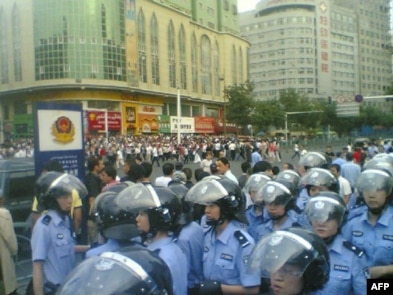
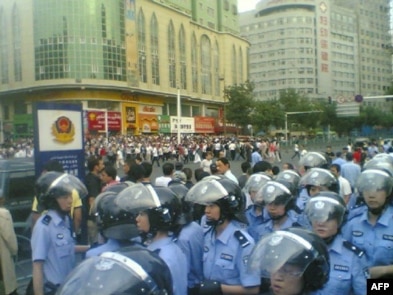
    An image released by the U.S.-based Uyghur American Association of the clashes in Urumqi on July 5.

    July 06, 2009

    Current and former Uyghur activists abroad have rejected Chinese officials’ accusations of involvement in weekend violence that has left 140 people dead and hundreds injured in Xinjiang province, a heavily Uyghur swath of western China where ethnic and social frustrations run high.

    Chinese officials have blamed “separatists” in the Xinjiang autonomous region and Uyghur plotters abroad — including the World Uyghur Congress — for rioting that broke out on July 5 and quickly escalated before thousands of additional security troops were dispatched to get a handle on the unrest.

    Uyghur exiles have rejected Chinese officials’ claims of a plot and said the unrest was caused by police opening fire on a peaceful protest. The exiles said the riot was an outpouring of anger over government policies and Han Chinese dominance of economic opportunities.

    Police and other security forces continued their stepped-up presence on July 6, and reports suggested the streets were largely quiet.

    In a telephone interview with RFE/RL’s Tatar-Bashkir Service from his home in Germany, the vice president of the World Uyghur Congress, Asgar Can, downplayed Chinese allegations of involvement by his group in the unrest.

    “If any protest appears in East Turkistan [the Xinjiang region], the Chinese government always blames the World Uyghur Congress for allegedly arranging those protests,” Can said. “Instead of blaming us, the government should listen to the problems of Uyghurs in the region and give what our people demand from the government, and this kind of protest would never happen.”

    Can accused Beijing of persecuting Uyghurs through suppression of their Turkic language as well as religion and speech, population-control measures, and nuclear tests in their historical homeland.

    “This protest is just a response to the inhuman treatment of Uyghurs by the Chinese government,” Can said.

    His group issued a statement condemning “China’s brutal crackdown of a peaceful protest in Urumchi.”

    Major Minority

    Uyghurs are thought to compose roughly half of the Xinjiang region’s population of around 16 million.

    In a historical context Xinjiang (New Frontier) is widely regarded as a part of Central Asia and, specifically, a region known as Eastern Turkistan. It became a tense hot spot following the implosion of the Soviet Union and newfound independence for five Central Asian republics in 1991.

    As a result, clashes between the most outspoken Uyghur proponents of independence and Chinese authorities have been a frequent occurrence over the past 15 years or so.

    Speaking after the latest unrest, Rozimukhamet Abdulbakiev, a former Uyghur activist in neighboring Kygyzstan, suggested the woeful rights situation was to blame for the kind of deep resentment that might have sparked the bloodshed.

    “When the Soviet Union collapsed and the Kyrgyz, Kazakh, Uzbek states became independent, the Uyghurs became especially eager [to pursue] their independence with a new strength — this is what we’re seeing today,” Abdulbakiev, a former head of NGO Ittipaq (Unity) in Kyrgyzstan, told RFE/RL’s Kyrgyz Service in Bishkek.

    “If the Chinese government were democratic and if it carried out political reforms, then this kind of harsh resistance would disappear,” he added.

    Abdulbakiev called the unrest “a political and social matter” with roots in Beijing’s treatment of a beleaguered minority.

    “Even though China granted Xinjiang the status of an autonomous Uyghur region, there is no sign of autonomy there. There are no rights for Uyghurs there — nothing,” Abdulbakiev said. “The Chinese totalitarian regime has suppressed all freedom of speech, freedom of the press, freedom of personality, freedom of conscience [for Uyghurs] — that is why, of course, people have risen against it.”

    Xinjiang is a major corridor for Chinese trade and energy ties with Central Asia, and is itself rich in gas, minerals, and agricultural production.

    Other International Reaction

    The latest violence followed a June clash between Uyghurs and Han Chinese in the southern Guangdong province in June that reportedly left two Uyghurs dead.

    UN Secretary-General Ban Ki-moon responded to the violence by saying differences must be resolved peacefully through dialogue. He also urged governments to protect the lives and safety of civilians, as well as freedoms of speech, assembly, and information.

    Italy’s President Giorgio Napolitano brought up the question of human rights at a press conference with his Chinese counterpart, Hu Jintao, in Rome. He said both sides agreed that “economic and social progress that is being achieved in China places new demands in terms of human rights.”

    In London, a spokesman for Prime Minister Gordon Brown urged restraint from all sides.

    written by Andy Heil and RFE/RL correspondent Antoine Blua with contributions from RFE/RL’s Kyrgyz and Tatar-Bashkir Services

    https://www.rferl.org/a/Kyrgyz_Uyghur_Sees_Roots_Of_China_Unrest_In_Beijing_Policies/1770623.html

  • Urumqi Tense, Quiet after Violence

    Urumqi Tense, Quiet after Violence

    2009-07-05

    China blames overseas Uyghurs for inciting rioting in the northwestern city, saying at least 140 people died in the violence.

    Sent by a witness

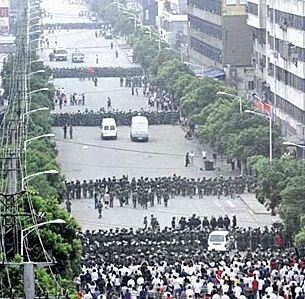
    On this picture sent to RFA by a witness, cordons of Chinese riot police face up to demonstrators on July 5, in Urumqi.

    UPDATED JULY 5, 1722 GMT

    HONG KONGChinese authorities in the northwestern Xinjiang Uyghur Autonomous Region (XUAR) said the capital Urumqi was calm under tight security following deadly weekend riots, with tensions still simmering below the surface, as the United Nations chief called for restraint and peaceful dialogue.

    The clashes, which left at least 140 dead and hundreds injured, flared after an initially peaceful demonstration took to the city’s streets in protest at how the authorities handled recent violence between majority Han Chinese and Uyghur factory workers in the southern province of Guangdong, eyewitnesses said.

    According to the official Chinese Xinhua news agency, 57 dead bodies were retrieved from Urumqi’s streets and lanes, while all the others were confirmed dead at hospitals.

    Security forces were now manning checkpoints at strategic points throughout the city, and ethnic minority officers were being drafted from outlying regions to help interrogate detained suspects, police said.

    XUAR police chief Liu Yaohua told reporters Monday that apart from the 140 confirmed dead, 828 people were injured in the deadly violence that erupted Sunday night, and that the death toll would “continue to climb.”

    Liu said rioters burned 261 motor vehicles, including 190 buses, at least 10 taxis and two police cars, with vehicles still visibly aflame on the city streets early Monday.

    Rioters destroyed 203 shops and 14 homes, and several hundred people had been detained, he added.

    “Police have tightened security in downtown Urumqi streets and at key institutions such as power and natural gas companies and TV stations to prevent large-scale riots,” Xinhua quoted Liu as saying.

    International concern

    truck_200
    Armored police car in an unknown Urumqi street, on July 5.
    In Geneva, United National Secretary-General Ban Ki-moon called Monday for restraint, while Italian President Giorgio Napolitano raised the issue of human rights with Chinese President Hu Jintao and British Prime Minister Gordon Brown’s government voiced concern over the violence. In Washington, U.S. officials declined to comment.

    “Wherever it is happening or has happened, the position of the United Nations and the secretary-general has been consistent and clear: that all the differences of opinion, whether domestic or international, must be resolved peacefully through dialogue,” Ban told a news conference.

    “Governments concerned must also exercise extreme care and take necessary measures to protect the life and safety of the civilian population and their citizens and their properties, and protect freedom of speech, freedom of assembly, and freedom of information,” he added.

    Fear of escalation

    Uyghur witnesses said the protest began when as many as 1,000 Uyghurs gathered to demand a probe into the deadly fight in Guangdong late last month.

    Before the demonstrators reached the People’s Square in central Urumqi, armed police were in position and moved to disperse them, one witness said.

    Police “scattered them [the protesters],” he said. “They beat them. Beat them, including girls, very, very viciously,” he said. “The police were chasing them and captured many of them. They were beaten badly.”

    ‘Electroshock weapons’

    “When the demonstrators reached the People’s Square, armed police suppressed them using electroshock weapons and so on,” he said, adding, “after that, other protests erupted in Uyghur areas of town.”

    A shopowner in Urumqi who declined to give his name said he had had to close for business as police swarmed through the city.

    “We closed our doors from last night. Armed police dispersed the protesters in about two hours. Firefighters were also dispatched and last night police were all over the city,” he said in an interview Monday.

    “Riots took place in bus stations, in tourist spots, and in shopping areas. Scores of Uyghurs were killed. Armed police were carrying automatic assault rifles and machine guns. There were thousands of soldiers. It had a tremendous impact, and we won’t be able to go to work for three days,” another resident said, also speaking on condition on anonymity.

    arrest_200
    A young Uyghur man is being taken away by two helmeted Chinese policemen in an Urumqi street, on July 5.
    “When the protest started… I was near the Bank of China in Nanmen. There were many people. Police surrounded the areas from Döngköwrük to Nanmen,” one youth said Sunday. “There were police, paramilitary. They were fully armored, and they had steel helmets, too.”

    “One was giving a speech in front of the bank and people were applauding him… Most of them were students,” he said.

    “Police circled around them, and we couldn’t get inside.”

    Another youth said the protest began peacefully but became violent after police fired on the crowd, and protesters then attacked cars and shops. His account couldn’t be independently confirmed.

    City ‘now calm’

    A police officer contacted by telephone early Monday said a curfew had been imposed on Uyghur areas.

    “People are dead. This might have planned by evil-minded people,” the officer said.

    Urumqi is home to 2.3 million residents, including many Uyghurs, who have chafed for years under Chinese rule. The city is located 3,270 kms (2,050 miles) west of Beijing.

    Uyghur sources said the protest was organized online and began early July 5  with about 1,000 people but grew by thousands more during the day.

    Online messages meanwhile called on Uyghurs in other major cities to stage protests Monday to show support for the Uyghurs who died in Shaoguan.

    “We decided to hold a demonstration and stressed that it shouldn’t be violent,” an organizer of Sunday’s demonstration said in an interview.

    Security in Urumqi is always tight, including strict controls over information. Witnesses spoke Sunday on condition of anonymity.

    Exiles blamed

    In a televised speech on Monday, XUAR Governor Nur Bekri explicitly blamed the clashes on Rebiya Kadeer, a former businesswoman who was jailed by Chinese authorities for subversion before she was paroled and admitted to the United States.

    Kadeer now serves as leader of the Washington-based Uyghur American Association and Munich-based World Uyghur Congress, and she has been accused repeatedly of fomenting separatism among Uyghurs against the Chinese authorities.

    “This riot is typical, directed from overseas but carried out inside [China], organized and premeditated,” Nur Bekri said. “On July 5, Rebiya made a phone call to China to incite the riot and by 7 p.m.  protests erupted in Urumqi, and in some locations there was violence.”

    smoke_200
    Smoke rise above Urumqi from a location near South Gate (Nan Min) on July 5, as demonstrators clashed with police.
    Both Kadeer and a spokesman for the World Uyghur Congress, Dilshat Rashit, have rejected the charge.

    The Uyghur American Association, in a statement late Sunday, cited reports that 1,000 to 3,000 protesters marched through the Döngköwrük [Erdaoqiao] area of Urumqi on Sunday, “some of whom were waving the flag of the People’s Republic of China.”

    Chinese authorities deployed regular police, anti-riot police, special police, and the People’s Armed Police to contain them, it said, citing unnamed witnesses as saying that an unknown number of Uyghur protesters died after police fired on them.

    Kadeer said the violence “could have been avoided if the Chinese authorities had properly investigated the Shaoguan killings.”

    In separate interviews, three Uyghur youths now under Chinese government protection said the fighting in Shaoguan began when Han Chinese laborers stormed the dormitories of Uyghur colleagues, beating them with clubs, bars, and machetes.

    The clashes began late June 25 and lasted into the early hours of the following day. At least two people were killed and 118 injured, and witnesses said the numbers could be higher.

    Underlying resentment

    message_250
    Screen shot from a message board in Uyghur showing a message in an image, calling for a demonstration in Kashgar, in front of the mosque, on July 6.
    Like Tibet, which erupted in protests in early 2008, the XUAR has long been home to smoldering ethnic tensions related to religion, culture, and regional economic development that residents say has disproportionately enriched and employed majority Han Chinese immigrants.

    China has accused Uyghur separatists of fomenting unrest in the region, particularly in the run-up to and during the Olympics last year, when a wave of violence hit the vast desert region.

    The violence prompted a crackdown in which the government says 1,295 people were detained for state security crimes, along with tighter curbs on the practice of Islam.

    XUAR Party Chief Wang Lequan was quoted in China’s official media as saying the fight against these forces was a “life or death struggle,” and he has spoken since of the need to “strike hard” against ethnic separatism.

    Activists have reported wide-scale detentions, arrests, new curbs on religious practices, travel restrictions, and stepped-up controls over free expression.

    Original reporting by Mamatjan Juma, Shohret Hoshur, and Mehriban for RFA’s Uyghur service and by Qiao Long fro RFA’s Mandarin service. Translated from the Uyghur by Mamatjan Juma and from the Mandarin by Jia Yuan. Uyghur service director: Dolkun Kamberi. Mandarin service director: Jennifer Chou. Written and produced in English by Sarah Jackson-Han. Edited by Luisetta Mudie.

    https://www.rfa.org/english/news/uyghur/riots-07052009153209.html
  • Creeping Islamism in Turkey

    Creeping Islamism in Turkey

    July 3, 9:12 AM · Richard Shulman – NY Israel Conflict Examiner
    A.P. Photo/ Burhan Ozbilici

    The Islamist ruling party in Turkey [AKP] has “a strategy for a creeping Islamization that culminates in a Shari’a (Islamic law) state not compatible with a secular, democratic order.  The AKP does not advertise this agenda and often denies it.”  Turkish courts confirmed the secret agenda.  However, in the name of democracy, the U.S. and the EU demand that countervailing Turkish circles accept the AKP positions subverting the military, judiciary, and educational system.  This Western pressure is naïve, for it betrays the democratic elements in Turkey to the Islamists, who, as they consolidate power, crimp democracy.  Democracy is not just rule by the majority but allows civil rights, minority opinion and cultural freedom consistent with constitutional order.  In Turkey, democracy is a cover for creeping Islamism and the ending democracy.

    Can’t expect much policy revision by Europe.  Europe is losing sight of the values of its civilization [or is reverting to hedonism and apathy].  Europe doesn’t understand what is happening to it.  Europe has proved inept at ethnic problems.

    Ordinary reform in Turkey is not enough.  Needed is fundamental reform, such as Europeanizing Islam.  Turkish immigrants in Islamic enclaves in Germany are not like Europeans in matters of tolerance and democracy.  The AKP head called their possible assimilation into Europe a “crime against humanity.”  In other words, he wants them to retain their hostility in exchange for German hospitality.  [Sounds like preparation for introducing civil war to Europe.]

    If the Turkish immigrants assimilated into European culture, they could become a welcome and useful addition to Europe, whose population is declining.  Can’t expect much policy revision in Turkey.  Islamists, being undemocratic, don’t compromise.

    Thus, when the AKP legalized the head scarf, which signifies Islamization, and the Supreme Court found it contravened their secular constitution, the AKP threatened to shut the court.

    Many Europeans praised the AKP on this issue, as being moderate and democratic.  As a result of the misguided European notion of democracy, moderate, secularist Turks feel abandoned by the West and alienated towards it.  In Turkey, this issue is debated more honestly than it is in Europe.

    The only difference between moderate and jihadist Islamists is the use of ballots.  The naïve West thinks that including Islamists in politics would tame it.  It didn’t in Gaza, Lebanon, and Iraq.  Hamas and Hizbullah kept their militias, which contravenes democracy  (Paul Marshall, Jewish Political Chronicle, spring 2009, p.11 from M. E. Quarterly, winter 2009).

    The Western foreign policy establishment has taken a counter-productive position on this.  Secularist Europe actually is helping repress secularist Turkey!

    For another discussion of Turkish Islamism, click here:

    Author Richard Shulman is an Examiner from New York. You can see Richard’s articles at: “

  • Turkey appoints new representative to UN

    Turkey appoints new representative to UN

    Baki Ilkin was Turkey’s former permanent representative to the UN. Saturday, 04 July 2009 10:15 Turkey has appointed a new representative to the United Nations (UN).

    ertugrul-apakan

    Turkey appointed Foreign Ministry Undersecretary Ertugrul Apakan as its new permanent representative to the UN on June 29.

    The concerned decree was published on Saturday’s Official Gazette.

    Baki Ilkin was Turkey’s former permanent representative to the UN. He represented Turkey in the UN for the past four and a half years, and retired on July 1.

  • Uighurs need media attention

    Uighurs need media attention

    Dear friends,

    According to a resident, internet has been disconnected through out Xinjiang, a sign that the Chinese gov. has and will murder many more innocent Uighurs.  They have confiscated phones, cell phones, computers and any other form of communication devices for they do not want the world to hear the protesters’s cries for help.  It is now our job to communicate the message that these brave Uighurs are sacrificing their lives to communicate to the rest of the World.  We need as much media attention as we can get, please contact your local media and give them information about he protest and let them know that this was a peaceful protest that is violently suppressed by the Chinese gov.  Email them, call them, mail them, send them photos, links, youtube videos, please be presistant remind them that the people are dying by the second and we can not afford to waste any time.  It may be hard to divert media attention from the ever so important Michael Jackson’s death, but please be persuasive, try to evoke their compassion if they have any, with videos and photos of this horrific event!!!!!!

    Thank you and God bless!