Month: July 2009

  • Azeri Delegation Makes Rare Trip To Karabakh

    Azeri Delegation Makes Rare Trip To Karabakh

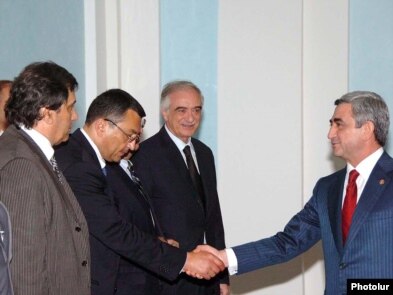
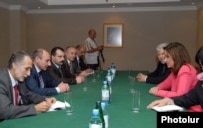
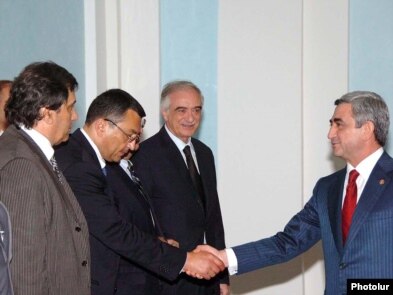
    Armenia — Azerbaijani Ambassador to Russia Polad Bulbuloglu (C) and members of his delegation meet with President Serzh Sarkisian in Yerevan on July 3, 2009.

    03.07.2009
    Lusine Musayelian

    An Azerbaijani delegation led by a prominent diplomat and public figure paid a rare visit to Nagorno-Karabakh and Armenia on Friday as part of a Russian-backed initiative to rebuild bridges between the two estranged peoples.

    “We are here to create relations between people,” Polad Bulbuloglu, Azerbaijan’s ambassador to Russia, said after arriving in Stepanakert along with several Azerbaijani intellectuals, two of them parliament deputies.


    The delegation crossed into Karabakh from a northern section of the heavily fortified Armenian-Azerbaijani line of contact. Troops deployed there temporarily cleared the area of landmines to ensure the group’s safe passage.


    The Azerbaijanis were accompanied by Mikhail Shvydkoy, a former Russian culture minister who acted on behalf of President Dmitry Medvedev. They were joined in Karabakh by Armen Smbatian, the Armenian ambassador in Moscow. Bulbuloglu and Smbatian already organized a similar trip two years ago.


    “Unlike our first trip, we have had pretty heated debates here this time around,” Bulbuloglu told journalists after he and his companions met with Nagorno-Karabakh President Bako Sahakian, members of the Karabakh parliament and local intellectuals. He did not go into details.


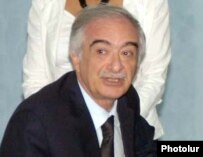
    Armenia — Polad Bulbuloglu in Yerevan on July 3, 2009.

    Bulbuloglu, who had previously served Azerbaijan’s culture minister, said the initiative is aimed at strengthening trust between Armenians and Azerbaijanis and thereby facilitating a peaceful settlement of the Karabakh dispute. “Neither the Armenians, nor the Azerbaijanis are going to fly to outer space [for good,]” he said. “We have to live together. That is why we need to make contacts, to create relationships, to instill mutual respect.”


    “Our peoples have for centuries lived side by side, and I am deeply convinced that after a certain number of years everything will be sorted out and we will again live together,” added the former popular singer.


    The Azerbaijani visitors then traveled to the nearby town of Shushi, that had a predominantly Azerbaijani population before being captured by Karabakh Armenian forces in 1992. They went into a local house that belonged to Bulbuloglu’s late father.


    The delegation proceeded to Yerevan later in the day to meet with President Serzh Sarkisian. “We have always been and remain of the opinion that it is possible to find solutions to difficult issues through cooperation and dialogue,” Sarkisian said, according to his office.


    Joined by Smbatian and several other Armenians, the group traveled to Baku after the meeting. Azerbaijani President Ilham Aliev is due to meet them on Saturday.

     http://www.armenialiberty.org/content/article/1768889.html
  • OSCE ‘Encouraged’ By Karabakh Progress

    OSCE ‘Encouraged’ By Karabakh Progress

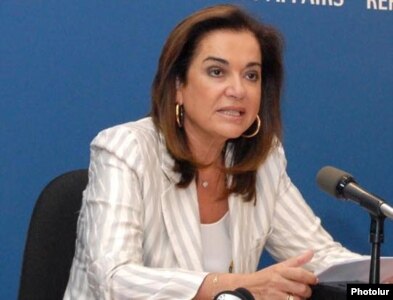
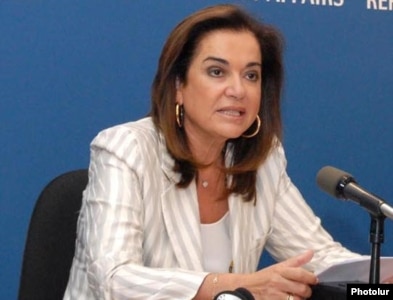
    Armenia — Greek Foreign Minister Dora Bakoyannis holds a news conference in Yerevan on July 3, 2009.

    03.07.2009
    Tigran Avetisian, Sarkis Harutiunian

    Greek Foreign Minister Dora Bakoyannis welcomed Armenia’s ongoing dialogue with Turkey and sounded optimistic about the resolution of the Nagorno-Karabakh conflict on Friday as she visited Yerevan in her capacity as chairwoman-in-office of the Organization for Security and Cooperation in Europe.

    Nagorno-Karabakh President Bako Sahakian asserted, however, the conflict is unlikely to be settled anytime soon.

    The issue was high on the agenda of Bakoyannis’s talks with President Serzh Sarkisian and Foreign Minister Eduard Nalbandian. She also met Sahakian in Yerevan late on Thursday.

    “[Armenian-Azerbaijani] talks are at a critical point and I am encouraged by the political will expressed by both sides and the Minsk Group’s commitment to bring about positive results,” Bakoyannis told a news conference.

    She announced that Sarkisian and his Azerbaijani counterpart Ilham Aliev will again meet soon to try to “build on this momentum.” “We are optimistic that the meeting of the two presidents, which will take place in Moscow, will make progress on the issue,” she said.

    International mediators acting under the aegis of the OSCE’s Minsk Group hope that Aliev and Sarkisian will remove the final obstacles to signing a framework peace accord when they meet later this month.

    Armenia — Greek Foreign Minister Dora Bakoyannis (R) meets the ethnic Armenian leadership of Nagorno-Karabakh in Yerevan on July 2, 2009.

    Sahakian was far more pessimistic about peace prospects when he spoke to journalists after meeting with the Greek leader. “I don’t expect that we will register such success in the course of this year,” he said. “Not just this year but any other time. We can never anticipate a breakthrough as long as the Nagorno-Karabakh Republic does not participate in the process.”

    Sahakian did not say whether the authorities in Stepanakert agree with the existing basic principles of a Karabakh settlement put forward by the Minsk Group mediators. Some Karabakh officials have rejected the compromise formula as unacceptable.

    Bakoyannis also discussed with the Armenian leaders other regional security issues and the dramatic rapprochement between Armenia and Turkey. “Armenia is an important country for stability in the South Caucasus,” she said. “While continuing political reforms at home, it has begun a sensitive dialogue with Turkey, it has demonstrated maturity and self-confidence that larger and stronger countries often miss.”

    Nalbandian stood by his earlier assurances that the Turkish-Armenian dialogue may still yield tangible results despite recent statements by Turkish leaders. “We have reached some agreements to normalize relations and open the border without any preconditions,” he said.

    Prime Minister Recep Tayyip Erdogan and other Turkish officials have repeatedly stated in recent months that Ankara will not establish diplomatic relations and open the Turkish-Armenian border until the Karabakh conflict is resolved.

    https://www.azatutyun.am/a/1768646.html

  • Medvedev had a telephone conversation with Abdullah Gul

    Medvedev had a telephone conversation with Abdullah Gul

    July 3, 2009
    14:45

    The topics of discussion included Russian-Turkish cooperation in international affairs and current trends in trade and economic cooperation.

    Both sides welcomed the stability of the Russian-Turkish strategic partnership and the continued trust-based, constructive dialogue at all levels. All these factors significantly contribute to resolving regional problems and have a positive influence on the overall international climate.

    The parties also expressed satisfaction with the dynamic development of bilateral trade and economic cooperation, even in the difficult circumstances of the global crisis. When discussing specific issues, the Presidents gave particular attention to promoting cooperation in energy and fuels.

    The conversation was initiated by the Turkish side.

  • IMF TALKS PROVIDE WAY TO GAUGE ANKARA’S FISCAL DISCIPLINE

    IMF TALKS PROVIDE WAY TO GAUGE ANKARA’S FISCAL DISCIPLINE

    Nicholas Birch 7/02/09

    Turkey and the International Monetary Fund will be making a final push in the coming weeks to see whether they can conclude a loan agreement, according to Prime Minister Recep Tayyip Erdogan. Turkish analysts say the Turkish-IMF wrangling is masking a more important question: is Ankara committed to sustaining fiscally prudent policies that have made it an attractive foreign investment destination during this decade?

    “Turkey may be able to roll over debt this year, but that is not the issue”, says Elif Bilgi, managing director of EFG Securities, an Istanbul brokerage. “The issue is whether Turkey is going to continue with fiscal prudence.”

    After decades of boom-and-bust cycles that culminated in a banking crisis in 2001, Turkey pulled itself together under the current Justice and Development Party (AKP) government, pushing through a program of reforms and privatization that brought in up to $20 billion in foreign direct investment annually.

    This year, though, huge increases in spending on municipalities and health have dug a deep budgetary hole. Turkey’s deficit rose 268 percent during the first four months of this year to TL 20.1billion ($12.8 billion) and is expected to reach 7 percent of GDP by the end of 2009.

    Turkey’s leaders say the results reflect its efforts to stimulate a slowing economy, and insist there is no need for concern. With counter-cyclical fiscal easing going on all over the globe these days, they have a fair point.

    After six years in which it maintained impressive budget surpluses, Turkey does have a little money to spend during these rainy days. Meanwhile, increasing pressure on state finances looks likely to be offset by a current account deficit that is expected to plummet from $42 billion last year to $10 billion in 2009, due mainly to lower petrol prices and falling imports.

    But Ankara’s argument is also a touch disingenuous. For a start, Turkey began loosening fiscal policies during the run up to general elections in 2007 — well before the start of the global financial crisis. More importantly, analysts say, the budget deficit today is as much the result of Turkey’s reluctance to tackle crucial structural reforms, as it is of recent efforts to stimulate a domestic economy in crisis.

    “The whole Turkish fiscal adjustment story was good, but over-rated: a lot of tweaking of indirect taxes — on alcohol, for instance — and little effort to attack structural weakness in the budgetary system”, says Murat Ucer, Istanbul-based economist for the New York economic intelligence company GlobalSource.

    The shortcomings of Turkey’s budget system are legion. According to a May 2009 report by the Britain-based International Budget Partnership, Turkey trails far behind its developing peers in Eastern Europe and South America in terms of budget transparency. And recent changes to regulations on municipal spending have reduced central government oversight even further, says Guven Sak, head of the Economic Policy Research Foundation of Turkey, an Ankara-based think-tank.

    But the key problem is a tax system that is heavily dependent on indirect levies, such as sales tax. That leaves the country’s finances extremely vulnerable to economic downturns.

    IMF officials overseeing the $10 billion stand-by arrangement Turkey completed in 2008 have talked constantly about the need to contain a shadow economy that analysts believe to amount to a third of Turkish GDP. On May 20, Treasury Minister Mehmet Simsek highlighted the urgent need to “up the fight against the unrecorded economy” and “collect income tax” from a broader base.

    Putting words into action now looks set to be tough, though. The IMF expects Turkey’s GDP to shrink by 5.1 percent in 2009, hardly an ideal environment in which to promote zealous tax inspection.

    For Guven Sak, this is where a new IMF loan could play a useful role. “IMF funds could reduce treasury reliance on banks for loans, freeing banks up to finance companies hit by more efficient taxation,” he argues.

    The Turkish-IMF negotiations have proven mildly acrimonious so far. On June 26, Erdogan complained that the IMF has brought up political issues during loan negotiations. “When the IMF goes into political matters, it is not acceptable to us,” Erdogan said during a visit to Brussels.

    There is a political reason for the Turkish leader’s apparent unwillingness to tackle budget and tax reform: general elections in 2011. His party cruised to victory in 2007’s general elections, gaining 47 percent of the vote. But since then, the AKP has seen its political fortunes plummet. Erdogan was clearly stunned when the party garnered only a 39 percent share in local elections this March. “The 2011 polls will define all of Erdogan’s actions from now on”, says Murat Yetkin, Ankara bureau chief for the liberal secular daily Radikal. “If he thinks [a new policy] will cost him votes, he will take all risks and not sign along the dotted line.”

    Upping the efficiency of income and corporate tax collection never was a vote-winner. What makes the issue especially sensitive for Erdogan is that tax evasion is widespread among small and medium enterprises and Anatolian businessmen that form a key portion of the AKP’s base of support.

    Few analysts foresee Turkey facing major economic problems in the short-term, with or without a new IMF deal. For Murat Ucer, though, the government’s ongoing failure to agree on the need for a fiscal rule bodes ill for the middle-term. “Turkey is losing sustainability of public finances”, he said. “For the past three years, we have been at a crossroads: are we going to tackle structural reforms? Or are we going to basically risk going back to the 1990s, with unsustainable debt and high inflation? We haven’t started that game yet, but the trend is in that direction.”


    Editor’s Note: Nicolas Birch specializes in Turkey, Iran and the Middle East.

  • UK swine flu can no longer be contained

    UK swine flu can no longer be contained

    Government moves to ‘treatment phase’ as health secretary says infection rate could reach 100,000 a day by end of August


    Swine flu is spreading so rapidly across Britain that there could be 100,000 new cases a day by the end of next month, the health secretary, Andy Burnham, said today.

    The UK would immediately move to the “treatment phase” of its plan to combat swine flu, meaning doctors would no longer test for the H1N1 virus and urge anyone with symptoms to stay at home, Burnham told the House of Commons.

    The first swine flu vaccine would be made available from August, with 60m doses available by the end of the year, he added.

    “We have reached the next stage in management of the disease,” Burnham said. “The national focus will be on treating the increasing numbers affected by swine flu. We will move to this treatment phase across the UK with immediate effect.”

    The move does not mean the H1N1 virus, which was declared a pandemic by the World Health Organisation last month, is becoming more deadly, just that it can no longer be contained.

    Burnham said there was a “considerable rise” in swine flu cases last week.

    “We have always known it would be impossible to contain the virus indefinitely and at some point we would need to move away from containment to treatment.

    “Cases are doubling every week and on this trend we could see over 100,000 cases per day by the end of August.

    “The pressure on the system is such that it is the right time to take this step. Scientists can expect to see rapid rises in the number of cases.”

    Burnham added that the public should be reassured by the steps being taken to tackle the virus. He said: “We are the only country in the world to be able to offer anti-virals to everyone as well as those at greater risk.”

    The government’s chief medical officer, Professor Sir Liam Donaldson, said the production of a vaccine was “at an advanced stage” and denied that the outbreak was out of control.

    Speaking at a special briefing at the Department of Health, he said: “We are continuing to take a very firm grip on this situation. We have a big stockpile of anti-virals, the biggest probably in the world. We have vaccine at an advance stage of production.”

    Donaldson added that despite its rapid spread, the virus outbreak was “following a predictable path”.

    The Health Protection Agency said a further 458 patients in England had been confirmed with swine flu, while the figure for the UK as a whole rose to 7,447.

    Efforts to trace people who had been in contact with swine flu cases would now stop and schools no longer needed to close when hit by the virus, unless particular circumstances made it necessary.

    The government has said that not everybody with swine flu would receive anti-viral drugs, which may be reserved for at-risk groups.

    The daily collation of swine flu cases would also end because it was proving time-consuming. Instead, “more general” estimates of numbers would be given. Other affected countries already update their swine flu numbers less frequently, such as weekly or every other day.

    The Scottish health secretary, Nicola Sturgeon, announced a similar shift in swine flu policy at a simultaneous briefing in Edinburgh.

    She said: “We’ve always said it would be impossible to limit the spread of what is a contagious virus indefinitely.

    “We’ve always said that, when it did start to spread more widely within communities, we would require to make a judgment about when to shift efforts from intense containment to treatment, or mitigation.”

    Sturgeon, who is also the deputy first minister of Scotland, said “high-risk” groups such as children under five, pregnant women and the elderly would get priority access to medication.

    Scotland’s chief medical officer, Harry Burns, said the country could expect to have a tenth of the UK cases of swine flu. He predicted there would be about 10,000 new cases a day in Scotland by August.

    He said: “It could be a bit less, it could be a bit more. It also presupposes that there isn’t a downturn, if it continues to rise at this rate, and it’s doubling approximately every week, you can do the sums yourself.”

    However, Scottish health officials said the swine flu infection rate may have already peaked, as the number of new cases in three hotspots in the greater Glasgow area appears to be in decline.

    After infection rates peaked at 111 confirmed cases on 25 June, with Scotland experiencing the first two swine flu deaths in Europe, the rate has remained steady at about 60 new cases a day over the last week.

    The rapid spread in two of the major hotspots – Dunoon in Argyll and Paisley south of Glasgow – now appears to have stopped and cases have begun to decline sharply.

    The official statistics on the virus were likely to underestimate the true scale of infection in the UK because now only a sample of patients in the hotspots had a diagnosis of swine flu confirmed by lab tests. Many people were thought to have such mild symptoms that they were not bothering to contact their doctors while others were being treated in surgeries without being regarded as suspected swine flu cases.

    In swine flu hotspots such as London, the West Midlands and parts of Scotland diagnosis of the virus was already being done by doctors rather than laboratory testing, and tracing the contacts of people with swine flu and the use of preventative anti-viral drugs had stopped. Anti-viral drugs were still being offered to all people with symptoms.

    Although a bout of swine flu was currently causing less serious illness than traditional seasonal flu, three people with other serious health conditions in the UK have died after catching the virus and there are concerns it could mutate into a more virulent form.

    The chief medical officer, Sir Liam Donaldson, has warned that there may be tens of thousands of cases each week this autumn, because the virus is more likely to thrive in a colder climate.

    Guardian
  • Swine Flu as Biological Warfare Weapon?

    Swine Flu as Biological Warfare Weapon?


    Swine Flu as Biological Warfare Weapon?

    Do you think that the H1N1 strain of swine flu is likely to be a CREATED weapon of mass infection? Consider the logistics involved in order for this virus to have combined itself the way it has. From an article on NAtural News….

    (NaturalNews) Perhaps due to the genetic makeup of the fast-spreading H1N1 strain of influenza — which includes genetic elements from bird flu, swine flu and human flu spanning three continents — there is considerable speculation that the origins of this virus are man-made……..

    Is there any hard evidence of laboratory origins?

    As of this moment, I have not personally seen any conclusive evidence of laboratory origins for this H1N1 swine flu. I am open to the possibility that new evidence may emerge in this direction, however, and I am suspicious of the genetic makeup of the virus as one possible indicator of its origins.

    I am not a medical specialist in the area of infectious disease, but I have studied microbiology, genetics and a considerable amount of material on pandemics. What seems suspicious to me is the hybrid origin of the viral fragments found in H1N1 influenza. According to reports in the mainstream media (which has no reason to lie about this particular detail), this strain of influenza contains viral code fragments from:

    • Human influenza
    • Bird Flu from North America
    • Swine flu from Europe
    • Swine flu from Asia

    This is rather astonishing to realize, because for this to have been a natural combination of viral fragments, it means an infected bird from North America would have had to infect pigs in Europe, then be re-infected by those some pigs with an unlikely cross-species mutation that allowed the bird to carry it again, then that bird would have had to fly to Asia and infected pigs there, and those Asian pigs then mutated the virus once again (while preserving the European swine and bird flu elements) to become human transmittable, and then a human would have had to catch that virus from the Asian pigs — in Mexico! — and spread it to others. (This isn’t the only explanation of how it could have happened, but it is one scenario that gives you an idea of the complexity of such a thing happening).

    A news report on the alternative media website “InfoWars” says the following…

    During the Security and Prosperity Partnership (SPP) Summit in Montebello, Canada in 2005, the “three amigos” (Bush, Harper and Calderon) released “North American Plan for Avian and Pandemic Influenza,” described as a “collaborative North American approach that recognizes that controlling the spread of avian influenza or a novel strain of human influenza, with minimal economic disruption, is in the best interest of all three countries.” The plan outlines how “Canada, Mexico and the United States intend to work together to prepare for and manage avian and pandemic influenza.”….

    On Monday, UN Secretary-General Ban Ki-moon stoked the fear of a global flu pandemic. He said the Mexican flu outbreak is the “first test” of the “pandemic preparedness work undertaken by the international community over the past three years.” Ban Ki-moon said if “we are indeed facing a pandemic, we need to demonstrate global solidarity. In our interconnected world, no nation can deal with threats of such dimension on its own.”

    For Ki-moon and the global elite, “global solidarity” in “our interconnected world” translates into yet another push for world government. Ki-moon’s dire warning falls on the heels of the G20 summit where plans were announced for implementing the creation of a new global currency to replace the U.S. dollar’s role as the world reserve currency. British Prime Minister Gordon Brown and others repeatedly called for “global governance” and a “New World Order.”


    If this is your first introduction to the idea that our governements could be so devious, take a deep breath, and just consider that all is NEVER what it seems. Granted InfoWars reporting tends to be a little on the outside of extreme sometimes, but I do believe that there is a distinct probability that away from the option of one world government control (and all that) … that this is just a simple biological warfare weapons test. Well not all that simple, however, it is a fairly well known fact that governments the world over are testing out new strains of viruses and bacterium.

    I am also going to encourage you to compare how this virus is behaving when held up to typical flu pandemics.

    If you don’t think that governments would intentionally spray or test anything on humans then think again. You really need to watch this YouTube video on ChemTrails – It may not convince you but it should get you thinking. OK I know only wierdos talk about chem trails but this is a news story with real laboratory confirmed testing of what falls. It’s a very short clip worth watching.

    What do you think? Have you considered the possibility that certain world governments are using Mexico (and the world) as their own personal petri dish for the swine flu?