Month: July 2009

  • Armed Mobs Throng Urumqi

    Armed Mobs Throng Urumqi

    2009-07-07

    Witnesses say thousands of armed Han Chinese are on the streets of the Xinjiang Uyghur Autonomous Region’s capital vowing revenge after a deadly clash.

    AFP

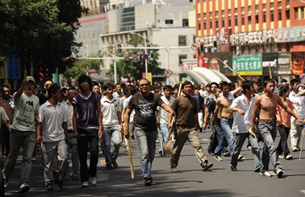
    Han Chinese march with sticks and shovels on a street in Urumqi, July 7, 2009.

    UPDATED JULY 7, 1730 GMT

    HONG KONGAn angry crowd of several thousand ethnic majority Han Chinese has gathered in Urumqi following weekend riots, amid a welter of rumors surrounding deadly clashes between Muslim Uyghurs and police, according to initial reports from foreign journalists and exiled Uyghur groups overseas.

    “Chinese civilians, using clubs, bars, knives, and machetes, are killing the Uyghurs,” the Munich-based World Uyghur Congress said in a statement.

    “They are storming the university dormitories, Uyghur residential homes, workplaces, and organizations,” it said, accusing the mob of killing unprotected Uyghur civilians.

    Foreign correspondents on the ground in Urumqi said they saw armed crowds of thousands of Han Chinese running through the capital of the northwestern Xinjiang Uyghur Autonomous Region (XUAR).

    “Two police officers just escorted a Uyghur woman with a baby through a Han crowd with clubs by the People’s theater,” Time correspondent Austin Ramzy wrote via the real-time micro-blogging platform Twitter.

    Telegraph correspondent Peter Foster reported via Twitter from Urumqi that thousands of armed Han Chinese had gathered near a mosque in Shanxi Alley in downtown Urumqi.

    Police tried to calm the crowd, which was armed with “snooker cues, axes, machetes, baseball bats, metal scaffolding poles, cattle prods, and a plastic mop handle,” according to Foster’s updates.

    Meanwhile, Al-Jazeera correspondent Melissa K. Chan tweeted, also from Urumqi, “A Han Chinese man with a stick just tore open our car door to beat our producer. Averted just in time.”

    Chan said Urumqi was now under martial law. Official media also reported further unrest. Two separate estimates by foreign journalists at the scene put the crowd at around 10,000.

    Despite Chinese officials’ decision to cut off the Internet and mobile phones, pictures, videos and updates from Urumqi poured into social-networking and image-sharing websites including Twitter, YouTube, and Flickr.

    A Han Chinese employee at a youth hostel in downtown Urumqi said, “We have a curfew now and troops are everywhere.”

    “We can still can drive on the streets—but I don’t know if the situation will get worse so I stored some bottles of water and instant noodles,” the employee said.

    “More Han Chinese live in Urumqi than Uyghurs now,” he said. “Many Uyghurs are afraid to go out now. They have their own friends, and we won’t try to be their friends.”

    “Before it was them attacking us. Now it’s our turn to attack them,” another Han Chinese resident said.

    But a municipal official downplayed the tensions.

    “We are coming to work as usual. What do you mean, take to the streets? We will see what happens. Ask again later,” the official said.

    “Of course there have always been ethnic separatists. They have existed for a long time. They are always looking for ways to make trouble. They will do it as soon as they spot an opportunity,” the official added.

    Chaos and vigilantes

    Police fired tear gas repeatedly at the protesters but they refused to disperse. Police were blocking them from getting through to an area of Urumqi populated by Uyghurs, who authorities have blamed for riots on Sunday that left 156 people dead and more than 1,000 injured.

    China’s state-run Xinhua news agency reported similar scenes in other parts of Urumqi.

    “Chaos was seen in a number of places in Urumqi on Tuesday afternoon,” the official Xinhua news agency reported.

    Back in Urumqi, al-Jazeera’s Chan tweeted: “There is no right or wrong anymore. Just vigilantes, Han and [Uyghur]. Mostly men but some women and even children.”

    “I asked a Han Chinese girl if she was scared. Yes. But this is to defend my country, she says with stick in hand.”

    The World Uyghur Congress said it had received several reports of deaths at the hands of Han mobs in different locations in Xinjiang, which is home to a population of Turkic-speaking Uyghurs, many of whom oppose Beijing’s rule, and a growing influx of migrants from the rest of China.

    Ethnic tensions have simmered for decades, with Uyghurs saying they are subject to racial discrimination and have scant access to the fruits of China’s breakneck economic growth of the past 30 years.

    China has said some overseas Uyghur separatist groups are connected with international terrorism.

    Foster reported via Shanghai-based Telegraph correspondent Malcolm Moore that some of the crowd were comparing exiled former Uyghur businesswoman Rebiya Kadeer to al-Qaeda mastermind Osama bin Laden.

    The Congress statement said: “[A] Uyghur young man was mutilated on [Urumqi’s] Dongbeilu. A Uyghur woman who was carrying a baby in her arms was mutilated along with her infant baby on Huanghelu.”

    Witnesses on the ground said the mood of the crowd was ugly, with a group of Han Chinese protesters attacking Telegraph correspondent Foster and his assistant, who were protected by police.

    The Uyghur Congress said Chinese security forces were “not taking any action” against the attackers, and that it had received telephone threats from “ethnic Han Chinese” at its headquarters in Munich.

    A Foreign Ministry spokesman said Tuesday that Sunday’s violence in the region was not a peaceful protest, but “evil killing, fire-setting, and looting.”

    Foreign Ministry spokesman Qin Gang told a regular news briefing: “Anybody calling the violence a peaceful protest is trying to turn black into white in an attempt to mislead the public.”

    Urumqi Communist Party chief Li Zhi went to the scene, addressing the crowd and calling for calm. The crowd roared soon after, before rushing off in the other direction, witnesses said.

    Earlier, Li had told reporters: “We immediately reinforced the emergency prevention and control measures after the riots started. Security was dispatched to the four main areas of unrest, and they swiftly took care of the matter in accordance with the law.”

    Internet curbs, media strategy

    Also Tuesday, Li confirmed at a news conference that authorities there had cut off Internet access in parts of Urumqi to stop the flow of information that it saw as a dangerous threat.

    “We cut the Internet connection in some areas of Urumqi in order to quench the riot quickly and prevent violence from spreading to other places,” Li said.

    The Paris-based media watchdog Reporters Without Borders accused authorities of wanting to see Urumqi “cut off from the rest of the world.”

    “Once again, the Chinese government has chosen to cut communications in order to prevent the free flow of information. We firmly condemn this behavior,” the organization said in a statement.

    Many phone lines have been disabled since the violence erupted, but others remain in working order.

    Netizens inside China said the personal update service Twitter, which is frequently used to transmit keywords, news and photos around the Chinese Web at a speed that eludes China’s censors, was blocked.

    “Twitter is blocked: In another act of net-nanny folly Twitter.com has been blocked on the Chinese mainland,” media analysis blog Danwei commented via the service Monday.

    Other users said the service was still accessible using third-party applications elsewhere on the Web.

    They said sensitive keywords such as “Xinjiang” were currently returning no search results on the Chinese Web, either.

    “Why is it that the moment something happens, the first thing they think of is blocking it?” user Keso tweeted. “Surely the fact that they do this shows that there are skeletons in the closet?”

    Authorities have meanwhile taken the unusual step of bringing foreign reporters to Urumqi to learn about the incident and setting up a media center in a city hotel.

    This contrasts with Beijing’s virtual blackout on previous instances of unrest, such as the Tibetan uprising of early 2008, but is in keeping with its handling of media immediately after the May 2008 Sichuan earthquake.

    But that initial openness ended amid allegations that corruption had resulted in shoddy construction of school buildings that collapsed in the quake.

    Shenzhen-based media commentator Zhu Jianguo said official media reports seemed to be intensifying conflicts rather than soothing them.

    “They are putting out information at a much faster speed than previously but their approach is exactly the same as it always has been,” Zhu said, suggesting the coverage was one-sided.

    “Now the incident has erupted into racial conflict, and it’s not a simple racial conflict either. It’s all over the country—it’s a crucial point at which the government faces off against the people.”

    Original reporting by RFA’s Uyghur, Mandarin, and Cantonese services. Written for the Web in English by Luisetta Mudie. Edited by Sarah Jackson-Han.

    https://www.rfa.org/english/news/uyghur/xinjiang-07072009054344.html
  • Ethnic Unrest Continues In East Turkestan

    Ethnic Unrest Continues In East Turkestan

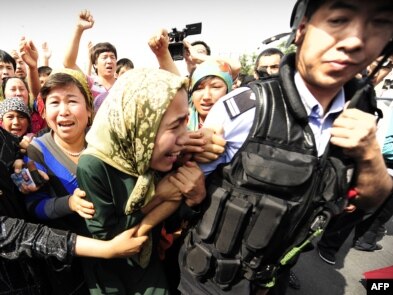
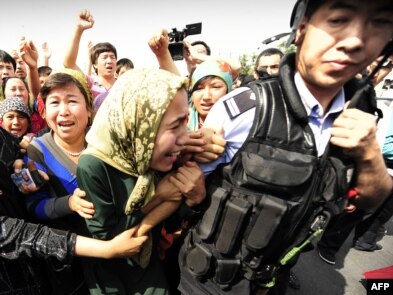
    Ethnic Uyghur women grab at a riot policeman as they protest in Urumqi, Xinjiang province, on July 7.

    July 07, 2009

    There are reports of continued violence in China’s autonomous Xinjiang region, with police dispersing unruly crowds of the country’s predominant Han ethnic group and scattered clashes between Han Chinese and Uyghurs.

    Han Chinese demonstrators smashed shops thought to be owned by minority Muslim Uyghurs in the regional capital, Urumqi, two days after ethnic unrest in the city that officials blamed on Uyghurs left more than 150 people dead. Police said more than 1,400 had been arrested.

    Meanwhile, dozens of Uyghurs faced off against police to protest the arrest of relatives since the rioting began, and authorities imposed a nighttime curfew in the city to prevent further “chaos.”

    Security forces have a heavy presence in the area in an apparent effort to prevent tit-for-tat attacks pitting Uyghurs, who represent about half of Xinjiang’s 16 million residents, against ethnic Han Chinese, who make up the overwhelming majority of the country’s 1.3 billion people.

    Chinese officials blamed the July 5 riots on the Germany-based World Uyghur Congress (WUC) and other Uyghur separatists, a charge the WUC has dismissed as a knee-jerk response from Beijing.

    In an interview with RFE/RL’s Uzbek Service on July 7, WUC President Rebiya Kadir rejected Chinese accusations that she or her organization was in any way involved.

    “They say that I am to blame for these events, but I am in no way responsible for this,” said Kadir, who lives in exile in the United States.

    “In fact, it is China’s government that caused this. China’s government for the past 60 years has suppressed not only Uyghurs but all Turkic nations such as Uzbeks, Kazakhs, and Kyrgyz. They put tens of thousands of them into prisons. But now the nation knows what democracy is, and it went out to protest.”

    Kadir put the put the true number of dead so far, “according to our information,” at more than 400. But there was no way to confirm that figure.

    She also said the authorities “arrested not 1,400 people, but many more than that.”

    Kadir warned that public perceptions of Uyghurs as a “violent” minority are fed by the official line and that Han-Uyghur violence could escalate.

    Fear Of More Bloodshed

    Reports from Urumqi say police fired tear gas to try to restore order when hundreds of Han Chinese armed with metal bars, clubs, and machetes marched through Urumqi, smashing Uyghur-run shops.

    Earlier in the day, at least 200 Uyghurs, mainly women, protested following news that more than 1,400 people were arrested in connection with the July 5 riots. Reuters quoted a man who had participated in that demonstration as claiming that police “took them all away and took them inside.” He said there were young children among the detained protesters.

    Urumqi Communist Party Secretary Li Zhi defended the broad police crackdown, saying the authorities “are protecting the safety of the women and the children.”

    He added, however, that “those who took part in the riots will be dealt with severely, if they were involved in disruption and violence they will be educated.”

    Official media said police on July 6 dispersed a protest by around 200 Uyghurs in Xinjiang’s second-largest city, Kashgar. Checkpoints were reportedly set up at crossroads between the airport and downtown Kashgar.

    Internet connections are still largely cut off in Xinjiang, according to reports.

    Outside China, officials said Molotov cocktails were thrown on July 6 at a Chinese Consulate in Munich, slightly damaging the premises. Uyghur protesters briefly scuffled with police during a protest outside the Chinese Embassy in Ankara on July 7. The consular section of the Chinese Embassy in The Hague was closed to the public, a day after protesters hurled rocks at the mission.

    Humanitarian Concerns

    The fresh unrest is apparently linked to a June clash between Uyghurs and Han Chinese in the southern Guangdong Province that reportedly left two Uyghurs dead.

    Uyghurs outside China say claims of a terrorist threat serve as an excuse for Chinese authorities to crack down on peaceful pro-independence sentiment and expressions of Uyghur identity. They blame police for sparking the initial violence on July 5.

    Rupert Colville, spokesman for UN High Commissioner for Human Rights Navi Pillay, told a news conference in Geneva that “the high commissioner is alarmed by the large number of casualties during [the July 5] rioting in Urumqi, as well as by continuing reports of high tension and unrest in the region.”

    He urged “Uyghur and Han civic leaders, and the Chinese authorities at all levels, to exercise great restraint so as not to spark further violence and loss of life” and called for an independent probe into the tragic weekend events.

    Human Rights Watch’s Asia advocacy director Sophie Richardson repeated calls for an investigation. She also stressed that “our concerns are once again that we’re going to see absolutely no attention paid to due process, arbitrary arrest, possible abuse and torture of detainees. These are very real concerns in China.”

    written by Andy Heil and RFE/RL correspondent Antoine Blua from RFE/RL and agency reports

    https://www.rferl.org/a/Ethnic_Unrest_Continues_In_Xinjiang/1771324.html

  • Ankara Approves Nabucco Following High Level Visit to Moscow

    Ankara Approves Nabucco Following High Level Visit to Moscow

    Ankara Approves Nabucco Following High Level Visit to Moscow

    Publication: Eurasia Daily Monitor Volume: 6 Issue: 128
    July 6, 2009 12:48 PM Age: 4 hrs
    Category: Eurasia Daily Monitor, Home Page, Turkey, Energy, Foreign Policy, Economics, Featured
    By: Saban Kardas
    Ankara has reportedly finally given the green light to the Nabucco project, and the intergovernmental agreement might be signed on July 13. When the news broke on the Russian deal with Azerbaijan (EDM, July 2), the Turkish media initially suggested it represented a lethal blow to Nabucco. Partly as a result of the Russian media’s manipulation, it was interpreted as a negative development to undermine the viability of Nabucco (www.nethaber.com, June 30).

    On July 1-2, the Turkish Foreign Minister Ahmet Davutoglu visited Moscow to meet his Russian counterpart Sergei Lavrov. Before his departure, Davutoglu said that Turkey was unconcerned about the gas deal between Moscow and Baku, and supported enhanced cooperation between its neighbors. Davutoglu maintained that growing regional cooperation, especially in energy, will benefit everyone in the region, (Anadolu Ajansi, July 1).

    Energy Minister Taner Yildiz made a similar point, arguing that the different projects are not alternatives and choosing one does not necessarily mean foregoing another. Yildiz added that the Russian-Azeri agreement would not affect Turkish-Azeri talks on the re-negotiation of the price for Turkey’s gas imports from Shah Deniz-I, and the country’s future imports from Shah Deniz-II (www.iha.com.tr, July 1).

    In Moscow, Davutoglu held talks on bilateral relations as well as regional security issues. During their joint press briefing, Davutoglu emphasized that Turkey and Russia have developed close economic, commercial, cultural and political ties, while both countries could solve their differences through dialogue. Davutoglu told reporters that, though the date was not set, Russian Prime Minister Vladimir Putin would visit Turkey in the near future. Lavrov also underlined that the approaches of the two countries toward regional and global problems overlap.

    Asked about the possibility of Turkey’s cooperation with Russia in the South Stream project, Davutoglu said: “There are no limitations and barriers on Russian-Turkish cooperation. We decided to consider all projects, including alternative energy projects. Therefore, I want to express our readiness to collaborate with Russia on South Stream or other projects in a transparent manner.” Responding to the same question, Lavrov said that if Turkey decided to join the project, the Russian side would prepare the necessary groundwork. He added that the Turkish energy minister will discuss the details with the Russian officials (Anadolu Ajansi, July 2).

    Indeed, Yildiz also visited Moscow at the same time, at the invitation of the Russian Deputy Prime Minister Igor Sechin. As the co-chairs of the joint Turkish-Russian economic council, Yildiz and Sechin discussed bilateral economic relations. Yildiz raised issues relating to Turkish investors operating in Russia, particularly the “customs crisis.” Cooperation in energy issues occupied a large part of Yildiz’s itinerary. Energy related topics included the Russian offer to build Blue Stream II beneath the Black Sea, the current status of Turkey’s first nuclear power plant tender which was awarded to a Russian consortium, preliminary negotiations for additional gas purchases from Russia, and the South Stream project (Milliyet, July 1).

    Sechin told Yildiz that Moscow has studied the feasibility of various possible projects to diversify energy supplies to Europe. He claimed that South Stream outperforms Nabucco in terms of its efficiency and economic feasibility, and invited Turkey to join the project. In particular, he claimed that Russia has enough proven gas reserves to feed South Stream. Nonetheless, the Russian delegation did not elaborate any specific role envisaged for Turkey in South Stream, which in its current form would not cross Turkish territory.

    Yildiz repeated Ankara’s frequent argument that Nabucco and South Stream are not necessarily competitors: “This is a strategic package. It includes important projects that concern the two countries, our regions and our neighbors.” The Turkish government will evaluate all offers on the table, and choose the project that satisfies both countries’ interests, Yildiz added (Cihan, July 2).

    These developments led to speculation that Nabucco was in crisis (www.cnnturk.com, July 2). On his return to Turkey, Yildiz dismissed Russian media reports that Moscow asked Ankara to withdraw from Nabucco. Moreover, Yildiz said that the negotiations on Nabucco were well advanced and the parties were close to signing a deal, though avoiding specifying a date. He added that the talks were being carried out by the foreign ministry and prime minister’s office (Hurriyet, July 3).

    On the same day, European Commission officials announced that Turkey extended an invitation to its Nabucco partners to attend a ceremony in Ankara to sign the long-delayed intergovernmental agreement on July 13 (Anadolu Ajansi, July 3). The commission spokesman and Nabucco officials provided no further details as to whether Turkish demands were met to ensure its supply security, especially the controversial 15 percent clause, which had been stalling the negotiations (www.euobserver.com, July 3).

    Davutoglu flew from Moscow to Bucharest at the invitation of his Romanian counterpart Cristian Diaconescu, where he met the Romanian president and other officials. He discussed bilateral partnerships and regional cooperation in the Black Sea. After emphasizing the flourishing ties between the two countries, Davutoglu praised their cooperation in the context of the Nabucco project. Though he noted that Nabucco and South Stream were not mutually exclusive, Davutoglu maintained “Nabucco is a strategic project for us. This will continue to remain our main priority” (Cihan, July 3).

    Both Davutoglu and Yildiz declined to set a date but affirmed that the intergovernmental agreement will be signed soon. Sources close to Prime Minister Recep Tayyip Erdogan’s office, however, reportedly confirmed that the government plans to hold a ceremony on July 13. If the schedule of the heads of state from the other Nabucco partners, Bulgaria, Romania, Austria and Hungary permits, then the agreement will be signed in Ankara (Hurriyet, July 4).

    What led to this turnaround in Turkey’s position and whether it secured concessions from its partners will be clarified if Ankara hosts the intergovernmental agreement next week. However, last week’s heavy diplomatic traffic, combined with Erdogan’s earlier contacts in Brussels, shows the extent to which Turkey wants to maximize its political and commercial gains by pitting the rival pipeline projects against each other.

    https://jamestown.org/program/ankara-approves-nabucco-following-high-level-visit-to-moscow/
  • France lays down the law on Turkey’s EU progress

    France lays down the law on Turkey’s EU progress

    HONOR MAHONY

    EUOBSERVER / BRUSSELS – France has warned Sweden to respect its views on Turkey’s EU membership negotiations during its EU presidency, saying it will tolerate the two sides moving closer only in certain areas.

    “Everybody knows that as regards enlargement we don’t have exactly the same position as regards Turkey,” said French president Nicolas Sarkozy following a meeting with his Swedish counterpart Fredrik Reinfeldt on Friday (3 July).

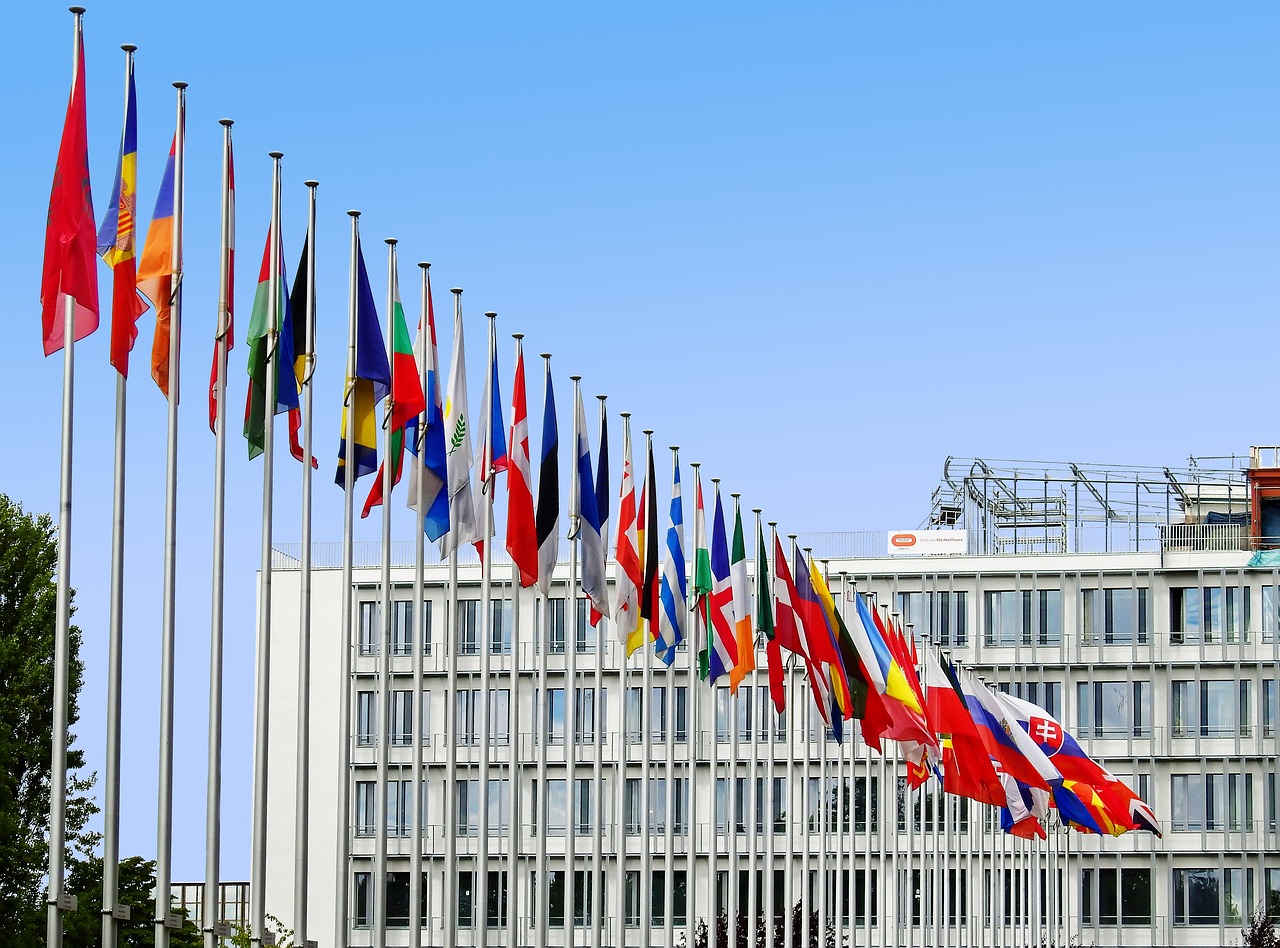
     France drew red lines for the Swedish EU presidency (Photo: European Commission)

    “I am very sensitive to the fact that the chairman of Europe has to take into account all the points of view.”

    Mr Sarkozy, a vocal opponent of Turkey’s full membership of the EU, said he would not hinder further progress in accession negotiations but only if it concerns non-sensitive areas.

    “France will not be against the opening of new chapters under the Swedish chairmanship but, of course, these chapters should allow that Turkey should be an associate member of Europe and not a fully-fledged member,” the president said.

    “I would not like to create any problems for the prime minister and he doesn’t want to create problems for me.”

    Paris in the past blocked negotiations on economic and monetary union with Turkey, seeing it as a step too far.

    Meanwhile, Sweden’s Mr Reinfeldt, in charge of the EU until the end of the year, outlined Stockholm’s position as diplomatically as possible.

    “We also talked about the continued enlargement of the EU. I think the Swedish position is well known,” he said.

    Sweden is one of the strongest proponents of Turkey eventually becoming an EU member

    The issue already caused tension between the two countries in June when Mr Sarkozy abruptly called off a planned visit to Stockholm due to pro-Turkey comments by Swedish foreign minister Carl Bildt to leading French daily Le Figaro.

    Slow progress

    Progress on Turkey’s EU membership negotiations has been painfully slow – in part due to foot-dragging by Ankara itself on reforms in human rights and democracy areas. But also due to a reluctance within part of the bloc itself, particularly France and Germany.

    Turkey has opened 11 of the 35 policy areas up for negotiation but has only managed to close one – with member states approval needed to both start and end each policy chapter – since it started membership talks with the EU nearly four years ago.

    Ankara has repeatedly warned that the EU’s lack of enthusiasm will turn ordinary Turks against the project. It has also suggested that the bloc would be shooting an own goal in terms of energy independence if it lost Turkey’s support.

    It has openly linked its co-operation on the Nabucco project, a cross-Turkey pipeline aimed at reducing Europe’s gas reliance on Russia, to EU membership progress.

    https://euobserver.com/eu-political/28412

  • Sarkisian Signals Frustration With Turkey

    Sarkisian Signals Frustration With Turkey

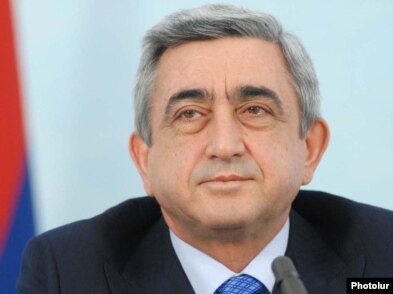
    Armenia — President Serzh Sarkisian.

    06.07.2009

    Sarkis Harutiunian


    After months of upbeat statements, President Serzh Sarkisian signaled on Monday his frustration with Turkey’s failure so far to unconditionally normalize relations with Armenia despite concessions made by him.

    “We want to eliminate closed borders remaining in Europe and to build normal relationships without preconditions,” he said, commenting on Turkish-Armenian relations after talks with the visiting President Demetris Christofias of Cyprus. “But in that endeavor, we do not intend to allow [anyone] to use the negotiating process for misleading the international community.”

    “Unfortunately, in our case, failure to honor mutual agreements leads to greater distrust and a deeper gap and requires much greater efforts in the future,” said Sarkisian. He did not go into further details.

    Sarkisian and his foreign minister, Eduard Nalbandian, have until now sounded cautiously optimistic about prospects for the establishment of diplomatic relations between Armenia and Turkey and the reopening of their border. Both men have effectively downplayed Ankara’s renewed linkage between Turkish-Armenian reconciliation and the resolution of the Nagorno-Karabakh conflict.

    The Armenian president has been under fire from his political opponents over a lack of tangible results in Armenia’s unprecedented rapprochement with Turkey that began shortly after he took office in April 2008. He faced particularly strong criticism at home and in the worldwide Armenian Diaspora in late April after Ankara and Yerevan announced a still unpublicized “roadmap” to normalizing bilateral ties.

    The announcement came on the eve of the annual remembrance of more than one million Armenians massacred by the Ottoman Turks during World War One. The timing is believed to have made it easier for U.S. President Barack Obama to backtrack on his pledges to officially recognize the massacres as genocide.

    Sarkisian’s harshest critics have accused him of willingly sacrificing U.S. recognition of the Armenian genocide without securing the lifting of the 16-year Turkish blockade of Armenia. They have also condemned his apparent acceptance of a Turkish proposal to form a commission of historians that would look into the 1915 mass killings and deportations of Armenians in the Ottoman Empire.


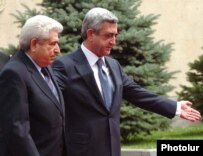
    Armenia — President Serzh Sarkisian (R) meets with his Cypriot counterpart Demetris Christofias in Yerevan on July 6, 2009.


    Speaking at a news conference with Christofias, Sarkisian said they discussed the Turkish-Armenian dialogue and the Karabakh conflict in addition to issues related to bilateral ties. In a joint statement, the two leaders said they will strive to deepen the Armenian-Cypriot relationship.

    Christofias voiced support for Armenia’s efforts to forge closer links with the European Union, of which Cyprus is a member. “Armenia can regard Cyprus as its envoy to the European Union,” he said.


    https://www.azatutyun.am/a/1770699.html

  • Patriach Kirill calls Russian church inauguration historic

    Patriach Kirill calls Russian church inauguration historic

    16:35 06/07/2009

    ISTANBUL, July 6 (RIA Novosti) – The head of the Russian Orthodox Church, currently on a visit to Istanbul, said on Monday the inauguration of a Russian church on the grounds of the Russian Consulate General was a historic event.

    Patriarch Kirill of Moscow and All Russia and Ecumenical Patriarch Bartholomew of Constantinople consecrated the restored St. Constantine and Helen Church and held the first liturgy in the building on Monday.

    The two church leaders held prayers at St. George Cathedral in both Russian and Greek on Sunday.

    “This is a historic event. And it was pleasing to God that the opening of this church coincided with our brotherly meeting – so that the two patriarchs could hold a divine service together,” the Russian patriarch said.

    Kirill, who arrived in the country on Saturday, thanked the Greek patriarch for his “blessing to resume services in this church.”

    The St. Constantine and Helen church was built in 1832, on the territory of the summer residence of the Russian embassy located on the shore of the Bosporus. After the 1917 revolution, it was closed. Three years ago it housed boiler plants, but following large-scale restoration work the church was reopened.

    Patriarch Bartholomew thanked Patriarch Kirill for his first visit as head of the Russian Church to the senior patriarchate of the Greek Orthodox Church.

    “During this visit we renewed our relations, discussed issues of common interest and made a pledge to each other that our churches will contribute to the further development of inter-Orthodox relations just as God himself wishes,” he said.