Month: July 2009

  • Demonstrators in Washington Protest Chinese ‘Terror’ Against Uighurs

    Demonstrators in Washington Protest Chinese ‘Terror’ Against Uighurs


    08 July 2009

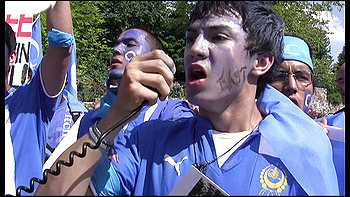
    Passions flared in Washington Tuesday as ethnic Uighurs and their supporters marched through the streets.  

    They were protesting what they call the Chinese government’s rough treatment of ethnic Uighurs in western China.

    Shouting “Shame on China,” supporters of China’s Uighur minority marched through the streets of Washington.

    More than 100 people turned up to protest what they say is China’s brutal suppression of their friends and relatives in the western province of Xinjiang.

    Rebiya Kadeer is a Uighur, an advocate for her people, and President of the World Uyghur Congress.

    “We want to be the voices of Uighurs who are dying in Urumqi in Xinjiang. We want to be their voices and get their message across to you,” says Rebiya Kadeer.

    Chinese officials have blamed Kadeer for the violence in western China, where Muslim Uighurs have clashed with Han Chinese, the country’s dominant ethnic group.

    Chinese authorities say 156 people died Sunday when Uighurs took to the streets to protest a brawl between Han Chinese and Uighurs in Guangdong last month.

    On Tuesday, Muslim women sobbed in the streets and argued with riot police.  

    Han Chinese men wielded clubs, shovels and knives; and the government declared a curfew.

    Meanwhile, Kadeer says the official casualty figures are too low.

    “Do you think out of all those demonstrations the only people who died were 156? I don’t think so. I believe that the upward number is 1000 and the lower number 500,” says Rebiya Kadeer. 

    Kadeer spent close to six years in a Chinese prison before being released in 2005 and coming to the United States.

    “Uighur people consider me to be their mother and the leader of their democratic movement, and I will continue to lead them,” says Rebiya Kadeer.

    Kadeer’s daughter, Kekenus Sidik, was also at the demonstration.

    “My mother was in prison for six years, my father for ten years all for political reasons. I haven’t seen the rest of my family for over a decade. So I am a Uighur and this is the perspective I can give you,” says Kekenus Sidik.

    VOA NEWS

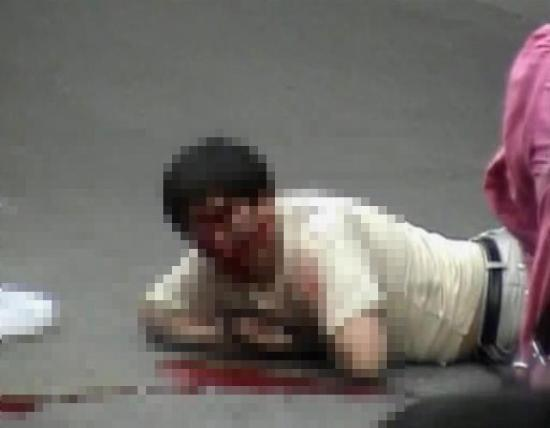
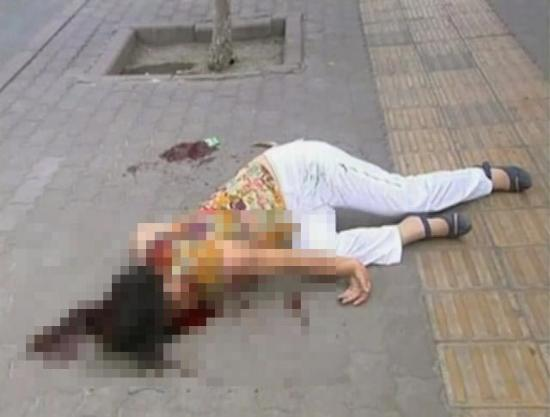
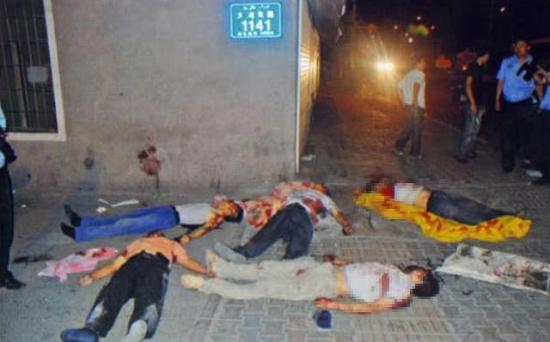
    Photos below are from Sincan


  • Dr. Israel Charny Condemns Denial of Armenian Genocide in British Parliament

    Dr. Israel Charny Condemns Denial of Armenian Genocide in British Parliament


    Publisher, The California Courier
    Senior Contributor, USA Armenian Life Magazine

    In an earlier column I wrote about the special conference held at the British Parliament on May 7, organized by the British-Armenian All-Party Parliamentary Group. Dr. Israel Charny and I were invited as guest speakers. I spoke about “The Armenian Genocide and Quest for Justice.” Dr. Charny could not attend due to illness, however, his prepared remarks were read by Peter Barker, a former broadcaster of BBC Radio.
    Dr. Charny is an internationally-known authority on the Holocaust and the Armenian Genocide. He is the Executive Director of the Jerusalem-based Institute on the Holocaust and Genocide, past President of International Association of Genocide Scholars, Editor-in-Chief of Encyclopedia of Genocide, and author of several scholarly books. Dr. Charny’s lengthy paper was titled: “Confronting denials of the Armenian Genocide is not only honoring history, but a crucial policy position for confronting threats in our contemporary world.”
    In his remarks presented at the British Parliament, Dr. Charny described the conference on the Armenian Genocide he attended two years ago in Istanbul. He found “the prevailing discourse stilted, blocked and rigid with denials.” The overwhelming majority of the statements were “one-sided rehashes of Turkish denial propaganda; a basic intellectual failure since they did not even mention or refer to or in any way acknowledge any of the voluminous documentation and evidences of the Armenian Genocide that are now part of world culture; and a great number were emotional diatribes rather than ‘scientific’ or properly scholarly contributions.”
    In his paper, Charny singled out the presentation at the Istanbul conference of Prof. Yair Auron, his colleague from Israel, who spoke “in a strong resonant voice that there was no question but that the Armenians had suffered genocide at the hands of the Turks.”
    In his London remarks, Dr. Charny’s also discussed the “failure of the State of Israel, but not of Israelis, to recognize the Armenian Genocide,” expressing his “deep regret and shame” that Israel (where he lives) and the United States (where he was born), “have failed seriously in their moral responsibility towards the Armenian people.” He felt “particularly wounded as well as angry at such failures by my Jewish people when we too have known the worst horrors of being victims of a major genocide, and therefore we should be all the more at your side as deeply committed allies in all aspects of preserving and honoring the record of the Armenian Genocide.”
    Dr. Charny announced “the happy news [that] the battle for recognition and genuine respect for the memory of the Armenian Genocide [was won] on the level of everyday Israeli culture.” In great detail, he explained that “throughout the year there are major statements in our culture about the Armenian Genocide, including many full-length feature stories and interviews in all of our major newspapers and on our television. On April 24, there is powerful coverage, for example, this year on Roim Olam or Seeing the World, a major TV news magazine; there is an annual seminar at the Hebrew University of Jerusalem at which this year the keynote speaker was Prof. James Russell of Harvard University, and it was my honor to be the keynoter the year before together with an influential member of the Knesset who was totally knowledgeable about the Genocide and totally clear about Israel’s error in not recognizing it; and there is of course an annual commemoration by the Armenian Community — it was there that the two ministers in the past announced their recognition of the Armenian genocide. During a too-brief period, we also had two ministers of the Israeli government who officially recognized the Genocide, and although the governments in question promptly disavowed these ministers’ statements as private and not speaking for the country, the records of those ministers honoring the Armenian Genocide on behalf of the State of Israel cannot be erased. I would say that both the everyday Israeli man on the street and the professional scholars of the Holocaust, such as Prof. Yehuda Bauer perhaps the ranking scholar of the Holocaust at Yad Vashem, are basically sympathetic and committed to paying homage to the Armenian Genocide. A few years ago four of us, including one of the above former ministers, Yossi Sarid, Prof. Bauer, Prof. Yair Auron, an indefatigable scholar of the Armenian Genocide and of Israel’s denials of same, and myself traveled together to Yerevan to lay a wreath at the Armenian Genocide Memorial.”
    As he has done many times in the past, Dr. Charny expressed regret that “sadly and shamefully the pull of practical government politics still leads to official Israel cooperating with Turkey in gross denials of the Armenian Genocide. No less than the arch fighter for peace in the Israel-Palestinian conflict, Shimon Peres, now President of Israel, then serving as Israel’s Foreign Minister, twice went notably out of his way to insult the history and memory of the Armenian Genocide.”
    In a scathing letter, Dr. Charny told Peres in 2001: “You have gone beyond a moral boundary that no Jew should allow himself to trespass…. As a Jew and an Israeli, I am ashamed of the extent to which you have now entered into the range of actual denial of the Armenian Genocide, comparable to denials of the Holocaust.”
    In response to a second “especially insulting” denial by Shimon Peres in 2002, Dr. Charny sent him one of my columns from The California Courier, with the following note: “I am enclosing with great concern for your attention an editorial in a leading US-Armenian newspaper calling on Armenia to expel the Israeli Ambassador. For your further information, the author of this editorial, who is the head of the United Armenian Fund in the US — comparable to our United Jewish Appeal — was for many years a delegate to the UN Human Rights Commission in Geneva.”
    Dr. Charny concluded his London remarks: “I am happy to emphasize that the people and the culture [in Israel] very strongly recognize and honor the [Armenian] Genocide, and know how serious and important it is for us and the whole world.” He expressed his sincere hope that “some day we will succeed in changing the official Israeli government position.”

  • Mexico’s Ambassador to US Arturo Sarukhan Courageously Acknowledges “1915 Genocide By Turkey”

    Mexico’s Ambassador to US Arturo Sarukhan Courageously Acknowledges “1915 Genocide By Turkey”


    Armenian-Mexican Task Force Announced By Consuls General of Mexico and Armenia

    By Appo Jabarian

    Executive Publisher / Managing Editor

    USA Armenian Life Magazine

    Friday,  July 3, 2009

    Besides loving Mexico’s culture, people, tacos and tequila, Armenians around the world have one more reason to enhance their appreciation of the Estados Unidos de Mexico: Ambassador Arturo Sarukhan.

    Among the many nations that have opened their doors and hearts to the survivors of the Armenian Genocide, Mexico stands out as being a pluralistic sovereign state that has appointed a principled and courageous Armenian-Mexican seasoned diplomat, a respected expert on international affairs and an astute political strategist to its most important?ambassadorial post, the one in the United States.

    As Mexico’s top diplomatic representative in Washington, Ambassador Sarukhan leads his country’s efforts on such crucial issues as trade, proliferation of illegal firearms, immigration, curtailing of the traffic of illegal drugs, among others.

    Amb. Sarukhan is also credited for fostering good relations between the Armenian-American and Mexican-American communities. His insightful remarks in late 2008 inspired Shahe Mazbanian, a vice-president of business development at Bank of America, to summon help from his long-time friend and mentor Alberto G. Alvarado, Los Angeles District Director of the US Small Business Administration, to jointly lobby with their respective communities for active co-operation. Their efforts paid off in an impressive way. Both the Regional Hispanic Chamber of Commerce and the Armenian-American Chamber of Commerce jointly organized a June 25 breakfast meeting in Los Angeles’ Biltmore Hotel in honor of Ambassador Sarukhan.

    At the meeting, the Consuls General of Mexico and Armenia, Juan Marcos Gutierrez-Gonzalez and Grigor Hovhannissian separately spoke about the necessity of establishing strategic partnership between the Mexican and Armenian communities. As a direct result of this timely initiative, they announced the formation of a task force that would promote cooperation in the sectors of health, economic development, education and culture (Please see related news article by clicking on the following link: ).

    The Consulates General of Armenia and Mexico spearheaded the co-operation efforts. In a pre-taped video message, Rep. Adam Schiff (D-CA.) expressed his appreciation for the initiative and congratulated the two consulates.

    In a November 21, 2008 interview granted to The Armenian Reporter, Amb. Sarukhan emphasized that “communities like the Armenian and the Mexican communities are natural allies. They share agendas and challenges in this country. Many of them have come here driven by the same problems of lack of economic opportunities. Both are hard working societies. [In the past] the Armenian community faced the prejudice and racism and discrimination in this country that Mexican communities are facing today.”

    He stated that “It would make more sense if Armenian and Mexican communities work together especially in the West Coast and New England where we have the highest concentration of Armenian-Americans to bring down the bombastic nature of the debate, to look at the opportunities and the challenges in an objective and forward-looking way.”

    Mr. Sarukhan’s candid position regarding his Armenian roots is not only uplifting for the Armenian Youth, but also enriching for Mexico’s international image. His grandparents arrived in Mexico in the early 1930s. His grandfather was a Russian-Armenian also named Artur Sarukhanian, and grandmother, a survivor of the Genocide arrived in Mexico with the idea of coming to Canada. Having read a lot about Mexico, Sr. Sarukhan decided to stop in Mexico on their way to Canada. The elder Sarukhanians fell in love with Mexico and they stayed in Mexico. Amb. Sarukhan was born in Mexico.

    The prestigious website of The Woodrow Wilson International Center for Scholars named after Woodrow Wilson, president of the United States from 1913 to 1921, and a great friend of The Democratic Republic of Armenia (1918-1921), writes: “The grandson of refugees in Mexico, Ambassador Arturo Sarukhan is a career diplomat who joined the Mexican Foreign Service in 1993, and currently serves as Mexico’s Ambassador to the U.S. He was posted to the Mexican Embassy in the United States as a junior diplomat, served as Chief of Staff to the Ambassador, and was the head of the counternarcotics office at the Embassy. In 2000 he became Chief of Policy Planning at the Foreign Ministry and was appointed by the President as Mexican Consul General to New York City in 2003. He resigned from this post and took a leave of absence from the Foreign Service in 2006 to join Felipe Calderón’s presidential campaign as a foreign policy advisor and international spokesperson and became the Coordinator for Foreign Affairs in the Transition Team. In November of 2006 he received the rank of Ambassador and in February of 2007 was appointed Mexican Ambassador to the United States.”

    During the breakfast meeting’s question and answer period, Appo Jabarian of USA Armenian Life Magazine asked: “Amb. Sarukhan, at the beginning of your remarks you have used the term ‘1915 Genocide by Turkey.’ Does it mean that the government of Mexico officially recognizes the Armenian Genocide, or have you simply stated the facts as they are?”

    Amb. Sarukhan posed for a moment and then answered with a humorous flair. He said that “the newspapers are good at killing flies and diplomats,” causing an eruption of laughter. He then stated courageously that his remarks reflected his personal belief. He went on to elaborate that by telling the truth we can build a better future. He added that the truth can overcome everything; and can liberate even those who want to hide it.

    Through their pro-active co-operation, the Armenian- and the Mexican-American communities across the United States, can achieve substantial moral, political, and economic gains. Both communities come from similar backgrounds of family-values.
    The success and the longevity of their inter-ethnic alliance should serve as a model that can be emulated by Armenian-Americans in establishing similarly fruitful alliances with other communities.

  • Uighur Protesters March in Washington

    Uighur Protesters March in Washington

    Associated Press
    Tuesday, July 7, 2009; 5:00 PM


    Video: Click on the Picture

    An exiled Uighur leader accused by China of inciting ethnic violence says the Chinese government is responsible for the rising tensions.

    Rebiya Kadeer spoke to Uighur protesters at a rally in downtown Washington on Tuesday. About 100 people are holding blue flags with a white crescent and chanting “Shame on China” as they march to the Chinese Embassy.

    Chinese authorities have accused Kadeer of inciting violence between Muslim Uighurs and ethnic Han Chinese, in which at least 156 people have been killed. The riots broke out Sunday in China’s Xinjiang region.

    Kadeer disputes the number of fatalities, saying she believes at least 500 people have been killed in the riots.

    Kadeer says she’s seeking a stronger statement from the U.S. government about the violence.

    Washington Post

  • Han Chinese Terorists Throng Urumqi

    Han Chinese Terorists Throng Urumqi

    Witnesses say thousands of armed Han Chinese are on the streets of the Xinjiang Uyghur Autonomous Region’s capital vowing revenge after a deadly clash.
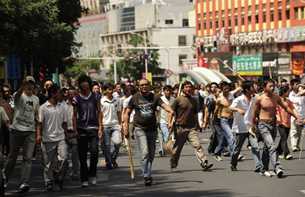
    HONG KONG—An angry crowd of several thousand ethnic majority Han Chinese has gathered in Urumqi following weekend riots, amid a welter of rumors surrounding deadly clashes between Muslim Uyghurs and police, according to initial reports from foreign journalists and exiled Uyghur groups overseas.

    “Chinese civilians, using clubs, bars, knives, and machetes, are killing the Uyghurs,” the Munich-based World Uyghur Congress said in a statement.

    “They are storming the university dormitories, Uyghur residential homes, workplaces, and organizations,” it said, accusing the mob of killing unprotected Uyghur civilians.

    Foreign correspondents on the ground in Urumqi said they saw armed crowds of thousands of Han Chinese running through the capital of the northwestern Xinjiang Uyghur Autonomous Region (XUAR).

    “Two police officers just escorted a Uyghur woman with a baby through a Han crowd with clubs by the People’s Theater,” Time correspondent Austin Ramzy wrote via the real-time micro-blogging platform Twitter.

    Telegraph correspondent Peter Foster reported via Twitter from Urumqi that thousands of armed Han Chinese had gathered near a mosque in Shanxi Alley in downtown Urumqi.

    Police tried to calm the crowd, which was armed with “snooker cues, axes, machetes, baseball bats, metal scaffolding poles, cattle prods, and a plastic mop handle,” according to Foster’s updates.

    Meanwhile, Al-Jazeera correspondent Melissa K. Chan tweeted, also from Urumqi, “A Han Chinese man with a stick just tore open our car door to beat our producer. Averted just in time.”

    Chan said Urumqi was now under martial law. Official media also reported further unrest. Two separate estimates by foreign journalists at the scene put the crowd at around 10,000.

    ‘Troops everywhere’

    Despite Chinese officials’ decision to cut off the Internet and mobile phones, pictures, videos and updates from Urumqi poured into social-networking and image-sharing Web sites including Twitter, YouTube, and Flickr.

    A Han Chinese employee at a youth hostel in downtown Urumqi said, “We have a curfew now and troops are everywhere.”

    “We can still can drive on the streets—but I don’t know if the situation will get worse so I stored some bottles of water and instant noodles,” the employee said.

    “More Han Chinese live in Urumqi than Uyghurs now,” he said. “Many Uyghurs are afraid to go out now. They have their own friends, and we won’t try to be their friends.”

    “Before it was them attacking us. Now it’s our turn to attack them,” another Han Chinese resident said.

    But a municipal official downplayed the tensions.

    “We are coming to work as usual. What do you mean, take to the streets? We will see what happens. Ask again later,” the official said.

    “Of course there have always been ethnic separatists. They have existed for a long time. They are always looking for ways to make trouble. They will do it as soon as they spot an opportunity,” the official added.

    Chaos and vigilantes

    Police fired tear gas repeatedly at the protesters, who refused to disperse. Police were blocking them from getting through to an area of Urumqi populated by Uyghurs, who authorities have blamed for riots on Sunday that left 156 people dead and more than 1,000 injured.

    China’s state-run Xinhua news agency reported similar scenes in other parts of Urumqi.

    “Chaos was seen in a number of places in Urumqi on Tuesday afternoon,” the official Xinhua news agency reported.

    Back in Urumqi, al-Jazeera’s Chan tweeted: “There is no right or wrong anymore. Just vigilantes, Han and [Uyghur]. Mostly men but some women and even children.”

    “I asked a Han Chinese girl if she was scared. ‘Yes, but this is to defend my country,’ she says with stick in hand.”

    The World Uyghur Congress said it had received several reports of deaths at the hands of Han mobs in different locations in Xinjiang, which is home to a population of Turkic-speaking Uyghurs, many of whom oppose Beijing’s rule, and a growing influx of migrants from the rest of China.

    Ethnic tensions have simmered for decades, with Uyghurs saying they are subject to racial discrimination and have scant access to the fruits of China’s breakneck economic growth of the past 30 years.

    China has said some overseas Uyghur separatist groups are connected with international terrorism.

    Foster reported via Shanghai-based Telegraph correspondent Malcolm Moore that some of the crowd were comparing exiled former Uyghur businesswoman Rebiya Kadeer to al-Qaeda mastermind Osama bin Laden.

    The Congress statement said: “[A] Uyghur young man was mutilated on [Urumqi’s] Dongbeilu. A Uyghur woman who was carrying a baby in her arms was mutilated along with her infant baby on Huanghelu.”

    Witnesses on the ground said the mood of the crowd was ugly, with a group of Han Chinese protesters attacking Telegraph correspondent Foster and his assistant, who were protected by police.

    The Uyghur Congress said Chinese security forces were “not taking any action” against the attackers, and that it had received telephone threats from “ethnic Han Chinese” at its headquarters in Munich.

    A Foreign Ministry spokesman said Tuesday that Sunday’s violence in the region was not a peaceful protest, but “evil killing, fire-setting, and looting.”

    Foreign Ministry spokesman Qin Gang told a regular news briefing: “Anybody calling the violence a peaceful protest is trying to turn black into white in an attempt to mislead the public.”

    Urumqi Communist Party chief Li Zhi went to the scene, addressing the crowd and calling for calm. The crowd roared soon after, before rushing off in the other direction, witnesses said.

    Earlier, Li had told reporters: “We immediately reinforced the emergency prevention and control measures after the riots started. Security was dispatched to the four main areas of unrest, and they swiftly took care of the matter in accordance with the law.”

    Internet curbs, media strategy

    Also Tuesday, Li confirmed at a news conference that authorities there had cut off Internet access in parts of Urumqi to stop the flow of information that it saw as a dangerous threat.

    “We cut the Internet connection in some areas of Urumqi in order to quench the riot quickly and prevent violence from spreading to other places,” Li said.

    The Paris-based media watchdog Reporters Without Borders accused authorities of wanting to see Urumqi “cut off from the rest of the world.”

    “Once again, the Chinese government has chosen to cut communications in order to prevent the free flow of information. We firmly condemn this behavior,” the organization said in a statement.

    Many phone lines have been disabled since the violence erupted, but others remain in working order.

    Netizens inside China said the personal update service Twitter, which is frequently used to transmit keywords, news, and photos around the Chinese Web at a speed that eludes China’s censors, was blocked.

    “Twitter is blocked: In another act of net-nanny folly Twitter.com has been blocked on the Chinese mainland,” media analysis blog Danwei commented via the service Monday.

    Other users said the service was still accessible using third-party applications elsewhere on the Web.

    They said sensitive keywords such as “Xinjiang” were currently returning no search results on the Chinese Web, either.

    “Why is it that the moment something happens, the first thing they think of is blocking it?” user Keso tweeted. “Surely the fact that they do this shows that there are skeletons in the closet?”

    Authorities have meanwhile taken the unusual step of bringing foreign reporters to Urumqi to learn about the incident and setting up a media center in a city hotel.

    This contrasts with Beijing’s virtual blackout on previous instances of unrest, such as the Tibetan uprising of early 2008, but is in keeping with its handling of media immediately after the May 2008 Sichuan earthquake.

    But that initial openness ended amid allegations that corruption had resulted in shoddy construction of school buildings that collapsed in the quake.

    Shenzhen-based media commentator Zhu Jianguo said official media reports seemed to be intensifying conflicts rather than soothing them.

    “They are putting out information at a much faster speed than previously, but their approach is exactly the same as it always has been,” Zhu said, suggesting the coverage was one-sided.

    “Now the incident has erupted into racial conflict, and it’s not a simple racial conflict either. It’s all over the country—it’s a crucial point at which the government faces off against the people.”

    Original reporting by RFA’s Uyghur, Mandarin, and Cantonese services. Written for the Web in English by Luisetta Mudie. Edited by Sarah Jackson-Han.

    Radio Free Asia
  • Recep Tayyip Erdogan: “Brutality against Uighurs must be prevented”

    Recep Tayyip Erdogan: “Brutality against Uighurs must be prevented”

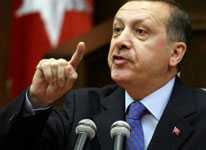
    Baku – APA. Turkish Prime Minister Racab Tayyib Erdogan took stance on bloody events taking place in Xinjiang-Uighur autonomous region of China, APA reports quoting Haberturk.

    Turkey is closely following the developments there: “Our Uighur brothers living in Turkey and Turkish people feeling this pain in their hearts hold protest actions condemning these events. We have always seen our Uighur brothers as a bridge between Turkey and China, the country we have always had normal relations with throughout the history. Necessary measures must be taken to prevent this brutality. We are temporary member of the UN Security Council for 2009-2010. We will also take these events into consideration there”.

     08 Jul 2009

    APA