Month: June 2009

  • U.S. Envoy Upbeat On Turkey-Armenia Relations

    U.S. Envoy Upbeat On Turkey-Armenia Relations

    U.S. Assistant Secretary of State for Europe and Eurasian Affairs Philip Gordon’s next stop on his regional tour is Georgia.

    June 10, 2009
    By Emil Danielyan, Ruben Meloyan

    In Armenia on the first stop of his first tour of the region, the new top U.S. diplomat for Europe and the former Soviet Union sounded optimistic about prospects for the normalization of Turkish-Armenian relations.

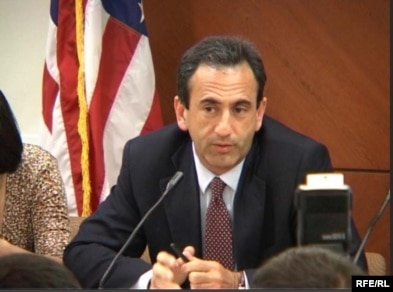
    “I have only been in office for two weeks, but it seemed to me that there are such important and even historic developments going on in Armenia and the region that I should try to come out here as soon as possible,” U.S. Assistant Secretary of State Philip Gordon told journalists on June 9.

    After holding what he called “excellent and productive talks” with President Serzh Sarkisian and Foreign Minister Eduard Nalbandian, Gordon also criticized the Armenian authorities’ handling of the May 31 municipal elections in Yerevan.

    According to official Armenian sources, the Nagorno-Karabakh conflict and the Turkish-Armenian rapprochement were high on the agenda of his Yerevan talks. They also discussed the current state of U.S.-Armenian relations. Sarkisian was quoted by his office as telling Gordon that his government finds their expansion “extremely important.”

    Speaking at an ensuing news conference, Gordon reaffirmed Washington’s strong support for the year-long fence-mending negotiations between Armenia and Turkey and an unconditional normalization of their relations.

    “Turkey-Armenia normalization would benefit Turkey, it would benefit Armenia, and it would benefit the entire region. Because of that, we don’t think it should be linked to anything else,” he said, commenting on Turkish leaders’ renewed linkage between the reopening of the Turkish-Armenian border and a resolution of the Nagorno-Karabakh conflict with Azerbaijan.

    Gordon stressed that normalization “should proceed within a reasonable time frame,” meaning that “the process can’t be infinite,” he said. “It can’t go on forever. I think the parties understand that.”

    “It’s not for me to tell the parties exactly what that means,” added the U.S. official. “But I think both sides do appreciate that they need to move forward, and I think they are, and I think they will.”

    Yerevan Vote ‘Not Satisfactory’

    Gordon also discussed with Sarkisian and Nalbandian U.S. economic assistance to Armenia under the Millennium Challenge Account (MCA) program. Some of that $236 million in assistance has been suspended by Washington because of Yerevan’s poor democracy and human rights records.

    The Armenian Foreign Ministry said that Nalbandian briefed Gordon on “steps taken by the Armenian authorities to implement democratic reforms.” It did not specify whether those steps include the May 31 municipal elections in Yerevan condemned as fraudulent by the opposition.

    Gordon indicated that the United States did not consider the polls free and fair. “The results were only tallied up a couple of days ago, and so we don’t have a formal statement or judgment right now,” he said.

    “But I have heard reports of irregularities and problems with the election. That wasn’t up to the standard that we would like to see.”

    The U.S. ambassador in Yerevan, Marie Yovanovitch, who was also present at the news conference, said a more detailed assessment of the elections based on the findings of U.S. Embassy observers will be released “in the next couple of days.”

    “We saw a number of instances of irregularities, fraud, and intimidation not only in one or two districts but throughout the city during voting and also during the count,” she said.

    Gordon at the same time disapproved of the decision by the main opposition Armenian National Congress not to take up its seats in Yerevan’s new city council. “Even imperfect election would be a better result if those who were asked to serve are able to do so,” he said.

    https://www.rferl.org/a/US_Envoy_Upbeat_On_TurkeyArmenia_Relations/1751225.html
  • Court dismisses Armenian Genocide denial

    Court dismisses Armenian Genocide denial

    Massachusetts District Court dismisses Armenian Genocide denial case

    In a major blow to Turkey’s global campaign to suppress the truth about the Armenian Genocide, U.S. District Court Chief Judge Mark Wolf today ruled in favor of the Massachusetts Department of Education, allowing it to continue teaching the facts of the Armenian Genocide, and other crimes against humanity, in public schools across the Commonwealth as constitutionally protected government speech, reported the Armenian Assembly of America (Assembly).
    “The Armenian Assembly appreciates the court’s ruling in this matter. It sends a clear message to Turkey and its revisionist allies that history cannot be rewritten to further Ankara’s state-sponsored denial campaign,” said Assembly Board of Trustees Chairman Hirair Hovnanian. Carolyn Mugar, the Board’s President, added, “Given the overwhelming historical and legal evidence documenting the incontestable fact of the Armenian Genocide, this ruling is a victory for all those concerned about genocide education and prevention.”
    Assembly Executive Director Bryan Ardouny noted that “today’s decision is in keeping with a growing trend toward teaching genocide prevention with nearly every state, including Massachusetts, formally recognizing the Armenian Genocide. We want to thank the office of the Attorney General of Massachusetts for not backing down in this case.”
    The court’s ruling preserves the teaching of accurate history, which is part of the official “Massachusetts Guide to Choosing and Using Curricular Materials on Genocide and Human Rights,” prepared in 1999. In 2005, the Assembly of Turkish American Associations (ATAA), along with others, filed the suit against the Department of Education arguing that the Commonwealth violated the plaintiffs’ First Amendment rights by removing materials from the curriculum that deny the events of 1915.
    In an unprecedented move, the plaintiffs attempted to use the federal courts to argue a tired and discredited practice that the “other side” of the story should be taught.
    “In light of the fact that Turkey criminalizes honest discussion of the Armenian Genocide, it is especially ironic that Turkish denialists turned to U.S. courts in an attempt to twist freedom of speech in America,” stated Assembly Board of Trustees Counselor Van Krikorian. “Even though the court viewed this case ‘in the light most favorable to plaintiffs,’ it still ruled in favor of truth, history and the U.S. Constitution. The sooner Turkey comes to terms with its past, the better it will be for everyone.”
    The Armenian Assembly immediately responded when the suit was filed, hiring Duke University Law Professor Irwin Chemerinsky, one of the nation’s leading First Amendment experts, and co-counsel Arnold Rosenfeld of the firm K&L Gates LLP. Over the past four years, the Assembly, and others, challenged the ATAA at every turn by filing a series of pleadings including an amicus curiae (friend of the court) brief. The brief was intended to assist the Court in bringing the case to a conclusion in favor of the Commonwealth.
    Attorneys Rosenfeld and Krikorian presented the amicus brief before Judge Wolf. Rosenfeld and Krikorian warned that if the court accepted the plaintiffs’ First Amendment claims, it would open the door for any extremist group, such as Holocaust deniers, to challenge curriculum matters in court.
    Attorney Gabrielle R. Wolohojian, then of Wilmer, Cutler, Hale and Dorr LLP, also represented an Amicus Class, which included the Armenian Bar Association, the Armenian National Committee of America, the Irish Immigration Center, the Jewish Alliance for Law and Justice and the NAACP.


    11.06.2009 11:28
  • White supremacist kills man

    White supremacist kills man

    An elderly white supremacist with a history of anti-Semitic tirades opened fire inside the Holocaust Memorial Museum, fatally wounding a security guard before being shot himself.

    Tourists scattered in panic, ducked and took cover as the shots rang out in the museum’s crowded entrance shortly after noon in the heart of the US capital, not far from the White House.

    The attack drew reactions of shock and sadness from President Barack Obama and other US leaders, Israel, and a US Muslim organization.

    The gunman was identified as James von Brunn, 88, a Maryland resident who has done time in prison for taking a gun into the US Federal Reserve in an apparently botched anti-Semitic attack, a federal law enforcement official told AFP.

    “It appears to be a lone gunman who entered into the museum and opened fire with what appears to be a rifle at this point,” Police Chief Cathy Lanier said.

    Security guard Stephen Tyrone Johns, 39, of nearby Maryland state, was pronounced dead after being rushed to a nearby hospital, police said. The gunman was in critical condition, Washington Mayor Adrian Fenty added.

    Obama — who last week became the first US president to visit the Nazi death camp in Buchenwald, Germany — expressed dismay, saying the incident underscored the need to counter prejudice.

    “I am shocked and saddened by today’s shooting at the US Holocaust Memorial Museum. This outrageous act reminds us that we must remain vigilant against anti-Semitism and prejudice in all its forms,” he said in a statement.

    The Holocaust-denying Von Brunn has written books on Adolf Hitler and his views on white superiority, including “Kill the Best Gentiles,” which his website calls “the culmination of his life’s work.”

    In a recent posting on his blog, he railed that “America is a Third-World racial garbage-dump — stupid, ignorant, dead-broke, and terminal.”

    Police and the Federal Bureau of Investigation said they had no warning of the attack, which erupted at 12:50 pm just inside the packed museum, which is often visited by school groups.

    The FBI said it had sent a special response squad to support the police, but it had no information “to indicate threats to area landmarks.”

    “An armed gunman came into the entrance and immediately opened fire striking one security guard. There was fire, gunfire returned. The gunman was hit,” Fenty said.

    Former defense secretary William Cohen said he was standing outside with a museum official when the gunman entered, apparently from a red vehicle left parked in the street.

    “When the shots rang out, we just ducked down and scattered,” Cohen said. “So we ran up the stairs. We didn’t know how many shooters were there, how many shots were going to continue, how many people were involved.”

    Cohen had been at the museum because a play written by his wife Janet Langhart Cohen was to be staged there Wednesday evening.

    Angela Andelson, 22, visiting from San Francisco, was walking toward the museum’s exit when she heard a loud bang “like someone had dropped something.”

    Then she saw a “gunman coming in (carrying) a long looking kind of gun.

    “I just ran in to one of the exhibits to try to take cover,” she said.

    “People were screaming and ducking down, getting on the floor, getting under benches.”

    Another witness, Maria Hernandez, was with her grandparents walking through the haunting exhibits which chronicle the Holocaust and the genocide of six million Jews under the Nazis.

    “We were in the exhibit ‘Remember the Children’ and we heard rounds fired and through the glass doors I saw a security guard firing towards the shooter and a man on his belly on the floor and when I looked back again, we were heading toward the exit, I saw blood all over the floor,” she told AFP.

    Israel said through its embassy that it was “shocked and saddened by today’s shooting incident.”

    The Muslim Public Affairs Council swiftly condemned what it called a “hate-motivated shooting.”

    “Tragic incidents like this one only strengthen our commitment to combatting intolerance in all forms through education and dialogue,” MPAC executive director Salam Al-Marayati said.

    Analysts noted the attack took place just five days after Obama became the first US president to visit the Nazi death camp in Buchenwald, Germany, where he renewed a historic commitment to Israel.

    Obama said Buchenwald was “the ultimate rebuke” to those “who insist that the Holocaust never happened, a denial of fact and truth that is baseless and ignorant and hateful.”

    “It’s hard to ignore the timing of this incident,” Brian Levin, a professor from the Center for the Study of Hate and Extremism at California State University, San Bernardino, told AFP.

    “Maybe he (von Brunn) feels his country is slipping away. So he sees a black president at Buchenwald, remembering the Holocaust, and decides to attack the biggest symbol of the Holocaust in the United States.”

    Mark Potok, director of the Alabama-based Southern Poverty Law Center, said the shooting followed a string of violent incidents by extremists in recent months that included the killing of three police officers in Pittsburgh in April and the murder of an abortion doctor in Kansas last month.

    “It’s really been quite an extraordinary period,” Potok told CNN, saying that there had been a “definite” surge in hate violence since Obama’s election.

    More than 30 million people have visited the museum since it opened in 1993, including 85 heads of state.

    AFP

  • Diplomacy, Inc.

    Diplomacy, Inc.

    The Power of Lobbies

    The Influence of Lobbies on U.S. Foreign Policy

    John Newhouse

    Summary —

    Lobbies representing foreign interests have an increasingly powerful — and often harmful — impact on how the United States formulates its foreign policy, and ultimately hurt U.S. credibility around the world.

    JOHN NEWHOUSE is a Senior Fellow at the World Security Institute and the author of a forthcoming book on foreign lobbies in the United States to be published by Simon & Schuster.

    The area around K Street in Washington, D.C., abounds with lobbyists, many of whom represent foreign governments or entities. Although some major foreign governments continue to work mainly through their embassies in Washington, nearly one hundred countries rely on lobbyists to protect and promote their interests. The subculture of public relations and law firms that do this kind of work reflects a steady decline and privatization of diplomacy — with an increasing impact on how the United States conducts its own foreign policy.

    The strongest lobbies promoting foreign interests are driven by cohesive ethnic population groups in the United States, such as Armenia, China, Greece, India, Israel, Taiwan, Ukraine, and, historically, Ireland. Even countries that have strong bilateral relations with the United States, such as Australia, Japan, and Norway, need lobbyists as well as embassies. Lobbyists can operate within the system in ways that experienced diplomats cannot. A lobbying group can identify with a domestic ethnic bloc even though it is paid by a foreign government. Ethnic politics can trump corporate interests and, more important, influence what agencies within the U.S. government may see as the national interest.

    The United States is a nation of immigrants — a strength that has also created vulnerabilities. Although ethnic population groups have at times offset isolationist tendencies in the United States, they also can find themselves conflicted on issues that could divide the motherland from the adopted country, the United States. In other cases, these so-called hyphenated groups unhesitatingly side with the United States and, in effect, become more royalist than the king.

    Source:  www.foreignaffairs.com, May/June 2009

  • Protesters break up BNP news conference

    Protesters break up BNP news conference

    By Adrian Croft


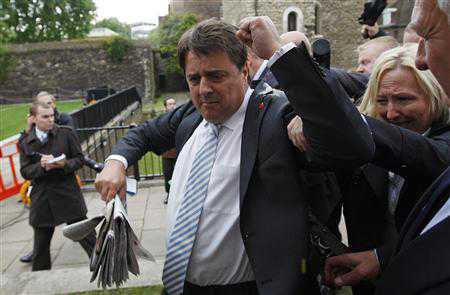
    LONDON (Reuters) – Scores of protesters throwing eggs and shouting “Nazi scum, off our streets” broke up a news conference on Tuesday by the British National Party which has just won its first seats in the European Parliament.


    BNP leader Nick Griffin and Andrew Brons, who both won European Parliament seats in the north of England in last week’s vote, had just started giving an open-air news conference outside parliament when they were charged by protesters.


    They threw eggs which broke on Griffin’s shoulder and at least one protester hit him with the stick of a placard, a Reuters photographer on the scene said.


    Chased by the protesters, Griffin and Brons fled in waiting cars. Demonstrators struck the cars with placards, which bore the slogan “Stop the Fascist BNP,” as they accelerated away.


    A police spokeswoman said two people had been taken to hospital after the protest, but she had no more information about them or their injuries.


    Police were looking into an allegation of assault on a woman at the protest and investigating reports of a road collision linked to the demonstration, she said. No one had been arrested.


    Police guarding parliament did not intervene in the protest.


    The BNP, which campaigns for a halt to immigration, voluntary repatriation of immigrants and British withdrawal from the European Union, has won local council seats but is not represented in the British parliament. 

    It is shunned by mainstream parties which regard its policies as racist. But it has gathered support in urban areas among a working class hurt by the worst recession in decades and competing for jobs and services with immigrants.


    It won more than 940,000 votes in last week’s European elections, enough to give it its first two deputies under a proportional representation system.


    Griffin said the protesters were a “mob for hire” that included supporters of the Labour Party.


    “This is a mob of students, lecturers, probably a few civil service parasites … and hardcore activists and supporters primarily of the Labour Party,” he told the BBC.


    An official of Unite Against Fascism, set up in response to what it sees as the rising threat from the extreme right in Britain and which organised the protest, was unrepentant.


    “I say to all those people that voted for them: They voted for the wrong thing. They voted for civil war, destruction and conflict in communities and surely that is a terrible thing to happen,” Weyman Bennett, the group’s national secretary, told reporters.


    The BNP was helped in last week’s election by a low turnout and protest voting after the major parties were tarred by a scandal over politicians’ perks.


    (Additional reporting by Stephen Hird; writing by Keith Weir; editing by Richard Balmforth)

    Reuters

  • US intelligence rivalry flares over British connection

    US intelligence rivalry flares over British connection

    John Stokes

    The CIA station in London is at the center of a bitter fight between different branches of the US intelligence community in Washington DC.

    For years, the CIA has had the right to appoint the station chief who runs US intelligence operations in London and liaises with MI6 and GCHQ. Now, the National Security Agency is arguing that they and not the CIA should run intelligence operations in the UK because they have more people on the ground and the work they do has far greater value to both countries.

    NSA have found useful allies in both Admiral Denny Blair, the Director of National Intelligence and General Jim Jones, the National Security Adviser who have been very receptive to the argument that intelligence form should follow function and reflect the realities of the 21st century.

    Last month, Blair wrote a memo to US intelligence chiefs saying that in future the DNI would appoint Heads of Stations overseas. It was a clear directive from the man who runs all US intelligence and is appointed by the President and Congress to do so. However, Leon Panetta, who heads the CIA and is the former Chief of Staff to President Bill Clinton, wrote his own letter to top CIA officials saying they could disregard Blair’s note.

    Panetta is a famous Washington bruiser and is well known for his take no prisoners style but such a confrontation has infuriated Blair who sees it as a direct challenge to his authority and battle has been joined. For once, Panetta may have misjudged the political winds as Congress is pushing hard for real intelligence reform and the CIA has fewer friends and less influence on Capitol Hill these days.

    It is no coincidence that those pushing for change in the Obama administration have a military background and that the NSA is run by one of their own, General Keith Alexander. It’s also true that for decades NSA has chafed under CIA’s apparent seniority and the two agencies have been arch rivals for generations. As recently as the Bush administration a major joint operation between CIA and NSA which all involved agreed was vital to the future of US security was stopped after a senior CIA official refused to implement the project which he thought gave unnecessary influence to NSA.

    The information revolution has placed further strains on the relationship. Twenty years ago, there was a clearer division of labour with NSA intercepting data on the move (email, faxes, phone calls) while the CIA targeted data at rest (documents, burglaring buildings). But recently the CIA has made a major push into the data gathering business arguing that the ones and zeros of the computer age are data and thus are fair game whether at rest or on the move.

    There are thousands of Americans based in Britain who work for NSA and work closely with GCHQ. By comparison, the CIA station, based in the US Embassy in Grosvenor Square, is important but a mere shadow of the NSA’s presence. Reality on the ground suggests that NSA will win this fight.

    Spectator

    10th June 2009