ARMENIAN COMMUNITY IN US MAKES ANOTHER PROVOCATION AGAINST TURKEY
Saturday, 13 June 2009
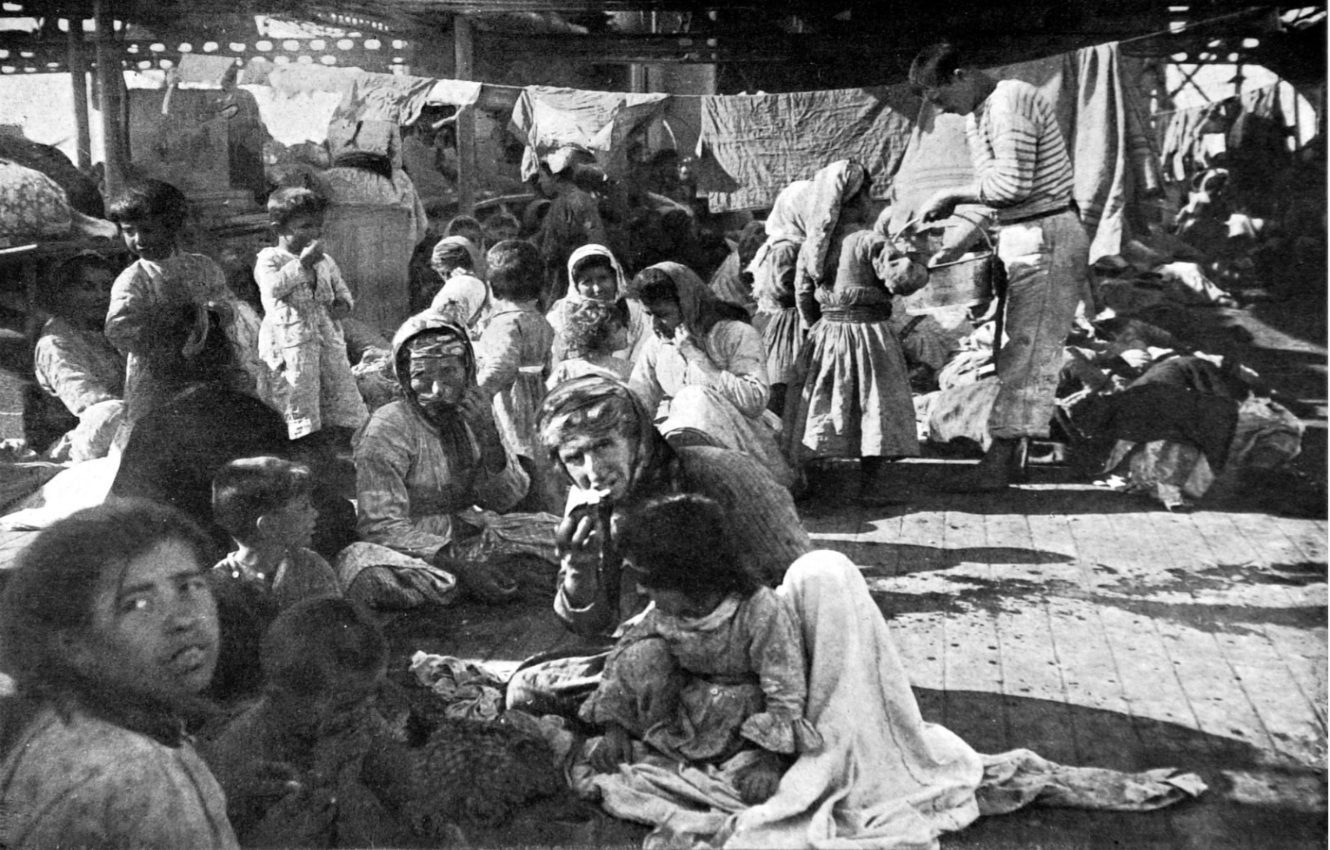
APA’s US bureau reports that the US-based law office of Geragos & Geragos owned by famous lawyer of Armenian descent Mark Geragosian addressed heirs of Ethnic Greek New York Life Policy Holders who “were murdered” in the Genocide perpetrated by the Ottoman Turks between 1915 and 1921.
“Prior to 1915, New York Life sold life insurance policies to thousands of Greeks living in the Ottoman Empire. Countless Greek policyholders were among the hundreds of thousands of Greeks who perished in the first Genocide of the twentieth century. In the ensuing chaos, many of the rightful heirs were unable to produce the documentation required to claim the insurance proceeds while others were unaware that they were entitled to any insurance benefits. In 2004, a class action settlement of $20 million which involved 2,300 Armenian New York Life policyholders with unpaid claims was awarded to the descendents of the victims massacred in the Armenian Genocide of 1915,” Geragos & Geragos noted in the special webpage launched for this purpose.
This is not the first campaign launched by the US Armenian community to damage Turkey”s image. Earlier, California State Assembly member of Armenian descent Paul Krekorian presented a bill “Justice for Genocide Victims” and wanted prohibition of investments in Turkey and other states that committed “genocide.”
Painting by Johann Peter Krafft from “The Enemy at the Gate” (Bridgeman Art Library)
THE ENEMY AT THE GATE
Habsburgs, Ottomans and the Battle for Europe
By Andrew Wheatcroft
Illustrated. 339 pp. Basic Books. $27.50
By 1683, Kara Mustafa, grand vizier of the Ottomans, was still a pasha with something to prove. He had been raised in the household of the illustrious Koprulu family, which would supply an unbroken succession of brilliant — if often ill-fated — grand viziers to the Ottoman court. Described by a contemporary as “corrupt, cruel and unjust,” Kara Mustafa had risen to become admiral of the Aegean galley fleet but had also succeeded in navigating the treacherous cross currents of palace intrigue; by 1675, the sultan had offered him his daughter’s hand.
His steady rise did nothing to satisfy his fierce ambition. For Kara Mustafa, the ultimate prize lay to the West. More than a century before, in 1529, Suleiman the Magnificent had besieged Vienna, but the onset of winter forced him to abandon the assault. To succeed where Suleiman had failed represented the pinnacle of imperial glory.
As Andrew Wheatcroft brilliantly shows in “The Enemy at the Gate,” the skirmishes and the pitched battles that raged for centuries between Habsburgs and Ottomans, and their numerous vassals on both sides, represented not so much a “clash of civilizations” as a collision of empires. For all the pious sloganeering that accompanied it, the struggle was only incidentally one between Islam and Christendom. Territory was the aim, along with something less tangible but equally compelling: the right to claim the legacy of the Roman Empire. Leopold I, Holy Roman Emperor, took it as given that the legacy belonged rightfully to the Habsburgs, but the Ottoman Sultan Mehmed IV believed just as fervently that the title of Roman Caesar was his. Had not his ancestor, Mehmed the Conqueror, toppled the Byzantines and seized Constantinople two centuries before? Far from wishing to obliterate the Byzantine past, the Ottomans meant to assume it as their own, and Vienna, the seat of the Habsburg empire, was the final prize.
Kara Mustafa is only one of many bold and complex characters Wheatcroft brings swaggering to the stage in his scholarly but fast-paced narrative. He is especially attuned to the hidden contradictions of his personages. Leopold I is seen as simultaneously rigid and dithering, a disastrous combination, while Mehmed IV, though bookish and retiring, reveled in martial exploits; he would lead his vast army as far as Belgrade before transferring command to Kara Mustafa. Wheatcroft relies on such adroit contrasts to depict these distant figures. Thus, Prince Eugene of Savoy, the “noble knight” of Habsburg legend, was not only the greatest general of the age but an impassioned bibliophile, a discerning connoisseur who managed his private life so discreetly that it remains a mystery to this day. Beside him, Charles V, Duke of Lorraine, another Habsburg hero, emerges as all raw courage and bristling audacity, a man most alive in the saddle amid the thick of battle.
Charles once remarked, “He that feareth not an enemy knows not what war is.” That observation is central to Wheatcroft’s account. His theme isn’t merely “Europe’s fear of the Turks” but “fear itself.” (As he notes in his coda, that fear is still rampant, camouflaged beneath recent — especially Austrian — dismay over Turkey’s continuing campaign to join the European Union.) Despite his best intentions, Wheatcroft’s narrative isn’t likely to allay such fears. Describing an attack by Ottoman cavalry and infantry — the dreadedsipahis and janissaries — he writes, “To face a howling tide of janissaries racing towards you, to watch the heads and limbs of your companions spin off the sharp edge of a sipahisabre required exceptional courage.” He conveys the spooky sense of stifled panic the besieged Viennese experienced as Turkish attackers began tunneling beneath the city’s defenses and the populace had to prick up its ears day and night for the telltale “noises of picks and shovels below the streets.”
Wheatcroft, the author of several earlier books on both Habs burgs and Ottomans, states that he set out here to portray the Ottoman “face of battle,” borrowing a phrase from the classic work by John Keegan, and in this he succeeds; his narrative is thrilling as well as thoughtful, a rare combination. Even so, a subtle imbalance prevails. The Ottomans inspired dread in their enemies; fear was part of their arsenal. But, as Wheatcroft repeatedly demonstrates, the Habsburgs were fearsome too, and perhaps even crueler than their opponents, engaging not only in full-scale massacres but in flayings, beheadings and impalements.
Perhaps because Wheatcroft hasn’t drawn on Ottoman Turkish sources, his Ottomans, for all his skill at depicting them, appear oddly imperturbable. After Kara Mustafa’s debacle before the walls of Vienna, he retreated to Belgrade; there, on Christmas Day 1683, he greeted the sultan’s executioners, kneeling with “stoic Ottoman calm,” and even courteously lifting his beard to expose his throat to the silk garrote. The story is legendary, and Wheatcroft recounts it well. Still, here as elsewhere, we’d like to hear the fierce heart beating beneath the legend.
Eric Ormsby’s latest book is “Ghazali: The Revival of Islam.”
Travel Age West magazine, which has been published for the past 40 years on the West side of America gave Turkey the Travel Age West Wave (Western Agents’ Vote of Excellence), which is an annual award given to those deemed by Travel Age West to be the best in tourism. Turkey has been given the ‘Best Vacation Value, Europe’ award. The award was given by the editor board of the magazine. The award ceremony is to take place on the 4th of June, in Los Angeles at the 4 seasons hotel. With the global financial crisis having a profound effect on the tourism sector, it is very important that Turkey has been given this award.
The chief editor, Kenneth Shapiro, visited the New York Culture and Promotion Attaché and informed Hasan Zöngür that Turkey was chosen for the award. Shapiro stated that ‘Turkey’s cultural richness and the diversity and quality of service the service sector made it an exceptional European destination.’
Man who killed guard at Holocaust museum has links to BNP
• White supremacist injured in Washington gunfight
• Records show 88-year-old was at fundraising events
Matthew Taylor and Daniel Nasaw
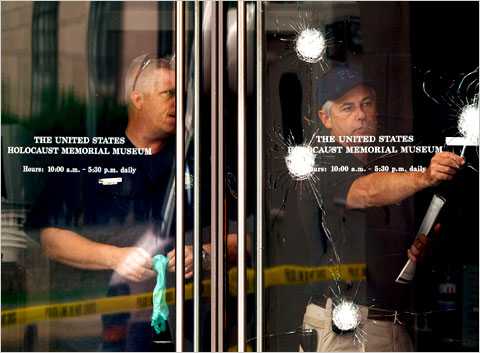
F.B.I. investigators examining a bullet-riddled door at the entrance of the Holocaust Memorial Museum, where a gunman entered the building and shot and killed a security guard. New York Times
A white supremacist who killed a security guard at a Holocaust memorial museum in the US has links to the British National party, which gained two MEPs in last week’s European elections.
Thousands of visitors fled the museum in Washington on Wednesday after James von Brunn opened fire, killing a security guard. In the gunfight that followed, the 88-year-old was shot, and is now in a critical condition in hospital.
Yesterday it emerged that Von Brunn, a longtime antisemite, had attended meetings of the American Friends of the British National party (AFBNP), which was set up to raise funds from far-right activists in America.
Mark Cotterill, who ran the US-based organisation before it folded in 2001, said: “He did attend meetings. I have just checked my database and he is down as ‘meetings only’, so he was not a major donor, although he may have put some money on the plate when it was passed round.”
The AFBNP treasurer, Todd Blodgett, also told the Washington Post that he and Von Brunn had attended fundraising meetings in Arlington County. The BNP leader, Nick Griffin, spoke to at least two AFBNP meetings and said the money raised by the organisation made a “significant contribution to the BNP’s [2001] general election campaign”.
Yesterday a spokesman for the party said: “You get a lot of people coming to meetings but I don’t think you can blame us for that. Even if he did go to meetings, it was nothing to do with us.”
However, anti-racism campaigners said Von Brunn’s links to the BNP underlined its extremist agenda. “It is clear that Nick Griffin is at the centre of an international network of white supremacists,” said Dan Hodges, of Searchlight. “The BNP must explain the full extent of his organisation’s links with this antisemitic gunman.”
The far-right party gained its first two MEPs in last week’s European elections – Griffin in the north-west and former National Front leader Andrew Brons in Yorkshire and the Humber.
During the campaign, photographs emerged of Griffin alongside the former Ku Klux Klan grand wizard Stephen “Don” Black, who was banned from the UK by the then home secretary, Jacqui Smith. He was also criticised for defending a BNP leaflet that said black and Asian Britons should be referred to as “racial foreigners”.
Yesterday Von Brunn was charged with murder and killing in the course of possessing a firearm at a federal facility, both capital offences under US federal law; police said hate crime charges were also possible.
At a press conference in Washington, Cathy Lanier, the Washington police chief, said security guard Stephen Johns was shot when he opened the door of the museum for Von Brunn. Other guards opened fire, and Von Brunn slumped to the ground.
In his car, officers found a notebook with a handwritten note saying, “You want my weapons, this is how you’ll get them. The Holocaust is a lie. Obama was created by Jews,” according to a court affidavit.
Von Brunn’s .22-calibre rifle held 10 more bullets and investigators found more in his car and at an apartment in nearby Annapolis, Maryland, that he shared with his son and his son’s fiancee.
Joseph Persichini, assistant director of the Washington FBI field office, said Von Brunn was known to the police as an antisemite and a white supremacist, who had a website that espoused hatred against African-Americans, Jews and others.
“We know what Mr Von Brunn did at the Holocaust museum. Now it’s our responsibility to determine why he did it,” said Joseph Persichini, assistant director of the Washington FBI field office. “We have to ask ourselves did all these years of public display of hatred impact his actions.”
A self-described artist, advertising man and author, Von Brunn wrote an anti-semitic treatise, Kill the Best Gentiles, decried “the browning of America” and claimed to expose a Jewish conspiracy “to destroy the White gene-pool”.
In 1983 Von Brunn was convicted of attempting to kidnap members of the US federal reserve board. At the time, police said he had wanted to take the members hostage because of high interest rates and the nation’s economic difficulties. On the website, Von Brunn blames his six-year imprisonment on “a Jew judge” and “Negro jury”.
Last night civil rights groups said they had been monitoring Von Brunn for decades.
Heidi Beirich, director of research for the Southern Poverty Law Centre’s intelligence project, said: “He thinks the Jews control the Federal Reserve, the banking system, that basically all Jews are evil. He’s an extreme antisemite.”
Vienna, June 12 – A Tatar activist recently given an 18-month suspended sentence for articles protesting Moscow’s Russification policies, says that the Internet activists may have kept him out of jail and, given the government’s increasing pressure on other media, they are often a last line of defense for the rights of ethnic and religious minorities in that country.
In an interview given to an independent Tatar journalist, Rafis Kashapov, a leader of the All-Tatar Social Center (VTOTs), explained that he has simply tried through his articles to attract the attention of society and the government to problems others have said less about (www.rupor.info/analitika/2009/06/09/lidera-oppozicii-v-tatarstane-osudili-k-lisheniju-/).
Among the issues he has raised are “the policy of Russification of national minorities, the restriction of the rights of Muslims, the deportation of peoples, fascism, corruption, drug abuse, alcoholism, depravity, and other social problems” that he believes can only be addressed by open and honest discussion.
If Russia were a normal democratic state, he suggested, “the leadership of the country would react positively” and seek a resolution of them. But in Russia, “instead of that, [the powers that be] opened a criminal case against” him, charging Kashapov with promoting extremism.
While the authorities have been angered by Kashapov for a long time, the last straw appears to have been his essay “Say No to Christianization!” posted online earlier this year in which he protested the actions of officials who allowed an Orthodox priest to baptize Tatar babies without the permission of their parents.
Addressing that issue in particular, Kashapov noted that the authorities had not taken the obvious step of inviting Christian and Muslim leaders to meet with them in order to overcome the problems these baptisms created and that, once they opened a case against him, prosecutors never questioned either the priest who baptized the children or the official who permitted it.
Unfortunately, however, the Russian government had no interest in finding the truth or even in examining his case more or less honestly, the Tatar leader said. Not only were two FSB agents present at every hearing, an indication of the political sensitivities of the case, but the judge routinely ignored protests by his lawyers.
Kashapov suggested that “the Internet possibly played a large role” in keeping him out of jail. Not only did he and his supporters place information about the case online when they had no other way of getting past the government’s information blockade, but “the majority” of those who read these materials “understood on whose side the truth is.”
Moreover, many of those who learned about his case, Kashapov continued, supported him in court, signed appeals, and organized demonstrations and protests on his behalf. And he used this interview to “express gratitude” to these individuals and also to the administrators of the sites of the independent information agencies.”
Kashapov said that their efforts were especially important because “at the present time in Russia is being conducted an unwritten nationality policy based on force over non-Russian peoples which precludes their free development, subjects them to humiliation and Russification and takes away their spiritual and material wealth.”
In Tatarstan, this policy involves the ban on the use of the Latin script, the closure of Tatar schools, and the problem of opening replacement in the Tatar language. And as is the case with many other national minorities, it involves Moscow’s decision to reduce to almost nothing the “national-regional component” in the curriculum of the public schools.
Those legitimate concerns are exacerbated, he said, by the Russian government’s flagrant ignoring of extremist behavior by Russian nationalist groups, like Spartak football fans who displayed pro-Hitler banners at a Kazan match, and by the Russian Orthodox Church, which is trying to baptize or convert the historically Islamic Tatars.
Individuals and groups in Tatarstan who have tried to expose and oppose such things, Kashapov said, have suffered. Indeed, he said, they like those elsewhere who share their commitment to freedom and national rights increasingly find themselves in a situation that is “difficult and dangerous.”
But he added, neither he nor they have any choice but to proceed: “Every time, when we multiply a lie, speak an untruth, or commit wrong actions, then by so doing we recognize and support the authoritarian powers that be of Russia, we work for it, and that means we strengthen it.”
And he added, “playing at democracy in Putin’s Russia has come to an end. It turns out that now the most reliable means [for the government] to resolve a problem is to ‘bury’ an individual just as in Stalin’s time.” According to the calculations of Moscow’s leadership once again, “where there is no person, there is no problem.”
Kashapov said that he has been physically threatened for his activities and that his family and friends had told him that “it would be better if [he] went abroad,” lest the powers that be “put [him] away in jail or still worse kill [him].” But he told his interlocutor, he has no plans to do so, preferring instead to continue his work in and for Tatarstan.
His lawyers have filed an appeal which is scheduled to be heard by the republic supreme court, but Kashapov does not expect to win in any Russian venue, given the politics of his situation. Instead, he — like so many other opponents of the regime — is already looking to the European Court of Human Rights in Strasbourg for legal vindication.
Turkey wishes liberation of the occupied lands of Azerbaijan.
Turkey will not open borders with Armenia, unless the lands are liberated, said Turkish ambassador to Azerbaijan Hulusi Kilic, speaking at the round table on the topic “Azerbaijani-Turkish relations in the regional geopolitical context” organized in the Center of Strategic Studies.
“20% of Azerbaijani lands have been under Armenian occupation for already 18 years. Evil wishers attempted to make the two fraternal states argue, spread information about the possible opening of the Turkish-Armenian border. Yet Prime Minister’s visit to Azerbaijan has made the situation clear.
The world got convinced that Turkey will never leave Azerbaijan and open borders with Armenia unless the territories are liberated from occupation”, noted the ambassador.

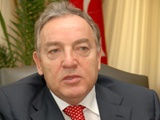
 Turkey will not open borders with Armenia, unless the lands are liberated, said Turkish ambassador to Azerbaijan Hulusi Kilic, speaking at the round table on the topic “Azerbaijani-Turkish relations in the regional geopolitical context” organized in the Center of Strategic Studies.