Month: June 2009

  • Equality bill will outlaw ‘apartheid’ constitution of the BNP

    Equality bill will outlaw ‘apartheid’ constitution of the BNP

    harrietharmanThe BNP’s “apartheid” constitution will be outlawed under legislation before parliament, Commons leader Harriet Harman told MPs yesterday.
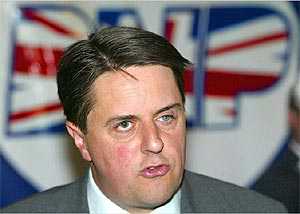
    Ms Harman said she was “shocked and horrified” by the election of BNP leader Nick Griffin and Andrew Brons to the European Parliament last week.

    She said there was “no place” in Britain for having a political party that only accepted white people as members and that the Equality Bill would prevent this.

    During questions on future business she told MPs: “We have all been shocked and horrified by the fact that two regions of this country, the North West and Yorkshire and Humberside, are represented by the British National Party, a party who have in their constitution a provision that you cannot be a member of that party if you are not white.”

    She added: “All of us should agree that there is no place for a political party in this country to have an apartheid constitution and the Equality Bill will prevent that being the case.”

    According to the BNP’s constitution, members must be from the “indigenous British ethnic groups deriving from the class of Indigenous Caucasian”‘.

    Tory Philip Davies said: “The reason why so many people voted for them the BNP wasn’t through an endorsement of their nasty creed of politics but out of frustration. The mainstream political parties don’t seem to be addressing their legitimate concerns in these areas.”

    A spokeswoman for the Government Equalities Office said: “The Equality Bill would give individuals a right to take legal action against the BNP, in respect of it excluding anyone from membership on grounds of race.”

    Source:  The Herald, Scotland, June 21 2009

  • Devils United

    Devils United

    The leader of the far-right British National Party wept as he saluted party members for helping win two seats in the European parliament.

    Nick Griffin was addressing delegates in a Blackpool hotel as part of the BNP’s “summer school” and Victory 09 celebrations.

    After listening to speeches by party bosses Mr Griffin was applauded to the stage.

    He managed just a “Thank you,” before he broke down. He thanked individuals and the collective membership for enabling two MEPs to be elected – himself in the North West and Andrew Brons in Yorkshire and the Humber.

    Speaking amid St George’s Cross bunting and sepia photographs of war veterans and impish little children, Mr Griffin applauded senior member Mark Collet, with whom he was cleared of inciting racial hatred in 2006.

    “The propaganda was exceptional,” he said of the BNP literature produced ahead of the local and Euro elections.

    Mr Griffin attacked the media for what he described as a smear campaign the likes of which he had never seen before. He attacked the three main parties for turning the country into a “multicultural bankrupt slum” and “organising and funding” the protesters against him.

    “Like a new boy at school,” was how he described visiting Brussels for the first time. But he said he had joined forces with other right-wing parties, forming “Devils United”.

    Outside The New Kimberley Hotel on the south promenade some 80 Unite Against Fascism members protested against the BNP.

    Four people were arrested near the protest, which police said was peaceful. The four were arrested on suspicion of inciting racial hatred.

    Press Association

  • Flowers of Turkey

    Flowers of Turkey

    This 1st edition guide book was published in Japan in 2008 for tourists visit in Turkey for particularly hiking and nature watching. There are 448 species of plants’ names with 7 different languages( by Latin=sientific name, English,Turkish, Japanese, German, French, Italian names) and it’s useful for the visitors of those language speakers. This book is made by light and strong quality of paper and easy to carry during your journey.

    Turkey is one of the full of nature lands with several different climates. Not many people know that there are over 10,000 plant species which includes 3,500 species of endemic flowers in Turkey. This is as many as in Europe all together. This book contains also the common species in other European countries , especially along to the mediterranean sea and Middle east countries.

  • End of the Silk Road for historic trading hub of Kashgar

    End of the Silk Road for historic trading hub of Kashgar


    Today is the last day for residents of one of the last surviving ancient cities in China to claim a bonus for agreeing to move out to make way for the wrecking ball.

    After the offer expires, the only inducement may be force.

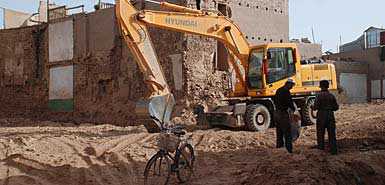
    Bulldozers are already crashing through the packed-mud walls of centuries-old homes. Yellow-helmeted workers toss bricks into wheelbarrows as they clear the rubble.

    The demolition of swaths of the Old Town of Kashgar is being carried out in the name of modernisation and safety. The famed trading hub on the Silk Road, on which caravans carrying silk and jade from China crossed with merchants from Central Asia bringing furs and spices, will effectively disappear.

    Walls throughout the town are stencilled with signs exhorting residents to support the makeover to prevent the damage wrought by last year’s massive earthquake in southwestern Sichuan province that killed 90,000 people.

    Many residents of the old quarter, members of the Muslim Uighur minority, are unconvinced.

    One old man, his beard white, taps a mud-and-straw wall. “These houses have withstood earthquakes for 2,000 years. They have wood inside to absorb the shock.” He gestures to a renovated building next door. “People are supposed to use these hard bricks. But look at the cement. There are gaps and it’s poor quality. Maybe this would fall more quickly.”

    City authorities have decided that most of these one and two-storey buildings must be razed. A small area visited by tourists seeking a flavour of Kashgar’s rich history will be preserved. Uighur residents, already distrustful of a Government that many regard as an occupation force, even doubt that.

    An elderly businessman, who refused to be identified for fear of retribution, said: “They don’t tell us anything. We don’t understand why they do this. Anyway, I don’t believe anything they say.” He is too frightened even to say who “they” are. He uses two letters, “GV “. He means the Government.

    Residents of the old city are reluctant to talk. Their fear is palpable. One gestures down the street. “The police are here. We must be careful.” In a house destined to disappear, a young girl slams the door into her rose-filled courtyard on visitors who ask about her home.

    The Government plans to spend $440 million (£270 million) to move 65,000 Uighur households – about 220,000 people – into modern housing. The aim is safer housing but other factors are at work.

    With a huge government stimulus package to boost the economy, authorities now have the money to tear down a warren of narrow alleys in which they fear Muslim Uighurs could foment separatist unrest. Days before last year’s Olympics two Uighurs rammed a lorry into a group of young police officers on a morning jog and then leapt out and attacked them with knives, killing 17. This month officials said that they had wrapped up seven terrorist cells in Kashgar.

    Non-governmental organisations are anxious that yet another remnant of China’s rapidly disappearing past is to vanish. The Beijing Cultural Heritage Protection Centre has issued an appeal to save the Old Town, saying that the threat to Kashgar is more serious even than that to the Chinese capital’s old alleyways or to Lhasa.

    It said: “Primarily due to its relatively distant location, information… is very hard to come by, hence so little monitoring and criticism on the poor preservation work of the local government.”

    Wu Dianting, a Beijing professor of regional planning who has studied the city, says that such large-scale raw-earth towns are now rare anywhere in the world. He describes them as well adapted for the desert region, being warm in winter and cool in summer. He has asked city authorities to reconsider. “Demolition would be a terrible pity.”

    Families are less concerned about their cultural heritage than about having a roof over their heads, and one under which they have sheltered for generations.

    Those who can afford to strengthen their existing homes and add a second storey may stay. The elderly businessman said: “Most people don’t agree. But they are poor. They have to move.”

    The extent of resistance is reflected in the forest of banners and wall slogans exhorting support for the improvements. One offered a bonus of 200 yuan (£20) a square metre for those who left by June 6; those staying until June 18 will be eligible for only 100 yuan. After that they will get nothing.

    Not all are opposed. One elderly Muslim merchant in an embroidered skullcap chatted between stalls selling grilled mutton kebabs as flat bread baked in earthen ovens and artisans beat copper pots. He said: “The new houses are much cleaner. They have a bathroom and a kitchen. It’s good to have proper sanitation.”

    He will still come down to the Old Town to gossip with friends around the main Id Kah Mosque. His son shrugs about the prospect of life in a block of flats. “What can you do? What can you do? We have no choice.”

    Times Online

  • Contemporary Necessary : Frankfurt School

    Contemporary Necessary : Frankfurt School

    Frankfurt school had been established to create a new resist about old traditional sociological theories and its main minds base on Horkheimer, Adorno, Marcuse and Habermas. We define foundation of Frankfurt school in near historical perspective. At this time European destruction on I.World War, different dimensions of Russian revaluation, fascist movements of Hitler and Mussolini in socialist regions of Europea influenced ideas of this school.

    Frankfurt school had been established to create a new resist about old traditional sociological theories and its main minds base on Horkheimer, Adorno, Marcuse and Habermas. We define foundation of Frankfurt school in near historical perspective. At this time European destruction on I.

    World War, different dimensions of Russian revaluation, fascist movements of Hitler and Mussolini in socialist regions of Europea influenced ideas of this school. In general founders had been affected by ideas of Marx. So we say that this school created a general table as Marxist methods to criticism. The project of the Frankfurt School was to develop a critical theory of contemporary society that would combine philosophy, social theory, economics and cultural criticism in a new type of interdisciplinary theory. Also there is a variety between main ideas and methods of Marx[1]. Frankfurt school adopted contributions of Marx to economical developments and his research and critique methods. So there is a new Critique Method of school.


    Frankfurt school believed that old principles should be transformed into new tools. On this way self image is important than common criticism. All theoretical points can be improve by firstly auto-criticism, hereby thinkers refused social and economical determinism which are existed on old Marxist theories, also disclaimed comdemnation individuals on common social body in Marx and Engel’s idea. Society needs to secret potentials of individuals according to school.


    Criticism will destroy all oppressive systems and people will be conscious against to ideologies. Capitalism is progressing quickly, so we don’t need old methods to understand contemporary circumstances. Modern capitalism is controlling people who are working in heavy conditions and it manipulating information and populer cultur to prevent disobediences. Frankfurt school is defining this as culture industry. Its first duty is to adapt people to capitalism. Culture industry creates some small daily relaxation materials in heavy working life. Industry abuses mass media organs to create artificial system and people know them as relaxation mechanisms. Theodor Adorno saw the culture industry as an arena in which critical tendencies or potentialities were eliminated. He argued that the culture industry, which produced and circulated cultural commodities through the mass media, manipulated the population. Popular culture was identified as a reason why people become passive; the easy pleasures available through consumption of popular culture made people docile and content, no matter how terrible their economic circumstances. School refuses its functions because these mechanisms are working to create again people’s work desires to capitalist system. Thus capitalism need to establish secret masks to legitimate its artificial system, contemporary sociologies are these masks. Theories of sociology and functionalism transformed to serve this idea.[2] Common target should be defined by thinkers as to create new solutions, share paradoxes in society and how they are produced by dominant system. Works of Adorno and Horkheimer heavily influenced intellectual discourse on populer culture.


    It is possible to create rational society with using Hegel’s ideas. Hegel says that reality is rational and humanity has an intelligence potential. So school is criticising modern society which is controlled by the cruel world system. Rational society is a common body which we are joining this with transforming environmental conditions. It gives standart opportunities to criticise available societies but Habermas creates a different model about it. He refuses rationality, humanity uses a concrete way. His utopic idea is that everybody should join to public discussions. Ideas of Habermas don’t base on rational society term, it is an ideal society which shares potential abilities of people.

    He determined three common points of human in Knowledge and Human Interests[3];


    – The technical human interest, which entails empirical and analytical ways of knowing and represents the world in terms of objects, processes and laws which describe the transformation of objects and processes


    – The practical human interest, which entails historical and hermeneutic ways of knowing that represent the physical, social, and cultural worlds as “texts” which have to be interpreted in order for meaning to emerge


    – The emancipatory human interest, which entails a critical way of knowing where critical theorems are gleaned through collective reflection on social and cultural practices and then used to restructure future actions.


    Thinkers of Frankfurt school focused on cultural and modernism problems. Related to this, they resisted to concrete rationalities of capitalist society. On this way they defenced importancy of cultural reality as against to economical functions. First resist to positivism had been created by Horkheimer. He aimed at dialectic positivists because of they shared a seperatist movement between phenomenons and values.[4] According to Horkheimer, positivism is a poor philosophical branch because it can not modernize itself and as epistemologically it can not understand real results. Horkheimer criticised positivism systematically in his articles and created common outlook to positivism of school.


    Criticism of Horkheimer improved by Habermas. In his “Knowledge and Human Interests” he define positivism as a monopolistic system which keeps information. If positivism recognises its target, it can be itself an information. It is possible to create this with using cathegories and notions which are refused by itself. Positivism had been established to give directions to people, it worked and today it has no important function. Also thinkers followed a way to criticise positivist approach of Marx. It shares a criticism to Soviets. Decisions can not depend on worker class, it should be established by theorists. So today’s authoritarianism of Soviet Marxism is a result of positivism, not Marxism.[5]

    Frankfurt school is a revisionist movement because criticism action of classic Marxist ideas and economical determinism.


    [1] Marxist Internet Archive, The Franktfurt School, www.marxist.org

    [2] Rudolf J. Siebert. “The Critical Theory of Religion: The Frankfurt School

    [3] Knowledge, Jurgen Habermas : http://www.psychiatriapsychoterapia.pl

    [4] Jeremy J. Shapiro. “The Critical Theory of Frankfurt “, in: Times Literary Supplement

    [5] Necati Bozkurt, 20. yy Düşünce Akımları , Sarmal Yayınları


    Mehmet Fatih ÖZTARSU

    Caspian Weekly

  • Erdogan Avoids Confrontation with the Military over Alleged Plot

    Erdogan Avoids Confrontation with the Military over Alleged Plot

    Erdogan Avoids Confrontation with the Military over Alleged Plot

    Publication: Eurasia Daily Monitor Volume: 6 Issue: 118
    June 19, 2009 02:58 PM
    By: Saban Kardas
    Since the publication of a document, allegedly prepared by Colonel, Dursun Cicek, outlining a plan to undermine the governing AKP and the Gulen movement last week, Turkish domestic politics has focused on the future of civil-military relations (EDM, June 15). Nonetheless, fears over a split between the government and the military did not transpire, and Prime Minister Recep Tayyip Erdogan has avoided such a dangerous confrontation. Instead of pursuing punitive action against the military authorities, Erdogan has demonstrated restraint and instead referred the matter to the courts.

    On June 15, the chief military prosecutor said that the allegations were being investigated. Based on a preliminary study of evidence, the prosecutor reached an opinion that the document was not prepared by any unit within the headquarters of the General Staff. If the authenticity of the document could be established, all personnel involved will be brought to justice, the statement added (Anadolu Ajansi, June 16).

    The office of the General Staff also released a press statement that criticized “the written and verbal comments and declarations targeting the Turkish Armed Forces (TSK), both openly and implicitly, on the assumption that the allegations are true.” It called on everyone to refrain from reaching any premature conclusion on the allegations before the legal inquiry has reached its judgment (www.tsk.tr, June 15).

    Pro-government and pro-Gulen media outlets labeled the action plan as a blatant attempt by the military to interfere with the jurisdiction of civil politics. They did not find the military authorities’ claims about the authenticity of the document credible, and questioned how the prosecutor might have formed an “opinion” on a document without having seen it. More importantly, in their view, despite the steps taken toward democratization, the existence of such a plan within the military was a grave development. They maintained that unless the government acts decisively against this threat, its democratization efforts will be damaged. They believe, if necessary, the government should ask for the resignation of the either the chief of the General Staff or his deputy who oversee the department that allegedly prepared the report (Yeni Safak, Zaman, June 16).

    The Chief of the General Staff General Ilker Basbug gave an interview to Hurriyet in which he responded to the growing criticism of the Turkish military. He reiterated that the military prosecutor was working on the case and his headquarters’ additional investigation had revealed that there was no concrete evidence linking the military to the document. When asked “was such an order [for the preparation of the document] issued by the military command?” Basbug responded “I even consider this question an insult. Such an order was never given.” He said he will take all measures necessary, if the alleged source of the document is proven, but added that he opposed referring the case to the civil courts (Hurriyet, June 16).

    In this context, curiously the AKP’s reaction was expected. When the allegations first emerged, Erdogan promised to defend democracy and take any necessary legal action. On June 16, he met Basbug to discuss these developments. Recently, both leaders had agreed to form a new consultation mechanism and hold weekly meetings every Thursday (Radikal, January 22). No statement was issued following this meeting, but during his address to the AKP’s parliamentary group later the same day, Erdogan insisted that the state institutions had acted in close coordination. He praised the handling of the case by the General Staff, saying that it acted “in a responsible and sensitive manner.” He called on the military and civil courts to conclude their investigations promptly (Anadolu Ajansi, June 16).

    The AKP filed a criminal complaint against the plan with the Ankara Public Prosecutor’s Office. The lawsuit defined those involved in alleged plots against the AKP and the government, as engaging in illegal activities. The AKP described such activities as unacceptable, and requested an immediate investigation (Cihan, June 16).

    The AKP’s lawsuit appears to be based on the assumption that the document is genuine, and consequently the discussions have focused on the forensic investigation into its authenticity. However, reports in the Turkish media demonstrate how deeply politically divisive the issue has become. Newspaper headlines on June 17 illustrated the extent of these divisions. Star, which is supportive of the government, insisted that the document was uncovered as part of the Ergenekon investigation and was true, while Haberturk, which is more critical of the government, questioned its authenticity.

    The Gendarmerie criminal investigation unit has allegedly completed its examination of the document, which hinges on whether the signature belongs to Colonel Cicek. Although the forensic report was not released, newspapers speculate over its possible content. Whereas Haberturk claimed that it is “99 percent certain” that the document was forged, Yeni Safak and Star maintained that according to a preliminary investigation there is “90 percent certainty” that the signature belonged to the Turkish colonel. Other papers alleged that he might have used different signatures, which could further complicate the investigation (Sabah, Aksam, June 19).

    The Zaman daily, close to the Gulen movement, questions this narrow focus on the authenticity of the document, and maintains that it cannot address public concern surrounding the accusations. Zaman was especially critical of efforts to transfer the investigation to the military courts. Citing similar instances in the past, Zaman claims that it might be used to promote a military cover up. It called for a more comprehensive parliamentary investigation into the allegations (Zaman, June 19).

    Nonetheless, Erdogan has refused to turn this case into an open confrontation with the military, and he remains committed to avoiding such conflict. Turkish domestic politics is increasingly conducted around controversial legal cases. Yet, in a political system as divided as Turkey’s, trust in the court system is lacking -and far from clarifying the allegations, the court might perpetuate existing divisions.

    https://jamestown.org/program/erdogan-avoids-confrontation-with-the-military-over-alleged-plot/