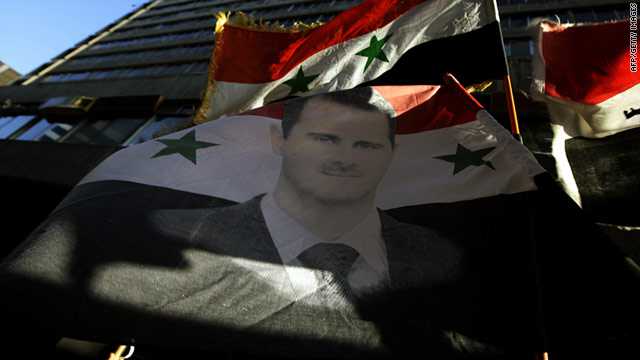
A demonstration in support of Syrian president Bashar al-Assad in Damascus on August 23.
(CNN) — Russia’s foreign minister slammed the European Union sanctions against Syria, Russian news agency RIA Novosti reported Saturday.
“We’ve always said that unilateral sanctions will bring no good. It destroys the partnership approach to any crisis,” Sergei Lavrov said.
The EU imposed a ban Friday on the import of Syrian oil, which is one of the latest diplomatic moves against Bashar al-Assad’s embattled regime.
The action was expected. The EU has been a top market for Syrian oil, and the group said it intended to make the move which will have a detrimental impact on the Syrian government’s oil revenues.
The EU also added four more Syrians and three entities to a list of those targeted by an asset freeze and a travel ban. But there is an exemption to the asset freeze for humanitarian purposes.
World powers have been bearing down on the al-Assad regime because of the government’s ferocious crackdown against peaceful protesters for nearly six months.
In joint statement, European Union countries agree to embargo on oil industry over violence against pro-democracy protesters
Reuters in Sopot
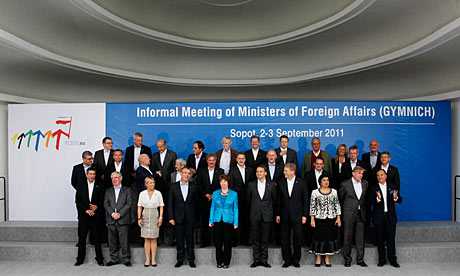
EU foreign ministers at a summit in Sopot, POland, where the announcement was made. Photograph: Kacper Pempel/Reuters
European Union governments have agreed to ban imports of Syrian oil and extended sanctions to seven new Syrian individuals and bodies to intensify pressure on President Bashar al-Assad’s government.
The US, the EU and other western powers want Assad to end a violent five-month-old crackdown on pro-democracy protesters that the United Nations says has killed 2,000 civilians. But Assad shows no sign of heeding their calls for him to step down.
The EU has already banned Europeans from doing business with dozens of Syrian officials, government institutions and military-linked firms tied to the violence, but those measures seem to have had little influence on Assad’s policy. Friday’s steps are the first time the EU has targeted Syrian industry and the key oil sector, but analysts say the sanctions, which do not go as far as the investment ban imposed by the US last month, may have only a limited impact on Assad’s access to funds.
“In view of the gravity of the situation in Syria, the council today further tightened the EU’s sanctions against that country,” EU governments said in a statement.
“The prohibition concerns purchase, import and transport of oil and other petroleum products from Syria,” they said. The decision also expanded the list of people and entities subject to EU travel bans and asset freezes by seven, including four individuals.
The measures goes into effect on Saturday. But Italy has won an exemption on existing contracts, which can be fulfilled until 15 November, underscoring divisions in Europe over energy sanctions which have slowed the implementation of economic measures against Assad.
Italy defended its demand for a grace period, with its foreign minister, Franco Frattini, saying Italian firms needed time to adapt. “It is a technical request,” Frattini told reporters. “Given that Italy imports 30% of all EU imports from Syria, we need … some weeks to comply with these sanctions, which we support and which obviously Italy had always called for.”
Dutch foreign minister Uri Rosenthal argued that the sanctions would apply real pressure. “They will go straight to the heart of the regime. This will squeeze the regime,” he said, but added that what was required was a UN resolution and a tough stance towards Assad by the Arab League.
Firms such as Anglo-Dutch Royal Dutch Shell and France’s Total are significant investors in Syria.
EU countries are the main buyers of Syrian oil exports, but industry sources say that even when imports to Europe are blocked, European companies will continue operating within Syria until the EU imposes sanctions on all co-operation with Syrian energy firms.
German Chancellor Angela Merkel no longer has enough coalition votes in the Bundestag to secure backing for Europe’s revamped rescue machinery, threatening a consitutional crisis in Germany and a fresh eruption of the euro debt saga.
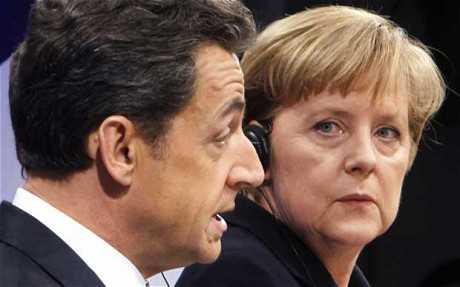
Seething discontent in Germany over Europe's debt crisis has spread to all the key institutions. Photo: AP
By Ambrose Evans-Pritchard
Mrs Merkel has cancelled a high-profile trip to Russia on September 7, the crucial day when the package goes to the Bundestag and the country’s constitutional court rules on the legality of the EU’s bail-out machinery.
If the court rules that the €440bn rescue fund (EFSF) breaches Treaty law or undermines German fiscal sovereignty, it risks setting off an instant brushfire across monetary union.
The seething discontent in Germany over Europe’s debt crisis has spread to all the key institutions of the state. “Hysteria is sweeping Germany ” said Klaus Regling, the EFSF’s director.
German media reported that the latest tally of votes in the Bundestag shows that 23 members from Mrs Merkel’s own coalition plan to vote against the package, including twelve of the 44 members of Bavaria’s Social Christians (CSU). This may force the Chancellor to rely on opposition votes, risking a government collapse.
Christian Wulff, Germany’s president, stunned the country last week by accusing the European Central Bank of going “far beyond its mandate” with mass purchases of Spanish and Italian debt, and warning that the Europe’s headlong rush towards fiscal union stikes at the “very core” of democracy. “Decisions have to be made in parliament in a liberal democracy. That is where legitimacy lies,” he said.
RELATED ARTICLES
Britain can easily weather eurozone break up if officialdom is sensible
28 Aug 2011
Downgrade risk over ICB banks report
27 Aug 2011
Christine Lagarde urges more cash for EU banks to head off recession
27 Aug 2011
Eurozone nations extend short selling ban
26 Aug 2011
Britain’s pension funds should invest closer to home
27 Aug 2011
Coalition refuses to open HBOS dossier
27 Aug 2011
A day earlier the Bundesbank had fired its own volley, condemning the ECB’s bond purchases and warning the EU is drifting towards debt union without “democratic legitimacy” or treaty backing.
Joahannes Singhammer, leader of the CSU’s Bundestag group, accused the ECB of acting “dangerously” by jumping the gun before parliaments had voted. The ECB is implicitly acting on behalf of the rescue fund until it is ratified.
A CSU document to be released on Monday flatly rebuts the latest accord between Chancellor Merkel and French president Nicholas Sarkozy, saying plans for an “economic government for eurozone states” are unacceptable. It demands treaty changes to let EMU states go bankrupt, and to eject them from the euro altogether for serial abuses.
“An unlimited transfer union and pooling of debts for any length of time would imply a shared financial government and decisively change the character of a European confederation of states,” said the draft, obtained by Der Spiegel.
Mrs Merkel faces mutiny even within her own Christian Democrat (CDU) family. Wolfgang Bossbach, the spokesman for internal affairs, said he would oppose the package. “I can’t vote against my own conviction,” he said.
The Bundestag is expected to decide late next month on the package, which empowers the EFSF to buy bonds pre-emptively and recapitalize banks. While the bill is likely to pass, the furious debate leaves no doubt that Germany will resist moves to boost the EFSF’s firepower yet further. Most City banks say the fund needs €2 trillion to stop the crisis engulfing Spain and Italy.
Mrs Merkel’s aides say she is facing “war on every front”. The next month will decide her future, Germany’s destiny, and the fate of monetary union.
The enigma of Italy’s ancient Etruscans is finally unravelled
DNA tests on their Italian descendants show the ‘tuscii’ came from Turkey
John Hooper in Rome
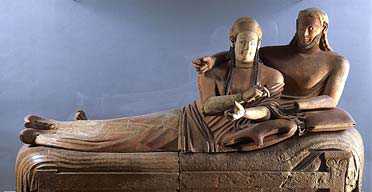
Ancient wonders … The Etruscans created great works of art including the Bride and Bridegroom, or the Married Couple. Photograph: Gianni Dagli Orti/Corbis
They gave us the word “person” and invented a symbol of iron rule later adopted by the fascists. Some even argue it was they who really moulded Roman civilisation.Yet the Etruscans, whose descendants today live in central Italy, have long been among the great enigmas of antiquity. Their language, which has never properly been deciphered, was unlike any other in classical Italy. Their origins have been hotly debated by scholars for centuries.
Genetic research made public at the weekend appears to put the matter beyond doubt, however. It shows the Etruscans came from the area which is now Turkey – and that the nearest genetic relatives of many of today’s Tuscans and Umbrians are to be found, not in Italy, but around Izmir.
The European Human Genetic Conference in Nice was told on Saturday the results of a study carried out in three parts of Tuscany: the Casentino valley, and two towns, Volterra and Murlo, where important finds have been made of Etruscan remains. In each area, researchers took DNA samples from men with surnames unique to the district and whose families had lived there for at least three generations.
They then compared their Y chromosomes, which are passed from father to son, with those of other groups in Italy, the Balkans, modern-day Turkey and the Greek island of Lemnos, which linguistic evidence suggests could have links to the Etruscans.
“The DNA samples from Murlo and Volterra are much more highly correlated to those of the eastern peoples than to those of the other inhabitants of [Italy],” said Alberto Piazza of the University of Turin, who presented the research. “One particular genetic variant, found in the samples from Murlo, was shared only with people from Turkey.”
This year, a similar but less conclusive study that tracked the DNA passed down from mothers to daughters, pointed to a direct genetic input from western Asia. In 2004, a team of researchers from Italy and Spain used samples taken from Etruscan burial chambers to establish that the Etruscans were more genetically akin to each other than to contemporary Italians.
The latest findings confirm what was said about the matter almost 2,500 years ago, by the Greek historian Herodotus. The first traces of Etruscan civilisation in Italy date from about 1200 BC.
About seven and a half centuries later, Herodotus wrote that after the Lydians had undergone a period of severe deprivation in western Anatolia, “their king divided the people into two groups, and made them draw lots, so that the one group should remain and the other leave the country; he himself was to be the head of those who drew the lot to remain there, and his son, whose name was Tyrrhenus, of those who departed”.
It was a Roman who muddied the waters. The historian Livy, writing in the first century BC, claimed the Etruscans were from northern Europe. A few years later, Dionysius of Halicarnassus, a Greek writer living in Rome, came up with the theory that the Etruscans were, on the contrary, indigenous Italians who had always lived in Etruria.
The Lydian empire had by then long since passed into history. Its inhabitants were said by Herodotus to have been the first people to make use of gold and silver coins and the first to establish shops, rather stalls, from which to trade goods. They gave the world the saying “as rich as Croesus” – Croesus was their last king.
Herodotus’s story about the drawing of the lots may or may not be true, but the genetic research indicates that some Lydians did, as he wrote, leave their native land and travel, probably via Lemnos, to Italy.
There, they were called “tuscii” in Latin. The obvious explanation for this has always been their fondness for building tower-like, walled, hilltop towns like those still to be seen scattered across Umbria and Tuscany.
But the latest conclusions may add weight to a rival, apparently more fanciful, theory that links their name to Troy, the “city of towers” and a part of the Lydian empire. The most likely date for the fall of Troy, as described by Homer, is between 1250 and 1200 BC.
The Etruscans’ contribution to Roman civilisation is still debated. They provided Rome with some of its early kings, and maybe even its name.
The “fasces”, the bundle of whipping rods around a double-bladed axe that became an emblem of authority for the Romans, was almost certainly of Etruscan origin.
However, not many words in Latin are thought to derive from Etruscan. An exception is “persona” from “phersu”.
The Etruscans unquestionably created glorious art. Among their most celebrated works is the so-called Sarcophagus of the Bride and Bridegroom (or Married Couple), which is in a Rome museum. It shows two people with slightly tip-tilted noses and pixie-like features.
It is known the Etruscans tried to predict the future by reading the patterns of lightning. It is thought that they introduced the chariot to Italy. They almost certainly ate good meat. Tuscany is famed for its beef, particularly that from the Chiana valley, which has been celebrated since classical times.
Another recent genetic study, of “chianina” and three other Tuscan cattle strains, found they were unrelated to Italian breeds. Yet matches were found in Turkey and the Balkans, along the supposed route of some of ancient Italy’s most enigmatic immigrants.
Timeline
1200BC First traces of Etruscan civilisation
700BC Etruscans borrow alphabetic writing from Greeks, and become first people in Italy to write
616-579BC Rome ruled by its first, legendary Etruscan king, Lucius Tarquinius Priscus
550BC Etruscan power at zenith. Three confederations hold Po valley and coast south of Rome, heartland of southern Tuscany, and western Umbria. Allied with Carthaginians, Etruscans trade across the Mediterranean
535BC At Alalia, off Corsica, fleet of Carthaginians and Etruscans defeat Greek fleet. But Carthaginians, not Etruscans, assert control over seas
510BC Last Etruscan king, Lucius Tarquinius Superbus, is expelled from Rome
474BC At Cumae, off Naples, Greek fleet defeats Etruscans, who start to lose grip on area south of Rome
396BC Romans capture Veii, an Etruscan settlement north of Rome; destruction of settlement marks start of long period in which Romans gradually annex towns of Etruscan heartland. By start of first century BC, all of Etruria has been absorbed by Rome republic
It has been a fashion in Turkish media in recent years to question and attack the ideology and accomplishments of Kemal Atatürk – a hero figure for the vast majority of Turks. Columnist Mustafa Akyol, who writes in Turkish Daily News, and who for years has been trying to discredit Atatürk, is one such media personalty.
This disturbing trend gained acceptance in certain journalistic circles within the past decade, in particular after the AK Party’s second electoral victoy in 2007. The growing influence of the Gülen Movement has given impetus to the Atatürk-bashing trend.
The attack comes mostly from radical conservatives and idealogs – some outright religious bigots -that cannot make peace with Atatürk’s legacy. These critics typically yearn for a “Second Turkish Republic” that have the markings of a bygone Ottoman era. In a conference held 3 months ago at the Kadir Has University in Istanbul, for example, Mr. Akyol reportedly expressed preference for the “democracy” of the Ottoman era!
The putative reason for Atatürk’s failing, according to these circles, is that Atatürk was anti-Islam, depriving Turks of the freedom to practice their faith. There are even some critics who castigate Atatürk for abolishing Caliphate.
It would be unrealistic to expect these critics, being imbued by religious prejudice, to appreciate what Atatürk has accomplished. Many of these critics like Mr. Akyol are apologists if not the products of the Gülen Movement, and they advocate an Islamist Turkey instead of a secular one. Most of them have joined hands with quack Creationists that assault Darwin’s Evolution Theory. All because it doesn’t fit with their religious dogma.
To realize the hollowness of their arguments, and why Atatürk was not anti-Islam, these opponents should read the works of such researchers as Sinan Meydan (e.g., “Cumhuriyet Tarihi Yalanları”) and Professor Ethem Ruhi Fiğlalı (e.g., “Atatürk And The Religion of Islam”). They will learn, for example, that Atatürk tried to free Islam from the shackles of dogma and advanced the notion that religion is a matter between an individual and God. This is also what Islam teaches. Atatürk eschewed “false prophets” that stood between man and God. He held that Islam should be in conformity with reason and logic. He sponsored the construction of mosques in Tokyo and Paris.
These are not the hallmarks of a leader who was anti-religion or anti-Islam.
But Atatürk’s accomplishments go far beyond religion: He freed the Turkish nation from the shackles of imperialism and introduced reforms toward a civil society, science and modernity – from alphabet to secularism to women’s rights. Thanks to his reforms, the decadence and backwardness of the waning years of the Ottoman Empire was left behind.
It was a call for the Turkish nation to catch up with the West in science and modernity. Turks could still practice their religion, but the State did not adopt or sponsor a particular religion.
If the opponents of Atatürk like Mr. Akyol are breathing freedom in Turkey today, they owe it to the leadership of Atatürk.
If Turkey has any realistic hopes to join the EU, it is because a measure of westernization that Atatürk’s reforms have ushered in. (Reversals in recent years notwithstanding ).
The secular establishment Atatürk founded – through the Republic – was requisite for democratization in Turkey.
It was for good reason that Professor Arnold M. Ludwig of Kentucky University, after 18 years of study of the world leaders of the 20th century (“King of the Mountain”), picked Atatürk as the top winner among the contestants. That makes Atatürk a towering figure in world history. Opponents of Atatürk would do well to read that seminal book.
And it is also remarkable that the Greek Premier Eleftherios Venizelos, a former enemy of Turkey, nominated Atatürk for the 1934 Nobel Peace Prize.
The bigotry and ignorance of these opponents – pathetic as they are in their efforts – could be ignored if it were not for the fact that they regularly pontificate in printed and visual media. It is lamentable that these opponents do not show greater respect for the legacy of a visionary figure beloved by the vast majority of Turkish people. In no major newspaper in the U.S., for example, would one find derogatory remarks about George Washington.
Notwithstanding, there is little doubt that Atatürk will remain a towering historical figure among Turks. Reactionary forces that resist change and want to hold on to the past will not hold the Turkish nation hostage to their hatred and bigotry.
The West fought a hard and grueling battle for Enlightenment, and it eventually won. Turkey eventually will also win; for it must. This is what progress is about.
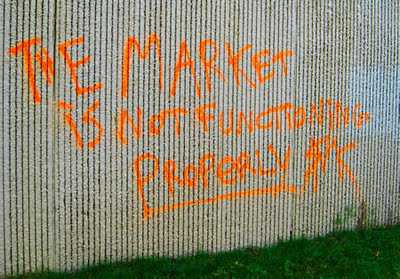
I look at the financial statements of the big banks. 10-Qs and the like. I’ve concluded that, for the most part, it’s a waste of time. There are usually 70 or so pages of numbers and discussion. Tons of data. But what is missing is a realistic appraisal of what the assets are actually worth.
Rather than go blind looking at small print I just look at market capitalization and assets. The balance sheet assets are a good proxy for what has to be funded. The market cap (shares outstanding X current market price) is the only number one can look at that is “real”. It is real because the “tape” and the market say so. It is a much more reliable number than what the accountants, auditors and management tell you.
Market cap is critical because there is a presumption that a big bank can go to the equity market and issue preferred and common stock equal to about 10% of the existing market valuation. A big equity valuation is a cushion in troubled times.
Societe Generale, Paris is a big bank that has been much in the news this week. SoGen is a top tier global bank. They have a very large deposit base and consumer business. They are also a big global trading bank. SG is well managed. I would call it one of the Crown Jewels of the financial picture in France. It is a classic Too Big to Fail.
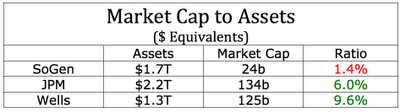
Having said all those nice things about SoGen I also have to point out that it has a very thin margin of market valuation to support its huge balance sheet. The market cap/asset ratios for SoGen, Wells Fargo and JPM:
Looking at this one sees the problem. SoGen is levered 4-6 X’s the US banks.
Under normal circumstances my way of looking at things is irrelevant. It only becomes significant when there are problems. Today we have problems.
There are monstrous gobs of liquidity in the world. But every day that goes by that liquidity is getting more and more risk adverse. Globally there is about $60 Trillion of funded debt of one form or another. That huge amount has to be rolled over constantly. A very substantial portion of this has maturities of less than six months. It is a “faith based” system. The assumption is that there will always be ample liquidity from the holders of cash to roll over everything without a hiccup. At the moment there is not much faith in that system.
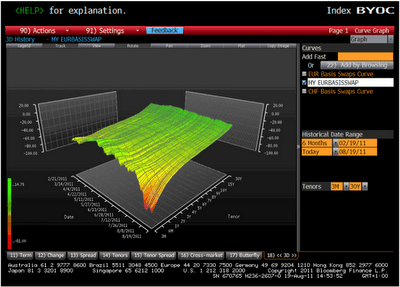
The nice folks at FTAlphaville put up this interesting chart Friday afternoon. It tells the story perfectly. Everything is green except the month of August and the very short end of the funding spectrum. The red area is a Short Squeeze.This is also a big Red Alert!
The lower the equity cap of any financial, the greater the risk that there are funding problems. This is what did in Lehman. Almost overnight they lost their funding sources. (Note: This is what happened to Drexel in 1989. I was there. It took ten days to go from soup to nuts.)
SoGen, being what they are, will not be the first bank to suffer liquidity problems. I used their equity numbers to make a point. It is the second tier Euro banks that are going to get squeezed. I have no doubt but they are already feeling the pinch.
I can’t see this going on much longer. We may have already passed the point where the downward spiral on funding availability is irreversible without global central banks stepping in.
.
That brings us to Jackson Hole. Damn near everyone I read is thinking that Bernanke is going to pull a rabbit out of his hat next weekend. Some new form of monetary stimulus will be announced and all will be well for the markets once again. I don’t agree.
While the US has some major league problems, those issues can’t be addressed by the Fed. There is nothing more that the Fed can do. With short-term rates at zero (and planted there for years to come) and the ten-year at 2% there is nothing left to be done. Or is there?
I maintain the next move by the Fed is to massively open up the dollar swap lines with European central banks. I don’t think Bernanke wants to announce this significant step at Jackson Hole. It is an EU issue and the Fed can’t take the lead on this. Opening the swap lines will prove to be very unpopular in the US. Politicians will jump on it as a bailout of Europe while America is struggling.
Bernanke is going to take some heat, when this happens (I think this is now a certainty, just not sure of the timing). But I also think that Bernanke is pushing (as I write) for this to happen. The only option left for Bernanke is to put another half trillion or so into the global system. He can’t do that in the US, but he has a great excuse today to do it in Europe.
I maintain the forum for this is not Jackson Hole. There is too much theater in all of this already. The Europeans don’t want this to be a circus (more than it already is). They want to be seen as responding to an EU problem, they don’t want to be seen as a slave to Bernanke and the Jackson Hole confab.
The announcement of the swap lines will not come from Wyoming. It will happen on a Sunday night. It either happens before next weekend, or the weekend after. Given that things are rapidly unwinding in the EU funding markets I don’t think they want to wait another two full weeks to put a band aid on the problem. They have to do something sooner than that. If they don’t, they risk a full scale liquidity blowout before September. If the blowout were to happen it would be very difficult to reverse. They have to (attempt) to get ahead of the problem before it is a crisis.
I think there is a decent chance this important next step takes place outside of Jackson Hole. It could happen this Sunday night. If I’m wrong, and we get nothing, the European funding markets are going to collapse next week. It will be very difficult to reverse the damage that this will cause. All the central bankers know this. They know that there is not much time left to act. They can’t wait another two weeks.