Tag: EU

  • Turkey accuses EU of bigotry, says its reforms are ignored

    Turkey accuses EU of bigotry, says its reforms are ignored

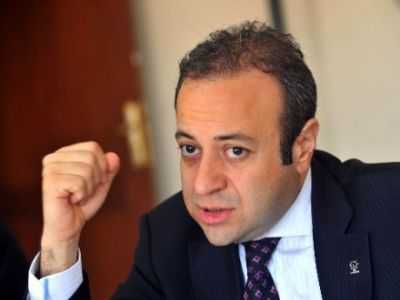
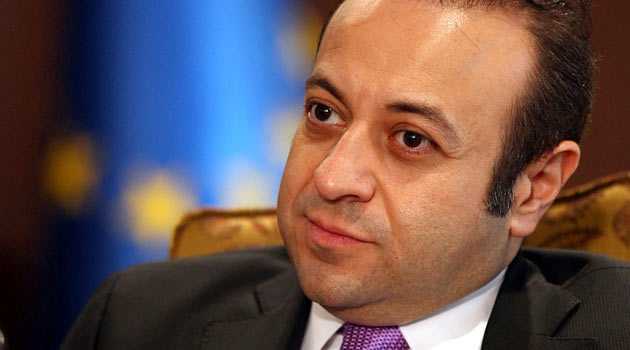
    Egemen Bağış

    ISTANBUL (Reuters) – Turkey accused the European Union of bias and bigoted attitudes towards the EU candidate country on Monday and blamed it for undermining the Turkish public’s trust in the bloc.

    Turkey criticised the European Commission’s latest report on its progress towards EU membership as it presented for the first time its own report highlighting its reforms over the last year.

    Turkey began accession talks in 2005 but the process has ground to a halt due to an intractable dispute over Cyprus, the divided island state which Turkey does not recognise, and opposition from core EU members France and Germany.

    Despite waning domestic support for joining the EU, Ankara has continued to push for full membership of the union and has said it wants to join before 2023, the centenary of the founding of the Republic of Turkey.

    “We observed that this year’s Turkey Progress Report was overshadowed by more subjective, biased, unwarranted and bigoted attitudes,” Turkey’s EU Affairs Minister Egemen Bagis said in a statement accompanying Turkey’s own 270-page report.

    Bagis said it was unacceptable that the European Commission report released in October had ignored Turkey’s “courageous” reforms over the last year and that this undermined the EU’s trustworthiness in the eyes of the Turkish public.

    The minister previously voiced his disappointment with the report in October, saying it failed to be objective, ignored the expansion of rights for religious minorities and had criticised the judiciary too sweepingly.

    A recent survey by the German Marshall Fund think-tank found a majority of Turks view the EU negatively, illustrating the declining enthusiasm for EU membership.

    Ankara has completed only one of the 35 policy “chapters” every candidate must conclude to join the EU. All but 13 of those chapters are blocked by France, Cyprus and the European Commission.

    Talks have also been blocked by the Commission which says Turkey does not yet meet required standards on human rights, freedom of speech and religion.

    “Today there is no government in Europe which is more reformist than our government,” Bagis said.

    “While EU countries are struggling in crisis, our country is experiencing the most democratic, prosperous, modern and transparent period in its history,” he said.

    “The ‘sick man’ of yesterday has got up and summoned the strength to prescribe medication for today’s Europe … and to share the EU’s burden rather than being a burden to it,” he said.

    The progress report prepared by Turkey, released on the website of its EU Affairs Ministry, cited the passage of reforms in the areas of the judiciary, education and workers rights as examples of progress over the year.

    Bagis told Reuters in Dublin earlier this month Turkey was hopeful France will unblock talks over EU membership on at least two policy chapters in the coming months ahead of a visit by President Francois Hollande.

    While Hollande has stopped short of endorsing Turkey’s EU candidacy, he has said it should be judged on political and economic criteria – a contrast to his predecessor Nicolas Sarkozy’s position that Turkey did not form part of Europe.

    German Foreign Minister Guido Westerwelle said on December 21 the current standstill in negotiations over Turkey’s membership bid was unsatisfactory and the new year offered an opportunity to tackle outstanding issues with renewed vigour.


    Reuters

     

  • Greece ‘most corrupt’ EU country, new survey reveals

    Greece ‘most corrupt’ EU country, new survey reveals

    Greece is perceived to have the most corrupt public sector of all 27 EU countries,a new global survey reveals.

    Worldwide, Denmark, Finland and New Zealand were seen as the least corrupt nations, while Afghanistan, North Korea and Somalia were perceived to be the most corrupt.

    Transparency International’s 2012 Corruption Perceptions Index gathered views on 176 countries worldwide.

    Two-thirds scored below 50, with zero highly corrupt and 100 very clean.

    The UK ranked 17th in the world, with a score of 74.

    Greece’s global ranking fell from 80th in 2011 to 94th in 2012, reflecting the country’s continuing economic turmoil and widespread tax evasion.

    Italy was ranked 72nd, below EU-newcomer Romania at 66 in the index.

    “Governments need to integrate anti-corruption actions into all public decision-making”, said Huguette Labelle, chair of Transparency International (TI), a body set up in 1993 to expose and tackle countrywide corruption.

    “Priorities include better rules on lobbying and political financing, making public spending and contracting more transparent and making public bodies more accountable to people.”

    TI believes there are strong correlations between poverty, conflict and perceived levels of corruption.


    BBC

  • Turks to European Union: No, Thanks

    Turks to European Union: No, Thanks

    By Emre Peker

    ISTANBUL — There was a time when joining the European Union was Turkey’s most-prized goal. Now, Turks don’t want to go anywhere near the bloc.

    Support for joining the EU has dropped to a record low of 17% from 34% last year, according to a survey published Tuesday by the Turkish European Foundation for Education and Scientific Studies, or Tavak. What’s more, almost 80% of the 1,110 people polled in eight cities across Turkey in June said they didn’t believe Turkey would join the 27-nation bloc.

    European Pressphoto Agency

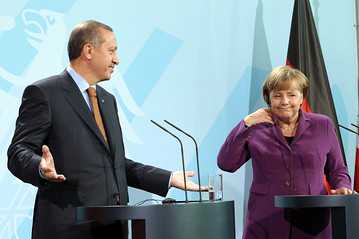
    German Chancellor Angela Merkel and Turkish Premier Recep Tayyip Erdogan on Nov. 2, 2011. Before that meeting, in a newspaper interview Mr. Erdogan accused Germany of blocking Turkey’s entry to the EU.

    At the heart of it is Turkey’s strong economic growth, contrasting with the EU, which has seesawed in and out of recession amid a financial crisis during the past three years, said Faruk Sen, chairman of Tavak. Also fueling sentiment against joining the EU are repeated snubs from EU leaders against Turkish entry to the bloc and a feeling that the union is anti-Islam, he said in an interview on Wednesday.

    “From now on, the EU will have to coddle Turkey, be more hands-on. Turkey is developing alternatives,” Mr. Sen said. “Think of it this way, a man doesn’t think of an alternative to a wife he very much loves, but if the woman withdraws, then the husband looks for alternatives.”

    Analogies of failed marriages aside, Turkey has indeed been deepening trade ties with the Middle East and North Africa in the past five years. While the EU is still Turkey’s biggest export market, its share of the pie is falling fast.

    As Turkey’s sales abroad have been growing at a healthy clip — reaching a record $135 billion in 2011 — the EU’s share shrunk to 46% in 2011 from 56% in 2007, according to the state statistics agency. As of June, Turkish businessmen had cut their sales to the EU to 39% while boosting exports to the Middle East and North Africa to 36%, up from 28% in 2011.

    Turkish Prime Minister Recep Tayyip Erdogan had made EU membership a priority after his party came to power in 2002 and clinched accession talks with the bloc in 2005. At the time, support for joining the union had peaked at 78%, Tavak’s Mr. Sen said, citing another survey.

    However, the thrust behind membership negotiations cooled as Mr. Erdogan grew more confident on the back of an average annual economic growth rate of 5.5% in the past decade, increased Turkey’s clout in the Middle East after spats with Israel, and used EU reforms to remove the military’s iron grip on politics.

    Indeed, of the 35 chapters that must be negotiated to complete Turkey’s accession only 13 have so far been opened. And, for the past two years, there has been no progress, according to the EU’s enlargement website. Turkey’s EU Affairs Ministry wasn’t immediately available for comment.

    However, despite waning enthusiasm in Turkey to join the EU, lack of progress in negotiations and the bloc’s shrinking importance as an export market, trade and investment ties will remain large, said Robert O’Daly, a senior analyst at the Economist Intelligence Unit in London.

    “Things have definitely changed since the negotiations started. While Turkish support to join the EU is extremely low, it’s not surprising given the problems in Europe and Turkey’s greater self confidence, both economically and politically,” Mr. O’Daly said Wednesday.

    Still, after years of work toward a union, the EU and Turkey are unlikely to pull the plug on the negotiations, regardless of low public support, according to Mr. O’Daly. “I don’t think it is the end of the road … the talks will officially remain in place, and on-and-off there are going to be stronger contacts, but I don’t see any real progress being made.”

    via Turks to European Union: No, Thanks – Emerging Europe Real Time – WSJ.

  • Turkey will ignore Cyprus as EU president

    Turkey will ignore Cyprus as EU president

    Mr. Bagis made the remarks during a speech at the London School of Economics on Wednesday
    Mr. Bagis made the remarks during a speech at the London School of Economics on Wednesday

    TURKEY’S EU Minister and Chief Negotiator Egemen Bagis has again said that Turkey would ignore the Republic of Cyprus, as EU president, adding “We will not take it as interlocutor as the rotating president of the EU this year.”

    Mr. Bagis made the remarks during a speech at the London School of Economics on Wednesday.

    When asked about Turkey’s stance towards the Republic of Cyprus which will undertake the rotating presidency of the EU in July, Bagis said that “Turkey would ignore the Greek Cypriot administration”.

    Bagis said: “We hope there will be a united Cyprus till July”, adding that “if there was not a united Cyprus till that date, Turkey would pursue its relations with European Commission, European Parliament and EU member states, but ignore the rotating president.”

    “EU candidate countries contact with EU president only if a chapter is opened to negotiations or during council partnership meetings”, said Bagis.

    He also said: “Turkey has 52 years of relationship with the EU, thus, six months is not a long time for Turkey.”


    Famagusta Gazette

  • Egemen Bagis: ‘Europe needs Turkey’

    Egemen Bagis: ‘Europe needs Turkey’


    Turkey’s chief EU negotiator explains why his country wants to join an EU in the midst of a deepening economic crisis.

    There is a change going on in the European political landscape. Although their agendas vary from country to country, political parties appealing to some form of traditional or nationalistic values have recently garnered significant footholds in the parliaments of Finland, Norway, Holland, Hungary, Sweden and Italy.

    There is often one common concern that unites these parties: Can Turkey, a predominantly Muslim country, join the European Union?

    Turkey is at the doorstep of Europe and it wants to come in. Despite growing anti-Muslim sentiments and a deepening economic downturn in Europe, Turkey is still negotiating to become a full member of the European Union.

    On this episode of Talk to Al Jazeera, we ask Egemen Bagis, Turkey’s minister for European affairs and its chief EU negotiator, if Turkey is still as interested in joining the EU as it previously was or whether its perspective has changed.

    He explains why, for Turkey, the process of joining the EU is “more important than the end result” and why aspiring to the standards of the European Union has been critical to his country’s development. 

    Bagis describes the EU as “the grandest peace project in the history of mankind” and shares his views on how Turkey would be able to “turn that continental peace project into a global one”.

    He also discusses press freedom and reform of the judiciary; the issue of the Armenian ‘genocide’ and Turkey’s relationship with France in the wake of the French senate’s decision to approve a bill that will make it illegal to deny that the mass killing of Armenians in the Ottoman Empire in 1915 was genocide; and Turkish foreign policy and his country’s position in the region.”If we had joined [the EU] we would have warned them and prevented them from going into these difficult [economic] situations. So maybe we could have prevented Europe from going down. Joining Europe doesn’t mean we are assuming their debts, that doesn’t mean we are assuming their unemployment. Right now, Turkey has one of the lowest unemployment rates in Europe and the fact that we will join the European Union, is not something that will happen tomorrow. By the time Turkey completes all negotiations, by the time all the chapters are completed, I’m sure this economic crisis will be over, because no crisis lasts forever. But even in the case that there are still difficulties, Turkey can contribute positively to closing the gap.”


    Al Jazeera


  • European Union to pressure Turkey on its judicial system

    European Union to pressure Turkey on its judicial system

    European Union to pressure Turkey on its judicial system

    BRUSSELS

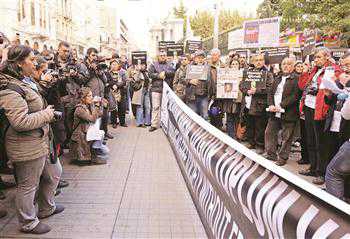
    Demonstrators protest the arrest of journalists. Lengthy detention periods are a significant problem despite measures taken to prevent them, a draft EU report says. DAILY NEWS photo, Emrah GÜREL

    The European Union has prepared to release a judiciary report on Turkey this week criticizing the justice system, particularly the unreasonable periods of detention.

    The EU Council’s report was prepared upon the visit of the Council of Europe Commissioner for Human Rights Thomas Hammarberg to Turkey in October.

    “There are some functional problems that have continued for a long time and have affected the system negatively,” said the report, according to daily Hürriyet. The report also cites the problem of presumption of innocence not being used in court decisions when arresting suspects.

    Problems in independence of judges and prosecutors

    There are also problems in impartiality and independence of judges and prosecutors, said the report, which also criticized the prolonged periods of detentions and prosecutions. The report urged officials to use “release on bail” as an option instead of detention.

    The European Court of Human Rights has made over 2,200 decisions against Turkey between 1995 and 2010.

    Almost 700 of these decisions were about violating the right to a fair trial. More than 500 of the cases were about freedom and security of the people. The judicial reform strategy that started in 2009 to adjust the laws within the EU norms should be put into action, the report said.

    Lengthy detention periods were still a significant problem despite measures taken to prevent them. The lack of compensation for the duration of detention or lack of access to a mechanism to fasten the prosecution also increases the judiciary problem, the report said.

    via POLITICS – European Union to pressure Turkey on its judicial system.