Tag: Donald Trump

  • Boom Times for Turkey’s Lobbyists in Trump’s Washington

    Boom Times for Turkey’s Lobbyists in Trump’s Washington

    ADAM KLASFELD

    MANHATTAN (CN) – Some five years ago, Turkey’s soft power suddenly swelled in the United States as the country’s lobbyists and pro-government charities received millions in newfound funding.

    That was the same year that leaked tapes appeared to show then-Prime Minister Recep Tayyip Erdoğan instructing his son Bilal to dump massive amounts of money tied to a multibillion-dollar money-laundering scheme.

    “Now, what I say is, you take everything that you have in the house out,” Erdoğan could be heard telling his son, in recordings quickly viewed by millions on YouTube and translated from Turkish by the now-shuttered Turkish newspaper, Zaman.

    “What can I have on me, Dad,” Bilal replied in that transcript. “There is your money in the safe.”

    Made public in early 2014, the tapes depicted Erdoğan fretting that Istanbul police conducted home raids on the top officials of his ruling Justice and Development Party and his then-ally Reza Zarrab, a gold trader charged with corrupting them. The Turkish government disputed its authenticity, but academic researchers doubted claims of doctoring.

    Zarrab would implicate Erdoğan in a bribery-fueled conspiracy to violate U.S. sanctions against Iran three years later in a New York federal courtroom — a development Erdoğan tried to head off by lobbying intensely with reported help from President Donald Trump and his attorney, Rudy Giuliani.
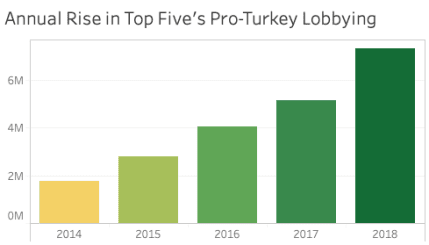
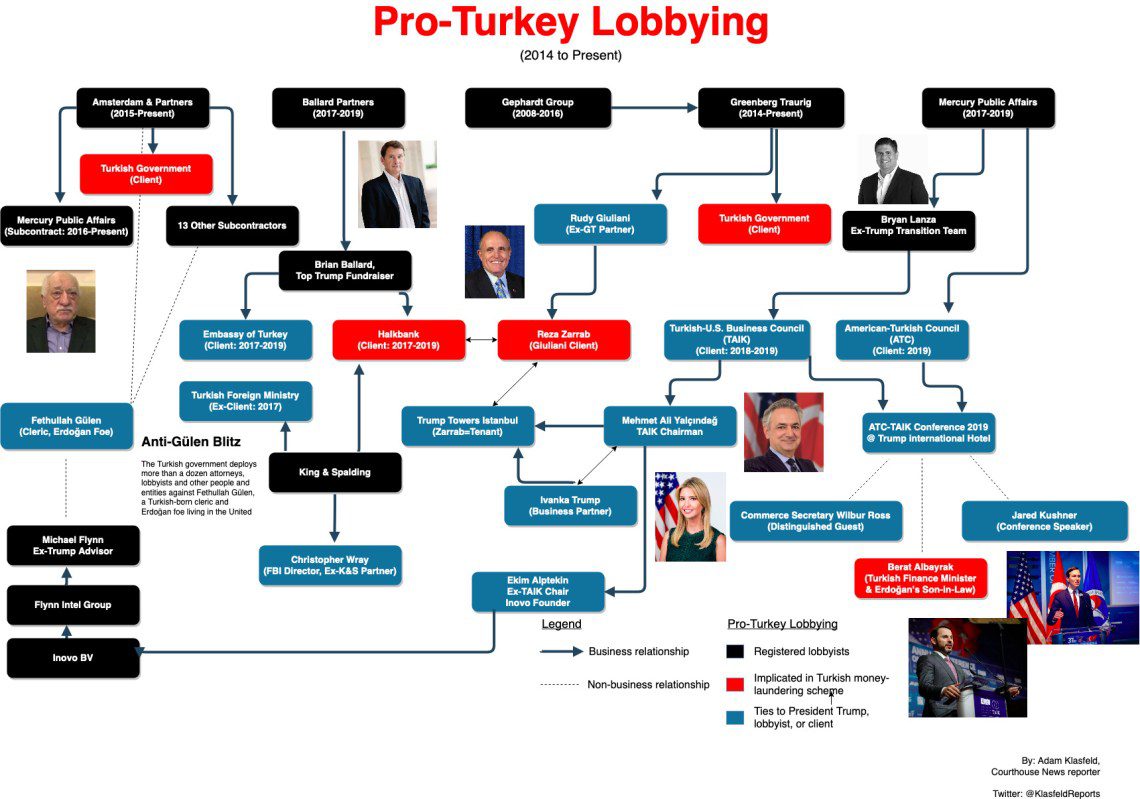
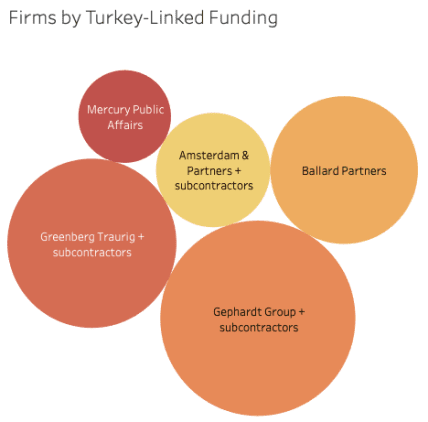
    Courthouse News studied the Justice Department’s foreign lobbying database to identify the five largest recipients of money linked to the Turkish government between 2014 and 2018: Amsterdam & Partners, Ballard Partners, Gephardt Group, Greenberg Traurig, and Mercury Public Affairs. The budgets of those five, including their subcontractors, more than quadrupled collectively during this time frame, from more than $1.7 million in 2014 to more than $7.3 million in 2018.

    Gephardt Group, a longtime lobbyist for Turkey named for the Democratic congressman who founded it, cut ties with its government at the end of 2016. The new guard of registered Turkish agents that replaced Gephardt would be deeply tied to Trump and his associates.

    Budgets of pro-Turkey charities linked to both Erdoğan and Trump also ballooned during this period.

    Bilal Erdoğan, the son from the 2014 recordings, signed the incorporation papers of the U.S.-based charity Turken Foundation just a few months after audio of him and his father caused an uproar. Turkey’s main opposition party unearthed Turken’s IRS records showing that tie in a document request. Public records show that another of Erdogan’s children, Esra Albayrak, sat on Turken’s board.

    As a tax-exempt 501(c)3 corporation, Turken does not have to disclose its donors, but it reported receiving a more than $24 million contribution the next fiscal year. Spending that money lavishly, the charity paid more than $17.5 million for the sites where it is building a 32-story skyscraper in midtown Manhattan, for use as Islamic student housing. It also bought legendary boxer Muhammad Ali’s farm in Michigan earlier this year for a reported $2.5 million.

    Hacked emails published by WikiLeaks showed Bilal Erdoğan’s interest in a different midtown Manhattan property, valued at $25 million, that Trump Organization representative Elena Baronoff had been offering in 2013.

    Known as Trump’s “Russian hand,” Baronoff died of leukemia two years later.

    Turken did not reply to an email requesting comment.

    Here is a breakdown of the top players in pro-Turkey lobbying and charity between 2014 and 2018.

    Gephardt Gets Out
    More than a decade ago in 2009, a ProPublica investigation found that the Turkish government’s lobbyists contacted members of Congress more often than those from any other country.

    A year before that article, Turkey first signed its contract with former Missouri Representative Richard Gephardt. Turkey had been successful in projecting an image of Erdoğan as a bridge between political Islam and liberal democracy, but Erdoğan’s corruption scandal — and his response to it — stained that international goodwill starting in late 2013.
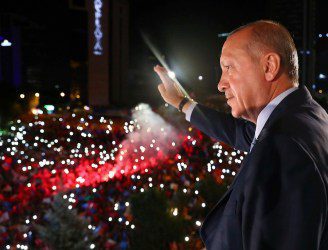
    Turkey’s President Recep Tayyip Erdogan waves to supporters of his ruling Justice and Development Party (AKP) in Ankara, Turkey, on June 25, 2018. (Presidency Press Service via AP, Pool)

    Once the leaked tapes of his son hit the internet, Erdoğan tried to ban Twitter and purge the prosecutors investigating him. Records that Gephardt disclosed under the Foreign Agents Registration Act show the firm spinning issues of “internet freedom” in Turkey with U.S. legislators and responding to the concerns of the House Foreign Affairs Committee about “The Future of Turkish Democracy.”

    Amid Erdoğan’s autocratic rise, Gephardt Group hired five subcontractors to help manage Turkey’s bruised international image: Dickstein Shapiro LLP and LB International Solutions in 2014; Greenberg Traurig and Capitol Counsel in 2015; and longtime congressional staffer Brian Forni in 2016.

    Gephardt could not be reached directly. The firm’s vice president, Greg Carnrick, did not respond to phone and email requests for comment.

    Asked by phone to explain why the firm terminated its eight-year contract with the Turkish government, Janice O’Connell — one of Gephardt’s former lobbyists for Turkey — supplied a one-word answer.

    “No,” O’Connell replied, abruptly hanging up the phone.

    Some Gephardt subcontractors continued to work for Greenberg Traurig, a billion-dollar legal powerhouse that took over Turkey’s lobbying contract the same year Giuliani took on Zarrab as a client.

    Giuliani’s Role Grows
    In 2017, leading up to the Zarrab trial, the Turkish government ratcheted up its legal, diplomatic and lobbying offensive. Ditching the firm led by the Democratic Gephardt, the Turkish government signed on two firms connected to influential Republicans.
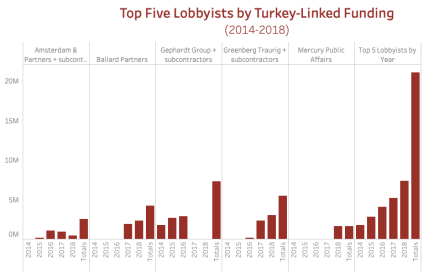
    Ballard Partners, whom Politico dubbed the “Most Powerful Lobbyist in Trump’s Washington,” made more than $4 million on two contracts: nearly $2 million from the Turkish embassy and more than $2 million from Halkbank, the Turkish state-run bank indicted just this past fall in New York. For that sum, the firm dispatched a trio of agents deeply tied to Trump’s State Department, Treasury Department and White House.

    The second firm, Greenberg Traurig, tilted slightly Republican in its political donations from 2016, but it had a partner with a direct line to Trump: Giuliani. The former New York City mayor shuttled between the White House and Turkey’s capital of Ankara to push for a prisoner swap that would have blocked damning testimony from Zarrab that accused Erdoğan of ordering billions of dollars in illicit trades through Halkbank.

    Giuliani’s growing reputation as a shadow secretary of state for the Trump administration, in both Turkey and Ukraine, has alarmed Democrats on Capitol Hill. Seven senators signed a letter over a year ago that asked the Department of Justice to assess whether Giuliani has complied with registration requirements for foreign agents.

    Senator Tammy Duckworth, one of the signers, is still waiting for the Justice Department to respond after following up on that inquiry last month.

    “I’ve asked the Justice Department twice … and I have not gotten a reply from that,” Duckworth told Courthouse News in a phone interview. “So, I’m not quite sure how Mr. Giuliani, who’s neither been elected by the American people nor confirmed by the United States Senate is out there conducting what amounts to foreign policy on behalf of the president because he’s the president’s personal attorney.”

    Following publication of this story, Giuliani called the suspicions that he may have violated foreign lobbying requirements a “maliciously false claim.”

    “Michael Mukasey and I were criminal counsel in a pending proceeding, seeking a prisoner exchange for Zarrab,” Giuliani said. “The FARA and lobbying laws have complete exclusion for lawyers representing a client in a proceeding.”

    The senators stopped short of accusing Giuliani of breaking the laws regarding foreign agents. Their letter requested an inquiry into the question from the Department of Justice, which did not respond to a request for comment.
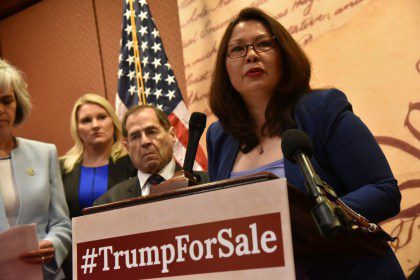
    Senator Tammy Duckworth raises concerns about President Donald Trump’s conflicts of interests in a June 20, 2017, press conference. (Photo courtesy of Senator Duckworth’s office)

    Duckworth also called it uncertain whether “Mr. Giuliani is also getting some personal gain from some of his actions, for example, in Turkey.”

    Court documents show that Giuliani was paid directly by Zarrab, who admitted to the money-laundering scheme.

    Greenberg Traurig and Giuliani cut ties in 2018 as the former mayor ramped up his work for Trump.

    The firm’s shareholder Robert Mangas, who signed the Turkey lobbying contract, claims never to have spoken to Giuliani on any matter related to Turkey.

    “Mr. Mangas and Mr. Giuliani never worked together on any matters related to Turkey, including the Zarrab case,” the firm’s managing director Jill Perry said.

    Greenberg Traurig, whose donations have skewed Democratic in 2018, made inroads on both sides of the aisle in Congress. The firm’s most recent filing reported numerous emails and two meetings apiece with Republican Senator Lindsey Graham and the chief of staff for Representative Ilhan Omar, the only member of the Democratic Party not to vote to recognize the Armenian genocide or approve sanctions against Turkey. Omar’s office did not respond to a request for comment.

    The firm raked in more than $5 million in fees and expenses from Turkey, paying nearly $2 million of that amount to subcontractors for the firms Capitol Counsel, Baker Donelson and LB International Solutions, whose president, Lydia Borland, helped a Turkish political action committee donate to U.S. politicians.

    Enemies of Erdogan
    During his clampdown on perceived opponents, Erdoğan went to war against his party’s former allies: followers of Fethullah Gülen, a Turkish-born cleric living in self-imposed exile in rural Pennsylvania. The main firm in charge of the Turkish government’s anti-Gülen offensive was Amsterdam & Partners, which hired at least 14 subcontractors, records show.

    Those arrangements were properly disclosed under the Foreign Agents Registration Act. Federal prosecutors believe that the Turkish government nestled its way into murkier relationships with at least one Trump ally.

    Trump’s former national security adviser Michael Flynn would admit that he concealed the Turkish government’s ties to his anti-Gülen blitz, a secret foreign influence initiative branded “The Truth Campaign.”
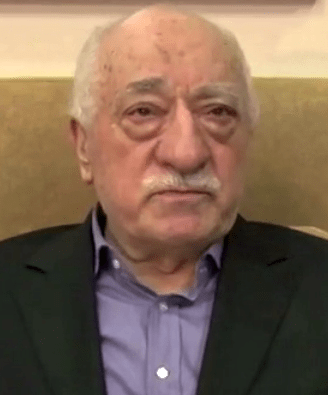
    Pennsylvania-based Turkish cleric Fethullah Gulen (Photo credit: Voice of America)

    The Dutch company Inovo BV paid $600,000 to Flynn Intel Group under the contract, which included an Election Day op-ed under Flynn’s name in The Hill.

    “The forces of radical Islam derive their ideology from radical clerics like Gülen, who is running a scam,” the editorial read. “We should not provide him safe haven.”

    Flynn’s column compared Gülen to Iran’s mullahs and Osama bin Laden, and court papers would later show that Flynn’s Turkish proxies had written several passages. One of the alleged ghostwriters, Trump transition team member Bijan Kian, would later be convicted of unregistered foreign lobbying only to have that conviction overturned. Inovo’s founder Ekim Alptekin was also indicted but did not appear in court and is presumed to be living in Turkey.

    The Wall Street Journal reported that Flynn discussed a plan with Turkish officials to “whisk” Gülen from his Pennsylvania home and back to Turkey outside the extradition process. Flynn denied that he tried to kidnap the cleric, but ex-CIA Director James Woolsey told the paper he witnessed the conversation.

    Other Turkish-funded media offensives against Gülen were disclosed. Amsterdam & Partners, led by attorney Robert Amsterdam, made nearly $1.3 million in fees by vilifying Gülen for the Turkish government, and the firm paid more than a dozen subcontractors a nearly equivalent amount to assist in the task.

    During a phone interview, Amsterdam denied that his crusade against Gülen was financially motivated.

    “It’s more out of dedication to the cause than for profit,” the attorney remarked, adding he even “took a haircut” in that pursuit.

    That cause has found multiple devotees in the Trump administration, including Giuliani, whom Bloomberg reported pushed to cut government grants to Gülen-affiliated schools across the United States.

    “That’s got nothing to do with me,” Amsterdam said of Giuliani.

    Amsterdam has been a vituperative critic of Gülen, echoing the Turkish government’s depiction of the cleric as a shadowy cultist behind the 2016 failed coup attempt against Erdoğan’s government.

    Amsterdam even purchased an anti-Gülen billboard near his home in Saylorsburg, Pennsylvania. The billboard, which showed Gülen’s face next to the words “School Children at Risk,” had been intended to run on a highway in the village that the cleric calls home.
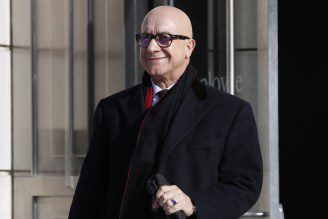
    Bijan Kian, a onetime business partner to former national security adviser Michael Flynn, leaves the FBI Field Office on Dec. 17, 2018, in Washington. (AP Photo/Jacquelyn Martin)

    Amsterdam admitted to having paid for it but claimed that it never went up because of pressure from Gülen’s organization.

    Alliance for Shared Values, an umbrella organization associated with Gülen’s movement, responded that they were “not aware,” but “not surprised,” that Amsterdam attempted to put that message near the cleric’s home.

    “Through his agents, the Erdoğan government made several attempts to defame and harass Mr. Gülen and visitors to the retreat center where he lives,” the group’s executive director Alp Aslandogan said. “These efforts include organizing loud and profane protests, mailing defamatory fliers to neighbors, flying planes with defamatory signs and showing a defamatory film at a local theater.”

    The Gülen movement, also known as Hizmet, the Turkish word for service, describes itself as a group dedicated to interfaith dialogue. The Obama administration rebuffed Turkish pressure to extradite Gülen, with former Vice President Joe Biden emphasizing the U.S. courts require due process and evidence of wrongdoing.

    “Only a federal court can do that,” Biden said in August 2016. “Nobody else can do that. If the president were to take this into his own hands, what would happen would be he would be impeached for violating the separation of powers.”

    Referring to the multimillion-dollar campaign against Gülen, Aslandogan added: “If the facts were on the Erdoğan government’s side, they would have spent far less and had even an ounce of success.”

    Reaching out to major TV, radio and print outlets, Amsterdam’s subcontractor Stroud Communications helped tout his book titled “Empire of Deceit,” accusing Gülen-affiliated charter schools of fraud. The title inspired the parody website “Empire of the Deceit” by Amsterdam’s critics, quoting a Globe & Mail editorial that describes the Canadian attorney as a “legal gun-for-hire and a public relations svengali.”

    Mercury Public Affairs, which made more than $87,000 from its contract with Amsterdam, later registered as a foreign agent for work with two Turkish clients directly. The firm made $1.6 million the year after announcing a major hire, Bryan Lanza, who served as Trump’s communications director on the presidential transition team.

    Both times that Trump announced a troop withdrawal from Syria — moves in late 2018 and 2019 that stunned top U.S. security officials — Trump had just spoken on the phone with Erdoğan, and Mercury rushed to defense the decision.

    Mercury, which has not responded to press inquiries, circulated an editorial by top Turkish diplomat Mevlüt Çavuşoğlu describing the United States’ longtime Kurdish allies as terrorists and another by Erdoğan, printed in The New York Times.

    Business or Pleasure at Trump Hotel?
    Having a new agent with deep ties in the Trump White House paid dividends for Mercury Public Affairs in taking on two major Turkish nonprofit groups as clients: Turkey-U.S. Business Council (TAIK) and the American Turkish Council (ATC).
    Every year, both charities join forces to host a lavish U.S.-Turkish Conference that brings together powerful military, business and political figures from both countries to mingle and discuss the future of bilateral relations. The last two conferences took place at the Trump International Hotel in Washington.

    TAIK’s current chairman Mehmet Ali Yalçındağ is Ivanka Trump’s former business partner for Trump Tower Istanbul. Alptekin, who was indicted in Flynn’s “Truth Campaign,” is a former chair.

    Under the Foreign Agents Registration Act, Mercury had to disclose all of its contacts with government officials and media representatives. Lanza repeatedly called and emailed the Commerce Department’s Deputy Secretary Earl Comstock on behalf of TAIK in 2018.

    The next year, Commerce Secretary Wilbur Ross would be one of the conference’s “Distinguished Guests,” posing in a photograph next to Yalcindag.

    Turkish Coalition of America, which organizes the 109-member-strong “Turkey Caucus” of U.S. Congress members, struggled for cash for much of this past decade, reporting negative revenue in 2014 and 2016. In 2017, the charity reported $4.6 million in revenue, by far the largest in that decade, after receiving a large grant from the Turkish Cultural Foundation, another Washington-based charity.

    The coalition’s president Lincoln McCurdy emphasized that the charity complies with nonprofit rules in service of its mission to promote public education.

    “TCA’s limited lobbying efforts are fully independent and are neither coordinated with nor controlled by any other organization or lobbying campaign, including that of the government of Turkey,” McCurdy, a former consul for commercial affairs at the U.S. Consulate General in Istanbul, said in an email.

    The lobbying expenditures reported by the group represent a small fraction of what it spends in total.

    Turkish Heritage Organization, a new nonprofit that sprung up in 2015, burst quickly into prominence with more than $3 million in contributions over the course of three years.

    When the House was still controlled by Republicans in 2017, its Committee of Foreign Affairs heard testimony from the organizations president, Ali Cinar, about the supposed threat to Turkey’s democracy from Gülen and Kurdish militants, not its strongman leader, Erdoğan.

    “There is no Turkish legislation that includes any provision that would lead to imprisonment of journalists on account of their journalistic work,” Cinar told Congress.

    Under Turkey’s constitution, insulting the president is a crime, and Erdoğan’s government by then had become the world’s leading press jailer for two years running. It has held onto that record ever since.
  • Why Turkey is invading Syria

    Why Turkey is invading Syria

    Türkiye neden Suriye’yi işgal ediyor

    … and how it’s getting what it wanted.

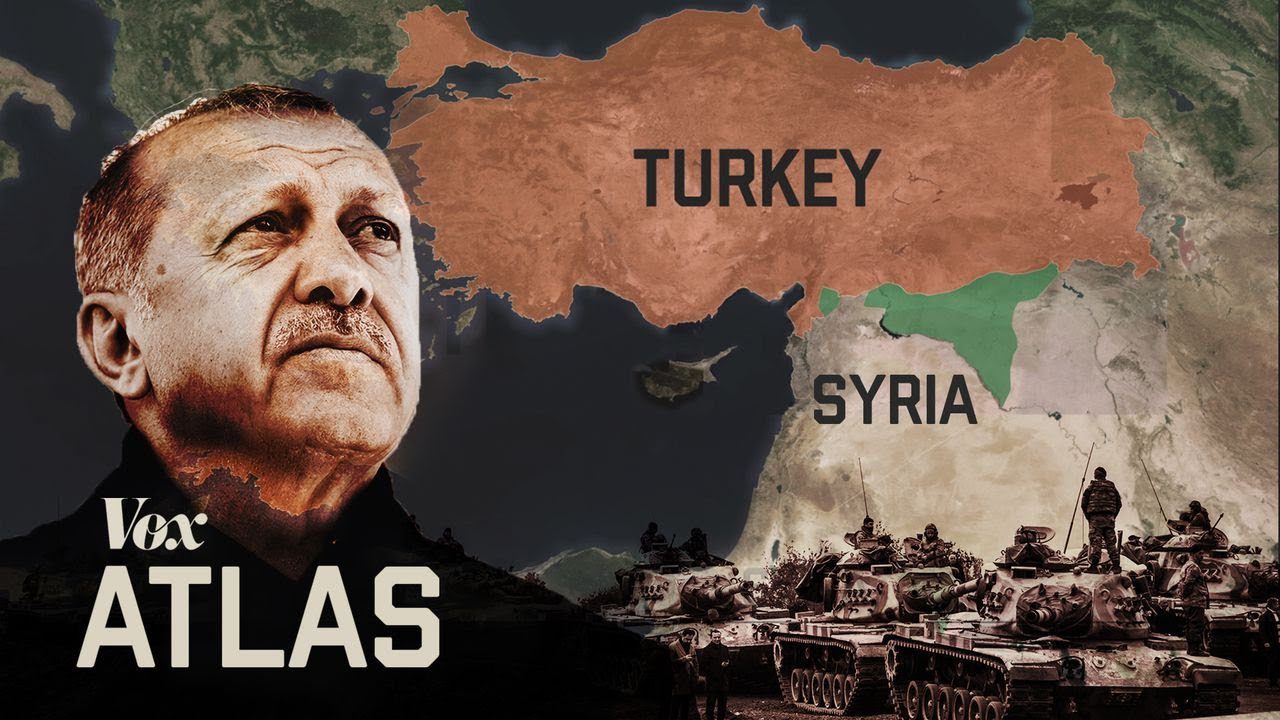
    On Oct. 9, 2019, Turkey launched an attack in northeastern Syria. Turkey made the move shortly after the US announced it would remove some of its troops from the region.

    Turkish President Recep Tayyip Erdoğan had his eyes on the region for years. Turkey, he argued, needed a “safe zone” to serve as a buffer against the Syrian War happening just across the border. Yet back home in Turkey, there were other factors at play that accelerated his calls for an invasion that involved Erdoğan’s own political survival.

    The move has recalibrated alliances in the Syrian War and added new uncertainty on the future of the region.

    To learn more, check out these additional resources:

    Vox’s previous reporting on the conflict:
    https://www.vox.com/world/2019/10/16/20908262/turkey-syria-kurds-trump-invasion-questions
    https://www.vox.com/world/2019/10/23/20928769/trymp-syria-turkey-doctrine

    The Institute for the Study of War’s reports on the US withdrawal from Syria:

    Vox Atlas demonstrates where conflicts occur on a map and the ways in which foreign policy shapes a region. Watch all the episodes here:

    Vox.com is a news website that helps you cut through the noise and understand what’s really driving the events in the headlines. Check out .

    Watch our full video catalog:
    Follow Vox on Facebook:
    Or Twitter:

  • Trump says Islamic State leader Abu Bakr al-Baghdadi blew himself up as U.S. troops closed in

    Trump says Islamic State leader Abu Bakr al-Baghdadi blew himself up as U.S. troops closed in

    Oct. 27, 2019 at 10:40 a.m. GMT-4

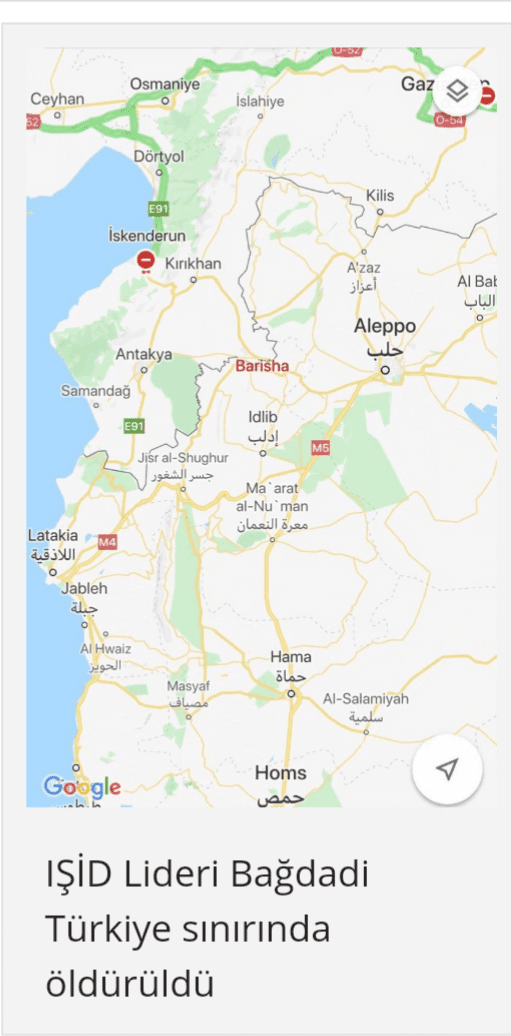
    President Trump on Sunday announced that Abu Bakr al-Baghdadi, the elusive Islamic State leader, died during a U.S. military operation in Syria, a major breakthrough more than five years after the militant launched a self-proclaimed caliphate that inspired violence worldwide.

    “Last night the United States brought the world’s Number One terrorist leader to justice,” Trump said in a televised announcement from the White House. “He was a sick and depraved man, and now he’s gone.”


  • Trump Surrenders to Erdogan’s Demands: The Tail Wags the Dog

    Trump Surrenders to Erdogan’s Demands: The Tail Wags the Dog

    Anytime Pres. Trump talks to another head of state on the phone, we can expect a disastrous outcome. Trump does not realize the consequences of his decisions on the United States and the world. He does not ask for proper briefing from his top aides and does not follow their advice.

    Pres. Trump’s telephone conversation with Turkish President Recep Tayyip Erdogan on October 6 was no exception. While the White House reluctantly released the summary of Pres. Trump’s scandalous phone call with the President of Ukraine followed by the whistleblower’s report, Trump’s conversation with Erdogan is not yet made public and no one knows what exactly transpired during that phone call. All we know is that Erdogan asked Trump to remove the U.S. troops from Northern Syria, allowing Turkey to invade Syria, to expel hundreds of thousands of Kurdish civilians from the 20-mile area inside the Syrian border, and kill hundreds of Kurds, the US allies on the ground in the fight against ISIS terrorists. The Turkish troops are committing War Crimes and Pres. Trump has allowed them to do so!

    The whole world immediately realized that this was a grave mistake by Trump. Even Republican members of Congress who had been blindly supporting him and ignoring his many illegalities and immoralities, have loudly criticized their ‘darling’ President. The US Congress discussed adopting sanctions against Turkey which pressured Trump to do the same.

    On Oct. 9, three days after Erdogan’s phone call with Trump, the Turkish forces invaded Syria. On that same day, Trump sent Erdogan a childish letter, threatening to “destroy the Turkish economy — and I will.” Trump also warned Erdogan that history “will look upon you forever as the devil if good things don’t happen.” Trump ended his letter by telling Erdogan “don’t be a tough guy. Don’t be a fool! I will call you later.” This was a uniquely stupid presidential letter in the annals of diplomatic correspondence. Pres. Erdogan’s office stated that he promptly dumped Trump’s letter in the garbage can, where it belonged!

    In the meantime, in response to strong criticism by almost everyone in the world — except for Turkey, Azerbaijan and Russia — Pres. Trump started spewing his usual nonsense. First, he called the Kurds US allies. He then changed his mind and called them “Communists,” “terrorists” and “no angels.” Trump went so far as blaming the Kurds for not supporting the US army in Normandy, France, during the Second World War, forgetting that the Kurds possessed neither a country nor an army! According to the Washington Post, Pres. Trump has made 13,435 false and misleading claims in his first 1,000 days in office. That’s on average 13 lies per day — an unprecedented record for anyone, let alone the President of the United States!

    After undermining the Kurds in his pronouncements, Pres. Trump dispatched his Vice President Mike Pence and Secretary of State Mike Pompeo to Ankara, supposedly to restrain Erdogan’s brutal treatment of Kurds in Northern Syria.

    After several hours of negotiations, the two sides made contradictory announcements about what they had agreed upon. The American side called the agreement a “ceasefire,” while the Turkish side called it a “pause” for five days. Nevertheless, Trump quickly claimed to have scored a major victory, as he does on all occasions, usually without any merit. If anything, it was a victory for the Turks who gained everything they wanted from the United States — the green light to proceed with their invasion of Northern Syria, mass deportations and brutal killings of Kurds. What’s worse is the escape of hundreds of ISIS terrorists from their detention camps during the Turkish attack. The ceasefire or the pause did not even last 24 hours! The Turkish forces and their jihadist partners violated it on day one. Only a fool would trust Erdogan’s promises or agreements. Amazingly, Trump agreed to remove the US sanctions against Turkey before they were even implemented.

    The removal of the US sanctions was confirmed in a lengthy letter signed by the Turkish and US delegates at the UN, titled “Joint Turkish – US Statement on Northeast Syria” which was submitted to the UN Security Council and the UN Secretary-General on October 17.

    In this letter, the US shamelessly capitulated to all of Turkey’s demands:

    — “…The US understands Turkey’s legitimate security concerns on Turkey’s southern border.”

    — “The Turkish side expressed its commitment to ensure safety and well-being of residents of all population centers in the safe zone controlled by the Turkish Forces and reiterated that maximum care will be exercised in order not to cause harm to civilians and civilian infrastructures.”

    — “The two sides agreed on the continued importance and functionality of a safe zone in order to address the national security concerns of Turkey, to include the recollection of YPG heavy weapons and the disablement of their fortifications and all other fighting positions.”

    — “The Turkish side will pause Operation Peace Spring in order to allow the withdrawal of YPG from the safe zone within 120 hours. Operation Peace Spring will be halted upon completion of this withdrawal.”

    — “Once Operation Peace Spring is paused, the US agrees not to pursue further imposition of sanctions under the Executive Order of October 14, 2019, ‘Blocking Property and Suspending Entry of Certain Persons Contributing to the Situation in Syria,’ and will work and consult with Congress, as appropriate, to underline the progress being undertaken to achieve peace and security in Syria, in accordance with UNSCR 2254. Once Operation Peace Spring is halted as per paragraph 11 the current sanctions under the aforementioned Executive Order shall be lifted.”

    Interestingly, the text of the US – Turkish agreement never once mentions the Kurds by name, whereas the whole Turkish invasion is being carried out for the purpose of eliminating Kurds from Northern Syria.

    The United States forces were stationed in Syria in violation of international law, and contrary to the wishes of the Syrian government. The same applies to the Turkish forces. The departure of the US forces is not wrong. Their arrival was wrong. And Trump’s claim that he wants the US forces out of the Middle East is an outrageous lie, since the same day that he decided to withdraw the American troops from Syria, it was announced that most of these soldiers would be relocated to Iraq and he will send 3,000 fresh US troops to Saudi Arabia. This is yet another one of Trump’s lies which needs to be added to his over 13,000 other lies!

  • Trump withdraws U.S. forces from northern Syria, and administration scrambles to respond

    Trump withdraws U.S. forces from northern Syria, and administration scrambles to respond

    The morning’s most important stories, curated by Post editors.

    (AFP via Getty Images)

    Trump withdraws U.S. forces from northern Syria, and administration scrambles to respond

    “This is total chaos,” a senior administration official said on a day when Cabinet secretaries denied that the United States had “abandoned” its Syrian Kurdish allies to invading Turkish forces.
    By Karen DeYoung, Dan Lamothe, Missy Ryan and Kareem Fahim  ●  Read more »

    Democrats and Republicans on Oct. 13 criticized President Trump’s withdrawal of U.S. troops from positions in northern Syria. (JM Rieger/The Washington Post)

    October 13 at 10:46 PM

    President Trump’s order to withdraw essentially all U.S. forces from northern Syria came after the commander in chief privately agitated for days to bring troops home, according to administration officials — even while the Pentagon was making public assurances that the United States was not abandoning its Kurdish allies in the region.

    The officials, granted anonymity to describe internal deliberations, described Trump as “doubling down” and “undeterred,” despite vociferous pushback from congressional Republicans who have been loath to challenge the president apart from a few issues, such as national security.

    Behind the scenes, Trump has tried to convince advisers and lawmakers that the United States is not to blame for Turkey’s military offensive, which has targeted Kurdish fighters who have aided the U.S. fight against the Islamic State.

    But experts — and many Republicans — say otherwise. And even Trump allies say the president needs to do a better job of selling the troop withdrawal to the public, beyond tweets.

    The escalating crisis in northern Syria has prompted further criticism from foreign policy heavyweights in Trump’s party, who argue that the president’s strategies abroad send a concerning message to allies and endanger regional partners.

    “I’ve always looked at the approach the administration takes as very transactional and very short-term in nature,” former senator Bob Corker (R-Tenn.), who chaired the Senate Foreign Relations Committee, said in a phone interview Sunday. “It’s almost seeking headlines for the very next day, but not really thinking through the longer-term impact on our ­country.”

    In a tweet and later in the interview, Corker warned against the decision to withdraw support for Kurdish forces, telling The Post that it was a “blight on our character.” He said, too, that it would only embolden Turkish President Recep Tayyip Erdogan, who has given no indication that he would halt the offensive that began Wednesday despite the threat of sanctions from the U.S. Congress and international condemnation.

    “To pull the rug out and to do so in such a hasty manner, where there’s been no preparation, nothing has been done to limit the damage to them, and as [former defense secretary Jim] Mattis and others have said, this is going to create additional activities, additional opportunities for ISIS . . . it’s bad all the way around,” said Corker, who has remained relatively quiet since he left office in January.

    Such criticisms have been echoed publicly and privately by current Republican elected officials who have been increasingly alarmed by the withdrawal, announced in a late-night White House statement on Oct. 6 and fully fleshed out by Defense Secretary Mark T. Esper on Sunday.

    Trump has closely watched that kind of public criticism in recent days — complaining frequently about comments from Sen. Lindsey O. Graham (R-S.C.) in particular — but has been encouraged to stay the course by other allies who support a withdrawal, such as Sen. Rand Paul (R-Ky.) and Fox News Channel host Tucker Carlson, according to administration officials.

    The president, one senior administration official said, was particularly heartened by a segment from another Fox News host, Lou Dobbs, defending him last week.

    A U.S. soldier sits atop an armored vehicle in Syria’s Hasakeh province near the Turkish border on Oct. 6. (Delil Souleiman/Afp Via Getty Images)

    For his part, Graham appeared to be more aligned with Trump on Sunday evening, saying that he planned to work with Democratic and Republican lawmakers on economic sanctions against Turkey.

    “The outrage in Syria about Turkey continues. The ripple effect I was concerned about has happened at a faster pace than I believed. The administration needs to be far more aggressive,” Graham said in an interview.

    Graham and Sen. Chris Van Hollen (D-Md.) have drafted legislation that would place sanctions on the U.S. assets of people at the highest levels of the Turkish government, including Erdogan, as well as on any military transactions with Turkey.

    The two are circulating their plan among Senate offices.

    Graham and Sen. Christopher A. Coons (D-Del.) have also asked Senate Majority Leader Mitch McConnell (R-Ky.) and Senate Minority Leader Charles E. Schumer (D-N.Y.) to arrange a briefing from the Pentagon and State Department, as well as intelligence officials, on the withdrawal.

    An aide to Schumer deferred to the majority leader’s office, although Schumer has said that he wants Esper; Gen. Mark A. Milley, the chairman of the Joint Chiefs of Staff; and Kenneth F. McKenzie Jr., the head of U.S. Central Command, to appear publicly before senators. A spokesman for McConnell said Sunday that he had no announcements to make. A private briefing could help shape the congressional response, as could a closed-door Senate Armed Services Committee hearing on Syria scheduled for Thursday morning.

    Some Republican donors and officials worried that Trump’s decision would trap them in an untenable situation and have deleterious effects around the world. Furthermore, the significant intraparty rift is coming at a time when Trump particularly needs Republican support as he faces the threat of impeachment.

    “Republican senators are going to increasingly resemble a herd of ostriches with their heads in the sand,” said Dan Eberhart, a prominent Republican donor. “They don’t want to break with Trump while simultaneously wanting to disagree with his policy on allowing Turkey to get away with exterminating the Kurds inside Syria.”

    Still, Trump has resisted the repeated urging from some of his closest allies to intervene in the situation and has become more convinced that bringing troops home is both the right decision and a key political promise to fulfill ahead of the 2020 ­election.

    That view has been reinforced by the reaction from supporters. At a campaign rally in Minneapolis last week, the crowd chanted “Bring them home!” as Trump noted that U.S. troops had been in Afghanistan — the longest war in American history — for nearly two decades.

    During deliberations in the past, Trump has repeatedly pushed to remove troops from Syria but has usually been dissuaded by top officials, such as John F. Kelly, his former chief of staff.

    The usual argument against removing troops, according to former senior administration officials, would be that doing so would cause widespread deaths and chaos and Trump would be blamed for it.

    “Normally, convincing him he would be blamed for death and chaos could keep it from happening at least at that moment,” one former senior administration official said.

    But current administration officials say many moderating officials like Kelly are gone, and longtime friends say the move is consistent with Trump’s worldview — and that he has long wanted to do this.

    “When he looks at a conflict, he’ll say, do we have a national interest? What is our national interest?” said Chris Ruddy, a Trump ally. “A secondary thing is the money issue. Why are we spending billions, if not trillions, in places like Afghanistan and the Middle East?”

    Corker also suggested that the president’s decision was swayed by a circle of current advisers putting “un-thought-out ideas in the president’s head.”

    “I just have known through my years there that so many people have access to the president,” Corker said, declining to name them. “Typically, you want the people who are giving input to have credentials and have knowledge of the area, but I know that’s not the case necessarily today.”

    Some Trump allies were urging him to do more. Retired Gen. Jack Keane, who regularly speaks with Trump and has been a candidate for positions in the past, said he should quickly enforce a no-fly zone and warn Turkish officials that there would be retaliation.

    Keane said international allies had flooded the State Department with concerns about trusting the United States.

    “All is not lost,” he said. But not doing anything, he said, “sends a message about trust and reliability, something the United States has taken some pride in since World War II, that we can be counted on.”

  • It’s clear. Trump doesn’t want to be president anymore.

    It’s clear. Trump doesn’t want to be president anymore.

    President Trump walks to board Marine One on the South Lawn at the White House on Oct. 10. (Jabin Botsford/The Washington Post)
    President Trump walks to board Marine One on the South Lawn at the White House on Oct. 10. (Jabin Botsford/The Washington Post)
    Oct. 11, 2019 at 5:10 p.m. EDT

    Nancy Gibbs, a former managing editor of Time, is the director of the Shorenstein Center on Media, Politics and Public Policy at Harvard University’s Kennedy School of Government.

    With each passing day, President Trump flaunts his great and unmatched wisdom and so invites us to play armchair, arm’s-length therapists. So let me float an untested theory about what is unfolding before our eyes. And then let’s test it.

    ARTICLE CONTINUING IN THE FOLLOWING LINK


    https://www.washingtonpost.com/opinions/2019/10/11/its-clear-trump-doesnt-want-be-president-anymore/