Tag: Donald Trump

  • Trump’s Israeli-Palestinian ‘Peace Plan’ Is Recipe for a Prolonged War

    Trump’s Israeli-Palestinian ‘Peace Plan’ Is Recipe for a Prolonged War

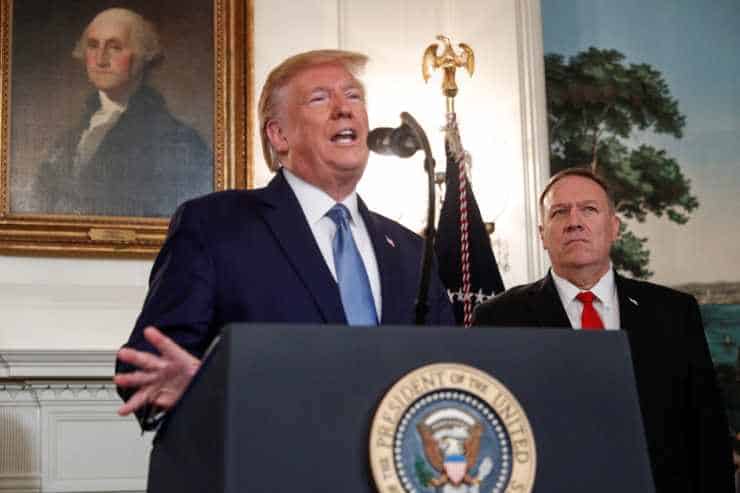
    Pres. Trump unveiled in the White House on January 28, 2020 his long-awaited ‘peace plan’ between Israelis and Palestinians. The architect of the plan is the President’s son-in-law and senior adviser Jared Kushner.

    The ‘peace plan’ had several drawbacks even before it was announced. To begin with neither Pres. Trump nor his son-in-law had any clue about the complexity of the Arab-Israeli conflict. From the start of his Presidency, displaying his ignorance, Trump kept saying that this is an easy problem to resolve. His son-in-law, an Orthodox Jew, is just as ignorant about the Middle East conflict. If the problem was so easy to resolve, it would have been solved a long time ago.

    Trump’s ‘peace plan’ is nothing but a ploy to distract attention from Israeli Prime Minister Benjamin Netanyahu’s indictment on corruption charges and Pres. Trump’s impeachment proceedings. A good faith mediator between Israelis and Palestinians must be objective and neutral. Pres. Trump is far from fulfilling this basic requirement, not after moving the US Embassy from Tel Aviv to Jerusalem, recognizing the disputed Jerusalem as the capital of Israel, and announcing that Syria’s Golan Heights, occupied by Israel in the 1967 war, is Israeli territory. These are matters of complicated international law and subject to extensive negotiations. These are the reasons why the conflict has not yet been solved. Only someone who is ignorant of these complexities would opine that this is an easy issue to resolve and come up with a plan that is completely one-sided and meets all of Israel’s demands, but none of the Palestinians!

    The proposed ‘peace plan’ actually promotes neither the interests of Israelis nor Palestinians. The terms of Pres. Trump’s plan is dictated by Israel under the guise of preserving its security. It ‘legitimizes’ the Jewish settlements in the West Bank and prolongs their existence. These settlements inside the borders of a future Palestinian state create a considerable risk to the security of Israeli settlers, continuing the conflict and bloodshed. The proposed Palestinian state is surrounded on all four sides by Israel maintaining total military control over Palestinians. Furthermore, the status of Jerusalem remains unresolved. Israel is supposed to take over the entirety of Jerusalem, restricting Palestine’s capital to a village in the outskirts of the city. This is totally unacceptable not only to Palestinians, but all Arabs and Muslims in the world, as well as all those who believe in peaceful settlement through international law.

    Trump’s ‘peace plan’ provides a window of four years for negotiations between the two parties. However, right at the bat, the plan places Palestinians in a losing situation depriving them of their sovereign rights in a weak and diminished area, as Israel will shortly declare the Jewish settlements in the West Bank as Israeli territory.

    No Palestinian leader attended the January 28 White House ceremony. Palestinian Authority President Mahmoud Abbas rejected the “deal of the century,” calling it the “slap of the century.” He also refused to accept the $50 billion investment plan offered by the White House. Abbas said: “Trump, Jerusalem is not for sale. Our rights are not for sale.” Out of 22 Arab States, only the Ambassadors of Bahrain, Oman, and United Arab Emirates attended the White House ceremony.

    On February 1, the foreign ministers of the Arab League’s member states unanimously adopted a resolution rejecting the Trump Israeli-Palestinian ‘peace plan,’ stating that “it does not satisfy the minimum of the rights and aspirations of the Palestinian people.”

    In a rare sign of unity, Abbas met last Tuesday with the leaders of Hamas, Palestine Liberation Organization and Islamic Jihad to form a common stand against Trump’s ‘peace plan.’ If anything, this ‘peace plan’ has served to unite the diverse and often conflicting Palestinian groups.

    At the conclusion of the White House ceremony last week, Mosques in the West Bank and East Jerusalem began broadcasting a verse from the Koran that warns, “Do not obey the disbelievers and the hypocrites.”

    Twelve Democratic Senators signed a joint letter to the White House criticizing the ‘peace plan’ as “one-sided [and] not a legitimate attempt to advance peace. It is a recipe for renewed division and conflict in the region.” All Democratic Presidential candidates objected to Pres. Trump’s ‘peace plan,’ criticizing it as being a ‘unilateral move’ leaving out the Palestinians. Former U.S. President Jimmy Carter also denounced the ‘peace plan’: “the unilateral annexation to Israel of a large piece of the occupied Palestinian territories offers the Palestinians fragmented statehood, without control of their borders…. The plan violates the two-state solution based on the 1967 borders….”

    The ‘peace plan’ is actually contrary to Israel’s national interests, according to many American Jews and Israelis who were harshly critical of Trump’s plan. Israel’s leaders do not seem to understand that the more they antagonize the Palestinians, the more they prolong the hostilities and continue to live under a state of war and terror!

    “Peace Now,” Israel’s largest and longest-standing movement advocating for peace through public pressure, announced on its website that Trump’s ‘peace plan’ “not only neglects to advance peace, but also has the potential to severely harm prospects for a genuine peace plan for both parties.”

    The American Jewish liberal advocacy group “J Street” denounced the peace deal as having “zero chance of serving as the basis for renewed diplomacy….  It was the logical culmination of repeated bad-faith steps this administration has taken to validate the agenda of the Israeli right.”

    The Jewish-led “Americans for Peace Now” declared the ‘peace plan’ “a recipe for disaster, for annexation, for the perpetuation of Israel’s occupation of the West Bank, for the perpetuation of the Israeli-Palestinian conflict, [and] for misery and bloodshed.”

    Pres. Trump’s ‘peace plan’ will hopefully never see the light of day. Both Israelis and Palestinians should denounce violence and sit at the negotiating table to find a peaceful solution to their long-standing conflict. They should both avoid the intervention of mediators who are more interested in their own self-interests than the interests of Arabs or Israelis!

  • Trump Backs Away From Further Military Conflict With Iran

    Trump Backs Away From Further Military Conflict With Iran

    A day after Iranian missiles fell on bases housing American troops in Iraq, the president said that no Americans were harmed and that Iran now “appears to be standing down.”

    ‘Iran Appears to Be Standing Down,’ Trump Says

    In an address to the nation, President Trump spoke about the conflict with Iran after its retaliatory strikes on two bases housing American troops, and announced new economic sanctions against Tehran.

    As long as I’m president of the United States, Iran will never be allowed to have a nuclear weapon. Iran appears to be standing down, which is a good thing for all parties concerned, and a very good thing for the world. The American people should be extremely grateful and happy. No Americans were harmed in last night’s attack by the Iranian regime. We suffered no casualties. All of our soldiers are safe, and only minimal damage was sustained at our military bases. The United States will immediately impose additional punishing economic sanctions on the Iranian regime. These powerful sanctions will remain until Iran changes its behavior.

    ‘Iran Appears to Be Standing Down,’ Trump Says

    In an address to the nation, President Trump spoke about the conflict with Iran after its retaliatory strikes on two bases housing American troops, and announced new economic sanctions against Tehran.CreditCredit…Doug Mills/The New York Times

    By


    WASHINGTON — President Trump backed away from further military action against Iran and called for renewed diplomacy on Wednesday as the bristling confrontation of the past six days eased in the aftermath of an Iranian missile strike that seemed intended to save face rather than inflict casualties.

    “Iran appears to be standing down, which is a good thing for all parties concerned and a very good thing for the world,” Mr. Trump said in a televised statement from the Grand Foyer of the White House, flanked by his vice president, cabinet secretaries and senior military officers in their uniforms. “The United States,” he added, “is ready to embrace peace with all who seek it.”

    The president sounded as eager as the Iranians to find a way out of a conflict that threatened to spiral out of control into a new full-fledged war in the Middle East. While Mr. Trump excoriated Iran’s “campaign of terror, murder, mayhem” and defended his decision to order a drone strike killing the country’s top security commander, he dropped for now his bombastic threats of escalating force, vowing instead to increase economic sanctions while calling for new negotiations.

    The president’s statement came hours after Iran’s government indicated that it had “concluded proportionate measures” avenging the killing of the commander, Maj. Gen. Qassim Suleimani, with the launch of ballistic missiles at two Iraqi military bases housing American troops. The missiles did not result in any American or Iraqi deaths, an outcome interpreted by some analysts as a deliberate attempt by Iran to claim it had responded, but without provoking Mr. Trump.

    But analysts cautioned that even as the two sides edged away from a military clash in the short term, the conflict could very well play out in other ways in the weeks and months to come. Iran has many proxy groups that could stir trouble for American troops or allies like Israel and Saudi Arabia, and experts remained wary of a possible Iranian cyberstrike on domestic facilities.

    President Hassan Rouhani of Iran made clear that his country still saw its mission over the long run as driving the United States out of the Middle East after the killing of General Suleimani. “Our final answer to his assassination will be to kick all US forces out of the region,” Mr. Rouhani wrote on Twitter.

    Ayatollah Ali Khamenei, the country’s supreme leader, hailed Iran’s missile strike as a “slap in the face” of the United States and suggested that it would not be the end of the clash. “What matters is that the presence of America, which is a source of corruption in this region, should come to an end,” he said in a televised speech to a hall filled with imams and others, who chanted, “Death to America!” and “Death to Israel!”

    And the top American military officer disagreed with those who saw the missile strike as halfhearted and unintended to kill. “The points of impact were close enough to personnel and equipment, I believe — based on what I saw, and what I know — that they were intended to cause structural damage, destroy vehicles and equipment and aircraft, and kill personnel,” Gen. Mark A. Milley, the chairman of the Joint Chiefs of Staff, told reporters.

    The operation against General Suleimani may also prove to have consequences beyond the direct relationship with Iran. Outraged that the general was killed after arriving at Baghdad International Airport, Iraq’s Parliament voted to expel the 5,000 American troops from the country. Such a decision would still have to be enacted by the caretaker government, but the Pentagon has begun preparing for the possibility of losing its bases in the country nearly 17 years after the invasion ordered by President George W. Bush.

    Lawmakers in both parties welcomed Mr. Trump’s decision to pull back from the brink, but Democrats and even some Republicans expressed discontent with closed-door briefings provided on Wednesday about the supposedly “imminent” threat of attack cited in justifying the drone strike on General Suleimani.

    Several lawmakers said the presentations were unpersuasive. Two Republican senators, Rand Paul of Kentucky and Mike Lee of Utah, said afterward that the administration officials offered mainly generalities rather than concrete new information about any upcoming attack.

    “Drive-by notification or after-the-fact lame briefings like the one we just received aren’t adequate,” Mr. Lee told reporters.

    He also complained that one of the officials warned senators against publicly debating the administration’s actions because it would embolden the enemy, calling that “insulting and demeaning” to the Senate and the Constitution. “It’s un-American, it’s unconstitutional and it’s wrong,” Mr. Lee said.

    A Democrat, Representative Gerald E. Connolly of Virginia, called the briefing “sophomoric and utterly unconvincing,” and said that he believed “more than ever the Congress needs to act to protect the constitutional provisions about war and peace.”

    Even though the threat of further conflict with Iran appeared to recede for now, Speaker Nancy Pelosi announced that the House would vote on Thursday on a measure curtailing Mr. Trump’s war-making power by requiring him to halt military action against Iran within 30 days unless Congress votes to approve it.

    Such a measure has little chance of becoming law given Republican control of the Senate and Mr. Trump’s veto pen, although Mr. Lee said he had been persuaded to vote for a similar resolution being offered by Senator Tim Kaine, Democrat of Virginia, because of the administration briefer’s effort to silence him.

    Mr. Trump’s 10-minute televised statement on Wednesday morning was his most extended effort to explain last week’s drone strike on General Suleimani. He surrounded himself with his national security team, including Vice President Mike Pence, Secretary of State Mike Pompeo, Defense Secretary Mark T. Esper, General Milley and Robert C. O’Brien, the national security adviser. They stood stoically around the president without commenting.

    The administration’s messages have been conflicting and confusing. In recent days, the president was forced to walk back threats to target Iranian cultural sites after the defense secretary made clear that doing so would be a war crime. The American headquarters in Baghdad had written a letter indicating it was withdrawing from Iraq, only to have the Defense Department say it was a draft document with no authority.

    In his statement on Wednesday, Mr. Trump sought to pin the current crisis on a predecessor, blaming former President Barack Obama for striking a “foolish” nuclear agreement with Iran in 2015 that unfroze billions of dollars of money for Tehran that could be used to finance ballistic missiles and terrorist activity. “The missiles fired last night at us and our allies were paid for with the funds made available by the last administration,” Mr. Trump said.

    There was no way to know if that was literally true, because money is fungible, but some of the president’s claims about the nuclear agreement were false, exaggerated or unsubstantiated claims. He asserted, among other things, that Iran’s hostile acts against America and its allies increased after the deal, rather than after the Trump administration withdrew from it in 2018, as statistics indicate.

    Either way, he urged Britain, France, Germany, Russia and China to recognize that it was effectively dead and called on those countries to join him in negotiating a replacement for the Joint Comprehensive Plan of Action, as the agreement is officially known, that would go further to constrain Iran’s nuclear ambitions.

    “They must now break away from the remnants of the Iran deal, or J.C.P.O.A., and we must all work together toward making a deal with Iran that makes the world a safer and more peaceful place,” Mr. Trump said.

    The call on Europeans may fall on deaf ears. Only hours before Mr. Trump spoke, European leaders repeated their commitment to the pact and urged Iran to return to compliance despite American sanctions. Ursula von der Leyen, the president of the European Commission, and Josep Borrell Fontelles, the foreign policy chief, both said the deal should be preserved.

    Similarly, Mr. Trump in his statement called on NATO, an alliance he has regularly scorned, to take on a larger role in the Middle East, and he spoke by telephone with Jens Stoltenberg, the NATO secretary general, about the idea.

    But NATO allies have little interest in following Mr. Trump’s lead, and in recent days they have been withdrawing troops from Iraq to avoid becoming entangled in the conflict between the United States and Iran.

    Maps: How the Confrontation Between the U.S. and Iran Escalated

    Here’s how the situation developed over the last two weeks.

    The president defended the drone strike, calling General Suleimani “the world’s top terrorist” responsible “for some of the absolutely worst atrocities” of recent years.

    “In recent days, he was planning new attacks on American targets, but we stopped him,” Mr. Trump said without elaborating or offering evidence. “Suleimani’s hands were drenched in both American and Iranian blood. He should have been terminated long ago.”

    But Mr. Trump emphasized that he did not want a wider war despite his efforts to build up American combat capacity. “The fact that we have this great military and equipment, however, does not mean we have to use it,” the president said. “We do not want to use it.”

    He said instead that he would ratchet up sanctions on Iran, although administration officials said later that they had no specific plan to do so. The administration has already imposed so much economic pressure on Tehran that it was unclear if additional measures would make a meaningful difference.

    Still, in Washington, Republicans and Democrats alike breathed sighs of relief that the two nations seemed to be pulling back from violent confrontation, at least for now.

    “I applaud the president for de-escalating the situation and putting us back on the path of diplomacy,” said Senator Jim Risch, Republican of Idaho and the chairman of the Senate Foreign Relations Committee. “We do not seek conflict, but the United States will not be deterred from protecting American lives and our vital national security interests.”

    But Democrats faulted Mr. Trump for stoking that eyeball-to-eyeball face-off in the first place and said that the United States would still reap negative consequences. “I am glad that the road to war may be narrowing,” said Senator Christopher S. Murphy, Democrat of Connecticut, “but the damage done to U.S. national security interests is enormous and potentially irreparable.”

    General Suleimani, the commander of the elite Quds Force of the Islamic Revolutionary Guards Corps, helped direct wars in Iraq, Syria, Lebanon and Yemen and was held responsible for attacks on American troops in Iraq that killed at least 600 during the height of the Iraq war. More recently, American officials blamed him for a Dec. 27 rocket attack on a base in Iraq that killed an American civilian contractor.

    The Iranian missile strikes, which began early Wednesday morning local time — late Tuesday in Washington — targeted Al Asad Air Base, long a hub for American military operations in Iraq, and another base in Erbil in northern Iraq, which has been a home for Special Operations forces in the fight against the Islamic State.

    The Pentagon said 16 short-range ballistic missiles were fired from three different locations in Iran and that 11 of them struck Al Asad and one hit Erbil, with the rest missing the bases. General Milley attributed the lack of casualties not to lack of intent but to the military’s own early-warning systems and bunkers.

    Mr. Esper said the missiles damaged tents, taxiways, a parking lot, a helicopter and other targets. “Nothing,” he said, “that I would describe as major.”

    Reporting was contributed by Helene Cooper and Alan Rappeport from Washington, and Steven Erlanger from Brussels.


  • Trump says Armenia massacres were not genocide, directly contradicting Congress

    Trump says Armenia massacres were not genocide, directly contradicting Congress

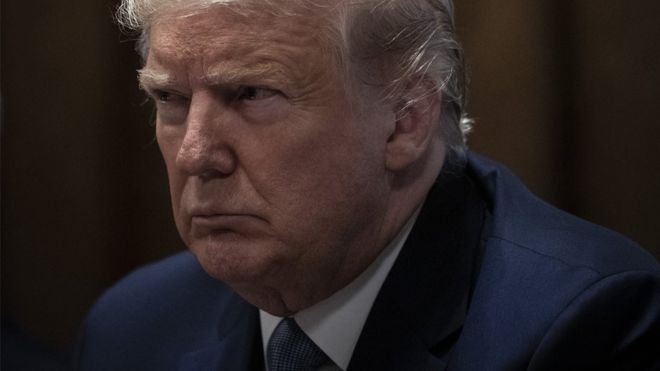
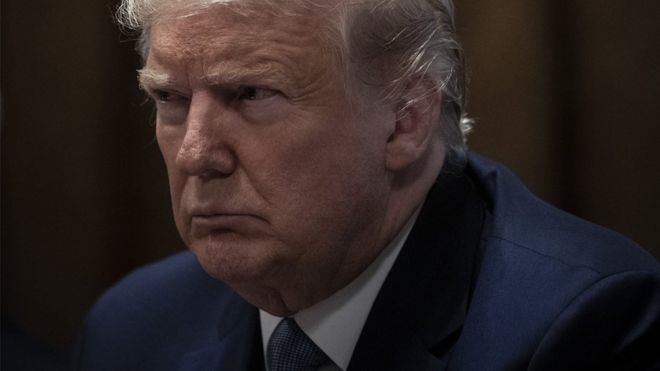
    President Donald Trump listens during a meeting about the Governors Initiative on Regulatory Innovation

    The Trump administration has said it does not consider the mass killings of Armenians in 1915 to be a genocide, contradicting a unanimous vote by the US Senate.

    The historic vote last week incensed Turkey, which has always denied that the killings amounted to a genocide.

    Turkey’s foreign ministry on Friday summoned the US ambassador to express its anger over the vote, accusing the US of “politicising history”.

    Armenia says 1.5 million were killed in an effort to wipe out the ethnic group.

    The killings took place in the waning days of the Ottoman Empire, the forerunner of modern-day Turkey.

    “The position of the administration has not changed,” said State Department spokeswoman Morgan Ortagus in a statement on Tuesday. “Our views are reflected in the president’s definitive statement on this issue from last April,” she said.

    In a statement last April on the anniversary of the killings, Mr Trump said the US paid tribute to the victims of “one of the worst mass atrocities of the 20th century”, but he did not use the word genocide. Instead he encouraged Armenians and Turks to “acknowledge and reckon with their painful history”.

    Armenian refugees at a camp in 1915

    In the wake of two votes last week in the US House and Senate to recognise the massacres as genocide – a long-awaited symbolic victory for Armenians – Turkey’s authoritarian president Recip Tayyip Erdogan threatened to shut down Incirlik air base, which is based in Turkey and hosts US nuclear warheads.

    Mr Erdogan also said he could close Kurecik radar base as a threat of US sanctions hung over Turkey after its recent military offensive in Syria.

    He called the votes – known as simple resolutions – “worthless” and the “biggest insult” to Turkish people. Simple resolutions do not bind the president, leaving him free to ignore them.

    The Armenian prime minister, Nikol Pashinyan, hailed the Congress and Senate resolutions as “a bold step towards serving truth and historical justice”.

    A previous effort at passing the resolution through the Senate was blocked by Senator Lindsay Graham – a staunch Trump ally – at the instruction of the White House.

    • Q&A: Armenian genocide dispute
    • US House says Armenian mass killing was genocide
    • US Senator blocks Armenian genocide resoution

    There is general agreement that hundreds of thousands of Armenians died when the Ottoman Turks deported them en masse from eastern Anatolia to the Syrian desert and elsewhere in 1915-16. They were killed or died from starvation or disease.

    The total number of Armenian dead is disputed. Armenians say 1.5 million died. The Republic of Turkey estimates the total to be 300,000. According to the International Association of Genocide Scholars (IAGS), the death toll was more than a million.

    Media captionArmenia mass killings explained in 60 seconds

    Armenia mass killings explained in 60 seconds

    The dispute about whether it was genocide centres on a question of premeditation – the degree to which the killings were orchestrated. Many historians, governments and the Armenian people believe they were; but some scholars have brought that into question.

    Turkish officials accept that atrocities were committed but argue that there was no systematic attempt to destroy the Christian Armenian people. Turkey says many innocent Muslim Turks also died in the turmoil of war.

    Mr Trump gave a warm welcome to Mr Erdogan in Washington DC last month, despite a recent invasion by Turkey of north-east Syria that targeted the Kurds – formerly US allies in the region. The invasion infuriated many US politicians and military officials and led to calls on the president to impose sanctions on Turkey.

    During a meeting in Washington last month, Mr Trump said he was a “big fan” of Mr Erdogan, ignoring widespread criticism over the Turkish president’s poor human rights record.

    Mr Trump predecessor, Barack Obama, promised as a presidential candidate to recognise the massacres of Armenians as genocide but after his election did not use the word.

  • Erdogan’s White House Visit May Have Only Delayed the Inevitable Storm

    Erdogan’s White House Visit May Have Only Delayed the Inevitable Storm

    Sinan Ciddi
    Sinan Ciddi
    Board of Contributors
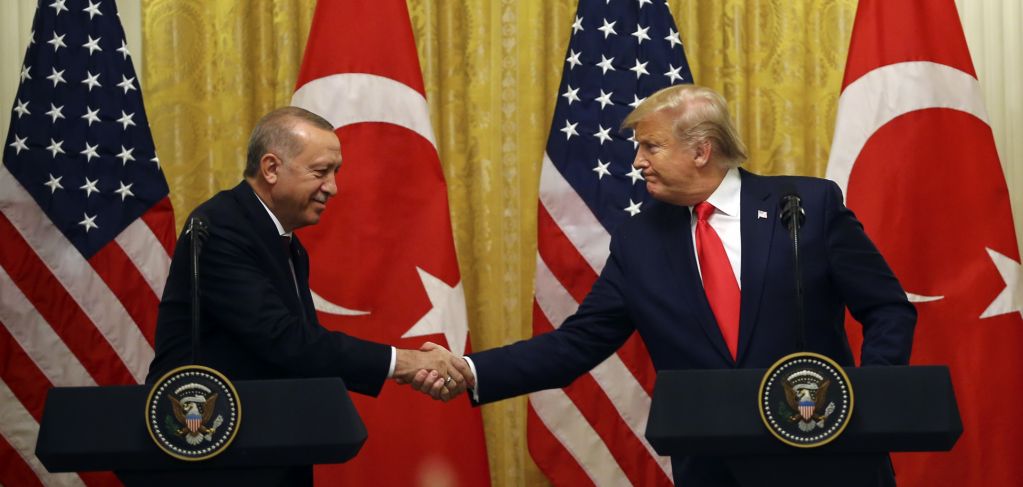
    Turkish President Recep Tayyip Erdogan and U.S. President Donald Trump hold a news conference at the White House on Nov. 13, 2019.

    Turkish President Recep Tayyip Erdogan (L) and U.S. President Donald Trump hold a news conference at the White House on Nov. 13, 2019. Other than Trump, Erdogan appears to have few friends left in Washington.

    (HALIL SAGIRKAYA/Anadolu Agency via Getty Images)
    Highlights
    • Despite some worries otherwise, Turkish President Recep Tayyip Erdogan’s visit to Washington was largely free of drama, but it also didn’t achieve any breakthroughs toward resolving long-standing bilateral disputes.
    • U.S. President Donald Trump essentially has given Turkey a chance to reconsider its position on buying S-400 missile defense systems from Russia, dangling the possibility of readmittance into the F-35 program as a lure.
    • Satisfying Washington will be tough, as doing so would likely anger Russia, which could retaliate by imposing measures on Turkey that could prove damaging to the interests of both Erdogan and his country.

    Turkish President Recep Tayyip Erdogan’s White House visit on Nov. 13 can be regarded as a win for Erdogan only in a narrow, yet significant sense. Amid the threat of looming U.S. sanctions, Erdogan’s meeting with U.S. President Donald Trump ended with the Turkish president voicing Ankara’s demands in the Oval office and, apparently, managing to stave off punitive U.S. measures.

    To be clear, Erdogan’s visit resolved none of the long-standing bilateral disputes between the United States and Turkey, and Erdogan — who is viewed with contempt by nearly all U.S. federal agencies — would not have been welcome in Washington had it not been for Trump’s personal invitation. Turkey, after all, has few friends left in the U.S. capital after its recent incursion into northern Syria to attack the U.S.-backed Kurdish military forces that have been fighting the Islamic State and its purchase of Russian S-400 missile defense systems, which many see as a violation of its NATO commitments.

    Conversely, it is unclear what Trump gained from giving numerous photo opportunities to a leader whom American governmental institutions widely regard as an unreliable partner at best, as well as an authoritarian leader who is visibly cozying up to Russia at the expense of the Western alliance’s interests. Most observers of Turkey have reached the conclusion that the alliance between Turkey and the United States exists in name only and definitely not in substance. There is ample reason to believe that Turkey and the United States will continue to drift further apart without more substantive engagement on the issues that divide the beleaguered allies.

    Erdogan arrived in Washington with a long list of requests, most of which seemed aimed at preserving himself and his government. Worries that the United States was going to disclose some of the more questionable sources of Erdogan’s vast personal wealth and the future of Turkey’s Halkbank apparently topped the list. Last month, U.S. prosecutors in the southern district of New York charged state-owned Halkbank with violating U.S. sanctions on Iran.

    Erdogan arrived in Washington with a long list of requests, most of which seemed aimed at preserving himself and his government.

    Additionally, Erdogan angered administration officials and a group of U.S. senators who attended his Oval Office meeting with Trump when he showed a video on an iPad depicting the leader of the Kurdish-led Syrian Democratic Forces, Mazloum Abdi, as a terrorist who should be apprehended and handed over to Turkey rather than invited to visit Washington. When U.S. Sen. Lindsay Graham brushed aside this act of propaganda, the focus of the discussion moved to Turkey’s purchase of Russian S-400 missile defense systems. From the joint statement that followed Trump’s meeting with Erdogan, it is clear the United States was interested in driving home one key ask of Turkey: Find a verifiable way to shelve the S-400s and, in return, rejoin the F-35 fighter jet program. If not, expect severe and debilitating sanctions.

    Stuck Between a Rock and a Hard Place

    On the S-400 issue, Erdogan faces an interesting conundrum and one of the most consequential decisions he will make. More than just losing face, Turkey would find it difficult to nullify its purchase of the S-400s. From past experience, Erdogan is keenly aware that angering Russian President Vladimir Putin is a sensitive issue, and there are credible reports suggesting Putin could release a trove of embarrassing and compromising materials that would showcase Erdogan and his family’s questionable financial dealings and international connections. Putin also could punish Turkey economically by terminating existing trade and tourism agreements vital to the health of Turkey’s economy.

    On the flip side, failing to satisfy Washington on the S-400 issue could unleash a barrage of sanctions. For the time being, the United States appears to have given Turkey an opportunity to think hard about the issue and act appropriately. As it stands, the U.S. case against Halkbank and a proposed resolution in the U.S. Senate to recognize the killing of Armenians by Ottoman Turks as genocide (the U.S. House of Representatives overwhelmingly passed a similar resolution last month) have both been put on ice as a gesture of goodwill and a signal that the United States is serious in its interest to bring Turkey back into the Western fold. As aggressive and credible as the U.S. position may be, some American officials worry that pushing Turkey too hard and punishing it with sanctions will drive it deeper into the open arms of Russia. Although Turkey has few friends in the U.S. Defense and State departments, no one is interested in Turkey formally pledging itself to the Russian camp.

    A Fatigued and Insecure Ruler

    It appears from observing Erdogan that hubris increasingly masks a lack of confidence, while insecurity shadows and undergirds his 17-year rule. Shortly before his scheduled visit to Washington, Erdogan gave a 36-minute speech on the 81st anniversary of the death of Mustafa Kemal Ataturk, the founder of the modern Turkish Republic. He underplayed the achievements of the republic to focus instead on a series of inaccurate observations that modern-day Turkey’s successes basically lay in the heritage of its predecessor, the Ottoman Empire. Lack of historical knowledge and nuance aside, it apparently was lost on Erdogan that the Ottoman state would never have allowed someone with a common background like his to occupy an influential government position, let alone become head of state.

    Erdogan should not be underestimated, however. He is a master tactician, with the ability and will to change the public discourse and political climate to his advantage on a whim. Over the past six years or so, he has mobilized such prowess solely for his self-preservation. It remains to be seen if he can use his powers and influence in the service of his country’s national interests.

  • Erdogan Meets Trump in the White House: The Result is a Tragicomedy

    Erdogan Meets Trump in the White House: The Result is a Tragicomedy

    It is difficult to know where to start commenting on the ridiculous press conference between Turkish President Recep Tayyip Erdogan and US Pres. Donald Trump at the White House on November 13, 2019. Unfortunately, we do not know what was discussed when the two presidents met earlier behind closed doors.

    Before Erdogan came to Washington, several Democratic and Republican members of Congress had signed a joint letter advising Pres. Trump not to invite the Turkish President to the White House which Trump ignored. This was not surprising given the fact that he had repeatedly called Erdogan “a friend” and “a tough guy who deserves respect.” Furthermore, Trump, as a presidential candidate in 2015, confessed that he had a financial interest in Turkey: “I have a little conflict of interest because I have a major, major building in Istanbul. It’s called Trump Towers — two towers, instead of one. … And I’ve gotten to know Turkey very well. They’re amazing people. They’re incredible people. They have a strong leader.” During the joint press conference, Pres. Trump described Turkey as “a great NATO ally,” “a strategic partner of the United States,” and “I am a big fan of the President [Erdogan].”

    Trump refused to impose legally required sanctions on Turkey for the purchase of Russian S-400 missiles. NBC News reported last week that former National Security Adviser John Bolton stated during a speech in Miami “that he believes there is a personal or business relationship dictating Trump’s position on Turkey because none of his advisers are aligned with him on the issue.” The House of Representatives had adopted two resolutions a week earlier reaffirming the recognition of the Armenian Genocide by the overwhelming bipartisan vote of 405 to 11, and placing sanctions on Turkey and some of its leaders, including Erdogan, by a vote of 403 to 16, after Pres. Trump withdrew US forces from Northern Syria, abandoning the Kurdish partners and allowing the Turkish military and its jihadist allies to murder hundreds of Kurdish civilians and deport around 200,000 Kurds and others from the area South of the Turkish border.

    At the White House press conference, there were several astonishing moments. First of all, Erdogan expressed his anger at the Armenian Genocide Resolution adopted by the House of Representatives on October 29, 2019. Erdogan repeated the usual Turkish propaganda line that there should be a historical commission to study the facts of the Armenian Genocide, while Pres. Trump silently looked on. Neither Erdogan nor Trump is probably aware that this issue has been studied by scores of historians, including the International Association of Genocide Scholars, which issued a joint statement confirming the veracity of the Armenian Genocide.

    During the joint press conference, Pres. Trump encouraged Erdogan to call on a Turkish journalist for a question. Trump told Erdogan: “Would you like to pick somebody? A friendly person from Turkey, friendly. Only friendly reporters. We like to see, there aren’t too many of them around.” There are no journalists left in Turkey who are not friendly to Erdogan. This year alone, 68 journalists were arrested in Turkey which has jailed more reporters than any other country in the world.

    Trump then proceeded to whitewash Erdogan’s crimes against Kurds by stating: “And, by the way, I think the president [Erdogan], he may have some factions within Kurds, but I think the president has a great relationship with the Kurds. Many Kurds live currently in Turkey, and they’re taken care of.” This is an absolute lie! Over 30,000 Kurdish citizens of Turkey have been killed by the Turkish military in the last few decades. Furthermore, 15 elected Kurdish mayors were dismissed by the Turkish government and arrested on trumped up charges.

    During the White House press conference Erdogan made another scandalous statement saying that he returned a letter that Pres. Trump had sent him on Oct. 9, 2019, by leaving it on the President’s desk during their meeting. In that letter, Pres. Trump had told Erdogan, “Don’t be a tough guy! Don’t be a fool!”

    Erdogan made one more idiotic comment on November 13, 2019, during his visit to the Washington Center of Turkey’s Directorate of Religious Affairs. Erdogan claimed that Armenians were “nomads” during the Armenian Genocide. Armenians “used to travel in different places as nomads. The forced deportation took place while they were living the same way as nomads in Turkey,” Erdogan falsely alleged, ignoring that Armenians were natives in their lands where they had lived for thousands of years before the Turkic tribes came from East Asia and conquered their homeland.

    An incredible conversation took place a week before Erdogan arrived in the United States. Turkish newspaper Sabah reported that during a phone call between the Turkish and US presidents on November 5, 2019, Erdogan said Pres. Trump asked him “whether it would be more suitable to use the word ‘war’ instead of calling it ‘genocide’?” Surprisingly, Erdogan said he rejected Trump’s suggestion on the grounds that “a war is between two states and that Armenians had in fact been subject to forced migration.”

    Erdogan told Trump that “there are efforts to intimidate us with the so-called Armenian bill and sanctions threat.” Pres. Trump then asked Erdogan how previous US presidents handled the Armenian Genocide issue, to which Erdogan replied: “Until now, I have worked with Bush and his son, and in the same way with Obama. Now I am working with you. At that time, they would refer this [genocide resolution] to the [House] committee and the committee would send it back. This time they bypassed the committee and sent it to the Congress.” Erdogan said Trump replied: “I will study it and talk to friends.”

    Of course, Erdogan gave false information to Pres. Trump. The Armenian Genocide resolution had been approved by the full House of Representatives twice before in 1975 and 1984, and had passed through the House Foreign Affairs Committee several times.

    It is ironic that Pres. Trump is asking Erdogan for advice on what to call the Armenian Genocide and how previous US presidents handled the genocide issue. All those ‘proud’ Armenian-American supporters of Trump should initiate immediate steps to educate the US president on the facts of the Armenian Genocide so he is not fed lies by the likes of denialist Erdogan!

    Immediately after his meeting with Erdogan and the joint press conference on Nov. 13, Pres. Trump invited a small group of Republican Senators to the White House to meet with Erdogan at Trump’s presence. This was an obvious ploy on the President’s part to dump the responsibility on the Senate for any action the Senators may take against Turkey.

    Following this meeting, when the Senators returned to the Senate floor, Sen. Robert Menendez (Dem.-N.J.) proposed to suspend the rules and bring the pending Armenian Genocide resolution directly to the full Senate bypassing the Senate Foreign Relations Committee. Sen. Lindsey Graham (Rep.-South Carolina) objected to Sen. Menendez’s request for consent. Under Senate rules, all it takes is one Senator to object, to prevent the Resolution to bypass the Senate Foreign Relations Committee. Sen. Graham, in his Senate remarks, explained: “I just met with President Erdogan and President Trump about the problems we face in Syria by the military incursion by Turkey. I do hope that Turkey and Armenia can come together and deal with this problem.” Sen. Graham added that he was objecting “not because of the past but because of the future.” Those remarks made his objection even worse.

    Sen. Graham’s rejection has confused some people into believing that the Armenian Genocide resolution is dead in the Senate. It is not. The Senate Foreign Relations Committee now has to consider the resolution and then, after approval, forward it to the full Senate.

  • Boom Times for Turkey’s Lobbyists in Trump’s Washington

    Boom Times for Turkey’s Lobbyists in Trump’s Washington

    ADAM KLASFELD

    MANHATTAN (CN) – Some five years ago, Turkey’s soft power suddenly swelled in the United States as the country’s lobbyists and pro-government charities received millions in newfound funding.

    That was the same year that leaked tapes appeared to show then-Prime Minister Recep Tayyip Erdoğan instructing his son Bilal to dump massive amounts of money tied to a multibillion-dollar money-laundering scheme.

    “Now, what I say is, you take everything that you have in the house out,” Erdoğan could be heard telling his son, in recordings quickly viewed by millions on YouTube and translated from Turkish by the now-shuttered Turkish newspaper, Zaman.

    “What can I have on me, Dad,” Bilal replied in that transcript. “There is your money in the safe.”

    Made public in early 2014, the tapes depicted Erdoğan fretting that Istanbul police conducted home raids on the top officials of his ruling Justice and Development Party and his then-ally Reza Zarrab, a gold trader charged with corrupting them. The Turkish government disputed its authenticity, but academic researchers doubted claims of doctoring.

    Zarrab would implicate Erdoğan in a bribery-fueled conspiracy to violate U.S. sanctions against Iran three years later in a New York federal courtroom — a development Erdoğan tried to head off by lobbying intensely with reported help from President Donald Trump and his attorney, Rudy Giuliani.
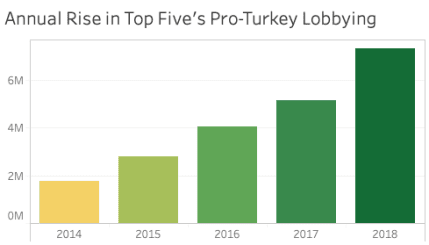
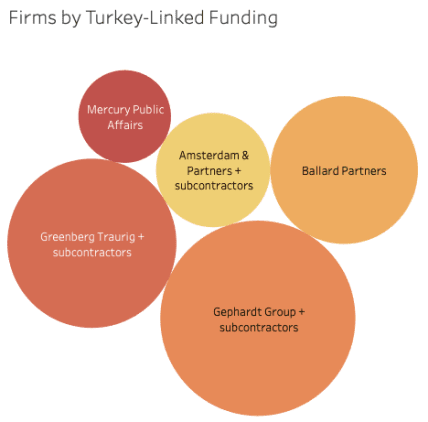
    Courthouse News studied the Justice Department’s foreign lobbying database to identify the five largest recipients of money linked to the Turkish government between 2014 and 2018: Amsterdam & Partners, Ballard Partners, Gephardt Group, Greenberg Traurig, and Mercury Public Affairs. The budgets of those five, including their subcontractors, more than quadrupled collectively during this time frame, from more than $1.7 million in 2014 to more than $7.3 million in 2018.

    Gephardt Group, a longtime lobbyist for Turkey named for the Democratic congressman who founded it, cut ties with its government at the end of 2016. The new guard of registered Turkish agents that replaced Gephardt would be deeply tied to Trump and his associates.

    Budgets of pro-Turkey charities linked to both Erdoğan and Trump also ballooned during this period.

    Bilal Erdoğan, the son from the 2014 recordings, signed the incorporation papers of the U.S.-based charity Turken Foundation just a few months after audio of him and his father caused an uproar. Turkey’s main opposition party unearthed Turken’s IRS records showing that tie in a document request. Public records show that another of Erdogan’s children, Esra Albayrak, sat on Turken’s board.

    As a tax-exempt 501(c)3 corporation, Turken does not have to disclose its donors, but it reported receiving a more than $24 million contribution the next fiscal year. Spending that money lavishly, the charity paid more than $17.5 million for the sites where it is building a 32-story skyscraper in midtown Manhattan, for use as Islamic student housing. It also bought legendary boxer Muhammad Ali’s farm in Michigan earlier this year for a reported $2.5 million.

    Hacked emails published by WikiLeaks showed Bilal Erdoğan’s interest in a different midtown Manhattan property, valued at $25 million, that Trump Organization representative Elena Baronoff had been offering in 2013.

    Known as Trump’s “Russian hand,” Baronoff died of leukemia two years later.

    Turken did not reply to an email requesting comment.

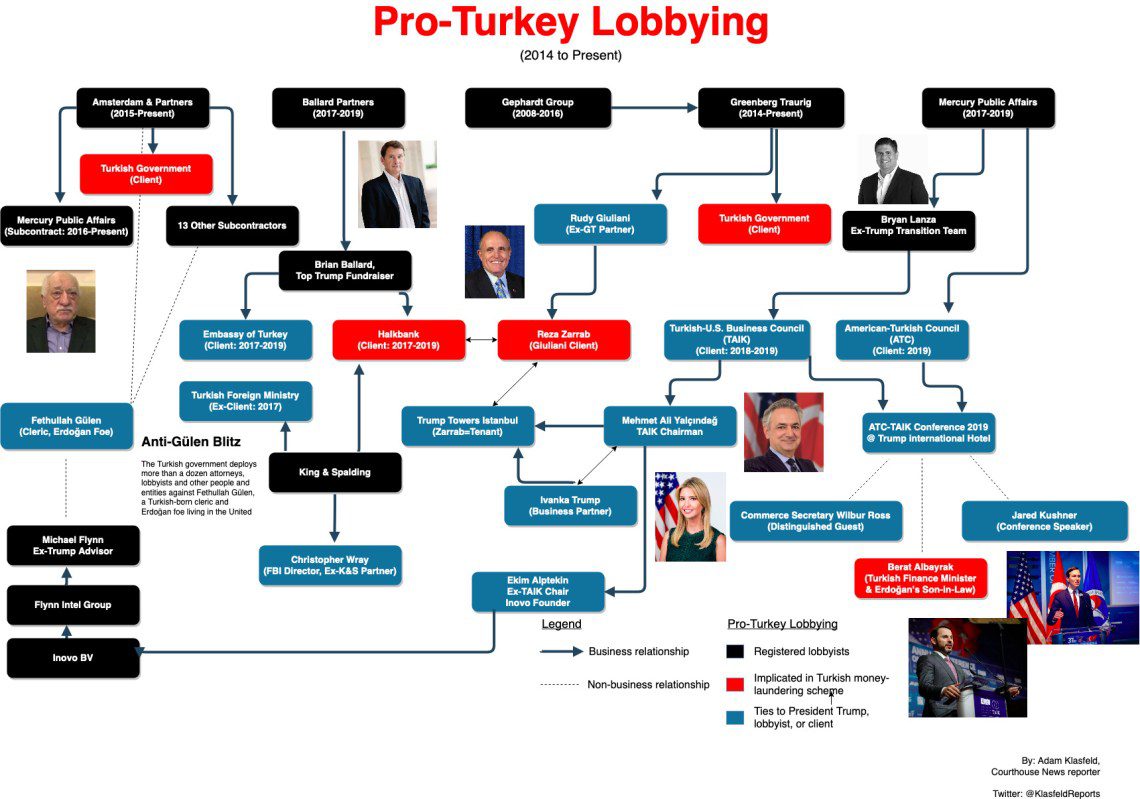
    Here is a breakdown of the top players in pro-Turkey lobbying and charity between 2014 and 2018.

    Gephardt Gets Out
    More than a decade ago in 2009, a ProPublica investigation found that the Turkish government’s lobbyists contacted members of Congress more often than those from any other country.

    A year before that article, Turkey first signed its contract with former Missouri Representative Richard Gephardt. Turkey had been successful in projecting an image of Erdoğan as a bridge between political Islam and liberal democracy, but Erdoğan’s corruption scandal — and his response to it — stained that international goodwill starting in late 2013.
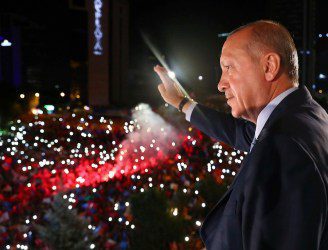
    Turkey’s President Recep Tayyip Erdogan waves to supporters of his ruling Justice and Development Party (AKP) in Ankara, Turkey, on June 25, 2018. (Presidency Press Service via AP, Pool)

    Once the leaked tapes of his son hit the internet, Erdoğan tried to ban Twitter and purge the prosecutors investigating him. Records that Gephardt disclosed under the Foreign Agents Registration Act show the firm spinning issues of “internet freedom” in Turkey with U.S. legislators and responding to the concerns of the House Foreign Affairs Committee about “The Future of Turkish Democracy.”

    Amid Erdoğan’s autocratic rise, Gephardt Group hired five subcontractors to help manage Turkey’s bruised international image: Dickstein Shapiro LLP and LB International Solutions in 2014; Greenberg Traurig and Capitol Counsel in 2015; and longtime congressional staffer Brian Forni in 2016.

    Gephardt could not be reached directly. The firm’s vice president, Greg Carnrick, did not respond to phone and email requests for comment.

    Asked by phone to explain why the firm terminated its eight-year contract with the Turkish government, Janice O’Connell — one of Gephardt’s former lobbyists for Turkey — supplied a one-word answer.

    “No,” O’Connell replied, abruptly hanging up the phone.

    Some Gephardt subcontractors continued to work for Greenberg Traurig, a billion-dollar legal powerhouse that took over Turkey’s lobbying contract the same year Giuliani took on Zarrab as a client.

    Giuliani’s Role Grows
    In 2017, leading up to the Zarrab trial, the Turkish government ratcheted up its legal, diplomatic and lobbying offensive. Ditching the firm led by the Democratic Gephardt, the Turkish government signed on two firms connected to influential Republicans.
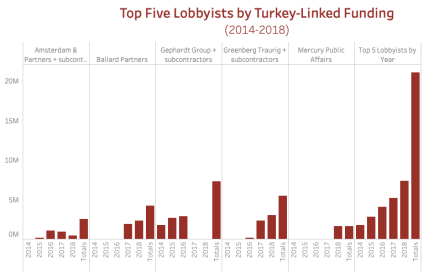
    Ballard Partners, whom Politico dubbed the “Most Powerful Lobbyist in Trump’s Washington,” made more than $4 million on two contracts: nearly $2 million from the Turkish embassy and more than $2 million from Halkbank, the Turkish state-run bank indicted just this past fall in New York. For that sum, the firm dispatched a trio of agents deeply tied to Trump’s State Department, Treasury Department and White House.

    The second firm, Greenberg Traurig, tilted slightly Republican in its political donations from 2016, but it had a partner with a direct line to Trump: Giuliani. The former New York City mayor shuttled between the White House and Turkey’s capital of Ankara to push for a prisoner swap that would have blocked damning testimony from Zarrab that accused Erdoğan of ordering billions of dollars in illicit trades through Halkbank.

    Giuliani’s growing reputation as a shadow secretary of state for the Trump administration, in both Turkey and Ukraine, has alarmed Democrats on Capitol Hill. Seven senators signed a letter over a year ago that asked the Department of Justice to assess whether Giuliani has complied with registration requirements for foreign agents.

    Senator Tammy Duckworth, one of the signers, is still waiting for the Justice Department to respond after following up on that inquiry last month.

    “I’ve asked the Justice Department twice … and I have not gotten a reply from that,” Duckworth told Courthouse News in a phone interview. “So, I’m not quite sure how Mr. Giuliani, who’s neither been elected by the American people nor confirmed by the United States Senate is out there conducting what amounts to foreign policy on behalf of the president because he’s the president’s personal attorney.”

    Following publication of this story, Giuliani called the suspicions that he may have violated foreign lobbying requirements a “maliciously false claim.”

    “Michael Mukasey and I were criminal counsel in a pending proceeding, seeking a prisoner exchange for Zarrab,” Giuliani said. “The FARA and lobbying laws have complete exclusion for lawyers representing a client in a proceeding.”

    The senators stopped short of accusing Giuliani of breaking the laws regarding foreign agents. Their letter requested an inquiry into the question from the Department of Justice, which did not respond to a request for comment.
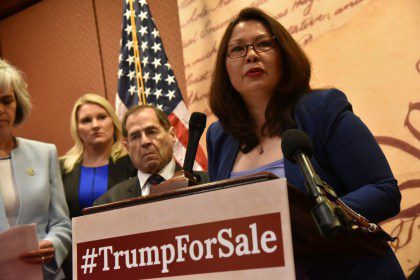
    Senator Tammy Duckworth raises concerns about President Donald Trump’s conflicts of interests in a June 20, 2017, press conference. (Photo courtesy of Senator Duckworth’s office)

    Duckworth also called it uncertain whether “Mr. Giuliani is also getting some personal gain from some of his actions, for example, in Turkey.”

    Court documents show that Giuliani was paid directly by Zarrab, who admitted to the money-laundering scheme.

    Greenberg Traurig and Giuliani cut ties in 2018 as the former mayor ramped up his work for Trump.

    The firm’s shareholder Robert Mangas, who signed the Turkey lobbying contract, claims never to have spoken to Giuliani on any matter related to Turkey.

    “Mr. Mangas and Mr. Giuliani never worked together on any matters related to Turkey, including the Zarrab case,” the firm’s managing director Jill Perry said.

    Greenberg Traurig, whose donations have skewed Democratic in 2018, made inroads on both sides of the aisle in Congress. The firm’s most recent filing reported numerous emails and two meetings apiece with Republican Senator Lindsey Graham and the chief of staff for Representative Ilhan Omar, the only member of the Democratic Party not to vote to recognize the Armenian genocide or approve sanctions against Turkey. Omar’s office did not respond to a request for comment.

    The firm raked in more than $5 million in fees and expenses from Turkey, paying nearly $2 million of that amount to subcontractors for the firms Capitol Counsel, Baker Donelson and LB International Solutions, whose president, Lydia Borland, helped a Turkish political action committee donate to U.S. politicians.

    Enemies of Erdogan
    During his clampdown on perceived opponents, Erdoğan went to war against his party’s former allies: followers of Fethullah Gülen, a Turkish-born cleric living in self-imposed exile in rural Pennsylvania. The main firm in charge of the Turkish government’s anti-Gülen offensive was Amsterdam & Partners, which hired at least 14 subcontractors, records show.

    Those arrangements were properly disclosed under the Foreign Agents Registration Act. Federal prosecutors believe that the Turkish government nestled its way into murkier relationships with at least one Trump ally.

    Trump’s former national security adviser Michael Flynn would admit that he concealed the Turkish government’s ties to his anti-Gülen blitz, a secret foreign influence initiative branded “The Truth Campaign.”
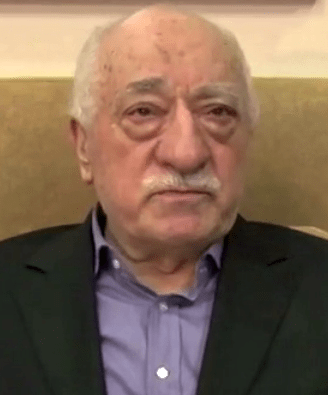
    Pennsylvania-based Turkish cleric Fethullah Gulen (Photo credit: Voice of America)

    The Dutch company Inovo BV paid $600,000 to Flynn Intel Group under the contract, which included an Election Day op-ed under Flynn’s name in The Hill.

    “The forces of radical Islam derive their ideology from radical clerics like Gülen, who is running a scam,” the editorial read. “We should not provide him safe haven.”

    Flynn’s column compared Gülen to Iran’s mullahs and Osama bin Laden, and court papers would later show that Flynn’s Turkish proxies had written several passages. One of the alleged ghostwriters, Trump transition team member Bijan Kian, would later be convicted of unregistered foreign lobbying only to have that conviction overturned. Inovo’s founder Ekim Alptekin was also indicted but did not appear in court and is presumed to be living in Turkey.

    The Wall Street Journal reported that Flynn discussed a plan with Turkish officials to “whisk” Gülen from his Pennsylvania home and back to Turkey outside the extradition process. Flynn denied that he tried to kidnap the cleric, but ex-CIA Director James Woolsey told the paper he witnessed the conversation.

    Other Turkish-funded media offensives against Gülen were disclosed. Amsterdam & Partners, led by attorney Robert Amsterdam, made nearly $1.3 million in fees by vilifying Gülen for the Turkish government, and the firm paid more than a dozen subcontractors a nearly equivalent amount to assist in the task.

    During a phone interview, Amsterdam denied that his crusade against Gülen was financially motivated.

    “It’s more out of dedication to the cause than for profit,” the attorney remarked, adding he even “took a haircut” in that pursuit.

    That cause has found multiple devotees in the Trump administration, including Giuliani, whom Bloomberg reported pushed to cut government grants to Gülen-affiliated schools across the United States.

    “That’s got nothing to do with me,” Amsterdam said of Giuliani.

    Amsterdam has been a vituperative critic of Gülen, echoing the Turkish government’s depiction of the cleric as a shadowy cultist behind the 2016 failed coup attempt against Erdoğan’s government.

    Amsterdam even purchased an anti-Gülen billboard near his home in Saylorsburg, Pennsylvania. The billboard, which showed Gülen’s face next to the words “School Children at Risk,” had been intended to run on a highway in the village that the cleric calls home.
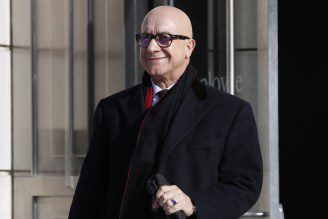
    Bijan Kian, a onetime business partner to former national security adviser Michael Flynn, leaves the FBI Field Office on Dec. 17, 2018, in Washington. (AP Photo/Jacquelyn Martin)

    Amsterdam admitted to having paid for it but claimed that it never went up because of pressure from Gülen’s organization.

    Alliance for Shared Values, an umbrella organization associated with Gülen’s movement, responded that they were “not aware,” but “not surprised,” that Amsterdam attempted to put that message near the cleric’s home.

    “Through his agents, the Erdoğan government made several attempts to defame and harass Mr. Gülen and visitors to the retreat center where he lives,” the group’s executive director Alp Aslandogan said. “These efforts include organizing loud and profane protests, mailing defamatory fliers to neighbors, flying planes with defamatory signs and showing a defamatory film at a local theater.”

    The Gülen movement, also known as Hizmet, the Turkish word for service, describes itself as a group dedicated to interfaith dialogue. The Obama administration rebuffed Turkish pressure to extradite Gülen, with former Vice President Joe Biden emphasizing the U.S. courts require due process and evidence of wrongdoing.

    “Only a federal court can do that,” Biden said in August 2016. “Nobody else can do that. If the president were to take this into his own hands, what would happen would be he would be impeached for violating the separation of powers.”

    Referring to the multimillion-dollar campaign against Gülen, Aslandogan added: “If the facts were on the Erdoğan government’s side, they would have spent far less and had even an ounce of success.”

    Reaching out to major TV, radio and print outlets, Amsterdam’s subcontractor Stroud Communications helped tout his book titled “Empire of Deceit,” accusing Gülen-affiliated charter schools of fraud. The title inspired the parody website “Empire of the Deceit” by Amsterdam’s critics, quoting a Globe & Mail editorial that describes the Canadian attorney as a “legal gun-for-hire and a public relations svengali.”

    Mercury Public Affairs, which made more than $87,000 from its contract with Amsterdam, later registered as a foreign agent for work with two Turkish clients directly. The firm made $1.6 million the year after announcing a major hire, Bryan Lanza, who served as Trump’s communications director on the presidential transition team.

    Both times that Trump announced a troop withdrawal from Syria — moves in late 2018 and 2019 that stunned top U.S. security officials — Trump had just spoken on the phone with Erdoğan, and Mercury rushed to defense the decision.

    Mercury, which has not responded to press inquiries, circulated an editorial by top Turkish diplomat Mevlüt Çavuşoğlu describing the United States’ longtime Kurdish allies as terrorists and another by Erdoğan, printed in The New York Times.

    Business or Pleasure at Trump Hotel?
    Having a new agent with deep ties in the Trump White House paid dividends for Mercury Public Affairs in taking on two major Turkish nonprofit groups as clients: Turkey-U.S. Business Council (TAIK) and the American Turkish Council (ATC).
    Every year, both charities join forces to host a lavish U.S.-Turkish Conference that brings together powerful military, business and political figures from both countries to mingle and discuss the future of bilateral relations. The last two conferences took place at the Trump International Hotel in Washington.

    TAIK’s current chairman Mehmet Ali Yalçındağ is Ivanka Trump’s former business partner for Trump Tower Istanbul. Alptekin, who was indicted in Flynn’s “Truth Campaign,” is a former chair.

    Under the Foreign Agents Registration Act, Mercury had to disclose all of its contacts with government officials and media representatives. Lanza repeatedly called and emailed the Commerce Department’s Deputy Secretary Earl Comstock on behalf of TAIK in 2018.

    The next year, Commerce Secretary Wilbur Ross would be one of the conference’s “Distinguished Guests,” posing in a photograph next to Yalcindag.

    Turkish Coalition of America, which organizes the 109-member-strong “Turkey Caucus” of U.S. Congress members, struggled for cash for much of this past decade, reporting negative revenue in 2014 and 2016. In 2017, the charity reported $4.6 million in revenue, by far the largest in that decade, after receiving a large grant from the Turkish Cultural Foundation, another Washington-based charity.

    The coalition’s president Lincoln McCurdy emphasized that the charity complies with nonprofit rules in service of its mission to promote public education.

    “TCA’s limited lobbying efforts are fully independent and are neither coordinated with nor controlled by any other organization or lobbying campaign, including that of the government of Turkey,” McCurdy, a former consul for commercial affairs at the U.S. Consulate General in Istanbul, said in an email.

    The lobbying expenditures reported by the group represent a small fraction of what it spends in total.

    Turkish Heritage Organization, a new nonprofit that sprung up in 2015, burst quickly into prominence with more than $3 million in contributions over the course of three years.

    When the House was still controlled by Republicans in 2017, its Committee of Foreign Affairs heard testimony from the organizations president, Ali Cinar, about the supposed threat to Turkey’s democracy from Gülen and Kurdish militants, not its strongman leader, Erdoğan.

    “There is no Turkish legislation that includes any provision that would lead to imprisonment of journalists on account of their journalistic work,” Cinar told Congress.

    Under Turkey’s constitution, insulting the president is a crime, and Erdoğan’s government by then had become the world’s leading press jailer for two years running. It has held onto that record ever since.