Category: Regions

  • Phl Ambassador to Turkey Discusses Trade and Investment Promotion with Officials of the Association for Social and Economic Solidarity with Pacific Counties

    Phl Ambassador to Turkey Discusses Trade and Investment Promotion with Officials of the Association for Social and Economic Solidarity with Pacific Counties

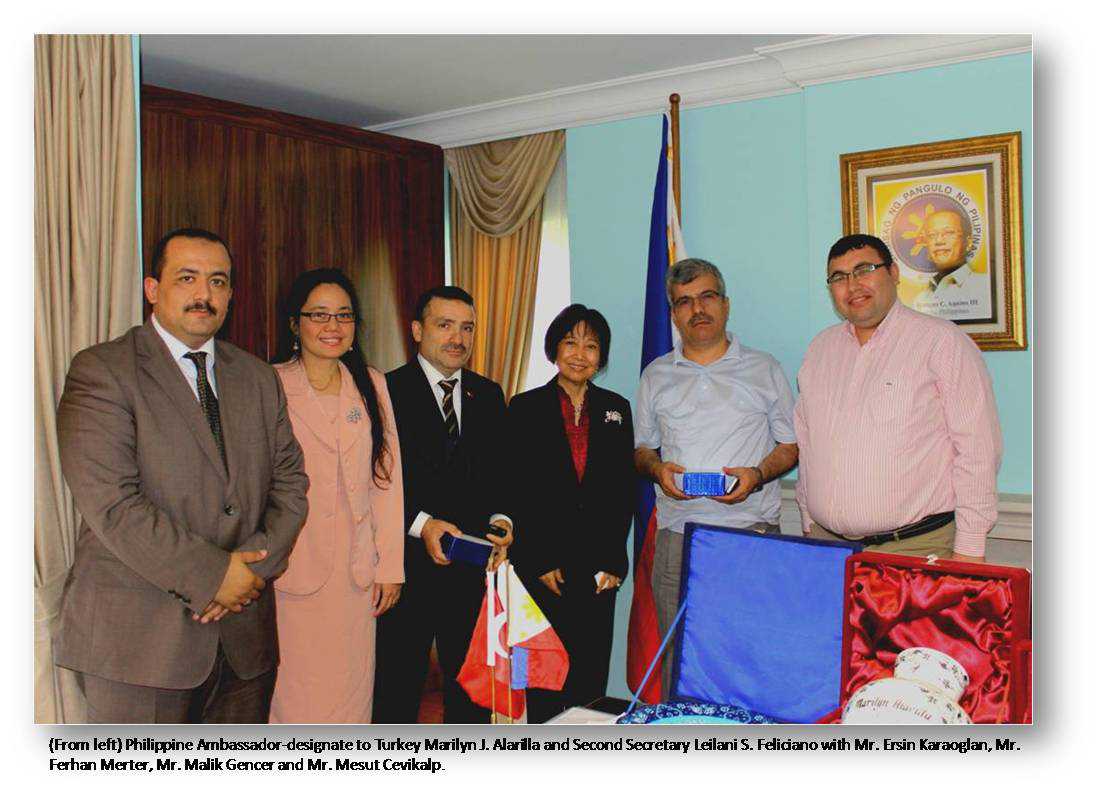
    20 September 2011-The Philippine Embassy in Ankara reported that officials of the Istanbul-based Association for Social and Economic Solidarity with Pacific Countries called on Ambassador-designate Marilyn J. Alarilla on September 15 at the Embassy to discuss economic and cultural cooperation activities implemented in the Philippines.

    The Association officials present during the meeting were General Secretary Ersin Karaoglan, Board Member Ferhan Merter, Philippine-based Fountain International School Director-General Malik Gencer, and Turkish news magazine “Aksiyon” correspondent Mesut Cevikalp.

    Also present during the meeting was Second Secretary Leilani S. Feliciano.

    The Association for Social and Economic Solidarity with Pacific Countries is a partner organization of the Confederation of Businessmen and Industrialists in Turkey, which is organizing the 2011 Trade Bridge Fair to be held on October 24 to 30 in the Istanbul Congress Center.

    The Association officials discussed the expected participation of ten Philippine companies in the forthcoming Trade Bridge Fair, which will focus on food, agricultural products, consumer goods and home appliances.

    During the meeting, Ambassador-designate Alarilla encouraged the Turkish representatives to explore cooperation between Philippine and Turkish companies in construction and infrastructure projects, food industry including tropical and marine products, jewelry including pearl-based items, and business process outsourcing and other IT-related services.

    Embassy and Forum officials agreed to continue their cooperation particularly on exchange information on future programs and projects.

    via Phl Ambassador to Turkey Discusses Trade and Investment Promotion with Officials of the Association for Social and Economic Solidarity with Pacific Counties.

  • Dutch euro-parliamentarians blast Turkey

    Dutch euro-parliamentarians blast Turkey

    Expatica 20 September 2011

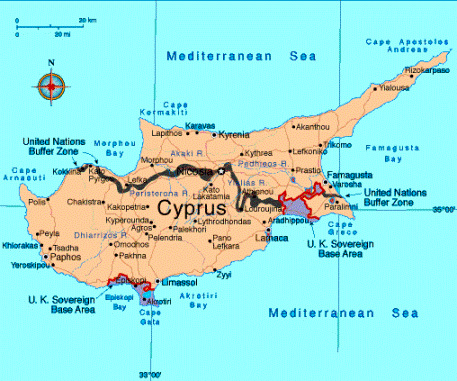
    The conservative VVD, senior partner in the Dutch coalition government, has launched a fierce attack on Turkey in the European Parliament. The leader of the VVD delegation, Hans van Baalen, said Turkey had disqualified itself as a potential EU member state with remarks made on Sunday by its deputy prime minister, Besir Atalay. He warned that Turkey would freeze its ties with the European Union if Cyprus occupied the rotating presidency of the EU in the second half of 2012 as planned.

    MEP Van Baalen pointed out that Turkey has been illegally occupying northern Cyprus since 1974 and has blocked every attempt at reconciliation between the Greek and Turkish communities. Turkey also refuses to normalise relations with the Greek part of the island.

    The VVD wants the European Commission to ask the Turkish government to explain this behaviour. (…)

    via Dutch euro-parliamentarians blast Turkey | EuropeNews.

  • Russian search giant Yandex expands into Turkey, opens Istanbul office

    Russian search giant Yandex expands into Turkey, opens Istanbul office

    Russian search giant Yandex expands into Turkey with new search portal and Istanbul offices

    Russian search giant Yandex today announced its expansion into Turkey, opening a Turkish version of its search engine and incorporating a range of other services tailored for Turkish users but also opening an office in Istanbul.

    Yandex has made sure to introduce its core search product but also serves pictures and videos, demonstrating small tweaks that can help users find books and poetry just by entering one line from the text itself. On top of its search features, Yandex’s Turkish portal will also offer email services, news, translation and other services.

    Yandex’s CEO Arkady Volozh notes how big a move this is for the Russian search giant:

    “It’s the first time we start offering web search services in a country where almost nobody speaks any Russian. We have considered countries with a well-developed internet market, a growing web user audience and a lot of local language content. Turkey was a clear first choice. Instead of just localizing our services for this country, we custom-built an entirely new product – tailored specifically to web users in Turkey.

    The company has already employed over twenty new staff in its new Istanbul office, making sure that it can add to its technological innovations with a deep understanding of the local culture, the language and the varying preferences of its users.

    In August, Yandex acquired ‘social newspaper’ service The Tweeted Times as part of a push to integrate more social data into its search results. Similar to Paper.li, it generates a ‘newspaper’ on the Web containing stories shared by people that they follow on Twitter. The team behind have now joined Yandex to work on boosting its search and content services with information from social networks.

    In 2010, Yandex generated 64% of all search traffic in Russia and was the largest Russian Internet company by revenue. It floated on the NASDAQ earlier this year.

    via Russian search giant Yandex expands into Turkey, opens Istanbul office.

  • If it’s good for Gaza it’s good for Turkey

    If it’s good for Gaza it’s good for Turkey

    It’s become a widely accepted assumption that Turkey is a rising powerhouse in the Middle East. The country’s prime minister Reccep Tayyip Erdogan has been cast as a “new sultan in a neo-Ottoman empire” after he staged a “conqueror’s march” last week through Egypt, Tunisia and Libya and lectured Arab leaders that he knows how to treat Israel, the ““West’s spoiled child,” as he put it.

    There is considerable irony in all of this. Once upon a time the Ottoman Empire included at one time or another most of the Arab countries in the Middle East and stretched across much of North Africa. Unfortunately for the Turks they picked the losing side in the First World War and paid the penalty by having their empire taken away from them in 1923  by the Treat of Lausanne. Last week, however, the one-time colonials cheered the man who now leads their former imperial master. Go figure.

    Yet, some think the new Ottoman emperor’s new clothes are threadbare. Guy Bechor, an Israeli expert on the Arab world, points out that Turkey faces a “credit bubble” that could burst at any time. Indeed, according to Bechor, Turkey’s budget deficit compared to its GDP is at 9.5 per cent, just shy of Greece’s 10 per cent. By comparison, Israel’s budget deficit is about three per cent and likely to drop to two per cent. Turkey’s economic growth – 10 per cent this year – is the result of “financial manipulation.”

    Apparently Turkey’s banks have been handing out loans and mortgages at very low interest rates, prompting Turkish citizens to pile on the debt (Does this sound familiar?) This easy credit policy is made possible by Turkey’s Central Bank acting at the behest of Erdogan’s government. The result, says Bechor, is that Turkey’s external debt has doubled in the last 18 months, only 15 per cent of which was financed by foreign investment.

    In effect, says Bechor, Erdogan’s popularly with Turkish voters is the result of cheap money, not a swing to Islamic fundamentalism on the part of the electorate. That popularity could disappear if, or when, the bubble pops? It’s happened elsewhere. The Greek economy is near collapse and civil unrest is rife. Europe’s economies are stagnant and anti-status quo sentiment is everywhere.  President Obama is increasingly unpopular because unemployment in the United States remains stubbornly high at about nine per cent. Turkey may well go that way, too. Turkey’s unemployment, Bechor points out, is about 13 per cent, its currency has dropped sharply against the dollar and the country’s stock exchange has lost 40 per cent of its value in the last six months.

    One of the tried and true tactics of politicians is to conjure an external enemy with which they can divert the populace  from their own  corruption and incompetence. Arab leaders, in particular, have pulled this stunt for decades, encouraging anti-Israeli sentiments and promoting a blame-the-Jews attitude among their people as a way to explain the backwardness and failure of  Muslim societies. Of course, the ultimate diversion is war.

    Erdogan is certainly fomenting hostility toward Israel, which not so long ago had close economic and military ties with Turkey. The two countries cooperated to keep the Middle East from boiling over, with Turkey serving as a sane counterbalance to the madmen who ran Iran and Iraq. Indeed, as journalist Martin Peretz observes, Turkey was once a “buffer against Muslim millenarianism.”

    Not any more.  Erdogan plays to the Islamists, using religious extremism to further his own ends, whatever they may be. Does anyone seriously think last year’s Gaza flotilla sailed without Erdogan’s approval or wasn’t intended as a deliberate provocation of Israel? Nine people died and dozens were wounded when Israeli navy commandos seized a Turkish ship, the Mavi Marmara that was part of a six-boat flotilla of self-proclaimed pro-Palestinian “activists” trying to run Israel’s blockade of the Gaza Strip. The Turks have been demanding an Israeli apology ever since and using Israel’s refusal as an excuse to expel Israel’s ambassador and harass Israeli businessmen in Turkey. Erdogan has even threatened to send the Turkish navy to protect another flotilla.

    Such a threat raises some interesting scenarios. Turkey is a NATO member. Under the NATO charter an attack on one NATO member is considered an attack on all. If Israel, in the act of defending itself, sinks a Turkish ship, does that constitute an act of war against the NATO alliance?

    The idea is absurd, of course, yet it makes you wonder why western leaders are allowing a NATO member to play such dangerous games. If  Erdogan continues promoting Turkey as an imperial power at the expense of Israel, NATO will have to rethink its continued membership in the “western” alliance.

    The question, of course, is why Erdogan acts as he does. One possible answer is President Obama who, if he could get away with it, would abandon the one stable and sane ally the United States has in the Middle East, namely Israel, in order to curry favour with the Muslim world. Obama’s imprimatur, tacit or otherwise, is all over Erdogan’s antics. In Peretz’s words: “(Obama’s) adoring view of Erdogan has stimulated the Turkish regime to be a force not for stability in Cairo or Ramallah.”

    Perhaps the Israelis should be a force for instability among all those Kurds, sending “flotillas” to those who loathe Turkey’s continued imperialist domination of their traditional homelands. Indeed, it’s only logical–and fair–that if Erdogan supports the creation of a state for the “Palestinians,” then, presumably,  he’d support creating a state for the Kurdish people on their traditonal homeland even if that terrority subtracts from Turkey’s. If  it’s good for Gaza then surely it’s good for Turkey, too.
  • Talking to Turkey

    Talking to Turkey

    Talking to Turkey

    Rebecca N. White

    At the Pentagon yesterday, Secretary of Defense Leon Panetta met with his Israeli counterpart, Ehud Barak. According to a spokesman, Panetta stressed “America’s continued commitment to ensuring Israel’s qualitative military edge” in particular. The SecDef is expected to travel to the region “in the near future” to meet with Barak again in what will be the pair’s third meeting since Panetta took office.

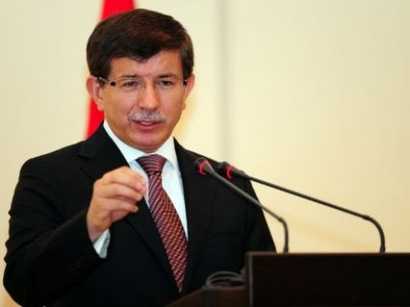
    The sitdown came as tensions continue to rise in Israel’s neighborhood. Secretary of State Hillary Clinton spoke with Turkey’s foreign minister, Ahmet Davutoglu, yesterday and explained Washington’s concern about Israel and Turkey’s strained relations. She called on Ankara to mend its relationship with Israel. President Obama will meet today with Turkish prime minister Recep Tayyip Erdogan. The UN General Assembly opens tomorrow in New York, and later in the week the Palestinians are expected to make a bid for statehood in the Security Council.

    Clinton also spoke at a pre-General Assembly event at the UN about women in politics. Along with Brazil’s president Dilma Rousseff, Clinton called for greater equality for women in the political sphere. She tried to bring some levity to the room, quipping, “As someone who tried to be a president, it’s very encouraging to see those who actually ended up as a president.”

    Treasury Secretary Timothy Geithner is meanwhile denying reports in Ron Suskind’s new book, Confidence Men, that he ignored a request from President Obama to consider dissolving Citigroup. “I lived the original, and the reality I lived, we all lived together, bears no relation to the sad little stories I heard reported from that book,” Geithner said. White House spokesman Jay Carney cautioned that the book gets many facts wrong. Neither has read the book.

    via Talking to Turkey | The National Interest Blog.

  • Turkey seeks alliance with Egypt as Middle East restructuring begins

    Turkey seeks alliance with Egypt as Middle East restructuring begins

    by Gaius Publius

    An important under-the-radar process has started in the Middle East, which could result in a major restructuring of alliances and powers.

    Earlier Myrddin reported on (and analyzed) the possibility of war between Turkey and Israel over Israel’s May 2010 assault on the Turkish-flagged humanitarian flotilla bound for Gaza.

    There is no question that relations between Israel and Turkey have reached a new, almost rock bottom low. After that attack, which resulted in the deaths of nine Turkish citizens, Turkey has said that the Turkish navy would escort the next Gaza-bound rescue ships. That makes it put up or shut up for Israel, with war hanging in the balance.

    Now, in a brilliant bit of diplomatic maneuvering, Turkey is working on an alliance with Egypt (my emphasis):

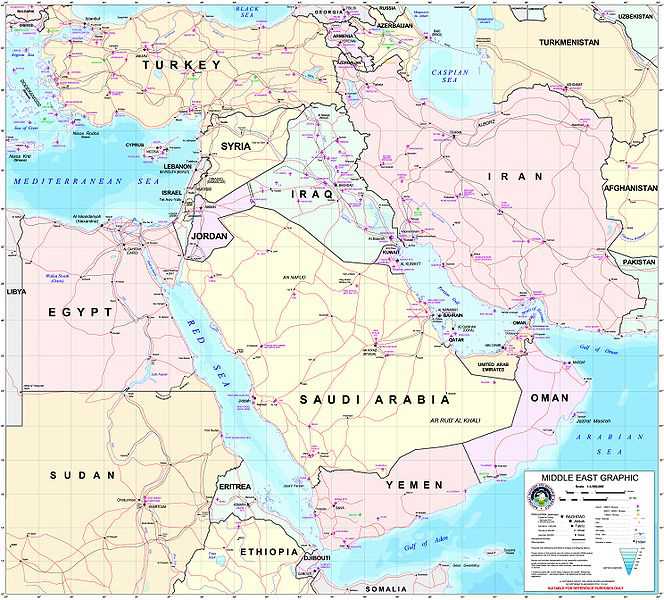
    A newly assertive Turkey offered on Sunday a vision of a starkly realigned Middle East, where the country’s former allies in Syria and Israel fall into deeper isolation, and a burgeoning alliance with Egypt underpins a new order in a region roiled by revolt and revolution.

    The portrait was described by Foreign Minister Ahmet Davutoglu of Turkey in an hourlong interview before he was to leave for the United Nations, where a contentious debate was expected this week over a Palestinian bid for recognition as a state. Viewed by many as the architect of a foreign policy that has made Turkey one of the most relevant players in the Muslim world, Mr. Davutoglu pointed to that issue and others to describe a region in the midst of a transformation. Turkey, he said, was “right at the center of everything.”

    He declared that Israel was solely responsible for the near collapse in relations with Turkey, once an ally, and he accused Syria’s president of lying to him after Turkish officials offered the government there a “last chance” to salvage power by halting its brutal crackdown on dissent.

    Strikingly, he predicted a partnership between Turkey and Egypt, two of the region’s militarily strongest and most populous and influential countries, which he said could create a new axis of power at a time when American influence in the Middle East seems to be diminishing.

    This is seriously one to watch. Egypt and Turkey are as close as you get in the Middle East to Arab–Europe crossroads states, with cultures and economies that share in both worlds. (And the article is an excellent review of Turkey and its strengthening place in the Arab world; very impressive.)

    Will Turkey follow through on a navy-escorted Gaza humanitarian flotilla? If so, will Israel attack? As Myrddin points out, if Israel backs down, the hard-right Netanhahu–Avigdor Lieberman government could fall.

    And long-term, imagine a Middle East dominated by a pro-Palestine Egypt–Turkey axis instead of the Israel–Syria “warring states” status quo. Couple that with diminished U.S. influence, presence & credibility; add a dash of Palestinian de-facto statehood via the U.N. — and suddenly the world looks different from over there.

    This certainly could stir the pot, and not in the bad way.

    GP

    via US Politics | 2012 Election – AMERICAblog News: Turkey seeks alliance with Egypt as Middle East restructuring begins.