Category: Regions

  • Egyptians in Turkey for new business ties

    Egyptians in Turkey for new business ties

    Gökhan Kurtaran

    ISTANBUL
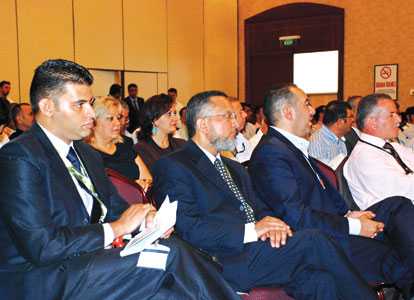
    An Egyptian business delegation with of 41 members listens to local counterparts in southern Turkey. The trade volume between the parties reached $3.4 billion last year. AA photo
    An Egyptian business delegation with of 41 members listens to local counterparts in southern Turkey. The trade volume between the parties reached $3.4 billion last year. AA photo

    Egyptian businessmen visited Turkey for the first time since the revolution to look for ways to resume business bonds with the country, said the head of the Egyptian-Turkish Business Council on Monday.

    “The visit of Turkish Prime Minister Recep Tayyip Erdoğan to Egypt last week has worked more than thousands of compliments could be made for Egypt-Turkey relations,” said Zuhal Mansfield, head of Turkish-Egyptian Business Council at the Foreign Economic Relations Board of Turkey, or DEİK, in an e-mail response to Hürriyet Daily News questions. There have been close relations with the new Egypt following uprising that began Jan. 25, she said.

    A delegation of 41 Egyptian businessmen visited Turkey’s southern province of Adana and Mersin on Monday and will visit two major industrial cities in the south, Gaziantep and Iskenderun, on Tuesday to have bilateral meetings with Turkish businessmen.

    “Our prime minister went there to pave the way for Turkish traders and businessmen,” said Mansfield, noting that the visit has proved that Turkish and Egyptian business bonds would be stronger than ever. Turkey’s approach during the North African country’s hard times would play a significant role in developing closer ties with Turkey, she said.

    The Turkish and Egyptian trade volume reached $3.4 billion by the end of last year. “We aim to reach a total trade volume of $10 billion in the next five years,” Mansfield said.

    There were almost no Turkish businessmen in Egypt five years ago, according to Mansfield, who said Turkish businesses have invested approximately a total of $1.5 billion in Egypt during the last five years. According to her, Egypt in its post-revolution era will witness approximately $5 billion in Turkish investment by 2015.

    Mansfield also said the new Egyptian interim government should start issuing five-year visas for Turkish businessmen, adding that this would accelerate the business relations between both countries. Turkey and Egypt already have been working on a draft for a free trade zone agreement that is expected to be signed in 2020. “We can backdate it to 2015.”

    Turkish bank in Egypt

    The business council head said opening banks in both Turkey and Egypt was a must to ease transactions between the two countries. “Now it’s time to have a [Turkish] bank in Egypt,” she said. Mansfield also said Turkey and Egypt would soon start roll on-roll off maritime services between Mersin and the Egyptian city of Alexandria.

    “The southern province of Adana ranks as the 13th biggest goods supplier of Egypt, exporting nearly $25 million to Egypt annually,” said Sadi Sürenkök, chairman of the Adana Chamber of Commerce said, according to an Anatolian news agency report on Monday. “I believe trade between the countries will accelerate,” Sürenkök added.

    “We aim to have closer bonds with Turkish businessmen as we also would like cooperate in textile and construction sectors,” said Ahmet Hassan, vice chairman of Alexandria Chamber of Commerce, the agency reported. “We will do our best and ease the investment process for Turkish investors in Egypt,” he said.

    via Egyptians in Turkey for new business ties – Hurriyet Daily News.
  • Opening NATO office still on table despite Turkish claims

    Opening NATO office still on table despite Turkish claims

    By YAAKOV KATZ

    09/19/2011 12:36

    Gov’t officials deny Ankara’s assertion that Turkey had blocked Israeli attempt to open office in western military alliance’s headquarters.

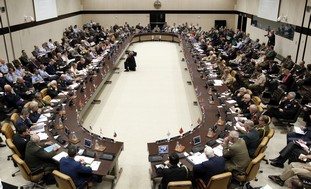
    The possibility of opening an Israeli mission at NATO headquarters in Brussels is still “on the table” government officials said on Monday, in response to Turkish claims that Ankara had succeeded in vetoing the initiative.

    On Sunday night, Turkish Foreign Minister Ahmet Davutoglu told the CNNTürk news channel that Turkey had succeeded in blocking an Israeli attempt to open an office in the Western military alliance’s headquarters.

    RELATED:

    Analysis: NATO membership a restraint for Turkey

    Jerusalem brushes off Ankara threat to go to The Hague

    “Israel recently made an attempt to open an office at NATO [headquarters] in Brussels.

    We said we would veto this attempt and the issue was not even put on the agenda,” Davutoglu said.

    But Israeli officials involved in relations with NATO said that the option of opening an office at NATO headquarters in Brussels was “realistic” and was currently under consideration within the Foreign Ministry and Defense Ministry.

    “We do not know of any veto or of the possibility that one country can veto an offer that was made by NATO,” one government official said.

    In recent years, Israel has significantly boosted its cooperation with NATO and regularly participates in workshops and seminars organized by the Western military alliance and member countries. In 2010, the Israel Navy and NATO signed an agreement to deploy a missile ship with Active Endeavour, a NATO mission to patrol the Mediterranean Sea and prevent terror and weapons smuggling.

    Israel is also seeking to receive an upgraded status following the conclusion of a Strategic Concept review the military alliance is currently conducting that will enable Israeli officials to participate in top NATO forums – even though Israel is not a member of the alliance but a member of the Mediterranean Dialogue, which was created in 1994 to foster ties with Middle Eastern countries like Israel, Jordan, Egypt and Morocco.

    Earlier this year NATO extended invitations to all of the countries involved in the Mediterranean Dialogue and other non-membership forums to open offices at NATO headquarters in Brussels.

    Defense officials said that the offer was still relevant and that it was being “positively considered” by the government. It is still unclear what the rank of the Foreign Ministry or Defense Ministry official will be who would man the mission if established.

    “We could gain from having an office in NATO headquarters which could eventually lead to a more significant increase in cooperation,” one defense official said.

    via Opening NATO office still on tabl… JPost – Diplomacy & Politics.

  • U.S. Seeks to Strengthen Trade Ties With Turkey

    U.S. Seeks to Strengthen Trade Ties With Turkey

    By JOE PARKINSON

    ISTANBUL—The U.S. is seeking to triple trade with Turkey over the next five to six years, the U.S.’s undersecretary of state for trade and commerce, Francisco Sanchez, said Monday, underlining Washington’s commitment to anchor an increasingly assertive ally at odds over Israel.

    Speaking at a news conference in Istanbul after attending the inaugural meeting of the Turkey-U.S. business council, an advisory group to boost commercial ties, Mr. Sanchez said business links between Washington and Ankara had “never been better,” singling out Turkey’s energy sector as a potential target for future U.S. investment.

    “I’d like to see us triple [trade] in the next five or six years. I think it’s very doable,” Mr. Sanchez said, adding that “I don’t believe any two partners will ever agree 100% on everything. The key is to look at how we manage those differences.”

    The business council was launched in part out of recognition that for strategic allies, the two nations had relatively weak trade ties. But data show that trade between the U.S. and fast-growing Turkey has begun to strengthen. In 2010 bilateral trade swelled to a record $15 billion, while the first seven months of this year have already seen $12 billion in trade volumes, Mr. Sanchez said. Turkey’s economy expanded 11% in the first half of 2011 compared with a year earlier, outstripping China to post the fastest growth of any G-20 economy.

    The call for strengthening commercial ties comes at a politically sensitive moment for the longtime allies, who wield the two largest militaries in the North Atlantic Treaty Organization.

    Diplomatic tensions have escalated rapidly between Turkey and Israel—Washington’s closest partners in the region—most recently over Israel’s refusal to apologize for an operation to board a Gaza-bound ship last year that killed nine activists, eight of whom were Turkish citizens and one Turkish-American. Ankara expelled top Israeli diplomats, cut military ties and vowed to send navy vessels to escort aid ships in the future.

    That has coincided with Turkey showing signs of trading its vaunted “zero problems with neighbors” foreign policy for a more muscular approach, bidding to become the leading power in the Middle East and North Africa.

    Turkish Prime Minister Recep Tayyip Erdogan has set similar goals to boost trade with partners around the Middle East. Last week he pledged in Cairo to triple trade and investment with Egypt, after signing ambitious, if largely political, energy agreements.

    The U.S.’s Mr. Sanchez acknowledged that political challenges could burden efforts to boost commercial ties, but stressed that the importance of the relationship for both parties meant solutions could be found.

    “There is no challenge that can overcome the importance of this relationship. You can see it in the numbers; we have a growing and vibrant relationship. This relationship is too important and too valuable to the U.S. and Turkey,” the undersecretary said.

    The potential for such challenges was on display Monday as U.S. company Noble Engineering Inc. began exploratory drilling for gas off the southern coast of divided Cyprus, ignoring Turkish warnings that it would retaliate by launching its own explorations in the eastern Mediterranean.

    Mr. Sanchez wouldn’t comment on the Texas-based company’s operations, and brushed off questions over how the U.S.’s fast-sinking popularity in Turkey could hamstring its efforts to boost business collaboration, stressing that the commercial objectives of the allies were aligned.

    The latest global poll by the Pew Research Center in May showed that the lowest approval rating for the U.S. of six Muslim nations surveyed was in Turkey—at just 10%, down from 17% last year. U.S. President Barack Obama didn’t fare much better, with only 12% of Turks expressing confidence for the U.S leader, against 73% who didn’t.

    Write to Joe Parkinson at [email protected]

    via U.S. Seeks to Strengthen Trade Ties With Turkey – WSJ.com.

  • Dutch queen warns nation of tough economic times

    Dutch queen warns nation of tough economic times

    By Mike Corder Associated Press

    THE HAGUE, Netherlands—Dutch Queen Beatrix warned her subjects Tuesday to brace for a year of tough budget cuts as the government struggles to protect the economy from any shocks emanating from Europe’s debt crisis.

    Beatrix’s speech to lawmakers in Parliament’s 13th century “Knights’ Hall” was the first written by the conservative government of Prime Minister Mark Rutte, which came to power last year pledging to slash euro 18 billion in government spending.

    “The year ahead will be a year of tough savings measures that will hit everybody,” Beatrix warned, after riding from the Noordeinde Palace to Parliament in her gold-trimmed carriage through the crowd-lined streets of The Hague.

    The measures included in Finance Minister Jan Kees de Jager’s budget already have been widely publicized after it was accidentally posted online last Thursday.

    They include deep cuts to the country’s generous social security network and raising the retirement age from 65 to 66 in 2020 and to 67 five years later.

    The government is forecasting economic growth of 1 percent in 2012, inflation of 2 percent and a budget deficit of 2.9 percent.

    It has also warned that more savings may still be necessary, depending on developments in the debt crisis.

    “A well-functioning European internal market and stable euro are essential for the government’s goals,” Beatrix said.

    Opposition Labor Party leader Job Cohen slammed the government for a divisive package of savings.

    “The pile of cuts by the Cabinet hits large groups of people,” Cohen said. “But the richest are being sheltered and the Netherlands will become weaker in the long term because of the plans.”

    De Jager was formally presenting his budget package to lawmakers later Tuesday.

    “The debt crisis underscores the importance of healthy government finances,” he tweeted after the queen’s speech. “Budgetary discipline is an absolute priority for this Cabinet.”

    www.boston.com,  September 20, 2011

    Economic storm threatens the Netherlands, says finance minister

    The Netherlands will have to dig its heels in to withstand the coming economic storm, finance minister Jan Kees de Jager told MPs on Tuesday, as he formally handed over the government’s 2012 spending plans to parliament.

    ‘We are being threatened by something, but we don’t know what is heading for us, or when”, the minister said.

    ‘It is clear that 2012 is going to be a difficult year for a lot of people,’ De Jager said. ‘We have to make difficult choices and they will hurt.’

    €70m too much

    The Netherlands is a financially solid country, but still runs a deficit and the debt is increasing. This year alone the country will spend €70m too much every day.

    The cabinet is trying to carve out a leading role in restoring financial stability to the EU, he said. This is why the government is keen to tighten up eurozone budget rules and prevent the spread of the Greek crisis. In the long term ‘we have to ensure our weaker brother does not bring down other countries in its wake,’ De Jager said.

    MPs and ministers will hold two days of debate on the 2012 plans on Wednesday and Thursday. The actual documents were published last week but ministers have refrained from commenting on them since then.

    www.dutchnews.nl, 20 September 2011

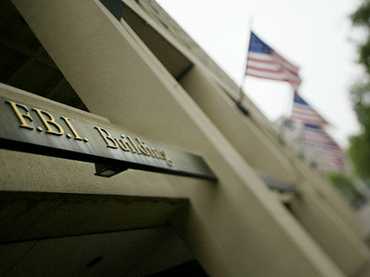
  • FBI organizes almost all terror plots in the US

    FBI organizes almost all terror plots in the US

    FBI organizes almost all terror plots in the US

    The Federal Bureau of Investigation employs upwards of 15,000 undercover agents today, ten times what they had on the roster back in 1975.

    If you think that’s a few spies too many — spies earning as much as $100,000 per assignment — one doesn’t have to go too deep into their track record to see their accomplishments. Those agents are responsible for an overwhelming amount of terrorist stings that have stopped major domestic catastrophes in the vein of 9/11 from happening on American soil.

    Another thing those agents are responsible for, however, is plotting those very schemes.

    The FBI has in recent years used trained informants not just to snitch on suspected terrorists, but to set them up from the get-go. A recent report put together by Mother Jones and the Investigative Reporting Program at the University of California-Berkley analyses some striking statistics about the role of FBI informants in terrorism cases that the Bureau has targeted in the decade since the September 11 attacks.

    The report reveals that the FBI regularly infiltrates communities where they suspect terrorist-minded individuals to be engaging with others. Regardless of their intentions, agents are sent in to converse within the community, find suspects that could potentially carry out “lone wolf” attacks and then, more or less, encourage them to do so. By providing weaponry, funds and a plan, FBI-directed agents will encourage otherwise-unwilling participants to plot out terrorist attacks, only to bust them before any events fully materialize.

    Additionally, one former high-level FBI officials speaking to Mother Jones says that, for every informant officially employed by the bureau, up to three unofficial agents are working undercover.

    The FBI has used those informants to set-up and thus shut-down several of the more high profile would-be attacks in recent years. The report reveals that the Washington DC Metro bombing plot, the New York City subway plot, the attempt to blow up Chicago’s Sears Tower and dozens more were all orchestrated by FBI agents. In fact, reads the report, only three of the more well-known terror plots of the last decade weren’t orchestrated by FBI-involved agents.

    The report reveals that in many of the stings, important meetings between informants and the unknowing participants are left purposely unrecorded, as to avoid any entrapment charges that could cause the case to be dismissed. Perhaps the most high-profile of the FBI-proposed plots was the case of the Newburgh 4. Around an hour outside of New York City, an informant infiltrated a Muslim community and engaged four local men to carry out a series of attacks. Those men may have never actually carried out an attack, but once the informant offered them a plot and a pair of missiles, they agreed. Defense attorneys cried “entrapment,” but the men still were sentenced to 25 years apiece.

    “The problem with the cases we’re talking about is that defendants would not have done anything if not kicked in the ass by government agents,” Martin Stolar tells Mother Jones. Stolar represented the suspect involved in a New York City bombing plot that was set-up by FBI agents. “They’re creating crimes to solve crimes so they can claim a victory in the war on terror.” For their part, the FBI says this method is a plan for “preemption,” “prevention” and “disruption.”

    The report also reveals that, of the 500-plus prosecutions of terrorism-related cases they analyzed, nearly half of them involved the use of informants, many of whom worked for the FBI in exchange for money or to work off criminal charges. Of the 158 prosecutions carried out, 49 defendants participated in plots that agent provocateurs arranged on behalf of the FBI.

    Experts note that the chance of winning a terrorism-related trial, entrapment or not, is near impossible. “The plots people are accused of being part of — attacking subway systems or trying to bomb a building — are so frightening that they can overwhelm a jury,” David Cole, a Georgetown University law professor, tells Mother Jones. Since 9/11, almost two-thirds of the cases linked to terrorism have ended with guilty pleas. “They don’t say, ‘I’ve been entrapped,’ or, ‘I was immature,’” a retired FBI official remarks.

    All of this and those guilty pleas often stem for just being in the right place at the wrong time. Farhana Khera of the group Muslim Advocate notes that agents go into mosques on “fishing expeditions” just to see where they can get interest in the community. “The FBI is now telling agents they can go into houses of worship without probable cause,” says Khera. “That raises serious constitutional issues.”

    From the set-up to the big finish, the whole sting operation is ripe with constitutional issues such as that. A decade since 9/11, however, the FBI is reaching through whatever means it can pull together to keep terrorists — or whom they think could someday become one — from ever hurting America.

    www.rt.com, 09 September, 2011

  • Cancer fear over cola colourings: Call to ban ingredient used in Coke and Pepsi

    Cancer fear over cola colourings: Call to ban ingredient used in Coke and Pepsi

    By Sean Poulter

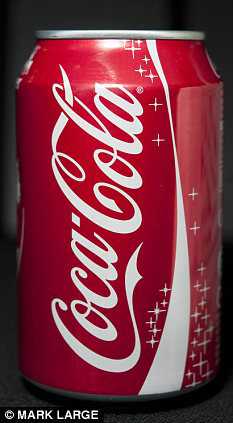
    A health risk? America's National Toxicology Program says both 2-MI and 4-MI found in Coke are animal carcinogens

    An ingredient used in Coca-Cola and Pepsi is a cancer risk and should be banned, an influential lobby group has claimed.

    The concerns relate to an artificial brown colouring agent that the researchers say could be causing thousands of cancers.

    ‘The caramel colouring used in Coca-Cola, Pepsi, and other foods is contaminated with two cancer-causing chemicals and should be banned,’ said the Center for Science in the Public Interest (CSPI), a health lobby group based in Washington, DC.

    ‘In contrast to the caramel one might make at home by melting sugar in a saucepan, the artificial brown colouring in colas and some other products is made by reacting sugars with ammonia and sulphites under high pressure and temperatures.

    ‘Chemical reactions result in the formation of two substances known as 2-MI and 4-MI which in government-conducted studies caused lung, liver, or thyroid cancer or leukaemia in laboratory mice or rats.’

    America’s National Toxicology Program says that there is ‘clear evidence’ that both 2-MI and 4-MI are animal carcinogens, and therefore likely to pose a risk to humans.

    Researchers at the University of California, Davis, found significant levels of 4-MI in five brands of cola.

    The executive director of the CSPI, Michael F Jacobson, has petitioned America’s food regulator, the Food & Drug Administration, to take action.He said: ‘Carcinogenic colourings have no place in the food supply, especially considering that their only function is a cosmetic one.’

    Mr Jacobson said the name ‘caramel colouring’ does not accurately describe the additives, explaining: ‘It’s a concentrated dark brown mixture of chemicals that simply does not occur in nature.’

    Popular drink: The Beatles drinking bottles of coca cola in Paris in 1964. Scientists say its 'caramel colour' is a mixture of chemicals that does not occur in nature

    He added that while regular caramel could not be described as healthy, ‘at least it is not tainted with carcinogens’.

    U.S. regulations distinguish between four types of caramel colouring, two of which are produced with ammonia and two without it. The CSPI wants the two made with ammonia to be banned and has received backing from five prominent cancer experts, including several who have worked at the National Toxicology Program.

    The type used in colas and other dark soft drinks is known as Caramel IV, or ammonia sulphite process caramel. Caramel III, which is produced with ammonia but not sulphites, is sometimes used in beer, soy sauce, and other foods.

    The CSPI admitted that any risk associated with consumption of the chemicals would be extremely small. It said the ten teaspoons of sugar found in a can of regular cola would be more of a health problem.

    However, it argued the levels of 4-MI in the tested colas still may be causing thousands of cancers in the U.S. population alone.

    Earlier this week, it was claimed that Coca-Cola’s secret recipe had been leaked. It was even suggested it might be possible to recreate the taste and look on the kitchen table.

    The leak claims were denied by the company, where a spokesman said: ‘Many third parties have tried to crack our secret formula. Try as they might, they’ve been unsuccessful because there is only one “Real Thing”.’

    Coca-Cola and Pepsi did not respond to a request for a response to the CSPI claims.

    This morning Coca-Cola rejected the CSPI’s concerns.

    A spokesman said: ‘Our beverages are completely safe. CSPI’s statement irresponsibly insinuates that the caramel used in our beverages is unsafe and
    maliciously raises cancer concerns among consumers.

    ‘This does a disservice to the very public for which CSPI purports to serve.

    ‘Studies show that the caramel we use does not cause cancer.’

    The company said its drinks do not contain 2-MEI. It said they do contain 4-MEI in trace amounts.

    It said: ‘These extrapolations by CSPI to human health and cancer are totally unfounded.’

    www.dailymail.co.uk, 17th February 2011