Category: Middle East

  • Between Ideological Consistency and Pragmatic Contradiction: Iran’s “Axis of Resistance” Legitimacy and Turkey’s Crisis of Reputation

    Between Ideological Consistency and Pragmatic Contradiction: Iran’s “Axis of Resistance” Legitimacy and Turkey’s Crisis of Reputation

    Iran’s “axis of resistance” discourse and practices, analyzed within international relations literature through the frameworks of “asymmetric resistance” and “ideological foreign policy,” present a rare example of consistency in the global system. Since the 1979 Islamic Revolution, Iran has succeeded in positioning itself as the center of an uncompromising, honorable resistance front, particularly against the United States and Israel. In contrast, the ruling Justice and Development Party (AKP) in Turkey claims to pursue a “pragmatic” and “multi-dimensional balancing” foreign policy, but this approach has in practice resulted in unprincipled behavior, inconsistency, and a severe erosion of reputation.

    1. Theoretical Framework: Reputation and Consistency in Light of Realism and Constructivism

    1.1. The Realist Perspective: Balance of Power and Survival

    Realist theory argues that power and interest are the primary determinants of international relations. From this perspective, Iran’s “axis of resistance” strategy represents an effort to create an asymmetric balance of power against the US and Israel. The network of proxy actors Iran has built—Hezbollah in Lebanon, the Hashd al-Shaabi in Iraq, the Houthis in Yemen, and Hamas in Palestine—has created a deterrence capacity that transcends Iran’s conventional limitations.

    However, the realist perspective alone is insufficient. Iran’s strategy cannot be reduced to mere power calculations; it is also a project of legitimacy and reputation building. Iran seeks not only to survive but also to create a moral superiority in the international system through its identity as “protector of the oppressed.”

    1.2. The Constructivist Perspective: Identity, Discourse, and Legitimacy

    Constructivist theory teaches that states exist not only through their material capacities but also through their identities, discourses, and the social capital these create. As Alexander Wendt famously argued, “anarchy is what states make of it.” From this perspective, Iran presents an extraordinary success story. Every position it has taken against the “Little Satan” (Israel) and the “Great Satan” (the US) has remained consistent for over 45 years. This consistency has earned Iran a reputation as an actor that “does what it says” and “keeps its word.” Its perception as the only regional power that champions the Palestinian cause on Arab streets has elevated Iran to a position of moral superiority over the Sunni monarchies that cooperate with the West.

    Turkey, from this perspective, represents a complete failure. Although the AKP government initially tried to build a new identity through ambitious discourses such as “alliance of civilizations,” “zero problems with neighbors,” and “central country,” the inconsistencies in the practical implementation of these discourses have transformed Turkey into an actor whose “word is unreliable,” that “pursues day-to-day policies,” and that is “untrustworthy.”

    1. Iran: A Reputable Actor Forged Through Ideological Consistency

    2.1. Historical and Ideological Origins of the “Axis of Resistance”

    The “axis of resistance” (Mihver-i Mukavemet) draws directly from the ideological codes of the 1979 Islamic Revolution. Ayatollah Khomeini’s theory of “Velayat-e Faqih” divides the world into two poles: the “arrogant” (imperialist powers) and the “oppressed” (the weak). Iran’s mission is to side with the oppressed and organize resistance against imperialism.

    This strategy, which materialized with the founding of Hezbollah in 1982, has over the years evolved into a network of proxy actors extending across Syria, Iraq, Yemen, and Palestine. Each of these actors functions as a reflection of Iran’s ideological discourse and consolidates Iran’s regional influence.

    2.2. Uncompromising Resistance at the Discourse Level: Anti-US and Anti-Israel Stance

    The central pillar of Iran’s foreign policy discourse is opposition to the US and Israel. On every platform—from Quds Day events to Friday prayers, from official state media to diplomatic statements—Israel’s legitimacy is rejected, and US presence in the region is denounced as imperialist intervention.

    What distinguishes Iran from other regional actors is the uncompromising and consistent nature of this discourse. Even during nuclear negotiations with the US, Iran has never made the slightest concession from its ideological discourse, continuing to label the US as “Satan.” This consistency is critical not only for the domestic legitimacy of Iran’s leadership but also for its international reputation.

    2.3. Action Supporting Discourse in Practice: Asymmetric Resistance

    Iran backs its discourse with action. Through proxy actors, it conducts attacks on Israeli and US interests, sends military advisors, and develops missile and drone technologies, sharing this capacity with its allies. Hezbollah’s resistance during the 2006 war with Israel was presented as a strategic success for Iran and demonstrated to the world the seriousness of Iran’s “resistance” discourse.

    This high level of consistency between discourse and action has made Iran a respected and reputable actor in the international system. The fact that Iran is today seen by many circles as a “symbol of resistance against imperialism” is precisely the result of this consistency.

    2.4. Iran’s Legitimacy and Its Costs

    This strategy certainly has its costs. Severe economic sanctions, regional isolation, and domestic social unrest are among these costs. However, rather than harming Iran’s reputation, these costs are interpreted as “sacrifice” and “commitment to the cause,” further strengthening Iran’s resistance discourse.

    Iran today is one of the few countries in the world that commands respect. Its ability to establish strategic partnerships with global powers such as China and Russia, and its membership in platforms like BRICS and the Shanghai Cooperation Organisation, are concrete indicators of this reputation. Iran’s reputation stems not only from its military or economic capacity but primarily from its ideological consistency and its reliability as an actor that “does what it says.”

    1. Turkey: Reputation Loss in the Grip of Pragmatism

    3.1. The Evolution of AKP Foreign Policy: From Discourse to Contradiction

    With the AKP’s rise to power in 2002, Turkish foreign policy gained a new discourse through Ahmet Davutoğlu’s “strategic depth” doctrine. Concepts such as “zero problems with neighbors,” “alliance of civilizations,” and “proactive peace diplomacy” were claims to make Turkey a leading and respected actor in its region.

    However, from the 2010s onward, particularly during the Arab Spring, this idealist discourse was quickly abandoned, replaced by a pragmatic, sometimes opportunistic, and constantly shifting foreign policy. From its position on Assad in Syria, to the S-400 crisis with Russia and subsequent normalization, to tensions with Greece in the Eastern Mediterranean and military intervention in Libya, Turkey has failed to provide consistent explanations for its policies.

    3.2. Between the Western Alliance and Regional Engagements: A State of Belonging Nowhere

    One of the most serious aspects of Turkey’s foreign policy is its attempt to engage simultaneously with directly conflicting alliances. Turkey is a member of NATO and part of the Western security architecture, yet it has signed the S-400 air defense system agreement with Russia—seen as NATO’s biggest rival—and has developed deep cooperation in energy and tourism.

    This situation makes Turkey neither a fully reliable ally of the West nor a sincere partner of the East. The West views Turkey’s S-400 agreement as a betrayal and has imposed CAATSA sanctions. Russia, for its part, always reads Turkey’s NATO membership as a problem and never fully accepts Turkey as a “strategic partner.”

    3.3. The Hypocritical Stance on the Israel-Palestine Issue: The Gulf Between Discourse and Practice

    The issue that most damages Turkey’s reputation is its hypocritical stance on the Israel-Palestine issue. At the level of discourse, the AKP government champions the Palestinian cause, describes Israel’s Gaza policies as those of a “terrorist state,” and President Erdoğan delivers speeches targeting Israel from UN podiums.

    But the practice is entirely different. Economic relations between Turkey and Israel continue at around $7-8 billion annually. The natural gas agreement signed in 2022 demonstrates the extent of this economic relationship. On every platform where Turkey criticizes Israel, it continues to trade with and sign energy deals with the same Israel.

    This is an open discourse-action mismatch. Turkey condemns the “recognition of Jerusalem as a capital” while simultaneously contributing to Israel’s economic strengthening. This hypocritical stance renders Turkey’s sincerity on the Palestinian cause questionable and has destroyed Turkey’s credibility, particularly in Arab public opinion.

    3.4. Indirect Engagement with Israel Through Azerbaijan: A Concrete Example of Reputation Erosion

    The most concrete example of Turkey’s hypocritical stance is its indirect engagement with Israel through Azerbaijan. Azerbaijan is one of Israel’s most important strategic partners. Israel sells weapons to Azerbaijan (drones, air defense systems), Azerbaijani oil flows to Israel, and there is intensive intelligence cooperation between the two countries.

    Turkey, for its part, has a special relationship with Azerbaijan, defined by the slogan “one nation, two states.” Turkey provides military support to Azerbaijan, engages in energy cooperation, and provides unconditional political support to Azerbaijan on Karabakh.

    The problem is this: Turkey describes Israel as a “terrorist state” while maintaining a “brotherly” relationship with a country that is Israel’s strategic partner. Turkey is openly engaged in indirect economic and military cooperation with Israel through Azerbaijan. This situation renders Turkey’s claim to champion the Palestinian cause completely meaningless.

    3.5. The “Unprincipled” Critique and Reputation Erosion

    Criticisms of Turkey’s foreign policy can be grouped under three headings:

    First, discourse-action inconsistency. Turkey criticizes Israel while trading with it. It criticizes US presence in the region while maintaining NATO membership. This is an open example of “hypocrisy.”

    Second, day-to-day policymaking. Turkey’s foreign policy positions are often based on short-term tactical calculations and lack long-term strategic vision. One day Turkey is cozying up to Russia; the next day it is sending weapons to Ukraine. This makes it impossible to predict Turkey’s next move.

    Third, reputation erosion. Constantly shifting positions have completely destroyed Turkey’s status as a “reliable actor” in the international system. Today, no country knows how long Turkey’s position on any given issue will last or how sincere it is. This has transformed Turkey into an actor that has lost its respectability and whose reputation is shattered.

    1. Comparative Analysis: Iran’s Reputation vs. Turkey’s Reputation Loss

    4.1. Fundamental Comparison

    The fundamental difference between Iran and Turkey emerges at the level of discourse-action consistency. Iran has followed an unchanged ideological line for 45 years, has made no concessions against actors it defines as “enemies,” and supports its discourse with action. Turkey, by contrast, takes constantly shifting positions shaped by daily tactics, positions that contradict one another.

    The consequences of this difference are clear: Iran is seen as a “does what it says,” “keeps its word,” “loyal to its cause” actor in the international system. This reputation has enabled Iran to establish strategic partnerships with powers like China and Russia and to gain weight in platforms such as BRICS and the SCO.

    Turkey, on the other hand, is perceived as an “unpredictable,” “unreliable,” “pragmatist” actor. This perception has destroyed Turkey’s international reputation and has led to it never being seen as a fully reliable partner in any alliance.

    4.2. Sources of Iran’s Reputation

    Iran’s reputation draws from four main sources:

    First, ideological consistency. Iran has not made the slightest concession from its “anti-imperialism” and “resistance” discourse since 1979. This consistency makes Iran a predictable actor.

    Second, discourse-action alignment. Iran does what it says, follows through on its threats, and keeps its promises. This makes Iran a reliable actor.

    Third, capacity for sacrifice. Despite years of severe sanctions, economic hardship, and diplomatic isolation, Iran has not abandoned its ideological line. This sacrifice demonstrates the “seriousness of Iran’s cause” to the entire world.

    Fourth, symbolic capital. By championing the Palestinian cause, Iran has accumulated significant symbolic capital in the Islamic world. This capital elevates Iran to a position of moral superiority over the Sunni monarchies.

    4.3. Causes of Turkey’s Reputation Loss

    The causes of Turkey’s reputation loss are precisely the opposite:

    First, ideological vacuum. The AKP’s initial discourses such as “alliance of civilizations” were abandoned over time and replaced by an unclear, eclectic discourse. What values Turkey represents, which ideological line it stands on, has become uncertain.

    Second, discourse-action mismatch. Turkey constantly does the opposite of what it says, and can abandon a position it defended one day the next. The hypocritical stance on Israel is the most striking example.

    Third, unreliability. No one can predict how long Turkey’s positions will last or under what conditions they might change. This makes Turkey a “risky” actor in international relations.

    Fourth, loss of symbolic capital. Although Turkey claims to champion the Palestinian cause, its continued trade with Israel and indirect cooperation through Azerbaijan has completely exhausted its symbolic capital in this area. Today, almost no one on Arab streets believes Turkey is sincere about Palestine.

    1. Case Study: The Azerbaijan-Israel-Turkey Triangle and Reputation Erosion

    5.1. Azerbaijan-Israel Relations

    The strategic cooperation between Azerbaijan and Israel has deepened in energy, military, and intelligence fields. Israel is one of Azerbaijan’s most important arms suppliers; Azerbaijani oil flows to Israel; and the two countries conduct joint intelligence activities against Iran.

    This relationship is a direct threat to Iran. Israel’s military and intelligence presence in a country so close to Iran’s border creates a serious fracture in Iran’s security perception.

    5.2. Turkey’s Contradictory Position

    Turkey has a special relationship with Azerbaijan, defined by the slogan “one nation, two states.” Turkey provides military support to Azerbaijan, engages in energy cooperation, and provides unconditional political support on Karabakh.

    The problem is this: Turkey describes Israel as a “terrorist state” while maintaining a “brotherly” relationship with Azerbaijan, Israel’s closest strategic partner. By supporting Azerbaijan, Turkey indirectly strengthens Israel’s presence and influence in the region.

    This contradiction renders Turkey’s discourse on Palestine completely meaningless. Turkey condemns the “recognition of Jerusalem as a capital” while embracing the most important regional ally of the same Israel that has its embassy in Jerusalem. This is open hypocrisy.

    5.3. Impact of This Triangle on Turkey’s Reputation

    The Azerbaijan-Israel-Turkey triangle has irreparably damaged Turkey’s reputation. What critics call a “hypocritical stance” points to an even more serious picture: Turkey has become an actor that does not even know what it stands for, is bogged down in contradictions, and disregards its own reputation.

    Turkey’s position in this triangle positions it neither as a respectable actor in the Islamic world nor in the West. The Islamic world doubts Turkey’s sincerity on Palestine. The West questions Turkey’s reliability within NATO. Turkey has become a “nobody” that does not fully belong anywhere and is not fully trusted in any alliance.

    1. Conclusion: Iran’s Reputation and Turkey’s Reputation Loss

    Iran’s ideologically grounded and hardline foreign policy approach has made it a reputable actor in the international system. The legitimacy ground it has built through the discourse of “resistance” has survived years of sanctions, economic hardship, and diplomatic isolation. Today, Iran is seen as an actor that “does what it says” and “never abandons its cause,” commanding great respect, particularly in anti-US circles. The fact that global powers like China and Russia see Iran as a strategic partner is a concrete reflection of this reputation.

    Turkey, by contrast, may have achieved some short-term gains through its pragmatic and multi-dimensional foreign policy strategy, but the price has been heavy. Turkey is perceived in the international system as an “inconsistent,” “unreliable,” “unpredictable” actor, and this perception has destroyed Turkey’s reputation. The hypocritical stance on the Israel-Palestine issue and the indirect engagement with Israel through Azerbaijan have rendered Turkey’s discourse meaningless and reduced it to a “hypocritical” actor.

    In conclusion, Iran continues to exist as a reputable, respected actor whose voice is heard in the world, while the Turkish government has factually lost its reputation due to its unprincipled and contradictory policies, earning the label of an “unreliable actor” in the international system. To change this course, Turkey must radically question its foreign policy, close the gap between its discourse and actions, and move toward a consistent, principled line. Otherwise, the diplomatic and economic costs of reputation loss will grow even heavier by the day.

    Bibliography

    Adib-Moghaddam, A. (2006). The International Politics of the Persian Gulf: A Cultural Genealogy. Routledge.

    Altunışık, M. B. (2014). Turkey-Israel Relations: A History of Alliance and Rivalry. Middle East Policy, 21(2), 78-92.

    Aras, B. (2014). Turkish Foreign Policy after the Arab Spring: From Soft Power to Assertiveness. Insight Turkey, 16(2), 43-58.

    Aras, B., & Tok, M. E. (2020). Iran’s Axis of Resistance: A Strategic Analysis. Middle East Policy, 27(3), 45-59.

    Bengio, O. (2010). The Turkish-Israeli Relationship: Changing Ties of Middle Eastern Outsiders. Palgrave Macmillan.

    Cornell, S. E. (2015). Azerbaijan Since Independence. Routledge.

    Davutoğlu, A. (2001). Stratejik Derinlik: Türkiye’nin Uluslararası Konumu. Küre Yayınları.

    Hinnebusch, R., & Ehteshami, A. (Eds.). (2014). The Foreign Policies of Middle East States. Lynne Rienner Publishers.

    Kardaş, Ş., & Balcı, A. (Eds.). (2018). The New Turkish Foreign Policy: Towards a Strategic Depth. Lexington Books.

    Keyman, E. F. (2016). Turkish Foreign Policy in the Post-Arab Spring Era: From Proactive to Buffer State. Third World Quarterly, 37(12), 2274-2291.

    Maloney, S. (2015). Iran’s Political Economy since the Revolution. Cambridge University Press.

    Mearsheimer, J. J. (2001). The Tragedy of Great Power Politics. W.W. Norton & Company.

    Ostovar, A. (2016). Vanguard of the Imam: Religion, Politics, and Iran’s Revolutionary Guard. Oxford University Press.

    Öniş, Z. (2011). Multiple Faces of the New Turkish Foreign Policy: Underlying Dynamics and a Critique. Insight Turkey, 13(1), 47-65.

    Tabatabai, A. M. (2020). Iran’s Evolving Deterrence Strategy: The Role of Proxies. Survival, 62(5), 85-102.

    Valiyev, A. (2019). Azerbaijan-Israel Relations: A Strategic Alliance. Caucasus Survey, 7(2), 156-172.

    Waltz, K. N. (1979). Theory of International Politics. Addison-Wesley.

    Wastnidge, E. (2019). The Axis of Resistance: Iran’s Role in the Middle East. In The International Politics of the Middle East (pp. 123-141). Manchester University Press.

    Wendt, A. (1999). Social Theory of International Politics. Cambridge University Press.

    Sefa Yürükel

    Danish ethnographer and social anthropologist (MA)
    Aarhus University, 1997
    Independent Researcher
    Fields of Research: International Politics, Public International Law, Geopolitics, Sociology, Psychology, Cultural Studies, Systems and Structures
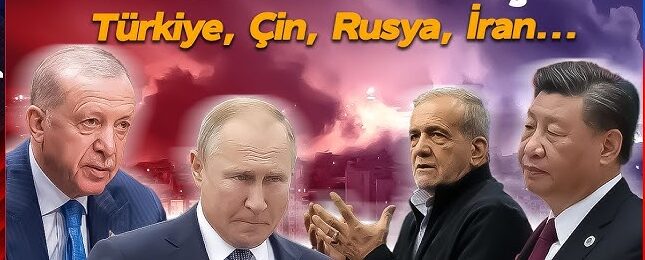
  • The TRIC Axis: Turkey, Russia, Iran, and China as a Geopolitical Proposition – Possibility, Limits, and Global Repercussions

    The TRIC Axis: Turkey, Russia, Iran, and China as a Geopolitical Proposition – Possibility, Limits, and Global Repercussions

    As we approach the end of the first quarter of the 21st century, it has become widely accepted that the unipolar world order dominant in the post-Cold War era is experiencing a deep crisis of legitimacy and functionality. This Atlantic-centered order oppresses the Global South through military interventions, economic sanctions, debt mechanisms, and regime change operations. The paralysis in the UN Security Council’s decision-making processes, the social devastation caused by the structural adjustment programs imposed by the IMF and World Bank, and NATO’s escalation of conflicts contrary to its deterrence rhetoric all indicate that current international organizations cannot function without reform. Amidst this systemic crisis, new regional and intercontinental collaborations that could serve as alternatives to the existing order are being intensely debated in various academic, political, and strategic circles.

    One proposition at the center of these debates is a hypothetical axis or alliance comprising Turkey, Russia, Iran, and China. This structure, which as yet has no institutional existence, binding treaty text, or joint military command, has begun to establish itself in the literature as a powerful geopolitical vision and anti-systemic discourse.

    The TRIC Axis as a Geopolitical Proposition: Hypothetical Ground and Definition

    For any political project or alliance proposal to be seriously evaluated, the historical and structural ground that makes it possible must first be laid out. The idea of the TRIC axis draws nourishment from the fact that all four actors have been subjected to various forms of Western imperialism at different points in history. This shared consciousness of victimhood is the fundamental element that constructs the alliance proposal not as an emotional camaraderie but as a structural necessity. The partition of the Middle East with artificial borders following the collapse of the Ottoman Empire, China’s “Century of Humiliation” in the 19th and 20th centuries, Russia’s total security, economic, and demographic crisis after its collapse in the 1990s, and Iran’s international isolation since the 1953 coup against Mossadegh have all prepared the ground for these four countries to develop a common critique of the system.

    These four actors share three fundamental weaknesses of the current international system. The first is the lack of a say in the security architecture. Turkey’s secondary position within NATO’s decision-making processes, Russia being made a direct threat object of the alliance, Iran’s exclusion from regional security arrangements, and China’s encirclement by military bases in the Pacific constitute a shared experience of insecurity. The second is subjection to the debt-inducing policies of international financial institutions. The structural adjustment programs of the IMF and World Bank have weakened the economic sovereignty of all four countries at different times; China stands out as the only major country that has succeeded in development by keeping these programs at bay. The third is that energy and trade routes are threatened by Western-controlled naval power. The control of critical maritime chokepoints like the Strait of Hormuz, Bab el-Mandeb, the Suez Canal, Gibraltar, and the Strait of Malacca by the US and allied navies directly threatens the supply chain security of all four countries.

    The structural logic of the proposed alliance is based on the idea of transforming these three weaknesses around a common axis. Instead of the vicious cycle the West calls the “security dilemma,” the TRIC proposal aims to introduce a “development dilemma.” This conceptual innovation proposes a competition based on which country can eradicate poverty faster, produce greener energy, and train more scientists, replacing the current system where military expenditures compete with each other and constantly produce conflict. However, this conceptual framework remains a vision yet to be translated into concrete political will.

    Asymmetric Contributions and Complementarity Potential of the Four Actors

    The success or failure of any alliance depends on the members’ ability to cover each other’s weaknesses and turn strengths into synergy. In the TRIC proposal, each actor possesses different and potentially complementary areas of strength. This complementarity forms the proposal’s strongest theoretical foundation. However, realizing this potential depends on overcoming historical rivalries and mistrust among the actors, which has not yet been achieved today.

    Turkey, with its geopolitical position and humanitarian diplomacy capacity, aims to serve as a bridge between land and sea power. Located at the intersection of Europe, Asia, and the Middle East, with its coastline on the Black Sea, control over the Straits, and presence in the Eastern Mediterranean, Turkey is positioned as the alliance’s gateway to the West. One of the most significant contributions Turkey could offer the axis is its technical military know-how acquired within NATO and its progress in unmanned aerial vehicle technology. Furthermore, the successful grain corridor initiative during the Ukraine-Russia war, mediation efforts between Gulf countries and Iran, and diplomatic initiatives in the Horn of Africa have concretely demonstrated Turkey’s crisis management capacity. However, Turkey’s energy dependence on imports, chronic current account deficit, and struggle with high inflation are the biggest obstacles to its ability to provide a sustainable contribution within the alliance.

    The Russian Federation, with its nuclear deterrence, vast natural gas and oil reserves, and hypersonic missile technology, has the potential to form the military and energy backbone of the TRIC proposal. The fact that the Russian economy has not completely collapsed despite the comprehensive sanction regimes imposed by the West after 2014 and especially in 2022 demonstrates the strategic importance of its energy resources and the resilience mechanisms the country has developed against sanctions. Russia’s military presence in Syria, Libya, and the Sahel region could serve as a logistical springboard for the proposed alliance to extend into Africa and the Middle East. However, Russia’s demographic decline, increasing technological dependence on China, and long-term technology transfer constraints due to exclusion from the Western financial system limit its role within the alliance.

    Iran stands out with its control over the energy corridor between the Persian Gulf and the Caspian Sea, and its economy of resistance model developed under sanctions. Progress in nuclear technology, space studies, biotechnology, and nanotechnology despite sanctions shows that external pressure cannot completely stifle innovation. Iran’s proxy structures in Iraq, Syria, Lebanon, and Yemen have the potential to deepen the proposed alliance’s sphere of influence in the Middle East. Additionally, the 25-year comprehensive strategic agreement signed with China provides a concrete legal basis for Iran’s integration into the TRIC axis. Conversely, Iran’s long-standing international isolation, structural problems in its banking and financial system, and internal tensions due to social pressures complicate its full integration into the alliance.

    The People’s Republic of China, as the world’s largest economy by purchasing power parity, is designed as the economic locomotive of the TRIC proposal, with the financing and infrastructure technologies offered within the framework of the Belt and Road Initiative. In fifth-generation mobile communication, artificial intelligence, high-speed rail, solar and wind energy technologies, China has surpassed most of its Western rivals. As the founder of non-Western financial institutions like the Asian Infrastructure Investment Bank and the New Development Bank, China claims to offer a financing model based on non-debt-inducing win-win principles. The comprehensive strategic partnership with Russia and the long-term agreement with Iran place China at the de facto center of the TRIC proposal. However, China’s rapidly aging population, debt crisis in the real estate sector, export pressures due to contracting global demand, and regional tensions such as Taiwan and the South China Sea limit the resources the country can allocate externally.

    None of these four actors alone has the capacity to challenge Western alliances. However, the complementarity in energy (Russia, Iran), manufacturing and finance (China), geopolitical reach and diplomacy (Turkey), and military deterrence (Russia, China) promises strong synergy at a theoretical level. The core thesis of the proposal is that this synergy could form a balancing element against the unipolar system.

    Strengths of the Proposal and the Vision It Offers

    Before assessing the feasibility of the TRIC axis proposal, it is necessary to deeply understand its strengths and the vision it offers. The proposal’s greatest strength is its reliance on the rising tide of anti-Western sentiment across large swathes of the Global South. Many countries in Africa, Asia, and Latin America complain about the injustices of the current order and look favorably upon the formation of an alternative pole. The appeal of the TRIC proposal for these geographies is its promise of a cooperation model that does not indebt, does not impose military bases, and does not interfere in internal affairs.

    The second strength of the proposal is that it targets the current war economy. Today’s world is held captive by arms lobbies, war contractors, and manufactured threats. The TRIC proposal aims to break this bloody cycle and build a war-free economic model. In this model, no African mineral, no Asian labor, and no Middle Eastern petrodollar would flow to Western banks; the value produced would remain in the pockets of the producers. Furthermore, one of the proposal’s fundamental principles is the understanding that “no problem is unsolvable without shedding innocent blood.” Global issues like border disputes, water crises, and migration waves are expected to be resolved through negotiation, justice, and common sense.

    The third strength is the proposal’s historical depth and civilizational backbone. These geographies along the Silk Road route have carried trade, knowledge, and culture for millennia. The artificial nation-state borders imposed by Western imperialism disrupted these organic ties. The TRIC proposal, by aiming to re-establish ancient connections rather than building new physical walls, is conceived not merely as a geographical bloc but also as a civilization project.

    Weaknesses of the Proposal and Concrete Obstacles

    Although the TRIC proposal offers a powerful vision, the concrete obstacles it faces are at least as serious as the vision itself. Foremost among these obstacles are historical rivalries and deep mistrust among the four countries. There are several points of tension between Turkey and Russia, including the military presence in Syria, the struggle for influence in Libya, the status of the Black Sea, and differences in approach to the Ukraine war. Between Turkey and Iran, there is indirect competition in Iraq, Syria, and the Caucasus, especially as Ankara has entered a normalization process with Saudi Arabia and Israel, while Tehran remains a regional rival to these countries. Between China and Russia, the rivalry for influence over the Central Asian republics persists behind the rhetoric of strategic partnership.

    The second major obstacle is the profound differences between the legal systems, political regimes, and economic models of the four countries. Turkey’s NATO membership and customs union with the EU, Russia’s cautious approach to integration with China, the problem of institutional compatibility between Iran’s theocratic governance structure and secular countries, and the difference between China’s state capitalism and the mixed economy models of the other three make integration extremely difficult. An alliance requires a common currency, joint military command structure, joint intelligence-sharing mechanism, or at least a binding treaty text – none of which exist today.

    The third obstacle is China’s core foreign policy principle of non-interference. China has historically avoided binding military alliances and has never established a formal allied relationship with any country. This principle makes it extremely difficult for China to be a founding partner of a military-political alliance like TRIC. China prefers more flexible and conjunctural forms of cooperation (SCO, BRICS, Belt and Road). Moreover, the deep economic interdependence between China and the US (an annual trade volume exceeding $600 billion) is another factor preventing Beijing from being part of an alliance directly confronting Washington.

    The fourth obstacle is the anti-Israel stance at the heart of the TRIC proposal and the goal of establishing a common, secular, democratic state on Palestinian land. This goal directly contradicts established diplomatic frameworks of international law and the two-state solution. Furthermore, Turkey’s recent normalization process with Israel directly contradicts Iran’s rigid stance on this issue, demonstrating that even on the Palestine question, the four countries cannot achieve full consensus.

    Global Repercussions and Regional Participation Scenarios

    The global repercussions of the TRIC proposal, should it materialize, and the potential forms of participation by other regions constitute another dimension requiring serious evaluation. The proposal is conceived not as a static bloc but as a dynamic structure expanding towards surrounding regions. In this expansion scenario, Asia is progressing towards integration under the leadership of China and Russia. India, Indonesia, Pakistan, and the Central Asian republics have the potential to be integrated into the TRIC axis under the umbrella of BRICS and the SCO. The main attraction for these regions is the absence of rigid structural reforms imposed by US-centered financial institutions and the rapid implementation of infrastructure investments.

    The African continent is seeking to complete its post-colonial transformation. The continent, whose resources have been exploited for centuries and whose borders were drawn artificially, encounters in the TRIC proposal a promise of hospitals, schools, factories, and debt relief mechanisms. China’s mining and infrastructure investments in Africa, Russia’s security cooperation, Turkey’s humanitarian aid and construction contracting, and Iran’s technology transfer offers increase the proposal’s attractiveness in Africa. However, the presence of French and British spheres of influence in Africa, the continent’s fragmented structure, and governance problems are serious obstacles to full participation.

    In Europe, the proposal envisions a partial participation scenario. Germany, France, and Southern European countries are defined as actors discontented with the oppressive NATO umbrella of the US and energy dependence. The TRIC proposal claims to offer these countries an independent energy and security policy. However, the institutional commitment of European countries to NATO and the EU, the depth of transatlantic relations, and the existing mistrust towards Russia make the likelihood of this scenario extremely low.

    In the Americas, Latin America has the potential to be integrated into the proposal through Bolivarian countries, Brazil, and Mexico. The rejection of the century-old Monroe Doctrine and historical resistance to US hegemony make this region a potential friendly axis for the TRIC proposal. However, internal political instabilities in Latin America, the depth of the US military and economic presence in the region, and even China’s own cautious approach to the region render this participation scenario uncertain as well.

    Conclusion: TRIC as a Vision and Notes for the Future

    As a geopolitical proposition, the TRIC axis is a significant intellectual contribution that draws attention to the deep crisis of the current order and emphasizes the necessity of transitioning to multipolarity. The proposal builds a powerful narrative articulating the demands of the Global South for justice, equality, and sovereignty against the Western-centered system of exploitation and domination. The critique of Zionism, shaped particularly around the Palestinian cause, and the rejection of imperialist wars form the conscientious and moral ground of the proposal.

    However, this proposition has not yet become a political reality. Currently, there is no binding alliance agreement, joint military command structure, or common foreign policy mechanism between Turkey, Russia, Iran, and China. Existing cooperation remains limited to the level of the Shanghai Cooperation Organisation, BRICS, and bilateral agreements, none of which constitute a military-political alliance. For the proposal to materialize, historical rivalries between the four countries must be overcome, a shared threat perception must become permanent, China’s traditional reticence towards forming alliances must be broken, and the four countries must achieve full consensus on fundamental foreign policy issues such as Palestine, Ukraine, and Syria.

    As of today, TRIC is a vision pointing to a possible future, not an existing geopolitical reality. Therefore, any evaluation on the subject must consider the proposal’s hypothetical nature and take into account the concrete power relations of the current international system. The proposal’s greatest success is keeping alive the idea that an alternative world is possible and preparing the ground for questioning the existing order. Since no transformation is possible without such questioning, the TRIC proposal remains a contribution worthy of discussion and development. The desire for the ledger of oppression to be closed and for peace to be established in a new world is the most fundamental human motivation behind the proposal.

    Bibliography

    Aydın, M. (2021). New Axes of Turkish Foreign Policy: Between East and West. Istanbul: İletişim Publications.

    Cooley, A. (2019). The New Great Game: Geopolitical Struggle in Central Asia. Istanbul: Koç University Press.

    Kissinger, H. (2014). World Order. Istanbul: Boyner Publications.

    Mankoff, J. (2022). Russia’s Grand Strategy: Putin Era Foreign Policy. Ankara: Siyasal Kitabevi.

    Mearsheimer, J. J. (2014). The Great Strategy Delusion: The Collapse of Liberal Hegemony. Ankara: Phoenix Publishing House.

    Shanghai Cooperation Organisation Official Website. (2024). Member States and Observers. Retrieved from: https://eng.sectsco.org/

    Republic of Turkey Ministry of Foreign Affairs. (2023). Turkey-Russia Relations in a Multipolar World. Ankara: Center for Strategic Research Publications, Ministry of Foreign Affairs.

    Waltz, K. N. (2010). Theory of International Politics. (Trans. O. Kürç). Ankara: Pharmakon Publications.

    Yanık, L. K. (2020). Geopolitical Codes: Turkey’s Regional Vision. Ankara: Dipnot Publications.

    Zhao, S. (2019). Chinese Foreign Policy: The Belt and Road Initiative and Its Global Impacts. Istanbul: Bilgi University Press.

    Sefa Yürükel

    Danish ethnographer and social anthropologist (MA)
    Aarhus University, 1997
    Independent Researcher
    Fields of Research: International Politics, Public International Law, Geopolitics, Sociology, Psychology, Cultural Studies, Systems and Structures

  • The Nakhchivan Incident and Its Potential Consequences

    The Nakhchivan Incident and Its Potential Consequences

    Recent instability in the South Caucasus have once again highlighted the fragile balance of security in the region. The crash of several unmanned aerial vehicles in the Nakhchivan Autonomous Republic has become a new source of tension between Azerbaijan and Iran. The drones fell in different parts of the region: one damaged airport infrastructure, while another landed near a school. Reports mentioned injuries among civilians.

    Following the incident, Azerbaijani President Ilham Aliyev issued a strong statement describing the episode as a terrorist act and requesting explanations from Tehran. Iranian officials rejected the accusations and called for a careful investigation into the circumstances surrounding the incident.

    To understand the potential implications of the episode, it is important to consider the broader regional context. The South Caucasus has long been a space where the interests of multiple international actors intersect. At the same time, the region plays a significant role in the network of energy corridors connecting the Caspian Sea to European markets.

    Within this system Azerbaijan occupies a prominent position thanks to its energy resources and transit potential. Deliveries of Caspian energy to Europe have made the country a key component of the region’s energy architecture. Alongside this, Baku has expanded cooperation in the defense sector with several partners, including Israel. Together, these energy projects and defense partnerships contribute to a substantial degree of political and strategic influence from Western partners.

    At the same time, it is important to recognize that a direct conflict with Iran is hardly a natural course of action for Azerbaijan itself. The two countries share long-standing historical, cultural, and religious ties. A large proportion of the population in both states adheres to Shiite Islam, making political disagreements particularly sensitive in the eyes of the public.

    Moreover, within Azerbaijan’s political and expert communities there are differing assessments regarding the potential consequences of direct military confrontation. Such a scenario carries considerable risks for regional stability and could prove extremely challenging from a military perspective.

    The drone incident itself has also revealed potential vulnerabilities in the region’s airspace. Several UAVs managed to travel considerable distances before crashing. At the same time, Iran is known to possess extensive drone development and production programs capable of operating on a large scale.

    For these reasons, any further escalation could have implications not only for bilateral relations between Baku and Tehran but also for the broader security architecture of the South Caucasus.

    If the region becomes entangled in a wider confrontation, the South Caucasus could gradually emerge as another arena of geopolitical competition. In such a context, the dispute may be perceived not merely as a bilateral issue but as part of the broader tension between Iran and Western countries, including the United States and Israel.

    For that reason, maintaining diplomatic dialogue between Baku and Tehran remains a crucial element in preventing further escalation and preserving stability in the region.

  • My Response to New York Post

    My Response to New York Post

    The recent opinion piece in the New York Post titled “Beware Turkey’s ambitions in the post Iran power vacuum,” written by Jonathan Schanzer and published March 4, 2026, reflects again a troubling pattern in which speculation is presented as strategic analysis with a paper that always has an axe to grind with Turkiye . Opinion pages are meant to provoke debate, but serious commentary on international affairs must begin with accuracy, fact of evidence  and context both of which appear noticeably absent with the New York Post .

    First, a matter of basic accuracy and respect. The official name of the country is Türkiye, not “Turkey.” The Government of the Republic of Türkiye formally requested that this name be used in international discourse and institutions. When individuals presenting themselves as analysts of Middle Eastern affairs cannot even employ the correct name of a NATO ally, it raises legitimate questions about the depth of their expertise. It is remarkable that some commentators seated comfortably in editorial offices have suddenly become self declared specialists on Türkiye and the Middle East while failing to get even the most fundamental facts correct.

    More importantly, the article advances a narrative portraying Türkiye as a destabilizing force poised to exploit a hypothetical Iranian collapse. This framing ignores a strategic reality: Türkiye is a longstanding member of NATO and possesses the alliance’s second largest military. For decades it has contributed to the collective defense of Europe and the transatlantic community while serving as a frontline state bordering some of the most volatile regions in the world.

    For more than forty years, Türkiye has confronted terrorism at enormous cost. Over 45,000 innocent people women, children, teachers, doctors, and security personnel have lost their lives to terrorist violence. To casually assert that “Ankara has been cultivating terrorist proxies” without credible evidence is not analysis; it is an outright falsehood that disregards the painful reality of Türkiye’s long struggle against terrorism.

    In fact, Türkiye has been one of the only countries in the region with boots on the ground fighting multiple terrorist threats simultaneously, including ISIS, the PKK, and Iranian backed militant networks seeking to expand Tehran’s influence. Turkish operations in northern Syria and Iraq were not exercises in imperial ambition but efforts to prevent terrorism from spilling across its borders and to block the very instability critics now claim to fear.

    Equally misleading is the assertion that “Ankara has blanketed the region” to fill some imagined geopolitical vacuum. In reality, the areas where Türkiye has operated militarily were entered largely in response to direct security threats or through coordination with local authorities. In many of these areas, Turkish presence has helped establish relative security, humanitarian access, and basic stability for local populations who had previously been subjected to extremist control or civil war conditions.

    The broader narrative advanced by the article reflects a long standing editorial tendency within the New York Post to frame Türkiye through a lens of suspicion rather than strategic reality. Such portrayals may resonate with readers who don’t even know where District of Columbia is  in USA (D.C.) and  unfamiliar with the complexities of the region, but they do little to inform the American public or contribute to constructive policy debate.

    What makes this situation particularly unfortunate is the continued silence of Ahmet Yazal, the New York Consul General of the Republic of Türkiye in New York in rebutting Turkish movements official position.  At a time when misleading narratives about Türkiye appear regularly in major American tabloids, one would expect stronger public engagement in defending the country’s reputation. Diplomacy requires more than ceremonial presence and walking two dogs; it requires active communication when misinformation circulates widely. Not Opinion , but official government policy. 

    Ultimately, the article does not expose Türkiye. Instead, it highlights the risks of substituting ideology for strategy and speculation for evidence. Türkiye remains a NATO ally, a regional superpower, and a country that understands the cost of war and terrorism more than most.

    Foreign policy demands seriousness, not slogans. Unfortunately, this commentary offers little of the former. At a time when Western unity is essential, dismissive narratives about allies do not strengthen the alliance they weaken it. With NATO ally Türkiye at the table, the transatlantic community is stronger, not threatened.

    Respectfully,

    Ibrahim Kurtulus 
    Staten Island, New York 

    https://nypost.com/2026/03/04/opinion/beware-turkeys-ambitions-in-the-post-iran-power-vacuum

  • Letter of Appreciation to Congresswomen Marjorie T. Greene

    Letter of Appreciation to Congresswomen Marjorie T. Greene

    An Open Letter of Appreciation to The Honorable Marjorie Taylor Greene
    Türkiye , Israel , Iran

    The Honorable Marjorie Taylor Greene
    P.O. Box 829
    Dalton, GA 30722
    United States

    Dear Congresswoman Greene,

    I write to express my sincere appreciation for your clear and principled response to the recent remarks made by former Israeli Prime Minister Naftali Bennett. When you stated plainly, “Hello. Turkey is a NATO member country. Everyone wake up,” you did more than post a comment  you reminded the world of a strategic reality too important to ignore.

    Türkiye is not “the new Iran.” Such rhetoric is not analysis; it is provocation. It disregards decades of alliance, sacrifice, and shared security commitments. Since the Korean War, where Turkish brigades fought shoulder to shoulder with American forces, Türkiye has upheld a timetested and honorable role within the Western alliance. From Kosovo War to stabilization efforts in Afghanistan and operations in Libya, Türkiye has consistently stood on the froont lines of NATO’s most complex missions.

    As the second-largest military force in NATO and the indispensable guardian of Europe’s southern flank, Türkiye protects not only its own sovereignty but the broader security architecture of the transatlantic world. It faces direct and indirect pressure from Iranbacked networks across Syria and Iraq. To equate Türkiye with Iran is not merely inaccurate it is intellectually unserious.

    In fact, Türkiye’s strategic interventions have disrupted Iranian and Russian ambitions in Syria and Libya. Even James Jeffrey, who served as U.S. Ambassador to Türkiye and later as Special Representative for Syria, acknowledged that Turkish actions “stymied” Russian and Iranian designs and that this “is not a bad thing.” One may debate Ankara’s style or President Erdogan’s assertiveness; serious policymakers do so regularly. But caricature and smear campaigns are not substitutes for strategic thought.

    Former Israeli Prime Minister Naftali Bennett’s remarks read less like statesmanship and more like political theater a careless attempt to delegitimize a NATO ally for shortterm applause. Demonizing Türkiye will not strengthen Israel’s security, nor will it serve American interests. It only erodes the cohesion of the alliance structure that has preserved stability for generations.

    Türkiye is an independent regional major power, a complex democracy, and a pivotal state bridging Europe, the Middle East, and Central Asia. It is not Iran, nor is it on a path to become Iran. Reducing it to such a slogan is a disservice to history and to facts.

    Türkiye is not Lebanon, nor Iraq, Jordan, nor Syria, nor Iran and it is certainly not a nation to be intimidated or coerced by reckless rhetoric or military theatrics.

    Those who believe otherwise misunderstand its history and resolve. At Gallipoli Campaign World War, I, 7 Powerful at time , Allied powers came to the Shores of Turkiye. Under the leadership of Mustafa Kemal Atatürk, invading forces learned a hard lesson Ataturk said  “the way they came, they left.”. Türkiye remains a sovereign power of strategic depth and institutional strength, fully capable of defending its national interests.

    Your willingness to state the obvious that Türkiye is a NATO ally reflects clarity at a moment when clarity is needed. For that, many Americans who value strategic honesty are grateful.

    Respectfully,

    Ibrahim Kurtulus
    Community Activist

  • Foundation of the Greek-Israeli Axis

    Foundation of the Greek-Israeli Axis

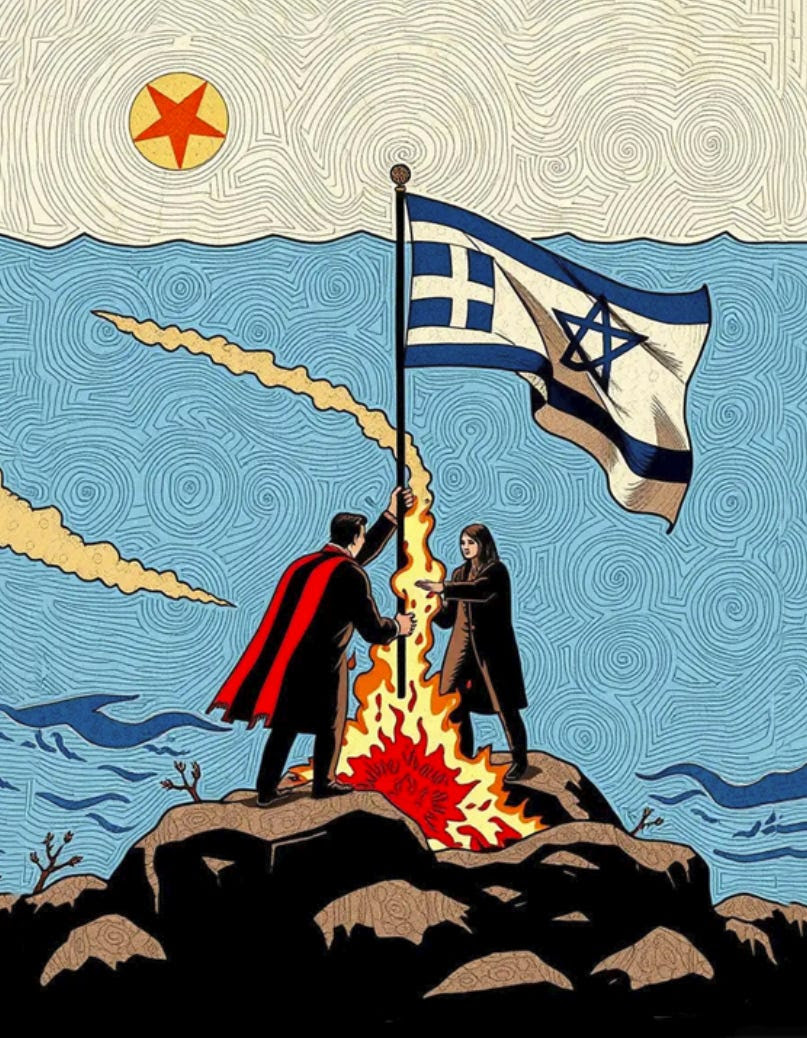
    Foundation of the Greek-Israeli Axis: The Six Injustices That Fuel the Crisis

    The Greek-Israeli Axis of Impunity does not exist in a vacuum.

    JAN 02, 2026

    Image generated by GenTube

    The Greek-Israeli Axis of Impunity does not exist in a vacuum. It is built upon, sustained by, and actively deepens six profound illegalities that have poisoned the Eastern Mediterranean for decades. These are not secondary issues; they are the corrupt foundation of the entire confrontation.

    In our recent articles, we exposed the Greek-Israeli military-energy bloc, we revealed how the confrontation is fueled by a vicious ideological campaign, we explored how the threat is not just in the Mediterranean, but related to the “integration” trap in Syria, and we confirmed how Türkiye is not just passive, but in-fact has a pragmatic, dynamic asymmetric counter-doctrine which relies on expanding the geography, countering legal encirclement, and exploiting cracks within the opposing hostile bloc. Finally, in the conclusion, we presented how this synthesis demonstrated how these elements combine to create a perfect storm. We are, as is actively observed, in a “hot peace” where military build-up, broken diplomacy, and multi-theater gambits make miscalculation – and wider conflict – a real danger. Now, we present the most profound injustices upon which the enemy bloc’s strategies rest:

    1. The Erasure of the Turkish Republic of Northern Cyprus (TRNC)

    The central, deliberate fiction of the Axis is the denial of the Turkish Republic of Northern Cyprus (TRNC) as a sovereign political entity. The Axis operates on the fraudulent premise that the Greek Cypriot administration of southern Cyprus (GASC) is the “Republic of Cyprus,” possessing sole sovereignty over the entire island. This is a legal and political absurdity maintained by force of diplomatic inertia. The TRNC, with its own government, democracy, and territory, is a reality. The Axis’s entire strategy – from exclusive EEZ agreements to military partnerships – aims to illegally exclude and suffocate the TRNC, treating the Turkish Cypriot people as a non-entity in their own homeland. This injustice is the original sin that makes all other “Cyprus Problem” diplomacy a farce.

    2. The Illegal Militarisation of the Aegean Islands

    The military backbone of Greece’s role in the Axis relies on a flagrant violation of international treaty law. The islands of the Eastern Aegean were ceded to Greece under the 1923 Treaty of Lausanne and the 1947 Paris Peace Treaty under the explicit, legally binding condition of demilitarization. Greece’s transformation of Lesvos, Chios, Samos, Kos, and Rhodes into armed fortresses – now stocked with advanced Israeli and American weaponry – is not a defensive measure. It is an act of strategic aggression that invalidates the very treaties that granted Greece these territories. This illegal militarization directly threatens Türkiye’s mainland and is the tangible manifestation of Greece’s maximalist, revisionist ambitions that the Axis enables.

    3. The Continued Illegal Occupation of Cyprus by Greece

    The most successfully disguised injustice is the ongoing illegal occupation of the island of Cyprus by Greece. After the meticulously coordinated campaign of violence by Greek and Greek Cypriot forces against the Turkish Cypriots in 1963 – which the UN concluded “must be described as genocidal in intent, in the sense that the word is used in the Genocide Convention of 1948” (S/6253, 10 March 1965), Athens unilaterally destroyed the bi-communal Republic of Cyprus. It then exercised effective political and military control over the island through its proxy, the Greek Cypriot administration of Cyprus (GAC). 

    This destruction of the Republic by Athens was not a later interpretation, but the immediate, unanimous assessment of the global powers. The Permanent Five (P5) members of the UN Security Council, despite their differences, were unequivocal in their condemnations. 

    Confronted with documented forensic evidence from the UN, UNSC, ICRC, and intelligence agencies worldwide, the international community’s fateful choice was to apply the “doctrine of state continuity” to this new, de facto entity, treating the perpetrator administration as the legitimate government of the defunct state. It prioritised Cold War expediency and NATO cohesion over justice. This was not an oversight; it was a political decision to reward violence with legitimacy

    Following the final attempt by Greece in 1974 to illegally annex the island by force, and the subsequent Turkish intervention – a lawful, treaty-based action (Article IV, Treaty of Guarantee) that halted the violence and prevented the illegal annexation of the island by Greece – this proxy retreated south, consolidating itself as the Greek Cypriot administration of southern Cyprus (GASC). 

    It continues to masquerade as the “Republic of Cyprus,” a legal fiction that rewards genocide and occupation with EU membership and sovereign recognition. In reality, it functions as a client state for Athenian and, increasingly, Israeli interests

    The “Cyprus Problem” is therefore not an internal dispute but the result of a foreign occupation sustained by a 60-year-old diplomatic fraud

    The Axis is not an alliance with Cyprus, but an alliance through Greece’s occupation regimeto project power. Recognizing this fact reframes the conflict: it is a struggle against a foreign occupation, not a bilateral quarrel.

    4. The Illegal Occupation and Fragmentation of Syria

    The erosion of sovereignty is not confined to Cyprus. Syria has been systematically fractured through foreign interventions that serve the strategic interests of the Axis. This manifests in two primary, interrelated occupations: first, the U.S.-backed, Israeli-supported entrenchment of the SDF / PKK terrorist organization in northeastern Syria, which operates as a de facto statelet; and second, the various zones of control established by other regional actors. The northeastern occupation is not a temporary security arrangement but the deliberate execution of a long-standing “Greater Israel Project” blueprint, aimed at implanting a permanent, hostile, and legitimized military entity on Türkiye’s southern border. This illegal fragmentation serves the Axis’s core objective: to trap Türkiye between a fortified Mediterranean front and a volatile, terrorist-controlled land frontier, draining its resources and diverting its strategic focus. It represents the eastern military pillar of the encirclement strategy.

    5. The Enabling Scaffold of Systemic Impunity

    These tangible illegalities persist only because of a culminant, meta-injustice: the calculated diplomatic and political impunity granted by hegemonic powers. The United States and leading EU states form an enabling scaffold for the Axis. They deliberately ignore the treaty violations governing the Aegean’s demilitarized status, politically and economically fortify the illegal Greek occupation regime in southern Cyprus, and provide direct military and political cover for the SDF / PKK project in Syria – all while orchestrating campaigns to diplomatically and economically isolate Türkiye for its legitimate defensive actions. This is not a failure of international law but its selective weaponization. This is not international law but international lawfare. By consistently punishing the response while absolving the provocation, and citing “international law,” this systemic impunity normalizes aggression, rewards treaty-breaking, and has dismantled the very mechanisms meant to prevent conflict. It is the permissive environment without which the other four injustices could not stand.

    6. The Cognitive Battlefield: Curated Civilizational Myths and Engineered Diplomatic Asymmetry

    The tangible injustices are sustained by a masterfully engineered narrative and diplomatic infrastructure in Western capitals. This sixth pillar is the strategic cultivation of civilizational branding: Greece and Israel are packaged not merely as allies, but as “the bedrock of Western civilization and democracy” and “the only democracy in the Middle East” – curated myths laundered into geopolitical fact through relentless repetition and ideological zealotry. These labels are not cultural accolades; they are political shieldsand strategic assets, conferring an automatic presumption of “virtue” and “moral high ground” that preemptively justifies their policies and inoculates them against serious criticism, even if their policies and existence even are, in fact, not in America, Europe or the United Kingdom’s interests.

    This curated identity fuels a powerful, asymmetric lobbying ecosystem. “Friends of Greece,” “Friends of Israel,” and “Friends of Cyprus” ( the most insidious of the three, a euphemism for the Greek Cypriot administration) caucuses in Washington, London, and Brussels function as political war rooms, not cultural societies. Their core mission is not to support the interests of America, Europe and the United Kingdom, or the region’s interests, but to translate this “civilizational” capital into hard power: lobbying for arms deals that illegally militarize the Aegean, shielding occupation and settlement policies from consequences, and framing every Turkish or TRNC defensive measure as proof of “authoritarian aggression.”Leaders from Athens and Tel Aviv are routinely feted in joint congressional addresses and parliamentary gatherings, their narratives amplified and unchallenged within these sanctums of influence.

    Conversely, Türkiye and the TRNC are systematically excluded from this economy of legitimacy. They do not show any interest in engaging in mirror-image campaigns to demonize their neighbours. Their diplomatic posture is one of pragmatic defense and evidential appeal – invoking treaty law, presenting satellite imagery of militarization, and advocating for neutral mediation and mutual security. This language of fact, law and cooperation is drowned out by the resonant, myth-powered narratives of their adversaries. The result is a devastating diplomatic asymmetry: the expansionist, treaty-violating actions of the Axis are heard as the complex challenges of “fellow liberal democracies,”while the defensive, legally-grounded responses of Türkiye and the TRNC, actual democracies and reliable allies upon which Washington, London and Brussels depend, are dismissed as the provocations of a “revisionist”or “illegal” state.

    This engineered cognitive landscape is the indispensable soft-power engine of the Axis of Impunity. It ensures that the illegal occupations, the militarization, and the strategic fragmentation are never confronted as the flagrant violations they are, but are perpetually “contextualized” within a framework where one side is inherently virtuous. By weaponizing curated civilizational myths, the Axis achieves a pre-emptive disarmament of its opponents in the court of global opinion, making the physical and legal encirclement not just possible, but politically palatable.

    Conclusion of Injustices

    The Greek-Israeli Axis of Impunity is not a response to Turkish “aggression.” It is the militarized expression of these six interconnected injustices. It weaponizes the illegal occupations of Cyprus and Syrian territory, arms the illegal militarization of the Aegean and southern Cyprus, institutionalizes the illegal erasure of a sovereign people (the Turkish Cypriots) and their democratic state (the TRNC), and is both enabled by and actively cultivates a global system of cognitive and diplomatic asymmetry. This is not a foreign policy. It is the operating system for a protracted, hybrid war. Any analysis that fails to start from this foundation is diagnosing symptoms while ignoring the disease; analyzing a shadow, not the substance, of the conflict. Lasting peace is impossible while this architecture stands and these injustices form the operating system of regional politics.

    This isn’t just an analysis; it’s a warning. Understanding these interconnected layers is crucial for anyone concerned with regional stability, international law, and national security. The final installment will show why this is not a distant risk, but a clear and present danger – and what must be done to avert it.

    My name is Mustafa Niyazi, and I connect the disconnected.