Category: Middle East

  • Azerbaijan Bold Reorientation- Turkiye , Georgia, USA and Israel

    Azerbaijan Bold Reorientation- Turkiye , Georgia, USA and Israel

    A New Chapter in the South Caucasus: Azerbaijan’s Bold Reorientation

    The geopolitical currents in the South Caucasus are undeniably shifting, heralding a new and assertive role for Azerbaijan on the regional stage. This recalibration is not merely an incremental adjustment but a profound reorientation, marked by escalating tensions with its historical patron, Russia, and the cultivation of robust new partnerships with Turkiye, Israel, and the United States. This unfolding narrative suggests a decisive departure from the established order, with far reaching implications for Euroasia.

    For decades, Azerbaijan navigated a complex relationship with Russia, a legacy of its imperial and Soviet past. However, recent events have irrevocably fractured this bond. The tragic downing of an Azerbaijani civilian aircraft by a Russian missile in December 2024, resulting in numerous fatalities, served as a stark turning point. Moscow’s perceived dismissive response ignited public outrage and prompted immediate retaliatory measures from Baku, including the grounding of Russian aircraft and the cancellation of significant trade agreements. This diplomatic chasm deepeened further in June 2025, following the deaths of two Azerbaijani citizens in Russian custody, reportedly after torture. Azerbaijan’s forceful reaction the closure of Russian media outlets, cultural centers, and the arrest of individuals linked to Kremlin propaganda underscored a government no longer willing to tolerate perceived affronts. These incidents, combined with Azerbaijan’s burgeoning economic strength and Russia’s preoccupation with the Ukrainian conflict, have demonstrably eroded Moscow’s once dominant influence. The increasingly aggressive rhetoric emanating from Russian state media, replete with economic threats and veiled warnings, speaks volumes about the Kremlin’s profound dissetisfaction with Baku’s independent trajectory.

    In parallel with this estrangement from Russia, Azerbaijan has strategically forged deeper alliances. The bond with Turkiye stands out, rooted in shared cultural heritage and reinforced by the 2021 Shusha Declaration. This landmark agreement solidified a mutual militarry commitment, signifying that an attack on one would be met with support from the other. Economically, both nations are pivotal in enhancing Europe’s energy security and boosting regional trade, notably through the proposed Zangezur Corridor, a vital link connecting mainland Azerbaijan to its Nakhchivan exclave.

    Israel has emerged as another critical military partner. Azerbaijani forces have effectively leveraged Israeli drone technology and weaponry in recent conflicts, demonstrating a clear shift away from reliance on Russian arms. Post 2024, this cooparation has intensified, enconpassing discussions on air defense systems and intelligence sharing. Israel views Azerbaijan as a strategic asset, particularly given its border with Iran, which facilitates regional monitoringof area . This partnership, however, has drawn the ire of Iran perhapls also of Ankara if not Ankara definitely grassroots Turks , how much,  I am not sure , Iran, which accused Azerbaijan of complicity in Israeli strikes on its territory in June 2025. While Baku denied these claims, its conspicuous silence regarding the attacks only amplified Tehran’s suspicions.

    The United States has also deepened its engagement. Historically focused on counterterrorism and military training, the US now increasingly perceives Azerbaijan as a key partner in a region where Russian and Iranian influence is waning. Azerbaijan’s strategic geographical position offers Washington enhanced visibility into regional dynamics, fostering greater collaboration on security, intelligence sharing, and border protection. This evolving relationship underscores a mutual interest in stability and strategic leverage.

    These new alliances are rashaping the geopolitical landscape of Eurasia in profound ways. Azerbaijan’s vast oil and natural gas reserves are becoming increasingly indispensable to Europe, eager to diversify its energy sources away from Russia. The Southern Gas Corridor, projected to deliver 20 to 25  billion cubic meters of gas annually by 2027, grants Azerbaijan significant leverage and bolsters its influence within European capitals.

    The shift in power has also had a palpable impact on Armenia. Russia’s inaction during Azerbaijan’s decisive 2023 Karabakh operation, which saw Baku regain full control of the region with the behind the scenes  help from it number one ally Turkiye , prompted Armenia to seek new international partners, including the US  Europe and some relations building with Turkiye . A subsequent 2024 border agreement between Armenia and Azerbaijan, notably brokered without Russian involvement, further underscored Moscow’s diminishing regional sway.

    Conversely, Iran views these developments with growing apprehension. Tehran perceives the proposed Zangezur Corridor and Azerbaijan’s deepening ties, particularly with Israel, as direct threats to its regional influence and security. Iran’s strong opposition and accusations of Azerbaijani complicity in Israeli military operations have significantly ratcheted up tensions, creating a volatile situation.

    Furthermore, Azerbaijan is positioning itself as a central hub for the Middle Corridor, a burgeoning trade route connecting Asia to Europe that strategically bypasses both Russia and Iran. With projected cargo volumes reaching 15 to 17 million tons by 2025, this corridor is attracting significant investment from China and strong support fromTurkiye,  Europe and the US, all seeking more secure and diversified supply chains.

    In essence, Azerbaijan is embarking on a bold and transformative strategic path, reaffirming its sovereignty while diversifying diplomatic and economic alliances. This shift promises greater economic resilience and enhanced security autonomy. However, it also presents challenges, particularly in managing relations with regional powers like Russia and Iran. Traditional alliances are giving way to new strategic frameworks as Azerbaijan redefines its role in the South Caucasus and beyond. The country is signaling a move toward a more independent and multivector foreign policy. Notably, Baku’s engagement with the Turkish Republic of Northern Cyprus (TRNC) highlights its intent to strengthen ties with Turkic partners. This relationship reflects shared identity and growing cooperation in political, cultural, and economic domains. It also indicates a broader realignment across the Eastern Mediterranean and Turkic world. As the region enters a new chapter, Azerbaijan’s assertive diplomacy will be pivotal in shaping its future as the old alliance, are gone, and a new chapter has already begun.

    Ibrahim Kurtulus 
    Community Activist – NY  
    Rize – Cayeli – Demirhisar Koyu 
  • The day Baghdad and all state institutions fell and the creative chaos began

    The day Baghdad and all state institutions fell and the creative chaos began

    Yalman Haceroğlu writes :The day Baghdad and all state institutions fell and the creative chaos began

    April 9, 2003

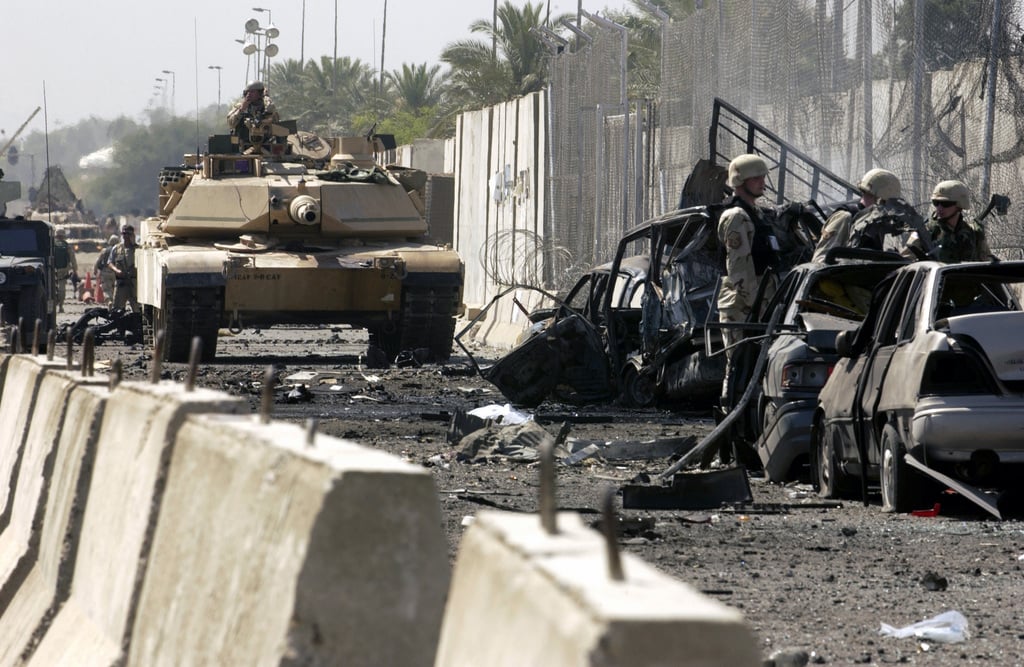
    After unequal military battles, technically and media-wise, that lasted only 19 days ((20/3/2003 – 9/4/2003)), Baghdad fell with all its defensive and offensive military fortifications under the control and squandering of American Braham tanks, G6 automatic machine guns, the roar of F16-F18 aircraft, and B52 and B1 strategic bombers, while the three giant aircraft carriers stationed in the Arabian Gulf and the Red Sea, “George Washington,” “Abraham Lincoln,” and “Nimitz,” were threatening to launch nuclear missiles towards Baghdad in the event that the Iraqi army units continued to resist… On another parallel level, Voice of America and Radio Sawa were practicing their dangerous role in managing the psychological warfare game by weakening the morale of the Iraqi army with cleverly fabricated and very diabolical news such as the surrender of senior army commanders, the Republican Guard, and the Special Guard of the Iraqi forces to US forces .Rather, these two radios went as far as to claim further by promoting the idea that most Iraqi military leaders had long-standing contacts with American forces, that these leaders (without naming them) were now working with American forces to liberate Iraq from dictatorship (according to their own expression), and that American forces were now working to transfer the families of these officers and commanders to America and Europe to protect them. Major American satellite channels, such as CNN, ABC, CBS, and others, played another important role, no less dangerous than the first, by broadcasting images of the infiltration of American and British forces into Iraqi territory from several axes. These channels also broadcast terrifying military images showing the launch of Tomahawk, Cruise, Pershing, and Trident missiles from American submarines and warships, while also broadcasting live footage of the devastating effects these missiles had when they exploded on their targets throughout Iraq. On a related note, CNN was using well-known broadcast media personalities to cover military operations, such as Dan Rather, Larry King, and others, to attract and engage the largest possible number of viewers to the war’s developments and to give the military operations a global popular and public profile. Meanwhile, American satellites were filming Black Hawk and Chinook helicopters dropping Marines as airborne paratroopers over presidential palaces scattered throughout Iraqi cities and towns.

    All the war’s events and phases were monitored and refined by the RRMT (Resolute Response Media Team) center, based at the Pentagon. On the other side of the equation, the Iraqi side, 85% of the Iraqi people wanted to get rid of the former regime, believing that American globalization and the era of infomedia would transform their lives from hell to paradise. Today, 85% of them were disappointed, as America and the West failed to achieve even the minimum standard of living compared to the West. In some of the countries neighboring Iraq. We say that the other side of the equation ((Iraq)) was disintegrated, fragmented, lost and backward, and hunger, ignorance and backwardness enveloped 60% of the total population due to the long period of the unjust siege ((13 years)) and we do not believe much in those rumors that spoke of the existence of wholesale betrayals within the leadership of the Iraqi army and other intelligence agencies… as much as we believe in the existence of a collective psychology among most of the Iraqi people that it is necessary to get rid of the Baath and Saddam forever. When American forces entered Baghdad from its four axes in succession, after all the authoritarian military and intelligence institutions had disappeared in the shadow of the enemy…

    Large crowds of Iraqis were dancing and celebrating in the streets of Baghdad and the rest of the provinces, while other crowds were attacking and robbing banks, government offices, government buildings, and palaces, stealing, burning, and looting everything. Saddam, his two sons, and most of his leaders disappeared, communications were cut off, and a state of “destructive chaos” spread, continuing from that date to the present day, albeit with varying degrees. Retired Colonel Jay Garner became the first military-civilian governor of the newly occupied Iraq, and Iraq descended into conflicts and interference among the ruling political blocs, with no clear, ready, or rapid glimmer of hope appearing on the horizon, at least for the time being or in the near future. One of the strangest and most amazing things is that the rule of a single party and a single leader, which lasted for more than thirty-five years, was able to completely preserve the unity and cohesion of Iraq and to provide civil peace for the Iraqis, and to preserve the structure of the state and its general laws, while the occupying forces and those who joined them after 4/9/2003 were unable to provide that… and this is a historical fact that we must now fully acknowledge without any omission.

  • “In the Shadow of Sectarian War: Turkey’s Collapse” ( poem)

    “In the Shadow of Sectarian War: Turkey’s Collapse” ( poem)

    A nightmare unfolds on Syrian land,
    In BOP’s hand, Turkey’s role is a reprimand,
    PKK has statehood, its borders expand,
    HTS occupies, its people in command.

    Erdoğan calls for genocide, a vile plea,
    “Fight the Assad remnants,” he says, setting them free,
    A massacre of a people, eyes dark with rage,
    And that cruel politics, we silently engage.

    With Turkish government’s hands, terror grew strong,
    PKK in Syria, where it doesn’t belong,
    Traitors within cheer as they watch with delight,
    A nation’s future, decayed in the night.

    Alevi blood spills on Syrian soil,
    Sectarian strife, an ever-deepening toil,
    In Turkish lands, these rotten schemes,
    Turn brother against brother, shattering dreams.

    HTS, entrenched in bloodied lands,
    Radicalism thrives, Turkey’s stained hands,
    A state forged through terror, brutality’s call,
    And we stand silent, watching it all.

    We are of the Great Middle East Project ‘s pawns, enslaved to this game,
    The secular republic falls, we share the blame,
    In Syria’s flames, every life lost,
    Turkey’s shadow looms, but at what cost?

    Erdoğan, the hand that legitimized PKK,
    Turns a blind eye to HTS’s slay,
    In Syria’s dark, we vanish away,
    History will recall this betrayal, come what may.

    Oh, Turkish people, awaken from this fire,
    Our so-called allies now conspire,
    In the Great Middle East Project ‘s plans, we shall disappear,
    In the shadow of sectarian war, Turkey will fall, I fear.

    By Sefa Yürükel
    March 11, 2025
    Norway

  • Poem of Resistance Against Genocide in Syria

    Poem of Resistance Against Genocide in Syria

    Humanity is silent, its tongue turned to stone,

    In Syria, a bell written in blood is sown.

    Alevi and Christian, are their existence denied?

    Questions lost in darkness, nowhere to hide.

    Radical storms blow the fate away,

    Every hole carved by torture, by death’s cruel sway.

    By Jolani’s command, in HTS’s hand,

    Hope collapses, screams vanish into the sand.

    The Free Syrian Army, genocide in every town,

    All the villages are wrecked, fear wears its crown.

    In the eyes, pain; in the hearts, a crack,

    Every soul, a pawn, lost to the brutal track.

    With Erdoğan and Bahçeli’s hands at play,

    Every pain grows, every tear turns gray.

    Kalın, Fidan, silent in the shadows they stand,

    The foundations of the Great Middle East Project’s destruction, seen by all in the land.

    Genocide is not the suffering of one, but of the whole world,

    Yet no one stops, no one sees, no flag is unfurled.

    The dark path of Jolani and the FSA’s hand,

    Disappears from sight, but leaves a mark on the land.

    Oh world, now is not the time to remain mute,

    Let’s follow justice, let’s find the route.

    Every soul, every life is worth the fight,

    Don’t forget this, let’s scream it out tonight!

    Wake up again, those still sleeping in the dark,

    Let’s ignite the fire of resistance, leave our mark.

    If genocide not ends, humanity dies,

    But if we resist, then victory is ours to rise!

    By Sefa Yürükel

    March 12, 2025

    Norway

  • A Call for Humanity Against the Genocide in Syria ( Poem)

    A Call for Humanity Against the Genocide in Syria ( Poem)

    In the deep wound of Syria,

    The hearts of Alevis and Christians bleed.

    Radical winds blow,

    The dark clouds of genocide loom, at any moment.

    In the hands of Hayat Tahrir al-Sham,

    In the hands of the Free Syrian Army,

    Humanity dies, hope fades,

    The existence of a people comes to an end.

    The silent approval of the Great Middle East Project’s servants Erdoğan and Bahçeli,

    The secret path of Kalın and Fidan,

    While destroying the conscience of a nation,

    The Turkish people will burn in this fire too.

    Everyone’s eyes have gone blind,

    Voices rose, but went unheard,

    The doors of justice are shut,

    We are all guilty, none of us have been judged.

    We make a call to the whole world,

    It’s time to stop the genocide,

    A hope for Alevis and Christians,

    It’s time to fight for humanity before it’s too late.

    Defend secularism, uphold rights with honor,

    In the midst of war, with conscience,

    Let’s unite against war,

    Let’s build our resistance on law and justice.

    It is not to destroy a nation, a people,

    But to unite, to shout together,

    The heart of humanity is silent, its eyes are crying,

    But we, together, will awaken the world.

    By Sefa Yürükel

    March 13, 2025

    Norway

  • A CALL TO ALL HUMANITY

    A CALL TO ALL HUMANITY

    Fulfill Your Duty Against the Genocide of Alevis and Christians in Syria

    Dear Defenders of Humanity,

    A genocide is currently taking place in Syria, specifically targeting Alevis and Christian minorities. The perpetrators of this crime against humanity are radical Islamist terrorist organizations such as Hayat Tahrir al-Sham (HTS,) HTS leader Ahmed El Sara and factions of the Free Syrian Army (FSA), supported by political actors. Serious allegations suggest that Turkish President Recep Tayyip Erdoğan, MHP leader Devlet Bahçeli, National Intelligence Organization (MIT) Chief İbrahim Kalın, and Foreign Minister Hakan Fidan are involved in supporting these actions. Therefore, it is imperative to file criminal complaints urging institutions such as the International Criminal Court (ICC) and the European Public Prosecutor’s Office to launch investigations and take necessary action.

    Mere statements or online meetings are no longer enough. This issue directly concerns Turkey as well, and all national and international legal avenues must be pursued to ensure that those responsible are brought to justice. Legal professionals and bar associations must take the lead in filing lawsuits against those who commit and support this genocide. Additionally, well-documented and academically grounded complaints should be submitted to the relevant prosecutors’ offices in various countries.

    This is not solely the responsibility of Alevi associations; all human rights organizations, individuals committed to secular and democratic values, civil society institutions, and political organizations must take action. Genocide is not just the concern of a particular group; it is a crime against all of humanity. If you truly stand for secularism and human rights, now is the time to act.

    Large-scale protests must be organized, legal proceedings must be meticulously followed, and effective communication strategies must be employed to draw international attention to this atrocity. A structured struggle must be conducted based on Turkey’s founding principles—secularism, the rule of law, and human rights.

    This is not just a warning; it is an urgent call to action for humanity. Time is running out, and this fire will soon threaten Turkey as well.

    The time to take responsibility before history is now.

    Sincerely,
    Sefa Yürükel
    Social Anthropologist and Ethnographer
    Researcher on Genocides and Terrorism
    Norway