Category: Greece

  • Health Reasons Force Erdogan to Cancel Athens Visit

    Health Reasons Force Erdogan to Cancel Athens Visit

    Health Reasons Force Erdogan to Cancel Athens Visit

    Publication: Eurasia Daily Monitor Volume: 6 Issue: 119
    June 22, 2009
    By: Saban Kardas
    On June 20 Prime Minister Recep Tayyip Erdogan cancelled a planned trip to Athens. Although his health condition was offered as the reason for the last-minute cancellation, it did not prevent speculation that Erdogan sought to use the pretext of his health concern to protest about recent Greek diplomatic initiatives against Turkey.

    Erdogan was scheduled to visit Athens to attend the opening the new Acropolis Museum. Prior to the opening ceremony, Erdogan was expected to meet Greek Prime Minister Costas Karamanlis, and both were to address bilateral issues including the conditions of minorities, as well as recent developments regarding the Cyprus dispute (Cihan Haber Ajansi, June 19). On the morning of June 20, Erdogan attended some meetings in the Aegean town of Izmir. He was expected to fly to Athens later that afternoon and return to Turkey that night. It was later announced that Erdogan had telephoned Karamanlis and informed him of his cancellation. He told Karamanlis that he would like to visit Athens at the earliest opportunity. A statement from Erdogan’s office explained that due to sunstroke, which Erdogan experienced during his visit to Edirne on June 19, his doctors had recommended rest. On June 21 he also cancelled the rest of his program in Izmir and his trips inside Turkey, and returned to Istanbul to rest over the weekend (ANKA, June 20).

    Deputy Prime Minister Bulent Arinc told reporters on June 21 that Erdogan was in good condition, and would resume his functions the following day. Arinc added that Erdogan had experienced temporary hypertension related to weariness, but this was not a serious problem. After resting in Istanbul, Erdogan was expected in Ankara on June 23, to attend an AKP party meeting and also have a working lunch with E.U. ambassadors (Anadolu Ajansi, June 21).

    However, the official statement did not satisfy some diplomatic observers who believe that political motives were behind Erdogan’s last-minute decision. They suggested two issues which might have influenced Erdogan’s decision: Karamanlis’ public complaints about the Turkish Air Force allegedly violating Greek airspace in the Aegean Sea and the E.U. Presidency’s latest conclusions which referred to Turkey as a country of origin and transit in illegal immigration, at Greece’s urging (Radikal, Hurriyet Daily News, June 21). The Greek media also speculated that Erdogan might have cancelled his trip to express his displeasure over these developments. They argued that Erdogan might have wanted to avoid confronting Karamanlis on the Aegean and illegal immigrants’ issues (Anadolu Ajansi, June 20).

    An interrelated set of disputed claims by Ankara and Athens in the Aegean Sea has proved a major long-standing bilateral source of tension between the two countries. Due to the ongoing controversy over the delimitation of national airspace, Flight Information Regions (FIR) and military over-flight rights, Turkish and Greek fighters engage each other in tactical military provocations (so-called “dog-fights”), which frequently heighten tensions between the two countries. Greece considers the flights of Turkish jets in the disputed zones as violations of its national airspace or transgressions of the FIR. During his contacts in Brussels in the context of the E.U. Summit, Karamanlis reiterated Athens’s complaints concerning Turkish jets’ “violations of Greek airspace,” and added that he “discussed this issue with Obama and would raise it during [his] meeting with Erdogan” (www.cnnturk.com, June 19).

    The Greek attempt to use the E.U. as leverage to pressure Turkey on a different issue also reportedly angered Ankara. Last week, the European Council discussed the challenge of illegal immigrants, and ways to improve cooperation with countries of origin and transit. The presidency conclusions issued at the end of the summit announced that, as part of its external policies, the E.U. will seek to sign readmission agreements with major countries of origin and transit. By the time such agreements are concluded, the E.U. will require the implementation of existing bilateral agreements (www.eu2009.cz, June 19). Greece reportedly threatened to veto the presidency conclusions, if the European Council did not specify Turkey, along with Libya, as a key country of origin and transit. Although Turkey was not mentioned in the draft document, following last-minute changes, the final communiqué made reference to it (www.abhaber.com, June 19).

    Athens claims that a great majority of illegal immigrants arriving in Greece transit Turkey and it expects Ankara to be more cooperative in the readmission of those immigrants. Ankara claims that since the final destination of those immigrants are E.U. countries, Turkey cannot be expected to bear the heavy financial burden of readmitting them, which would cost over 1.2 million Euros and demands fairer burden-sharing (Hurriyet, June 20).

    The declared justification for Erdogan’s cancellation of his trip is perhaps true; yet, the very fact that it resulted in such speculation indicates the level of tension between the two countries. Athens has long blocked the progress of Turkish-E.U. relations, and the two neighbors even came to the brink of war over the Aegean issues in the 1990’s. In the post-1999 period, when the Turkish-E.U. talks were revitalized following the Helsinki Summit, bilateral relations entered a new phase. The resulting normalization of the relationship produced concrete results; in addition to launching diplomatic talks to discuss a resolution to the bilateral issues, Athens removed its objections to Ankara’s entry into the European Union. During the rapid wave of domestic reforms following the AKP’s accession to power in 2002, which resulted in the launch of membership talks in 2005, Erdogan developed a close working relationship with his Greek counterpart and visited Athens twice in 2004. However, parallel to the stalling of Turkey’s E.U. accession process since 2005, Turkish-Greek relations also experienced a downturn, which largely resulted from Turkey’s inability to resolve its differences with Greek Cypriots. If he is serious about his claim to revive Turkey’s E.U. bid, Erdogan must talk to his Greek counterpart and reach a consensus on bilateral and E.U. related issues. In this context, he might soon visit Athens.

    https://jamestown.org/program/health-reasons-force-erdogan-to-cancel-athens-visit/
  • Greek carrier Aegean to start flights to Turkey

    Greek carrier Aegean to start flights to Turkey

    17 Jun 2009

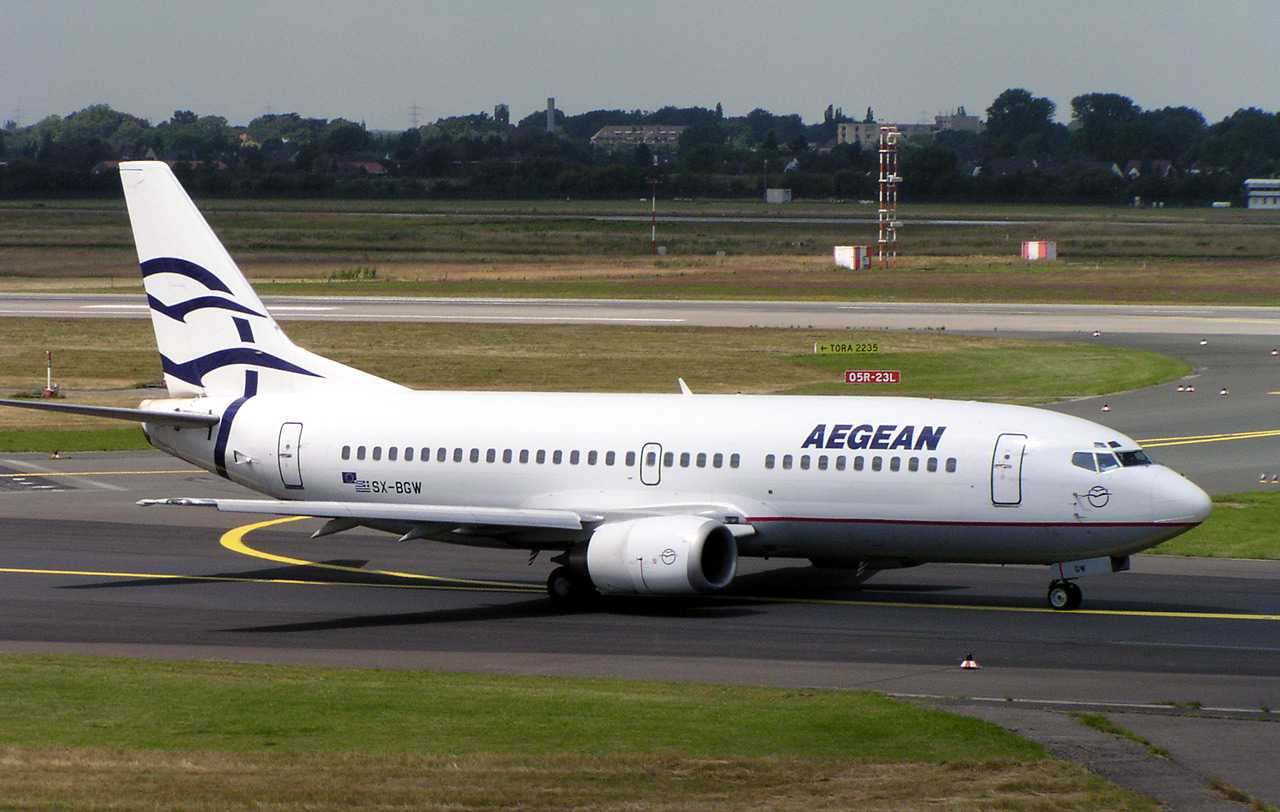
    ATHENS, June 17 (Reuters) – Greek carrier Aegean Airlines (AGNr.AT) said on Wednesday it will start a daily service to Istanbul, Turkey from Sept. 9, expanding its international routes.


    Aegean, Greece’s largest airline by passenger numbers in 2008, competes with recently privatised Olympic Airlines.


    The airline has been steadily expanding its routes outside Greece, adding seven destinations since late 2008, including Brussels, Berlin, Barcelona, Venice and Paphos in Cyprus.


    It will fly Airbus A320 aircraft on the Istanbul route.


    “After five years of efforts Aegean can now link Athens with a city symbolising so much for Hellenism,” chief executive Dimitris Gerogiannis said in a statement.


    Last month, Aegean clinched a deal to join Star Alliance, which includes UAL Corp’s United (UAUA.O), German Lufthansa (LHAG.DE), Air Canada ACa.TO., and Continental (CAL.N), eyeing access to many markets across the globe with large communities of Greek descendants. (Reporting by George Georgiopoulos; Editing by Dan Lalor)

    Reuters

  • BNP and Greek Connection Unleashed

    BNP and Greek Connection Unleashed

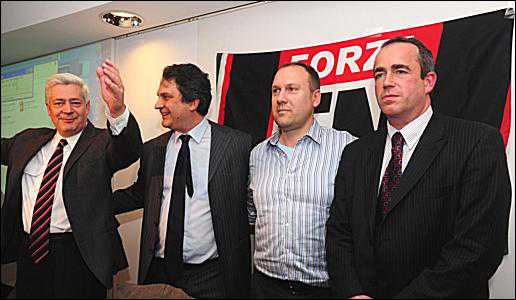
    THIS chilling picture shows BNP deputy leader Simon Darby being given a NAZI SALUTE at a fascist rally.


    Three extremists flashed the banned Hitler-style sign to the British far-right boss outside the event in Italy.


    Our exclusive snap fuels fears of danger ahead as the British National Party gains popularity in the recession.


    Darby, leading a drive for seats at the European Parliament elections in June, was following Stratos Karanikolau, from the Greek nationalist Proti Grammi (Front Line) party.

    They were joined by MEPs Roberto Fiore, a convicted terrorist, and Holocaust denier Bruno Gollnisch at the 400-strong meeting in Milan.


    Last night Labour MP Jon Cruddas said: “This shows the BNP are a gang of thugs parading as politicians.”


    bnp-greek-2

    POLITICAL LINE-UP: Gollnisch, Fiore, Karanikolau and Darby

    News Of the World

  • South Stream Gets a Boost

    South Stream Gets a Boost

    Business Week
    May 18, 2009
    Gas Pipelines: South Stream Gets a Boost
    Key countries sign on to Russia’s South Stream project, giving it an edge over the rival Nabucco pipeline proposal in a race with geopolitical repercussions
    By Jason Bush

    On May 15, Russia signed deals with Italy, Serbia, Bulgaria, and Greece, bringing the South Stream project, a major new gas pipeline to Europe, one step closer to reality.

    At a meeting in Sochi, attended by Russian Prime Minister Vladimir Putin and Italian Prime Minister Silvio Berlusconi, Russia’s Gazprom (GAZP.RTS) and Italy’s ENI (ENI.MI) agreed to double the planned pipeline’s capacity to 63 billion cubic meters. In addition to ENI, Gazprom signed memoranda of understanding with Greek natural gas transmission company DESFA, Serbia’s Srbijagas, and Bulgarian Energy Holding.

    The participating countries also signed documents needed to start work on the 2,000km (1,243-mile) pipeline. With completion planned by 2015, South Stream eventually will pump natural gas from southern Russia under the Black Sea, bringing it via Bulgaria, Serbia, Hungary, and Greece to terminals in western Austria and southern Italy.

    The agreement represents a significant diplomatic coup for Russia in a great geopolitical race that will help determine the source of Europe’s energy supplies for decades to come. That race has been visibly gaining pace over recent weeks. Backers of a rival pipeline to southern Europe are now vying to put together the necessary political support. “It’s very much down to the wire now,” says Chris Weafer, chief strategist at UralSib (USBN.RTS), a Moscow bank. “There’s definitely a race on to get all the signatures in place.”

    Concerns About a Stranglehold

    It’s no coincidence that the agreements on South Stream come just days after a key summit in Prague designed to give political impetus to Nabucco, a proposed rival pipeline through Turkey that is backed by the European Commission and the U.S. In the eyes of the EU and the U.S., the key advantage of Nabucco is that it would bypass Russia, diminishing Europe’s already heavy dependence on Russian gas. Imports from Russia presently account for around 40% of gas imports and 25% of gas consumption in Europe. Concerns about Russia’s stranglehold on Europe’s energy have only intensified recently, following this January’s damaging price spat between Russia and Ukraine, which briefly saw Russia’s gas supplies to Europe suspended.

    Those fears help explain the recent burst of activity surrounding Nabucco, a project that has been under discussion since 2002. In addition to the Prague summit, the EU has also been busy courting Turkey, a key transit country, which is expected to sign an agreement in June paving the way for Turkey to host the pipeline. Previously, there had been concerns that Turkey would try to use the pipeline as a bargaining chip in EU accession negotiations.

    But despite the recent progress on Nabucco, it all still looks to many analysts like a case of too little, too late. “I believe Nabucco still looks very problematic,” says Jonathan Stern, director of gas research at the Oxford Institute for Energy Studies. “It might work, or it might not, but I don’t think it’s going to work quickly.” He argues that the pipeline probably won’t be viable until around 2020­much later than the 2014 starting date currently being advanced.

    It doesn’t help that Russia, eager to safeguard its dominant position as Europe’s energy supplier, is already one step ahead of the game. The agreements reached in Sochi underscore Russia’s success in winning over key customers and transit countries for South Stream­a project that contradicts the EU’s stated policy of diversifying Europe’s energy supplies.

    Where to Get the Gas

    Even without the competition from South Stream, major question marks continue to hang over the whole economic viability of the Nabucco project. One key problem is financing: So far the EU has only committed a small fraction of the €7.9 billion ($10.6 billion) needed to build the pipeline. An even more basic question is where the gas for Nabucco (ultimately targeted at 31 billion cubic meters per annum) will come from.

    The original idea behind the pipeline was to ship gas from the Caspian region and Central Asia, with gas-rich countries such as Azerbaijan, Kazakhstan, Turkmenistan, and Uzbekistan supplying the fuel. The snag is that of these four countries, only Azerbaijan signed up to the Prague agreement backing the project.

    The other three Central Asian countries, under diplomatic pressure from Russia, pointedly declined to do so. In any case, no one has figured out how Central Asian gas could be linked up with Nabucco. A pipeline under the Caspian is impossible until all the bordering states resolve a long-running dispute over the sea’s legal status, giving Russia an effective veto.

    Analysts therefore believe the only way Nabucco can be viable is if Iran can now be talked into supplying gas for the project­a scenario that the U.S. previously fought. And despite recent overtures from U.S. President Barack Obama to improve relations with Iran, it’s still far too soon to talk of any diplomatic thaw.

    Meanwhile, the Russians are making progress with South Stream, which currently appears to be the more economically viable of the two. In sharp contrast to Nabucco, the Russians have no shortage of gas that could potentially be transported to Europe via the pipe, and the Russians also seem committed to financing the project. “It’s expensive, controversial, and hard to implement,” says Valery Nesterov, oil and gas analyst at Russian investment bank Troika Dialog. “But at least it has investment guarantees, and a resource base, to be secured by Gazprom. Though not without problems, the financial guarantees and resource base are still more realistic than those secured by Nabucco.”

    Snail vs. Tortoise

    It’s far too early, though, to declare victory for the Russians. The South Stream project also faces many daunting obstacles. Indeed, the great pipeline race might be said to resemble a marathon contest between a snail and a tortoise. “At this stage, it’s not clear where the gas is going to come from for either route,” says UralSib’s Weafer.

    Although Russia has huge gas reserves that could potentially be shipped Europe’s way, most of those reserves are still sitting deep under the Arctic tundra, in the remote Yamal region of Northern Siberia. The cost of bringing them to market is gargantuan­around $250 billion, according to estimates by Royal Dutch Shell (RDSA). The current global recession has only increased the uncertainty about future gas demand, making Gazprom even more reluctant to invest. Russia and the EU have so far failed to hammer out legal agreements that would regulate joint ventures between Gazprom and Western partners. “It’s a real mess,” says Weafer.

    Then there’s the tremendous cost of the South Stream pipeline itself. Officially estimated at between €19 billion and €24 billion ($25.6 billion to $32.4 billion), it’s around three times as expensive as the alternative Nabucco route. Those costs could now be especially problematic, at a time when the global financial crisis is depressing gas prices and Gazprom’s profits. “Gazprom is facing financial difficulties in the years to come,” says Nesterov, “and the cost of the project is tremendous.”

    So despite South Stream’s diplomatic head start, the outcome of the great pipeline race is still far from certain. And neither pipeline is likely to provide any quick solution to Europe’s mounting long-term energy needs.

    Bush is BusinessWeek’s Moscow bureau chief.

  • Heavy Traffic at Bulgaria Border Crossing Points with Greece, Turkey

    Heavy Traffic at Bulgaria Border Crossing Points with Greece, Turkey

    Car traffic has formed at Bulgaria’s border crossing point with Greece and Turkey over tourist interest towards those destinations for the 6 day holiday in Bulgaria.

    The situation, though, has not led to significant standstills, director of Regional Border Police Directorate – Smolyan,Totor Georgiev, said, as cited by Focus News. In his words, for a short period of time lines of cars had formed at about 8:00 am at Kulata border checkpoint.

    Currently, all five customs offices are working. Officials advice Bulgarians who travel to Turkey to use the border crossing points at Lesovo and Malko Tarnovo, as well.

     Novinite

  • 2009 ANNUAL DUES, DONATIONS and Book Sales

    2009 ANNUAL DUES, DONATIONS and Book Sales

    2009 MEMBERSHIP DUES AND YOUR DONATIONS ARE NEEDED TO CONTINUE OUR POSTED PROGRAMS WITH OUT INTERUPTION

    THE FOLLOWING LINKS WILL TAKE YOU TO THE DUES AND DONATIONS PAGE

    ÜYE AİDATLARI, BAĞIŞLAR VE KİTAP SATIŞLARI

    Dear Friends,

    The Turkish Forum (TF) is the GLOBAL organization with branches and working groups COVERING 5 CONTINENTS, working with many regional Organizations in the America, Europe, Asia, Africa, Australia and Turkey.  TF’s mission is to represent the Turkish Community in in the best way possible, to empower the people of Turkish origin and friends of Turkey to be active and assertive in the political and civic arenas, to educate the political establishments, media and the public on issues important to Turks, and cultivate the relations between the working groups located an five continents, serving the Turkish Communities needs.

    In order to achieve these goals we have performed many activities and completed many projects, THEY ARE ALL LISTED IN THE WEB PAGES OF TF, . You have been informed about these activities and projects, many of you participated voluntarily and contributed heavily and still contributing to these activates and projects. As the events happen and the major steps taken the information always reaches to you  by the TF Grassroots DAILY NEWS Distribution Service.  Needless to say, each activity and project requires a large amount of human and financial resources. TF has a  completely volunteer board, none of the board members receives any compensation or salary or even a small reimbursement. TF also has many volunteer committee members, WELL ESTABLISHED ADVISORY BOARD and project leaders. In addition to our large volunteer pool, please see them an https://www.turkishnews.com/tr/content/turkish-forum/ TF sustains Permanent Offices in New England, Germany and in Turkey and has a number of professional staff to upgrade its systems, and to solve the technical problems.  Please check our website at https://www.turkishnews.com/tr/content/turkish-forum/

    As the 2009 did begin we kindly ask you to support TF by becoming a member, if you are not already one.  You can also contribute a donation if you wish to upgrade your regular membership  to a higher level. Your financial support is critical to TF in order to pursue its mission in a professional manner. Needless to say, it is the financial support that we receive from our members and Friends of Turkey  is the backbone of our organization. As long as this support is continuous we can achieve our objectives and work for the communities across the globe.  Your contribution is tax-exempt under the full extent of the law allowed under Internal Revenue Code 501(c) (3).

    Becoming a member and making an additional contribution are easy: You may become a member online at http://www.turkishnews.com/dagitim/lists/?p=subscribe&id=3

    I thank you for your belief in TF, and look forward to another successful year with your uninterrupted support.

    Sincerely,
    Kayaalp Büyükataman

    Dr. Kayaalp Büyükataman, President CEO
    Turkish Forum- World Turkish Coalition