Istanbul-born economist Nouriel Roubini says the current turmoil in Greece would not have occurred if the European-Union member had looked east to Turkey and took copied its reform effort after the 2001 crisis. Speaking to businesspeople in Bursa, Roubini says Turkey’s membership in the EU will only strengthen the union and predicts a revival in membership talks
If Greece had followed Turkey’s lead in making financial reforms in 2000-2001, it would not be in such dire straits today, one of the world’s most prominent economists told Turkish business leaders Wednesday in Bursa.
Nouriel Roubini spoke at an event organized by the Automotive Industry Exporters Unions. The renowned economist, dubbed “Dr. Doom” because of his early prediction of the global financial crisis, addressed nearly 400 people, most of whom paid 350 euros to listen to him.
Evaluating the worst global recession since the 1930s, Roubini said when the United States economy sneezed, the world would generally catch a cold, in the latest crisis, however, it had come down with “pneumonia.”
“But the recent news is good,” Doğan news agency quoted him as saying. “The recovery has started. The debate is whether it will be a V-shaped, fast recovery, a U-shaped slow recovery or a W-shaped, double-dip recovery. My opinion is it will be a U-shaped process. This recovery will not be stable and steady.”
Touching on positive economic data coming from the U.S., Europe and Japan, Roubini said newly developing economies will recover faster than Turkey and economies in Asia. He predicted a gross domestic product growth of 3 percent for the U.S., 2 percent in the eurozone, 5 to 6 percent in Turkey and 9 percent in China this year.
“In the second half of the year, the growth rate might slow down in the U.S., dragging average annual growth down to around 2 percent,” he said.
Turkey and other developing markets derived the correct lessons from the 2001 crisis and engaged in structural reforms, Roubini said. “Meanwhile, developed economies [in the West] started to have problems.”
Reflecting on the importance of the U.S. economy in exiting the global crisis, Roubini said the stimulus policies implemented by governments worldwide are of crucial importance, as there will be trouble if they are implemented for too long or if they are curtailed too soon.
Drama in Greece
The reason the Greek drama engulfed eurozone economies is because “it did not implement structural reforms in time” and because of high budget deficits, the economist said.
“The crisis in Greece will create huge problems,” he said. “Some countries might leave the euro. A possible intervention by the International Monetary Fund would only postpone the problem, not solve it. This crisis is a crucial test for the eurozone. If Greece had followed Turkey’s post-2001 reforms, it would not be in this situation today.”
Turkey’s importance in the global economy will increase further, according to Roubini. “But Turkey should diversify in the trade sense,” he said. “It should orient toward new markets. Besides Europe, it should develop trade relations with the Middle East and Asia. These regions will post [remarkable] growth in the following period.”
Turkey is “moving on its path” by taking the necessary lessons from the past, Roubini said. “It is open to foreign investment. Its labor costs are relatively low. It could be a center for financial inflows from Europe to the Middle East. It may be a trade center between the east and the west. You have a strong workforce, but it needs training.”
Erdoğan’s suggestion ‘might not work’
Reflecting on Prime Minister Recep Tayyip Erdoğan’s suggestion that every member company of the Turkish Union of Chambers and Commodities Exchanges employ one extra worker to overcome unemployment, Roubini said this “might not work.” What the government has to do instead is engage in “structural, fiscal and financial reforms,” he said, according to the daily Hürriyet.
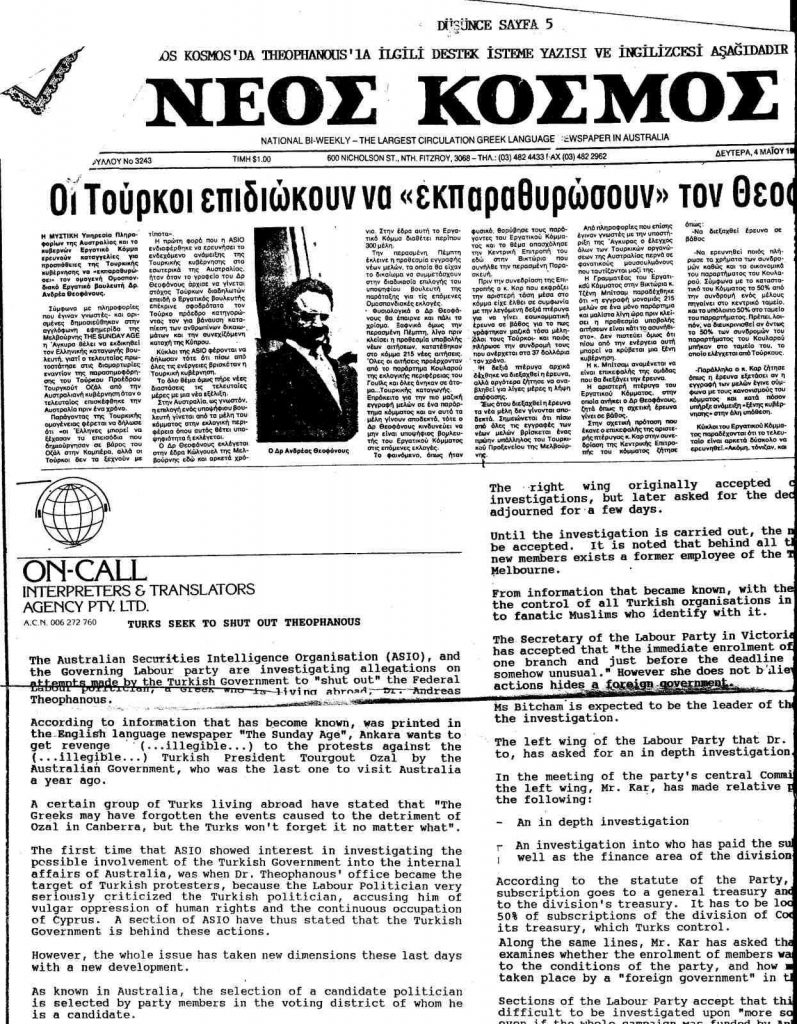
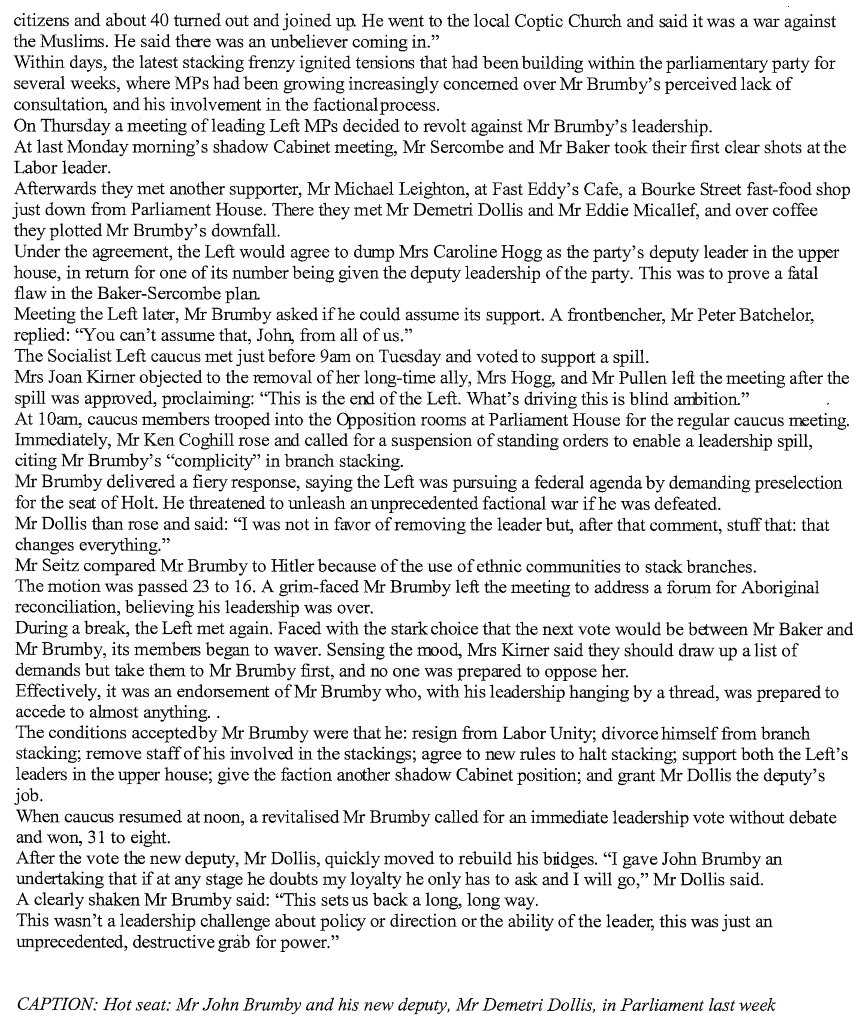
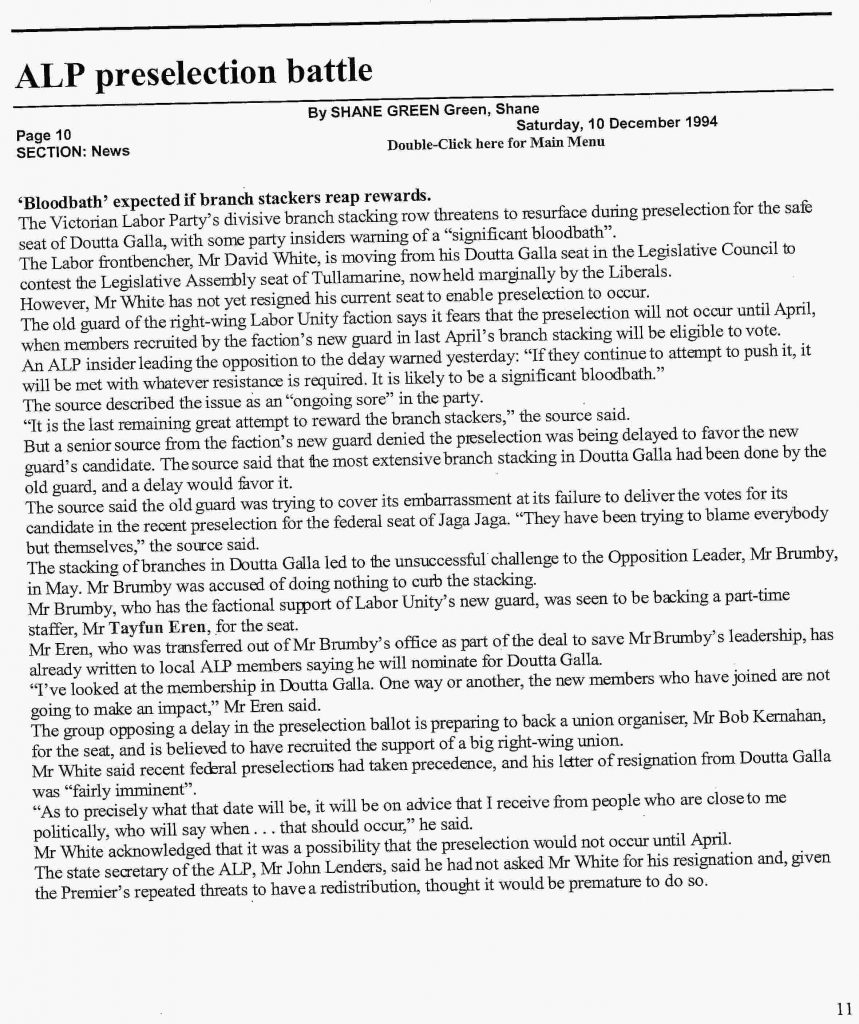
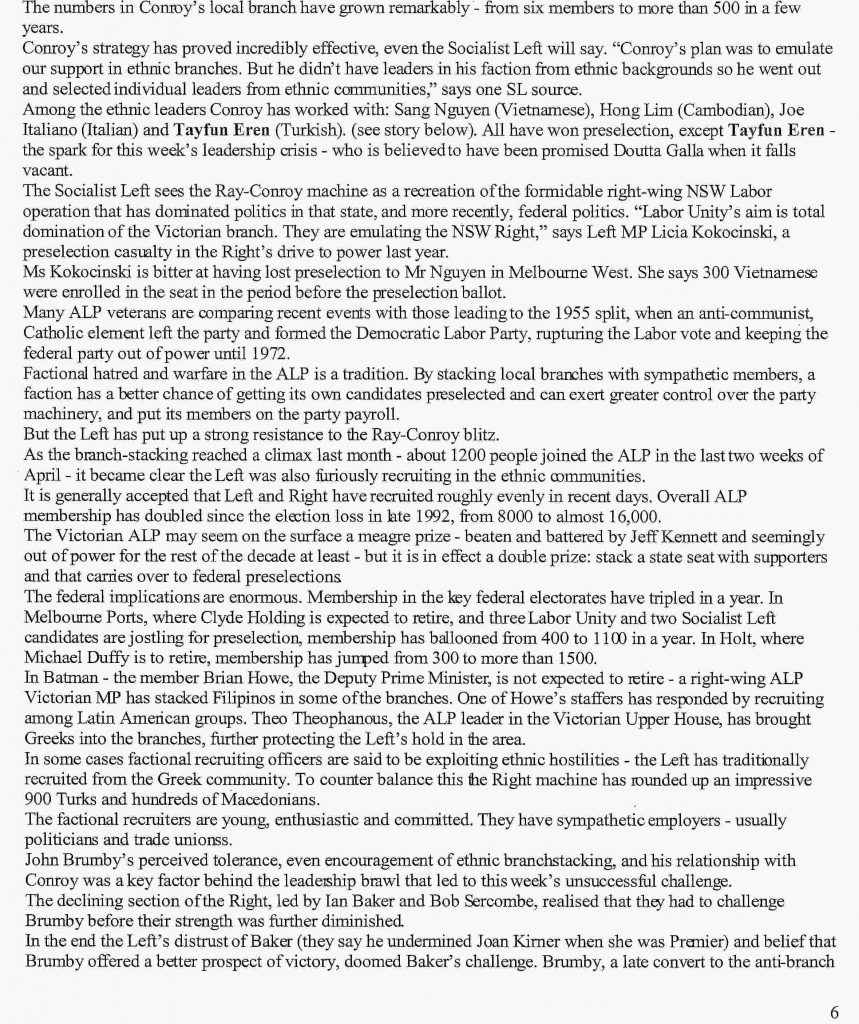
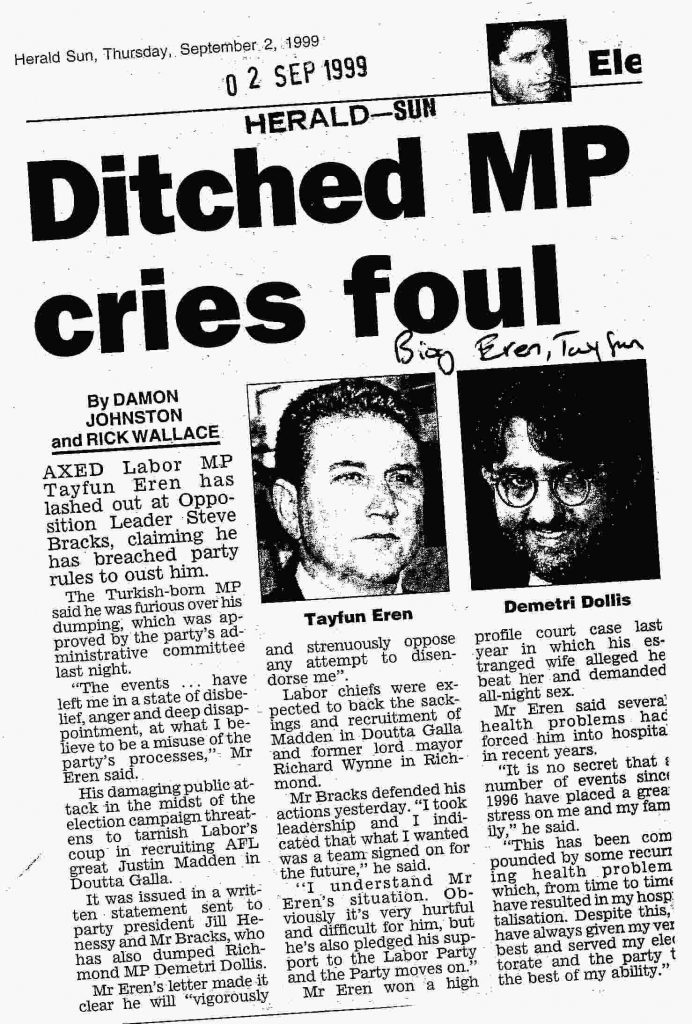
Avustralya’da eski Labor milletvekilerinden Tayfun E. Eren dostumuzun hasmı ve Türk davasına 1999’dan beri aktif bir şekilde sürekli köstek olan Dollis ile ilgili arkaplan aşağıda… En son Assyrian “Genocide” ve Pontus konusunu planlayan ve yürürlüğe sokan kişi bu Dollis… 1999 dan evvel de Avusturalya meclisinde Yunanistan’ın ‘köstebek’ görevini yapıyordu. Şu anda Papandreou’nun danışmanlarından oluyor kendileri… Ve 1999’dan beri de Yunanistan’ın Dışişlerinde çalışıyor… İlgililerin dikkatine sunulur… Detaylı bilgi isteyenler Turkish Forum’a başvurabilirler…
Saygılar,
Tayfun E. Eren
Haluk Demirbag
—
George Papandreou faces early test after winning Greek elections
Peter Wilson, Europe correspondents
From:The Australian
October 05, 2009 1:57PM
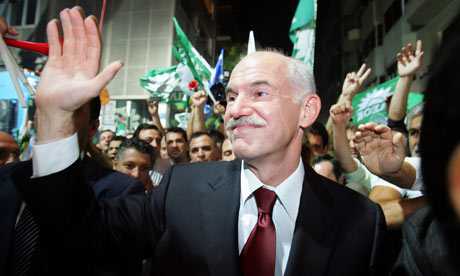
Greek socialist party leader George Papandreou after being elected prime minister of Greece. Picture: Getty Images Source: The Australian
GREEK voters have thrown out their five-year-old conservative government and made centre-left leader George Papandreou prime minister, a post previously held by both his father and grandfather.
Mr Papandreou, a US-born former foreign minister, will follow his father Andreas and grandfather George in heading Greece’s government but he faces urgent economic challenges and a major battle to curb corruption.
AUDIO: Peter Wilson talks to George Papandreou
The PASOK socialist party that his father founded in 1974 is expected to win about 160 seats in the 300-seat parliament, reassuring markets by securing a stable majority at a time when urgent government reforms are needed.
Mr Papandreou pledged to “turn a page” on scandals and economic malaise associated with the outgoing conservative government.
“We stand here united before the great responsibility which we undertake,” Mr Papandreou told cheering supporters in central Athens when the result became clear.
“We have a mandate to turn a new page,” Mr Papandreou said as supporters of his Pasok party celebrated the socialists’ return to power after more than five years in opposition.
“Today we start together the great national effort of placing the country back on a course of revival, development and creation. We don’t have a day to waste.”
He said PASOK had waged “a good fight to bring back hope and smiles on Greeks’ faces … to change the country’s course into one of law, justice, solidarity, green development and progress”.
PASOK won by a larger than expected margin of 44per cent to 34per cent over the conservative New Democracy party.
Mr Papandreou, 57, told The Australian last week that if elected he would make several reforms to help members of the Greek diaspora in Australia and elsewhere, making it easier for them to work in Greece and to vote in Greek elections.
He said he would change Greece’s tough education rules so as to recognise three-year bachelor degrees issued by Australian universities as the equivalent of four-year Greek degrees, removing a hurdle that has long frustrated Australians wanting to work in Greece.
He also vowed to allow the one million-plus registered Greek voters who live overseas to vote by mail or at local consulates instead of the current system which requires them to travel to Greece to cast a ballot.
Often criticised in Greece for speaking English more fluently than Greek, Mr Papandreou has fought PASOK’s old-style party chieftains in a bid to modernise the party, dropping from its candidate list several factional heavies including the former prime minister Costas Simitis.
The defeated prime minister, Costas Karamanlis beat Mr Papandreou in elections in 2004 and 2007 but yesterday resigned the leadership of New Democracy to accept responsibility for his failed gamble of calling a snap election just half way into a four-year term of parliament.
Dora Bakoyannis, the 55-year-old foreign minister who served as mayor of Athens during the 2004 Olympic Games, is the frontrunner to replace him as leader of the conservative party, a post once held by her father Constantine Mitsotakis.
Mr Karamanlis had called for an austere series of government cuts to rein in the deficit and national debt but he was hampered by the fact that he had made little progress in the previous five years on his vows to fight corruption and reform an outdated government bureaucracy.
Mr Papandreou campaigned on a promise of a 3 billion Euro ($5b) stimulus package but faces immediate talks with Euro zone officials concerned that Greece’s budget deficit is already twice the 3 per cent of GDP allowed under the rules of the common currency.
The socialist leader has vowed to increase wages and pensions and fund the extra spending by increasing taxes on the rich and cracking down on tax evasion.
Raised in Sweden and the US when his father was in political exile, Mr Papandreou promised to appoint an advisory panel of foreign economic experts and tackle Greece’s high levels of corruption and its tradition of new governments handing out state jobs and contracts to their own cronies.
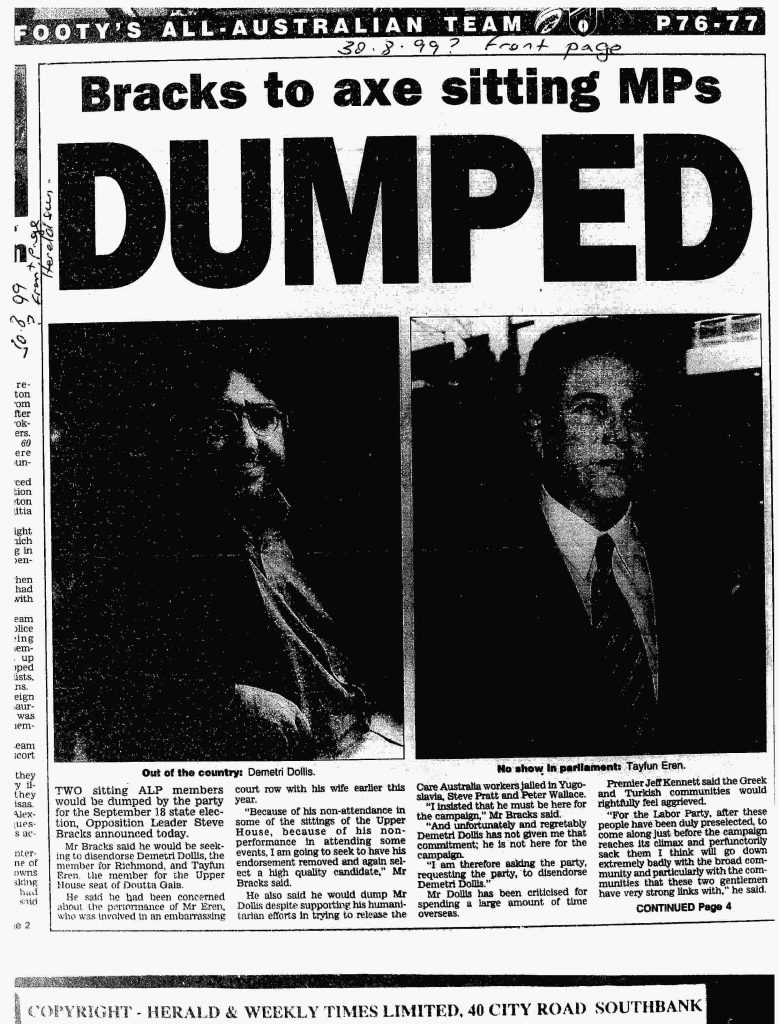
A senior job in the new administration is certain to go to close Papandreou advisor Demetri Dollis, a former Victorian Labor MP who served as deputy leader of the state opposition before being stripped of his ALP preselection by then leader Steve Bracks in 1999 for spending too much time overseas.
Mr Dollis held a high-level job in the foreign ministry when Mr Papandreou was foreign minister and has worked in Mr Papandreou’s personal office over the past five years.
, October 05, 2009
[2]
Papandreou looks to Greek diaspora as he forms new cabinet
George Papandreou is expected to tap international talent for his government to help tackle Greece’s multiple crises
Helena Smith in Athens
guardian.co.uk, Tuesday 6 October 2009 10.50 BST
George Papandreou is expected to announce his cabinet later today. Photograph: Simela Pantzartzi/EPA
Greece‘s socialist leader George Papandreou was sworn in as prime minister this morning amid clear indications that the new government he will lead will seek to tap talent in the diaspora to address the multiple crises facing the country.
The English-speaking prime minister, propelled into office following an overwhelming victory in Sunday’s elections, is expected to announce a cabinet this afternoon to take on Greece’s financial and economic crisis and social malaise.
US-born Papandreou was educated in Sweden, England and Canada and is a Harvard University fellow. His closest aides include English-speaking Greeks born and brought up in Africa, America and Australia. The 57-year-old politician is himself more comfortable speaking English than Greek.
“Part of my identity is being a Greek of Greece and a Greek of the diaspora,” Papandreou told the Guardian. “I think in many ways being Greek is being ecumenical, open to the world. We are a country that has always been open with ideas and contact with the rest of the world as a shipping nation and tourist destination.”
Through his network of connections as head of Socialist International, the global grouping of leftwing parties, Papandreou has already embarked on talks with renowned experts in the fields of economy and public health. The Nobel economics laureate Joe Stiglitz is in touch with him “on a daily basis”, offering advice on how to rescue Greece’s debt-ridden economy from the brink of bankruptcy.
Also a Harvard professor and international health expert now sits in the Greek parliament following his appointment as a non-elected MP with Papandreou’s Pasok party.
“George has always said there is an untapped world and that is the other Greece in the diaspora that he is going to work with, talk to and take advice from to help us get the country out of this situation,” said Dimitris Dollis,a Greek Australian who is among Papandreou’s senior advisers. “Ties with the diaspora are going to be much stronger.”
Among candidates for prominent cabinet roles are George Papaconstantinou, a graduate of New York University and the London School of Economics who worked at the OECD in Paris, and Louka Katseli, a former economics professor at Yale.
After years of introspection under the outgoing centre-right government, Greece is also expected to become far more “open and outward looking” in its foreign policy under Papandreou, who won international plaudits back in the 90s when he almost single-handedly improved relations with Turkey by daring to pursue reconciliation.
“Being parochial is a state of mind and we want to get out of it,” said a source close to Papandreou who will be one of his senior foreign affairs advisers. “The [outgoing] conservatives chose to tread water in a turbulent sea, no initiatives were taken and relations with out neighbours gradually stalled. Our approach is going to be a lot more cosmopolitan, open and creative which is George’s natural inclination.”
The change in style has been welcomed by western diplomats startled by the rise of nationalism and xenophobia in Greece in recent years.
And amid speculation that Papandreou will assume responsibility for foreign affairs – at least initially – many are hopeful that relations with neighbouring Turkey, Macedonia and the rest of Europe will improve. In Istanbul and Ankara there were scenes of jubilation with some Turks cracking open bottles of champagne when news of Pasok’s victory came through. In recent months ties with Turkey have worsened with tensions in the Aegean rising noticeably.
https://www.theguardian.com/world/2009/oct/06/george-papandreou-sworn-greek-pm, 6 October 2009
[3]
Greek NGO teacher Lerounis returns to Greece after release by Afghan Taliban militants
Greek teacher and NGO worker Athanassios Lerounis arrived in Athens on Saturday following his release earlier in the week by Afghan Taliban militants seven months after they kidnapped him in the Chitral region in northern Pakistan.
Lerounis, chairman of the non-governmental organisation Greek Volunteers, was kidnapped outside his museum in the remote Kalash valley last September, while his guard was fatally shot. He had been working on a cultural project in the area since 2001.
Professor Lerounis, a Greek teacher and social worker, was kidnapped on September 8, 2009 following an attack on the Kalash village of Brun, in Pakistan, where he lived. He was abducted outside the ethnological museum Kalash-Dur he had created himself in Pakistan to preserve and showcase the culture of the Kalash people. Lerounis has also founded two primary schools, three motherhood centers and the Kalash Cultural Center in Bumburate Valley.
Lerounis was released in Nooristan province in Afghanistan on Wednesday, and Pakistani officials took him to Chitral later that night. He was taken to the Greek embassy in Islamabad on Friday morning to await transportation back to Greece arranged by the Greek government.
A visibly moved and relieved Lerounis arrived Saturday at Athens’ ‘Eleftherios Venizelos’ International Airport, where he thanked everyone who had helped in securing his release.
“I am very happy to be standing on Greek ground after so many months. A big thank you to the people in Pakistan, the Greek government and the personal interest of the prime minister, who acted as a human being and not a politician,” Lerounis told waiting reporters.
Lerounis also thanked prime minister George Papandreou’s personal envoy to Islamabad, ambassador-at-large Dimitris Dollis, and the Greek ambassador in Islamabad Petros Mavroidis, who accompanied the NGO volunteer on his flight to Greece, as well as all people who were supportive throughout his ordeal.
Dollis confirmed a statement by Wazir on Thursday that no ransom was paid, adding that Lerounis’ release was a big success of the Greek government, Greek diplomacy and the country, and called Lerounis “an example of perseverance”.
Asked if he would return to the Kalash tribe, Lerounis said that “with the support of the Greek and Pakistani government, I would like to return there some day and continue my work”.
http://www.hri.org/news/greek/ana/2010/10-04-12.ana.html#10, 12 April 2010
Denis O’Callaghan’s letter (April 9th) condemning President McAleese’s laying of a wreath at the tomb of Ataturk because he was “responsible for the ethnic cleansing of Smyrna in Asia Minor” is a very partial view of history.The Turkish capture of Smyrna occurred as the culmination of a Greek attempt to conquer Anatolia, which led to large scale ethnic cleansing of Muslims, starting in Smyrna itself and reaching to where it was stopped by Ataturk, at the gates of Ankara.The Greeks were victims of their own irredentist dreams of a new Byzantium and their misplaced faith in Lloyd George, in attempting to impose the punitive Treaty of Sèvres on Turkey.In any other context, such as that applied to the second World War, the recapture of Smyrna would be seen as an act of liberation and the blame for the unfortunate events of September 1922 placed at the hands of the original aggressors. – Yours, etc,Dr PAT WALSH,Leyland Crescent,Ballycastle, Co Antrim.
From The Author of
Forgotten Aspects Of Ireland’s Great War on Turkey1919–1924(Unutulan Yönleriyle İrlanda’nın Türkiye’ye Karşı Büyük Savaşı: 1914–1924) Dr. Pat Walsh. ATHOL BOOKS, Belfast 2009
Contributed by Mr Yusuf Cinar, Mr Nizam Bulut, Galway, Ireland
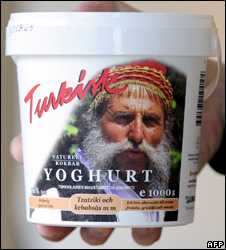
A Greek man is suing a dairy in Sweden for 50 million kronor ($6.9m; £4.5m) for using his image on pots of Turkish-style yoghurt, Swedish media report.
The man only found out his moustachioed face featured on the containers of Turkisk Yoghurt made by Lindahls when a friend living in Stockholm told him.
Athanasios Varzanakos told Swedish Radio his friend “was annoyed and asked how it was possible” when informed.
The dairy said it bought the photograph in good faith from an image library.
Chief executive Anders Lindahl said it had come as a shock when the Greek man lodged a 40-page legal complaint saying that the company had used a misleading image because he had no links with Turkey.
“We bought it from a photo agency so we assumed that everything was in order,” Mr Lindahl told the AFP news agency.
The image remains on the Lindahls website despite the legal action.
Relations between Greece and Turkey have long been strained and at times have turned into outright hostility.
Turkey and Greece on Thursday announced a series of measures to build confidence between the rival neighbors, including joint military training designed in part to ease years of tension over airspace and sea boundaries and a local arms race.
Turkey’s Foreign minister Ahmet Davutoglu said the new moves ultimately could help limit arms spending.
As well, 10 key ministers, including those in charge of foreign and European Union affairs as well as energy and economy would meet at least twice a year, Davutoglu and Greece’s Deputy Foreign Minister Dimitris Droutsas announced.
The ministers said their armies would increase cooperation through joint training and conferences. The move is designed to encourage Turkish and Greek officers, who have for decades regarded each other as potential enemies, to work with each other.
The countries have been at odds for years over flight procedures over the Aegean Sea border. For decades, their warplanes have often engaged in mock dogfights.
“The measures will boost confidence between the two peoples and armies,” Droutsas told a joint news conference with Davutoglu.
Greece is suffering from a severe economic crisis and plans to cut defense spending in 2011 and 2012. Responding to a question over whether Turkey would follow Greece’s lead, Davutoglu said that there would be no need for arms spending if the neighbors could build a “common future.”
“We have a vision and it is not based on mutual threat but on mutual interests,” Davutoglu said. “If we manage to build a common future, there will be no need for defense spending.”
Davutoglu pointed out that his government has already reduced military spending, saying the government has spent more on education than arms in recent years.
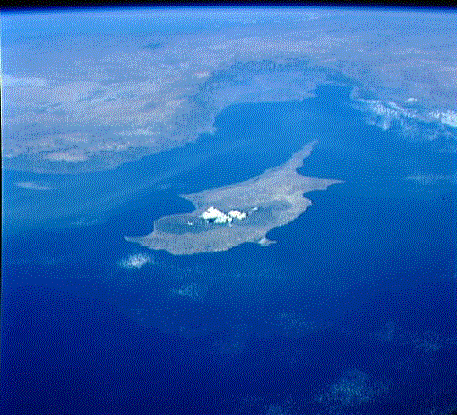
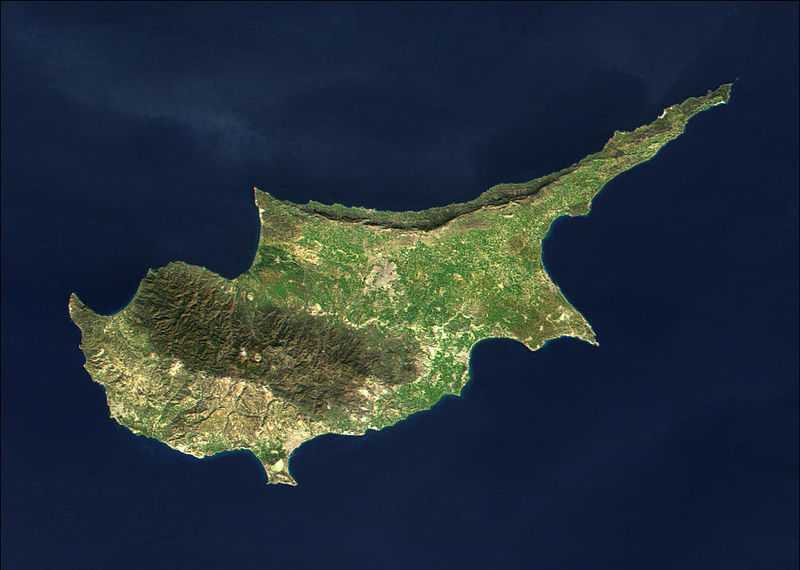
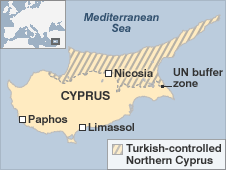
EU-member Greece supports Turkey’s membership bid in the European Union, hoping that it will help solve territorial issues. The largest snag is the divided island of Cyprus where Turkey keeps about 40,000 troops.
Turkey began EU membership talks in 2005, but negotiations on some policy have been frozen over Turkey’s refusal to allow ships and planes from Cyprus to enter its ports and airspace, and the EU says Ankara must open its airspace to the EU member if it wants to get closer to membership itself.
In return, Turkey insists on the lifting of what it says is the unofficial trade embargo on the breakaway Turkish Cypriot state in the north of the island, which was divided into a Greek Cypriot south and a Turkish Cypriot north following Turkey’s 1974 invasion.
Later this month elections in the Turkish-occupied north of Cyprus could see President Mehmet Ali Talat being ousted in favour of a hardliner, Dervis Eroglu.
Cyprus has been divided since 1974 when Turkey invaded following a coup by Greek Cypriot extremists, bent on union with Greece.
Mr Talat was elected in 2005, having promised to deliver a reunification deal with the Greek Cypriots but, despite being locked in talks with his opposite number, Demetris Christofias, for the past 18 months he has been unable to announce a deal.
Both Greece and Turkey say they want the issue resolved and the UN Secretary General Ban Ki-Moon visited Cyprus in February and urged both sides to show “courage”.
In 2004 a previous deal, the so-called Annan Plan, was approved by Turkish Cypriots in a referendum but rejected by Greek Cypriots.
Do you live in Cyprus or were you born there? Do you think the two communities will ever be able to live together? What do you blame for the failure to reach a deal? What do you think the main sticking points are? You can tell us your experiences using the form below. If you are happy to be contacted by the BBC, please include your phone number.
 Is time running out for a deal in Cyprus?