Category: Greece

  • EU to Send Reinforcements to Greek Border

    EU to Send Reinforcements to Greek Border

    By STEPHEN FIDLER

    The European Union agreed Tuesday to send a rapid-response border force to help Greece patrol its land frontier with Turkey, as local Greek law enforcement has been overwhelmed by an influx of thousands of illegal immigrants entering the 27-nation bloc.

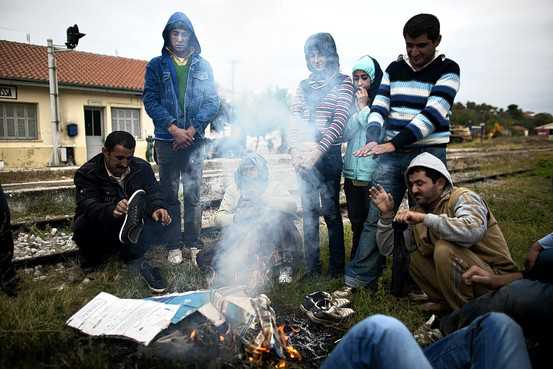
    Immigrants at the train station in Nea Vissa, north of Orestiada, Greece, a main crossing point from Turkey.

    Ilkka Laitinen, head of Frontex, the Warsaw-based agency coordinating management of the EU’s external borders, signed a decision Tuesday to send in the rapid-intervention force for its first deployment since it was created in 2007. The force can call on 500 to 600 border agents from EU member states, who will wear their national uniforms and can be armed.

    Greece requested help Sunday, after its own border forces couldn’t cope with the influx.

    A spokeswoman for the European Commission, the EU’s executive arm, said Frontex was carrying out an assessment to establish what size the force should be and what assets, such as dogs and vehicles, would be needed. It isn’t clear when the force will arrive.

    Immigration into the EU is on a downward trend because of the sluggish European economy—but more immigrants than ever are choosing to enter the bloc by land rather than sea. Once inside the EU, people can move across most national borders—with a few exceptions, such as the U.K.—without having to go through immigration controls.

    The focus on the Greek land border comes as authorities clamp down on sea crossings in the Mediterranean. In the second quarter, 90% of the people trying to enter the EU illegally through Greece were detected at the land border, compared with 65% in the first quarter.

    Frontex noted an eightfold rise in the second quarter from the first in the number of North Africans trying to get into the EU overland from Turkey. People from North African countries used to get to the EU largely through Spain and Italy. Large numbers of Afghan nationals and some Somalis are also using the Greek entry point.

    Libya has increased its surveillance of migrants, although in June Tripoli ejected the United Nations refugee agency that was monitoring 13,000 refugees and asylum seekers in its territory who had attempted to enter Europe but were stopped, many on the high seas. Stepped-up Libyan and Italian sea patrols are limiting crossings using a traditional route into the EU via Sicily and southern Italy. Spain also signed agreements with Senegal and Mauritania resulting in increased monitoring by those governments, which has limited immigration from these countries.

    Many clandestine entrants don’t have papers and claim to be from another country—many North Africans, for instance, claim to be Afghan—, making it difficult to repatriate them.

    Manfred Nowak, a senior United Nations official, said last week that immigrants had overcrowded Greek prisons and overwhelmed law enforcement. He said some immigrants were being detained in degrading conditions, and cited numerous allegations of beatings by police officers.

    After a 10-day visit, Mr. Nowak said Greek border stations, police stations and migrant detention centers were in “a critical state” and that there was a backlog of 52,000 cases of people seeking asylum in Greece. The Greek government shouldn’t have to bear the burden on its own, he said. “This is a truly European problem which needs a joint European solution.”

    In the second quarter of this year, Greek patrols detected 9,500 attempted illegal border crossings into Greece from Turkey, out of a total 26,500 detections at border-crossing points all over the EU, according to data from Frontex. A similar number were caught crossing into Greece from Albania, probably to do temporary farm work before returning home. Most people are trying to cross within a few miles of the town of Orestiada, on the border with Turkey.

    “Given that in July 2010, 150 to 200 illegal migrants were detected each day at Orestiada and that very few are currently to be returned [sent back] to Turkey, it is likely that the Greek authorities will continue to be overwhelmed by the sheer number of arrivals,” Frontex said in a report published last month. It predicted numbers would increase further if action wasn’t taken.

    Write to Stephen Fidler at [email protected]
  • EU teams to patrol Greek-Turkey border

    EU teams to patrol Greek-Turkey border

    By Rachael Brown

    Posted Tue Oct 26, 2010 10:28am AEDT

    Rapid Border Intervention Teams (RABIT) from the European Union (EU) have been sent to the Greek-Turkish border in an effort to curb an influx of illegal migrants from Africa and Asia.

    The European Commission says the flow of illegal migrants entering Greece has reached alarming proportions.

    Greece is the first country to ask for help from the EU’s border intervention teams.

    The Commission says hundreds of migrants from northern Africa and war zones like Iraq, Pakistan and Afghanistan have flooded through the Greek-Turkish border in recent weeks.

    The border guards will answer to Greece and will be armed, but can only use their weapons for self defence.

    The deployment comes a week after a UN expert said migrants in Greece are frequently held in inhumane conditions due to filthy and overcrowded detention centres, poor police training and a spike in arrivals.

    via EU teams to patrol Greek-Turkey border – ABC News (Australian Broadcasting Corporation).

  • Greece, Turkey Vow to Tackle Illegal Immigration

    Greece, Turkey Vow to Tackle Illegal Immigration

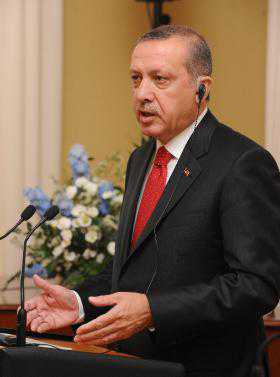
    VOULIAGMENI, Greece  — Turkish Prime Minister Recep Tayyip Erdogan on Friday promised closer cooperation with EU neighbor Greece to fight illegal immigration into Europe in exchange for Greek assistance to help relax visa rules for Turks.

    Erdogan is visiting Greece for the second time in five months, as the two countries seek to boost trade and sideline their traditional rivalry.

    “On (immigration) we will start cooperation so that we can deal with this problem … it is a common problem,” Erdogan said after a two-hour meeting with Greek Prime Minister George Papandreou on the fringes of a Mediterranean climate change conference near Athens.

    Greece is the European Union’s busiest transit point for illegal immigration and has faced a spike in recent months in clandestine traffic across its 125-mile land border with Turkey.

    Greek officials have long accused authorities in Turkey of failing to make a determined effort to stop immigrants sneaking into Greece and of ignoring an agreement to accept the return of detained migrants.

    Papandreou said Greece and Turkey had agreed to “reactivate” that agreement.

    “We decided on a common initiative toward the EU … to make our cooperation more systematic and much more effective in dealing with this problem,” he said.

    “At the same time, we discussed the very important issue of liberalizing the visa process for Turkish citizens entering the European Union.”

    NATO allies Greece and Turkey have improved ties over the past decade but remain at odds over war-divided Cyprus and boundaries in the Aegean Sea. The disputes have hindered Turkey’s bid to join the European Union.

    Papandreou said the two leaders had discussed the course of efforts to resolve those disputes “in a very positive atmosphere.”

    And Erdogan described as “very significant” a recent decision by his government to grant Turkish citizenship to 12 senior clerics at the Ecumenical Patriarchate in Istanbul, the center of Orthodox Christianity around the world.

    Clerics must have Turkish citizenship to be able to succeed the current Ecumenical Patriarch, 70-year-old Bartholomew I.

    On Thursday, NATO’s secretary general Anders Fogh Rasmussen said on a visit to Athens that Greece and Turkey were showing a greater willingness to cooperate.

    “I appreciate very much the close contact, as I see it, that we are now witnessing between Ankara and Athens,” the NATO chief said.

    “I think Prime Minister Erdogan’s visit to Athens … is yet another testament to the improvement of relations, and we appreciate that very much.”

    Leaders and representatives from 16 Mediterranean countries are attending the meeting at the seaside resort of Vouliagmeni, south of Athens, also joined by environmental campaigners and representatives of the World Bank and European Investment.

    Papandreou said Mediterranean countries were “particularly vulnerable” to global warming — facing more frequent droughts, heatwaves and forest fires — and said he was encouraged by Erdogan’s presence at the conference.

    “This is proof that two neighbors can place their differences to one side to face common threats,” he said, in his opening remarks earlier Friday.

    The conference ends Saturday.

    via Greece, Turkey Vow to Tackle Illegal Immigration – FoxNews.com.

  • Turkey, Greece to revisit Aegean problems with fresh ideas

    Turkey, Greece to revisit Aegean problems with fresh ideas

    Deep-rooted Aegean border problems will be re-examined Friday by the Turkish and Greek prime ministers, who are set to meet in Athens on the sidelines of an international climate summit.

    According to diplomats, however, there is no expectation of an instant breakthrough in resolving such problems even though Prime Minister Recep Tayyip Erdoğan’s recent statements had fueled hopes to this effect.

    “We do not want [military] flights over the [Aegean] islands,” Erdoğan said in an interview with the Greek daily Kathimerini on Wednesday, asking that a compromise be reached through mutual understanding and effectively setting forth a series of proposals that could reduce tensions.

    By means of a compromise, Erdoğan suggested that NATO be invited to monitor how the two countries’ jets use the airspace over the Aegean since both neighbors are members of the alliance.

    Meanwhile, Erdoğan’s belief in the need to foster more civilian involvement in attempts to prepare sufficient groundwork for a solution to the bilateral problems could be counted as his second proposal.

    Another suggestion came from Erdoğan’s chief foreign policy advisor, İbrahim Kalın, who said at a conference in Athens that Turkey could annul its declaration of “casus belli” if Greece withdrew possible plans to expand its territorial waters to 12 miles.

    The suggestion was followed by calls from Turkey to eliminate all problems between the two countries in the Aegean so that both could benefit from tourism in the region.

    Apart from tourism, the two countries could also launch joint drilling efforts in the Aegean to explore potential hydrocarbon reserves.

    What makes these ideas more meaningful is that Turkey has removed Greece from its threat list, the National Security Policy Paper – widely known as the “red book.”

    “We should go over these issues step-by-step, without making them a matter of daily political consumption,” a senior diplomat told the Hürriyet Daily News & Economic Review on Thursday.

    “It should be noted Turkey seriously and sincerely wants to engage in a process of resolving current problems,” said the diplomat. However, there have been no concrete responses from Greek authorities on the suggestions made by their Turkish counterparts.

    Commentators from both sides have observed positive attitudes in both capitals about moving forward and finding a way to solve disputes. One form of evidence is that the exploratory talks between the two countries’ foreign ministries launched in the early 2000s have produced some progress in diplomats being able to introduce a road map for greater dialogue.

    Turkey and Greece disagree over territorial water borders, airspace and the sovereignty of some islets in the Aegean. Greece believes there are no gray areas regarding the sovereignty of some congested islets in the Aegean. According to diplomats, the sovereignty issue can only be solved through the European Court of Justice while other disputes could potentially be solved through bilateral mechanisms.

    However, it is not very likely the leaders will finalize any solution in the near future as diplomats believe “there are so many other things to do.”

    Hurriyet

  • A Greek love affair

    A Greek love affair

    As tensions with Turkey grow, Israel bolsters ties with neighboring Greece. Foreign Minister Dimitris Droutsas says friendship between two nations can only get stronger

    Itamar Eichner

    The relationship between Israel and Greece at this time can be described as a love affair. After a long period of cool relations, accompanied by harsh criticism of Israel, a new era has begun under the leadership of Greek Prime Minister George Papandreou. The reason for the rapprochement, and for the warm Israeli ties with Cyprus as well, has to do with the grave crisis in Israel-Turkey ties – with Ankara being a longtime rival of the two island states.

    The love affair pertains to almost every aspect. Israeli tourists who abandoned Turkish resorts discovered Greece and saved the locals from the damages of the grave economic crisis. Meanwhile, Israeli and Greek gunships engaged in a joint maneuver last week, possibly as a hint to Turkish PM Erdogan, who put an end to such Israeli-Turkish cooperation. On another front, talks are underway on a future gas pipelines from Israel to Europe that would pass through Greece.

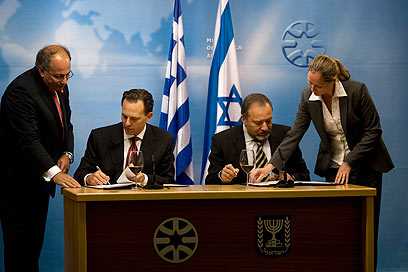
    A multitude of ventures. Droutsas and Lieberman (Photo: AP)
    A multitude of ventures. Droutsas and Lieberman (Photo: AP)

    In recent weeks, Greek media outlets have reported at length about the dramatic improvement in ties between the two countries. A Greek military source said that Israel is mostly interested in aviation cooperation, while the Greeks expected to receive defense technologies and embark on joint projects to develop defense systems.

    In August, Prime Minister Benjamin Netanyahu visited Greece as PM Papandreou’s guest, and last week a senior Greek delegation visited Israel in order to identify areas for cooperation. In an unusual move, delegation members met with PM Netanyahu, as well as other senior officials.

    In another development highlighting the current idyll, Greek Foreign Minister Dimitris Droutsas landed in Israel Sunday for a two-day visit. Among other things, he was expected to sign a new aviation cooperation agreement with his counterpart, Avigdor Lieberman.

    Strategic interests

    Ties between the two nations were never cold and have been conflict-free, despite their long history, Droutsas told Yedioth Ahronoth in a special interview, adding that the current Greek government intends to bolster the renewed tied further.

    When asked if Turkey should be concerned, Droutsas said that the cooperation between Jerusalem and Athens would never go against any other nation. On the contrary, he said, “One of the main parameters here is to stabilize the entire region. The Middle East is of vital interest for Greece.” Athens, he added, wishes to cultivate peaceful and neighborly relations in the region, which could only benefit its prosperity.

    Israel and Greece share political, economic, cultural and defense ties, he continued, and also to create strategic ties which would span all areas equally. “One thing is very clear – Israel is a pioneering nation when it comes to high-tech and we would be thrilled if such cooperation proved fruitful.”

    As for the rumored Israeli-Greek gas line, Droutsas said that energy, in any form, is of great significance to Greece and Europe, and naturally – for Israel as well. Nevertheless, he qualified, it is still too early to discuss specific plans.

    The Greek economy has been slowly recovering from one of the worst recessions in its history, and the gradual process – and underlying potential – has not escaped the attention of Israeli investors, who are eying Greek investments. According to Droutsas, the biggest potential currently lies in the tourism and renewable energy industries and the government in doing its best to attract foreign investors.

    The deepening crisis between Israel and Turkey had a resounding effect on the Turkish tourism industry, as tension between the two leading Israelis to practically abandon their once-favorite vacation destination, in favor of nearby Greece.

    “There is a very impressive 60% growth in tourism from Israel. If in 2009 155,000 Israelis visited us, in 2010, so far, we’ve had over 250,000. We are delighted and flattered that Israelis prefer Greece now, and we hope it will not be a fleeting phenomenon, but one that keeps growing,” Droutsas said.

    Greece’s beauty, he added, is one that takes a lifetime to experience. “Israelis should know that we welcome them. We want to cultivate these ties, because a touristic link is also a cultural one between our people,” he said.

    ‘We understand Israel’s concerns’

    But what about Turkey’s new affinity to Iran? According to the Greek FM, while naturally, every nation is free to prioritize policies as it sees fit, Greece’s foreign policy focuses on two avenues: pursuing a set of values and principles which promote stability, and participating in formulating European Union policies, in a way which would bolster the EU’s international standing and position. “Turkey’s position on Iran does not coincide with that of the EU,” Droutsas said – a point that cannot be taken lightly considering that Ankara wants to become a member nation.

    Greece, he added, supports the EU’s position that every peaceful way to resolve the Iranian problem should be exhausted. “We are truly concerned by the fact that no such progress has been made. Things today are perilous.”

    When asked where Athens stands on the issue of Gaza-bound flotillas – especially in view of recent report that it had prevented such sails from leaving its shores, Droutsas treads carefully: “Greece understands Israel’s legitimate security concerns perfectly. Simultaneously, we understand the humanitarian problems in Gaza. Israel’s decision on mitigations was a step in the right direction, but the difficult situation in Gaza does not contribute to the peace process.”

    Gaza’s frustration, he continued, “Pushed parts of the Palestinian people to the extreme and fuels the fires of radical groups, which in turn has various implications on Israel’s security. The situation has prompted Greece and Cyprus to promote an initiative which may ease the flow of humanitarian aid to the Gaza Strip.”

    Greek public opinion of Israel, however, is less forgiving, but Droutsas believes that can be changed.

    “Strengthening the ties between our countries reflects a sentiment shared by both nations…the harsh humanitarian situation in Gaza and the perpetuation of the Palestinian problem harm Israel’s international image, not just its image in Greece.

    “That is why I feel Prime Minister Benjamin Netanyahu’s decision to pursue peace talks with Mahmou Abbas is so important. Both leaders deserve our support. They must develop mutual trust that would enable them to resolve the situation.”

    Droutsas also believes that the differences between Israelis and Greeks are minute.

    “We have so much in common, in all aspects of life,” he said. To illustrate, he points out that he has no idea how it is that the many successful Greek-style Israeli singers, such as iconic singer Yehuda Poliker, have yet to become mega-stars in Greece.

    “I wish my visit had started on a Friday – I missed the chance to see Poliker at the Zapa Club in Tel Aviv,” he said.

    ynetnews

  • Bagis says Turkey, Greece could overcome unresolved issues

    Bagis says Turkey, Greece could overcome unresolved issues

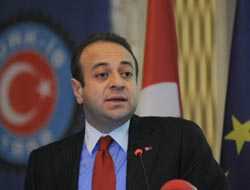
    Bagıs said he believed the Greek government would take the necessary steps to meet the demands of the Turkish population there.

    Sunday, 17 October 2010 16:20

    Chief Negotiator for Turkey’s accession talks with the EU, State Minister Egemen Bagis, said Turkey and Greece could overcome the unresolved problems between them by adopting new approaches and discourses.

    In an exclusive interview with Greek newspaper Athens Tipos tis Kiriakis published Sunday, Bagis made comments on Turkish-Greek relations and the minorities issue.

    Bagis said everyone grasped that the deadlock in certain unresolved issues between the two countries favoured no one, noting that it was time to move ahead and bring new approaches and discourses in long standing issues to the benefit of both countries.

    Bagis pointed out that for the first time since the time of Ataturk and Venezilos, governments of both countries reached out to each other with such vigour.

    “We may not have made the desired progress yet, but we can sincerely say that our governments and peoples share the same approach in overcoming unresolved issues,” said Bagis.

    He said the signing of 22 agreements and the establishment of the High Level cooperation Council between the two countries, was a milestone in Turkish-Greek relations. He said significant progress have been recorded in the commercial relations between the two countries, adding that the new target was boosting the trade volume from $2.7 billion to $5 billion.

    Stressing that issues of Greek and Turkish minorities in the two countries were in fact a matter of human rights, Bagis said these should be addressed by the governments of the two countries on the basis of good will. Referring to the principal agreement between Turkish authorities and the Fener Greek Patriarchate to turn the disputed orphanage in Buyukada to an environmental institute, Bagis said this was just one of the major steps taken by the Turkish government about the Greek minority in Turkey.

    He said the Heybeliada Seminary issue was Turkey’s internal affair. He said Turkey’s Greek Orthodox citizens had the right to practice their religions, expressing his confidence that Turkey would find a solution to this issue from an human rights perspective. He pointed out that the problems of the Turkish minority in Western Thrace was also a matter of human rights adding that he believed the Greek government would take the necessary steps to meet the demands of the Turkish population there.

    Source: Worldbulletin