Category: Greece

  • Semi-pregnant!

    Semi-pregnant!

    OPINION

    Yusuf KANLI

    As Turkey’s European Union membership process continues on its long and winding uphill road with no clarity, after so many decades, whether inshallah it will be completed one day with a happy orthodox marriage or a mateessüf (unfortunate) firm rebuff with an indecent offer of becoming a “privileged partner,” or mistress, of Europe, some European bureaucrats and politicians were reported to be shocked to see a sharp drop in the interest in the Turkish media to the just-released annual progress report…

    Turks are of course frustrated with the European Union membership process. When they first knocked on the door of Europe with a request for membership it was in the early 1960s. In 1963 Turkey and the forefather of today’s EU signed the so-called Ankara Agreement, which called for Turkey’s membership in the community once it completed its preparations and improved its economy and democracy to meet European standards. The 1963 accord had two dimensions, an economic one and a political one. The economic dimension of the Ankara Agreement was completed, with considerable delay, in 1995, and Turkey joined in the European customs union and became the first-ever country to engage in the customs union scheme without completing full EU accession.

    Indeed, from the day Turkey engaged in the customs union deal it agreed to a transformation of its membership-targeted EU process into a “mistress affair” or privileged partnership as by entering into the customs union without getting the political bonus, or membership and the right to contribute to the shaping of European policies, Turkey liberally opened its entire market to EU industry and commerce. That is, from 1995 on Turkey-EU relations have been something like semi-pregnancy; Turkey is in the EU, has to abide with EU decisions and policies, but it is not an EU member and thus totally out of the policy-making process of the EU.

    Yet, though he refuses even to commit himself to a marriage sometimes in the future and insists on saying, “Well, we have an affair, let’s live it liberally… Perhaps, who knows what the day will bring, we may marry one day, or just part ways,” the European arrogant “husband” keeps on asking “mistress Turkey” to conform with this or that decision of the European family, walk the extra mile and offer some additional compromises to please the spoiled Greek Cyprus kid, provide some improvements in the rights and liberties of the non-Muslim as well as Muslim minorities and even take such steps that might seriously endanger the national and territorial integrity of the country.

    As if such oddities were not enough, every other day Turkey would be insulted with some ludicrous claims regarding Cyprus or find itself trying to understand some masterpieces of Turkish animosity pouring out of the mouths of an arrogant small French man or a blunt German lady who happen to be sitting in governmental seats in their countries. Yet, European “friends” of Turkey are astonished to see a marked decrease in the support in Turkey for the country’s EU membership bid.

    Come on, Europe must try to understand why a person like President Abdullah Gül, who over the past many years repeatedly expressed full support to EU membership, has started to talk all of a sudden about the probability of Turks saying no in a referendum – if the process is ever completed and Turks go to a referendum to make the final decision on accession – on EU membership. What Gül said is indeed what many people, including this writer, have been stressing for the past many years: Turkey needs Europe and Europe needs Turkey. If Europe does not want Turkey in, Turkey definitely does not want to be with the EU either. Turkey is no parasite which might think membership in the EU is an existential issue for itself.

    Since the 2005 start of the accession talks process negotiations have started in only 13 headings, provisionally closed only in one heading but unfortunately most of the remaining 22 chapters of the 35 overall chapter acquis communitaire have been held hostage by either France or the Greek Cypriot administration.

    While issues of freedom of expression, press freedom, democratic representation and such fundamental democracy shortcomings are not given adequate prominence in Turkey-EU political dialogue, held hostage by some extraneous issues, it is indeed sad to see Europeans complaining about why Turks feel frustrated with the EU process.

    Perhaps Europe must try to find an answer to why Prime Minister Recep Tayyip Erdoğan, in his typical arrogance, declared the other day that in the next 18 months or so Turkey might be compelled to make a final decision on its EU bid if Europe continues to ominously keep Turkey in a waiting room.

    There cannot be a semi-pregnancy.

    , November 10, 2010
  • No ifs or buts, Turkey must be part of the EU

    No ifs or buts, Turkey must be part of the EU

    Cyprus is just an excuse for those who cannot stomach the accession of a Muslim country

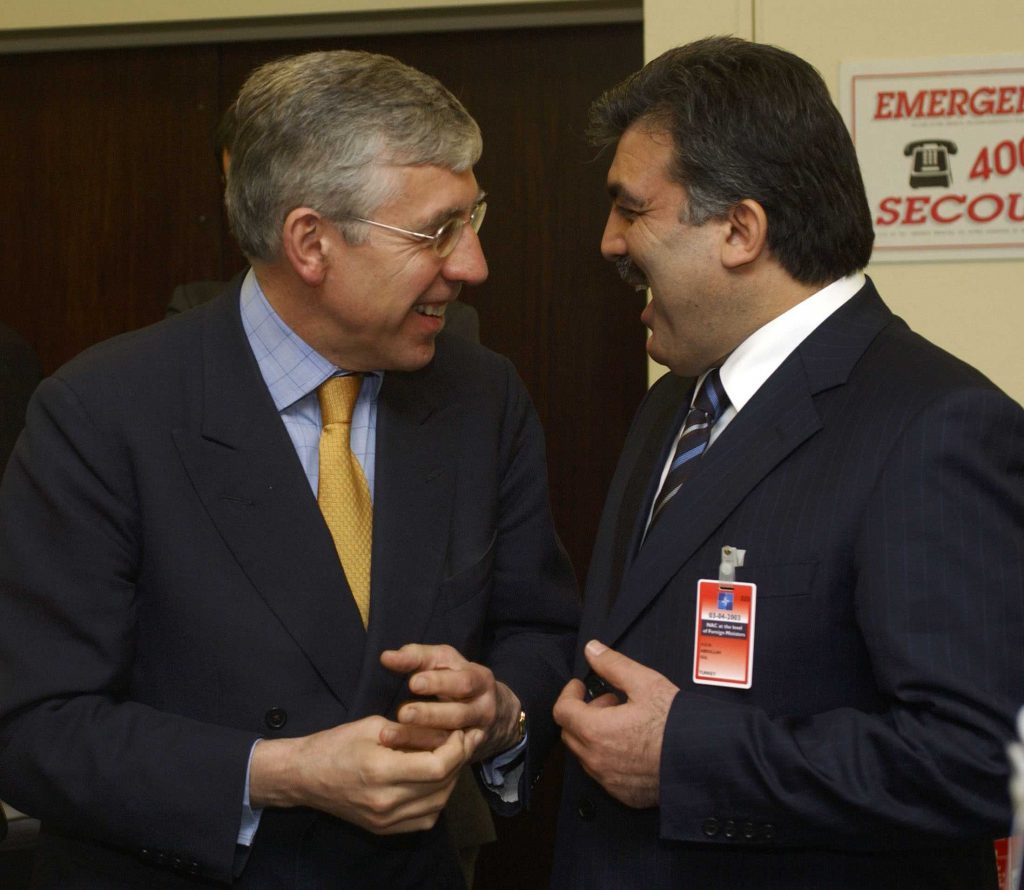
    Jack Straw

    Photo: NATO

    The most important strategic decision facing the EU is its future relationship with Turkey. The UK’s position has long been clear and bipartisan — full Turkish membership of the EU as soon as possible. David Cameron told the Commons in June that “we should back \[Turkey’s membership\] wholeheartedly”. Britain’s unambiguous support for Turkey will be underscored by the visit of Abdullah Gül, its President, this week, with the award to him tomorrow by the Queen of the Chatham House Prize.

    Forty-six years after Turkey first signalled its wish to join the EU, there was some hope in 2005 that rapid progress towards this goal might be achieved. Following tortuous negotiations under the UK Presidency all 27 members of the EU agreed on 3 October 2005 actively to start accession negotiations with Turkey .

    But the wheels have come off, with potentially disastrous consequences. In the summer, in light of Turkey’s refusal to back tougher sanctions on Iran , Robert Gates, the US Defence Secretary, claimed that Turkey may have been “pushed by some in Europe” towards Iran. This “pushing away” has not followed from any conscious rethinking of the 2005 decision to embrace Turkey, but principally because Europe’s strategic future with Turkey (population 74 million) is now hostage to negotiations over Cyprus. (Greek Cypriot population 0.75 million, Turkish Cypriot 0.25 million).

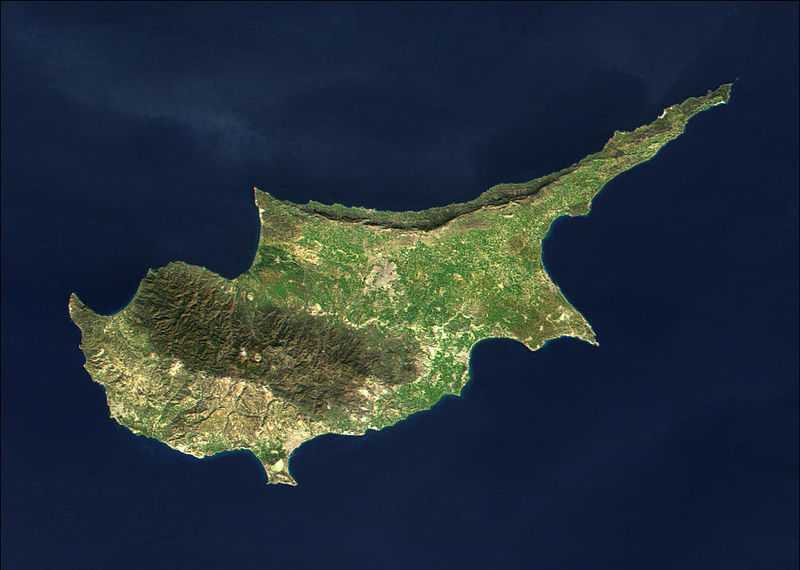
    Cyprus is an internationally recognised sovereign state. However, the writ of the Government of Cyprus extends only to the south of the island, ever since the Turkish Army’s occupation of the predominantly Turkish Cypriot north in 1974. A UN “Green Line” runs through the middle of the capital, Nicosia, with the government of the not-so-far recognised “Turkish Republic of Northern Cyprus” (TRNC) in control in the north, with thousands of Turkish troops garrisoned there too.

    There are two stories: one of the “unjustifiable” Turkish invasion; the other of such “violent oppression” by the Greek majority of the minority that Turkish protection was (and is) vital. Both sets of stories have truths, but because Greek Cyprus was admitted to the EU before any settlement of the island’s future it is their truths which dominate EU decisions on Turkey .

    Of the 35 chapters of the draft accession treaty with Turkey, 18 (the key ones) are blocked or frozen — eight by a formal EU decision, four by France, and six by Cyprus. Although there is opposition in France to Turkish membership, the naked vulgarity of those whose real objections are that Turkey is 98 per cent Muslim would be far easier to counter without the convenient excuse that Cyprus provides.

    Each of the blocks on Turkey’s accession can be plausibly explained by reference to some failure by Turkey , or the TRNC, to meet formal undertakings in full. But there is a larger reality here, that failures by the EU or Cyprus are brushed aside. In 2004 the President of Cyprus, Tassos Papadopoulos, signed a UN accord for a referendum on a new power-sharing constitution. He then campaigned duplicitously for a “no” vote. He was rewarded with EU membership, while solemn EU commitments to the Turkish Cypriots who kept to their side of the bargain and voted “yes” have never properly been delivered.

    Despite Turkey’s longstanding acknowledgement that because of its size, and differential wage costs, there would have to be decades-long transitional restrictions, especially on free movement of labour, it has been more toughly treated by the EU than any other applicant state.

    Take Bulgaria and Romania . They were admitted to the EU in 2007 after waiting only ten years. Their GDP per head is similar to Turkey’s. There are serious concerns, still, about corruption and inadequate judicial systems in these two countries. Yet the EU chose (and I was party to this) to apply a Nelson’s eye to some of those shortcomings in pursuit of a wider strategic goal. In other words the EU showed some practical vision now so lamentably lacking for Turkey.

    Under a succession of able Special Representatives the UN has made heroic efforts over the years to find a one-state solution for Cyprus, in accordance with the UN mandate for a “bi-zonal bi-communal federation, with political equality”. This task now falls to Alexander Downer, the former Australian Foreign Minister. He’s talented and experienced, and might pull off success.

    Next week, the Greek Cypriot President Demetris Christofias, and the TRNC President Dervis Eroglu have critical talks with the UN Secretary-General. We should pray for success. But the chances of a settlement would be greatly enhanced if the international community broke a taboo, and started publicly to recognise that if “political equality” cannot be achieved within one state, then it could with two states — north and south.

    It is time for the UK Government to consider formally the partition of Cyprus if the talks fail. This will be very controversial in the UN as well as the EU. Russia will be vehement in its opposition — as it was with Kosovo. But those who respond by inviting me to wash my mouth out with carbolic might like to say how much longer the EU and the UN can tolerate the current approach, whose only consequence so far has been to paralyse the development of relations with Turkey.

    Good reasons led me to believe that having (Greek Cypriot) Cyprus within the EU would assist the peace process. This judgment has not been borne out by events. When in 2004 Cypriot behaviour did lead us to have second thoughts, we should have faced down the explicit threat from Greece to veto all other accessions (of states such as Poland and Hungary ) unless Cyprus came in at the same time.

    We cannot turn the clock back. But we can change the terms of trade. The EU needs Turkey rather more than Turkey needs the EU.

    Jack Straw was Foreign Secretary 2001-06

    The Times, London

  • EU police battle surge in illegal immigrants

    EU police battle surge in illegal immigrants

    ATHENS: European Union border teams have arrived in north-eastern Greece to help authorities stem an influx of migrants across its border with Turkey.

    It is the first time that a rapid-intervention border team has been deployed to an EU member state since the Frontex teams were created in 2007.

    Frontex agreed to send the team of 175 officials last month after Greece asked the EU agency for help because of the increasing number of refugees – mainly from Africa and Afghanistan – attempting to cross the border to find their way into the EU.

    Advertisement: Story continues below

    Personnel and equipment from Germany, Romania, Austria, Bulgaria, Hungary, Slovakia and Denmark will be deployed along the border. The mission is expected to last for two months and efforts will focus on policing a previously unguarded 12-kilometre river border between the towns of Nea Vyssa and Orestiada.

    The Greek daily Kathimerini said more than 30,000 migrants had entered the EU across the narrow stretch of river. Frontex recorded a sixfold increase there in the number of immigrants trying to enter Greece in the second quarter of this year.

    More people are trying to cross via Turkey because a previously used route from Libya to Italy was closed last year by a controversial bilateral agreement which allows Italian vessels to turn back migrants’ boats caught at sea.

    According to United Nations officials, 300 to 400 migrants enter Greece each day, which has lead to a crisis in the country’s migrant detention system.

    Last week the United Nations called on EU states to stop all transfers of asylum seekers back to Greece under the Dublin II agreement due to the poor conditions they face in the country.

    The Dublin agreement allows states to send asylum seekers back to the country where they first entered the EU to have their application processed.

    Last month Greece, which has vowed to crack down on illegal immigration, had a backlog of more than 52,000 asylum claims waiting to be processed.

    Deutsche Presse-Agentur

  • EU deploys rapid intervention teams at Greek-Turkish border

    EU deploys rapid intervention teams at Greek-Turkish border

    BRUSSELS, Nov. 4 (Xinhua) — The first deployment of Rapid Border Intervention Teams (RABIT) is taking place at the Greek- Turkish border, European Commission said here on Thursday.

    The deployment of RABIT, a mechanism which enables the deployment of community border guards, aims to control the massive inflow of undocumented immigrants from Turkey.

    Some 175 officers have been mobilized over 12 kilometers with the aim to secure the land and help the Greek authorities to enhance surveillance.

    The European Commission said on Thursday the deployment is expected to have an important impact on traffickers and smugglers at the border. In addition to border guards, technical resources, transport and equipment will also be provided.

    Commissioner for Home Affairs, Cecilia Malmstrom, is expected to travel to Greece on Thursday afternoon and to observe the operation during the whole day on Friday.

    Related:

    Visiting Turkish PACE president angers Greek Cypriot host

    NICOSIA, Nov. 2 (Xinhua) — Cyprus Parliament speaker Marios Karoyian on Tuesday voiced displeasure at the visiting President of the Parliamentary Assembly of the Council of Europe(PACE), Turkish parliamentarian Mevlut Cavusoglu, for crossing over to the breakaway Turkish Cypriot north while on an official visit to Cyprus.

    Cyprus has been divided since 1974 when Turkey militarily intervened and occupied the north of the island following a coup by a group of Greek. Ankara does not recognize the Cyprus government and refers to it as the Greek Cypriot administration.   Full story

    PACE president rejects Cyprus’ accusation over visit to Turkish Cypriot north

    NICOSIA, Nov. 4 (Xinhua) — Mevlut Cavusoglu, President of the Parliamentary Assembly of the Council of Europe (PACE), has rejected accusation that he “misled”the Greek Cypriot host over his recent visit to the Turkish Cypriot part of the island.

    Cavusoglu, from Turkey, visited the divided Mediteranean island from October 31 to November 2. Apart from his contacts in the Greek Cypriot south, which is under effective control of the internationally recognized Republic of Cyprus, he also crossed to the breakaway Turkish Cypriot north to meet officials there.   Full story

    via EU deploys rapid intervention teams at Greek-Turkish border.

  • Why is the E.U. Sending Armed Guards to Greece?

    Why is the E.U. Sending Armed Guards to Greece?

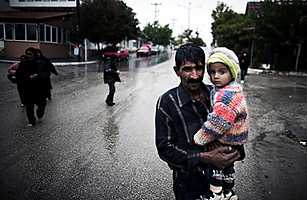
    A migrant from Pakistan holds his daughter while walking in Nea Vissa, Greece, near the border with Turkey. A flood of would-be migrants and asylum seekers in Greece's northeastern border region with Turkey has sparked a humanitarian crisis, according to the local United Nations refugee agency. Angelos Tzortzinis / AFP / Getty Images
    A migrant from Pakistan holds his daughter while walking in Nea Vissa, Greece, near the border with Turkey. A flood of would-be migrants and asylum seekers in Greece's northeastern border region with Turkey has sparked a humanitarian crisis, according to the local United Nations refugee agency. Angelos Tzortzinis / AFP / Getty Images

    As the world watches Greece wrestle with its crushing debt and crippled economy, the country is quietly struggling to manage another burgeoning crisis: the dramatic influx of illegal immigrants crossing from Greece into the European Union. Officials say Greece receives about 85% of Europe’s total illegal immigrants, many of them coming through Turkey. Now it doesn’t know what to do with them — or how to stem the flow.

    So at Greece’s request, the E.U. took the unprecedented step on Tuesday of agreeing to deploy border guards to help the country police its land border. “We could not handle this situation alone anymore,” says Christos Papoutsis, Greece’s Minister of Citizen Protection. “We don’t have the centers to house the people, we don’t have the staff to help them.”

    (See photos of immigration in Europe.)

    Greece and Frontex, the Warsaw-based agency that coordinates the patrolling of the E.U.’s external borders, are still working out the details of the deployment, including the number of guards — who will be armed — as well as when they will arrive. But both Papoutsis and a spokeswoman for the E.U. Commission, the 27-nation bloc’s executive arm, say the guards — who are part of the so-called rapid-intervention force — will operate under Greek command — and that the deployment will happen “as soon as possible.”

    This will be the first time the rapid-intervention force has been deployed since it was created in 2007. And in another sign that the E.U. is taking the migration influx into Greece more seriously than ever before, earlier this month Frontex opened a regional center in the port city of Piraeus, the agency’s first office outside of its Warsaw headquarters.

    (See photos of violent austerity protests in Greece.)

    Though the number of illegal migrants entering Europe has decreased overall, the number of illegal crossings along Greece’s land border has gone up, according to Frontex. Greece was the point of entry for about 90% of illegal border crossings into the E.U. in the second quarter of this year, compared to 65% in the first quarter. The E.U. Commissioner for Home Affairs, Cecilia Malmstroem, said in a statement on Oct. 24 that the number of illegal immigrants at the Greek land border with Turkey has “reached alarming proportions,” adding that “Greece is manifestly not able to face the situation alone.”

    (Read about how Greece is courting foreign investments.)

    Malmstroem pointed out that one hotspot for illegal crossings is an eight-mile stretch near the northeastern Greek town of Orestiada. “Every day, we have more than 300 people trying to enter illegally along this area,” says Greek minister Papoutsis. “In relation to the size and population of Greece, that is essentially like adding an entire new village to the country every day.”

    One reason so many migrants are now trying to cross through Greece is the increased sea patrols off the coasts of Spain and Italy, countries through which many North African migrants had slipped into the E.U. in the past. Libya has also stepped up its sea patrols, cutting off another well-traveled route into Europe through Sicily and southern Italy.

    (Comment on this story.)

    Many of those who have made their way into Greece identify themselves as Afghans and often ask for asylum, though few have identification. Frontex has noted a six-fold increase in the number of Afghans who sought to cross into Greece illegally in the second quarter of 2010.

    Because few illegal immigrants have papers, it’s hard to repatriate them. For those asking for asylum, the process could keep them waiting in limbo in Greece for years. This summer, the country had a backlog of some 52,000 asylum claims waiting to be processed, according to the United Nations. Greece itself is partly at fault for the backlog, since asylum requests are funneled through one central, understaffed office. Papoutsis says the government is now drafting a law that would help make the evaluation of asylum requests more efficient, including adding offices to speed up the process.

    But in its quest to get a handle on the flood of illegal immigrants, Greece also has an E.U. rule called the Dublin Regulation adding to its troubles. Under the law, countries can send asylum seekers back to the country through which they first entered the E.U. — and these days, in most cases, that’s Greece. Stavros Lambrinidis, a Greek member of the European parliament who works on asylum and border issues, and other E.U. leaders are calling for changes to the regulation that would, among other things, stop the practice of sending asylum seekers back to already overwhelmed countries such as Greece.

    “Greece is the main entry point now, so everyone stays here,” he says. “But the rest of Europe must help and take people in, because the pressure on Greece is enormous right now. It’s in the best interest of everyone, especially the asylum-seekers.”

    Lambrindis and Papoutsis also hope neighboring Turkey will help the Greeks break up the human-trafficking rings that smuggle people into Europe. But in the meantime, Greeks are focusing on the immediate problem — stopping illegal migration across their land border — before increasingly fragile relations between migrants and citizens deteriorate further. “Greeks are already worried about jobs, the decreasing quality of their lives in this bad economy,” says Papoutsis. “They are afraid. And I don’t want the xenophobes in this country to exploit that.”

    via Why is the E.U. Sending Armed Guards to Greece? – TIME.

  • Turkey Considers Cooperation with Greece on Illegal Immigration to Europe

    Turkey Considers Cooperation with Greece on Illegal Immigration to Europe

    Turkey Considers Cooperation with Greece on Illegal Immigration to Europe

    Publication: Eurasia Daily Monitor Volume: 7 Issue: 194

    October 27, 2010

    By: Saban Kardas

    Turkish Prime Minister, Recep Tayyip Erdogan, met his Greek counterpart, George Papandreou, on the margins of the Mediterranean Climate Change Initiative conference near Athens last week. The positive reporting of the Erdogan-Papandreou meeting marks the deepening rapprochement between the two countries, after their normalization slowed down in the second half of the 2000’s.

    Characterized traditionally by historical enmity and territorial disputes, Turkish-Greek relations have undergone a remarkable improvement in the past decade. The so-called Greek-Turkish rapprochement started with the two earthquakes that devastated both countries in 1999. The mutual assistance and solidarity the two nations extended to each other in response provided fertile ground to develop closer political ties. As a result, Greece, which had blocked Turkey’s EU membership process, changed its policy and became an advocate of the EU’s enlargement to include Turkey. Since coming to power, Erdogan has ascribed special importance to normalizing ties with Greece, as reflected in his close personal relationship with the former Greek Prime Minister, Kostas Karamanlis.

    However, in parallel with the deterioration of Turkish-EU relations, Turkish-Greek relations also experienced difficult times in the second half of the 2000’s. Although the Turkish-Greek trade volume has expanded throughout the decade, there has been little concrete progress over the political disputes that had traditionally dominated their relationship. The Turkish side largely preferred to pursue a policy of constructive ambiguity, and adopt a gradual approach to solving the disputes, while the Greeks from time to time expressed their disappointment over the ongoing uncertainty. Turkey’s resistance to referring the Aegean disputes to the International Court of Justice and the ongoing “dog fights” between Turkish and Greek fighter jets in the Aegean Sea remained a major source of disagreement, resulting in an occasional heightening of tension (EDM, June 22, 2009).

    The global financial crisis, which dealt a serious blow to the Greek economic system, ironically, provided another fresh impetus to resolve bilateral disputes. In that context, the recent talks follow on Erdogan’s historic trip to Greece in May, when the two countries signed over 20 agreements to develop relations in various fields, including energy, the environment and illegal immigration. They also decided to launch the High Level Strategic Cooperation Council, which complemented similar arrangements Turkey has formed with its other neighbors. Erdogan also expressed Turkey’s readiness to help Greece to recover from the financial crisis, through what he called “enhanced economic partnership” The two sides, however, failed to reach any concrete agreement on the major issues in the bilateral relationship, such as the conflicting claims in the Aegean Sea, the status of the minorities, or the Halki seminary and the Cyprus issues (Anadolu Ajansi, May 15).

    Granted, Turkish leaders’ extension of a friendly hand to Greece and their statements calling for dampening military tensions in the Aegean through closer bilateral dialogue was ground-breaking in many ways. This thinking is largely in line with Ankara’s recent policy of pursuing “zero problems with neighbors,” and prioritizing economic cooperation over political disputes. Indeed, as a stark reflection of this new thinking, Turkey will reportedly not include Greece, Russia, Iran and Iraq as enemy countries in its national security document, which is currently being revised.

    Speaking to Greek TV stations, Erdogan, also expressed clearly that Turkish flights in the Aegean have decreased significantly and that Ankara supports the idea of ceasing them entirely (Today’s Zaman, October 21). By de-securitizing its relationship with Greece and its other neighbors, Turkey hopes to reap the benefits of peace dividends, by significantly cutting military expenditures and instead focus on mutual economic gains. In the case of Greece, by turning the Aegean into a basin of peace, the Turkish government hopes, for instance, to enable the exploration of offshore hydrocarbon resources, and further cooperation in the transportation of oil and gas to European markets.

    It appears that the technical level contacts between both countries have continued since May, seeking common ground in their political disputes. In the wake of the latest trip, both parties are talking more resolutely about a shared strategic vision and pursuing win-win cooperative policies. Toward these objectives, there are stronger indicators that they might be involved in serious discussions on the resolution of thorny issues, including the Ecumenical Patriarchate and joint Turkish-Greek initiatives to curb illegal immigration to the EU. Following his meeting with Papandreou, Erdogan vowed to start cooperation on illegal immigration, so that they could tackle what he called a “common problem.” The Greek media even speculated that by the end of the year the parties might finalize a compromise agreement on the resolution of the Aegean disputes, on which they had already agreed in principle (Anadolu Ajansi, October 22; www.ekathimerini.com, October 25).

    Most Turkish media outlets preferred to present Erdogan’s trip as a major achievement which boosted his popularity in Greece. Similarly, the Greek media also underscored the optimism generated by the Erdogan-Papandreou meeting (Taraf, October 24). However, some Greek observers maintain that the Papandreou government’s closer dialogue with the Turkish government “may ring alarm bells in many circles in Greece which would interpret it (and they do) as an indication of Greece losing diplomatic ground in the Aegean, or even in Greek Thrace” (Hurriyet Daily News, October 24).

    In any case, the resolution of the remaining disputes with Greece serves the Turkish government’s foreign policy objectives. Especially by addressing the illegal immigration issue and the reopening of the Halki seminary, Turkey can remove major obstacles which have bedeviled its accession process into the EU. The EU has been expecting Turkey to harmonize its practices on illegal immigration with European regulations, and reopen the Greek Orthodox seminary to show its support for human rights. Moreover, through its constructive dialogue with Greece, Ankara solicits the support of Athens within the EU. Recently, the Turkish government has tried to mobilize the pro-Turkey EU members so that they could break the stalemate over membership talks. Reportedly, in exchange for its cooperation on the illegal immigration issue, Turkey expects Greece to at the very least, assist with the relaxation of European visa regulations for Turkish citizens.

    https://jamestown.org/program/turkey-considers-cooperation-with-greece-on-illegal-immigration-to-europe/