Category: Greece

  • Greece Worries Over Recent Wave of Migrants Through Turkey

    Greece Worries Over Recent Wave of Migrants Through Turkey

    Greece is expressing concerns that a recent wave of North African immigrants may seek to enter their border via Turkey.
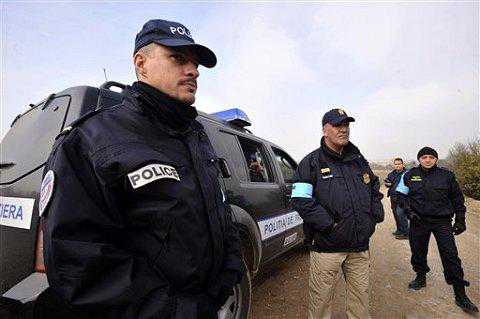
    Frontex Police officers stay near the border with Turkey as they are deploy to help Greek border police to control the crossing of illegal immigrants to Greece and Europe near Nea Vyssa, northeastern Greece, 480 kilometers east of Thessaloniki (File Photo)
    Frontex Police officers stay near the border with Turkey as they are deploy to help Greek border police to control the crossing of illegal immigrants to Greece and Europe near Nea Vyssa, northeastern Greece, 480 kilometers east of Thessaloniki (File Photo)

    Istanbul becomes a hub to human smugglers

    Istanbul, Turkey’s largest city, is only a few hours drive to the Greek border. Its international airport offers direct flights to most African and Middle Eastern countries and there are few visa requirements for most people entering.

    This combination has made the city one of the centers for people seeking to enter the European Union illegally whether for political or economic reasons.

    Many turn to what is known as a “connection man” who links the migrants with human smugglers who assist them across the border.

    It is a ‘big business,’ says smuggler

    One of these of “connection men” is Michael – not his real name. He is from West Africa, and says human smuggling in Istanbul is now a big business, but it is not without risks.

    “So it’s easy. It’s a big business. There is a lot of money involved,” he said. “That’s why there are new people now involved in this way. To my knowledge I have almost 10 or 12 contacts. The main route to Greece: They can go by land or by ship,” continued Michael. “But by ship – usually one voyage per 3 months. By land there is a voyage one time a week. But there are more risks by land . If your food finishes or you get bad [sick], maybe you can die, they will forget you there. No one will take care or you. And the second risk is that as Turkey and Greece were once long time enemies, there are mine lands in the border. There are people dying in this way.”

    EU: 80,000 illegal migrants per year into Greece

    Despite the risk, the EU says 80,000 illegal migrants enter Greece through Turkey every year . One of them is David from Nigeria.

    “One time I tried to the best I can, to cross over to Greece. All they promised us we are bringing you a boat. All we saw was a balloon boat,” he said. “And, because of the distance, we travelled for two days. I saved the life of two guys who were with me. Both were so afraid that they could not even handle anything. But I alone I was able to paddle the balloon boat and we went across to Greece. But by the time we got across the police caught us and kept us in cells for one week, two weeks, three weeks.”

    David was eventually deported back to Turkey, where he is now considering another attempt.

    To stem the growing flow of migrants, EU border police were sent to help Greek security forces. Athens now fears with the Middle East and Northern Africa turmoil those numbers could rise even further.

    Leaders discuss illegal immigration

    The Greek minister responsible for illegal migration, Christos Papoutsis, visited Ankara earlier this month to discuss the issue.

    Professor Ahmet Icduygu of Istanbul’s Koc University warns that human smuggling is becoming increasingly sophisticated

    “Overall, I say its a very well working system, through the networks of the friends and relatives,” said Icduygu. “And the mobile phones, it’s quite important in all this smuggling and trafficking business.”

    Competition in human smuggling business

    According to experts, human smuggling has become a multimillion dollar business. Connection man, Michael says such competition is driving prices down and now many migrants only have to pay if the trip to their destination is successful.

    “No one pays cash [upfront] now because of the competition,” said Michael. “If I have a friend who wants to go Italy, I present myself as a guarantor and take his money. And, when he reaches Athens or Rome he calls me, meaning that he is safe, he is now in Europe. And, then I call the guy and pay him.”

    The increasingly level of sophistication of human smugglers along with the growing competition can only make Istanbul even more attractive to would-be migrants. Observers say with the escalating turmoil in Libya and other countries in the region in the coming months could well see business growing for the human smugglers.

    via Voice of America

  • Turkish FM wants better links with Thessaloniki

    Turkish FM wants better links with Thessaloniki

    Davutoglu promises to improve connections after meeting mayor Boutaris

    Thessaloniki Mayor Yiannis Boutaris (l) and Turkish Foreign Minister Ahmet Davutoglu talked for about 40 minutes on Thursday.

    Thessaloniki Mayor Yiannis Boutaris and Turkish Foreign Minister Ahmet Davutoglu met in the northern port city on Thursday as part of the latter’s visit to Greece.

    “I am determined to help create strong bonds of friendship between Thessaloniki, Istanbul and Izmir,” said Davutoglu.

    “I will support efforts for sea, air and rail connections between Thessaloniki and Istanbul.”

    Boutaris said that he would try to accommodate Turkish requests for a mosque and Muslim cemetery in Thessaloniki.

    The mayor has made it known he wants to attract Turkish tourists to the city.


  • Greek P.M.: Zionism and the IMF’s Last Best Friend

    Greek P.M.: Zionism and the IMF’s Last Best Friend

    by James Petras*

    New York (United States)

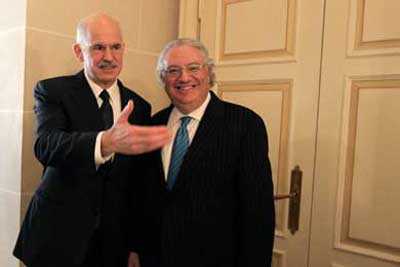
    In the midst of the Arab uprisings throughout the Middle East, at a time when even the European (EU) has publicly condemned Israel’s blockade of Gaza and its illegal land seizures in the West Bank and East Jerusalem, Greek Prime Minister George Papandreou promised a visiting delegation of U.S. Jewish leaders, his full support to undermine EU opposition and promote Israeli economic, diplomatic and political interests in Europe.

    Prime Minister George Papandreou (l) promised Alan Solow, Chairman of the Jewish Community Centers Association to help Israel forge closer EU ties. Athens, 24 February 2011.

    U.S. Zionists, recently returned from a visit to Athens described Papandreou as by far the most amenable (‘servile’) European leader they have met in recent memory. Papandreou’s slavish submission to Israeli interests includes his promise, to a delegation of U.S. zionist notables, to use his influence to pressure the new Egyptian military junta to continue to uphold the Mubarak agreements with Israel [1]. These include the continued blockade of Gaza and support of Israel’s military assaults on Lebanon, Syria and Palestinians. In other words Papandreou is openly supportive of Egypt’s past collaboration with Israeli clandestine assassinations and kidnapping of Arab militants.

    Papandreou demonstrates a greater interest in promoting Israel’s exports to the European market, than the country he ostensibly represents. He promised a delegation from the Conference of Presidents of Major American Jewish Organizations “to integrate Israel into the European market” [2] while he shrinks the Greeks economy by 10% between 2009-11 and doubles unemployment from 8% to 16%. Papandreou’s gross servility to Israel and the American Zionist power structure is manifested in his cordial reception and recent agreements with Israel’s Prime Minister Netanyahu and his foreign minister, the notorious Zionist-fascist Avigdor Lieberman – the same Lieberman who advocates wholesale expulsion of Palestinians from the West Bank. No Greek Prime Minister, since the Zionist state was founded, has exhibited such a bizarre display of active collaboration with Israel’s colonial claims in the Middle East. No European leader has so eagerly anticipated and implemented the demands of American Zionist organizations with such zeal.

    What is most striking about Papandreou’s servility to Israeli and American Zionist interests, is that it takes place when most of the rest of the world, from Europe, Turkey, Lebanon, Latin America, to North Africa (Egypt, Tunisia) and the vast majority of Arabs are moving toward isolating Israel. In other words, Papandreou is embracing a pro-Israel policy which is alienating Europe, isolating Greece from over a hundred million Arabs and undermining Greek agricultural (citrus) exports to the EU market.

    Papandreou’s perverse and highly prejudicial foreign policy is matched by his extraordinary adherence and enforcement of the debt payment policies dictated by the IMF and the bankers of the EU and the US. His behavior is particularly shameless at a time when the next Irish government is threatening to declare a debt default if payments are not reduced. In his eagerness to ingratiate himself with the overseas bankers, Papandreou has systematically extracted billions of euros via a 20% reduction in wages, salaries and pensions and transferred it to the coffers of the banks. In the process Papandreou’s policies have doubled the unemployment rate, shrank the economy and undermined any future growth for the next decade.

    Papandreou rejected the Argentine formula, which in the face of a similar crises in 2001-02 , defaulted rather than deepen poverty. Under President Kirchner, Argentina renegotiated its debt, shaving bond payments by 75% and imposing a moratorium. As a result, Argentina recovered from the crises and maintained a growth rate of 7% for over a decade while reducing unemployment from 22% to less than 6%.

    If Papandreou acts as a submissive messenger boy for Israel and its Zionist fifth column in America, he features prominently as the eager and aggressive “bill collector” for the overseas banks. He will go down in historical infamy as a willing accomplice of Israeli war crimes, an upholder of its unequal treaties with Egypt in his foreign policy and the enforcer of financial predators who impoverish millions of Greeks at home.

    Having decimated the Greek economy via transfers of billions abroad and undermined economic relations with the Arab countries, Papandreou offers to sell Greece’s most lucrative transport, ports energy and communication companies to Chinese, Israeli and Wall Street investors and speculators. It is ironic that George Papandreou the son of former Prime Minister Andreas Papandreou should reverse each and every one of his father’s policies, especially with regard to the Middle East.

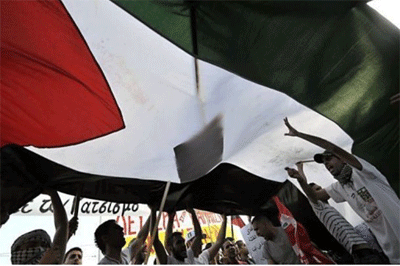
    Pro-Palestinian demonstration outside Israeli Embassy in Athens.

    In 1981 after Andreas Papandreou was elected he invited me to Athens to discuss policies and programs of his future government. The first thing he told me was the importance of supporting the Palestinian struggle and how he had a successful meeting with Yasser Arafat, who regaled him with a prized pistol, which he displayed to me. A year later when I returned to Greece to direct and develop a research center, he invited me for a swim. We were accompanied by a dozen underwater security guards, patrolling offshore, against a potential assassination plot by Mossad, according to the prime minister, in reprisal for his solidarity with the Palestinians in Lebanon.

    A few days later over 50,000 Greeks led by Culture Minister Melina Mercuri marched in solidarity with the Palestinians and in repudiation of Israel’s role in the bloody massacre of 2000 women and children in Sabra and Shatila. The contrast of the two generations of Papandreou’s could not be more stark; while Andreas saw Greece as a bridge between Europe and the Arab East, George sees Greece acting as a pimp for Israeli business interests in Europe and as a lobbyist for its dominance in the Middle East. The Zionists have lost an old client in Mubarak and gained a new one in Papendreou.

    Like Mubarak, George Papandreou combines servility to his imperial mentors with arrogance and brutality to his Greek subjects. As the Egyptians demonstrated it will take the Greek people more than marches and occasional strikes to bring down an entrenched client of the empire. But it can be done as was exemplified in Cairo!

    James Petras
    James Petras is a Bartle Professor (Emeritus) of Sociology at Binghamton University, New York. He is the author of 64 books translated in 29 languages and has published over 2000 articles. His most recent book: Global Depression and Regional Wars, Clarity Press (2009).

    http://www.voltairenet.org/article168625.html, 27 FEBRUARY 2011

  • Athens Chaos, Police officer turned into a fireball

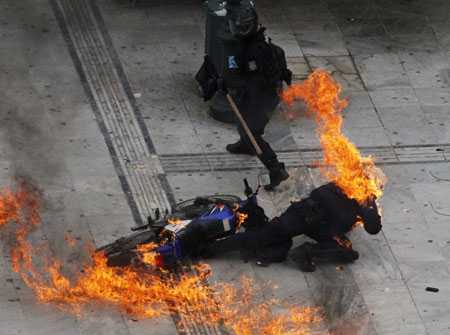
    Athens Chaos, Police officer turned into a fireball

    Greek riot police, protesters clash

    Unions are angry at the ongoing austerity measures

    ATHENS, Greece (AP) – Young demonstrators hurled rocks and fire bombs at riot police as clashes broke out Wednesday in Athens during a mass rally against austerity measures, part of a general strike that crippled services and public transportation around the country.

    Police fired tear gas and flash grenades at protesters, blanketing parts of the city center in choking smoke. Thousands of peaceful demonstrators ran to side streets to take cover. A police officer was attacked and his uniform caught fire in the city’s main Syntagma Square, and his motorcycle was burned.

    At least two people were injured and another three arrested. One group of rioting youths smashed paving stones in front of the central Bank of Greece, but there were no immediate reports of any serious damage.

    More than 30,000 protesters attended the Athens rally, which had been calm before the clashes. Protesters chanting “Don’t obey the rich — Fight back!” marched to parliament as the city center was heavily policed. A brass band, tractors and cyclists joined the rally.

    The rally was part of Greece’s first major labor protest this year as Prime Minister George Papandreou’s Socialist government faces international pressure to make more lasting cuts after the nation’s debt-crippled economy was rescued from bankruptcy by the European Union and the International Monetary Fund.

    The 24-hour strike halted trains, ferries and most public transport across the country, and led to the cancellation of more than 100 flights at Athens International Airport. The strike also the closed the Acropolis and other major tourist sites.

    State hospital doctors, ambulance drivers, pharmacists, lawyers and tax collectors joined school teachers, journalists and thousands of small businesses as more middle-class groups took part in the protest than have in the past. Athens’ main shopping district was mostly empty, as many small business owners shuttered their stores.

    Unions are angry at the ongoing austerity measures put in place by the Socialist government in exchange for a euro110 billion ($150 billion) bailout loan package from European countries and the IMF.

    Stathis Anestis, deputy leader of Greece’s largest union, the GSEE, said workers should not be asked to make more sacrifices during a third straight year of recession.

    “The measures forced on us by the agreement with our lenders are harsh and unfair. … We are facing long-term austerity with high unemployment and destabilizing our social structure,” Anestis told The Associated Press. “What is increasing is the level of anger and desperation … If these harsh policies continue, so will we.”

    Elsewhere, about 15,000 people rallied and minor scuffles broke out in Greece’s second largest city, Thessaloniki, while Anestis said around 60 demonstrations were being planned in cities and towns across Greece. He said the GSEE was in talks with European labor unions to try and coordinate future strikes with other EU countries.

    Earlier this month, international debt monitors said Greece needed a “significant acceleration” of long-term reforms to avoid missing its economic targets. It also urged the Socialist government to embark on a euro50 billion ($68 billion) privatization program to pay for some of its mounting national debt that is set to exceed 150 percent of the GDP this year.

    The IMF has said some of the frequent demonstrations against the Greek government’s reforms were being carried out by groups angry at losing their “unfair advantages and privileges.”

    AP

    Wane.com

    Photo: Mirror

  • Greek Plan to Build Turkish Border Fence Draws Fire

    Greek Plan to Build Turkish Border Fence Draws Fire

    ISTANBUL, Turkey — The United States is not the only country searching for ways to control its borders. In hopes of stopping the entry of thousands of illegal immigrants, Greece has announced plans to build a fence along its porous border with Turkey, its neighbor to the east.

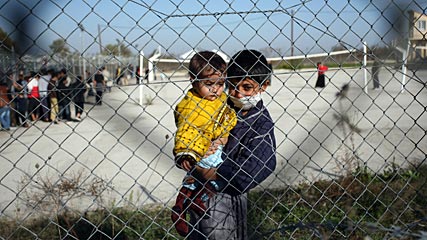
    Greek Plan to Build Border Fence Draws Fire in Turkey  Angelos Tzortzinis, AFP / Getty Images  Immigrant children peer out through the fence of an immigrant detention center in the village of Filakio, on the Greek-Turkish border.
    Greek Plan to Build Border Fence Draws Fire in Turkey Angelos Tzortzinis, AFP / Getty Images Immigrant children peer out through the fence of an immigrant detention center in the village of Filakio, on the Greek-Turkish border.

    Originally, the fence was to be 128 miles long. However, after heavy media criticism in which the proposed fence was compared to the one along sections of the U.S.-Mexico border, it was reduced to just 8 miles long and 9 feet high along the weakest point of the border, near the Greek town of Orestiada.

    According to Greek Public Order Minister Christos Papoutsis, more than 100,000 people entered Greece illegally last year. The country was reportedly the only member of the European Union that saw illegal immigration rise last year.

    “The Greek public has gone beyond its limits in terms of its capacity to welcome illegal migrants,” Papoutsis said, according to Greek news agency Ana. “Greece cannot take it anymore. We plan to build a barrier on the land border to block unauthorized immigration.”

    The plan has drawn the condemnation of the human rights organization Amnesty International. “It’s clearly a European confession of failure,” Amnesty’s Wolfgang Grenz told a German newspaper Monday. Grenz said that by allowing Greece to build the fence, the EU would break its own principles regarding human rights.

    Both the Turkish government and the European Commission have said that border protection is a matter for states to decide themselves.

    An average of 200 illegal immigrants reportedly crossed into Greece from Turkish soil every day in 2010. They mainly came from Afghanistan, Pakistan and Africa. Many were seeking asylum as refugees within the EU. Others were migrant laborers seeking work inside the EU.

    About 90 percent of all illegal immigrants that enter the EU come through Greece, according to officials.

    In November, EU Rapid Border Intervention Teams (RABITs) were deployed along the Greek border. However, their effectiveness as a deterrent to illegal immigrants was called into question, as many of the people crossing into Greece actually sought out authorities to speed up their entry into the EU asylum system.

    Metim Corabatir, a spokesman for the Office of the United Nations High Commissioner for Refugees (UNHCR) in Turkey, told AOL News in a phone interview that while every country had a right to protect its borders, fences do not deter illegal immigrants

    “Building fences do not solve this kind of problem fully,” Corabatir said. “We should not forget that there are people moving for different reasons. Some are economic migrants. There are also people seeking protection. For this region, border control managers must be sensitive to the needs of people seeking protection.”

    Situated at a geographical crossroads, Turkey has long been one of the primary stops along the road to the West. Partly due to often criticized immigration laws and the lengthy time it takes to apply for asylum through the UNHCR, most asylum seekers make Turkey a transit point and seek asylum within the EU by crossing illegally into Greece.

    According to Corabatir, while Greece grew more frustrated last year over the flood of illegal immigrants, the total number of people crossing over from Turkey was not up. “If you compare the figures, there has not been a big change in the number of people who have been trying to enter Greece through Turkey. What has changed is the route,” he said.

    Previously, illegal immigrants tried to reach Greece through the Aegean Islands between Turkey and Greece. Corabatir said there was a shift to the land border as Greece took better control of its sea borders with the help of the EU.

    The total number of people who enter Turkey every year illegally is unknown. Most leave Turkish territory quickly, and the only figures available come from Turkish authorities, who Corabatir says detain an estimated 50,000 to 60,000 illegal entrants every year. Some academics estimate that Turkey has between 200,000 and 400,000 illegal migrants entering the country every year.

    Even if asylum seekers were granted refugee status in Turkey, Corabatir said, the UNHCR would still seek to resettle them in third countries. “They cannot stay in Turkey forever and enjoy full refugee rights,” he said. “Their access to social benefits and the right to work is very limited in Turkey.”

    Despite this, the number of people seeking refugee status in Turkey had increased in recent years. In a trend that might bring relief to Greece, Turkey’s economy is developing rapidly, and immigrants who are focused on work possibilities as supposed to refugee status are finding more opportunities there.

    “In some cities like Istanbul and Izmir, some people will earn money and be happy,” said Corabatir. “This is a new phenomenon. We think Turkey will become more of a target country for economic migrants.”

    via AOL

  • Greek barrier on border with Turkey to keep out migrants

    Greek barrier on border with Turkey to keep out migrants

    ATHENS—Greece on Saturday announced plans to build a barrier along its border with Turkey in a bid to stem the flow of illegal immigrants into the European Union.

    “The Greek public has gone beyond its limits in terms of its capacity to welcome illegal migrants. Greece cannot take it any more…We plan to build a barrier on the land border to block unauthorized immigration,” the country’s immigration minister, Christos Papoutsis, told Greek news agency Ana without providing any details.

    It was the first time Papoutsis raised the idea of building a barrier along the country’s 150-kilometer (93-mile) land border with Turkey, which has become the main route for illegal migrants to enter the European Union, with almost half of detected illegal entries.

    From January to the beginning of November, 32,500 illegal migrants were intercepted in a single 12.5-kilometer (7.8-mile) stretch of the border along the Evros river.

    More than 200 guards with European border agency Frontex were deployed in the area in November, which the agency said led to a 44 percent drop in the number of illegal entries.

    The UN High Commissioner for Refugees has repeatedly urged Greece to ensure its efforts to fight illegal immigration do not harm legitimate asylum seekers, including Afghans, Iraqis, and Somalis, who are often among migrants crossing at its border.

    via Greek barrier on border with Turkey to keep out migrants – INQUIRER.net, Philippine News for Filipinos.