Category: World

  • Turkish President Erdogan Embroiled  In New $15 Million Financial Scandal

    Turkish President Erdogan Embroiled In New $15 Million Financial Scandal

    Publisher, The Calfornia Courier

    Turkey’s President Recep Tayyip Erdogan came to power 14 years ago as a devout Muslim, announcing that he intended to eliminate corruption from Turkish politics.

    As he consolidated his authority and moved from Prime Minister to an autocratic President, he forgot his promises and engaged in the very corrupt policies which he had condemned. As British historian Lord Acton has said… “power tends to corrupts; absolute power corrupts absolutely!”

    This week, I wish to cover Erdogan’s fourth corruption scandal, starting by summing up the first three involving him and his family.

    The first case is regarding Erdogan receiving an oil tanker worth $25 million as a gift from Mubariz Mansimov, an Azeri billionaire, in 2008. At Erdogan’s request, Mansimov later became a Turkish citizen and changed his last name to Gurbanoglu.

    The second case occurred in December 2013, when Erdogan and four of his Ministers were implicated in a multi-million dollar corruption probe. Faced with litigation, all four Ministers resigned. However, Erdogan interfered in the trial, dismissing the lawsuit and firing the prosecutors and policemen who had exposed his Ministers’ corrupt practices! The private phone conversations between Erdogan and his son Bilal had been recorded, revealing their discussions on how to hide the hundreds of millions of dollars in cash they had received mysteriously!

    The third case of corruption is the ongoing trial in New York City regarding a billion-dollar scheme to smuggle gold for oil from Turkey to Iran in violation of U.S. sanctions on Iran. Reza Zarrab, a Turkish-Iranian gold dealer pleaded guilty last week to all seven charges, exposing the participation of a Turkish banker, Mehmet Hakan Atilla, and seven other defendants, including Turkish Economy Minister Zafer Caglayan, who was accused of receiving millions of dollars in bribes from Zarrab in exchange for arranging the illegal scheme. Zarrab also implicated Pres. Erdogan for having authorized the illegal gold for oil trade.

    The fourth and latest corruption scheme involves members of Erdogan’s family who reportedly transferred $15 million to an off-shore company called Bellway Limited in the tax haven of Isle of Man, United Kingdom, in December 2011 and January 2012. This accusation was made by Turkey’s main opposition Republican People’s Party (CHP) leader Kemal Kilicdaroglu. The Isle of Man is a self-governing British Crown dependency in the Irish Sea between England and Ireland.

    Party Chairman Kılıcdaroglu recently announced that a company was established on August 1, 2011 on the Isle of Man with a founding capital of 1 British pound. He revealed the bank statements and copies of the $15 million wire transfers to the Bellway Limited company:

    — On December 15, 2011, Erdogan’s brother-in-law Ziya İlgen transferred $2.5 million, and on Dec. 26, 2011, $1.25 million.

    — On December 15, 2011, Erdogan’s brother Mustafa transferred $2.5 million, and on Dec. 26, 2011, $1.25 million.

    — On December 27, 2011, Erdogan’s father-in-law Osman Ketenci transferred $1.25 million, and on Dec. 28, 2011, $1 million.

    — On December 27, 2011, Erdogan’s former executive assistant Mustafa Gündogan transferred $1.25 million, and on Dec. 28, 2011, $250,000.

    — On December 29, 2011, Erdogan’s son Ahmet Burak Erdogan transferred $1.45 million, and on January 4, 2012, $2.3 million.

    Kilicdaroglu filed a parliamentary motion requesting an investigation of the transfers. However, the majority dominated by Erdogan’s AK Party voted down the measure. When Kilicdaroglu was addressing the Parliament regarding the allegations against Erdogan, the State TV cut off the live transmission!

    Turkish prosecutors announced last week that they are investigating the charges against Erdogan. However, as is widely known, no judge would dare to rule that Erdogan is guilty of any crimes, given the fact that many judges are dismissed or jailed for not complying with the Turkish President’s wishes.

    As expected, Erdogan was furious at the allegations against his family. He declared that he would resign from his post if it is proven that he has a bank account in a foreign country. Ahmet Ozel, a lawyer for Pres. Erdogan stated that the bank documents publicized by Kilicdaroglu were “fake” and described the allegations as “lies.” Erdogan threatened that Kilicdaroglu “would pay a price,” and filed a lawsuit against him seeking $500,000 for defamation!
    These scandals may have an adverse effect on Pres. Erdogan’s re-election in 2019, assuming that he would permit a fair election. We hope that Pres. Erdogan remains in office as he persists to undermine Turkey’s reputation worldwide!

  • Erdogan Keeps Alienating Everyone, Including Distinguished Foreign Scholars

    Erdogan Keeps Alienating Everyone, Including Distinguished Foreign Scholars


    Turkish President Erdogan is a ‘blessing’ to all those who are opposed to Turkish autocratic rule and massive violations of human rights. Not a day passes without the Turkish government behaving brutally against scholars, human rights activists, non-governmental organizations, journalists, and political opponents. Erdogan has done more harm to Turkey’s image around the world than anyone else since the Ottoman Turks’ implementation of the 1915Armenian Genocide.
     
    The latest manifestation of Turkish intolerance of free speech and academic freedom was displayed when the University of Michigan’s Workshop for Armenian Turkish Scholarship decided to hold a conference at the European Academy in Berlin, Germany, on Sept. 15-18, 2017. The conference was co-organized by the University of Michigan, USC Dornsife Institute of Armenian Studies, and Lepsiushaus Potsdam, under the auspices of Dr. Martina Münch, Minister for Science, Research and Culture of the State of Brandenburg in Germany.
     
    Prominent multinational scholars, including Turkish academics, were invited to participate in this important conference. However, the Turkish Council of Higher Education prevented the travel of distinguished professors from Turkey to attend the conference on “Past in the Present: European Approaches to the Armenian Genocide.”
     
    Prof. Beth Baron, President of the Middle East Studies Association (MESA), sent a highly critical letter to Pres. Erdogan and Prime Minister Yildirim in September on behalf of its 3,000 members worldwide, describing Turkish efforts against the conference as “an assault on the academic freedom of scholars in Turkey and a disturbing new instance of a broader trend of stifling scholarship on topics deemed taboo by your government…. The events surrounding the WATS conference in Berlin represent another depressing instance of your government’s failure to respect basic human rights’ protections under Turkish law despite Turkey’s clear international obligations.”
     
    Radical Turkish politician Dogu Perincek announced that the conference would “serve imperialism and the interests of Kurdistan” and called the Turkish participants ‘traitors.’ Other right wing nationalists and pro-government media in Turkey also denounced the conference.
     
    MESA’s President sent copies of her critical letter to: President of the Turkish Parliament; Justice Minister of Turkey; President of the Turkish Higher Education Council; Chair and Vice Chair of the European Parliament Subcommittee on Human Rights; High Representative of the European Union for Foreign Affairs and Security Policy; Commissioner for European Neighborhood Policy and Enlargement Negotiations; Council of Europe Commissioner for Human Rights; Committee on Foreign Affairs of the European Parliament; United Nations High Commissioner for Human Rights; United Nations Special Rapporteur on the promotion and protection of the right to freedom of opinion and expression; United Nations Special Rapporteur on the right to education; Turkey’s Ambassador to the United States; and United States Ambassador to Turkey.
     
    Not surprisingly, several weeks later, neither Pres. Erdogan nor the Prime Minister had responded to the MESA letter!
     
    In addition, a statement was issued by the WATS Organizing Committee on Sept. 18, 2017, describing Ankara’s refusal to allow Turkish scholars to attend the Berlin conference “an attack on free speech and academic freedom, indeed, to extend such intellectual repression beyond the borders of Turkey. We share the concern of the Middle East Studies Association (MESA) of North America that such actions seriously and scandalously damage scholarship and the free exchange of knowledge.”
     
    WATS stated that the conference came “under sustained attack by Turkish ultra-nationalist political circles in Turkey and Germany. Long-time deniers of the Armenian Genocide in the international arena declared that the conference will ‘serve imperialism and the interests of Kurdistan’ and framed the Kurdish issue as forming ‘the second Israel,’ clearly an anti-Semitic slur.”
     
    WATS also declared that “Turkey has been hurt by the current atmosphere of intimidation and threats as evidenced in the treatment of the scholars who wished to attend the WATS conference in Berlin…. We… call on the Turkish government to restore the academic freedoms that have been and are being violated in Turkey. We demand as well that the Turkish state desist from interfering in intellectual exchange and expression outside of Turkey…. Such interference infringes on the democratic order in Turkey and in hosting countries. The events surrounding the WATS conference in Berlin demonstrate one more instance of the Turkish state’s refusal to respect basic human rights’ protections both under Turkish law and Turkey’s clear international obligations.”
     
    Finally, Dr. Fatma Muge Gocek, Professor at University of Michigan (originally from Turkey) and co-organizer of the Berlin conference, wrote a commentary in the Washington-based Ahvalnews.com Turkish website on Nov. 10, 2017, titled: “Harassment of Turkish academics in the West should be stopped.”
     
    Prof. Gocek wrote: “I have been constantly harassed by the Turkish state because of my work. This harassment has taken the form of online slander campaigns, anonymous threats traced back to Turkey, and people at my talks planted by the Turkish state who try to challenge and demean me. I have encountered this harassment both in the United States and in Europe, despite the fact I have only given lectures at universities. Once, the FBI had to be called in to investigate a personal threat I received. This situation, which was already bad and completely antithetical to the freedom of expression and opinion, has become worse this year.”
     
    Prof. Gocek further stated that the Turkish protesters who came to the Berlin conference “not only heckled and filmed participants, but also tried to break into our meeting. Finally, Turkish newspapers reported our activities as a bizarre conspiracy to attempt to control Turkey and create a second Israel there.”
     
    Prof. Gocek concluded her critical commentary by calling on Western countries to take action against Turkey: “What is most disturbing for me is not only the persistence of Turkish state violence in Turkey, but its extension outside the country, as I have experienced in Europe and the United States. It is time for the West to take an effective stand against this escalating harassment on its own soil. I believe that such harassment differs from terrorist violence only by degree as both intend to challenge, undermine and destabilize Western norms and values. Only by taking an effective stand against foreign state harassment would the West be able to contain the lack of accountability for violence that exists within such authoritarian countries like Turkey.”
  • St. Petersburg IPU Assembly to beat several records

    St. Petersburg IPU Assembly to beat several records

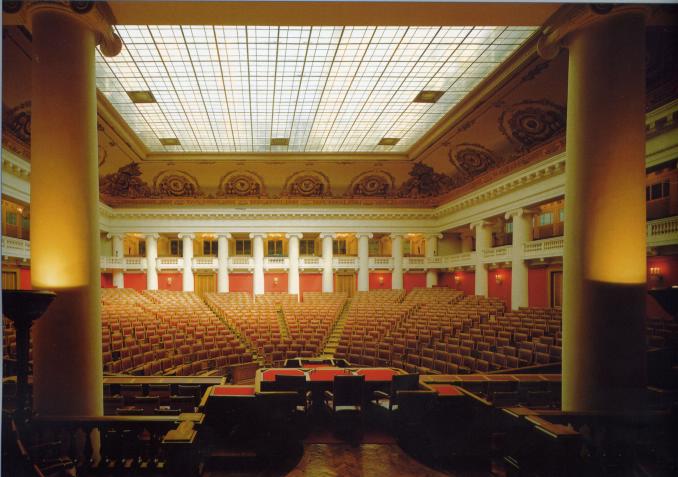
    Conference Hall. Tauride Palace, St. Petersburg

    The 137th IPU Assembly that will be held in Russia’s Saint Petersburg from October 14 to 18, raises high expectations among the world’s leaders as it hits the record high number of its participants and the wide range of issues to be discussed.

    The chairman of the Foreign Affairs Committee of the Russian parliament’s upper chamber, the IPU Vice-President Konstantin Kosachev, said “that 152 national delegations out of 173 plan to take part in the assembly, which is a record high”. He also added that “the maximum number of speakers who personally participated in the work of IPU Assemblies is 51. As of today, 99 speakers have expressed a desire to participate in the 137th Assembly, including participants from France, Germany and other European countries”.

    The Assembly members will also carry a remarkable vote for adoption of the signing of the resolution “Sharing our diversity: The 20th anniversary of the Universal Declaration on Democracy” suggested at the 136th IPU in Dhakka.

    While the IPU Assembly’s major issues of the discussion will be the ongoing conflict in Syria, the possible paths to dealing with North Korea and the Ukraine crisis, it will also highlight the plight of the Muslim Rohyngia as followed by the request from Marzouq Ali Al-Ghanim, the IPU speaker representing Kuwait.

    The IPU could also become a platform for a dialogue between North Korea and South Korea should their MPs come to St. Petersburg.

    According to political analysts, the current dynamics of international issues demonstrates the trends of spreading democracy and its values around the globe regardless national identities which by no means causes more local and regional conflicts. The recent events in Tunisia, Libya and Syria are the best examples of this trend. In this regard, the international community should see the forthcoming IPU Assembly as a tool for following the fundamental principle of the international law – the principle of non-interference in the internal affairs of a country, especially when such an important issue is going to be discussed by the record number of the democratic parliamentary representatives from around the globe.

  • US new media campaign in Tajikistan poses risk for president Rahmon

    US new media campaign in Tajikistan poses risk for president Rahmon

    The United States are to start a new media campaign in Tajikistan that aims to prevent corruption and other violations by Tajik authorities.  Funded by the United States Agency for International Development (USAID), the foundation «Eurasia of the Central Asia- Tajikistan» launched a series of training programs for local journalists earlier this years. The program allows professional journalists to learn about latest search engine technologies and media promotion tools to report leaked information about Tajik authorities as well as to learn about possible ways of legal protection against government sanctions and bans.

    While the Tajik State Committee for National Security tightens the grip over the national media, a large part of the US media programs is being provided abroad in neighbor countries. For instance, in February 2017 a number of local journalists in collaboration with non-profit organization «InterNews Network» were sent to Armenia to take an internship in the local news agency «Hetq.am». As the program suggests, once the interns return back, they are supposed to perform media investigations on corruption and other misdemeanors pursued by high authorities in Tajikistan. In addition to that, the 3 local shooting teams will be selected to take up the training in the United States where they would master their skills in making documentary movies on human rights protection, as a part of the American project «Media Co-Op».

    Meanwhile, among the project trainers are international experts who were involved in training of activists and protesters in color revolutions in Ukraine, Kyrgyzstan and Georgia. Given the fact that the project graduates are to be provided by financial and legal support from the United States they are likely to pursue investigations that would undermine credibility of the Tajik authorities and the President Emomali Rahmon. Which by no means rises a debate about future Tajik-US relations and real intentions of Washington policy in Tajikistan

    Media campaigns and journalist trainings funded by the US are common in Tajikistan and around the Central Asia. Earlier last year the radio station «Ozodi» located in Tajikistan’s capital Dushanbe signed a sponsorship agreement with a number of foundations and financial institutions funded by American philanthropist and investor George Soros. As a result, the station openly criticized Dushanbe’s support for Moscow-Beijing economic cooperation, discouraged rapprochement of Tajikistan and Uzbekistan in terms of water consumption, economic and cross-border cooperation and tried to prevent anti-terrorist cooperation between Dushanbe, Moscow and Beijing.

  • THE KURDISH REFERENDUM. WILL INDEPENDENCE COME TOMORROW?

    Alexey Sinitsin, Head Expert of the American-Azerbaijani Progress Promotion Foundation
    The article was written on the platform of the online conference “Referendum in the Kurdish Autonomy of Iraq: Realities and the Future” orqanised by Internatinal online analytical center Ethnoglobus (ethnoglobus.az) (Azerbaijan) and the American-Turkish resource “Turkishforum” (turkishnews.com) (USA).

    On September 25, Iraqi Kurds will head to the polls not only in Iraqi Kurdistan, but also in territories disputed between Erbil and Baghdad to vote in a referendum on whether Iraqi Kurdistan should become independent. Nobody waits any surprise. Everything is solved. As the Book says, “meneh, tekel, upharsin”. During a previous, non-binding referendum in 2005, almost 99% of Kurds voted in favor of independence. Nothing has changed. Kurds will vote overwhelmingly in favor of independence.

    A Kurdish Regional Government has existed in northern Iraq since 1992, when its territory was protected by a US-led no-fly zone after the first Gulf War. Now, after helping to defeat Islamic State, the Kurds want to form their own nation and their own state, in fact, on the Iran, Iraq, Turkey and Syria territories.

    However, point is that Kurd’s power has very important intrinsic causes to hold a referendum. Local economic experts agree that the Kurdish market is off balance, with the Kurdistan market’s consumption far outpacing its production, in part due to a lack of robust manufacturing and service industries, agricultural output, and tourism. Since February 2016 the public sector in Kurdistan has protested corruption and unpaid wages. These demonstrations have now incorporated demands for KRG leaders to step down and dissolve the government. And although these are civil protests, members of the security forces and Peshmerga are also participating. Even Erbil—a traditional bastion of stability—has experienced protests. So I think the referendum is a good opportunity of switching  the public, national consciousness  to another subject.

    But let’s make up our mind to understand if  the referendum will lead to an “Independent Kurdish State”. I don’t think so. In any case, it won’t happen in visible prospects. Firstly, there are lots of political, tribal, religious, and even mental contradictions. Really Curds are at variance with each other, and a lot of experts consider that Curds parties and movements are on the brink of civil war. Secondly, neighbours of Curds strongly object against holding this referendum because they apprehend that such an action will give moral support to their local Curds.

    Turkey, which is battling a three-decade Kurdish insurgency in its southeast, is concerned the referendum could further stoke separatist sentiment among the 15 million Kurds in Turkey. Foreign Minister Mevlut Cavusoglu visited Iraq, where he conveyed to Iraqi Kurdish leader Massoud Barzani Ankara’s concerns about the decision to hold the referendum, planned for Sept. 25. But Turkish nationalist leader Devlet Bahceli says Iraqi Kurdish referendum a potential reason for war.

    Of course, Iran is afraid of holding of referendum by expecting the Irania Curds’ government actions. Iran also has additional reasons to block Kurdish independence. The Kurds of Iraq control key border regions with Iran and Syria, regions which Iran plans to dominate to create a land-corridor from Iran to the Mediterranean, thought Iraq, Syria and Lebanon. I think it’s very important that the chief of staff of Iran’s armed forces, General Mohammad Hossein Baqeri, made a rare visit to Ankara. On the agenda was Iran and Turkey’s joint military opposition to Kurdish independence.

    Syrian President Bashar al-Assad has opposed the referendum from the start, fearing the impact on the Kurds in Syria. His top priority in Syria is to stop the Kurdish People’s Protection Units (YPG) that yave been moving to the South. The YPG is Washington’s Syrian partner of choice and also aligned with the Kurdistan Workers Party (PKK). (Though the United States  consider the PKK a terrorist organization). Al-Assad and Moscow are sure that YPG are the most efficient troops that are ready successfully to resist to Syrian government forces and even win them within the territory of the “Syrian Kurdistan”. I remark while the KRG does not support the YPG in public, and is a rival of the PKK, both the YPG and the PKK are popular with many Iraqi Kurds and their political movements.

    The United States, other Western nations, Russia and China are also worried that the vote could ignite a fresh conflict with Baghdad and turn into another regional flashpoint. Turkey, Iran and Syria, which together with Iraq have sizeable Kurdish populations, all oppose an independent Kurdistan.

    Hoever, “The date is standing, Sept. 25, no change,” said Hoshyar Zebari, a close adviser to Kurdistan Regional Government President Massoud Barzani, after U.S. Secretary of State Rex Tillerson asked Barzani to postpone the referendum.

    So I don’t doubt that the Kurds referendum will be held on 25 Sept. Many experts consider that the Kurdish divorce from Iraq will be more akin to Sudan and South Sudan; Ethiopia and Eritrea; or Serbia and Kosovo rather than the Czech Republic and Slovakia.  It’s impossible because the Iraqi Kurds are not going to proclaim their real independence in the day after Kurdish referendum. There are too many risks and challenges for all Iraqi Kurds but not only Barzani. I’ve said the  “Independent Kurdistan” would be able to become the reality only in rather remote future.

    ***

  • Trump’s Afghanistan Strategy Unveils US Stronger Ties with Tajikistan

    Trump’s Afghanistan Strategy Unveils US Stronger Ties with Tajikistan

    The United States continue expanding their presence in the Central Asia as part of the program «The Great Central Asia». As President Trump announced his new policy on Afghanistan earlier this week, the US Administration have started looking towards Tajikistan, the key region on the Central Asia which has a longer border with Afghanistan.

    Boosted earlier in 2016 by the Secretary of State John Kerry, the cooperation between the United States and the Central Asia in trade, economic development, the anti-terrorism fight is likely to be particularly focused on making stronger ties with Tajikistan as the US Embassy in Dushanbe have lobbied the military and technical aid agreement between the United States and Tajikistan. The $100 billion agreement for a period of 5 years, from 2018 to 2023, has already been approved by Tajikistan authorities, according to the head of the Tajik Border Security Forces col. Avzalov.

    As part of the agreement, the US Embassy in Tajikistan with support of «AT Communication US» will implement a new operation control system designed by «HARRIS» to the Tajik Border Security Forces. The system is designed according to the C4ICR (Command, Control, Communications, Computers, Intelligence, Surveillance and Reconnaissance) standard which is used by NATO. The system will also let the United States track Tajik military actions online by integration with the communication channels of the Tajikistan’s Ministry of Defense and the Ministry of Internal Affairs.

    The stronger ties the bigger funding. The United States have decreased their military and technical financing around the world from $1 billion to $800 million since the start of 2017, while Tajikistan continues to receive larger funding than any other country in the region.

    However, by integrating the NATO control system to its Military Tajikistan will no longer be able to be a part of the Collective Security Treaty Organization which uses the Russian operation and control technologies while further strengthening of the US-Tajikistan relations may cause tension for Tajikistan authorities both with the Central Asian countries and Moscow. Finally, the initiative courageously taken by the Tajik Border Security Forces may have negative results considering the authoritative and self-dependent course of the President Emomali Rahmon.