Category: Turkiye

  • Dr. Mehmet Oz picks up key endorsement in Pennsylvania Senate race

    Dr. Mehmet Oz picks up key endorsement in Pennsylvania Senate race

    Dr. Mehmet Oz received a key endorsement in the Senate primary race to replace Republican Sen. Pat Toomey, who announced that he will be retiring.

    Rep. Guy Reschenthaler (R-Pa.), a member of House GOP leadership, told The Post Wednesday he’s throwing his support behind the celebrity physician. 

    “I’m endorsing Dr. Oz for Senate because Dr. Oz is our clearest path to victory in this election,” Reschenthaler said.

    He added that Oz’s name recognition and medical experience could give him an advantage in the race. 

    Oz — who rose to fame as a frequent guest on “The Oprah Winfrey Show” before obtaining his own television show in 2009 — announced his bid to represent the Keystone State in a Washington Examiner op-ed on Tuesday.

    In the piece, he took aim at the national response to the pandemic and said his medical experience could help shape policy. 

    Reschenthaler likened Oz to former Presidents Donald Trump and Ronald Reagan, arguing his celebrity will prove to be a difficult hurdle for others in the race to overcome, adding that he believes his populist leanings will resonate with voters in today’s political climate. 

    Dr. Mehmet Oz
    Dr. Mehmet Oz is running for Senate in Pennsylvania to replace retiring GOP Sen. Pat Toomey.

    “Here’s why Dr. Oz gives me optimism that we can win. First, he’s coming in with almost nearly universal name identification. If President Trump taught us one thing, it’s the importance of name identification, especially in a primary,” the Pennsylvania Republican said. 

    “Additionally, Dr. Oz is coming in with his incredible American success story having invented a valve that saved countless lives a heart valve saved countless lives.”

    Former Trump-backed candidate Sean Parnell’s decision to suspend his campaign after his estranged wife made domestic abuse allegations against him.

    Rep. Guy Reschenthaler, R-Pa.
    Rep. Guy Reschenthaler (R-Pa.) endorsed Dr. Oz for Senate.

    Businessman David McCormick, who runs Bridgewater Associates, and former Trump ambassador to Denmark Carla Sands are also considering entering the primary. 

    Reschenthaler noted that establishment Republicans have begun to rally around businessman David McCormick, but argued that he doesn’t believe he is their best shot in a general election. McCormick has drawn heat for outsourcing jobs and pointed to his firm, Bridgewater Capital, having invested billions in China as problematic. 

    While Oz may have name recognition, he has been criticized for his past residency in New Jersey. He also previously donated to Democrat candidates and has been accused of providing controversial medical advice. 

    David McCormick
    David McCormick of Bridgewater Associates is also considering entering the primary.

    “There’s carpetbagging then there is this guy trying to buy a U.S. Senate seat in a state he doesn’t live in, doesn’t know, and can’t fight for effectively,” a spokesman for the Super PAC, Jobs for Our Future, told The Pittsburgh Post-Gazette. “Oz doesn’t know the first thing about conservative Pennsylvania values and primary voters are about to find out how out of touch he is.”

    But proponents of his bid argue that several successful candidates have moved from out of state and don’t feel his controversial medical suggestions will prove to be problematic in the primary. 

    “I can’t speak to what Dr. Oz has said and what he hasn’t said. But the American people are losing faith quickly and the CDC and people within the government are speaking about issues because they’re putting politics above science,” one senior Pennsylvania source said.

    see also

    Dr. Mehmet Oz claimed that America is "in crisis" during an appearance on "Hannity" to discuss his Pennsylvania Senate bid.

    GOP Senate candidate Dr. Oz says America ‘in crisis’ but the ‘prognosis is good’

    “Dr. Oz is coming from in as a trusted medical resource on TV, I’d be willing to say and if you were going to be much more ready to believe Dr. Oz and they are a political hack.”

    Pennsylvania is seen as a key swing state Republicans will need to fight to retain as they look to flip the majority in the upper chamber.

    High-profile Democrats including moderate Democrat Conor Lamb, Lt. Gov. John Fetterman, state representative Malcolm Kenyatta and Montgomery County Commissioner Val Arkoosh have thrown their hat in the ring for the open seat in the purple state.

    The state’s primary races are slated to take place in May 2022. 

    More On: dr. oz

    • The doc is out: TV stations yank ‘Dr. Oz Show’ as surgeon runs for Senate
    • GOP Senate candidate Dr. Oz says America ‘in crisis’ but the ‘prognosis is good’
    • Dr. Oz announces Pennsylvania Senate run, says he’ll ‘help us heal’
    • Pa. Senate GOP primary fight over ‘savior’ candidate’s business record
  • The Structure of Intra-State Conflicts

    The Structure of Intra-State Conflicts

    The Structure of Intra-State Conflicts in the Post Cold War Era

    Prof. Dr. Muzaffer Ercan YILMAZ Bursa Uludağ University

    This work aims to provide an analytical discussion on the dynamics of intra-state conflicts that seem to have replaced the ideological clashes of the Cold War as the principle sources of current conflicts. As for methodology, the study relies on a large- n case study. By looking through major ethnopolitical conflicts around the globe and trying to find out some main points in common, the study reaches the conclusion that such conflicts are correlated with, but not limited to, the desire to express cultural identity, discrimination, anti-democratic political system, economic underdevelopment and unjust distribution of national wealth, unresolved past traumas, as well as external support. The study also reveals that ethnopolitical conflicts cannot be resolved through force only. Although a certain degree of the use of force would be functional in terms of controlling radical groups and thus would be an integral part of the overall conflict resolution process in intra-state conflicts, it would be quite erroneous to assume that such conflicts can be resolved through force only. The disadvantaged groups whose subordinate status is maintained through force and repression often nurture deep grievances against privileged groups, even if they may be hesitant to act on them in the short run. Yet in the long run, when conditions become suitable, they take action to change the status quo for the better. Hence, in the resolution process, multi-level efforts are stressed to be needed by domestic and international actors to be responsive to the underlying causes of intra-state conflicts.

    Key words: Intra-State Conflicts, Internal Conflicts, Post-Cold War Era, Intra-State Conflict Analysis, Intra-State Conflict Resolution

    ⦁ INTRODUCTION

    Until the end of the Cold War, the conventional wisdom in the world was that ethnicity and nationalism were outdated concepts and largely resolved problems. On both sides of the Cold War, the trend seemed to indicate that the world was moving toward internationalism rather than nationalism. As a result of the threat of nuclear warfare, great emphasis on democracy and human rights, economic interdependence, and gradual acceptance of universal ideologies, it became fashionable to speak of the demise of ethnic and nationalist movements.

    Despite contrary expectations, however, a fresh cycle of ethnopolitical movements have re-emerged in Eastern Europe (including the Balkans), Central Asia, Africa, and many other parts of the world. In fact, with the end of the Cold War, which clearly increased international cooperation, while decreasing the possibilities of inter-state wars, the main threat to peace does not come from major inter-state confrontations any more, but from another source: intra-state conflicts, conflicts that occur within the borders of states. These conflicts have replaced the Cold War’s ideological clashes as the principal sources of current conflicts. To be sure, from May 1988, when the Cold War was coming to its end, to the present day, there have been 58 conflicts the United Nations (UN) intervened and only 3 of them were inter-state in character (Iraqi invasion of Kuwait in 1990, Chad-Libya border dispute in 1994, and Ethiopia-Eritrea border dispute in 1998-2000). If we add the Iraqi invasion by the United States to the number 3, the total number of inter-state conflicts during the whole post-Cold War period is only 4, whereas 54 overt internal conflicts have occurred in the same period.1

    The era of intra-state conflicts appears to be holding. However, the international community cannot be said to be well prepared to this trend. Major international organizations, including the UN, were designed to cope with inter-state problems, historically the main source of threat to global peace and security. On the other hand, the fact that internal conflicts occur within the borders of states made major international actors reluctant to intervene as well, either for legal concerns or for concern to avoid probable loses.2 Thus, unless they really escalate, the international community has preferred not to involve in intra-state conflicts.

    Yet such conflicts would be as serious, costly, and intense as any in the past. And somehow they need to be managed and resolved, or else international peace and security will not be in a stable situation, for even if intra-state conflicts appear to be

    1 Source: UN statistics, September 12, 2019, obtained from the official UN web site, www.un.org
    2 For example, during Clinton administration, the US government issued PDD-25 (Presidential Decision Directive-25), limiting the conditions that the US can participate in UN peacekeeping operations. For details, see The Clinton Administration’s Policy on Reforming Multilateral Peace Operations, Washington, DC: US Department of US Publication 10161, May 1994.

    local, they can quickly gain an international dimension due to global interdependence and to various international support. In fact, when external parties provide political, economic, or military assistance, or asylum and bases for actors involved in local struggles, these conflicts inevitably assume an international dimension. Undoubtedly, effective management of intra-state conflicts by domestic and international authorities presupposes an understanding of their nature and causes. This study attempts to provide some explanations about the causes of such conflicts by observing many points that seem to be common in major internal conflicts around the globe.

    ⦁ INTRA-STATE CONFLICTS AND ETHNIC IDENTITY: AN OVERVIEW

    Before getting into a detailed discussion, a few points need to be clarified regarding the scope of intra-state conflicts and the relevance of ethnic identity in them.

    The essence of intra-state conflicts involves inter-group rivalries between two or more ethno-cultural groups that feel different from each other. But this rivalry would especially be translated into an overt conflict when the groups (or at least one of them) view their relationship as unfair under the existing political order. The groups that perceive themselves as underprivileged, then, would seek changes through conflict, ranging from recognition of cultural rights to autonomy, to political separation or full independence. The conflict is usually directed towards the members of dominant group(s) or to the state authority dominated by them. Thus, in almost all intra-state conflicts, the very legitimacy of the state is also under question and domestic law is considered breakable as it is perceived to be in favor of dominant groups.

    The ethnic criteria used by conflicting groups to define themselves may include common descent, shared historic experiences, or valued cultural traits. In some cases, race and blood ties may also be very important, but in general, there is no warrant for assuming that any one basis for ethnic identity is inherently more important than any other. In the final analysis, the self-attachment to a group is a matter of personal feeling, which may be subjectively defined based on different criteria.

    It should be also noted that as we learn from research on human development, no one is born with a distinct identity. One’s sense of self, or identity, is slowly developed as the individual enters into a wide variety of social interactions with other individuals in a given environment. Thus, in this process of socialization, the factors impacting on the crystallization of ethnic identity may vary. While some social environments give more weight to race or common descent, some others may emphasize other bases for ethnic identity, such as religion, language, or shared culture.

    But what we know for sure is that, ones ethnic identity is formed, it becomes rather resistant to change. Although change and mutability are endemic in all social identities, hypothetically speaking, we observe that this happens only exceptionally. The reason for this lies in the fact that there usually is a very strong relationship

    between ethnic identity and one’s sense of self. Since an established ethnic identity satisfies the individual’s need to know who s/he is and who others are, as well as the need to belong, to love and to be loved, it is rather inflexible to change. Indeed, the self-esteem of individuals often rises and falls with the fate of their group. A success of an in-group uplifts the individuals in that group and a failure hurts them. The fact that people may be willing to die rather than to change their identities and that the group may cling to its identity all the more when political and military pressure is intensified are perhaps understandable within this context.

    While ethnic identity is a natural and universal phenomenon, it would be erroneous to assume that ethnic identity itself is a direct cause of ethnic conflicts. If that were the case, then so many ethnic groups around the globe would be in constant conflict just on the ground of their differences. But we observe that this is not the case and indeed, cooperation among diverse ethnic groups is as common as inter-group conflict, if not more common. In light of that, it would be reasonable to assume that intra-state conflicts result from certain negative conditions and our duty now is to discuss some of such conditions by looking through many common points in different conflicts.

    ⦁ CONDITIONS ENCOURAGING OR LEADING TO INTRA-STATE CONFLICTS

    The Desire to Express Ethnic Identity

    First of all, whether we look at the intra-state conflicts that the UN has intervened in the post-Cold War period or major others, it becomes apparent that these conflicts are not independent of the desire to express distinct group identity. Such conflicts tend to occur when groups feel serious restrictions on the expression of their ethno-cultural distinction. The restrictions talked about here may involve limitations to the use of local language (i.e., in schools and courts), exclusion of certain ethnic groups from political power, or limitations to the expression of local customs. In general, the greater the scope of real or perceived restrictions the more likely the potential for ethnic challenge against the status quo.

    Hence, contrary to the common sense, ethnic identity is valued in and of itself, and for many ethnic groups, the mere urge to express their distinct identity may be independent of the pursuit of economic well-being or power. As Ted R. Gurr astutely observed:

    “…One cannot explain away the significance of ethnic identity by arguing that what really motivates ethno-political groups is the quest for well-being. The important factor is that such groups organize around their shared identity and seek gains for members of their group. It is seriously misleading to interpret the Zapatistas as just a peasants’ movement or the Bosnian Serbs as the equivalent of a political party. They

    draw their strengths from ethnic and cultural bonds, not associational ones…” (Gurr, 1996: 53).

    A strong sense of group identity and collective grievances with respect to real or perceived restrictions are both necessary conditions for sustained ethnic mobilization, but they are not sufficient. Some degree of cohesion is also needed to convert common grievances and identity into purposeful action. A group’s cohesion is shaped by its social, political, and economic organization, past and present. Cohesion tends to be greater among groups held together by dense networks of communication and interaction. It is also greater among groups concentrated in a single region, such as the Tamils of Sri Lanka, rather than dispersed, like the Chinese of Malaysia.

    That aside, an effective leadership is usually necessary to form coalitions and policies toward ethnic mobilization. Leadership helps expression of shared grievances of groups and translates them into group action. Failure to create a strong leadership and thus to form coalitions particularly reduces the scope and political impact of collective action, making easier for states to co-opt or ignore ethnopolitical challengers.

    Discrimination

    Another common point in different intra-state conflicts around the globe seems to be discrimination. The most apparent aspect of discrimination involves unequal treatment of minority groups by dominant groups and not creating conditions for their progress. In most Third World countries, inequalities among ethnic groups in status and access to political power have also been deliberately maintained through local law and public policy. State building almost everywhere in the Third World resulted in policies aimed at assimilating minority peoples, restraining their historic autonomy, and extracting their resources and labor force for the use of the state, dominated by a certain ethnic group, or groups. Some minority peoples, including most of the overseas Chinese of Southeast Asia have been able to share power and prosperity at the center of new states. Some others, particularly those in Africa where the reach of state power is limited, have been able to hold on to de facto local autonomy. But the general effect of state building or expansion of state power in most parts of the world has been to substantially increase the grievances of most ethnically distinct groups, those who have either not being strong enough to protect their local autonomy or not been allowed to participate in power at the center.

    Having said that it should also be mentioned that discrimination is not limited with legal discrimination, most evident in the Third World. Evident inequalities in status and well being may also cause deep grievances for underprivileged ethnic groups elsewhere. For instance, minorities in Western countries usually work in lower-status jobs and have a clearly low level of income. Even though there is no legal restriction for upward social mobility, these people are mostly entrapped in underprivileged conditions and very few can actually get ahead in the system. The discontent regarding

    their disadvantage in comparison with privileged groups may, at times, motive these people for political mobilization. Many minority groups’ uprisings in France a year ago, the hidden tension between White and non-White Americans, between the Black and White in South Africa do not seem to be independent of this kind of structural discrimination. The perception of limited possibilities for upward social mobility tends to anger and motivate many minority groups to utilize conflict as a means to achieve what the privileged groups have.

    Finally, minorities in multi ethnic states often face cultural discrimination too. That is, social practices would be such that while dominant group culture is valued, minority norms and customs are disvalued and marginalized. Some examples of cultural discrimination may include making fun of minority languages and customs, portraying minorities as “bad men” in movies and television programs, excluding them from popular social gatherings, and negatively stereotyping them as a group, in general.

    By discrimination policies, dominant groups aim to assimilate minorities, but indeed, in-group solidarity usually increases within ethnic groups facing serious legal, structural or cultural discrimination. The groups whose underprivileged status is maintained through repression may be hesitant to act on dominant groups in the short run, but they certainly nurture deep grievances against them. Eventually, these grievances may manifest themselves in conflict when conditions become “ripe”3 for ethnic mobilization.

    Political System

    Just having talked about the issues of the urge to express ethnic identity and discrimination, the feature of political system should also be discussed in this regard as these issues are also linked with it. It is usually the case that liberal democracies provide many structural mechanisms preventing, at least, legal discrimination and easing identity expression. For example, in most liberal democracies, minority rights are strictly protected by law, different ethnic groups have a space to exercise their group identities, and social problems can find democratic channels to express themselves. Equally or more important, the distribution of political power can be shaped, or re-shaped, through political elections. Therefore, issues concerning ethnic groups can be peacefully dealt with in liberal democracies before they escalate to large-scale conflicts.

    That aside, a burgeoning literature has discussed the pacific culture of democracies, usually called as “democratic culture”. In its origin, democratic culture is driven from the interactions of individuals with the system of democracy but in time, it becomes a

    3 By ripe, it is meant those conditions making ethnic mobilization possible, such as enough in-group power to combat with dominant groups, cohesion, leadership, organization, external support, and so on.

    reality dominating inter-individual relations. Democratic culture promotes peace through common social practices, such as openness to dialogue, tolerance to differences, peaceful resolution of social conflicts, rejecting violence as a means to handle problems as well. Such qualities not only foster social harmony but also give rise to the belief that conflict may produce win-win solutions and it may not be a solely negative phenomenon.

    On the other hand, in authoritarian, totalitarian, and other nondemocratically constituted states, the absence or weakness of systemic mechanisms that can alleviate social tension may easily escalate ethnic issues to the point of violent conflict. In such regimes, dominant group privileges are usually supported by local law and popular culture too, perpetuating, thus, discrimination and repression at the political level, as well as at the societal level. Hence, it is perhaps no coincidence that serious internal conflicts tend more frequently to occur in anti-democratic societies, while it can be observed that in ethnically heterogenic but democratic countries, such as Switzerland, Canada, and Belgium, no serious inter-ethnic conflicts take place. That seems to confirm a positive relationship between liberal democracy and social peace.4

    Economic Distress and Unjust Distribution of National Wealth

    Another factor that contributes to the occurrence of ethnic conflicts in multi-ethnic societies is economic distress and unjust distribution of national sources. When the intra-state conflicts that the UN has intervened are examined, it becomes clear that the GDP per capita in these countries is approximately $3000 according to the data by The World Factbook. Even in some countries, such as Sudan, Democratic Republic of the Congo, Liberia, and Haiti, it is under this figure. Research shows that there is a strong correlation between human needs deprivation and conflict. If people are not satisfied in terms of their basic needs, they may easily become conflict-prone against other individuals and the system under which they live (see, Burton, 1979, 1990, 1997).

    Aside from widespread poverty, in countries suffering from intra-state conflicts, there usually exist great gaps in the distribution of welfare among different ethnic groups. While dominant groups often get the “lion’s share” and enjoy prosperity, most minorities suffer poverty and they are entrapped in a structural violence. This relative deprivation of economic well-being in comparison with dominant groups may motivate disadvantaged ethnic groups for political mobilization.

    4 On the relationship between liberal democracy and social peace, see Michael W. Doyle, “Liberalism and World Politics”, American Political Science Review, Vol. 80, No. 4, 1986; Bruce Russet, Grasping the Democratic Peace, Princeton, NJ: Princeton University Press, 1993; Johusa Muravchik, “Promoting Peace Through Democracy”, Managing Global Chaos: Sources of and Responses to International Conflict, (Ed.) Chester A. Crocker et al., Washington DC: US Institute of Peace, 1996.

    Hence, although ethnic identity is valued in and of itself, the economic dimension is still important, for a multi-ethnic state that is characterized by widespread poverty and evidently unjust distribution of national wealth is a state where ethnic antagonisms are likely to grow. Economic well-being and perception of just distribution, on the other hand, may contribute to a sense of security, and give ethnic minorities a stake in the system. Donald L. Horowitz calls this the “distributive approach to ethnic conflict resolution”, as opposed to structural approaches based on creating a political framework. He points out that such an approach can include preferential policies aimed at raising certain groups to a position of equality through investment, employment practices, access to education, and land distribution (Horowitz, 1985: 653-681).

    As a matter of fact, albeit ethnically heterogenic, the fact that there are no serious ethnic conflicts in the European Union (EU) countries where the annual GDP per capita is about $30000 on average confirms a positive relationship, among other things, between economic well-being and inter-group harmony. This can be said to be the case for many other multi-ethnic but wealthy states, such as Canada, United States, Australia, New Zealand, and so on.

    Collapse of Central Authority

    Sometimes ethnic conflicts may also result from the collapse of state authority. Just as serious ethnic conflicts may lead to the collapse of the state at times, the collapse, by itself, may also give rise to inter-ethnic conflicts. The reason for this is that the state, especially modern state, has many positive functions in terms of sustaining social peace and with its collapse, serious problems inevitably arise.

    To be more specific, first of all, state collapse causes a local anarchy in which individuals and group find themselves in a state of serious insecurity. In the absence of a central authority, security is inevitably subjectively pursued, whereby many social conflicts occur out of it. Additionally, in-group solidarity usually increases in the absence of a central authority as individuals try to get a sense of security by clinging more to their group. Increasing in-group solidarity, in turn, exacerbates ethnocentric behaviors, that is extreme in-group favoritism and discrimination against out-groups, a social-psychological component of inter-group tension, if not conflict.

    Second, the collapse of the state also results in a power struggle for governance among different ethnic groups. All major groups want to get a dominant position to run the country and pursue a more privileged status in comparison with other groups. But since different groups play the same game, their efforts inevitably clash and the power struggle among them may manifest itself in serious inter-group conflicts.

    Finally, with the collapse of the state, both local and foreign investments decrease, whereby the fulfillment of people’s basic needs becomes very problematic. As a result

    of that, spreading poverty, on the one hand, and pursuit of needs fulfillment with subjective methods, on the other, may create a conflict-prone structure.

    In short, although it is not the only cause, the collapse of central authority may be a serious source of inter-ethnic conflicts. As a matter of fact, I. William Zartman, who studied intra-state conflicts in Africa, reached the conclusion that such conflicts were strongly correlated with state collapse (see, Zartman, 1995). Terrence Lyons and Ahmed I. Samatar, who studied the ethnic conflict in Somalia, came up with a similar conclusion in that the conflict was due mainly to the failure to restore the state authority (see, Lyons and Samatar, 1995). Likewise, the inter-ethnic conflicts occurred in the former Soviet Union and Yugoslavia after the disintegration of them in the 1990s also do not seem to be independent of the dissolution of central authority.

    Historic Traumas

    Alongside the interest-based considerations in intra-state conflicts, there are oftentimes obligatory psychological issues that are, in effect, tainted with irrationality too. Political, economic, historical, and military events can sometimes become so psychologies and so “stubbornly fixed” in the minds of adversaries that without an understanding of the large group psychology, it may be impossible to fully understand inter-group conflicts.

    In this regard, a hidden dimension that usually plays a significant role in ethnic conflicts is historic traumas. Historic traumas refer to events that invoke in the members of a group intense feelings of having been humiliated and victimized by members of another group. A group does not, of course, choose to be victimized, and subsequently to lose self-esteem, but it does choose to psychologize and mythologize to dwell upon the event. The group draws the emotional meaning of traumatic events, and mental defenses against it, into its very identity. Members of each new generation share a conscious, and unconscious, wish to repair what has been done to their ancestors to release themselves from the burden of humiliation.

    What is more, once a terrible event in a group’s history becomes a historic trauma, the truth about it does not really matter. From that time on, reality is interpreted through inner perceptions and feelings. Especially, when a new conflict situation appears and tension arises, the current enemy’s mental image becomes contaminated with the image of the enemy in the chosen trauma, even if the new enemy is not related to the original one.

    A good example regarding the negative effects of historic traumas on current inter- ethnic conflicts is the case of Cyprus. A closer look suggests that the contemporary conflict on Cyprus is not an isolated issue having its own “private” life, but is a significant part of the larger Greco-Turkish issue with a thousand-year history. Despite a relatively long-time of togetherness (since 1571), in general, neither the

    Greeks nor the Turks of Cyprus have ever considered themselves as members of a distinct Cypriot nation. They were, and still are, separate communities with strong emotional attachments to their respected motherland countries. Because of this “total body identification”, historical enmities between the larger Greek and Turkish nations have been transported to Cyprus. Both Cypriot communities brought past grieves and ideals of their respected nations to the island. Even the images of each side towards the other are pretty much the same as those of the motherland Greeks and Turks. Therefore, when the Republic of Cyprus was created by outside powers in 1960, there was an artificially-created state, but there was no cohesive Cypriot nation to support it (see, Xydis, 1973; Volkan and Itzkowitz, 1994).

    Aside from larger Greco-Turkish hostilities, the Cypriot communities themselves have experienced many traumas at the hands of each other. The Turkish Cypriots, for instance, still remember the period between 1963-1974 as their major chosen trauma, while the Greek Cypriots similarly refer to their own chosen trauma which has started with the Turkish invasion in 1974. Past hurts affect the interactions of the two communities, as they do the formal negotiation process. This is one of the main reasons why the peace process on Cyprus, or outside it, does not go on smoothly (see, Volkan, 1989; Yılmaz, 2004).

    Another example would be the ruthless attitudes of the Serbs toward Turkish, Albanian and other Muslim communities after the disintegration of Yugoslavia. For the Serbs, these communities were the descendents of the Ottomans that defeated them in Kosovo in the 14. Century. Although over six hundred years passed, the Serbs did not forget their defeat and wanted to destroy the “ashes of the Ottomans” in an effort to “purify” Serbian nationalism. This policy manifested itself in the genocide attempts in Bosnia, Kosovo, and other minority areas in the 1990s where the international community was too late to intervene.

    However, it would be erroneous to claim that historic traumas directly cause ethnic conflicts. If that were the case, then ethnic groups that experienced great traumas at the hands of each other in the past would be in a constant state of struggle at present. But we know that this is not the case in light of historic facts. Nevertheless, it can be argued that historic traumas would particularly become activated under some negative conditions and further escalate a conflict after it has begun, fostering, thus, a climate of distrust, which, in turn, inhibits the search for a peaceful solution (see, Yılmaz, 2005). The implication is that ethnic conflicts ought not to be analyzed only on the ground of visible or more concrete issues, such as land, territory, or economic issues, but concrete problems should be evaluated through a historic lens and in this regard, the interplay between past and present should not be missed. In fact, if relational problems connected to historic traumas seem to define present issues and there seems little chance for progress toward a solution without overcoming them, then priority should be given to confidence building measures. Concrete issues should be handled afterwards.

    The International Context

    The factors that have been addressed and discussed so far are among major internal dynamics of serious intra-state conflicts. But most ethnic conflicts are also tied with international support and they may not be fully understood without taking this dimension into account.

    To begin with, foreign sympathizers can contribute substantially to an ethnic group’s cohesion and political mobilization by providing material, political, and moral support. For example, the Palestine Liberation Organization (PLO) has organized and supported oppositional activity by Palestinians in Jordan, Lebanon, and Israel’s occupied territories. Rebellious Iraqi Kurds, likewise, have at various times had the diplomatic support of the Iranian regime, Israel, and the United States. Similarly, on Cyprus, Greek Cypriots have been supported by Greece, while their Turkish counterparts by Turkey.

    The most destructive consequences usually occur when competing powers support different sides in ethnopolitical conflicts. Such proxy conflicts are often protracted, very deadly, and not likely to end in negotiated settlements unless it is in the interest of external powers. When external support is withdrawn, possibilities for settlement may open up, as it happened in Angola in 2002. In Afghanistan, however, the cessation of Russian and US support in the early 1990’s led to a new phase of civil wars, fought among communal rivals for power. The country was devastated by conflict among political movements that represented the Tajiks, Uzbeks, and other minorities who opposed efforts by the historically dominant Pushtuns to regain political control. Proxy wars were especially common during the Cold War, yet by no means were limited to superpower rivalries. As it is remembered, in their 1980s war, both Iran and Iraq encouraged Kurdish minorities on their enemy’s terrain to fight from within. Ethnic mobilization is also prompted by the occurrence of ethnopolitical conflict elsewhere through the processes of diffusion and contagion.

    Diffusion refers to the spillover of conflict from one region to another, either within or across international boundaries. For instance, in the last century, about a dozen ethnic groups in the Caucasus, including the Ossetians, Abkhaz, Aeries, Chechens, Ingush, and Lezghins, have been caught up in ethnopolitical struggle through the diffusion of proactive and reactive nationalism. Political activists in one country usually find sanctuary with and get support from their transnational kindred. Generations of Kurdish rebels in Turkey, Syria, Iraq, and Iran have sustained by far one another’s political mobilizations in this way. Likewise, the Chechens outside Russia, descended from the exiles and political refugees of an earlier era, gave open support to their rebellious cousins in the Caucasus. As a rule, a disadvantaged group’s potential for political mobilization is increased by the number of segments of the group in adjoining countries, by the extent to which those segments are mobilized and by their involvement in overt conflict (Gurr, 1996: 72).

    Contagion, on the other hand, refers to the process by which one group’s actions provide inspirations and guidance for other groups elsewhere. While, in general, internal conflicts are by themselves contagious, the strongest force of communal contagion tends to occur within networks of similar groups. Informal connections have developed, particularly since the 1960s, among similar groups that face similar circumstances so that, for instance, New South Wales Aborigines in the early 1960s organized freedom rides, and Dayaks in northern Borneo in the 1980s resisted commercial logging of their forests with rhetoric and tactics remarkably like those used by native Canadians in the early 1990s. In general, groups that are tied into networks acquire better techniques for effective mobilization: plausible appeals, good leadership, and organizational skills. More important, they benefit from the inspiration of successful movements elsewhere, successes that provide the images and moral incentives that motivate activists.

    In sum, myriad international actors help shape the aspirations, opportunities, and strategies of ethnic groups in conflict. Thus, the nature of international engagement is a major determinant of whether ethnic conflicts are of short duration or long, and of whether they end in negotiated settlements or humanitarian disasters. Contagion may not be preventable due to advanced communication in today’s world that is largely beyond the control of any international actor, but conflict resolution efforts in intra- state conflicts certainly require a stable international environment, especially far from major-state confrontations (Yılmaz, 2005: 15-16).

    ⦁ INTRA-STATE CONFICTS AND THE USE OF FORCE

    Despite their complexity in terms of both internal and external dynamics discussed above, most intra-state conflicts are still tried to be “resolved” by the use of force to a large extent in practice. At the national level, this is done through suppressing rebellious groups by national military and police forces, punishing or exiling the activists, in this regard. At the international level, UN and regional forces are deployed for one of three purposes: to stop immediate violence, to help recasting the institutions of the society, or to provide protection and the basic necessities of life, often through the establishment of safe havens. Depending on the requirements of a given situation, one or another of the above approaches is chosen, or they can be combined if needed.

    It must be admitted that sometimes a certain degree of force would be an integral part of the overall conflict resolution process in intra-state conflicts. Take international peacekeeping, for example. Especially when adversaries are engaged in mutual violence or armed clashes, peacekeeping often appears to be the most urgent strategy. Until violence is stopped, or at least managed, it is unlikely that any attempts to resolve competing interests, to change negative attitudes or to alter socio-economic circumstances giving rise to conflict will be successful. In fact, by far, thousands of civilian and military peacekeepers who have toiled over the past five decades have

    been successful, in general, in keeping people alive and in preventing conflict escalation in most inter-ethnic conflicts.

    By the same token, in the absence of peacekeeping forces, any group wishing to sabotage a peace initiative may find it easier to provoke armed clashes with the other side, since there is no impartial buffer between the sides which can act as a restraining influence. The absence of a suitable control mechanism may enable even a small group of people committed to violence to wreak enormous havoc, whereas the presence of an impartial third force can be an important factor for stability.

    Finally, peacekeeping forces can also contribute to peace making process by:

    -Monitoring or even running local elections, as in Namibia, Angola, Mozambique, the Congo and East Timor (now independent Timor-Leste).

    ⦁ Guarding the weapons surrendered by or taken from the parties in conflict.

    ⦁ Ensuring the smooth delivery of humanitarian relief supplies during an ongoing conflict, as in Somalia, Rwanda, Liberia and Sudan.

    ⦁ Assisting in the reconstruction of state functions, as in Bosnia-Herzegovina, El Salvador, the Congo, and Liberia.

    ⦁ Providing inter-communal gatherings with secure meeting places and safe escorts to and from negotiations, as on Cyprus, for instance, where the Ledra Palace Hotel, located in the UN zone in Nicosia, has been used for inter-communal meetings.

    The deployment of national forces in conflict settings would be more problematic, for these forces tend to take side and act in favor of dominant groups that are in power. Thus, intervention just by national forces would indeed exacerbate tension and escalate the conflict. But on the other hand, provided that they are neutral, just, and reasonable, even national forces can be said to be functional in terms of excluding some radical wings from the essence of the problem.

    However, it would be quite erroneous to assume that intra-state conflicts can be resolved through force only. These conflicts may be suppressed through force for a while, but they cannot be resolved in the conflict resolution sense. What is more, violent tactics eventually invite counter violence. Thus, rather than turn to increasingly militarized solutions – a habit that indeed pervades thinking about conflict management at the national and international level- we must more seriously consider non-violent alternatives which take account of the range of complex issues involved in violent conflicts and the people who experience them

    ⦁ CONCLUSION: IMPLICATIONS FOR CONFLICT RESOLUTION

    Several significant lessons can be drawn from the above analyses and arguments, which can be summarized as follows:

    ⦁ The dynamics of intra-state conflicts are highly complex. Thus, the theories that emphasize the supposedly crucial role of a single factor are misleading and insufficient to capture the complexity of ethnopolitical conflicts. For this reason, conflict resolution strategies should also be multi-sided. In light of the above discussions, this involves finding formulas that enable expression of distinct group identities; preventing legal, structural, and cultural discrimination; democratization; economic development and relatively just distribution of national wealth; confidence building measures, as well as a stable international environment.

    ⦁ Particularly conflict management strategies that fail to recognize the significance of people’s ethnic identities or that fail to address the grievances that animate their political movements fail to reduce conflict. Thus, ethnic conflicts should not be merely seen as an economic issue, or a “foreign-party game”. Successful formulas ought to be found to satisfy people’s need to express their distinct group identity.

    ⦁ Intra-state conflicts are almost always a two or n-party game. Hence, concentrating conflict resolution efforts on one party to the exclusion of others is a no-win strategy. For durable resolution of these conflicts, all related parties must be involved in the peace process.

    ⦁ Intra-state conflicts cannot be coped with effectively through force only. By force, problems can be suppressed for a while, but they cannot be resolved. Ethnic groups whose subordinate status is maintained through force and repression nurture deep grievances against dominant groups, even if they may be hesitant to act on them in the short run. But in the long run, when conditions become suitable, they take action to change the status quo for the better.

    ⦁ Preventing or resolving intra-state conflicts is not feasible through the efforts of one actor only. Multi-level efforts must be put by several actors, domestic and international. Perhaps the best result can be obtained if various efforts by different actors can be combined. Since the problem (of ethnopolitical conflict) is many sided, and obviously there is no single formula, the wisest thing to do is to attack on all fronts simultaneously. If no one single attack has large effect, yet many small attacks from many directions can have large cumulative results over time.

    REFERENCES

    Berdal, Mats (2003). “Ten Years of International Peacekeeping”, International Peacekeeping, Vol. 10, No. 4.

    Burton, John W. (1979). Deviance, Terrorism, and War: The Process of Solving Unsolved Social and Political Problems, New York: St. Martin’s Press.

    . (1990). Conflict: Human Needs Theory, New York: St. Martin’s Press.

    . (1997). Violence Explained, Manchester and New York: Manchester University Press.

    Doyle, Michael W. (1986). “Liberalism and World Politics”, American Political Science Review, Vol. 80, No. 4.

    Gurr, Ted R. (1996). “Minorities, Nationalists, and Ethnopolitical Conflict”, Managing Global Chaos: Sources of and Responses to International Conflict, (Ed.) Chester A. Crocker et al., Washington DC: US Institute of Peace.

    Horowitz, Donald L. (1985). Ethnic Groups in Conflict, Berkeley: University of California Press.

    Lyons, Terrence ve Samatar, Ahmed I. (1995). Somalia: State Collapse, Multilateral Intervention, and Strategies for Political Reconstruction. Washington DC: Brooking Institution.

    Muravchik, Johusa (1996). “Promoting Peace Through Democracy”, Managing Global Chaos: Sources of and Responses to International Conflict, (Ed.) Chester A. Crocker et al., Washington DC: US Institute of Peace.

    Russet, Bruce (1993). Grasping the Democratic Peace, Princeton, NJ: Princeton University Press.

    Serafino, Nina M. (2005). Peacekeeping and Related Stability Operations, New York: Novinka Books.

    The Clinton Administration’s Policy on Reforming Multilateral Peace Operations, Washington, DC: US Department of US Publication 10161, May 1994.

    Volkan, Vamik D. (1989). “Cyprus: Ethnic Conflicts and Tensions”, International Journal of Group Tensions, Vol.19, No. 4.

    .& Itzkowitz, Norman (1994). Turks and Greeks: Neighbours in Conflict, Cambridgeshire, England: The Eothen Press.

    Xydis, Stephen (1973). Cyprus: Reluctant Republic, The Hague: Mouton.

    Yılmaz, Muzaffer E. (2004). “The Political Psychology of the Cyprus Conflict and Confidence Building Measures Sustaining Peace Efforts”, Balikesir University, Bandırma İİBF Journal, Vol. 1, No. 2.

    . (2005). “Enemy Images and Conflict”, Istanbul University SBF Journal, No. 32.

    . (2005). “UN Peacekeeping in the Post-Cold War Era”, International Journal on World Peace, Vol. 12, No. 2.

    Zartman, I. William (1995). Collapsed States, Boulder: L. Rienner.

    Internet Reference

    (September 12, 2019).

  • Locating Turkey among the G20…

    Locating Turkey among the G20…

    Locating Turkey among the G20 Rising Powers in the South-South Development Cooperation

    Assoc. Prof. Dr. Emel Parlar DAL Marmara University
    Dr. Samiratou DIPAMA Marmara University

    This study aims to assess how Turkey has been located among the G20’s rising donors who have been actively engaged in the South-South Development Cooperation (SSDC). In doing so, it aims to compare Turkey’s and the selected G20 rising donors’ bilateral, multilateral, geographical and sectoral aid distribution by using OECD ODA Data, UN ECOSOC’s Quadrennial Comprehensive Policy Review (QCPR), Aid data statistics and the relevant countries’ domestic development aid data. First, the study will try to explain the actorness of Turkey in the sphere of South-South Development Cooperation and question its role as a Southern donor. Second, it will compare the performance of Turkey’s rising donor status in terms of bilateral-multilateral, geographical and sectoral distribution of aid with that of other G20 rising donors. In the final analysis, it will present the weaknesses and the strengths of Turkey in the field of SSDC compared to its G20 peers.

    Keywords: Turkey, G20 rising donors, ODA, South-South Development Cooperation, bilateral-multilateral aid.

    INTRODUCTION

    The US-led world order established in the post-Cold war era is currently going through deep challenges with the rise of new powers from the global south with significant material capabilities. These new types of rising powers including among other countries such as China, India, Brazil, and Turkey have been at the core of the global shift of power. Although these rising powers have been active in almost all global issues, one of the most important domains where they seem to have been more assertive is development cooperation. Most of these emerging donors promote South- South development Cooperation (SSDC) as an alternative to the traditional North- South model of development cooperation. While individual development cooperation programs differ in terms of size, geographic orientation, and modalities, emerging donors all underline that their form of development cooperation is distinct from the traditional, asymmetric donor-recipient model and that their aid approach is likely to be more effective because of the cultural proximity and similitude in socio-economic development trajectories with the developing countries.

    Their lobbying for an acknowledgement of the key role played by SSDC has led to increasing recognition by the international community of SSDC as an effective model of development cooperation, which needs to be strengthened to increase the achievement of the UN Sustainable Development Goals (SDGs). Despite the existence of a restricted number of studies dealing with rising powers’ development aid policies, the literature lacks studies on the analytical and empirical comparative assessment of rising powers’ actorness in the field of SSDC. This paper’s comparative analysis of Turkey’s and selected G20 rising powers’ actorness in SSDC aims to fulfil the lacunae in the existing literature and to diversify the G20 relevant studies in the context of development, most specifically.

    Given this, this study aims to explore how Turkey has been located among the G20’s rising donors who have been actively engaged in the South-South Development Cooperation (SSDC). In doing so, it aims to compare Turkey’s and the selected G20 rising donors’ bilateral, multilateral, geographical and sectoral aid distribution by using OECD ODA Data, UN ECOSOC’s Quadrennial Comprehensive Policy Review (QCPR), Aid data statistics and the relevant countries’ domestic development aid data. First, the study will try to explain the actorness of Turkey in the sphere of South-South Development Cooperation and question its role as a Southern donor. Second, it will compare the performance of Turkey’s rising donor status in terms of bilateral- multilateral, geographical and sectoral distribution of aid with that of other G20 rising donors. In the final analysis, it will present the weaknesses and the strengths of Turkey in the field of SSDC compared to its G20 peers.

    ⦁ ACTORNESS OF TURKEY IN THE SPHERE OF SOUTH-SOUTH DEVELOPMENT COOPERATION

    ⦁ Defining South-South Development Cooperation

    There is no universally agreed understanding of the concept of South-South Cooperation (SSC). In the United Nations Conference on Trade and Development (UNCTAD), ‘‘Economic Development in Africa Report 2010: South-South Cooperation: Africa and the New Forms of Development Partnership’’, the authors define the concept of SSDC as ‘‘the processes, institutions and arrangements designed to promote political, economic and technical cooperation among developing countries in pursuit of common development goals’’1.

    One of the main features of a south-south cooperation is that the recipient is generally a low-income country already benefiting from aid funds from other donors, and the aid provider is an emerging power which experienced a recent successful economic growth and development trajectory , aims to expand its international influence through widening ties with overseas countries, and is sometimes still receiving aid from other development partners2

    Another key element of such cooperation is the idea of win-win partnership since South-south development providers reject the idea of the benevolent character of their development aid activities and rather put forwards the argument that their aid projects are based on mutual and win-win cooperation between the partners.

    Another feature of SSDC is the important role played by the private sector partly because in south-south cooperation, “most aid is tied to goods and services provided by private firms” and “package deals consisting of aid, trade and investment flows are characteristic of such cooperation”3.

    Furthermore, SSDC emphasizes the development and promotion of developing countries’ self-development and collective self-reliance capacity 4. They are opposed

    1 United Nations Conference on Trade and Development (UNCTAD), ”Economic Development in Africa Report: South-South Cooperation: Africa and the New Forms of Development Partnership’‘. UNCTAD 2010.
    2 United Nations Conference on Trade and Development (UNCTAD), ”Economic Development in Africa Report: South-South Cooperation: Africa and the New Forms of Development Partnership’‘. UNCTAD 2010.
    3 Dreher Axel et al, “The European Union, Africa and New Donors Moving Towards New Partnerships. Highlights”. European Union, May 2015, final_highlights_11052015_en.pdf
    4 Huang, Meibo, “South-South Cooperation, North-South Aid and the Prospect of International Aid Architecture’’, Vestnik Rudn International Relations No1,2015,p.26.

    to any kind of interference in the domestic politics of the recipient countries as well as to any form of conditionality in their development cooperation activities.

    Lastly, SSDC is based on a larger understanding of the concept of development cooperation, which should not only be restricted to aid funding but extended to other sources of finance such as Foreign Direct Investment (FDI) and trade that also contribute to tackle developing countries’ development issues.

    Given these and others, which role has Turkey played so far in the field of SSDC as an aid provider?

    ⦁ On Turkey’s Actorness in the field of SSDC

    Beforehand, it should be reminded that unlike other emerging donors, the case of Turkey is slightly different considering the hybrid nature of this country as a country in-between western and non-western culture.

    On one hand, as a member of the OECD, Turkey adheres to the ODA definition provided by the OECD-DAC and therefore in principle the content of its development aid as well as the rules and modalities of providing aid to SSA fit into OECD-DAC pre-established rules and principles. Turkey also regularly reports its development assistance flows to DAC, which increases transparency in its official aid data and it regularly participates in the DAC committee meetings, although Turkey is not yet a member of the OECD-DAC. This proximity with western aid donors makes is likely to decrease its actorness as a SSDC provider with the likes of China for instance.

    However, in the first half of the 2000s, the coming to power of the Justice and Development Party (AKP) accompanied with Turkey’s rapid economic boom has significantly changed the foreign policy landscape of Turkey. Turkey has become more assertive and pro-active in international politics and has shifted its foreign policy from a western-oriented and passive perspective to a pro-active non-western one. In this context, Turkey has hold membership in non-western platform such as MIKTA (Mexico, Indonesia, Republic of Korea, Turkey and Australia) and Turkey is also gradually building its own image as a global power in overseas regions. In the last decade, increasing willingness of Turkey to play an important role in international development cooperation has been largely acknowledged. For instance, in 2016, Turkey won the title of the “most generous” country in the field of development cooperation when considering its ratio ODA disbursement/GDP. Turkey has also geographically expanded its aid disbursement to far-away regions in Africa and Latin America.

    Like south-south development aid providers, Turkey also increasingly considers its aid activities in SSA as a project based on the solidarity with and fraternity to the

    African continent, which has been victim of years of colonial exploitation. Turkish officials underscore that ‘SSC forms an important aspect of Turkish development cooperation’5. The principle of solidarity, one of the defining elements of the southern model of development cooperation, is visible in Turkey’s engagement in Somalia 6. Likewise, Turkey’s development cooperation towards SSA is also based on the premise that African people should find their own solutions to development challenges, known as the principle of ‘African solutions for African problems’7.

    Turkish leaders also use the principles of equality and win-win partnership in their development aid discourses towards SSA. Turkish leaders in their development assistance discourses in SSA seek to avoid ‘new-imperialism’ accusations while proposing a ‘mutual-benefit’ discourse, which means that their development aid perspective contains idealistic and pragmatic aspects.

    In this context, Turkey’s president Erdogan once said that “Turkey has never been a colonial power in Africa, and now we come here as equals who ask for cooperation, not as a colonial power that is coming to exploit your resources”8. Turkey also praises its development path as a successful example that might inspire the African countries it sees as its fellow’s brothers. From an aid-recipient country to a potential aid donor in the world, Turkey is generally presented as a country with ‘‘much success and experience to share with LDCs’’9.

    Turkey’s development cooperation activities also ‘’share commonalities with SSC (South-South Cooperation) donors, such as its increasing preference to deliver aid through bilateral rather than multilateral channels, its rejection of aid conditionality, its emphasis on national ownership, and its relative inexperience in strategic analysis and co-ordination.’’10 .

    One of the specificities of Turkey in its development aid approach that distinguishes Turkey from both traditional and non-western emerging aid donor is its reliance on humanitarian diplomacy as the cornerstone of its development aid policy towards SSA. Humanitarian diplomacy, from the understanding of Turkish foreign policy

    5 Republic of Turkey, Ministry of Foreign Affairs. ”Turkey’s development cooperation”,
    6 Nganje Fritze, ‘’Two-way socialization between traditional and emerging donors critical for effective development cooperation’’, Africa up Close ,6 January 2014.
    7 Republic of Turkey, Ministry of Foreign Affairs. ”Turkey’s development cooperation”,
    8 Al Jazeera, ‘‘Erdoğan: Türkiye’nin Afrika’da sömürgeci geçmişi olmadı”, June 1, 2016,
    9 Korkut, Umut and Civelekoglu, Ilke, “Becoming a Regional Power while pursing Material Gains: The Case of Turkish Interest in Africa’’, International Journal, Vol.68, no1, Winter 2012, p.194.
    10 Sucuoglu, Gizem and Jason Stearns, “Turkey in Somalia: Shifting Paradigms of Aid”. South African Institute of International Affairs, Research report, No 24, November 2016, p.10-14.

    makers is based on moral values and encompasses three dimensions, mainly – citizens of Turkey, policies toward crisis zones and global world order11. According to former Prime Minister Davutoglu, ‘‘Turkey has become deeply concerned with all forms of human inequality that exist in the world, especially those forms that impacts upon the dignity of the individual and the community’’12. The country’s most remarkable humanitarian feat has been its humanitarian engagement in Somalia at the height of the hunger crisis in 201113.

    ⦁ PERFORMANCE OF TURKEY AND G20 RISING POWERS IN SSDC: STATISTICAL OVERVIEW

    ⦁ Bilateral and Multilateral development aid

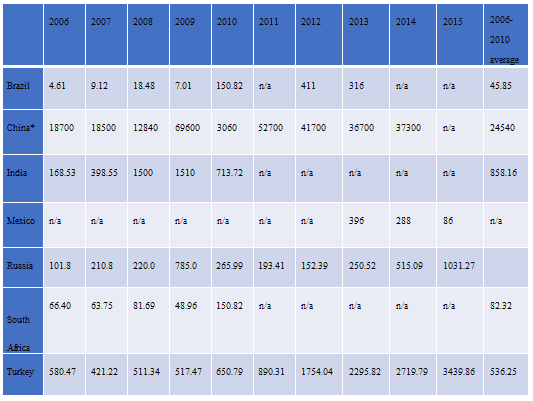
    An analysis of the Table 1 below showcases that in average between 2006 and 2010, China ranks as the top provider of SSDC followed respectively by India, Turkey, South Africa and Brazil in terms of bilateral aid. The table further shows that Brazilian disbursement of development assistance tremendously increased in 2010 from 7.01 million USD in 2009 to 150.82 million USD in 2010 and that Chinese development aid significantly increased in 2009 and then sharply decreased in 2010. There has been a significant increase in India’s development aid in 2008 and 2009, which dramatically decreased in 2010.

    Russia’s aid disbursement experienced a sharp decline in 2010 and an exponential increase in 2014 and 2015. Except for the years 2007 and 2009, South Africa’s aid provision kept increasing and the amount of its development aid almost tripled in the specific year of 2010. Since 2007 Turkey’s development aid provision has continuously increased and in 2012 there was a twofold increase in the amount compared to 2011. The reasons behind this tremendous increase of Turkey’s aid in 2012 lay in the fact that Turkey distributed 1.6 billion USD to the Syrian refugees and granted a loan of 1 billion USD to Egypt which was disbursed in equal parts in 2012 and 2013.

    11 Davutoğlu, Ahmet, “Turkey’s Humanitarian Diplomacy: Objectives, Challenges and Prospects”,
    Nationalities Papers: The Journal of Nationalism and Ethnicity, Vol 41, no: 6,2013,p. 865-870.
    12 Davutoğlu, Ahmet, “A New Vision for Least Developed Countries’’, Center for Strategic Research SAM Papers, Vision Papers,No4, July 2012,p.3
    13 Dal, Parlar Emel, Samiratou Dipama & Ferit Belder, “Assessing Turkey’s Development Aid Policy towards Africa: a constructivist perspective’’, International Relations and Dialogue of Cultures No 3,2014, p.104-124.

    Table 1: Estimates of Development Cooperation Flows (USD millions)

    Source: OECD-DAC, AidData dashboard

    *China’s data are about aid commitment and not aid disbursement

    Regarding multilateral development aid data, it stems from the Turkish International Cooperation and Development Agency (TIKA)’s 2016 report that in 2015 Turkey’s multilateral ODA was less than 2% of Turkish total ODA and that in 2016, bilateral ODA accounted for 6.327billion USD against 250.2 million USD for multilateral ODA14. The OECD specifically shows that Turkey’s contribution to multilateral institutions in 2016 went primarily to regional development agencies (68%), and then

    14 Turkish International Cooperation and Development Agency (TIKA), TIKA Development Assistance Report 2016.

    to respectively UN institutions (21%), and the World Bank group (2%) (OCED Statistics).

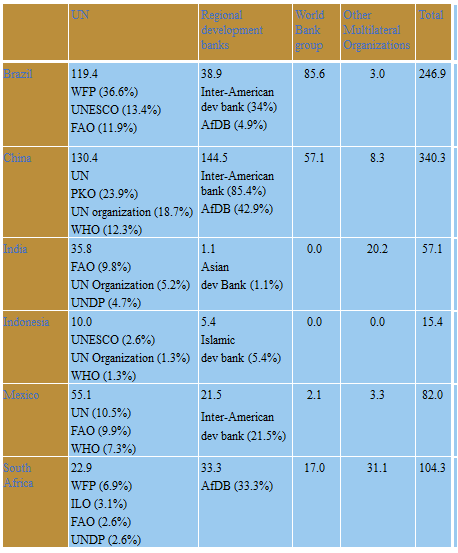
    Like the case of Turkey, it is also estimated that China uses bilateral channels in most of its development cooperation. (93% in 2013) (OECD 2015) and that half of Chinese multilateral flows is provided by the Inter-American Development Bank, the World Bank Group and the African Development Bank (see Table 2 below). In the same line, India also distributes 90% of its development aid via bilateral channels15. However, most of its multilateral aid is disbursed through the UN system (see Table 2 below).

    In contrast to Turkey, India and China, Indonesia mostly uses multilateral channels, most specifically the UN channels. However, it must be reminded that as seen in the table 2 between 2011 and 2013 the biggest multilateral recipient of Indonesia’s multilateral funds is the Islamic Development Bank 16. The same trend can also be seen between 2005-2009 in the case of South Africa whose bilateral development cooperation is only about 10% of its total aid 17. As seen in the table 2 the African Development Bank and the African Union are the biggest multilateral recipients of its multilateral aid. Brazil also seems to prioritize multilateral development aid because the OECD data indicates that in 2013, Brazil’s multilateral ODA accounted for 66% (208 million USD) of total ODA and that in 2015 Brazil provided 96 million USD of multilateral ODA, of which 57% disbursed to the UN and 43% to the Inter-American development bank18. Brazil and Mexico come closer in this respect because in 2014 Mexico’s multilateral ODA also accounted for 63% of its total ODA19.

    Russia seems to lay in the middle among our selected case studies because in 2015 Russia’s multilateral ODA was about 22% of its total ODA and the biggest share of its multilateral ODA belongs to the World Bank Group (about 53% of its multilateral ODA in 2015).In the same year it attributed 36% of its multilateral ODA to the United Nations and 1% to regional development banks and other multilateral organisations20.

    15 Organisation for Economic Cooperation and Development (OECD), Development Co-operation by Countries Beyond the DAC: Towards a more complete picture of international development finance, OECD, May 2015.
    16 Organisation for Economic Cooperation and Development (OECD), Development Co-operation by Countries Beyond the DAC: Towards a more complete picture of international development finance, OECD, May 2015.
    17 Yanacopulos H, ‘The Janus Faces of a Middle Power: South Africa’s Emergence in International Development’, Journal of Southern African Studies 40, No1,2013,p.203–216.
    18 Organisation for Economic Cooperation and Development (OECD), Development Co-operation Report 2017: Data for Development, Paris: OECD Publishing 2017.
    19 Organisation for Economic Cooperation and Development (OECD), Development Co-operation Report 2017: Data for Development, Paris: OECD Publishing 2017.
    20 Organisation for Economic Cooperation and Development (OECD), “The Russian Federation’s Official Development Assistance (ODA)”, assistance.htm

    Table 2: Estimates of funds accorded to the multilateral system: Non-OECD providers of Development Cooperation beyond the DAC (2011-2013 three-year average, USD million, current prices

    Source: OECD, Development Cooperation by Non-OECD Countries Beyond the DAC Towards a more complete picture of international development finance , OECD May 2015, operation%20by%20Countries%20beyond%20the%20DAC.pdf

    The comparative assessment of Turkey and the other selected G20 rising powers’ development aid shows that whereas Turkey, China and India and Russia distribute most of their aid bilaterally, Brazil, South Africa, Indonesia and Mexico prefer using multilateral channels. Russia appears to adopt a middle-ground approach since although its bilateral ODA share seems to be bigger, the share of its multilateral ODA is relatively higher than the ones of Turkey, India and China. Apart from Turkey, China and South Africa, which prioritise regional development bank groups, the UN system still remains the main recipient of the multilateral aid from Brazil, India, Mexico and Indonesia. In addition to this, it must be underlined that as seen in Table 2 the UN’s specialised agencies on food security and agriculture are the main channels of funding used by the above-mentioned G20 rising powers choosing to contribute most of their aid through UN channels. Russia turns out to be particular in this context because the majority of its multilateral ODA goes primarily to the World Bank Group.

    The table 3 below further ranks Turkey and the selected G20 rising powers in terms of their core and non-core multilateral contributions to the UN development system (UNDS). Core contributions are resources attributed to UN entities without restrictions, while non-core contributions are resources distributed to UN entities with some restrictions with regards to their use and application. In other words, with non- core multilateral contributions, states retain a margin of control with respect to the way the funding is spent. The table 3 below indicates that in terms of average contributions to the UN core development related activities, Turkey ranks as the 5th top contributor after Mexico, Brazil, Russia and China. Unlike China, Indonesia and Russia, Turkey with the likes of Brazil, Argentina, India, Mexico and South Africa provided more non-core contributions than core between 2014 and 2016.

    Table 3: G20 Rising Powers’ 2014-2016 average contribution for UN- Development related operational activities in thousands US dollars

    Core
    Non-Core

    Argentina
    10,192,666.7
    155,575,000

    Brazil
    29,856,333.3
    258,658,667

    China
    63,379,666.7
    55,797,000

    India
    15,916,666.7
    27,202,666.7

    Indonesia
    9,661,333.33
    8,307,333.33

    Mexico
    26,852,000
    57,480,333.3

    Russia
    44,414,333.3
    42,759,666.7

    South Africa
    6,779,333.33
    7,355,333.33

    Turkey
    24,075,333.3
    37,750,000

    Source: Self-calculated data based on the UN ECOSOC’s Quadrennial Comprehensive Policy Review (QCPR).

    ⦁ Sectoral and Geographical Distributions of Development aid

    Regarding the sectoral distribution of development aid, TIKA’s 2016 report shows that Turkey spent respectively 780 million USD for the “Social Infrastructure and Services Sector”, 90 million USD for the “Economic Infrastructure and Services Sector”, 23 million USD for the “Manufacturing Sector” and lastly 4 million USD for “Multi-Sectoral activities”21.

    In the case of Brazil, the AidData dashboard indicates that between 2000 and 2014, the top sectoral priorities of Brazil’s aid are respectively “Education” (36.11 million USD), “Agriculture” (19.59 million USD) and “Health” (17.65 million USD)22.

    In the case of China, between 2000 and 2014, the main sectors where China invest its financial aid are respectively “Energy Generation and Supply” (134.1 billion USD), “Transport and Storage” (88.8 billion USD) and “Industry, Mining and Construction” (30.3 billion USD)23.

    The 2014 White Paper on China’s Foreign Aid mentions that between 2010 and 2012, the main sectors of Chinese development aid (more than half went to Africa) were “economic infrastructure” (45% of bilateral funds) and “social and public infrastructure” (28% of bilateral funds)24.

    In the case of India, between 2006 and 2014, “Energy generation and supply” (882.72 Million USD) followed by “Transport and Industry” (550.19 million USD) rank among the top first sectoral priorities of India in its development aid program25.

    According to the OECD data, Russian Federation’s bilateral development cooperation mostly concentrated on the following sectors: public finance, nutrition, health, education and food security. While distributing its bilateral development aid, Russia prioritizes technical assistance projects, capacity building and scholarships, budget support and debt relief26.

    21 Turkish International Cooperation and Development Agency (TIKA), TIKA Development Assistance Report 2016.
    22 AidData dashboard,
    23 AidData dashboard,
    24 Information Office of the State Council (2014) (the 2014 White Paper)
    25 AidData dashboard,
    26 Organisation for Economic Cooperation and Development (OECD), “The Russian Federation’s Official Development Assistance (ODA)”, assistance.htm

    The main sectors of South Africa’s development aid between 2000 and 2014 are respectively “Government and Civil Society” (89.23 million USD), “Agriculture” (61.53 million USD) and “Education” (37.18 million USD)27.

    In sum, this paper argues that in terms of sectoral priorities, like China and India, Turkey seems to focus more on economic and social infrastructures and to pursue in this context a win-win partnership. This means that Turkey follows one of the core principles of SSDC which is about using aid to consolidate economic relations between the two partners in the SSDC. In contrast to Turkey, China, and India, the other G20 rising powers, namely Brazil, Russia and South Africa seem to give priority to social sectors such as health and education and agriculture.

    Coming to the geographical distribution, TIKA’s 2016 report shows that the top recipients of Turkish bilateral official development assistance in 2016 were respectively Syria, Somalia, Palestine, Afghanistan, Bosnia and Herzegovina, Kyrgyzstan, Macedonia, Kazakhstan, Azerbaijan and Niger. Out of these 10 countries, 3 are located in the Middle East (Syria, Palestine and Afghanistan), 3 are in South- East Europe (Macedonia, Azerbaijan and Bosnia and Herzegovina), two are in Central Asia (Kazakhstan and Kyrgyzstan), 1 from West Africa (Niger) and 1 from East Africa (Somalia)28.

    In the case of Brazil, an examination of the AidData dashboard showcases that between 20004 and 2014, Brazil ‘s main aid recipients include two west African countries ( Guinea Bissau and Cape Verde) , one north African country (Algeria) , 2 south African countries( Angola and Mozambique), one central African country ( Sao Tome and Principe), one Caribbean country ( Haiti), one South-east Asian country (Timor-Leste), and one south American country ( Paraguay)29. Here it must be noted that with the exception of Algeria and Haiti, all of the remaining top nine recipients of Brazil’s aid are, like Brazil, officially Lusophone. This distribution clearly shows that in development cooperation Brazil aims to strengthen its status as a regional power in a specific ‘region’ of the global South30.

    In terms of ODA, between 2004 and 2014, China’s top recipients include: 1 Caribbean country (Cuba), 3 West African countries ( Cote d’Ivoire, Nigeria and Ghana), 2 east African countries(Ethiopia and Tanzania), 1 central African country

    27 AidData dashboard,
    28 Turkish International Cooperation and Development Agency (TIKA), TIKA Development Assistance Report 2016.
    29 AidData dashboard,
    30 Cabral L, R Giuliano & J Weinstock, ‘Brazil and the Shifting Consensus on Development Co- operation: Salutary Diversions from the ‘Aid-effectiveness’ Trail?’, Development Policy Review, 32, no 2,2014, p.179–202.

    (Cameroun), 1 south Africa country (Zimbabwe),1 South-East Asian country (Cambodia) and 1 South-Asian country (Sri Lanka)31.

    Between 2006 and 2014, the top recipients of India’s aid include: 2 west African countries (Nigeria and Mali), one east African country (Ethiopia), one south African country (Mozambique), two Middle Eastern countries (Syria and Afghanistan), 3 South Asian countries (Bhutan, Nepal and Sri Lanka) and one South-East Asian country (Myanmar)32.

    In 2011, Eastern Europe and central Asia and SSA equally benefited each from 28% of Russian total ODA distribution while Latin America and Caribbean benefited each from 20% of Russian ODA. The same distribution is respectively 12% for South Asia, 9% for East Asia and 3% for Pacific and for the MENA region33.

    With the exception of Timor-Leste (a south-east Asian country) and Haiti (Caribbean country), South Africa concentrates the most of its development assistance on the SSA continent (Guinea Bissau, Guinea, Cape Verde, DRC, Sao tome and Principe, Zimbabwe, Mozambique and Lesotho)34. This is mainly due to the fact that South Africa prioritises Africa in its SSDC policies35.

    All these comparative geographical distributions of the selected G20 rising powers’ bilateral development aid show that whereas Turkey, Brazil and South Africa concentrate their SSDC activities on specific regions with strong historical and/or linguistic ties, China, India and Russia reach more geographically and culturally diversified groups in their SSDC projects.

    ⦁ ASSESSING TURKEY ‘S PERFORMANCE IN THE FIELD OF SSDC COMPARED TO ITS G20 PEERS

    This study argues that in recent years the importance of SSDC as an alternative model of development cooperation to the traditional north-south model has been increasingly acknowledged by both traditional and rising powers. The adoption of the 2030 Agenda for Sustainable Development by the UN General Assembly in September 2015 has further strengthened the importance of SSDC in the field of international development cooperation and one of the key models through which the delivery of the UN

    31 AidData dashboard,
    32 AidData dashboard,
    33 Ministry of Finance, “The Russian Federation ODA: National Report”, 2012,Available at:
    34 AidData dashboard,
    35 Dirco, “White Paper on South African Foreign Policy – Building a Better World: The Diplomacy of Ubuntu”, Pretoria: South Africa: Department of International Relations and Cooperation,2011.

    Sustainable Development Goals can be improved. This means that SSDC has already been benefiting from recognition by the international community, including Western donors. This explains why rising powers are actively engaged in SSDC.

    This study has shown that Turkey, China and India give more preference to economic and social infrastructures and in this regard pursue a win-win partnership, one of the core principles of SSDC. Compared to Brazil, Russia and South Africa which seem to give priority to social sectors such as health and education and agriculture, Turkey appears to be a stronger SSDC actor with the like of China and India.

    Like the cases of China and India, Turkey distributes most of their aid bilaterally. About 98% of Turkey’ s development aid is bilateral. The preference given to bilateral over multilateral development aid by Turkey, China and India lays in the fact that these countries seek to show their distinctiveness in the field of SSDC through following their own rules, principles and modalities in the formulation and disbursement of their aid activities. In this sense, like China and India, Turkey by prioritizing bilateral aid expressed its willingness to follow its own model of development cooperation, which as seen above presents strong similarities with SSDC. Bilateral development cooperation is likely to increase Turkey’s actorness in the field of SSDC as Turkey would have free-hand as to where and how to spend its money.

    However, an extensive focus on bilateral development aid might have reverse negative impact on Turkey’s and the other G20 rising powers’ quest for actorness in the field of SSDC because If Turkey’s bilateral aid rules and modalities significantly contrast with the established rules of multilateral development aid, it is likely that international donors( especially western donors) might be reluctant to grant recognition of Turkey’s actorness-seeking policies in the field of SSDC and Turkey’s actions in the field of SSDC might be seen as illegitimate by the international community. This is why non-core multilateral development aid play a key role in terms of allowing rising powers willing to show their particularities in the field of SSDC to reach this objective without being taxed as “outsiders” of the current international order. An analysis of the above data has shown that with the likes of Brazil, Argentina, India, Mexico and South Africa, Turkey seems to prefer non-core multilateral contributions compared to the core ones. This is an indication of Turkey’s willingness to retain control over the modalities of the use of their financial contribution by multilateral institutions while remaining part of this multilateral development aid order. In this regard, this paper argue that Turkey should prioritize non-core multilateral development aid over bilateral one as the main channel through which Turkey can show its distinctiveness in the field of SSDC while remaining attached to the multilateral rules of development aid.

    Similar to China and South Africa, Turkey prioritizes more regional development bank groups than UN Agencies for the channel of SSDC. More than half of Turkey’s

    multilateral funding is provided through channels outside of the UN. An integrated overview of Turkey’s financing strategies towards UN and non-UN funds suggests that although Turkey’s financial contribution has been increasing, it should redress the imbalance by contributing more to the funds, agencies and programmes of the UN.

    Geographical, cultural and historical connection is another element of SSDC. Like Brazilian and South African cases, Turkish aid concentrate on specific regions with strong historical and/or linguistics ties. In this sense, Turkey’s development path and experience is likely to be followed in an efficient manner by the recipient countries given that they share closer historical and linguistic ties. Turkish case differs from Chinese, Indian and Russia’s whose geographical reaches appear to be almost all encompassing, as the recipient countries are very diversified.

    CONCLUSION

    This article examined Turkey’s actorness in the field of SSDC in comparison with eight other G20 rising powers. The comparative task focused on a two -layered framework, namely bilateral vs multilateral aid and the geographical and sectoral distribution of development aid of the selected G20 rising powers.

    Regarding our selected case studies, the comparative data used in this study have shown that whereas Turkey, China and India provide most of their flows bilaterally, Brazil, Indonesia, South Africa, and Mexico channel a large share of their overall funding through multilateral organisations. This article argues that compared to Brazil, Indonesia, South Africa and Mexico, which prioritise multilateral channels over bilateral ones, China, India and Turkey give more preferences to bilateral development aid. Although bilateral channels provide donor countries with more flexibility opportunities over the rules and modalities of aid formulation and disbursement, it can negatively impact of the legitimacy of these countries’ aid projects vis-à-vis the international community of donors and ordinary citizens, especially when bilateral aid rules challenge the existing multilateral development aid norms. This leads to the point that Turkey is likely to consolidate its actorness in the sphere of SSDC through non-core multilateral aid because it would have the opportunity to show up its particularities as a SSDC actor while increasing international support and legitimacy of its aid activities. Non-core multilateral aid allows Turkey to retain some control over the use of the money given to multilateral institutions while remaining attached to the multilateral rules and as such would have more positive impact on Turkey’s actorness in the field of SSDC.

    Furthermore, the data on geographical distribution have shown that compared to, China, Russia and India, Turkey is less e eager to pursue a geographically and culturally extended actorness policies through bilateral SSDC because its top aid recipients are mostly concentrated on countries with strong historical and cultural ties with Turkey.

    In summary, Turkey and the selected G20 rising powers are more capable to achieve and consolidate their actorness in the field of SSDC through prioritizing non-core multilateral development aid because it provides rising powers with greater marge of maneuverer in terms of following the core principles of SSDC in the formulation and implementation of their development aid policies while widening international support of their actions.

    REFERENCES

    AidData dashboard,

    Al Jazeera, ‘‘Erdoğan: Türkiye’nin Afrika’da sömürgeci geçmişi olmadı”, June 1, 2016, gecmisi-olmadi

    Cabral L, R Giuliano & J Weinstock, ‘Brazil and the Shifting Consensus on Development Co-operation: Salutary Diversions from the ‘Aid-effectiveness’ Trail?’, Development Policy Review, 32,no 2,2014:179–202.

    Davutoğlu, Ahmet, “Turkey’s Humanitarian Diplomacy: Objectives, Challenges and Prospects”, Nationalities Papers: The Journal of Nationalism and Ethnicity, Vol 41, no: 6,2013: 865-870.

    Davutoğlu, Ahmet, “A New Vision for Least Developed Countries’’, Center for Strategic Research SAM Papers, Vision Papers,No4, July 2012 .

    Dal, Parlar Emel, Samiratou Dipama & Ferit Belder, “Assessing Turkey’s Development Aid Policy towards Africa: a constructivist perspective’’, International Relations and Dialogue of Cultures No 3,2014 :104-124.

    Dirco, “White Paper on South African Foreign Policy – Building a Better World: The Diplomacy of Ubuntu”, Pretoria: South Africa: Department of International Relations and Cooperation,2011.

    Dreher Axel et al, “The European Union, Africa and New Donors Moving Towards New Partnerships. Highlights”. European Union(May 2015), final_highlights_11052015_en.pdf

    Huang, Meibo, “South-South Cooperation, North-South Aid and the Prospect of International Aid Architecture’’, Vestnik Rudn International Relations No1,2015:24- 31.

    Information Office of the State Council (2014) (the 2014 White Paper)

    Korkut, Umut and Civelekoglu, Ilke, “Becoming a Regional Power while pursing Material Gains: The Case of Turkish Interest in Africa’’, International Journal, Vol.68, no1(Winter 2012):187-203.

    Ministry of Finance, “The Russian Federation ODA: National Report”, Available at:

    Nganje Fritze, ”Two-way socialization between traditional and emerging donors critical for effective development cooperation’’, Africa up Close ,6 January 2014, accessed on 28 October 2017, at, socialization-between-traditional-and-emerging-donors-criticalfor-effective- development-cooperation/,

    Organisation for Economic Cooperation and Development (OECD) Statistics at https://stats.oecd.org/

    Organisation for Economic Cooperation and Development (OECD), Development Co-operation by Countries Beyond the DAC: Towards a more complete picture of international development finance, OECD, May 2015.

    Organisation for Economic Cooperation and Development (OECD), Development
    Co-operation Report 2017: Data for Development, Paris: OECD Publishing 2017.

    Organisation for Economic Cooperation and Development (OECD), “The Russian Federation’s Official Development Assistance (ODA)”,

    Republic of Turkey, Ministry of Foreign Affairs. ”Turkey’s development cooperation”,

    Sucuoglu, Gizem and Jason Stearns, “Turkey in Somalia: Shifting Paradigms of Aid”. South African Institute of International Affairs, Research report, No 24, (November 2016).

    Turkish International Cooperation and Development Agency (TIKA), TIKA Development Assistance Report 2016.

    United Nations Conference on Trade and Development (UNCTAD), ”Economic Development in Africa Report: South-South Cooperation: Africa and the New Forms of Development Partnership’‘. UNCTAD 2010.

    Yanacopulos H, ‘The Janus Faces of a Middle Power: South Africa’s Emergence in International Development’, Journal of Southern African Studies 40, No1,2013:203– 216.

  • UN Peacekeeping Operations

    UN Peacekeeping Operations

    UN Peacekeeping Operations in Central African Republic: The Legality- Legitimacy Paradox

    Assoc. Prof. Dr. Gonca Oğuz GÖK Marmara Üniversitesi
    Assist. Prof. Dr. Radiye Funda KARADENİZ Gaziantep Üniversitesi

    UN Peacekeeping operations have been one of the most criticized missions of the United Nations since 1990’s. Blue Helmets’ role in humanitarian crises and civil wars have been widely discussed with reference to their structural limitations as well as their ineffectiveness in finding a workable solution to grave humanitarian crises. Yet, as the numbers of refugees are dramatically increasing in modern warfare, more people (especially women and children) became vulnerable to physical and sexual abuse and other crimes against humanity. The questions of UN peacekeepers’ accountability have always been problematic which further worsens the already problematic legitimacy of UN Peacekeepers in the eyes of the local population as well as global society for their respective missions. This paper attempts to analyze the “accountability” of Blue Helmets through the analyses of Peacekeeping Operation in the Africa region in 2000s and questions the possible judgement option by International Criminal Court (ICC) for their crimes against humanity.

    Key Words: Accountability, UN Peacekeeping Operations, Sexual Abuse, ICC

    ⦁ Introduction

    There has been a remarkable progress in terms of legalization in human rights field since the establishemnt of the UN. Especially after the Cold war, increasing number of human rights NGOs and their efforts challenged one of the strongest principles of the UN Charter: state sovereignity. Conceptualized by Katrene Sikking as “Justice Cascade”, in just three decades, state leaders in Latin America, Europe, and Africa have lost their “immunity” from any accountability for their human rights violations, becoming the subjects of highly publicized trials resulting in severe consequences.1 Furthermore, the Responsibility to Protect doctrine showcases a normative shift from “sovereignity as a right” towards “sovereignty as responsibility” for states. The establishment of a permanant court, International Criminal Court (ICC) has been a landmark event in the evolution of human rights norms in world politics. The normative evolution of human rights at the UN and the changing understanding of state sovereignity impose positive obligations on the state, thus promoting an understanding that the state and its rulers can do wrong. On the other hand, the UN has established a system of laws whereby the organization and its agents continue to enjoy “immunity” for crimes committed abroad.2 Although states have lost their immunity from any accountability for their human rights violations in changing world politics, the UN personel continues to enjoy irresponsibility and immunity from accountability, most notably the UN Peacekkepers3. UN’s Status of Forces Aggrement (SOFA) grants absolute immunity to peacekeepers—at least within the United Nations system—for crimes committed abroad. In other words, UN has no jurisdiction to conduct criminal investigations and prosecutions. Criminal investigation and prosecution of UN Peacekeepers are left up to states. Yet, the UN statistics and non-governmental organisation (NGO) reports demonstrate the number of offences committed by peacekeepers including human trafficking, rape and sexual slavery are widespread especially in Africa misions. This legal paradox, if not contradiction, of international human rights law increases the importance of “accountability” question as being one of the main sources of UN’s “illegitimacy” in world politics.

    There seems to be an evolution in terms of legalization in human rights field, but the main research question this paper asks; has this resulted in a more legitimate and “humane” governance of the UN in world politics? In other words, although there is

    1 Kathryn Sikkink, The Justice Cascade: How Human Rights Prosecutions are Changing World Politics, WW Norton Company, 2011
    2 Nadia Abramson, “United Nations Paacekeepers Can Do No Wrong: How Blue Helmets Achieved Immunity for Sexual Abuse in Cote D’Ivore and How to Ensure Accountability in the Future”, Student International Law Papers p: 11. (available at: per.pdf)
    3 Mara Pillinger, Ian Hurd, and Michael N. Barnett, “How to Get Away with Cholera: The UN, Haiti, and International Law”, Perspectives on Politics, March 2016, Vol. 14, No.1, p:70.

    ample evidence showing an evolutionary trend towards “legalization” on human rights field in the UN platform after the Cold War with respect to states’ and their leaders responsibilities, is there enough evidence supporting a “progress” in terms of a more “humane” governance through the UN? What are the persisting sources of “illegitimacy” of the UN in changing world politics? In light of above questions, this paper attepts to analyze the sources of UN’s illegitimacy with reference to the “accountability” issue of the UN Peacekeepers for their sexual abuses during the African missions by questioning the possible judgement option by International Criminal Court (ICC) for their crimes. This study argues that the “accountability” debade lies at the heart of the discussion of the sources of illegitimacy of the UN in humanitarian governance. Yet, as with the ambigiuites with persecution of peacekeepers in the ICC showcaes, the evolution of “legalization” in human rights field has not, yet, necessarily ends up-or completed- with a genuine “progess” in terms of a more humane global governance through the United Nations.

    ⦁ Sources of the Illegitimacy of the United Nations: The Accountablity Issue

    In democratic countries, citizens delegate power to their governments by electing them as their representatives. By willingly holding them to office, citizens recognize their government’s right to rule.4 However, since power is always delegated for a reason, Grant and Keohane argues, it is legitimate only so long as it serves its original purposes, in the case of the nation, it could be argued the protection of the rights and the pursuit of the public good.5 To be legitimate, governments are not only given the right to rule by their citizens but also held responsible by them.6 Thus, citizens at the national level have a right to “hold their governments to a set of standards”- for instance their promises before elections-to judge whether they have fulfilled their responsibilities in light of these standards and remove them from office if they do not think so in the end. 7 In other words, “people with power ought to be accountable to those who have entrusted them with it.”8

    On the other hand, the idea of “accountability” at the international level is much less clear in many aspects. Compared to domestic societies, there is not a world government above states capable of enforcing its rules or laws, judging and punishing immediately if not obeyed. Given the strong voluntary element in rule creation and rule following in the international system, Steffek argues, global governance is even

    4 Jean-Marc Coicaud, Legitimacy and Politics, Cambridge University Press, 2002, p: 10
    5 Ruth W. Grant and Robert O. Keohane, “Accountability and Abuses of Power in World Politics”,
    American Political Science Review, Vol. 99, No. 1 February 2005, p: 32
    6 Jean-Marc Coicaud, Legitimacy and Politics, Cambridge University Press, 2002, p: 33
    7 Ruth W. Grant and Robert O. Keohane’ ‘Accountability and Abuses of Power in World Politics’
    American Political Science Review, Vol. 99, No. 1 February 2005, p: 29
    8 Grant and Keohane, p: 32

    more dependent on legitimacy beliefs on the part of the ruled over than is any other.9 Furthermore, states remain the most prominent actors in world politics, but it is no longer even a reasonable simplification to think of world politics simply as politics among states. A larger variety of other organizations, from international organizations to multinational corporations as well as nongovernmental organizations exercise authority and engage in political action across state boundaries. As Keohane puts it, in a world of “interdependence without any organized government” or a world constitution, there are multiple audiences and subjects with respect to accountability. Keohane talks about, for instance, transnational accountability, in which demands are largely made by non-state actors and advocacy networks towards states.10 NGO’s and public opinion, Finnemore argues, has become consequential players in generating acceptance or rejection in international legitimacy claims including multilateral ones.11

    Thus the identity of the “accountability holders”, at the international level is much more complicated and yet the manner of holding decision makers accountable is less certain.12 Individuals, Steffek argues, are increasingly conceived of as the addressees of international rules and obligations either directly or indirectly.13 Furthermore, as International Organizations grow in power and scope, not only states as actors delegating authority to IOs, but also more populations are becoming increasingly effected and therefore vulnerable to their policies. Concerning organizations like the United Nations, their decisions and missions affect the daily lives of individuals which makes very difficult to exclude them as the addresses of accountability claims. 14 As UN’s decisions intrude more deeply to the daily lives of individuals around the world questions about their accountability and legitimacy necessarily arise.15

    In this regard, an important question is whether the UN should be held “accountable” for the violation of the international humanitarian law by forces under its command, namely the peacekeepers. Since Peacekeeping operations have been the main tasks of the UN especially after the Cold War Era, pressure continues to mount, especially from non-state actors, to make UN more “accountable” to domestic populations and

    9 Jens Steffek, The Legitimation of International Governance: A Discourse Approach, European Journal of International Relations, 9(2), p: 260
    10 Robert O. Keohane, “Global Governanace and Democratic Accountability”,
    11 Ian Johnstone, “Legislation and Adjudication in the UN Security Counsel: Bringing Down the Deliberatıve Deficit,” American Society of International Law, p: 277, 2008
    12 Andrew Hurrell, ‘Power, Institutions and the Production of Inequality’ Michael Barnett and Raymond Duvall (eds.) Power in Global Governance p: 56-57
    13 Jens Steffek, “Legitimacy in International Relations: From State Compliance to Citizen Consensus” (in), Hurrelmann, Schneider and Steffek (eds.) Legitimacy in an Age of Global Politics, Palgrave Macmillian, 2007), P:186
    14 Michael Barnett and Martha Finnemore, Rules For the World, Cornell University Press, 2004, p: 171
    15 Voeten, “The Political Origins of the UN Security Council’s Ability to Legitimize the Use of Force”, p: 528.

    transnational civil societies, as well as to increase access to participatory mechanisms for all affected actors.16 For instance, in 2010, United Nations peacekeepers accidentally brought cholera to Haiti. Nearly a million people were made sick and 8,500 died. Legal activists have sought to hold the UN responsible for the harms it caused and win compensation for the cholera victims. However, these efforts have been obstructed by the structures of public international law—particularly UN immunity—which effectively insulate the organization from accountability.17 Therefore, actors in global civil society increasingly demand setting up “new mechanisms” and norms of introducing accountability of the UN peacekkeping personel.18

    ⦁ UN Peacekeeping Operations and Immunity from Accountability: The Case of Africa

    The “accountability” of peacekeeping personnel for crimes committed on mission is something that the UN has been struggling more with in the last two decades. Peacekeeping operations has been one of the main tasks of the UN, especially after the Cold war era in terms of humanitarian crises management. As of 2015, the United Nations reported a completed fifty-five missions and sixteen currently active missions, covering every region of the world. The approved budget for United Nations peacekeeping operations from July 2014 to June 2015 totaled 7.06 billion U.S. dollars.19 Furtherore, the UN Peacekeping operations has widened in both scope and the definition of the mission. Historically, the original mission of peacekeeping operations was to cool down the conflicts and allow the parties to reach a final peace agreement on their own. Eventually, the mandates became more ambitious, allowing UN peacekeeping staff to hold elections, engage in the peace process, and assist in humanitarian crisis management. In its most extreme form, the United Nations has assumed the role of the government in some states emerging from conflict such as the missions in Cambodia, East Timor, and Kosovo. 20 Yet, most of these UN missions were highly criticized on the ground of being “ineffective” and highly “expensive” ones. For instance, During the cource of Bosnian War, UN Security Council had adopted almost 60 resolutions that mostly deal with the Bosnian peacekeeping force (UNPROFOR) which was the most expensive mission in the history of UN. Security Council veto powers which were unwilling to intervene to the war, issued very big missions to a peacekeeping force- UNPROFOR-which was not compatible with its resources. Ironically, Bosnian war has become both the most expensive misson in its

    16 Stewen Bernstein, “Legitimacy in Global Environmental Governance”, Journal of International Law and International Relations, Vol.1, No.1-2, p:142.
    17 Mara Pillinger, Ian Hurd, and Michael N. Barnett, “How to Get Away with Cholera: The UN, Haiti, and International Law”, Perspectives on Politics, March 2016, Vol. 14, No.1, p:70.
    18 Ibid, p:70.
    19 Nadia Abramson ,p:6
    20 Ibid, p:6

    history and also one of the most criticized ones, especially with its Srebrenitza case in 1995.21

    Apart from the important question of “effectiveness” due to structural limitations, UN Peacekkeping operations have been highly criticied on immunity from “accountability” with respect to criminal behaviour by Bluehelmets. Allegations of misconduct amounting to criminal behaviour have increased awareness of the problem of UN “immunity” especially in the last two decades.

    In fact, the problem of sexual abuses committed by peacekeepers has been acknowledged by the United Nations (UN) and other international organisations since 1995. However, the Brahimi Report, published in 2000, and which was supposed to provide a comprehensive review of peacekeeping operations, did not address this issue.22 Sexual abuse allegations against peacekeepers and aid workers became an international issue in late 2001 after the United Nations High Commissioner for Refugees (UNHCR) and Save the Children conducted a joint study on sexual exploitation of refugee communities in Guinea, Liberia, and Sierra Leone. The study uncovered allegations of abuse by United Nations peacekeeping forces, international and local nongovernmental organizations, and government agencies. The majority of victims involved were girls between the ages of thirteen and eighteen years old. 23 Following that, the General Assembly passed a resolution 57/306 on 15 April 2003, titled “Investigation into sexual exploitation of refugees by aid workers in West Africa”. Two years later, in 2005 the publication of “Zeid Report” was a turning point in terms of being the first comprehensive analysis of the problem of sexual exploitation and abuse by United Nations peacekeeping personnel.24 In that report, then Secretary-General Kofi Annan clearly underlined the “responsibility” of UN Peacekkeping forces for their sexual exploitation during their mission on Democratic Republic of Congo:

    “Sexual exploitation and abuse by a significant number of United Nations peacekeeping personnel in the Democratic Republic of the Congo have done great harm to the name of peacekeeping. Such abhorrent acts are a violation of the

    21Oliver Ramsbotham and Tom Woodhouse, Humanitarian Intervention in Contemporary Conflict, Cambridge: Polity Press, 1996, p: 186. One should note here, the history of UN peacekeeping operations were not always full of failures. In 1998, United Nations peacekeeping forces were awarded the Nobel Peace Prize for their valuable contributions as observers and negotiators in war-torn regions. See Abramson, p:11.
    22 Marco Odello and Róisín Burke, “Between immunity and impunity: peacekeeping and sexual abuses and violence”, The International Journal of Human Rights, 2016, p: 1.
    23 Abramson, p:4
    24 UN General Assembly Document, 24 March 2005 A/59/710 (available at

    fundamental duty of care that all United Nations peacekeeping personnel owe to the local population that they are sent to serve. 25 (emphasis edded)

    Since the publication of the Zeid Report in 2005, the UN has adopted a series of documents and some initiatives have been taken, mainly with administrative and disciplinary consequences for personnel considered responsible of sexual abuses.26 In this regard, a Conduct and Discipline Unit (CDU) was established at UN Headquarters in 2005 to provide oversight on conduct and discipline issues in peacekeeping operations and special political missions. Yet, there is still little clarity on the outcomes of the procedures set up by the UN and by states, showing that they do not yet act properly to address this phenomenon.27 Furthermore, new allegations of sexual misconduct surfaced in the Africa region with the work of NGOs in the last couple of years.28 Most recently, new allegations of sexual misconduct were report by a Human Rights Watch on Central African Republic.29 The UN statistics with regard to sexual exploitation and abuse allegations per missions and per years are shown in the following two tables .

    25 Ibid
    26 See UN Conduct and Discipline Unit (available at
    27 Odello and Burke, p: 2.
    28 See Melanie O’Brien, “Protectors on trial? Prosecuting peacekeepers for war crimes and crimes against humanity in the International Criminal Court”, ARC Centre of Excellence in Policing and Security, Griffith University (available at
    29 See https://www.hrw.org/africa/central-african-republic

    Sexual Exploitation and Abuse Allegations Per Mission Involving Minors

    Source: UN Conduct and Discipline Unit

    Sexual Exploitation and Abuse Allegations Per Year Involving Minors

    Source: UN Conduct and Discipline Unit

    The table clearly illustrates that almost all of the allegations are on missions in the Africa region. (UNMIL, UNOCI, UNMISS, MONUC, MONUSCO) In fact, Africa has been a giant laboratory for UN peacekeeping and has repeatedly tested the capacity and political resolve of an often dysfunctional 15-member UN Security

    Council.30 Several NGO Reports indicate that this is only the surface of the giant iceberg. Reports also emphasize that of the cases referred to states, few states respond to the referrals, and those that do rarely result in disciplinary action. Not all states have the legislative means to prosecute, and not all states take action to prosecute criminal conduct by their peacekeepers. It is also unclear from the UN reports what disciplinary action is taken, including whether or not prosecutions are held for criminal conduct. Confirmed cases of prosecution include the Canadian cases prosecuting nine defendants for torture and murder of a Somalian teenager; and the US case of Ronghi, found guilty of raping and murdering a ten-year-old girl in Kosovo.31 The UN has no standing army or police force available; consequently, it depends on the contributions of member states which may voluntarily contribute personnel for operations around the globe for accomplishing these broad missions.32

    More importantly, the UN still has no jurisdiction to conduct criminal investigations and prosecutions. Criminal investigation and prosecution is left up to states. The United Nations has two permanent sources of law and one case-specific negotiation tool to exercise its “immunity privileges” in peacekeeping operations. These are the United Nations Charter, the Convention on the Privileges and Immunities of the United Nations, and Status of Forces Agreements (SOFAs), respectively. According to Status of Forces Aggrement (SOFA) aggrement, if the host government believes that a foreign military member of the peacekeeping operation committed a criminal offense, the accused will be subject “to the exclusive jurisdiction of their respective participating states.” This language grants absolute immunity to peacekeepers—at least within the United Nations system—for crimes committed abroad. In fact, these immunities are codified as being necessary for the independent exercise of their functions in connection with the organization. However, paradoxically, these immunities challenge the very legitimacy of UN peacekeeping as producing immunity from criminal accountibiliy33.

    In sum, there ise considerable progress in human rights law with respect to the accountability of “states” on their violation of human rights. However, this is not true

    30 Adekeye Adebajo and Chris Landsberg, “Back to the future: UN peacekeeping in Africa”, International Peacekeeping, 7:4, 2000, pp: 161-188, p:161-162
    31 Melanie O’Brien, “Protectors on trial? Prosecuting peacekeepers for war crimes and crimes against humanity in the International Criminal Court”, ARC Centre of Excellence in Policing and Security, Griffith University (available at
    32 Abramson,p:6
    33 In 1989, the General Assembly requested the Secretary-General to prepare a “model status-of-forces agreement for peace-keeping operations,” which the Secretary-General presented one year later. At the very beginning of the document, Article II of the Model SOFA states that the Convention on the Privileges and Immunities applies to United Nations peacekeeping operations. Further, the document includes a provision on jurisdiction, which states, “All members of the United Nations peace-keeping operation including recruited personnel shall be immune from legal process in respect of words spoken or written and all acts performed by them in their official capacity.” See Abramson, p: 20

    for the world organization. State’s “sovereign immunity” norm is challenged with the advance of human rights norms and the establishment of International Criminal Court is one of the most influencial developments in human rights. The question is could this also be applied to Blue Helmets for their crimes commited abroad to overcome this accountability-immunity paradox which has increasingly become a real challenge to UN’s legitimacy and actorness in world politics?

    ⦁ Accountability of Blue Helmets: Prosecution Through International Criminal Court

    ICC has juristiction over 4 types of crimes: genocide, crimes against humanity, war crimes and aggression. However the abuses that the peacekeepers instigated do not seem to escalate to the level of either genocide, or crimes against humanity, as the Rome Statute, the authorizing treaty of the ICC, defines them.34 Firstly, it is difficult to imagine peacekeepers being actively involved in perpetrating genocidal acts, let alone being ascribed this type of special intention.35 The greatest difficulty in determining a crime by a peacekeeper to constitute a crime against humanity, on the other hand, lies in the fact that crimes by peacekeeping personnel ‘tend to be isolated and sporadic acts of military indiscipline or indifference’, rather than part of a widespread or systematic attack. A crime against humanity must be committed as part of the widespread or systematic attack. Furthermore, the aggressor’s act of murder, etc, must be pursuant to a “policy”. It is the existence of this policy that donates the criminal act with the character of a crime against humanity and excludes isolated acts of murder and so on from the court’s jurisdiction.36 Thus allegations against peacekeepers typically would not involve attacks against civilian populations involving such a widespread and systematic quality. A crime committed by a peacekeeper would most probably be considered an isolated incident and therefore would not amount to a crime against humanity.37

    As yet, the recent accounts of UN peacekeepers’ involvement in ‘sex trafficking’ and ‘child prostitution rings’ in the Africa region suggests that not all criminal acts of these soldiers are isolated, personal events. If peacekkepers’ acts are proved to be a part of a consistent pattern of offences by a number of persons, he or she may be properly charged with crimes against humanity.38 The majority of peacekeeping personnel would not be aware of the details of a plan or policy of a widespread or systematic

    34 Notar, Susan A. “Peacekeepers as Perpetrators: Sexual Exploitation and Abuse of Women and Children in the Democratic Republic of the Congo.” American University Journal of Gender, Social Policy and the Law. 14, no. 2 (2006): 413-429, p:426.
    35 Max Du Plesis and Stephen Pete, “Who Guards the Guardians: The ICC and serious crimes committed by United Nations peacekeepers in Africa”, African Security Review 13(4), 2004, p: 10.
    36 Ibid, p:10.
    37 Notar, p:413-429.
    38 Plesis and Pete, p:11.

    attack. Still it is something that those in superior positions within the mission may well be aware of, given their role in interacting directly with any leaders or commanders of parties to the conflict. The involvement of multiple peacekeeping personnel systematically in the sexual exploitation of the local population might be charged with crimes against humanity. 39

    With regards to war crimes, Under Article 8(1) of the Rome Statute there is no absolute requirement that a war crime be committed on a large-scale. Article 8(1) states that the ‘Court shall have jurisdiction in respect of war crimes in particular when committed as part of a plan or policy or as part of a large-scale commission of such crimes’. Therefore a single occurrence of a war crime is sufficient for the ICC to establish jurisdiction. A war crime avoids any similar requirement like being “systematic”, and thus it will be far more likely that a crime by a peacekeeper is classified as a war crime. The argument here is that, peace support operations are located in places experiencing on-going conflict, or in a post-conflict situation. Their very presence is related to the armed conflict. A crime such as sexual exploitation takes advantage of the situation created by the fighting, as the conflict has created a society in which women and children are vulnerable and open to abuse. Thus, it can be argued that these crimes are committed in the context of an armed conflict, and are associated with an armed conflict, even if hostilities have ceased. Crimes committed by peacekeeping personnel may fall within this “expansive” interpretation. 40

    On the other hand, it may be the case that the Court finds that the crime(s) in question do not have a direct link to armed conflict because it was committed after the cessation of hostilities, after the conclusion of peace, and thus might conclude that there is no jurisdiction under Statu of Rome, Article 8. Furthermore, there is no clear legal stance on the issue of peacekeeping personnel involvement in armed conflict, and whether and when they are considered to be “combatants” engaging in armed conflict or “civilians”. Thus, with regards to war crimes, the determination of the existence of an armed conflict and the status of such a conflict are the two biggest challenges.41 Ultimately, however, it would not be impossible to prosecute a peacekeeper under Article 8 of the Rome Statute. Once the existence of an armed conflict has been established, applying the broad interpretation of association with armed conflict established by the ICTY in the Foca case will enable the Prosecutor to argue that crimes committed by a peacekeeper are committed in the context of and are associated with an armed conflict, regardless of whether or not the peacekeeping personnel were engaged as combatants in that armed conflict. Another complication would be whether a peacekeeper’s crime can be linked to the attack or armed conflict. 42

    39 Ibid
    40 O’Brien, p: 12-25
    41 Fort the details of the legal issue, see O’Brein p: 12-25.
    42 Ibid.

    According to Plesis and Pete, if it can be shown that a peacekeeper committed a war crime (such as murder, torture, or rape) as part of a large-scale commission of such a crime, that peacekeeper may be guilty of a war crime without any need to prove the special intention that would be required for genocide and crimes against h ICC may have a role to play, but this role is strictly limited by the nature of the crimes over which this court exercises jurisdiction, and by the doctrine of complementarity which restricts the jurisdiction of the court to a great extent. Prosecutions of peacekeepers will most likely to continue to be conducted largely by the national state of the peacekeeper concerned, and prosecutions of such soldiers by the ICC will remain a very distant exception to that norm. 43 Yet, as this paper tries to showcases, the allegations are very rare which further increases the pressure towards UN system on accountability and increasingly became one of the crutial sources of its illegitimacy in World Politics.

    ⦁ In Guise of Conclusion: Evolution without Progress?

    UN’s legitimacy is the main source of its authority and power in world politics. To be powerful, it must be seen to serve some legitimate purpose- like preserving international peace and security, promoting human rights. More importantly, it must be perceveid to serve this “purpose” in an impartial, neutral and technocratic way, by using impersonal rules.44 As individuals are increasingly becoming the adresees of UN’s legitimacy claims, their beliefs about the legitimacy of the UN matters. As yet, there is ample evidence of harms caused by UN peacekeeping to people it is to serve. The United Nations has recently found itself accused of various kinds of harms, including exploiting weak and vulnerable people. Peacekeepers have repeatedly been accused of criminal activity and human rights violations, including trafficking, child abuse, and rape, and the UN has apparently been covering up this misbehavior, most recently in the Central African Republic. In many cases, rather than accepting responsibility the UN has relied on the law of immunity as a shield against accountability.45

    Although there exists an undeniable “progress” in terms of legalization in human rights field with respect to states-since their leaders are not immune from human rights abuses and could be held accountable through many ways including International Criminal Court; this progress seems not to be true for the UN. In contrast, the law of immunity has increasingly become a barrier towards the advancement of human rights in which UN is to serve in its Charter as exemplified by the immunity from accountability for sexual abuse of the UN Peaceekers in the Africa Region. There is

    43 Plesis and Pete, p: 12-15.
    44 Michael Barnett and Martha Finnemore, Rules for the World,Cornell University Press, 2004, p: 20-21
    45 See Mara Pillinger, Ian Hurd, and Michael N. Barnett, “How to Get Away with Cholera: The UN, Haiti, and International Law”, Perspectives on Politics, March 2016, Vol. 14, No.1.

    increasing pressure from civil society institutions to make UN more accountable to the people it is to serve. In sum, legalization is thought to serve “human beings” by limiting the ambitions and power struggles of states in world politics. The evolution in human rights field is the evindence of this, as yet the resistence of the UN for changing its structure and working methods is standing on the way towards that “progress”. This denotes to a legitimacy crises of the UN.

    References

    Abramson, Nadia, “United Nations Paacekeepers Can Do No Wrong: How Blue Helmets Achieved Immunity for Sexual Abuse in Cote D’Ivore and How to Ensure Accountability in the Future”, Student International Law Papers p: 11. (available at: uments/abramson.paper.pdf)

    Adebajo, Adekeye and Chris Landsberg, “Back to the future: UN peacekeeping in Africa”, International Peacekeeping, 7:4, 2000, pp: 161-188, p:161-162

    Barnett, Michael and Martha Finnemore, Rules for the World,Cornell University Press, 2004, p: 20-21

    Bernstein, Stewen, “Legitimacy in Global Environmental Governance”, Journal of International Law and International Relations, Vol.1, No.1-2, p:142.

    Coicaud, Jean-Marc, Legitimacy and Politics, Cambridge University Press, 2002, p: 10.

    Grant, Ruth W. and Robert O. Keohane, “Accountability and Abuses of Power in World Politics”, American Political Science Review, Vol. 99, No. 1 February 2005, p: 32

    Hurrell, Andrew, ‘Power, Institutions and the Production of Inequality’ Michael Barnett and Raymond Duvall (eds.) Power in Global Governance p: 56-57.

    Johnstone, Ian, “Legislation and Adjudication in the UN Security Counsel: Bringing Down the Deliberatıve Deficit,” American Society of International Law, p: 277, 2008.

    Michael Barnett and Martha Finnemore, Rules For the World, Cornell University Press, 2004, p: 171.

    Notar, Susan A. “Peacekeepers as Perpetrators: Sexual Exploitation and Abuse of Women and Children in the Democratic Republic of the Congo.” American University Journal of Gender, Social Policy and the Law. 14, no. 2 (2006): 413-429, p:426.

    O’Brien, Melanie, “Protectors on trial? Prosecuting peacekeepers for war crimes and crimes against humanity in the International Criminal Court”, ARC Centre of Excellence in Policing and Security, Griffith University (available at

    quence=1)

    Odello, Marco and Róisín Burke, “Between immunity and impunity: peacekeeping and sexual abuses and violence”, The International Journal of Human Rights, 2016, p: 1.

    Pillinger Mara, Ian Hurd, and Michael N. Barnett, “How to Get Away with Cholera: The UN, Haiti, and International Law”, Perspectives on Politics, March 2016, Vol. 14, No.1, p:70.

    Plesis, Max Du and Stephen Pete, “Who Guards the Guardians: The ICC and serious crimes committed by United Nations peacekeepers in Africa”, African Security Review 13(4), 2004, p: 10.

    Ramsbotham, Oliver and Tom Woodhouse, Humanitarian Intervention in Contemporary Conflict, Cambridge: Polity Press, 1996, p: 186.

    Sikkink, Kathryn, The Justice Cascade: How Human Rights Prosecutions are Changing World Politics, WW Norton Company, 2011.

    Steffek, Jens, The Legitimation of International Governance: A Discourse Approach, European Journal of International Relations, 9(2), p: 260.

    Steffek, Jens, “Legitimacy in International Relations: From State Compliance to Citizen Consensus” (in), Hurrelmann, Schneider and Steffek (eds.) Legitimacy in an Age of Global Politics, Palgrave Macmillian, 2007, p:186.

    Voeten, Eric “The Political Origins of the UN Security Council’s Ability to Legitimize the Use of Force”, p: 528.

    UN Conduct and Discipline Unit (available at

    UN General Assembly Document, 24 March 2005 A/59/710 (available at

    https://www.hrw.org/africa/central-african-republic

  • Human Security

    Human Security

    “Human Security” From Liberal Perspective: Is It a Comprehensive Model?

    Res. Assist. Dr. Cansu Güleç ARAS MEF University

    Classical liberal ideas were built on the concepts of equality, rationality, freedom and property. In the 18th century, Locke from England, David Hume and Adam Smith in Scotland, Montesque and Voltaire from France and Kant from Germany were the leading liberal thinkers. As an international theory that explained international politics and foreign policy, Liberalism emerged after the First World War. Names like Woodrow Wilson, Hobson, David Mitrany, Karl W. Deutsch, Michael Doyle, Francis Fukuyama, Stanley Hoffmann, Robert O. Keohane are among the most important representatives of liberal thought in international relations. According to Liberalism, world peace might occur with the residence of political and economic liberal norms at both national and international levels; the increase of interdependence and interaction; the international cooperation that carried out under the leadership of intergovernmental organizations; and the protection of human rights and governance. In security studies, the concept of human security is one of the most important concepts of the post-Cold War era that has been scholarly disputed. Indeed, the ethnic and religious-based conflicts after the Cold War led to evolution of the concept “national security” and the increase of the concerns about individual security in international relations. Since then, there have been attempts to “deepen and widen” the concept of security from the level of states to individuals. In that sense, the concept of “human security” considers human being as the reference object of security as well as it places the threats against human beings on the agenda. On the other hand, the mentioned concept objects the monopoly of the state in ensuring security through featuring the actors like international organizations and civil society. Accordingly, the concept of security will be discussed within the scope of liberal theory in this paper. Following the historical evolution, the conceptualizations about human security will be put forward. In addition, the criticisms toward the concept of human security will be analyzed. Finally, the evaluations regarding implementation and execution of human security will be discussed.

    Key words: Security Studies, Liberalism, Human Security, Globalization

    LİBERAL BAKIŞ AÇISIYLA “İNSAN GÜVENLİĞİ”: KAPSAYICI BİR MODEL Mİ?

    ÖZET

    Klasik liberal düşünce, eşitlik, rasyonellik, özgürlük ve mülkiyet kavramları üzerinde inşa edilmiştir. 18. Yüzyılda, İngiltere’den Locke, İskoçya’da David Hume ve Adam Smith, Fransa’dan Montesqueu, Voltaire ve Almanya’dan Kant önde gelen liberal düşünürler olmuşlardır. Liberalizmin uluslararası politika ve dış politikayı açıklamaya yönelik bir uluslararası ilişkiler teorisi olarak görülmesi ise I. Dünya Savaşı sonrasında ortaya çıkmıştır. Woodrow Wilson, Hobson, David Mitrany, Karl W. Deutsch, Michael Doyle, Francis Fukuyama, Stanley Hoffmann, Robert O. Keohane gibi isimler liberal düşüncenin uluslararası ilişkilerde önemli temsilcileri arasındadır. Liberalizme göre dünya barışı; siyasi ve ekonomik liberal normların ulusal ve uluslararası düzeyde yerleşik hale gelmesi, karşılıklı bağımlılığın ve etkileşimin artması, devletlerarası teşkilatların öncülüğünde gerçekleştirilecek uluslararası iş birliği, yönetişim ve insan haklarının korunmasıyla gerçekleşebilir. Güvenlik çalışmalarında insan güvenliği kavramı ise, etrafında pek çok kuramsal tartışmanın döndüğü Soğuk Savaş sonrası dönemin en önemli kavramlarından biridir. Zira, Soğuk Savaş sonrasında ortaya çıkan etnik ve dini temelli çatışmalar “ulusal egemenlik” kavramının evrim geçirmesine ve bireyin güvenliğine yönelik endişelerin, uluslararası ilişkiler gündemine yerleşmesine neden olmuşlardır. Söz konusu dönemden itibaren, güvenlik çalışmaları hem “genişlemeye” hem “derinleşme” ye uğramıştır. İnsan güvenliği, hem güvenliğin referans nesnesi olarak insanı kabul etmiş, hem de insana yönelik tehditleri gündeme taşımıştır. Öte yandan kavram, güvenliğin sağlanmasında uluslararası örgütler ve sivil toplum kuruluşları gibi aktörlere de çeşitli roller biçerek devletin bu alandaki tekeline karşı çıkmaktadır. Bu bilgiler ışığında, bu çalışmada liberal teori kapsamında güvenlik kavramı ele alınacak ve “insan güvenliği” kavramının genişleyen ve derinleşen güvenlik anlayışı ile beraber söz konusu teorik çerçevede nasıl yorumlandığı incelenecektir. Ortaya konulan tarihsel gelişimin ardından, insan güvenliğine yönelik belirsizliğin giderilmesi için yapılan kavramsallaştırmalar ortaya konulacaktır. Bununla beraber, insan güvenliği kavramına yönelik eleştiriler de analiz edilecektir. Son olarak, insan güvenliğinin hayata geçirilmesi ve yürütülmesine yönelik değerlendirmeler ortaya konulacaktır.

    Anahtar Kelimeler: Güvenlik Çalışmaları, Liberalizm, İnsan Güvenliği, Küreselleşme

    INTRODUCTION

    Security is an ambiguous concept and it is very open to different comments which include different dimensions. The actors in international relations usually consider the capabilities and the intentions of a possible rivals while making threat assessments, but it is also difficult for them to qualify and articulate the level of security. It can be argued that security consists of multiple elements some of which are shared by all actors and some of which are specific to a particular actor at a particular time.

    The actors in international environment such as states, individuals, international organizations and many others have a number of values. These values may include physical safety, economic welfare, autonomy, psychological well-being, and so on.1 It is argued that security points to some degree of protection of values acquired, and it has much in common with power or wealth. However, while wealth measures the amount of a nation’s material possessions and power is regarded as the ability to control the actions of others, security, in an objective sense, measures the absence of threats to acquired values, in a subjective sense, the absence of fear that such values will be attacked.2

    It can be claimed that the end of the Cold War has created an opportunity that the concept of security will be broadened, redefined or reconstituted. In that era, the definition of security as “the absence of existential threats to one state emanating from another” has been criticized by many reasons. First of all, the state is no accepted as the sole subject of security. Social, ethnic, religious minorities, individuals or humankind have been considered as objects that have security needs. Secondly, it has been argued that the attention devoted to the physical, territorial or political dimension of security is misplaced under conditions of complex interdependence. Other aspects are seen as significant in security terms which include economic resources, stability and institutions.3 Therefore, the narrowness of the military state-centric agenda was considered as politically and normatively problematic for those seeking to expand the concept of security.

    The rise of intra-state conflicts, societies’ fear of immigration, environmental problems and the acceleration of the HIV/AIDS epidemic demonstrated that traditional understanding of security was unable to meet the challenges of the post- Cold War era.4 In that sense, the concept of “human security” is one of the most

    1 David A. Baldwin, “The Concept of Secuirty”, Review of International Studies ,23, (1997): 13.
    2 Arnold Wolfers, “National Security as an Ambiguous Symbol”, Political Science Quarterly, Vol. 67, No. 4 (Dec., 1952): 484-485.
    3 Horald Müller, “Security Cooperation”, in Handbook of International Relations, Walter Carlsneas and others (ed.), (London: SAGE Publications, 2013), 607.
    4 Barru Buzan and Lene Hansen, The Evolution of Security, (Cambridge: Cambridge University Press, 2009),187.

    important concepts of the post-Cold War era that has been scholarly disputed. Indeed, the ethnic and religious-based conflicts after the Cold War led to evolution of the concept “national security” and the increase of the concerns about individual security in international relations. Since then, there have been attempts to “deepen and widen” the concept of security from the level of states to individuals. In that sense, the concept of “human security” considers human being as the reference object of security as well as it places the threats against human beings on the agenda. On the other hand, the mentioned concept objects the monopoly of the state in ensuring security through featuring the actors like international organizations and civil society.

    Accordingly, the concept of security will be discussed within the scope of liberal theory in this paper. Following the historical evolution, the conceptualizations about human security will be put forward. In addition, the criticisms toward the concept of human security will be analyzed. Finally, the evaluations regarding implementation and execution of human security will be discussed.

    THE LIBERALIST PERSPECTIVE OF SECURITY

    The Liberalist perspective has its roots from the 18th century enlightenment, and as a tradition in political theory, it takes individuals as its units of analysis. In early 20th century, especially after the WWI, liberalism reached prominence in international politics. On the other hand, there emerged periods when liberalism was under its most severe attack particularly in the 1930s. The dominant narrative in International Relations field was that Realism routed liberalism after World War II and liberalism had little to say about security. Nevertheless, liberal scholars continued to challenge realism in the 1950s and 1960s. Some continued to argue for conceiving the units of world politics as individuals rather than states. In 20th century, liberalism’s focus on increasing security by international law and organizations continued as well.

    Names like Woodrow Wilson, Hobson, David Mitrany Karl W. Deutsch, Michael Doyle, Francis Fukuyama, Stanley Hoffmann, Robert O. Keohane are among the most important representatives of liberal thought in international relations. According to Liberalism, world peace might occur with the residence of political and economic liberal norms at both national and international levels; the increase of interdependence and interaction; the international cooperation that carried out under the leadership of intergovernmental organizations; and the protection of human rights and governance.

    The theoretical point of origin for liberalism is the individual rather than as state. Liberal theory has paid particular attention to the state as the institution defined by its ability to make individuals secure. By treating state action as a function of individual beliefs and interests, the state is seen as instrumental to the purposes of individuals. Individual influence on states and on security is mediated through groups and institutions within and across states. Individuals can create, sustain, and destroy

    institutions and thereby enhance or degrade national and international security.5 Beside the individuals, a number of collectivities are the focus of analysis. Firstly states, but also corporations, organizations and associations are examples of these actors. Individual influence on states and on security is mediated through groups and institutions within and across states. Individuals can create and sustain institutions that may create conditions under which states will be more cooperative to their mutual benefit.6

    Liberals regards international institutions as actors that have feedback effects by deepening cooperation among states. The institutions whose global development policy discourse and programmes are analyzed in order to advance the arguments made about liberal perspective of security and development debate. The Western based institutional actors such as United Nations Development Programme (UNDP), the European Commission (EC), the World Bank and the are emphasized as being at the core of global governance networks linking conflict and security.7 Accordingly, the security is regarded as an interdependent issue in which economic interactions provide greater gains for the countries. Moreover, international institutions take a global stance on the environment, terrorism, epidemics, disasters as the only practical basis for coping with those problems.8

    One area of liberalism has developed arguments about democracies bearing on security cooperation. Beginning with Immanuel Kant, there has been a claim that democracies can behave differently than non-democracies in world affairs. Today, the emphasis on “democratic peace theory”, the notion that democracies are naturally peaceful among themselves. Accordingly, while democratic governments readily go to war with undemocratic ones, they do not plan for possible wars with each other since they do not see each other as threatening.9 Some analysts claim that combining democracy and an open economy and society produces this result. Others believe that democracies are more transparent in policies and policy making than non-democracies which makes for less suspicion, rivalry and conflict among them. According to another claim, democratic politics assumes compromise and the peaceful resolution of disputes through discussion. This brings dealings with other democracies in turn.10

    5 John M. Owen IV, “Liberalism and Security”, 9780190846626-e-33?result=1&rskey=033iMn (2010).
    6 Ibid.
    7 Melita Lazell, “Liberalism(s) and the Critical Securitization of Development Debate”, Globalizations, 13:4
    8 Patrick Morgan, “Security in International Politics: Traditional Approaches”, in Contemporary security studies, Alan Collins (ed.), (Oxford: Oxford University Press, 2013), 27.
    9 Morgan, “Security in International Politics: Traditional Approaches”, 28.
    10 Ibid.

    As it can be understood from these various forms of liberal understanding, the notion of security as a basic concept is applied in analysis of policy decisions via putting multiple dimensions. In sum, the main descriptors might be used for making assumptions from different perspectives of realist and liberal traditions.

    Table 1. Different Security Concepts

    TraditionForm of SecurityFocusWhat is at risk?Threats to Security
    Realist-basedNationalStateSovereignty, territorial integrityOther states and non-state actors
    Liberal -basedHumanIndividuals, mankind, human rights, rule of lawSurvival, human development and governanceState itself, natural catastrophe and change

    Source: P. H. Liotta, “Boomerang Effect: The Convergence of National and Human Security”, Security Dialogue vol. 33, no. 4, (December 2002): 475.

    Although there are many counter arguments and criticisms against it, liberalism as a tradition in security studies continues to make contributions since its emergence during the Enlightenment. Liberalism seeks to guide to international security insofar as individuals and the groups they organize affect or, at a maximum, erode states.11 One of its branches concerns the democratic peace and related research on democratic advantages in international cooperation. In addition, through globalization, societal needs for security transcend the traditional realm of territorial integrity and extend to transnational issues, from organized crime to migration, all of which lead to demands for enhanced security. Responses require contributions from non-state actors if effective regulation is to be achieved. They are partially based on the normative commitment to “human security” with the individual as core subject of entitlements to security – an offspring of liberal normative theory.12 The concept of human security

    11 Owen IV, “Liberalism and Security”.
    12 Horald Müller, “Security Cooperation”, 619.

    represents deepening and widening of the traditional notion of national security which is regarded as protection of state sovereignty and territorial integrity from external military threats.

    THE CONCEPT OF HUMAN SECURITY

    In traditional understanding, the concept of security is defined as protection of the sovereignty and territorial integrity of states from external military threats. This is a realistic approach that based on national security. Accordingly, states are viewed as the only referent object of security, which needs to be protected. This approach dominated security understanding especially during the Cold War period.13 Nevertheless, the Realist School of security thought has been challenged by many thoughts after the end of the Cold War on the ground that it does not provide sufficient understanding to the contemporary changes and challenges.

    Particularly, since the end of the Cold War, the subject matter of security studies has undergone both a “widening” and a “deepening.” The “widening” aspect of security has included consideration of non-military security threats, such as environmental scarcity and degradation, the spread of disease, overpopulation, migration, mass refugee movements, nationalism, economic and financial crises. The “deepening” aspect of security included the consideration of the security of individuals and groups, rather than focusing narrowly on external threats to states.14 In that framework, “human security” is containing common security, global security, cooperative security, and comprehensive security. The discussion of this concept encourages policymakers and scholars to think about international security as something more than the military defense of state interests and territory.15

    Even though the concept of Human Security does not have a universally agreed upon definition, there are some elements shared by all definitions of Human Security. These include a shift to the individual as the referent object of security. In addition, the definition of a security threat has been regarded as a threat to the quality of life of individuals. In other words, human security is about security for the people rather than of states.16 Also, the role of non-state actors has been recognized as agents for the assure of security. Finally, the importance of security has been shifted away from the traditional and exclusive concern with military and armed conflict. In that sense,

    13 Amitav Acharya, “Human Security”, in The Globalization of World Politics: An Introduction to International Relations, John Baylis, Steve Smith and Patricia Owens (eds.), (Oxford: Oxford University Press, 2014): 449.
    14 Rolad Paris, “Human Security: Paradigm Shift or Hot Air?”, International Security, Vol. 26, No. 2 (Fall 2001): 97.
    15 Ibid., 87.
    16 Amitav Acharya, “Human Security”,449.

    traditional, and Realist conceptions and practices of security has started to be criticized.17

    Although Human Security is treated as contested concept, the original formulation is conducted by UNDP with the publication of the Human Development Report of 1994. According to the UNDP, the potential threats to Human Security can be classified under seven central categories: economic, food, health, environmental, personal, community, and political security.

    ⦁ Economic security requires an assured basic income-usually from productive and remunerative work, or in the last resort from some publicly financed safety net.

    ⦁ Food security means that all people at all times have both physical and economic access to basic food. This requires not just enough food to go round. It requires that people have ready access to food-that they have an “entitlement” to food, by growing it for themselves, by buying it or by taking advantage of a public food distribution system.

    ⦁ Health security means guaranteeing a minimum protection from diseases and unhealthy lifestyles.

    ⦁ Environmental security means protecting people from the short-term and long-term ravages of nature, man-made threats in nature and deterioration of the natural environment.

    ⦁ Personal security requires protecting people from physical violence, whether from the state or external states, from violent individuals or sub-state actors, from domestic abuse and from predatory adults.

    ⦁ Community security means protecting people from the loss of traditional relationships and values and from sectarian and ethnic violence.

    ⦁ Political Security means ensuring people live in a society that honours their basic human rights, and ensuring the freedom of individuals and groups from government attempts to exercise control over ideas and information. 18

    17 Matt McDonald, “Human Security and the Construction of Security”, Global Society, Vol. 16, No. 3, (2002): 279.
    18 UN Human Development Report 1994, 24-32.

    Table 2. Types of Human Security and Root Causes

    TYPE OF INSECURITY
    ROOT CAUSES

    Economic insecurity
    Persistent poverty, unemployment, lack of access to credit and other economic opportunities

    Food insecurity
    Hunger, famine, sudden rise in food prices

    Health insecurity
    Epidemics, malnutrition, poor sanitation, lack of access to basic health care

    Environmental insecurity
    Environmental degradation, resource depletion, natural disasters

    Personal insecurity
    Physical violence in all its forms, human trafficking, child labour

    Community insecurity
    Inter-ethnic, religious and other identity-based tensions, crime, terrorism

    Political insecurity
    Political repression, human rights violations, lack of rule of law and justice

    Source: UN Human Development Report 1994, 24-25.

    UNDP proposed a concept of “human development” which focuses on building human capabilities to confront and overcome poverty, illiteracy, diseases, discrimination, restrictions on political freedom, and the threat of violent conflict. Accordingly, “every human being counts, and every human life is equally valuable. That universalism is at the core of the human development concept.”19

    The 1994 Human Development Report highlighted two major components of human security. One is “freedom from fear” and the other one is “freedom from want”. “Freedom for fear” focuses on reducing the human costs of violent conflicts through measures such as a ban on landmines, using women and children in armed conflict, child soldiers, child labor, and small arms proliferation, the formation of an International Criminal Court, and promulgating human rights and international humanitarian law. From this perspective, the UN Charter, the Universal Declaration of Human Rights, and the Geneva Conventions are the ‘core elements’ of the doctrine of human security. “Freedom from want” view is closer to the original UNDP formulation. It underlines the ability of individuals and societies to be free from a broad range of non-military threats, such as poverty, disease, and environmental degradation. On the other hand, both components agree that human security is about security of the individuals rather than states and protecting people requires going beyond traditional principles of state sovereignty.20

    Furthermore, the Human Security is considered as an inter-disciplinary concept that has some important features: “people-centered, multi-sectoral, comprehensive, context-specific, and prevention-oriented”.

    ⦁ As a people-centered concept, human security places the individual at the center of analysis,

    ⦁ As a multi-sectoral concept, it includes causes of insecurity relating for instance to economic, food, health, environmental, personal, community and political security.

    ⦁ As a comprehensive concept, it stresses the need for cooperative and multi- sectoral responses that bring together the agendas of those dealing with security, development and human rights.

    ⦁ As a context-specific concept, human security acknowledges that insecurities vary considerably across different settings and as such advances contextualized solutions that are responsive to the particular situations they seek to address.

    19 Human Development Indices and Indicators 2018 Statistical Update, 7.
    20 Amitav Acharya, “Human Security”, 495-496.

    ⦁ As a prevention-oriented concept, it introduces a dual focus on protection and empowerment. Protection includes strategies, set up by states, international agencies, NGOs and the private sector. It recognizes that people face threats that are beyond their control (such as natural disasters, financial crises and conflicts). Thus, human security requires protecting people in a systematic, comprehensive and preventative way. Empowerment, on the other hand, aims at developing the capabilities of individuals and communities to make informed choices and to act on their own behalf. Empowering people enables them to find ways and to participate in solutions to ensure human security for themselves and others.21

    The concept of Human security also points out the difference between “threat” and “vulnerability”. Firstly, a threat is considered as identifiable, often immediate, and requires an understandable response. For instance, military force has traditionally been sized against threats in order to defend a state against external aggression, to protect national interests and to enhance state security. Secondly, a threat is either clearly visible or commonly acknowledged. On the other hand, a vulnerability is often only an indicator, often not clearly identifiable, often linked to a complex interdependence among related issues, and does not always suggest a correct or even adequate response. Lioatta states that “while disease, hunger, unemployment, crime, social conflict, terrorism, narco-trafficking, political repression, and environmental hazards are at least somewhat related issues and affect the security of states and individuals, the best response to these related issues, in terms of security, is not at all clear. Even though Canada emphasized the relevance of human and environmental security to ‘high politics’ and attempted to restructure its armed forces to meet these challenges, the relevance of state-centered military forces for addressing or ‘solving’ non- state-centered issues is questionable.”22

    Moreover, a vulnerability is not clearly perceived, understood, and almost a source of debate. According to Liotta “…as a result of the 11 September 2001 attacks it is correct to suggest that the USA is vulnerable to terrorism in ways never previously understood or commonly acknowledged. Despite the USA’s isolated physical geography in relation to Europe, Asia, and the Greater Near East, its citizens are now vulnerable in ways never directly experienced before. Terrorism has become both a driving force and a critical uncertainty in security decisions.”23

    It is argued that with the rise of new issues around the world which encompass both widening and broadening aspects of security, a threat-based security dilemma is going along with the rise of various vulnerability-based survival dilemmas in contemporary

    21 Office for the Coordination of Humanitarian Affairs United Nations, Human Security in Theory and Practice Application of The Human Security Concept And The United Nations Trust Fund For Human Security, (2009): 7-8.
    22 Liotta, “Boomerang Effect: The Convergence of National and Human Security”, 478-479.
    23 Ibid.

    world.24 These shifts in the balance of threats and vulnerabilities require new strategies with more inclusive structures, missions, and budgets.

    THE DEBATE ABOUT HUMAN SECURITY

    Although Human Security has brought new actors and issues to the security agenda, it has also seen as problematic for a number of reasons. Most of these criticisms treat Human Security as a policy agenda, while many others are more critical of the main assumptions which Human Security is founded upon. For critics of human security, the concept is too broad to be analytically meaningful or useful as a tool of policy- making.

    Accordingly, there are two problems that limit the usefulness of the human security concept for practitioners of international politics. Firstly, the concept lacks a precise definition. Existing definitions of human security encompass everything from physical security to psychological well-being, which provides policymakers with little guidance in the prioritization of competing policy goals. Second, the idea of human security holds together a coalition of states, development agencies, and NGOs. As a unifying concept for this coalition, human security lacks precision, and thus encompasses the diverse perspectives and objectives of all the members of the coalition. This ambiguity diminishes the concept’s usefulness as a guide for policymaking.25

    Another criticism is concerned with Human Security as a security policy agenda. According to this critique, it is difficult to see how the Human Security approach could be “operationalized” particularly within present configurations of power and decision- making processes. In that sense, the work and implementation of Human Security are being questioned. Accordingly, setting the individual as the referent object of security causes some problems which Human Security sought in part to address. In that framework, the problem is the inability of Human Security to address adequately issues of identity if individuals constitute the set referent object of security. Accordingly, considering individuals as the referent object of security does not always represent the best means of understanding a particular situation of insecurity or redressing it. Issues of identity and ethnic difference may be ignored by a Human Security approach that effectively abstracts individuals, particularly if founded upon broadly universalized Western principles. For these critics, the reference object of

    24 Ibid., 481.
    25 Roland Paris, “Human Security: Paradigm Shift or Hot Air?”, International Security, Vol. 26, No. 2
    (Fall 2001): 88.

    security should be determined by the context in which a number of actors come to be threatened.26

    Another area of concern related to Human Security is around the question “how it would allow for the adjudication between competing claims and objectives”. For example, much of the deforestation in the Brazilian Amazon is caused by shifted cultivators and landless peasants, who cut down virgin tropical forest in order to sustain their families in the short term. In cases such as this, where different components of Human Security, such as environmental and economic, appear in opposition, whose security is to be addressed, and which types of concerns have priority? While the solution to both problems in this case may be related, judging between competing security claims may allow for an inability to create security.27

    Furthermore, the fact that Human Security is concerned with its universalism and its foundation on Western values is also being questioned. The link between Human Security and universalism is made explicitly in the UNDP’s Human Development Report of 1994. In that report, Human Security is described as a “universal concern’’. Thus, the general description of security in the Human Development Report regard security as the same for people everywhere. This universalism is related with the question of identity, particularly collective identity and difference. Additionally, Human Security is predicated upon a Western conception of the importance of democracy and, of greater concern, a commitment to free market economics, which potentially underestimate the questions of identity and difference.28

    Buzan also remains skeptical about human security, because it does not differentiate its agenda from that of human rights as regarding the referent object as the individual or humankind as a whole. According to him, this causes the danger that security is taken to be the desired end.29

    Newman claims that human security is normatively attractive, but analytically weak concept. For him, human security brings questions about the relationship between the individual and the state and about state sovereignty. Traditionally, state sovereignty and sovereign legitimacy rest upon a government’s control of territory, state independence and recognition by other states. The international legitimacy of state sovereignty rests not only on control of territory, but also upon fulfilling certain standards of human rights and welfare for citizens. As a result, the sovereignty of states that are unwilling or unable to fulfil certain basic standards may be at risk. The

    26 Matt McDonald, “Human Security and the Construction of Security”, Global Society, Vol. 16, No. 3, (2002): 280-81.
    27 Ibid.
    28 Ibid., 283.
    29 Barry Buzan, “A Reductionist, Idealistic Notion that Adds Little Analytical Value”, Security Dialogue, 35(3), (2004): 369–370.

    use of military force for human protection purposes is the powerful example of this concept.30

    According to some arguments, human security discourses are used as a justification to intervene other states. For example, the USA invaded Iraq through adopting human security discourse. Therefore, some perception of human security might be a tool to intervene in internal affairs of developing countries and impose Western values. Finally, human security is intertwined with the responsibility to protect and humanitarian intervention. For example, the international community intervened in Libya, but not Syria, Yemen, and Bahrain. According to this critics, human security promotes national security and power politics because the discourse to fulfill human security and human rights mainly depends on great powers.31

    CONCLUSION

    In the first half of the 20th century, world wars killed thousands of people, and left whole continents in devastation. During the Cold War, proxy wars killed thousands of people, and the world feared that a nuclear war would cause complete annihilation of the world. In the early 21st century, wars in Iraq, Afghanistan and Syria have killed thousands of people again. Although there was no major war after 1945, minor wars and terrorist attacks may continue to kill thousands of people.32 Under these circumstances, there emerged a number of intellectual debates regarding the security in International Relations, its scope and dimensions as well.

    It can be argued that human security is distinguished by three elements: its focus on the individual and human being as the referent object of security; its multidimensional nature; its universal or global scope, applying to states and societies of the North as well as the South. In addition, the concept of human security has been influenced by some developments: the rejection of economic growth as the main indicator of development and the accompanying notion of ‘human development’ as empowerment of people; the rising incidence of civil wars and intra-state conflicts involving huge loss of life, ethnic cleansing, displacement of people within and across borders, and disease out-breaks; the impact of globalization in spreading transnational dangers such as terrorism and pandemics; and the Post-Cold War emphasis on human rights and humanitarian intervention. The latter involves the principle that the international community is justified in intervening in the internal affairs of states accused of gross violation of human rights. This has led to the realization that while the concept of national security has not been rendered irrelevant, it no longer sufficiently accounts

    30 Edward Newman, “A Normatively Attractive but Analytically Weak Concept”, Security Dialogue, 35(3), (2004): 358-359.
    31 Hawre Hasan Hama, “State Security, Societal Security, and Human Security”, Jadavpur Journal of International Relations 21(1), (2017): 16-17.
    32 Joshua S. Goldstein and Jon C. Pevehouse, International Relations (10th Edition), (Pelgrave, 2014), 85.

    for the kinds of danger that threaten the societies, states, and the international community.33

    In conclusion, human security needs opportunities for creative synthesis and theoretical eclecticism. Liberal perspective might help the understanding of how human security can be promoted through interdependence, democracy and international institutions with its emphasis on non-state actors like international institutions and multinational corporations. However, it is also essential to put some insights about how human security notions are promoted by global power channels. Furthermore, the shifts in the global relations can help prospects for human security understanding. Otherwise, the concept will continue to be criticized by academics who carry out security studies due to the uncertainties regarding the definition and scope of human security.

    33Amitav Acharya, “Human Security”,451.

    BIBLIOGRAPHY

    Acharya, Amitav. “Human Security”, in The Globalization of World Politics: An Introduction to International Relations, John Baylis, Steve Smith and Patricia Owens (eds.). Oxford: Oxford University Press, 2014.

    Baldwin, David A. “The Concept of Secuirty”, Review of International Studies, 23,
    (1997): 5-26.

    Buzan,Barry. “A Reductionist, Idealistic Notion that Adds Little Analytical Value”, Security Dialogue, 35(3), (2004): 369–370.

    Buzan, Barry and Lene Hansen, The Evolution of Security. Cambridge: Cambridge University Press, 2009.

    Goldstein, Joshua S. and Jon C. Pevehouse, International Relations (10th Edition).
    Pelgrave, 2014.

    Hama, Hawre Hasan. “State Security, Societal Security, and Human Security”,
    Jadavpur Journal of International Relations 21(1), (2017): 1-19. Human Development Indices and Indicators 2018 Statistical Update.
    Lazell, Melita. “Liberalism(s) and the Critical Securitization of Development Debate”, Globalizations, 13:4 (2016): 361-376.

    Liotta, P. H. “Boomerang Effect: The Convergence of National and Human Security”, Security Dialogue, 33(4), (2002): 473–488.

    McDonald, Matt. “Human Security and the Construction of Security”, Global Society, Vol. 16, No. 3, (2002): 277-295.

    Morgan, Patrick. “Security in International Politics: Traditional Approaches”, in Contemporary security studies, Alan Collins (ed.). Oxford: Oxford University Press, 2013.

    Müller, Horald. “Security Cooperation”, in Handbook of International Relations, Walter Carlsneas and others (eds.). London: SAGE Publications, 2013.

    Newman, Edward. “A Normatively Attractive but Analytically Weak Concept”, Security Dialogue, 35(3), (2004): 358-359.

    Office for the Coordination of Humanitarian Affairs United Nations, Human Security in Theory and Practice Application of The Human Security Concept and The United Nations Trust Fund For Human Security, 2009.

    Owen IV, John M. “Liberalism and Security”, 1.0001/acrefore-9780190846626-e-33?result=1&rskey=033iMn . 2010.

    Paris, Rolad “Human Security: Paradigm Shift or Hot Air?”, International Security, Vol. 26, No. 2 (Fall 2001): 87-102.

    UN Human Development Report 1994.

    Wolfers, Arnold. “National Security as an Ambiguous Symbol”, Political Science Quarterly, Vol. 67, No. 4 (Dec., 1952): 481-502.

  • 100 YEARS AGO

    100 YEARS AGO

    100 YEARS AGO –  April 23, 1920

    Guran Tatlıoğlu

    April 23, 1921

    At the  end of the First  World War in 1918, the Ottoman  Empire was   defeated     with  Germany, the  victorious  states,  England,  France  and  Italy,    greece and  various  regions of  Turkey Had occupied,   including Istanbul  and  Izmir.  As the chief  occupier   of The Greek armies in Western  Anatolia,  bi r  many  villages,  towns  and  cities  settled,  seized  the rule of these places.  Greek  soldiers  began persecution of the indigenous  Turkish  people with the cooperation of   local  Greeks  and  Armenians, raped   women  and  girls,   tortures,  tattoos,    tresers  and  the killings   became  commonplace.

    The people were exhausted  and  tired. After years    of wars  and  defeats,  he was hopeful,  tired  and  poor. Devlet  management had   become a problem to ensure public order,    where  it  collapsed. Gangs were   made in an  environment like this. Some  of them  were intended to fight  against  the occupying     forces, oppose the  occupation,  rebelled to the Istanbul  government  that approved  the  occupation. Some  of   the gangs were just   bandit  –   with raids in this  chaotic  environment  – aimed at stealing  and  enriching  what they could steal from locals   with threats – and to enrichthem. Another    group   was commissioned by the      Istanbul  government to   oppose  resistance  to the invading insurgents.  In the country, some    of the     sultan’s supporters  were divided into two, and some wanted the patronage  of  Britain, the most  powerful  state of the time  ,  some of which was the American mandate.   Mustafa   Kemal  and  his friends  were fighting  an  independent  Turkey  and China against them. 

    The parliament  in Istanbul,  which lived for 50  days  after the Mondros agreement,  was dissolved by padishah on  December  21,  1918. In 1920,  after a  year’s break,  it was  revealed that Mustafa  Kemal  would convene  a  parliament  in Ankara and the Ottoman  Assembly    reopened   in January  1920.  The   parliament, which could live for  months,  was disbanded by British  occupying  forces on 16 March  1920 , where MPs  were arrested  and  deported  to the island of Malta.  Finally, on  April 23, 1920, the Turkish  Grand  National  Assembly was opened in the honor of Mustafa  Kemal.  The      land  government   had decided  that fighting the occupying  forces   could only  be successful with  the regular  army .

    Susurluk, Mustafa Kemal  Pasha ,  Bandirma,   Manyas,  Balikesir  and  Bursa  regionagainstthe  occupying  forces, from the end of the  war  from 1918,    Kuvvay-ı  Milliye name under the name local   Circassian  Ethem  is of particular  importance   among the groups that make guerrilla movements.   

    Circassian Ethem  was born in Bandirma in  1880.  The salum was the youngest of    Mr. Ali’s   son, from the shallow  Circassian  neck.     Two    b-and-a-half     brothers,  Reşit and Tevfik  Beyler,  graduated from Harbiye in 1901  ve  1902  and  joined the army of Osmanl. The other  two  brothers  Ilyas  and  Nuri  Gentlemen    died fighting  with  Greek  gangs.  Mr.    Ali did not want Ethem  to join the army.  However,  Ethem    came  to Istanbul from Bandirma  illegally and entered   suvari  little  Zabit  School in Bakirkoy ( Petty Officer  School).  The  Balkan  war also  collided in the Bulgarian  country  and  was awarded medals  for its usefulness . The    secret  organization of the Ottoman  Empire,  led by  Ashraf  Birdbasi in the First  World  War, is a guerrilla                in Iran, Iraq and Afghanistan under the command of The Organization – Isusa he  was involved in his wars and  wounded. That’s  why he had   returned to the country. 

    15 M in     1920  after the Greek  army’s invasion of   Izmir,  Circassian  Ethem  in order to  protect  the homeland  kuvvay  –  i  Seyyariye  under the name of guerrillaa  platoon  and  i   Start the fight  against  the Greek  troops.  At the         time, Circassian  Ethem’s  platozeleri  stood  in  someplaces for the greek army to advance or  pass. So he  helped   win the  time needed  to  establish the national  army .

    Co-operative Istanbul  government Prime Minister  Damat  Ferit  Pasha  , to prevent   the   National  Liberation  War,   armed  and  equipped  and  kuvva-  the head of the division  called    The Gods  The gendarmerie  major,  who was circassian,  brought Ahmet  Anzavur.  He started a  major  rebellion  against  the National  Liberation  forces in the Marmara region.    This riot movement called the”Anzavur  Rebellions”    soon    spread from Biga  to Balikesir.  He posed enough  threats to endanger   the National Liberation  Movement. 

    The Ankara government  has mandated Circassian  Ethem  to  quell  this  insurgency.  Ethem,  who has    5,000  horse-drawn water   power,  has suppressed this  rebellion .      Gerede  and    Yozgat  riots,     which were the threat of the national  movement of the time,  also  suppressed the Incubators of Circassian  Ethem at the request of Mustafa   Kemal.  Circassian      Ethem,  meanwhile, caught and   punished greek  and pro-Istanbul eteas  and the bandits that robbed the people.  The person who   decided   to execute them  immediately  without  allowing the rebels to be tried – in a  sense,  a regular army                  necessary for an illegality and a confederate zionic war.    due to the establishment of themas,    ankara government    has been at odds.  He  refused  his offer to join thearmy.    He  defected  to greek incubators.  He  was sent to Izmir  and then  to Germany  for  treatment  by the Greekscoured . He was charged with treason  and  enteredthe 150s  list. Years    later, whenhe was   150,he didn’t  return the idea that he had not committed  a  crime with a crime. He leftthe   world in  1950,  alongside    a  relative in Jordan. 

    Xx

          At the end of the First World  War, the Batin     Anatolia,  Kuvvay-I  Milliye – National  Forces- the region that entered  our  position when the movement  began  ,includingvillages    )  was as  follows ;

       Turkish Greek Armenian  Jewish

    Bandirma 46119 11.703  4030  –

    Erdek 11.143 20.815 186 252

    Gönen 43. 472 1480  48  –

    Edremit 39,906 – – 46

    Bale 29. 043  1113 –  –

    Burhaniye 23.100  215 –  –

    Quince 3.215  18.052  – –

    Balikesir 158.380 2.129  2.682 –

    Izmir                            111.486            87.497            12.857     24.403

    (Selek  1,  180  appendix  1)

    This List Susurluk is not seen. Susurluk Çerkez Ethem ve Anzavur Force Between Tan MuhareIronChen Ethem’in Susurluk’ta Greek Occupied to the commander Delivered OlmaSi ve Anzavur’s Susurluk’a up Come ve Susurluk Sulta, SultanMeadow’in British Has Borasit Mine Reason With The Turn aroundemde Importance carries. Theirurluk’ta  Estimated Information Brat Türk people yanısıra, bir Quantity Rum, Borasit in the mine Running 60  Armenian Family – 200’e Close Armenian Population – ve Az Amount Of Jewish available idi. Greeks Butşatlığı – Cemetery – Is would be said.  Jewish is My father learned ( Tüccardan HScientific Efendi). Grandpa (Helvaci zade Mehmet EfEndi  Muteber bir  Job adamı idi.  Grandpa ve Drool tahın hEleven factory, Bread Furnace ve Wholesale ve parakende Groceries Containing bir Job Instead ve Sizeable bir Farm sahipTi. 1902 Born the Drool in his youth Susurluk’ta bir From the Jew French Lessons aldığın, Teacher işyerine gelip of this Gave he’d say.. Grandpa ve Drool Greek from the invasion of After their Starting Kuvvay-ı Milliye To the transaction Façade behind Kelly ve This troops yiywill ve For help they were found.. Greek Occupied Commander Family punish Internalin Droolı 18 Years old  While, Same Case the Other Several young AboutBut Prisoners Got, Ago In Bandirma bir Salt in the warehouse tutuklamış. Sonra Givesit Island Over Atina’already it’svkedilmişler ve AtinaOf Two Years Khumalo VI. Konstantinos Military  hastaneWithoutof maidship ve süpürgecilik they had it done.. Salvation  War After their Free bırakılmışlar ve Again Girit Over Türkiye’ye They’re here.. Dedemin Salvation War in the Façade Rest Services Reason With  Old  Türkçe Written Gazi Mustafa Kemal Signed Weightı the bir İstiklal Medal available.

    Inthe  final  years of the First   World  Harbinin the vicinity, the Greek  and  Armenian  riot  movements  beganto sprout. For example, the Armenian church in the center  of the city in   Bandirma  pa-apazI  Avadis  church  sermonsthat the civilized  and  infortifiable  Armenian  nation  owns  this  land  –  now  that the time  of  this he    said he was coming, that God wantedit to be. Toros,  a teacher of the Armenian  primary school  in the Armenian  church,  described himself  as  a warfighter of independence.  Pharmacist  Istepan    expressed   his longing for the  national  flag.  In  addition  to provoking the    Armenian  people, they were abetting armenians      fleeing the Ottoman army  and  allowing them to join  the Armenian    gangs.  Organization-i  Mahsusa  (Turkish  Secret  Organization)  Bursa’s  Ibrahim Bey  entered  into the ranks  as an  agent .In August  1917  he caught the bflours,  with  documents   the crimes   were  substantiatedin court and they were executed.  

    Upon  the Greek      army’s invasion of Izmir,the native  Greeksof Bandirma  built the Greek  flag  Zafer  Tak, thinking that Greek  forces would come to Bandirma  and  beganto wait for  them . Along with    many  places in the Marmara  divide, there were scout  arms  led by  “Mavri  Mira” for  Bandirma  Rum  schools. Until he was 20,    Greek  youth  were joining them.  Pictures of Yunan  prime minister     andnizelosin the city and  Greek  flags were the original. Ottoman  hücluster  remedywasnot. In Bandirma,  theaskeri  and  the property  management  were incapable  of  greek  aggression. 

    Kara Hasanfor 200  people in the area to disrupt  security in  Biga,   Edincik  and  circassian  bandit  Deli Şükrü,  Karacabey  Çambaz    Hakki,  Anzavur,  Biga’da  Çerkez Sefer Bey,  In Balikesir,  the bandit’s  troops attached to The Drama’s  Riza  Bey  were causing  their movements .  Bandirma,  Gönen,  Susurluk  Bdetained,  edremit  and  ayvalik  was made possible  to make the journey as soonas there was no  robbery.   Therewas always  a  French  warship    in B andanma.    The  French-run  B-m-Izmirsaw this  as a fact for the protection   of the railway.  

    In addition to the  Circassian  and  Turkish  bandit    gangs,  the Greek  thug  was oneof the  reasons for  the deteriorationof security .   Local  Greek     gangswere   mostly    active  around  Erdek,  Bandirma  and  Marmara Island, where they   persecuted the local  Muslim  people.   These  gangs were joinedbyYunanpeople   from   the island of  Sisam,  who wore   native  Greek  dresses .

    With         the coordination   of opposing  movements  and the  purpose   of implementing  a  general  policy,  the inter-congressional  conventions were to be convened . Sivas  Congress on July  23,  1919,  First  Balikesir  Congress on July    26,    Erzurum  Congress closed on August 7 th n azilli,  August 16    Alaşehir  and  18  days  Then the Sivas  Congress  convened. These  congresses        were the basis   of mustafa kemal    pa’n’n’n’nnational state  establishmenttargets. 

      After the occupation of Izmir, Circassian  Ethem  Gönen,  Manyas,Balikesir  and   Bandirma n,  probably the villages of Çerkez  in Susurluk  Sultanmeadow,  Aziziye  and  Demirkapi villages    and      Borasit   madeni’s work by summoning the Circassians  he knew,  formed a  unity of 2,000  people.  Later,  this  union    reached 5,000  people.  They  set up a  defensive  line   in  Salihli,where the first Birdçubaşı  Ashref  Bey’s  farm is located.  The Farm  Organization  –    was the center of The Mahsusa.   They  then  provided important  services in suppressing    internal  disturbances  and  riots,  initially    in the Marmara  region.  But  these  Circassian  Ethem  forces  were commanded on their own, in a  sense  the disdemeanor      procession.  They’re also involved in thefat ma and  persecution    movements. Kisishand  and  social  relations  were processed according to the tribal  rules of the Circassians.  Duzce,   Konya,and  Yozgat  rebels  played a role in the raid. It is also   known that when they enter a house      under the pretext of looking for  weapons,  women go hand-to-hand  to crates  and  jewelry – and they’re not goingto be able to get into the house.  Since there was no  military    force in Ankara,  they     were cherished.

     One of  themoments of pre-em  events in the region is the cherkez  Ethem  ,  Anzavur  Ahmet  çhorse. Anzavur  ahmet was  one of the branchesof the Circassians  who settled  in Biga in Marmara Bolgesi, he was in service  as a gendarmerie  man in  his youth, followed   by eşkiya.  He  participatedin the follow-up of Cakircalı,  who was derived  between Aydin and Ödemiş  and    eliminatedin the early  years  of legitimacy.  So he went up to  the gendarmerieand went up to the regimental  captaincy.  Some  corruption was  referredto the nedenide  dispenser .  Anzavur  Milli  Mücadele’s  most  buddhist  days  becamea source of unrest  and crow’s wand  . He was ignorant  and  conservative.  He was  a  tally, a gang maker with    no  laws and  no order.  He    completedhis gang with the  release   of the prison-bound  inmate- the first time he’s been convicted of murder.  With the support of the British  and  the palace, it has sparked  riots  and  posed serious  dangers  where the occupying  authorities  wanted it. At one  point,  izmit  mutasarrafghina,    an  office between the governor’s  office and the prefecture,   was appointed.

    Anzavur’s matings beganon September  21,  1919.  He showed up   after the Sivas  Congress.    Greek  troops  coming from Izmir had not yet  reachedthe rebel  zone.  I. On November  2, 1919, susuren enteredthe Susuriaand Gönen on November 12,  1919,  in what is   called the Anzavur  rebellion.  Girı  Susurluk,  Manyas,  Ulu abat,  Kirmastı  ( Mustafa  Kemeal  Pasha),  Gönen  sides  allaa.     In the   villages  and  towns  he occupied,  hegatheredpeople in mosques-  the squares, the military service  ,the soldiers  should return to their hometowns –    or  join him, Kuvvay-  he   declared  that I Milliye  had “Alliance  and  Terakki”   bandits, that  they would be erased, that there was no  sultan’s  consent to stand up to the Greeks. 

        Kazim Özalp’s   61st division  in Balikesir and The 56th Division of Bursa’s  Bekir Sami  Bey with horsemen  and  pedestrian  soldiers  and  threethousand national   forcerle on November  15,  anzavur’u  susurluk around thevicinity. He pulled from the field  with 30  dead.  He was forced  to clash November 16/17 . It’s afairymoment.  1.Anzavur    resultedin his  defeat in everye-kmeat.  2.The      so-called Anzavur movement  began on February  16,  1920. This  movement,  which began in Biga,  spread rapidly to  Gforeen,  Susurluk,  Kirmasti  and  Bandirma. Gönenliler  200-strong    Governor  Rahmi  Bey joined forces  and  made a defense.  Rahmi  bey,   Mufti,   Mayor and  many    people from the people  were killed.  Bandirma  commander,   who is circassian,  Yusuf  Izzet  Pasha  was withdrawnto   Bursa.  Anzavur  completely  dominated   the area where he was found.  He entered Bandirma  easily   because of his native businessmen.   Anzavur  is  everywhere,  “The  Koranin my chest,  faith  in my heart, horse  in thestadium,i have dedicatedmy commitment to working for religion.  O  people,    comebehind my back.  Caliph  army,  Kuvvay-I will ruinthe Milliye  bandit.  Kuvvay-I  will establish Muhammadiye ,  Mustafa  Kemal is a  traitor”   he was walking aroundtherek.  He had his back on the sultan  and the Greek  forces. 

    On  April 15, 192,the National  forces –  Circassian  Ethem  forces-  defeated                              the anzavur and Gavur Imam forces, who are alleged to have been for 5,000 people, in the Tashbridge area between Susurluk Kirmasti . The  forces weretight-knit.       The rebels  took refugeon British  ships  in  Bandirma  and  Karabiga.  They  foughtthe National  forces around  Adapazari for a while.  Circassian  Ethem  clearedthe area from the rebels . He processed coffee tables in Bandirma.  Circassian  Ethem  and his older brother  Tevfik Bey set up the gallows  in towns    and   subordinated many    rebel  men.     A  week  later, on April  23rd,   the Turkish  Grand  National  Assembly was openedin  Ankara.    This   success of Circassian Ethe   m  made him a very  important  person, respected    , in the absence of the milli  army . Circassian  Ethem’s defeat of the Anzavur  and  Gavur  Imam  forces is an  important  pointof Kurtuluş  Savaşı.  If  otherwise  it was  Padisah  and  the Occupy  forces gained   great morale, the establishment  of a regular army would have been too   late. 

    Since thebandirma  was   on the coast of  marmara, the   Straits  were considered to be the statusquo and  hhad not been underthe full  dominance of  an internal  power.  It  was more  of a  town where the National  Forces  mentioned   it. Sometimes  Anzav   wasthe  scene   of    the  attackby British  soldiers  going to the port  after the abduction of the Akbas  ammunition. The Greek  birlikleri, who entered  Balıkesir  with the “Zafer  March”    campaign launched on June 22,  1920, added a bfor a  while  to  recover.  The Greek  Commander,  who is  confident that Turkish  troops  were disbanded,  went to  help  theb-altitudes  in Balikesir.     Thessaloniki,  Dedeağ     hungry, and the soldiers  they brought  from Iskeçe, on July    2,  1920  at 5:00  a.m. by taking ships to the ports of Bandirma  and  Erdek,   isgal these places   he did. They didn’t meet enme   in Bandirma.  He   has developed operationsin the direction of Karacabey and  Susurluk . Greek  Commander-in-Chief  Paraskevopulos arrived in Nanisma on July  5th,  three  days  after  the invasion,  while   Greek  Kyreg  tantdha konstantin  arrivedin B on July 6th.   (Aybek,  173-174)

    When Circassian   Ethem  came to Ankara  after the   appointment to bathe the Yozgat  rebellion, he was  greeted  and  compensated    by  Mustafa Kemal  Pasha, after the  Yozgat  rebellion wasstirn.   When he returned to    Ankara with his forces, Circassian  Ethem  bey  and   his       brothers,  ” with theg-showsmade  to them in Ankara,  even in the capital   of  Anatolia, Honor   and the men  who have  power are knitted…   Ethem  and  his brothers  were right to   consider  themselves masters of national revolution..  According to the thoughts, the  whole  national  Anatolian  presence was livingwith the force of their  rifles of parliament  and the Government ”  (Sener,53)

    The conflict    with the  Ankara  government has grown after  proposals   to  join thenational military  and  rejected  proposals for arabulupeople. On  December 27,  1920,Mustafa Kemal   telegraphedto Colonel  Ismet  Beye,  commander of the BatFront,    and  Refet Bey, commander of the Southern  Front, who said: “I don’t know what you’re doinghere. ”     (Balikesir  mebusu  Vehbi,  Saruhan  mebusu  CelalBayar,  Ethem’s abeyi  Saruhan  Mebusu  Reşit   Bey,  Formershir mebusu  Eyup  Sabri,        Antep  mebusu Kılıç Ali ( the advice  board covering theanswer)-  The Kuuvvayi-ı  Seyyare  work  can no longer  be solved through  peace  and  politics the   work    and  the problem has   been resolvedby  force  less. There is  noneed to inform Parliament   of the final phase of this- and that’s not the first timewe’ve been able to do so.     If we succeed, there   isno doubtthat the Assembly  will approve of what we do.  We have    enough  documents  and  evidence  to  prove that we are entitledto”. (Sener, 106)

    Mustafa Kemal Describes the situation    in the 543-547.ci  of Nutuk;  “The         masters,  Kutahya,   the decision of the delegation  to the deputy and the need for the prey  of  the delegation to communicate the needfor  the front line  commanders against the rebel Etem and his brothers to act on the operation against the rebel  Etem  and  his  brothers I ordered it.

     The masters- the military of the           operation, the capulsion   and the state  of the state,    the unjust  children of this to beg the ransom to the  mountains, who think it is a  thuggery.             Trace the whole  Turkish  homeland with their charlatans,  clamors,  and  the Turkish nation’s  Grand  National  Assembly with them, the inadequacy,  the  unjust  and any enemy  These             brothers,  who  have enough  pests  and private medicine storing their stobs, have the utmost  strength  and  istin their  hands,   including    the enemies they have.              in our historyof inkilap,  recording  as   an  exemplary  muessire, was  seen as essential  “…  

    When the board was a guest of Kütahya’da  Circassian  Ethem,  on December  29,  1920,   Ethem was drawn  to hisroom, and when the nervouserwas  too  corrupt, he told parliament  that he was full of  heavy  accusations.     sent; “Thereis no way to  continue  fighting  in these  wastes .  Even though    you’ve been in constant  meetings  for a year  –  the  biggest    job you’ve done  in the time –  it’s been to increase your own  foodto 300-400  liras . I think    you’ve been  informed of the sedition  that’s been in the army for months ,  butwith a  secret  session,   you’ve had the courageto resolve  and  prevent  them … Hü k ümet  members are a member of each of them who have sacrificed   your    holy  grev to your  personal interests by being sycophantsto each of them.. ”  (Ethem, 176)  wrote. Circassian  Ethem  later stated    in his memoir that he regretted    sending  this  telegram. 

    Mustafa Kemal   continues   in Nutku  (Speech, 545);

    ”  Masters,  in this  telgramnesty,  a  delusion called the protest name,  was indeed  drawn to the parliament  rial  and  readto parliament in a     trial. The  elfaz       and  phrase used in this –    so  galiz  and  so    biedeba – once it was read    ,  could not tolerate reading and  using it   again.  I don’t see such  a  despicable       delusion, and i don’t seeit as a must-have in your presence.  With this  delusion,    insulting  the individuals of the mebus, the legitimacy of the  Assembly of the National was violated,    and izzet Pasha delegation was demandingthe release    of the movement  to Istanbul.” 

    Circassian Ethem  forces  2326  militias  – 200  of them infantry-  159. The  exact  presence of the regiment was 4650  people,  6  machine  guns,  4 guns.  There  have been clashes with Western Front  Commander  Ismet  and The Southern  Front  commander,  Refet  Be.       The    national   army,  meanwhile,  wonthe Victoryof I.     On January 11,  1921,  the Greek  army was finally  withdrawn    from the defeat. 

    There were three  options  for Circassian Ethem ; To  surrender  to the  army, to choose freedom  by  climbing the  mountain and to fight, to seek refuge  in the Greeks.  Mr. Ethem  sends his brothers  and his  aide,  Mr. Sami,   to meet with the Greeks.  Cut the fire  is signed. He seeks   asylum for the Greeks.  The Yunans  accept    his  terms  . First,  his brothers  Reşit  and  Tevfik  Gentlemen take refuge.   As for   their  health,   he    decides to take refuge.  25  officers  and  700  troops    moveto the Greek  side.  Others  are released. 

     Mr. Ethem cannot carry out any kind   of  asylum.   He is drawnto the mountain  with his  elite  50-strong contingent.     Manyas     ,  Stirdirgı-  Susurluk  mountain  villages  stay for  a  while  and  friendsand friends are forced to stay in the Greek  kuvetts  due to the   forced conditionsof housing is found. They deal with Alexander, the Greek  Governor  from Susurluk, through  an  Armenian  interpreter  in the village of  Bir  Yoruk . They  cometogether to  Susurlu. In the   government mansion of Susurluk –  now the site of the statue of Ataturk, the  flag  pole  and the c.E.moon  garden – Circassian  Ethem  surrenders  to the Greek  commander.  His friends  are leftin their village with their guns.  His   brother  Tevfik  Bey,   who came to the susur,  governor Alexander, Tevfik  Bey’s  escort  officer  Yorgiyadis,   Şevket  Bey  and a few  friends  together  with  Circassian  Ethem  Susurluk  At the station    (opening   December  16, 1912) theysayto move  to Izmir by taking the train on a  day in late  February  1920. 

    The   Borasit     mine                                  in Susurluk, which has a very important place in Turkish Economic History until the First World War and beyond, was established on October 29, 1923, in The Republic of Turkey. faced many    difficult  problems in terms of production,  transportation,  and  management.   He changed hands  a couple of  times.  But  despite  all  the problems,  he continued to exist.  He  then made new  agreements  with  the Republican  government.  Borax,  which was placed in buckets  with the air  lineof the Borasit  Mine, was on its way to Omerköy  station.  The thick steel  rope,  which provides this air  line  4.5 km  long,    was usedto close  the  Dardanelles  during the First  Düya  war. 

    Resources;

    Kemal Ataturk; Lecture  I,II, Turkish Revolutionary History  Institute,Istanbul, 1960

    Selcuk Aybey; Salvation at the End of the  Barrel,Istanbul, 2006

    Circassian Ethem; My memories,    the prepared; Nermin  Taylan; Our  Books,Istanbul, 2014

    Sabahattin Selek; National  Struggle  I,II,Formal  Publications,1982

    Cemal Şener; Circassian  Ethem  Event,Any  Publications,Istanbul,1986

    Nurer Ugurlu; Kuvayi  Seyyariye,Formal  Publishing House,Istanbul,2007