Category: Sci/Tech

  • Researchers from Istanbul Technical University Describe Findings in Nanoparticles

    Researchers from Istanbul Technical University Describe Findings in Nanoparticles

    İstanbul Teknik Üniversitesini Nano parçacıklar üzerine başarılı çalışmaları için tebrik ediyoruz

    Researchers from Istanbul Technical University Describe Findings in Nanoparticles

    October 11, 2013

    c7300262-74d8-4675-9812-e1fa38108cbd

    By a News Reporter-Staff News Editor at Science Letter — New research on Nanoparticles is the subject of a report. According to news reporting originating in Istanbul, Turkey, by NewsRx journalists, research stated, “The kinetics of ZnO nanoparticles was examined by fluorescence measurements. Emission peak intensities of the ZnO nanoparticles synthesized at different conditions were monitored during wet-chemical reactions.”

    The news reporters obtained a quote from the research from Istanbul Technical University, “It was shown that the three stages of the reaction; nucleation, growth, and reaching the average size, can be followed by means of the fluorescence intensities corresponding to both bandedge (similar to 375 nm, similar to 445 nm, and similar to 485 nm) and deep-trap (similar to 520 nm and similar to 545 nm) transitions. With both higher stirring velocity and temperature the particle formation is faster. Although the nucleation time is not affected by stirring velocity, higher temperature causes faster reaction rate in all stages including nucleation.”

    According to the news reporters, the research concluded: “This method can be used for controlling the size of the nanoparticles.”

    For more information on this research see: Kinetics of ZnO nanoparticle formation via fluorescence measurements. Journal of Luminescence, 2013;143():741-745. Journal of Luminescence can be contacted at: Elsevier Science Bv, PO Box 211, 1000 Ae Amsterdam, Netherlands. (Elsevier – www.elsevier.com; Journal of Luminescence – www.elsevier.com/wps/product/cws_home/505700)

    Our news correspondents report that additional information may be obtained by contacting E. Alveroglu, Istanbul Technical University, Fac Sci & Letters, Dept. of Engn Phys, TR-34469 Istanbul, Turkey. Additional authors for this research include N. Yavarinia and Y. Yilmaz (see also Nanoparticles).

    Keywords for this news article include: Turkey, Eurasia, Istanbul, Nanotechnology, Emerging Technologies

    Our reports deliver fact-based news of research and discoveries from around the world. Copyright 2013, NewsRx LLC

    For more stories covering the world of technology, please see HispanicBusiness’ Tech Channel

    Source: Science Letter

    via Researchers from Istanbul Technical University Describe Findings in Nanoparticles – HispanicBusiness.com.

  • U.S. Military says Chemical weapons given to rebels in Turkey

    U.S. Military says Chemical weapons given to rebels in Turkey

    WND EXCLUSIVE

    U.S. military confirms rebels had sarin

    Classified document shows deadly weapon found in home of arrested Islamists


    author-image F. Michael Maloof

    F. Michael Maloof, staff writer for WND and G2Bulletin, is a former senior security policy analyst in the office of the secretary of defense.

    As part of the Obama administration’s repeated insistence – though without offering proof – that the recent sarin gas attack near Damascus was the work of the Assad regime, the administration has downplayed or denied the possibility that al-Qaida-linked Syrian rebels could produce deadly chemical weapons.


    However, in a classified document just obtained by WND, the U.S. military confirms that sarin was confiscated earlier this year from members of the Jabhat al-Nusra Front, the most influential of the rebel Islamists fighting in Syria.


    The document says sarin from al-Qaida in Iraq made its way into Turkey and that while some was seized, more could have been used in an attack last March on civilians and Syrian military soldiers in Aleppo.


    The document, classified Secret/Noforn – “Not for foreign distribution” – came from the U.S. intelligence community’s National Ground Intelligence Center, or NGIC, and was made available to WND Tuesday.


    It revealed that AQI had produced a “bench-scale” form of sarin in Iraq and then transferred it to Turkey.


    A U.S. military source said there were a number of interrogations as well as some clan reports as part of what the document said were “50 general indicators to monitor progress and characterize the state of the ANF/AQI-associated Sarin chemical warfare agent developing effort.”


    “This (document) depicts our assessment of the status of effort at its peak – primarily research and procurement activities – when disrupted in late May 2013 with the arrest of several key individuals in Iraq and Turkey,” the document said.


    “Future reporting of indicators not previously observed would suggest that the effort continues to advance despite the arrests,” the NGIC document said.


    The May 2013 seizure occurred when Turkish security forces discovered a two-kilogram cylinder with sarin gas while searching homes of Syrian militants from the al-Qaida-linked Jabhat al-Nusra Front following their initial detention.


    The sarin gas was found in the homes of suspected Syrian Islamic radicals detained in the southern provinces of Adana and Mersin.


    Some 12 suspected members of the al-Nusra Front were arrested. At the time, they were described by Turkish special anti-terror forces as the “most aggressive and successful arm” of the Syrian rebels.


    In the seizure, Turkish anti-terror police also found a cache of weapons, documents and digital data.


    At the time of the arrest, the Russians called for a thorough investigation of the detained Syrian militants found in possession of sarin gas.


    This seizure followed a chemical weapons attack in March on the Khan al-Assal area of rural Aleppo, Syria. In that attack, some 26 people and Syrian government forces were killed by what was determined to be sarin gas, delivered by a rocket attack.


    The Syrian government called for an investigation by the United Nations. Damascus claimed al-Qaida fighters were behind the attack, also alleging that Turkey was involved.


    “The rocket came from a place controlled by the terrorists and which is located close to the Turkish territory,” according to a statement from Damascus. “One can assume that the weapon came from Turkey.”


    The report of the U.S. intelligence community’s NGIC reinforces a preliminary U.N. investigation of the attack in Aleppo which said the evidence pointed to Syrian rebels.


    It also appears to bolster allegations in a 100-page report on an investigation turned over to the U.N. by Russia. The report concluded the Syrian rebels – not the Syrian government – had used the nerve agent sarin in the March chemical weapons attack in Aleppo.


    While the contents of the report have yet to be released, sources tell WND the documentation indicates that deadly sarin poison gas was manufactured in a Sunni-controlled region of Iraq and then transported to Turkey for use by the Syrian opposition, whose ranks have swelled with members of al-Qaida and affiliated groups.


    The documentation that the U.N. received from the Russians indicated specifically that the sarin gas was supplied to Sunni foreign fighters by a Saddam-era general working under the outlawed Iraqi Baath party leader, Izzat Ibrahim al-Douri.


    Al-Douri was a top aide to Saddam Hussein before he was deposed as Iraqi president.


    The sarin nerve gas used in the Allepo attack, sources say, had been prepared by former Iraqi Military Industries Brig. Gen. Adnan al-Dulaimi. It then was supplied to Baath-affiliated foreign fighters of the Sunni and Saudi Arabian-backed al-Nusra Front in Aleppo, with Turkey’s cooperation, through the Turkish town of Antakya in Hatay Province.


    The source who brought out the documentation now in the hands of the U.N. is said to have been an aide to al-Douri.


    Al-Dulaimi was a major player in Saddam’s chemical weapons production projects, the former aide said. Moreover, Al-Dulaimi has been working in the Sunni-controlled region of northwestern Iraq where the outlawed Baath party now is located and produces the sarin.


    The NGIC depiction of the variety of sarin as “bench-scale” reinforces an analysis by terrorism expert Yossef Bodansky, who said the recent findings on the chemical weapons attack of Aug. 21 on the outskirts of Damascus, Syria, was “indeed a self-inflicted attack” by the Syrian opposition to provoke U.S. and military intervention in Syria.


    Bodansky, a former director of the U.S. Congressional Task Force on Terrorism and Unconventional Warfare, said a preliminary analysis of the sarin showed that it was of a “kitchen” variety and not military grade.


    He questioned that the sarin was of a military variety, which accumulates around victims’ hair and loose clothing.


    Because these molecules become detached and released with any movement, Bodansky said, “they would have thus killed or injured the first responders who touched the victims’ bodies without protective clothes … and masks.”


    Various videos of the incident clearly show first responders going from patient to patient without protective clothing administering first aid to the victims. There were no reports of casualties among the first responders.


    “This strongly indicates that the agent in question was the slow acting ‘kitchen sarin,’” Bodansky said.


    “Indeed, other descriptions of injuries treated by MSF (The French group Doctors Without Borders) – suffocation, foaming, vomiting and diarrhea – agree with the effects of diluted, late-action drops of liquefied Sarin,” he said.


    The terrorism expert said that the jihadist movement has technologies which have been confirmed in captured jihadist labs in both Turkey and Iraq, as well as from the wealth of data recovered from al-Qaida in Afghanistan in 2001 and 2002.


    He added that the projectiles shown by the opposition, which were tested by U.N. inspectors, are not standard weapons of the Syrian army.


    Meanwhile, an  Italian former journalist and a Belgian researcher who were recently freed from their al-Nusra captives say they overheard their captors talking about their involvement in a deadly chemical attack “last month,” which would have been the Aug. 21 chemical weapons attack.


    The Italian, Domenico Quirico, and Belgian researcher Pierre Piccinin were released Monday after five months of captivity.


    “The government of Bashar al-Assad did not use Sarin gas or other types of gas in the outskirts of Damascus,” Piccinin said.


    While captive, Piccinin said the two had overheard a Skype conversation in English among three people.


    “The conversation was based on real facts,” said Quirico, claiming one of the three people in the alleged conversation identified himself as a Free Syrian Army general.


    He added that the militants said the rebels carried out the attack as a provocation to force the West to intervene militarily to oust the Assad regime.


    Both men told a news conference they had no access to the outside world while they were held captive and knew nothing about the use of chemical weapons until they heard the discussion on Skype.


    Now, a former analyst for the Central Intelligence Agency, Ray McGovern, similarly backs the claim that the Syrian rebels perpetrated the poison gas attack on Aug. 21


    McGovern was one of a number of veteran intelligence professionals who recently signed a letter to Obama saying that Damascus wasn’t behind the Aug. 21 chemical attack.


    As WND recently reported, former U.S. intelligence analysts claim current intelligence analysts have told them Assad was not responsible for the Aug. 21 poison gas attack, saying there was a “growing body of evidence” that reveals the incident was a pre-planned provocation by the Syrian opposition.


    The analysts, in an open letter to Obama, referred to a meeting a week before the Aug. 21 incident in which opposition military commanders ordered preparations for an “imminent escalation” due to a “war-changing development” that would be followed by the U.S.-led bombing of Syria. They said the growing body of evidence came mostly from sources affiliated with the Syrian opposition and its supporters.


    Those reports, they said, revealed that canisters containing chemical agents were brought into a suburb of Damascus, where they were then opened.


    “Initial meetings between senior opposition military commanders and Qatari, Turkish and U.S. intelligence officials took place at the converted Turkish military garrison in Antakya, Hatay Province, now used as the command center and headquarters of the Free Syrian Army and their foreign sponsors,” the analysts said.


    The VIPS memo to Obama reinforces separate videos, which show foreign fighters associated with the Syrian opposition firing artillery canisters of poison gas. One video shows Nadee Baloosh, a member of an al-Qaida-affiliated group Rioyadh al-Abdeen, admitting to the use of chemical weapons.


    In the video clip, al-Abdeen, who is in the Latakia area of Syria, said his forces used “chemicals which produce lethal and deadly gases that I possess.”
  • Israeli Firms in Middle of NSA Spy Scandal

    Israeli Firms in Middle of NSA Spy Scandal

    pacTwo Israeli companies, including one exposed by EIR in 2001-02 as under investigation in the U.S. for being part of a massive Israeli espionage network (see EIR, Feb. 1, 2002), have been identified as playing a central role in handling the NSA’s acquisition of call information from major telecommunications companies.

    * VERINT Systems, formerly known as Comverse Systems, a U.S.-based subsidiary of the Israeli Comverse Technologies, was reported by author and NSA expert James Bamford to have been designated by the NSA to process all the call information (metadata) obtained from Verizon. By the time it got the NSA contract, Comverse was already well-known as a leading firm in wiretapping, or what it called the “lawful interception market” for law-enforcement agencies. In 2002, about the time NSA launched its Stellar Wind operation, tapping into the major telecoms, former NSA Director Lt. Gen. Kenneth Minihan joined the Board of Directors of Comverse-Verint.

    * NARUS, another Israeli company, similarly processes all the information obtained from AT&T for the NSA. Narus was founded in Israel in 1997, and in 2010 was acquired by Boeing. Narus’s NarusInsight supercomputer system, which was installed in AT&T’s San Francisco Internet facility and identified by AT&T whistleblower Mark Klein, gave rise to a famous 2006 class action lawsuit filed by the Electronic Frontier Foundation against AT&T, Hepting v. AT&T.

    Additionally, AMDOCS, another Israeli telecommunications firm profiled by EIR in 2001-02, specializes in analyzing (i.e. data-mining) customer billing records for major U.S. telecoms; this data is similar to the “metadata” collected by the NSA on all phone calls in the U.S. Some investigators believe Amdocs is also involved in the NSA Stellar Wind program; indeed, it would be surprising if they were not.

    Ha’aretz reported on June 8 that both Verint and Narus have ties to both the Israeli intelligence agency Mossad, and the Israel Defense Forces intelligence-gathering unit 8200. Ha’aretz also raises the question of whether Mossad is a party to the intelligence-sharing arrangement between the U.S.’s NSA and Britain’s GCHQ, Britain’s Cheltenham-based signals-intelligence agency.

    larouchepac.com, June 12, 2013

  • Turkey aims to build home-grown nuclear industry, expertise

    Turkey aims to build home-grown nuclear industry, expertise

    * Nuclear key to Turkey reducing energy import dependence

    * Rosatom to bring Turkey’s 1st reactor on line in 2019

    * Japanese-French consortium building 2nd facility

    * Turkey wants new generation of nuclear engineers

    By Humeyra Pamuk and Orhan Coskun

    ANKARA, May 8 (Reuters) – Turkey wants to build a home-grown nuclear industry over the next decade as it seeks to cut reliance on costly imported oil and gas, even though the nuclear newcomer outsourced its first two atomic power plants to foreign firms.

    The fast-growing nation of 76 million people, which faces a ballooning energy deficit, last week awarded a $22 billion deal to a Japanese-French consortium to build its second nuclear power plant at Sinop on the Black Sea coast.

    The development of its planned first nuclear plant was also handed to a foreign company – Russia’s Rosatom, which aims for it to be operational in 2019.

    Turkey is set to overtake Britain as Europe’s third-biggest electricity consumer within a decade and is seeking to cut its reliance on imported energy, the root cause of a gaping current account deficit that is its main economic weakness.

    Developing an indigenous nuclear industry is part of that strategy. The government hopes that by the time it builds its third planned nuclear plant, local talent and technology will be the backbone of the project.

    Energy Minister Taner Yildiz said Ankara was looking for its third plant to be 80-85 percent built with Turkish engineering and expertise, although a foreign partner would probably still be involved in the financing.

    “We will wait for the third plant in order to accumulate our nuclear experience. We would team up with a foreign partner, but the third one will not be a build-and-operate deal,” he said, making clear Turkey would want to operate the plant itself.

    Turkey is adopting the same model that Gulf states with atomic ambitions such as the United Arab Emirates have used – relying on foreign talent and financing to build, operate and maintain their first plants as they seek to develop indigenous expertise.

    Japan’s Mitsubishi Heavy Industries Ltd and Itochu Corporation will build the 4,800 megawatt (MW) plant at Sinop, and France’s GDF Suez will operate it. French group Areva’s Atmea type reactors will be used.

    HUMAN CAPACITY CHALLENGE

    Analysts say developing competent human capacity and setting a clear-cut strategy should lie at the heart of the ambitions of a country new to nuclear energy, particularly after the Fukushima disaster in Japan two years ago prompted governments around the world to rethink their nuclear strategies.

    “Japan’s Fukushima Daiichi plant in 2011 demonstrates the consequences of technical and human failures in the sector,” the Brookings Institute said in a paper late last year that compared Turkey, Jordan and the United Arab Emirates’ nuclear plans.

    While the UAE has a more comprehensive approach to developing home-grown talent, Turkey has the advantage of a deeper level of experience in nuclear science, experts say.

    John Banks, one of the authors of the Brookings Institute paper, said Turkey needed to develop its human capacity fast.

    “It is understandable that Turkey would outsource these skills – talent, technology – but it still needs to be an intelligent customer to oversee the requirements,” he said, pointing out that the reactors planned for Turkey’s first and second planned plants were new designs untested elsewhere.

    “This poses a big challenge for the Turkish regulator … If you are talking about connecting these reactors to the grid within ten years … then do you have a workforce plan that stretches out that far?”

    The agreement with Japan envisages the setting up of Turkish vocational colleges and universities to provide nuclear training. Under the deal with Rosatom 100 students each year will be trained in Russia. The programme attracted over 5,000 applications for the positions this year.

    Turkey is working to establish universities and vocational colleges near Sinop, where the second plant will be located, with the aim of educating a new generation of nuclear engineers.

    Robin Mills at Dubai-based firm Manaar Consulting said Turkey was better placed to meet the human resources challenge than other nuclear newcomers such as the UAE.

    “I would think Turkey would have more capability to indigenize its nuclear power programme, given its large population and a strong engineering tradition.” (Editing by Nick Tattersall and Jane Baird)

    via Turkey aims to build home-grown nuclear industry, expertise | Reuters.

  • Turkey’s Aselsan secures Sikorsky helicopter subcontract

    Turkey’s Aselsan secures Sikorsky helicopter subcontract

    May 7 (Reuters) – Turkish defence and electronics company Aselsan will supply parts and software for Sikorsky BlackHawk military helicopters in a deal that will guarantee the company around $100 million in orders annually for the next five to six years.

    The deal is part of Turkey’s $3.5 billion order for 109 helicopters from United Technologies Corp’s Sikorsky unit, which as usual in such deals is tied in to orders and work for domestic manufacturers.

    “Right now we’re talking about 109 helicopters,” Cengiz Ergeneman told Reuters on the sidelines of a defence exhibition in Istanbul. “There will also be an export order of around the same amount….which (combined) will bring us business worth around $100 million annually for the next five to six years.”

    The 109 helicopters which Turkey agreed to buy in 2011 will be assembled in Turkey. The main contractor is Turkish Aerospace Industries (TAI) with components to be supplied by Sikorsky, Aselsan and other Turkish companies.

    The negotiations for the subcontracts were about to be finalised, Turkey’s undersecretary for defence industries (SSM) said in a statement on Monday.

    “In the scope of the program, Avionic suit will be designed by Aselsan, engine will be manufactured by TEI under the license of GE and landing gear and transmission will be manufactured by ALP Aviation which specializes in Black Hawk helicopter transmission system.”

    via Turkey’s Aselsan secures Sikorsky helicopter subcontract | Reuters.

  • Turkey selects Japan to build nuclear plant

    Turkey selects Japan to build nuclear plant

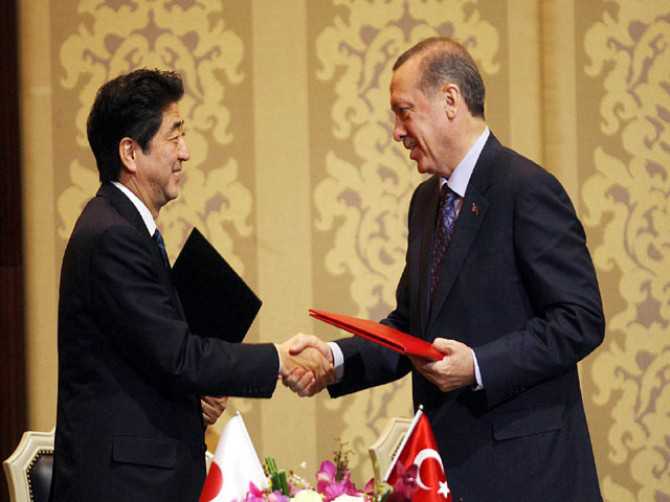
    Japan has learned from the Fukushima disaster and will offer technology with the highest safety standards while building Turkey’s second nuclear plant, Japanese Prime Minister Shinzo Abe said today.

    japan-turkey-sign-22b-nuclear-deal-1367614235-2442

    Turkey chose a Japanese-French partnership for the construction of a nuclear reactor on its Black Sea coast and a nuclear cooperation agreement was signed during Abe’s visit to Ankara.

    Despite being prone to earthquakes, energy-dependent Turkey declared in the wake of the Fukushima incident that it would stand firmly by plans to build three nuclear power plants.

    A powerful earthquake and tsunami off Japan’s northeastern coast knocked out vital cooling systems at the Fukushima Dai-ichi plant in 2011, causing multiple meltdowns and setting off the worst nuclear catastrophe since the Chernobyl disaster in 1986.

    Turkey’s Energy Ministry said the country decided to begin technical negotiations with Japan’s Mitsubishi Heavy Industries and France’s Areva, after companies from South Korea, China and Canada withdrew or were eliminated from the bid.

    The 5000-megawatt capacity plant is expected to cost US$22 billion and be operational in 2023.

    Russia will construct Turkey’s first plant in Akkuyu, on the Mediterranean coast. It is scheduled to begin test production in 2019.

    In constructing the second plant, “we are going to use first-class technology,” Abe said. “We have carried our experience in nuclear safety to the highest level through lessons learned from past accidents and risks.”

    “We will share our experience with Turkey,” he added. “We have raised standards, lifting us to the highest ranks in terms of nuclear safety.”

    Turkish Energy Minister Taner Yildiz said under the cooperation deal with Japan, Japanese experts also would work with Turkish engineers in selecting the site of a third nuclear plant.

    Turkish Prime Minister Recep Tayyip Erdogan said his country was a rapidly developing nation that was forced to diversify energy resources. He has repeatedly downplayed nuclear risks.

    “There may be a one in a million risk but that does not mean we can’t take a step,” Erdogan said. “We still take planes even if they crash, we still ride cars even if there are road accidents.”

    – AP

    via Turkey Nuclear Plant | Turkey tab Japan to build… | Stuff.co.nz.