Category: News

  • Turkey is 7th most terror hit country in the world

    Turkey is 7th most terror hit country in the world

    71 terror incidents in Turkey

    Turkey has been ranked seventh in the list of most hit countries by terror in the second quarter of 2008, according to a research released by the Center of Excellence – Defense Against Terrorism.
     
    Seventy-one separate terrorists incidents, which killed 38 people and injured 88 others, put the Turkey on the seventh place of the most-hit countries in the second quarter of 2008, the article titled “General Overview of the Terrorist Activities (April-June 2008)”, said.

    “The main suspect of these terrorist incidents was PKK/KONGRA-GEL terrorists. The most volatile city in this period was Sirnak in southeastern Turkey. Seventeen separate terrorist incidents killed 9 people and wounded 18 others in the city,” it said.

    According to the article, 2,396 terrorist incidents occurred worldwide in the period. A total 4,204 people were killed and 7,614 were injured in these incidents.

    Iraq topped the list of the most-hit countries with 857 separate attacks in which 1,575 people were killed and 3,247 others were injured.

    Thirty-five percent of total attacks in the world, 37 percent of total fatalities and 42 percent of total casualties sustained worldwide were recorded in Iraq, it added.

    First ten countries most hit by terrorism in the second quarter of the year are as follows:
                   
    Countries : Number of terror incidents
    ——————————
    Iraq : 857
    Afghanistan : 334
    Sri Lanka : 327
    Pakistan : 216
    India : 195
    Somalia : 112
    Turkey : 71
    Thailand : 55
    Nepal : 44
    Israel : 31

    Photo: DHA

  • Turkey eyes to turn Istanbul into a finance center

    Turkey eyes to turn Istanbul into a finance center

    Nazım Ekren

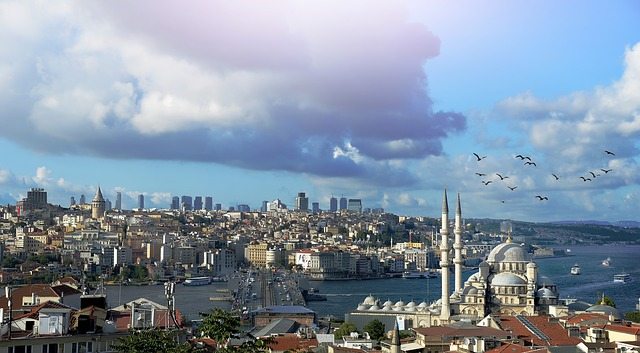
    Turkey discussed to turn Istanbul into a financial center on Thursday. Making Istanbul a financial center would contribute to development of not only this city, but also Turkey, Deputy PM Nazim Ekren said.
     
    “It will also help Turkey gain a global prestige,” Ekren also said in Istanbul Province Economic and Social Council Meeting. Ekren said that the timing of the project was right after the mortgage crisis in the United States.

    Ekren also said that the government was planning to establish a development agency in Istanbul within this year.

    Istanbul is a city where 20 percent of Turkey’s total population is living of which population has been up by 10-folds since 1950 and almost 15 million people are residing.

    Ekren said that Istanbul was providing one-fourth of the gross domestic product (GDP), 38 percent of overall industrial income, more than half of services, and 40 percent of tax revenues.

    “Istanbul can be a financial, cultural and logistic center of Turkey, thanks to its unique geographical location; rich historical, cultural and architectural heritage; giant infrastructural investments; economic links with Europe, Asia and the Balkans; and relatively cheap labor force,” the minister said.

  • Historic travel book to be exhibited at Istanbul Modern

    Historic travel book to be exhibited at Istanbul Modern

    ISTANBUL – Anatolian News Agency

    The “Seyahatname” exhibition of travel books will be on display at the Istanbul Museum of Modern Art in 2010. “Seyahatname” is a book reflecting the Ottoman Empire’s relations with other states and describing foreign cultures of cities that travelers visited.
     
    Curator of the exhibition Sinan Dirlik and art director Eray Makal say they see the exhibition as a lyric to Istanbul — the pearl of the Ottoman Empire, and are making their preparations on the grounds of this perception.

    The exhibition will be produced by Ece Seki and the 2Yaka Communication Company, as well as a research team of Ali Ay and Nihal Boztekin.

    The exhibition is planned go on display in January 2010 at the Istanbul Modern.

    While researchers and designers are preparing the project, contributions of other institutions and amateur researchers are expected to complete the project.

  • Country at a crossroads

    Country at a crossroads

    Turkey: The nation that straddles Europe and Asia is also torn between secular and Islamic views of government, between cultural stability and terrorist violence. The direction Turkey takes will say much about the future of both regions | Jill Nelson

    Turkey

    BODRUM and ISTANBUL, Turkey–It is 10:19 pm in the bustling resort town of Bodrum on the southwestern coast of Turkey, and the call to prayer sounds from a small mosque surrounded by several couture shops. Less than 10 men—summoned for the last of the five prayers said each day by devout Muslims—are praying inside its open doors, and those on the streets pay scant attention to the beckoning loudspeaker.

    A few blocks down the street, the Bodrum Marina Yacht Club begins a call of its own. Popular Turkish and American tunes draw more than a -hundred people to an outdoor stage to listen to a five-piece jazz band and a popular Turkish singer. Like other night clubs in Turkey, its music will pulse several hours past midnight. Although Bodrum lies in the Asian portion of Turkey, this town feels more a part of the West than the East.

  • RELIEF BUT NO VICTORY FOR AKP IN CLOSURE CASE

    RELIEF BUT NO VICTORY FOR AKP IN CLOSURE CASE

    By Gareth Jenkins

    Thursday, July 31, 2008


    On July 30, Turkey’s Constitutional Court narrowly voted to allow the ruling Justice and Development Party (AKP) to remain open in the case filed for its closure by Public Prosecutor Abdurrahman Yalcinkaya on March 14 on the grounds that the party had become a focus for anti-secular activities (see EDM, March 17). Instead, the court ruled that the AKP would be fined $20 million.

    In the run-up to the announcement of the verdict, a monetary fine—rather than closure or acquittal—had always appeared the most sensible, if least likely, outcome. The general expectation had been that, given the hard-line secularist composition of the Constitutional Court, the AKP would be closed. In fact, a majority of the 11 members of the court did vote to outlaw the AKP, with six voting for closure and only five for the party to remain open. However, under the Turkish Constitution, the closure of a political party needs the support of seven of the 11 members of the court.

    Yalcinkaya had also called on the court to ban 71 current and former members of the AKP, including Prime Minister Tayyip Erdogan and President Abdullah Gul, from membership of a political party on the grounds that their activities formed the basis for his application for the AKP’s closure. These charges were automatically dropped when the court decided to allow the AKP to remain open.

    There is little doubt that the closure of the AKP—particularly if it was accompanied by a ban on Erdogan—would have plunged the country even deeper into what was already the worst domestic political crisis in a generation, triggering early elections, increasing uncertainty and raising tensions in what is now a society dangerously divided over the role of religion in public life. As a result, the court ruling has come as an enormous relief. But it has not solved anything—merely bought Turkey some time.

    Since the AKP was founded in August 2001, it has angrily dismissed suggestions that it is an Islamist party and claimed to be committed to the principle of secularism enshrined in the Turkish constitution. Perhaps the most striking aspect of the Constitutional Court’s decision of July 30 was that 10 of its 11 members upheld Yalcinkaya’s claim that the AKP had become a focus for anti-secular activities, as exemplified by its attempt on February 9 to amend the constitution to lift the headscarf ban in Turkish universities (see EDM, February 11), only for the amendments to be annulled by the Constitutional Court on June 5 (see EDM, June 6). The difference between the 10 judges was not whether or not the AKP was attempting to erode secularism but whether its attempts were serious enough to merit the complete closure of the party. Six members of the court believed that they were. Four decided that a monetary fine was sufficient punishment. Only the court’s president, Hasan Kilic (born 1950), a conservative first appointed to the court by former President Turgut Ozal (1927-1993) in 1990, voted to dismiss Yalcinkaya’s application.

    In announcing the court’s ruling, a clearly shaken Kilic admitted that, even though the AKP had been allowed to remain open, the verdict constituted a “severe warning” to the party (CNNTurk, NTV, HaberTurk, July 30). In theory at least, the decision not to close the party for its past actions should serve as a restraint on the AKP’s future policies. Under Turkish law, members of the Constitutional Court are appointed by the president. President Gul is not due for reelection until 2012, and, as a former member of the AKP, can be expected to try to appoint conservative judges to the court. But none of the current members are due to step down until 2010, when three will reach the compulsory retirement age of 65. No other member of the court is due to retire until 2013. As a result, barring death or disability, at least seven of the 10 judges who ruled that the AKP had attempted to erode secularism will remain members of the court for the next five years—well after the deadline of July 2011 for the next general election. As a result, barring a change in the constitution, for the remainder of the government’s term, the judges who voted to uphold Yalcinkaya’s application will remain numerous enough to close down the AKP if they believe that it has not heeded the warning in the verdict of July 30.

    Logically, the confrontation between the AKP and secularists over the role of Islam in public life should thus shift away from high profile iconic issues such as lifting the headscarf ban to lower level skirmishes on the margins of the political arena, such as political appointments. For example, in early August the rectors at 21 Turkish universities—approximately one-fifth of all the universities in Turkey—are due to step down and be replaced by candidates chosen by President Gul, who is generally expected to try to tighten the AKP’s grip on the education system by appointing conservatives.

    However, given Erdogan’s past record of reckless and often impulsive behavior—such as in his abrupt attempt to amend the constitution in February—it would be naïve to assume that, after a few months have passed, he will not attempt once again to challenge Turkey’s secular establishment and perhaps try to resurrect his plans to promulgate an entirely new constitution (see EDM, November 27, 2007).

    Perhaps most importantly, the Constitutional Court ruling of July 30 has provided only a temporary respite, not a solution to the question of the role of Islam in public life. In theory, it offers a breathing space and an opportunity for the two sides to reach a compromise. Unfortunately, there is still no indication that it is an opportunity that either side is anxious to take.

    Ironically, though many will have been disappointed by the court’s decision not to close the AKP, the verdict also offers secularists what may be their last chance to create a credible alternative to the current government. If the AKP had been closed and early elections held in late fall this year, there would have been too little time either to replace the jaded, discredited leaders of the secularist opposition or to establish an entirely new party. The constitutional court’s verdict has thus also given secularists an opportunity to prepare to mount an effective challenge to the AKP at the next election. But it remains to be seen whether it is an opportunity that will be taken.

  • EU hails Turkish court decision not to ban ruling party

    EU hails Turkish court decision not to ban ruling party

    ELITSA VUCHEVA

    Today @ 09:27 CET

    The EU has welcomed a decision by Turkey’s Constitutional Court on Wednesday (30 July) not to ban the country’s ruling party, the AKP, while urging Ankara to now speed up needed reforms.

    “Despite everything, this is a good day for Turkey and for Europe,” EU enlargement commissioner Olli Rehn told the Reuters news agency.


    The AKP “has never been a focal point of anti-secular activities,” said Turkish Prime Minister Erdogan. (Photo: Wikipedia/Ekim Caglar)

    “There is a vast majority among the Turkish people who are in favour of European values. I’m sure this played a role,” he added.

    Cristina Gallach, spokesperson for EU foreign policy chief Javier Solana, also said that the decision was “positive.”

    “Turkey is living a tense situation and we very much hope that the decision by the court will contribute to restore political stability,” she told the press agency.

    Welcoming statements came also from certain member states, with UK foreign secretary David Miliband saying the verdict “is a cause for celebration for Turkey’s friends,” as it means that “Turkey can follow a more democratic and European path.”

    Additionally, Swedish foreign minister Carl Bildt said that “an attempt to stage a thinly disguised legal coup” against the Turkish government had failed, AFP reports.

    A serious warning

    Turkey’s constitutional court on Wednesday ruled against outlawing the country’s ruling Justice and Development Party – the AKP – which prosecutors had accused of undermining the country’s secular system and progressively transforming Turkey into an Islamic state.

    Lifting a ban on wearing Islamic headscarves in universities had raised the hackles of secularists in the country.

    The party won its reprieve by a narrow margin, however, with six judges out of 11 voting in favour of the ban – just one short of the number needed to close down the AKP.

    The judges nonetheless decided that the AKP’s budget for this year should be cut in half.

    “It is not a decision to close down the party, but it is a serious warning,” the court chairman, Hasim Kilic, was quoted as saying by Turkey’s Hurriyet.

    “I hope the party in question will evaluate this outcome very carefully and grasp the message intended,” he added.

    The AKP, which had denied the charges, welcomed the verdict.

    “The Justice and Development Party, which has never been a focal point of anti-secular activities, will continue to defend the basic principles of the republic,” Prime Minister Recep Tayyip Erdogan said.

    A call to ‘resume’ reforms

    For its part, the EU had indicated that banning the ruling party – which would also have resulted in Mr Erdogan, Turkish President Abdullah Gul, and several other AKP officials forced out of party politics for five years – could have had a negative effect on the country’s EU accession process.

    “Court cases to close political parties are not normal in EU democracies,” Mr Rehn had previously said.

    However, now that the party escaped the ban, Ankara should focus on speeding up its reform process, the commission stressed.

    “I encourage Turkey now to resume with full energy its reforms to modernise the country,” said the commissioner in a statement. “The relevant parties [should] work towards sustainable reforms based on a consensus forged through a broad-based dialogue with all sections of Turkish society.”

    “Alignment of Turkey’s rules on political parties with European standards is essential,” he added.

    “It is a step forward for parliamentary democracy in Turkey,” liberal MEP Andrew Duff, in Turkey for the verdict, said. “This implies that accession negotiations between Turkey and the EU can continue.”

    Turkey won EU candidate status in 1999 and began EU accession talks in 2005.

    Before joining the 27-nation bloc however, Ankara is expected to push ahead with reforms in several areas.

    Among other demands, Brussels wants the country to limit the power of the military, which still exercises “considerable political influence,” to effectively implement reforms on freedom of the speech and to improve protections for minority rights.