Category: Authors

  • Understanding the Armenian Question

    Understanding the Armenian Question

    Preface

    Overcoming Prejudice and Hatred

    The 1915 relocation was a dreadful operation for the Ottoman Armenians. It is undeniable that they suffered a great disaster with many innocent lives lost on their relocation routes.

    The Armenian genocide lobby claims that the Ottoman government intentionally “marched Armenians to their deaths”, thus committing the first genocide in history, and that the relocation law was only a pretext for the extinction of Armenians. This allegation of genocide does not ring true. It has no historical evidence or legal framework. To term the events of 1915 as genocidze is to detach genocide from its legal definition and to use it for political or religious purposes.

    No one has ever found any dependable documentary evidence to support the claim that the Ottoman government intended to exterminate the Armenians through relocation. On the contrary, there is considerable evidence of attempts to prevent such an outcome, though these were not very successful under the extraordinary conditions of World War I.

    The 1915 relocation law introduced by the Ottoman government was a wartime security strategy and operational measure undertaken for reasons of urgent military necessity. The Ottoman Empire was fighting alongside Germany against Britain, France, and Russia. Armenians saw this as an opportunity to establish their own state and they revolted against the Ottoman Empire, of which they were citizens.

    In Eastern Anatolia, tens of thousands of Armenians, including those under arms in the Ottoman army, fled to join the Russian Caucasian Army. Serving as scouts and advance units, they supported the Russian invaders. In Southern Anatolia, thousands of Armenian volunteers joined French Legion troops and took part in the occupation of numerous Ottoman provinces.

    Those Armenians who stayed behind were also a great threat to the Ottoman war effort and to the lives of the Muslims of Eastern Anatolia. Just before the war, more than 12,000 Armenian males of fighting age had gone to Russia from Eastern Anatolia. There, they were trained in partisan and guerrilla tactics. Immediately after Russia declared war on the Ottoman Empire, they returned to Anatolia. Joining with others who had never left Turkey, as well as Armenian deserters from the Ottoman army, they organized guerrilla activities on both sides of the Ottoman frontier. Henry Morgenthau, the American Ambassador in Istanbul, reported to Washington on 25 May 1915 that nobody estimated the Armenian guerrillas to be “less than 10,000, and 25,000 thousand is probably closer to the truth”.

    In the spring of 1915, when the British were at the Dardanelles, the Russians attacking in the east, and another British force apparently advancing on Baghdad, Armenian guerrilla activities had gained momentum all over Anatolia. Military supply and transport routes, and the communication channels of the Ottoman military units were sabotaged. Meanwhile the Armenian militias were attacking helpless Muslim villages in Eastern Anatolia and committing massacres against wholly innocent people. In some localities the entire Muslim population was killed. Armenian guerrillas were supported by Armenian villagers as well as by Armenians in the eastern cities that were home to leaders of their rebellion.

    For the Ottoman leaders, the Armenian uprising was the deadliest of all national security threats. On 14 November 1922, the New York Times reported that a total of 200,000 Caucasian and Ottoman Armenian volunteers fought against the Ottoman Empire in World War I. In response, at approximately the same time that the Armenians seized the City of Van, the Ottoman government ordered that the Armenian population residing in or near war zones be relocated to the southern Ottoman provinces, away from the advancing Russian army. Armenians living away from the front, if reported or suspected to be enemy collaborators, were also relocated.

    The Ottoman government took numerous measures for the care, protection and feeding of those subjected to deportation. However, under wartime conditions these measures were not fully implemented and unwanted suffering was not prevented. On the way to the south-eastern provinces, those being relocated were sometimes attacked by tribal gangs committing robbery or taking revenge for massacres of Muslims by Armenian bands, in some cases with the connivance of officials. Thousands of Armenians died in these attacks. The loss was multiplied by disease and famine.

    In reaction, the Ottoman government investigated the crimes that had been committed. Hearings were held across the eastern provinces, followed by court-martials, at which nearly 1,000 gang members and more than 600 civilian officials or military personnel were sentenced to imprisonment and, in some cases, execution for the attacks on or abuse of the Armenians.

    The Ottoman trials of 1915–1917, much before the end of war, unquestionably prove that the Ottoman government did not intend to exterminate Armenians through relocation. The number of Armenians who survived relocation also proves that there was no genocide. The well-known Armenian historian Richard Hovannisian has estimated that about 275,000 Ottoman Armenian refugees survived in post-war Syria, Lebanon, Jordan, Egypt, Iraq, and Iran. More than 100,000 Ottoman Armenians were in France, the United States, and elsewhere. These were survivors who had been completely in the hands of Ottoman soldiers and officials. Had the Ottomans wanted, they could have killed them all. Yet most of the relocated Armenians survived.

    Detailing the suffering and losses during the relocation, even though they were not caused by genocide, is undoubtedly a humanitarian matter. However, this should be treated without prejudice and hatred while giving due scholarly attention to history and facts. The historical fact is that during World War I the suffering of Armenians was one of the many disasters that faced all the peoples of the Ottoman Empire. Those who lived in Anatolia, including Turks, Kurds, Armenians, Greeks, and Jews, suffered and made each other suffer.

    Muslims were the dominant population in the Ottoman lands during World War I. This does not mean, however, that they were not affected by the devastation of this war. As revealed by the reports of some American missionaries, prior to the relocation ruling, Armenians also committed atrocious massacres in the villages they captured, including Van, which they occupied. In addition to the American archives, Russian, French, British, and German national archives are also full of documents recording the suffering inflicted on Muslims by rebel Armenian gangs both before and after the relocation. Moreover, the Greek occupation after World War I was also a period of extreme suffering for Muslims in Anatolia.

    The painful human tragedies of war should be perceived holistically, without any racial and/or religious discrimination. These sufferings should be shared and, when necessary, mourned together. The perception of common suffering can only be realised by understanding the experiences of all Ottoman people, Muslims, and non-Muslims, together.

    However, communicating the suffering in Anatolia during World War I faces two important obstacles today. These stem from the discriminatory and prejudiced approaches of those who try to impose the memory of relocation defined as “genocide”. The first obstacle is that the same sensitivity shown towards the suffering of Christians, especially Armenians, is not shown towards Muslims, Turks, and Kurds. The second is that the one-sided Armenian emphasis on such uffering overrides historical and legal facts and is used to support allegations of “genocide”.

    “Genocide” is a legal concept. The classification of a historical event or a process as “genocide” can only be based on legal rulings, not personal convictions. In other words, the acknowledgement of suffering cannot change the definition of historical and legal facts.

    Furthermore, the Malta Tribunal (1919-1921) which was conducted by the British Attorney General are key to establishing that the alleged Armenian genocide is a farce as it has no historical and judicial basis. The ruling of July 29,1921 corresponds to a “judgement of non-prosecution” which means, “if there is no legal evidence to support the Armenian massacre claims, there is no legal basis to file or bring a lawsuit”. As this ruling constitutes the first step to a court trial, the outcome of the Malta Tribunal is a final judicial decision consistent with the relevant description of 1948 United Nations Genocide Convention. Therefore, absolving the Ottoman Turks that “the “Armenian massacre”, or currently termed “genocide” allegations do not exist.”

    This book aims to cleanse the debate on the “Armenian genocide” of prejudice, positioning it on historical and legal facts, and therefore preventing it from becoming a vicious “hate fight”. This is because prejudice nourishes discriminatory approaches. It damages our will to live together.

    In order to overcome the prejudice surrounding the Armenian genocide and to be freed from the hatred fuelled by this prejudice, historical and legal facts must replace the “subjective-memory records” about the events of 1915, which have been transformed into some kind of “conscience fetishism”.

    Historical and legal facts reveal that life is not black and white, but that there are shades of grey in between. This perspective allows us to see not only that the legitimate reasons for the 1915 relocation do not “justify” Armenian suffering, but also that the suffering inflicted does not eliminate the legitimate reasons for the practice. Historical and legal facts give us the opportunity to meet in this grey zone, which is free from prejudices, is no longer a vicious “hate discourse”, and opens the door to mutual tolerance.

    My primary debt in writing this book is to Bilal Şimşir, a valuable researcher and diplomat who brought the events of the British H.M. Attorney General Office’s prosecution in Malta to Turkey’s agenda and opened his personal archives to me. I would also like to thank Jale (Swailes) Özer, President of the ADD (Atatürk Society UK), who provided me with the missing documents from the British archives.

    My work on this book was made possible by the support of my wife, Nazime Gürkan, and my family. Without their patience and collaboration, it could not have been completed.

    Uluç Gürkan, Ankara 2023
  • Ignoring Armenia’s Existential Problems, Pashinyan Talks Wrongly about the Diaspora

    Ignoring Armenia’s Existential Problems, Pashinyan Talks Wrongly about the Diaspora

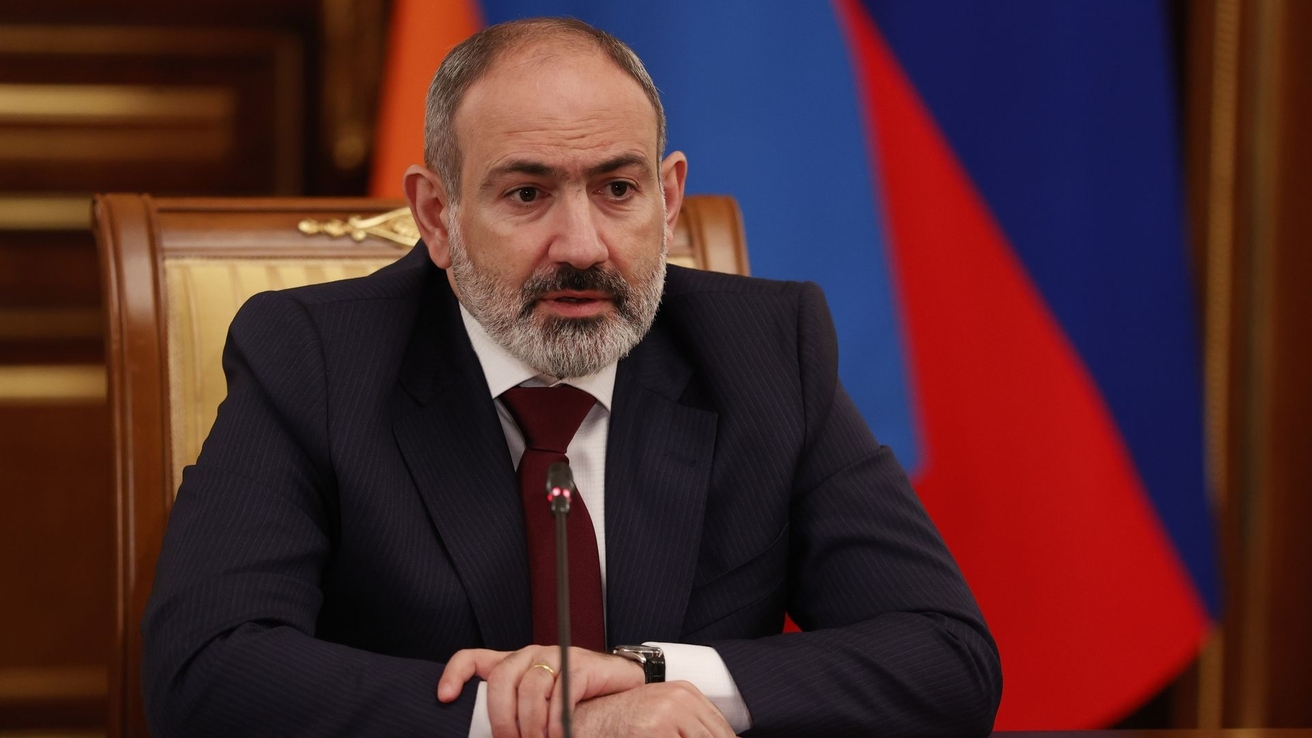
    Prime Minister Nikol Pashinyan met on June 19 with a group of Diaspora Armenians who worked as temporary staff members at various Ministries in Armenia.

    During his remarks to the group, the Prime Minister deviated from the subject matter and made senseless statements about the Diaspora. He said that “… in a large part of our history, during the history of the Third Republic, the Diaspora has often or sometimes been viewed as an auxiliary institution to the administration of the Republic of Armenia. The change that is occurring is as follows: we say that the Diaspora cannot be an auxiliary institution to the administration of the Republic of Armenia because the Republic of Armenia, like any state, is an instrument with its clear mechanisms where it is very clearly described who and how is managing that mechanism. If there is no detail or larger whole in the architecture of that mechanism, we are trying to connect that whole to that mechanism; we are inhibiting the progress of that mechanism. This is obvious. And in this logic, I think that the change that is taking place is very important and very essential. But, on the other hand, I want to look at it with reverse logic as well. In many cases, the Republic of Armenia was also perceived as an auxiliary or non-auxiliary tool for the administration of the Diaspora. I want to say that, in my understanding, this also needs to end. Why? Because in case we make the Republic of Armenia an auxiliary or non-auxiliary tool, we are placing the Republic of Armenia outside the limits of its jurisdiction and, therefore, we make the Republic of Armenia more vulnerable. Our strategy, which I have talked about, the conceptual framework of ensuring the security of the Republic of Armenia, is legitimacy which is also related to this — that we can act only where we have jurisdiction and legitimacy to act. We cannot act where we don’t have jurisdiction and legitimacy to act as a state. And because of this circumstance, social-psychological changes will inevitably take place in Armenia-Diaspora relations as well. I described what should not be as we had pictured. I mean, I understand that there is a certain gap within what I said, but I am not ready today to even attempt to fill that gap because I don’t think that’s my job or at least only my job. That requires wider discussions, and there, the Republic of Armenia or officials of the Republic of Armenia can have a say, say something, but I think that these discussions are more public and informal level discussions about how should be the new relations between Armenia and the Diaspora. They are no longer like that and will not be like that. I think that is obvious….”

    If you understood nothing from Pashinyan’s rambling words, you are not alone. The problem is that he always speaks without a prepared text causing him to stray from the subject and say things that he had not planned to say.

    In his lengthy statement, Pashinyan tried to refute a thought that did not exist in anyone’s mind — that “the Diaspora is viewed as an auxiliary institution to the management of the Republic of Armenia.” No one had said that. We have always envisaged the Diaspora’s role as providing humanitarian aid, investments and professional expertise to the homeland.

    On the positive side, I am glad Pashinyan acknowledged that Armenia has no jurisdiction to meddle in the internal affairs of the Diaspora. He has great difficulty managing the problems facing Armenia, let alone the issues of the Diaspora — something he knows nothing about.

    Pashinyan then strayed into the subject of ‘how many Armenians are there in the world.’ He said: “…There is another problem. We do not always attach big significance to arithmetic. Recently, a question arose in my head. We keep saying, ‘10 million Armenians, 10 million Armenians, 10 million Armenians.’ Is there a list of these Armenians somewhere or not? I am convinced that there isn’t. Here again is the phenomenon of sanctification. That number is sacred, do not touch it suddenly. It neither increases nor decreases. You cannot change it. It’s 10 million! If someone says that ‘it’s not 10 million, it’s 10,561,000,’ everyone will attack him and say, ‘ignorant, dilettante. How do you know that? Who counted it, etc.?’ If someone says: ‘no, it’s 9,200,000,’ they will say, ‘you scoundrel, you are belittling the global influence of Armenians. With the stroke of a pen, you wiped out 800,000 Armenians.’ This is our reality. This is about us, but we have to talk about it. If we don’t talk about it, what is the use?”

    The Prime Minister is wrong that no one knows the number of Armenians in the world. He could have checked Wikipedia under the topic of ‘Armenian population by country,’ which lists the approximate number of Armenians in each one of 107 countries. There are many other sources that give the number of Armenians in the world. Since no one has counted every single Armenian in the world, naturally, the 10 million is a rough estimate.

    If this subject really interests the Prime Minister, he should direct his High Commissioner for Diaspora Affairs to conduct a worldwide survey and compile a more accurate number of Armenians in the world.

    I also suggest that the Prime Minister’s aides write his speeches, so he can read from a written text and not stray into whatever comes to his head at the moment.

  • Turkey is Backing its Citizens Abroad While Armenia is Alienating its Diaspora

    Turkey is Backing its Citizens Abroad While Armenia is Alienating its Diaspora

    Armenia has a very large Diaspora, estimated at seven million — more than double Armenia’s population. Successive Armenian governments have attracted only a negligible portion of this valuable asset for the homeland’s benefit. The Diaspora is Armenia’s most valuable backer, yet it is ignored. This is akin to a starving man neglecting the bag of diamonds in his possession. 

    Regrettably, rather than attracting Diaspora’s support, the Republic of Armenia has done the exact opposite by erecting obstacles for the Diaspora’s participation in Armenia’s development. Diaspora Armenians are deprived of the right to vote in Armenia’s elections and are banned from holding high office. Even those who possess Armenian citizenship but live overseas are not allowed to cast their votes at Armenia’s embassies or consulates in foreign countries.

    The current Armenian government has gone out of its way to destroy the only bridge that existed between the homeland and its large Diaspora by closing down the Ministry of Diaspora. Instead, Prime Minister Nilol Pashinyan unwisely appointed Zareh Sinanyan, a useless Diasporan, as the “High Commissioner for Diaspora Affairs.” Sinanyan travels around the world, at Armenia’s taxpayers’ expense, to carry out propaganda for the Pashinyan regime.

    Meanwhile, the powerful Turkish government, recognizing the benefits of having close relations with its Diaspora, has embarked on a major campaign to strengthen its ties with Turks around the world.

    Turkish investigative reporter Abdullah Bozkurt posted on the Nordic Monitor website an article titled: “Turkey is expanding its diaspora engagement to promote political goals abroad.” He provides important details about Turkey’s outreach to its Diaspora.

    “The Turkish government plans to enhance its support for diaspora groups abroad, both financially and through other means, with the aim of fostering stronger allegiance to Turkey, navigating legal and administrative challenges in host countries, encouraging active political engagement and forging connections with non-Turkish religious communities,” Bozkurt wrote.

    The Turkish government’s Diaspora agency, “the Presidency for Turks Abroad and Related Communities” (YTB in Turkish), has prepared a 71-page official report titled: “Strategic Plan for 2024-2028,” which provides in great detail the specific goals of the agency, its vision, mission, and “strategy to mobilize approximately seven million members of the diaspora community to advance Turkish government policies.”

    YTB’s goal is “to contribute to Turkey’s ambition of becoming one of the world’s leading powers — a vision articulated by Turkish President Recep Tayyip Erdogan as the ‘Century of Turkey.’”

    YTB “recommended several policy actions to the Erdogan government. It urged the use of its diplomatic influence and public diplomacy tools to exert pressure on foreign countries to lift restrictions on Turkish diaspora groups. Cooperating with other Muslim religious groups in foreign countries is another recommendation put forward by the YTB to overcome restrictions on the Turkish diaspora.”

    YTB provides funding, logistical and technical support for the activities of Turkish Diaspora groups around the world. “YTB recently participated in a program organized by the Union of International Democrats (UID), an organization acting as a foreign interest group representing Erdogan’s ruling Justice and Development Party (AKP) abroad in Ankara.”

    The YTB report identifies groups who oppose the Turkish government’s policies, labeling them as ‘terrorists.’ “YTB said these opposition groups undermine the Turkish government’s public diplomacy efforts, sow division within the diaspora and pose political and security risks to groups aligned with the Erdogan government.”

    YTB stated that Turkish Diaspora students who receive scholarships from the Turkish government to study in Turkey will “become voluntary Turkish ambassadors.” YTB also suggested that these students be connected “with Turkish companies engaged in foreign trade” so they can “become economic actors” in the countries they reside.

    More ominously, “YTB actively collaborates with other Turkish government institutions, particularly Turkish intelligence agency MIT (Milli İstihbarat Teşkilatı), and also serves as a recruitment source for the spy agency within diaspora communities abroad. This includes exchange students who have studied in Turkey on government scholarships. Turkish embassies are also instructed to help with the work of the YTB in foreign countries with every available means.”

    YTB also collaborates with “non-Turkish groups referred to as ‘related communities,’ which include global Islamist networks such as the Muslim Brotherhood and Hizb ut-Tahrir networks, among others.”

    The Turkish government provided the YTB a total budget of $544.2 million for the years 2024-28, starting with $61.5 million for 2024, increasing to $83.5 million in 2025, $103.3 million in 2026, $133.5 million in 2027, and $162.4 million in 2028.

    YTB closely monitors the activities of the 15,000 foreign exchange students on government scholarships from 170 countries. In his speech on May 6, Pres. Erdogan disclosed that there are also 340,000 foreign students from 198 countries. “Furthermore, the agency [YTB] coordinates outreach efforts with over 150,000 graduates who have completed their education in Turkey. The Erdogan government also funds and supports nongovernmental organizations to complement the activities of the YTB with a $92.5 million budget. One of the main beneficiaries of this program is the UID, President Erdogan’s long arm abroad.”

    There are valuable lessons for Armenia’s leaders to learn from the Turkish government’s outreach to its Diaspora. But, is anyone in Armenia listening or cares?

  • Pashinyan Turned Armenia Into a Police State

    Pashinyan Turned Armenia Into a Police State

    The Armenian government had two options to resolve peacefully the popular uprising against the regime:

    1) Prime Minister Nikol Pashinyan could have resigned, turning over the reins of power to a coalition government which in six months would hold new parliamentary elections and choose a new Prime Minister;

    2) Pashinyan could have accepted the offer of the new leader of the opposition, Archbishop Bagrat Galstanyan, to sit down with him and discuss a negotiated solution to the current political crisis.

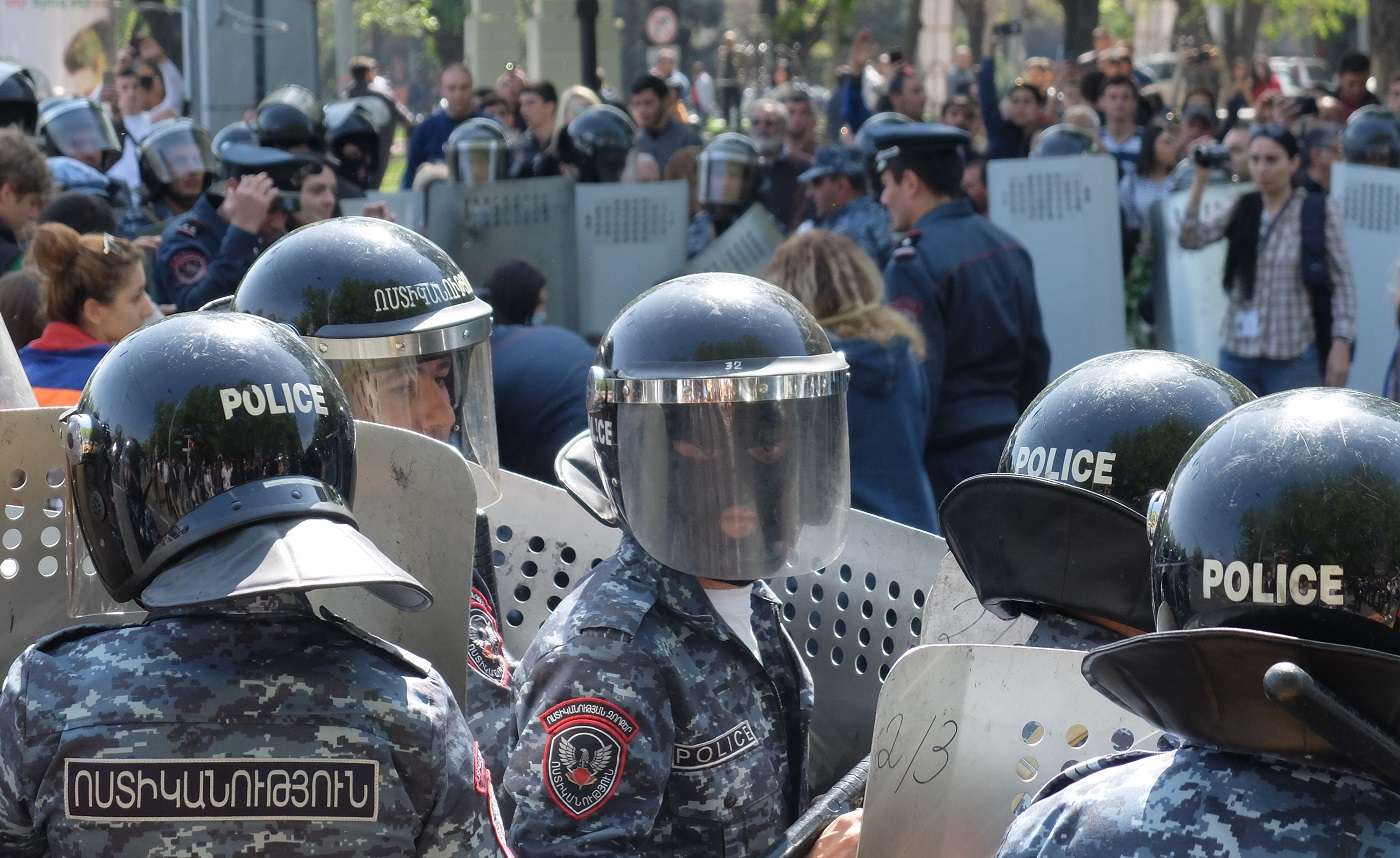
    Regrettably, Pashinyan chose neither one of the above options. He chose to attack the opposition by having his “well-fed” police beat and arrest a large number of protesters, including journalists and even clergymen, some of whom are in a hospital recovering from injuries they suffered at the hands of the police. The Prime Minister has secured the blind loyalty of the police officers by increasing their salaries several times and giving them constant bonuses. It is said that there are more policemen in the streets of Armenian cities than soldiers protecting the country’s borders.

    This is not surprising since Pashinyan, as an incompetent and inexperienced leader has mismanaged just about every decision he has made in the past six years. He is stubbornly clinging to his seat of power, dealing a mortal blow to the survival of the country.

    After initially calling his takeover of power a “velvet revolution,” Pashinyan quickly switched to what he described as a “steel revolution.” Incredibly, he campaigned during the parliamentary elections of 2021, holding a hammer in his hand and promising to bash the heads of his domestic opponents. He also threatened to slam them into the wall and flatten them on the asphalt. Furthermore, Pashinyan boasted that no judge would dare to deviate from his orders. Even though the Prime Minister claims to be a democrat, his behavior is more like that of a dictator. Pashinyan came to power in 2018 closing down the streets of Yerevan, ordering his followers to block the entrances of the Parliament and courthouses, smashing the doors of the State Radio station, and violating many other laws. However, when the opposition is now peacefully walking in the streets or even on the sidewalks, they are brutally attacked, punched and arrested by the ever-present police.

    Not surprisingly, the heads of Azerbaijan and Turkey have expressed their concern about Pashinyan remaining in power. Some Azeri and Turkish analysts even suggested that their countries dispatch armed troops to Armenia to protect Pashinyan, so he can continue making concessions.

    Another indication that Pashinyan is working against the interests of Armenia is the support he is getting from the West because he is doing what they are telling him to do which is in their interest, but contrary to the national interests of Armenia.

    Western countries only pay lip service to human rights, but maintain good relations with even the most dictatorial regimes in the world. That is the reason why not one critical word has been said by any Western state while Pashinyan’s police is brutalizing Armenia’s citizens.

    Fortunately, several non-governmental international organizations have condemned the lack of human rights in Armenia and criticized police brutality.

    On May 28, five major non-governmental organizations issued a joint statement against “mass detention” of protesters, “violence against some participants” and physical assault against a member of the Armenian Parliament which is a violation of Armenia law. The five organizations are: Helsinki Citizens’ Assembly Vanadzor Office, Transparency International Anticorruption Center, Protection of Rights without Borders NGO, Law Development and Protection Foundation, and Democracy Development Foundation.

    The joint statement deplored that Armenian law enforcement officers “continue to engage in unlawful and disproportionate use of force, illegal detentions, and violations of the right to liberty during the exercise of the right to freedom of assembly. The use of such methods by the police is the result of a longstanding policy of impunity within the system, leading to the use of violent force becoming the main tool of the police.”

    The joint statement further said that citizens have the freedom for peaceful assembly and the right to express their opinions freely “without fear of police violence.”

    Reporters Without Borders issued a separate statement calling “for an end to deliberate police violence against reporters.” At least five journalists were targeted by the police.

    The U.S. Freedom House also issued a statement saying: “We are concerned by mounting reports of police violence in Armenia. We urge Armenian authorities to investigate this pattern of excessive force and inhumane treatment and work with civil society to foster and implement meaningful reform.”

    The most shameful behavior was Pashinyan’s order to obstruct the entry of Catholicos of All Armenians Karekin II into the Sardarapat Memorial on May 28, Armenia’s Independence Day. To make matters worse, the Prime Minister lied when he was asked why the Catholicos and his entourage of clergy were hindered from placing a wreath at the Memorial, is a public venue.

    All police officers and government officials must be aware that after Pashinyan is gone they will be held responsible for their illegal and anti-Armenian actions.

  • The European Union is Due to a Dramatic Change 

    The European Union is Due to a Dramatic Change 

    In the UK, it is already clear that the current Conservative Party will lose the general elections to be held on 4 July by a landslide.

    In the USA, Presidential elections will be held in the first weeks of November.

    In the European Union, elections will take place this week, starting on Thursday morning and ending on Sunday evening. The course of events is contrary to the principles of the formation of the European Union.

    Let us go back a little and then I will come to the point.

    In 1945, after the Second World War, which ended with the defeat of Germany and the victory of the USA, the leading countries of the European continent, such as England, France, Germany, Italy, Spain, etc., saw becoming a political/economic colony of the USA as salvation in order to develop and return to the old days.

    Under pressure from the USA, Germany, France, Italy, Belgium, Luxembourg, Luxembourg and the Netherlands united in 1951 to establish the European Coal and Steel Community (ECSC) in order to strengthen the coal and steel sectors, the two basic raw materials of industry. The USA tightly controlled the ECSC both politically and economically. All the necessary capital was provided by US companies.

    As a second step, in order to expand its export market and to dominate the global economy and the financial world, the US forced the ECSC members and Britain to grant independence to their colonies. It took until 1967 for European countries to grant independence to their colonies. France continued to rule its colonies with critical minerals from behind the scenes until today, as if it had granted independence to its colonies.

    Going back to the beginning, it is certain that the Conservatives will lose power and the Labour Party, the main opposition party, will win the elections in the UK, which will start this week and continue until the end of the week. Although the first and second days of the elections will be official working days, voters who cannot take leave from their workplace will be able to cast their votes through methods such as ‘postal voting’ and ‘proxy voting’, which are not in force in our country yet.

    In the European Union elections, the nationalist and conservative parties are on the rise, while the Liberal and Green parties are on the decline. Despite the rise, nationalist and conservative parties are divided into two groups within themselves. One group is pro-US and the other is anti-US.

    In the European Parliament, some groups will lose seats while others will increase their capitulation. Of course, it is already becoming clear which groups will gain strength. In particular, the Renew Europe group, which includes French President Macron’s list, will lose 17 per cent of its seats. On the other hand, the Identity and Democracy Group (Identity and Democracy), formed by nationalists, will rise two places and take the 4th place.

    Although Germany and France, the pillars of the EU, have been in serious disagreement for several years, France, Germany and Italy will increase their number of seats in the Parliament. This indicates that the absolute influence of the USA on the EU will continue.

    The most important development will take place after the elections to the European Parliament.

    The issue of ‘ending veto rights in the European Union or ending unanimous voting and decision-making processes’ will be on the agenda of the European Parliament.

    Over the past 12 months, tens of thousands of EU citizens have submitted their opinions to the ‘Conference on the Future of Europe’, where the future of the European Union and their concerns were discussed. The most important conclusion of the conference was that ‘the European Union must reform in order to survive in tomorrow’s world, and that veto rights in the European Union must end and decisions must be taken by majority vote’.

    What will happen as a result? Countries such as the so-called ‘Republic of Cyprus’ will no longer be able to use the European Union for their own political and financial interests with the ‘Veto Right’ and hide behind the European Union.

    In summary, it seems that different developments will take place in the coming years, especially in the Eastern Mediterranean and the Middle East geography…

    Prof. Dr. (Civ Eng), Assoc. Prof. Dr. (Int. Rel) Ata ATUN

    Member of the Advisory Board of the TRNC President

    TRNC Republican Assembly 1st Term Deputy

  • Rather than Fizzling out, the Movement To Replace Pashinyan is Gaining Strength

    Rather than Fizzling out, the Movement To Replace Pashinyan is Gaining Strength

    Even since Archbishop Bagrat Galstanyan with his thousands of followers started marching towards Yerevan, many wondered what would happen on May 9 once they reached the Republic Square where Prime Minister Nikol Pashinyan’s offices are located.

    After arriving in Yerevan, Bagrat Srpazan gave one hour to Pashinyan to resign. When the hour was over and he did not resign, Srpazan announced that there would be acts of civil disobedience throughout the country beginning the next day. He urged his followers to act peacefully and not to commit any acts of violence.

    Pashinyan was hoping that the number of protesters would dwindle over time and the movement would fizzle out. The regime did everything in its power to vilify and defame Srpazan and the protesters. Government propagandists announced that there were merely around 20,000 protesters in the Republic Square on May 9, whereas most observers estimated the crowd to be several times larger. After misleading the Armenian public for six years with thousands of lies, Pashinyan continued his deceptive practices by claiming without any evidence that the protesters are Kremlin’s agents who were paid money to participate in these protests. Government leaders ridiculed not only Srpazan, but also the Armenian Church, an institution that has shepherded the nation ever since 301 AD, particularly during the absence of an Armenian state.

    To the disappointment of Prime Minister’s diminishing number of supporters, as his rating has gone down from 80% six years ago to 8% now, Srpazan held a second rally in the Republic Square with tens of thousands of followers in attendance. Despite the brutal actions of Pashinyan’s police which viciously attacked the peaceful protesters, the movement grew stronger rather than fizzling out. During the past week, Srpazan held separate meetings with groups of lawyers, doctors, retired military officers, artists, and dozens of opposition leaders.

    Srpazan proved the falsehood of Pashinyan followers’ repeated mantra that no one else can replace the Prime Minister. Srpazan succeeded for the first time to unite the various opposition groups under his leadership. Large segments of the public, livid at Pashinyan’s defeatist concessions to Azerbaijan, responded enthusiastically to Srpazan’s peaceful, but urgent message for change.

    Finally, Srpazan’s long-awaited big rally took place on May 26 during which several important announcements were made. The crowd was told that Srpazan would temporarily replace Pashinyan after which a coalition government will be formed, followed by parliamentary elections which will choose a new Prime Minister. Even though the Constitution requires that the Prime Minister be exclusively a citizen of Armenia for the preceding four years, Srpazan’s followers believe that his dual citizenship of Armenia and Canada would not prevent him from temporarily acting as Prime Minister. Srpazan made the commitment that he will be guided exclusively by legal requirements. Ironically, Pashinyan’s regime, which has violated just about every existing law, is demanding that the protesters comply with the laws of the country.

    During the May 26 rally, Srpazan also announced that after consulting with other high-ranking clergymen and Catholicos Karekin II, it was decided that he will freeze his 30-year-long spiritual service in order not to combine political activities with his religious position.

    Srpazan is attempting to topple Pashinyan the same way the latter toppled Prime Minister Serzh Sargsyan. Pashinyan and his followers violated dozens of laws to come to power, blocking the streets, the Parliament building, the courthouse, and smashing the locked doors of the Armenian radio station. However, Pashinyan thinks that he is the only one who can get away with breaking the law. Amazingly, he even boastfully proclaimed: “is there a judge in Armenia who cannot do what the Prime Minister says?” If anyone else does what he did, his barbaric police are ordered, as he himself announced during the Parliamentary campaign in 2021 while holding a hammer in his hand, to smash the heads of his Armenian opponents, even though he falsely claims to be a democrat. Ironically, Pashinyan never uses such vile language against the real enemies of Armenia — Azerbaijan and Turkey — whose leaders make the most offensive comments about Armenia.

    At the end of the mass rally in the Republic Square on May 26, Srpazan marched with his followers to the Prime Minister’s mansion and demanded that he meet with him and tell him to resign. However, it turned out that Pashinyan was not at home, visiting the flooded areas of Northern Armenia.

    Srpazan then led the large crowd back to the Republic Square where the rally had started several hours earlier. He urged his followers to engage in acts of civil disobedience throughout the country to pressure Pashinyan to resign.

    This is Armenia’s last chance to save the country from Pashinyan, a defeated and incompetent leader, who is willing to follow Aliyev’s and Azerbaijan’s orders, and make illegal and endless one-sided concessions, until the total loss of Armenia, after the loss of Artsakh!