Category: Authors

  • Haceroglu interviews the head of the Syrian Interim Government

    Haceroglu interviews the head of the Syrian Interim Government

    Yalman Haceroglu interviews the head of the Syrian Interim Government affiliated with the Syrian National Coalition: The next stage requires a comprehensive national dialogue… and no sectarian quotas in Syria.

    • Any new authority must start from the Geneva Statement of 2012 and UN dicession 2254 of 2015
    • We aspire to form a technocratic government capable of building the state and meeting the needs of the people, far from any sectarian or national considerations
    • Turkmen factions have played a prominent role since the beginning of the Syrian revolution in confronting the regime and fighting terrorism, including confronting the “PKK” and “PYD” organizations
    • We seek for Syrian relations with regional countries to be based on mutual respect and non-interference in internal affairs
    • The new Syria will seek to build strategic partnerships and benefit from its geographical location to enhance its role in trade, energy and transportation
    • The comprehensive role between receiving refugees and military, humanitarian and development efforts highlights Turkey’s steadfast commitment to the Syrian people
    • We count on continued Turkish support to achieve political transition and democratic transformation in Syria, in a way that guarantees the security and stability that the Syrian people deserve.

    Interview conducted by: Yalman Haceroğlu

    The armed factions of the Syrian opposition were able, during military operations, and within a few days, to The removal of the Assad regime and the curtain falling on the Syrian political scene that lasted for more than five decades. Here, many questions arise regarding the future of stability in Syria.
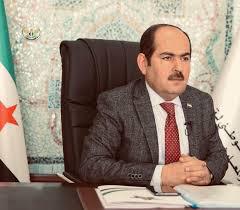
    1-Does the easy fall of the regime mean that the forces that seized power will have an easy task in achieving stability in Syria?

    How will the future political equation be written and what will be the participation of different ethnicities, nationalities and sects in the political process.

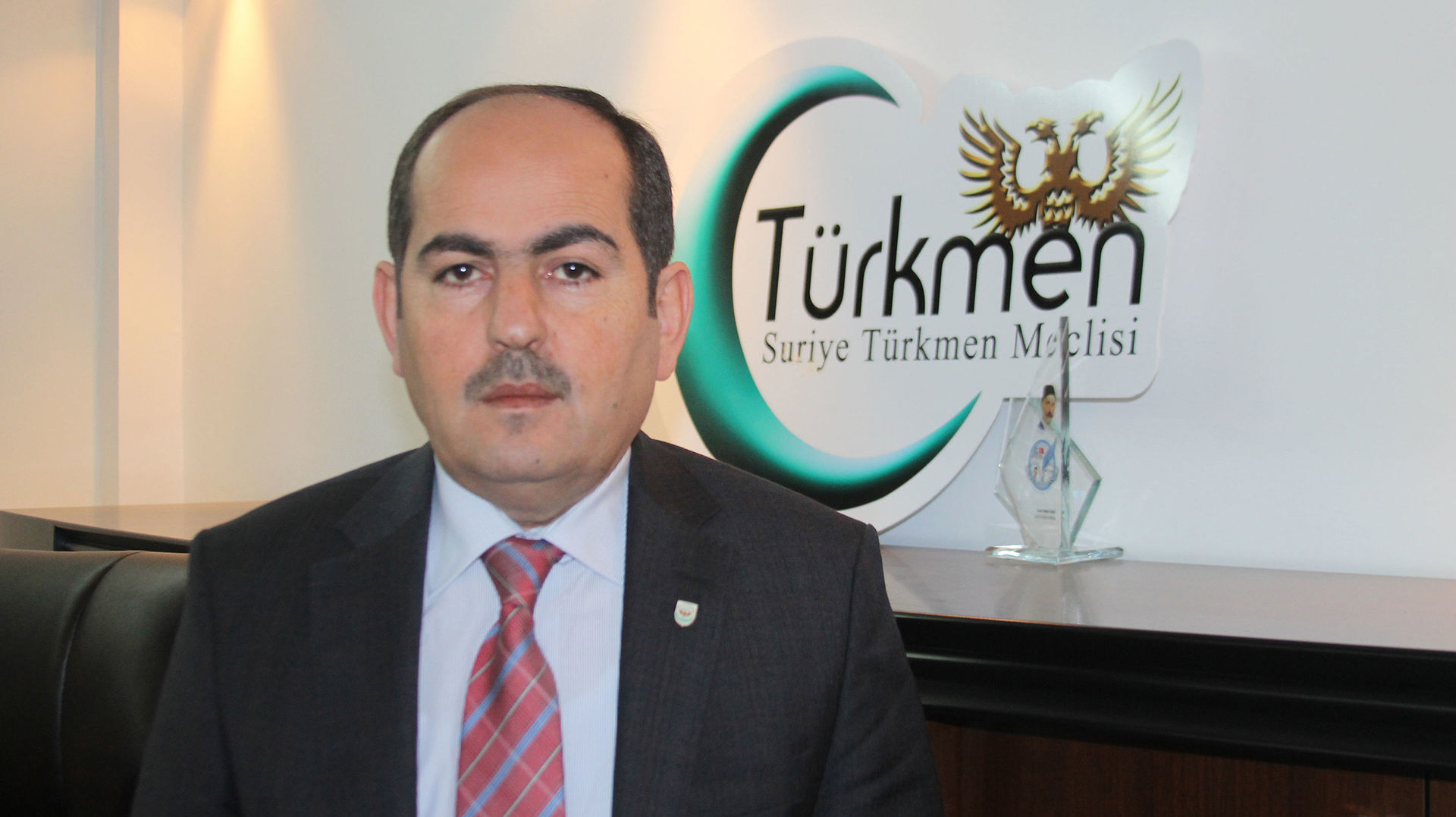
    We pose these questions and others to the head of the Syrian Interim Government of the Syrian National Coalition, Mr. Abdul Rahman Mustafa.

    2-How do you view the future political process in Syria?

    The future political process in Syria is a crucial axis for achieving sustainable stability and rebuilding the state on the foundations of democracy and social justice. With the fall of the Assad regime, it has become necessary for any authority that assumes the management of the country’s affairs to work to implement the spirit of international legitimacy resolutions, especially the Geneva Communiqué of 2012 and UN Resolution 2254 of 2015. This is represented by establishing a transitional government capable of managing the transitional phase and ensuring the transfer of power to the people in a peaceful and democratic manner.

    The next stage requires launching a comprehensive national dialogue that brings together all components of Syrian society, without exception or discrimination, and includes political, societal and civil parties. This dialogue must be supported by a sincere will to build trust between all parties and develop a clear vision for the future.

    Through this dialogue, a transitional government can be formed that expresses the aspirations of all Syrians, works to achieve justice, and rebuilds state institutions in a manner that serves the national interest.

    In this context, transitional justice is considered an essential element to address the effects of conflict and hold accountable those responsible for human rights violations, while working to redress the harm suffered by victims and ensuring national reconciliation.

    3-As the head of the Syrian Interim Government, what are the political foundations that will be followed in Syria to write the political equation through a government that includes different ethnicities and nationalities in Syria?

    We look forward to a transitional period of rule, which is an essential step to start comprehensive reform of various sectors, including the military, political, legal, economic and social sectors. This should be done with the effective participation of different ethnicities, nationalities and sects to ensure fair and comprehensive representation that enhances national unity and establishes the principles of democracy and human rights.

    Achieving stability in Syria requires a serious commitment from all parties to the political process based on international legitimacy decisions, in addition to building strong institutions in which human rights are respected and in which all Syrians participate on an equal footing. The ultimate goal must be to build a state of law and democracy that allows every individual the opportunity to live in dignity and justice. This commitment is the basis through which we can overcome the painful effects of the past and move forward towards a bright future for Syria and its people.

    4-Do you think, Mr. President, that the next government will be a quota government like what happened in Iraq, and how can we compare the scenes in Iraq and Syria?
    Many questions are being raised about the nature of the next government in Syria, and whether it will face the fate of governments based on sectarian quotas as is the case in Iraq.

    In this context, he explained that the ambition in the new Syria is directed towards forming a technocratic government that represents all Syrians and is capable of building the state and meeting the needs of the people away from any sectarian or national considerations. The main goal is to establish a national unity government that works to remove the fears of Syrians and enhance their sense of equal citizenship.

    Despite the great diversity that characterizes Syrian society, which includes different ethnicities and sects, the future vision seeks to elevate the status of citizenship as the basis for building the state, so that belonging to the homeland is above any other affiliation.

    We seek to avoid the sectarian quota model that has proven in many countries that it can lead to internal divisions and conflicts instead of achieving stability.

    The Syrian vision is to benefit from the lessons learned from regional experiences, with a focus on building a political system based on efficiency, justice and equality, far from any quotas that harm the national fabric. The challenges in Syria also require adopting a unified approach that works to build strong institutions capable of serving all Syrians without discrimination, ensuring national unity and sustainable development.

    5-Will elements of the Syrian armed factions, including the Turkmen armed factions, participate in the political process?

    The participation of the Syrian armed factions, including the Turkmen factions, in the future political process is vital to rebuilding Syria on democratic and inclusive foundations.

    It is necessary to integrate these factions into a comprehensive national dialogue aimed at establishing a unified national military institution that goes beyond the mistakes of the past and is subject to civilian authority, while respecting human rights and refraining from interfering in political affairs.

    Turkmen factions have played a prominent role since the beginning of the Syrian revolution in confronting the regime and fighting terrorism, including confronting organizations such as the PKK, PYD. Their continuation in these efforts reinforces the importance of involving them in the transitional phase to ensure the representation of all components of Syrian society and achieve the desired stability.

    Involving these factions in the political process will contribute to building a national army that reflects the diversity of Syrian society, and will strengthen civil-military relations on sound foundations, thus preventing the recurrence of previous painful experiences. This approach is in line with the aspirations of the Syrian people to build a democratic state that respects human rights and ensures the participation of all spectrums in decision-making.

    6-Mr. President, during your political work, you were the head of the Turkmen Council in Syria. First, how do you evaluate the Turkmen political activity in Syria?

    The Turkmen are considered an integral part of the Syrian fabric and a fundamental component of the Syrian people, whose diversity extends across different ethnicities and sects. They have had a prominent and influential role since the start of the revolution for freedom and dignity, as they stood by their brothers from various components of Syrian society, making great sacrifices in order to achieve the aspirations of the Syrian people towards freedom and justice.

    On the political level, the Turkmen Council and the Turkmen played an effective role in supporting the revolution, whether through political forums or through community and media activities. During my presidency of the Council, I was able to present the Turkmen voice in international conferences and forums, which contributed to clarifying the position of this component and its vital role in the Syrian revolution.

    The Turkmen political activity is characterized by a strong will to work within the comprehensive national framework, with a constant emphasis on the principle of national partnership based on equality and respect for the rights of all. The Turkmen were not only supporters of the revolution, but they were an essential part of the political movement calling for the unity of Syrian lands and the building of a civil, democratic state that accommodates all its people without discrimination. In our assessment of the Turkmen political activity, we find that it succeeded in preserving its Syrian national identity, while at the same time working to enhance cooperation with other groups to achieve a common vision for the future of Syria. These efforts reflect an advanced political awareness and a firm belief that the solution in Syria requires unifying ranks and working together to achieve the aspirations of the Syrian people in all their groups.

    7-Can we talk about the participation of the Turkmen people in Syria in the upcoming political process?
    The Turkmen people have proven during the Syrian revolution that they are a fundamental and effective component, with a strong will to contribute to building the future of Syria. Their participation was not only in the military or societal field, but was also evident in their participation in the political movement and their pursuit of achieving the aspirations of the Syrians for freedom and justice.

    The Turkmen were marginalized during the era of the defunct regime, like many components of Syrian society, but their participation in the revolution has re-shed light on their national role and active presence.

    This historical marginalization must be addressed by ensuring their fair and effective participation in the transitional phase and in the future political process, to ensure the representation of all spectrums and achieve the balance required to build a democratic state.

    We emphasize that building modern Syria requires a true national partnership that includes all components of society without exception, including the Turkmen. This partnership is the basis for strengthening national unity and consolidating the principles of citizenship, where every individual and component has a role in shaping the future of the country, regardless of race or sect.

    The Turkmen, through their history, sacrifices and participation in the revolution, have proven that they are an essential part of the project to build a modern state that reflects the aspirations of the Syrian people in all their diversity. This next stage will be an opportunity to achieve justice and equality, and to ensure that the Turkmen and all components have a voice and an effective position in political and administrative decision-making.

    8-How do you read the Syrian political scene in terms of Syria’s relationship with regional countries?

    The current Syrian political scene in terms of relations with regional countries is going through a sensitive and complex phase as a result of years of conflict and foreign interventions. With the fall of the regime, Syria has a new opportunity to reformulate its relations with its regional surroundings on completely different foundations, based on the principles of good neighborliness, joint cooperation, and building strategic partnerships that serve mutual interests.

    We seek for Syrian relations with regional countries to be based on mutual respect and non-interference in internal affairs, with a focus on enhancing cooperation in the political, economic, and security fields. The new Syria, after all the tragedies it has gone through, must be a source of stability and peace in the region, and seek to build bridges of trust with all neighboring countries in a way that enhances regional security.

    The relationship with regional countries will depend to a large extent on our ability to rebuild the Syrian state as a unified and stable entity that works to achieve the interests of its people, while at the same time respecting international agreements and working to enhance regional peace. We seek to transform Syria into a positive partner in the region, capable of contributing to resolving regional issues and enhancing stability rather than being an arena for conflicts.

    In this context, it is imperative to emphasize the importance of cooperation with friendly regional countries to rebuild, strengthen the economy, coordinate to combat terrorism, and ensure the safe and dignified return of refugees. These efforts will be the basis for building solid and sustainable regional relations that will make Syria an effective and positive country in its surroundings.

    9-If we draw the international political map, where will you find Syria’s position on this map?

    Syria is a country with a geostrategic position and a long history, and has always been an important axis in the region and the world. However, the former regime weakened its position by transforming it into an authoritarian state that serves its narrow interests. We aspire to restore Syria to its natural role as an effective state in the international community, built on the foundations of democracy and justice, contributing to regional and international stability and peace.

    The new Syria will seek to build strategic partnerships and take advantage of its geographical location to enhance its role in trade, energy, and transportation. Our goal is for Syria to be a model for a modern state that respects human rights, achieves the interests of its people, and restores its role as a source of stability and communication between the East and the West.

    10-How do you view the Turkish government’s support for the Syrian people, which has sheltered millions of Syrians and those fleeing the brutality of the Assad regime, as well as the Turkish government’s political support for establishing stability in Syria?

    It is impossible to talk about the Turkish role in supporting the Syrian people without referring to the great efforts made by the Republic of Turkey in various fields. It played a pivotal role in defeating terrorism and confronting terrorist organizations such as ISIS and PKK, PYD, as it provided significant military support to the Syrian National Army and the intelligent blood of the Turkish martyrs mixed with the blood of the martyrs of the National Army, who sacrificed side by side to liberate Syrian lands from terrorism and restore security to its people, which reflects the depth of brotherhood and solidarity between the Syrian and Turkish peoples.

    In addition to its military efforts, Turkey opened its doors to receive millions of Syrian refugees who fled the brutality of the Assad regime and the horrors of war, and provided them with shelter and care, affirming its humanitarian and moral commitment to the Syrian people. Turkey also contributed significantly to building institutions in the liberated areas, which helped restore life to normal. These efforts included establishing schools to provide education for children, building hospitals to provide health care, and developing basic infrastructure to support the local population.

    In addition, Turkey supported the Syrians in international forums, defending their legitimate demands before the world, and working to strengthen local governance and provide stability in liberated areas through development and administrative programs aimed at enabling Syrians to manage their own affairs.

    This comprehensive role that combines receiving refugees, military, humanitarian, and development efforts highlights Turkey’s steadfast commitment to the Syrian people. We count on this support to continue to achieve political transition and democratic transformation in Syria, ensuring the security and stability that the Syrian people deserve.

  • Reporting from the Ground: A Turkmen Perspective

    Reporting from the Ground: A Turkmen Perspective

    We’re delighted to welcome Yalman, our dedicated correspondent in Kirkuk, to the Turkish Forum family.

    Your dedication to bringing the voices and perspectives of the Turkmen people to our readers is truly invaluable. We are grateful for your courage, professionalism, and the vital work you do.

    We’re honored to share his work and look forward to the rich contributions he will continue to make to Turkish Forum

    Yalman Haceroğlu

    Home​ GSM 00967709324224​
    E-mail​ [email protected]
    Iraq – Kirkuk

    Education

    bagdad university -college of arts- English DEP 1984​

    ➢ High School Ma. Preparatory stage- MOUSUL UNİVERSİTY ​2018

    Media experience

    I started media work in 1982 through my work as a translator at Baghdad Radio, the Turkmen section. I have been appointed in the Public Corporation for Radio and Television under the title of Announcer on the Permanent Owner from 1994 to the end of 2002. I worked in the field of translation and translated many books into Arabic, Turkish, English. After 2003, I worked as the news director for Turkmen Eli satellite channel from April 2003 to May 2007, then I took over the management of Turkmen Eli satellite channel as general manager until the year 2020 in September. During my working in TURKMAN ELI TV I did more than 700 television interviews with iraqi, Araps and foreigners politicians, presidents and foreign diplomats I present lectures in media colleges in Arab countries and Iraq, especially at the University of Kirkuk about the writing of news. I participated in international visitors in USA that arranged by USA foreign ministry in 2006 as presentative of Iraq with 14 Arap countries. I take position in Iraq neighbors conference in Egypt sharm el-shyh. I was correspondent of los angels times in 2004-2005 in Kirkuk .
    I wrote articles in Arabic and Turkish in newspapers and websites on political, literary and media topics.

    Syndicates & Association Memberships
    1- Member of Iraqi announcers association 2001
    2- Association of radio and TV 1999
    3- Iraqi journalist syndicate 2003
    4- Iraqi translators association 1984
    5- Iraqi authors and litterateurs union 1999.

    DEGREE and DIPLOMAED
    1- Degree of honorary doctorate from union of middle east of France in Iraqi media
    2- 100 most effective characters in media

    WORKS and BOOKS

    1-Iraq after globalism discussing by politician
    2-Modrn Turkish media
    3-Translion the novel kill Henry kissinger

  • French Ambassador, not Pashinyan, Is Defending Armenia’s Interests

    French Ambassador, not Pashinyan, Is Defending Armenia’s Interests

    Something is terribly wrong when Armenia’s Prime Minister Nikol Pashinyan is making continuous concessions to Azerbaijan, while the French Ambassador to Armenia, Olivier Decottignies, is defending Armenia’s interests. Ironically, a foreign ambassador is more pro-Armenian than the Prime Minister of Armenia.

    When Azerbaijan’s President Ilham Aliyev repeated his lie about the non-existent “Western Azerbaijan” as a replacement for the Republic of Armenia, Pashinyan shamefully equated the fake “Western Azerbaijan” with Armenians’ historical demands for “Western Armenia.” It was the French Ambassador who responded to Aliyev on Nov. 24, 2024, on X: “The one and only: Western Azerbaijan is one of the 31 provinces of Iran whose capital and largest city is Urmia,” quoting from Wikipedia. He attached a map of Iran that indicated the location of the Western Azerbaijan province in Iran. The post was viewed over 93,000 times with 114 comments and 1,100 Likes. An Armenian with the pseudonym “Nemesis Melkonian” praised the French Ambassador on X: “Can you become our next prime minister? The current one is ethnically Turkish.” An Iranian replied: “As an Iranian” adding the OK hand sign. This was a slap in the face of Aliyev, but also a rebuke to Pashinyan, according to some Armenian commentators.

    On the same day, the French Ambassador also posted a photo of the well-known Blue Mosque in Yerevan and wrote: “In the gardens of the Blue Mosque of Yerevan, emblematic of the Persian heritage of Armenia.” This post was viewed 43,000 times with 46 comments and 660 Likes. While Azeri commentators falsely claimed that the Blue Mosque was of Azerbaijani origin, many others thanked the French Ambassador for featuring this historic Persian place of worship. The Iranian Embassy in Armenia expressed its appreciation to the French Ambassador by posting on X: “The Blue Mosque, a symbol of Iranian art, has been active again in the last three decades as the praying and congregation place of Muslims residing in Armenia and a touristic attraction. A great pleasure that its centuries-old Persian epigraphy has been preserved! Who can read them?” The embassy then added several images of Persian calligraphy found on the walls of the Mosque.

    Mordechai Kedar, An Israeli sycophant of Azerbaijan, jumping into the discussion, wrote an article in the Jerusalem Post on December 5, 2024, titled: “France’s ambassador sparks outrage with support for Persian hegemony in Armenia.” This is nothing but pure pro-Azeri propaganda.

    Kedar wrote that “The Azerbaijanis are outraged by these social media posts, as the Blue Mosque in Yerevan was built by Azerbaijanis, and trying to portray the mosque as ‘Persian’ demonstrates France’s support for Persian colonialism in the region. Furthermore, the Azerbaijanis are angered at the French diplomat’s attempt to portray West Azerbaijan as part of Iran.” If the Azeris were outraged by what the French Ambassador wrote, why is it any of Kedar’s business, unless he expects to gain something by volunteering to act as a propagandist for Azerbaijan?

    Kedar claimed that Armenians have described the Blue Mosque as Persian in order “to erase all traces of Azeri heritage from their country [Armenia].” Kedar is ignoring the fact that Azeris have destroyed thousands of Armenian historic monuments and churches in Artsakh and Azerbaijan. Making an even more outrageous claim, Kedar wrote that Persians “used these Armenian acts of delegitimization in order to expand their colonial influence into the South Caucasus.”

    To pile up the attacks on Armenia and France, Elnur Enveroglu wrote on the Azernews website that the French Ambassador’s tweets “revealed Decottirnies’ ignorance of history.” Elnur could not even spell the Ambassador’s last name correctly.

    Naturally, the French Ambassador could not leave unchallenged such nonsense from Kedar whose childish arguments disgraced the Jerusalem Post. The Ambassador replied: “Seriously, Mr. Kedar? The Blue Mosque in Yerevan was built under Persian rule in typically Persian style. Does calling a Roman aqueduct Roman ‘demonstrates support’ for colonialism?”

    Even though there was no reason for Nasimi Aghayev, Azerbaijan’s Ambassador to Germany, to stick his nose in this issue, but being a life-long falsifier of the truth, starting from his days as the Consul General of Azerbaijan in Los Angeles, he wrote: “Beautiful Azerbaijani Blue Mosque in Yerevan. Built in 1766 by Huseyn Ali Khan, Ruler of Azerbaijan Iravan [Yerevan] Khanate. The only surviving mosque in Armenia. All others (at least 269) were destroyed. Regrettably, Armenia continues to deny Blue Mosque’s Azerbaijani identity.” Mary Hogins rightly responded in a tweet to Nasimi: “You mean Persian Mosque, lying khiyar [cucumber]?”

    Nasimi must have forgotten that until 1918 there was no such country as Azerbaijan. Even then, the Secretary General of the League of Nations rejected Azerbaijan’s application to be recognized as a state by writing in an official memorandum in 1920: “This territory, occupying a superficial area of 40,000 square miles, appears to have never formerly constituted a State, but has always been included in larger groups such as the Mongol or Persian and since 1813 the Russian Empire. The name Azerbaijan which has been chosen for the new Republic is also that of the neighboring Persian province.” Case closed.

    In his fanatical zeal, Aliyev doesn’t seem to understand that his constant attacks on France, based on lies, are not going to end well for Azerbaijan. France is a superpower, while Azerbaijan is a banana republic, which does not even have bananas, ruled by a two-bit dictator!

  • Syria’s Collapse

    Syria’s Collapse

    Syria’s Collapse and the Resurgence of Türkiye: A Critical Turning Point in Middle Eastern Geopolitics.

    The Syrian conflict is rapidly reaching a breaking point, with Bashar al-Assad’s administration teetering on the brink of collapse. The Assad regime, already a shadow of its former self, faces an existential crisis compounded by growing internal dissent, economic devastation, and increasing isolation. As Syria falls apart, the region’s geopolitical landscape is being reshaped, and Türkiye has emerged as a decisive player whose role cannot be ignored.

    Türkiye’s Strategic Pushback Against Terrorism
    Türkiye’s unyielding stance on its national security has redefined the dynamics in northern Syria and Iraq . Through military operations and its strategic alliance with the Syrian National Army (SNA), Türkiye has neutralized the influence of the CIA backed PKK and its affiliates, the PYD and YPG, which Ankara sees as direct threats to its sovereignty. The Turkish government has been unequivocal: it will not tolerate the establishment of a terrorist PKK PYG YPG group -controlled autonomous region along its border, particularly one backed by the CIA and supported by the same terrorist groups the U.S. and EU have officially designated as such. It should be clearly noted Turkiye has never had a problem with Kurds . Turkiyes number one enemy is the CIA backed PKK, YPG and PYD.

    This determination has not only thwarted PKK/ YPG ambitions but has also showcased Türkiye’s ability to reshape the power lines in Syria. According to certain news outlets, Türkiye’s military presence in northern Syria remains vital, ensuring that these groups cannot create a land-grab-style movement that threatens regional stability.

    The United States’ Misstep
    What is most astonishing in this geopolitical chess game is the United States’ decision to align itself with terrorist organizations that they have labeled as terrorist ( During Senate Armed Services Committee Hearing on combating ISIS, U.S. Senator Lindsey Graham (R-South Carolina) questions Secretary Carter and General Dunford on the U.S. military strategy in working with terrorist PKK and PYG )


    https://www.youtube.com/watch?v=kLiVjIv9fdc&t=31s like the PKK and YPG instead of leveraging its NATO ally, Türkiye, the second-largest military power within the alliance. This miscalculation has not only strained U.S.-Türkiye relations but has also weakened Washington’s strategic influence in the Middle East.

    The Obama and Biden administrations’ decision to support the Kurdish Autonomous Administration of North and East Syria, controlled by PYG, PYD/PKK elements, represents a failure to prioritize long-term strategic alliances over short-term expediencies. As many news out lets aptly highlights, Türkiye’s resurgence has rewritten the rules of power in the region, pushing back against Iranian and Russian influence while exposing the U.S.’s flawed approach. For 24 years I have said in many of my speeches at Bowling Green Falg raisings “ Indeed, it would be impossible to view Turkiye s geo-graphic situation as anything but strategic , Only a peaceful, stronger, democratic, and secular Turkiye at the table can legitimize U.S and western policies & soft power in the region.”

    Let’s look at the Winners and Losers

    In the chaos of Syria, Türkiye and Israel have emerged as unlikely beneficiaries. Israel views Türkiye’s role as a linchpin in Syria positively, as it disrupts the “Shiite Crescent” that stretches from Tehran to Beirut. By cutting this axis in half, Türkiye has indirectly bolstered Israel’s security interests. Is why we saw on November 22, 2024 of Israeli, Internal Security Agency Shin Bet Chief Ronen Bar immediately flies to Türkiye underscores an essential truth: Türkiye’s role is indispensable to achieving meaningful progress in the Middle East.

    On the other hand, the resistance axis—comprising Assad, Tehran, and Hezbollah—has suffered significant setbacks. With Türkiye controlling key security zones in northern Syria, the balance of power has shifted, further isolating Assad and diminishing Iran’s foothold in the region.

    Türkiye: The Key to Stability
    Türkiye has consistently stated its commitment to Syria’s territorial integrity, yet its actions have been driven by an unshakable resolve to secure its borders. The Atlantic Council underscores that Türkiye’s military operations are not about territorial ambitions but about ensuring its national security. Türkiye’s presence in northern Syria has not only contained terrorist groups but also prevented Iran and Russia from consolidating power in the region.

    This is a clear message: without Türkiye at the table, no viable solution in Syria is possible. Türkiye’s actions have demonstrated that it is the indispensable actor in the region, capable of balancing competing interests while prioritizing its own security and national interests.

    A Wake-Up Call for Washington
    The U.S. must recognize that its relationship with Türkiye is pivotal to achieving long-term stability in the Middle East. While the damage done under the Obama and Biden administrations cannot be undone overnight, there is room for a recalibrated approach. Under a potential Trump White House, Washington must shift its focus from grand resets to pragmatic cooperation with its NATO ally.

    Türkiye’s secular governance, military strength, and strategic location make it an invaluable partner for the U.S. Moving forward, Washington should prioritize rebuilding trust with Ankara by addressing Türkiye’s security concerns and fostering meaningful collaboration on shared goals.

    Conclusion
    Türkiye’s resurgence has not only pushed back against the PKK/YPG , Russia and Iran but has also reshaped the geopolitical calculus in Syria and Iraq . As the Assad regime collapses , the importance of Türkiye as a stabilizing force and a counterweight to Iranian and Russian ambitions cannot be overstated. The U.S. and Israel must realign its policies, recognizing Türkiye’s critical role in the region, and work towards a future where this indispensable NATO ally is given the respect and partnership it deserves.

    Ibrahim Kurtulus 

    Community Activist 

  • Every Time Pashinyan Opens his Mouth He Harms Armenia’s Interests

    Every Time Pashinyan Opens his Mouth He Harms Armenia’s Interests

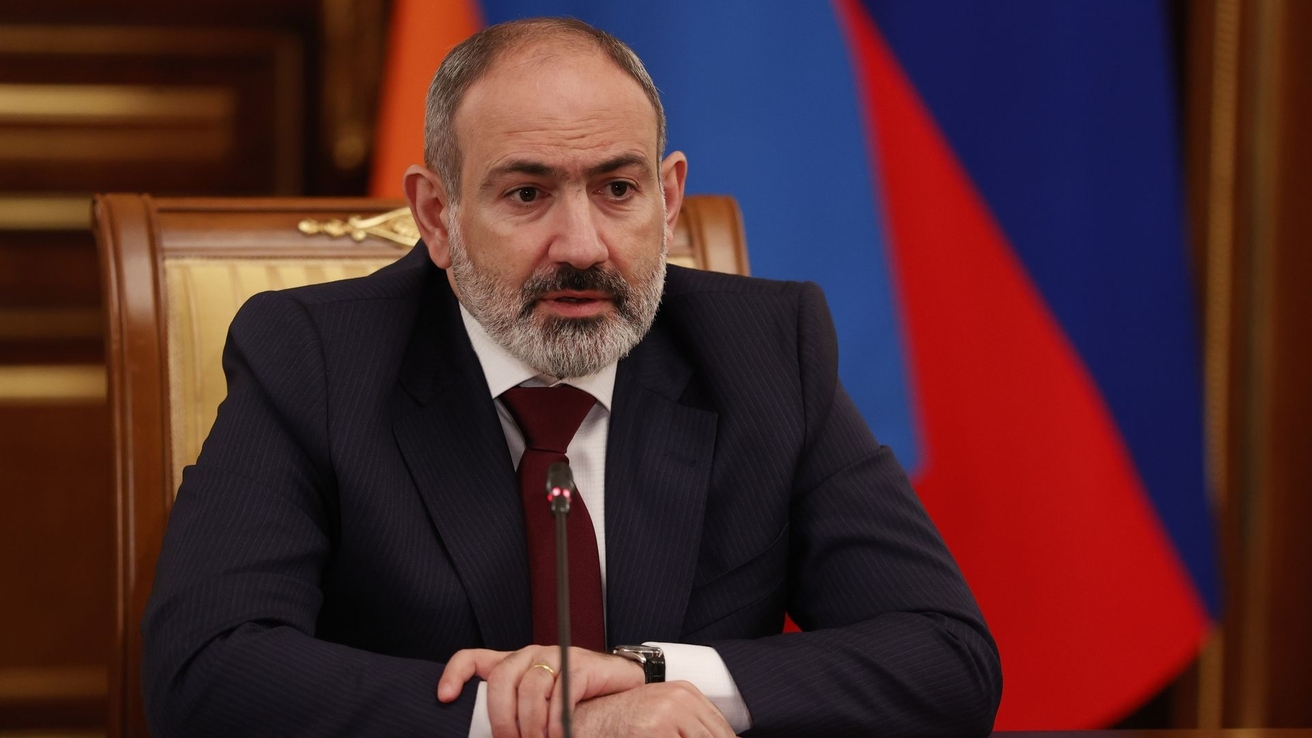
    Every time Armenia’s Prime Minister Nikol Pashinyan makes a public statement, he ends up damaging Armenia’s interests.

    The latest example of Pashinyan’s detrimental words is the 90-minute interview he gave to Armenia’s Public Television on November 22, 2024.

    The first question was about Pashinyan’s recent firing of six top government officials by sending them a text message on a Sunday evening. The journalist asked him, why did he fire them?

    Pashinyan stated that their “dismissals are not personalized but are rather related to systems.” Nevertheless, he said that the fired officials “were doing a good job.” The journalist pointed out that the Prime Minister made no systemic changes, but simply fired the individuals. He explained that these officials had made remarkable systemic improvements, but later, as time passed, they became part of the system. He went on admitting that “a similar thing happens to me too.”

    The journalist, Tatev Danielyan, then questioned Pashinyan about his dismissal of the Chairman of the Supreme Judicial Council, Karen Andreasyan, “a body completely independent of the executive branch. It turns out that at the Prime Minister’s, so to speak, urging, he decided to submit a resignation letter. Now your opponents say, what is this, if not pressure from one branch of government on the other?”

    Pashinyan gave the unconvincing explanation that “there was no urging from the Prime Minister, there was a request from the Prime Minister.” The Journalist responded by saying: “there is a rupture between the statements and actions of the executive branch about an independent judicial system.”

    There is no separation among the three branches of the government. Pashinyan single-handedly runs all three branches: the executive, legislative and judiciary. Anyone who deviates from his wishes is fired and replaced. Strangely, this is a man, who speaks about democracy day and night, violates the basic principles of democracy.

    Pashinyan then made the mistake of saying the officials he ‘requested’ to resign have two options: “fulfill the request and not to fulfill that request.” The journalist pointed out that if the official refused to resign, there would ‘consequences.’ Pashinyan pleaded ignorance by asking, ‘what consequence?’

    When asked if Pashinyan had consulted his advisors before firing the six officials, he proudly replied: “This was a one-person decision.”

    The journalist then asked if Pashinyan had requested the resignation of Narek Zeynalyan, a member of the ruling parliamentary bloc. Pashinyan said, yes. Zeynalyan had resigned, but fellow parliamentary member Hovik Aghazaryan has so far refused Pashinyan’s ‘request’ to resign. Pashinyan said: “I hope that my request will not remain unanswered.” Since that request, Aghazaryan has been interrogated several times by the authorities on suspicion of fraudulent activities. This is yet another example of the Prime Minister’s undue interference in the affairs of another branch of the government, the Parliament.

    Pashinyan had a lengthy discussion about his persistent efforts to convince Pres. Ilham Aliyev of Azerbaijan to sign what he calls “a peace treaty,” despite the fact that Aliyev has not only shown no interest in signing such a document, but has escalated his demands for further concessions from Armenia. Pashinyan does not seem to understand the difference between the signing of a piece of paper which he calls “a peace treaty,” and actual peace.

    However, the biggest gaffe Pashinyan made during his 90-minute interview was equating Aliyev’s demands for a fake “Western Azerbaijan” to replace the Republic of Armenia with Armenian demands for the historical territory of “Western Armenia.”

    Without being asked any question on this subject, Pashinyan reluctantly offered: “Let me say one more thing, but OK, I won’t say it.” But when the journalist urged him to say it, he dropped a major bombshell: “OK. I will say it. We get so upset and take it so hard, consider it a problem, somewhere some people use the term Western Azerbaijan, right? But we say, Western Armenia, don’t we think that it irritates some people? Just like we are irritated when they say Western Azerbaijan, the same way when they say Western Armenia, others are irritated. Now again, they will say, the routine treason, the vile scum. Today I am in a situation and in a responsibility, I am obligated to talk with our people and show them the cause-and-effect relationships, chains. If I don’t do that, it means that I am consciously leading our country towards the loss of statehood. I cannot allow that.”

    This is a very shameful statement by the head of the government of Armenia. One would expect such an answer from Erdogan or Aliyev, but not from Armenia’s leader. Incredibly, even Erdogan and Aliyev have not made such an anti-Armenian statement.

    The final question, believe it or not, was: “Can you tell me the real reason why you decided to shave [your beard]?” In keeping with his usual practice of dodging questions, Pashinyan said: “…it is clear that a change in the image is taking place…. I can only say one thing. When I decided to shave, I decided the day: I will do it on my eldest daughter’s birthday, although now that this interview goes on the air, my other daughters will ask why on her birthday, not on our birthday? I am convinced that Ashot [his son] is not ambitious in that regard, not only in that regard, and he will not raise such a question.”

  • The Book Reveals 8,000 Letters by Armenian Survivors of 1890’s Turkish Massacres

    The Book Reveals 8,000 Letters by Armenian Survivors of 1890’s Turkish Massacres

    I just received the first volume of a valuable book published in Yerevan in 2021 that makes public for the first time some of the 8,000 handwritten letters by survivors of the 1894-96 Turkish massacres of 300,000 Armenians in Western Armenia (present-day Turkey), organized by Sultan Abdul Hamid II.

    This unique book, authored by Vera Sahakyan and published by the Matenadaran, the repository of ancient manuscripts and documents in Yerevan, reproduces the eyewitness testimonies of 200 Armenian survivors of the Turkish massacres from the 28 villages in the Bulanekh province of the Mush region who had fled to Eastern Armenia. The heart-wrenching letters were sent to Catholicos of All-Armenians Mkrtich Khrimian (1893-1907), known endearingly as Khrimian Hayrig, located in Etchmiadzin, the headquarters of the Armenian Apostolic Church, seeking his compassionate aid for their basic necessities of food and lodging.

    The letters of the Armenian survivors were kept for several decades in the archives of Etchmiadzin and subsequently transferred to Matenadaran. The author plans to publish several more volumes in the future to cover the rest of the 8,000 letters. Many of the letters in volume 1 were translated into English by Lucine Minasian.

    Here are excerpts from some of the letters written to the Catholicos by the Armenian survivors of the 1894-96 Turkish massacres:

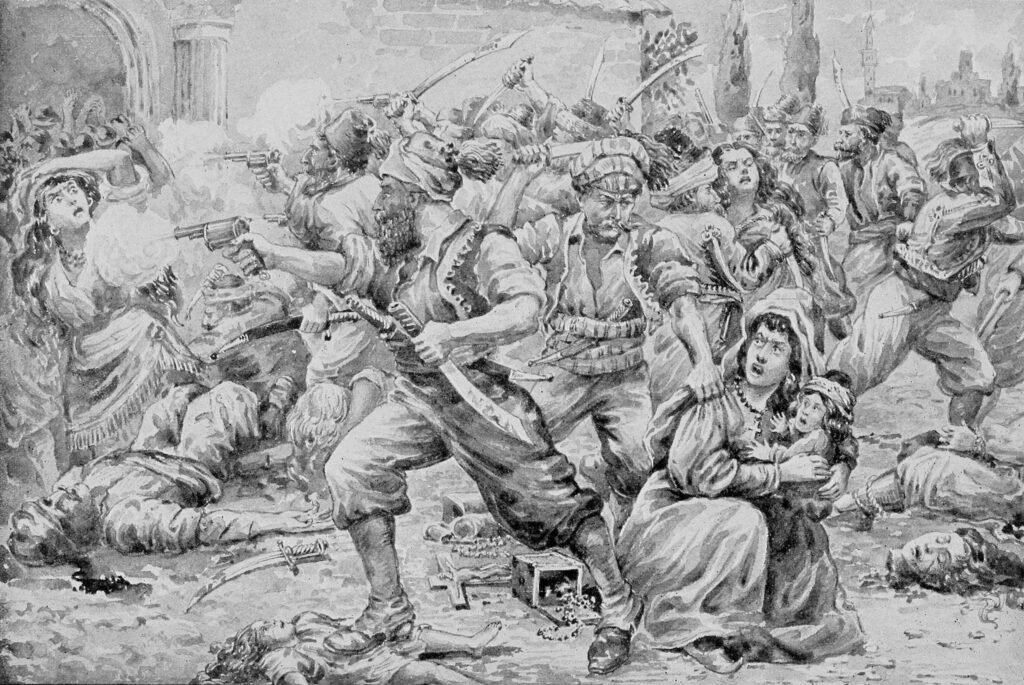
    Sketch by an eyewitness of the slaughter of Armenians at Sassoun, “Turkey and the Armenian Atrocities” by Rev. Edwin M. Bliss, Edgewood Publishing Company, 1896, p. 306 (Wikimedia Commons)

    — On October 29, 1896, Yeghiazar Hagopian, a refugee from Bulanekh’s Kakarlu village of Mush, wrote: “I was able to flee the barbaric Kurdish killings. Besides totally looting us, they murdered my son, and I barely escaped, only losing the fingers of my right hand. It’s already been four months that I have been wandering around here begging for alms…. My family, famished and naked, is impatiently waiting for me back in the homeland. I beseech you to at least grant me some travel money.”

    — On October 14, 1894, Mardiros Mouradian, an inhabitant from Khoshgaldi village of Lower Bulanekh, wrote: “The unlawful Tajiks [Turks] attacked my lamentable and poor family beating us with stones on the one hand, and fatally shooting my 20-year-old son on the other hand. They pillaged my whole fortune and even disrobed us.”

    — On July 11, 1895, Parish Priest Hovhannes Der Bedrossian from Molahkant village of Mush wrote: “Being attacked by Kurds and Hamidian troops, we abandoned our homes and possessions and barely fled secretly to Russia to survive. Now, we are wandering poor, delusional, famished… bereft of a single piece of dry bread.”

    — On January 2, 1896, Hagop Levoniants from Bulanekh’s Liz village wrote: “Our intention is self-defense — we appeal to you that you will free us, our people, and our homeland from the Turkish iron yoke. Hand us a few weapons so we can go and reach our eight friends who have been writing us letter after letter, asking us to reach them soon.”

    — On January 13, 1897, Mkrtich Haroutyounyan from Bulanekh’s Khristam Kadouk village wrote: “We barely survived the atrocities…and freed ourselves from the pitiless claws of the furious Ottoman government…. I plead for some rags and some rubles that will cover my travel costs, so I can protect my family from the frost and attain daily sustenance for them during the wintertime.”

    — On September 30, 1895, Yaghush Mkrtichian (five people) and Yalduz Mardirosian (six people), two widows of refugee families from Bulanekh’s Kharakhlo village of Mush, wrote: “Both of us have been widowed for almost two years, as the heads [of our families] were killed by the Kurds. Being frightened, we fled here. They took everything we owned. They didn’t leave anything — neither cattle nor possessions.”

    –On March 15, 1894, Baghdasar Margosian from Keakarlou village of Mush wrote: “Enduring numerous tortures and sufferings, we could barely free ourselves from death. The unlawful warden released us from prison, demanding 80 pieces of gold. Afterwards, they looted all my movable and immovable property and forcibly imprisoned my son.”

    — On July 17, 1895, Sahag Garabedian from Hamzasheikh village of Bulanekh Province wrote: “Because of the barbarity committed by the government and the Turks, we left our homeland and fled to Russia. My father died. Now there are five of us, including my old mother. Presently, my family lives in a hut with lice in the Armidlu village.”

    — On April 19, 1894, Priest Mateos Der Kevorkian from Bulanekh village and Sahag Serovpian from Karakilise village wrote: “Since September 1893, the Kurds and Turks of Turkey have been torturing our Armenians intensely and oppressing them. They have been looting our harvested wheat. They have been pillaging our stored wheat. At nights they commit adultery with our wives and then kill them. When the Armenian laborers come back from abroad, they rob their money and homes and kill them. Eighteen families from Hamzasheikh village were forcibly converted into Turkish religion. Three of them were killed and now there is an order to hang 28 people…. Effendis and aghas forcibly demand 40-50 gold pieces from Armenian peasants or kill them. Prelate Priest Nercess has been sentenced to two years in jail. They forcibly demanded from him 450 gold pieces which were collected by passing a plate [in church] and now he is in prison. Effendis and aghas are forcibly taking over the Armenian villages, harming and torturing people….”

    This is a valuable book because it:

    1) Documents the 1894-96 massacres of Armenians through eyewitness accounts of the survivors;

    2) Gives present-day Armenians the opportunity to find the names of their ancestors who used to live in Western Armenia;

    3) Reveals that some of the little-known villages in the region were indeed inhabited by Armenians.