Author: Ibrahim Kurtulus

  • “Islamic law”  Tulsi Gabbard’s Dangerous Smear of Paterson, New Jersey

    “Islamic law”  Tulsi Gabbard’s Dangerous Smear of Paterson, New Jersey

    Tulsi Gabbard’s suggestion that Paterson, New Jersey is somehow working to impose “Islamic law” is not merely false it is reckless, inflammatory, and deeply dangerous. It is a textbook example of fear mongering, rooted not in facts, but in prejudice and conspiracy theory.

    Paterson is an American city governed by the U.S. Constitution, New Jersey state law, and the democratic will of its residents not by religious doctrine, not by religious law , and certainly not by some imaginary parallel legal system fabricated for political theater. To suggest otherwise is to insult the intelligence of the American public and to deliberately sow division.

    For over 45 years, the Turkish American community in Paterson, New Jersey has lived, worked, paid taxes, built businesses, raised families, and contributed to the civic life of this city and our beautiful country of America. In all that time, there has never been a single instance zero of any Turkish American or Muslim American organization attempting to impose Islamic law, Muslim law, or any religious legal system. Not one ordinance. Not one proposal. Not one shred of evidence.

    What Ms. Gabbard is doing is not whistleblowing. It is character assassination aimed squarely at Muslim Americans.

    Once again, we see Tulsi Gabbard attempting to manufacture fear, to push a smear campaign against an entire community by recycling long debunked Islamophobic tropes. This narrative has been used before by her, and every time it collapses under scrutiny. It relies on the same tired formula: identify a Muslim majority or Muslim visible community, attach the phrase “Islamic law,” and let suspicion do the rest.

    This is not leadership. This is demagoguery. The language Ms. Gabbard employs is venomous and venom, once released, does not stay within the boundaries its author imagines. History teaches us a hard lesson: hatred never confines itself to its original target. Those who spread hatred eventually endanger everyone Christians, Jews, Muslims, immigrants, and native born Americans alike. Hate metastasizes. It does not self regulate.

    Let us be absolutely clear: Muslim Americans are not a threat to the United States, I am a Turkish American Muslim , I love America ,  America is my home , home to my daughters , my family, we are proud Americans . The real threat comes from those who weaponize misinformation, Like Ms Gabbard, who delegitimize fellow Americans based on faith, and who normalize conspiracy theories under the guise of “concern.”

    Ms. Gabbard is once again pushing conspiracy theories not facts, not evidence, not law. And conspiracy theories, when amplified by public figures, corrode trust, undermine democracy, and place innocent people in harm’s way.

    Paterson does not need lectures from politicians seeking relevance through outrage. It needs honesty, responsibility, and respect for truth. Muslim Americans including Turkish Americans do not need to prove their loyalty. We are proud Americans. They have already done so through decades of peaceful civic engagement, military service, entrepreneurship, and community leadership.

    Tulsi Gabbard should be called out plainly: Stop lying, Stop smearing, Stop endangering communities for political gain.

    Because the moment we allow baseless hate to masquerade as patriotism is the moment we betray the very American values we claim to defend.

    Ibrahim Kurtulus

    Community Activist

  • Yazal left a lasting mark

    Yazal left a lasting mark

    “New York’ta Turk Birliginin Mimari Buyukelci Baskonsolos Sayin Yazal’in iz birakan donemi”

    A gentleman I meet several years ago wrote ethe above comments on Social Media . In English translated to the following:  The statement claiming that “the era in which the Turkish Union was established in New York under the leadership of Ambassador and Consul General Mr. Ahmet Yazal left a lasting mark” I write Respectfully,  reflects, at best, a limited and ahistorical perspective, and at worst, a profound misunderstanding of what genuine leadership and community legacy truly mean within the Turkish American experience in New York.

     With respect, anyone making such an assertion appears not to have lived through nor personally experienced the distinguished tenures of former Turkish Consuls General who served this community with exceptional dedication, humility, and human connection. Figures such as Volkan Bozkır, Yusuf Buluc, Fuat Tanlay, Mehmet Nuri Ezen, Ömer Önhon, Mehmet Samsar, Mustafa Levent Bilgen, Ertan Yalçın, Alper Aktaş, and Reyhan Özgür did not merely occupy an office. They embodied it. Their service left indelible marks not because of ceremony or rhetoric, but because they became an integral part of the community’s daily life.

    These Consuls General practiced a true open door policy long before the phrase became fashionable. They knew community members by their first names. They sat at kitchen tables, visited living rooms, attended funerals and weddings, met children, listened to elders, and stood shoulder to shoulder with people during moments of pride and moments of grief. They walked into Turkish cafés, storefronts, NGOs, and grassroots organizations not for photographs, but for conversation, trust, and solidarity. When they entered a room, the community naturally gathered around them, not out of obligation, but out of affection and respect earned over time.

    By contrast, the claim that Mr. Yazal has left a comparable “iz” (footprint) does not withstand scrutiny when measured against concrete actions and omissions. The record to date shows repeated absences at moments when presence mattered the  most:

     the funeral of a Turkish–Korean War veteran, a hero who served both Türkiye and the United States;

     the funeral of Ata Erim’s wife, honoring a man who devoted over half a century to the Turkish American community;

     the 25th Annual Turkish Flag Raising on Wall Street for Cumhuriyet Bayramı, an unprecedented absence by a Consul General Yazal , despite participation by senior New York City officials; and neglecting to honor our Seyhitler (Police or Military Personal Who died in the line of duty,

     and most tellingly a resent NYPD event in Brooklyn, a growing disconnect from the grassroots, evidenced by community gatherings where the overwhelming majority neither recognized nor had any meaningful interaction with Mr. Yazal.

    Leadership is not defined by titles sir, social media praise, or carefully worded tributes. Nor is a “legacy” established through proximity to power or ceremonial appearances. A true footprint is measured by presence, empathy, continuity, and trust qualities that cannot be manufactured or retroactively declared.

    It is also important to acknowledge an uncomfortable reality: many within the community share these concerns quietly. A silent majority refrains from speaking openly, not out of agreement, but out of fear, the fear of exclusion from receptions, invitations, or access. Silence, however, should never be mistaken for consent.

    If one wishes to understand what a genuine and enduring “iz” looks like, one need only reflect on figures such as Ambassador Şükrü Elekdağ, eloquently remembered in a recent piece in TurkNetwork by Oya Bain a statesman whose legacy lives not in official statements, but in the hearts and conscience of the people he served. We the people.

    Respectfully, before elevating present performance to historic status, one must look honestly at the past. When that comparison is made with integrity, the difference between symbolic presence and substantive leadership becomes unmistakably clear.

    Ibrahim Kurtulus

    Community Activist 

  • A Rebuttal to Chris Eyte’s Misguided Portrayal of Türkiye

    A Rebuttal to Chris Eyte’s Misguided Portrayal of Türkiye

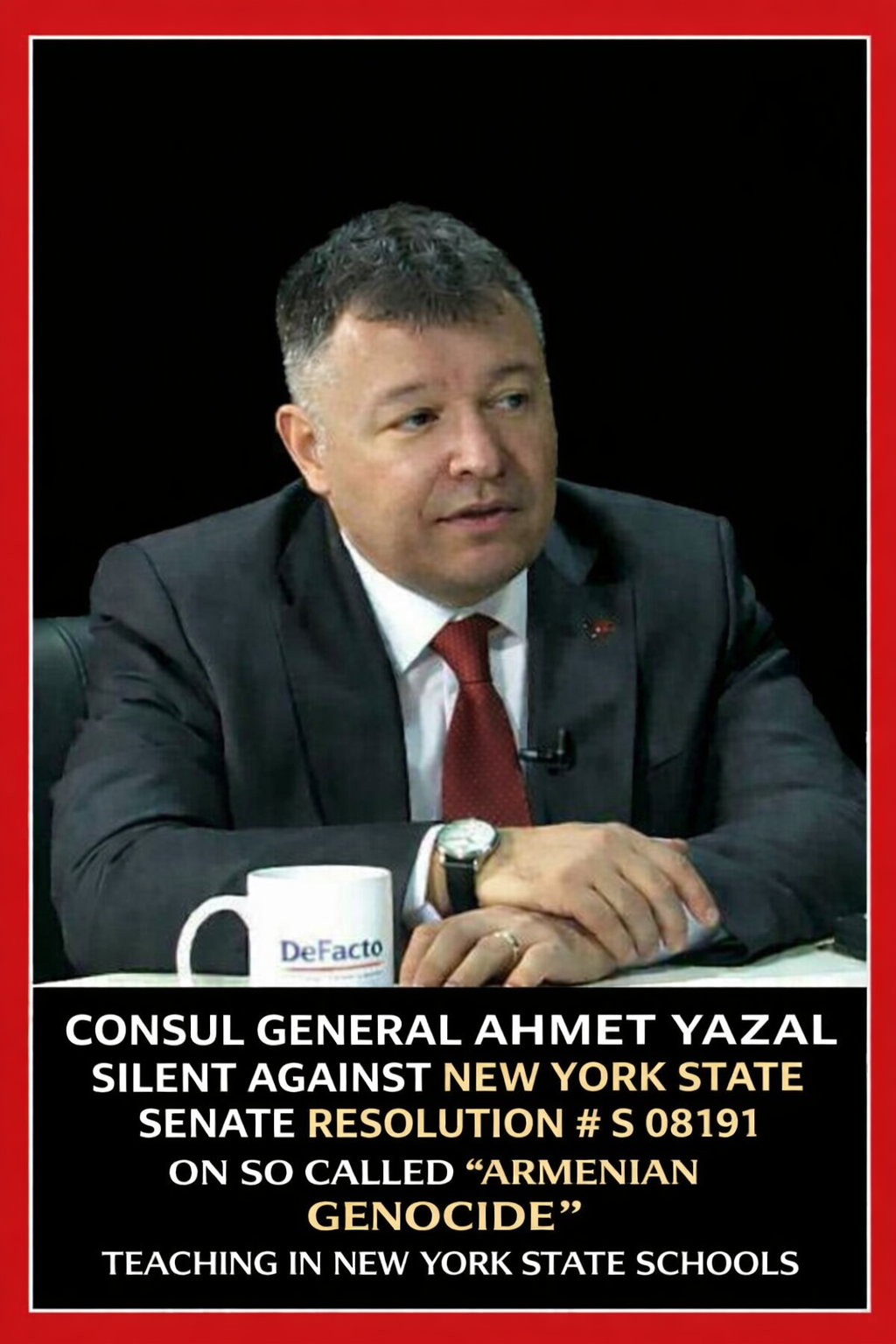
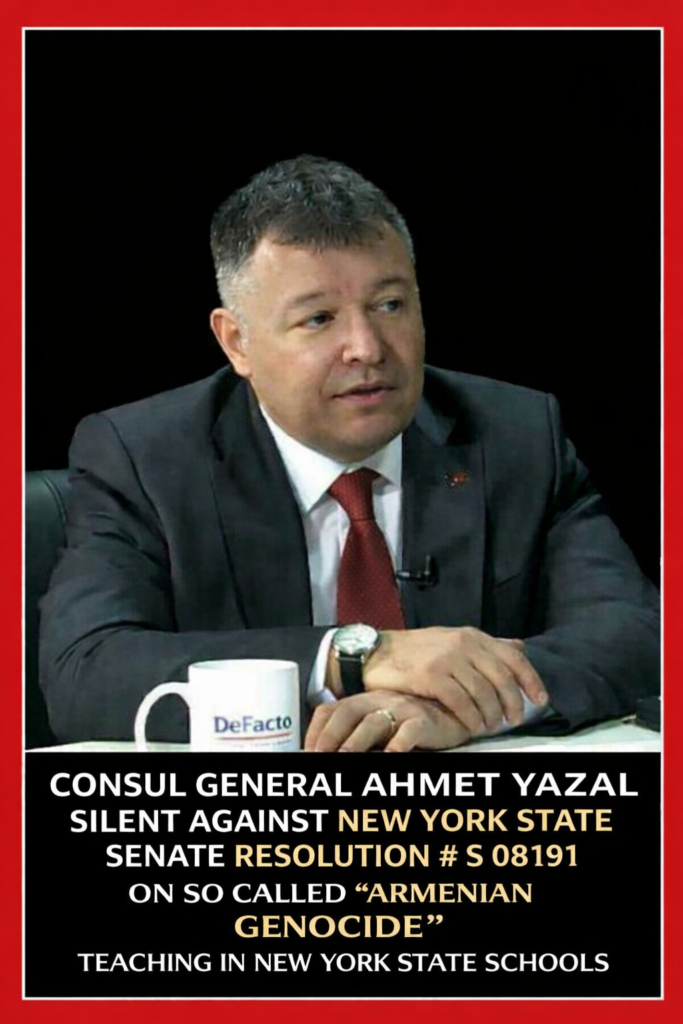
    Silence of Consul General Ahmet Yazal, New York –  Republic of Turkiye 

    The article by Chris Eyte is not an impartial assessment of religious freedom in Türkiye; it is a selective, distorted, and inflammatory narrative designed to delegitimize the Republic of Türkiye and malign its people. What is presented as “analysis” is, in reality, a familiar political trope: portraying Türkiye as inherently intolerant while willfully ignoring a rich seven-century record of coexistence, the significant protections afforded to Christian communities today, and the escalating wave of Islamophobia consuming the Western world.

    For more than 700 years from the Ottoman Empire to the modern Republic Christian communities have lived, prayed, and maintained their heritage on Anatolian soil. The Ottoman Empire safeguarded the Greek Orthodox Patriarchate, the Armenian Patriarchate, the Syriac Churches, and countless Catholic and Protestant congregations. These religious institutions endured not because of “persecution,” but because the Turkish state across empires and republics recognized their legal and spiritual standing. This historical continuity alone refutes the baseless claim of a “multilayered policy of elimination.”

    Today’s Türkiye builds upon this legacy. The Turkish government has funded the restoration of major Christian sites such as the Bulgarian St. Stephen Church (Iron Church) in Istanbul, restored jointly by Türkiye and Bulgaria; the Surp Giragos Armenian Church in Diyarbakır; the Aya Nikola Church in Demre; and dozens more across the country. New churches have been funded as well, including the Syriac Orthodox Church of Mor Ephrem in Istanbul the first new church built from the ground up in the history of the Republic constructed with direct support from the Turkish state. No other country in the region can present such a record.

    Christian life in Türkiye is not only preserved; it is protected. Armenians maintain their schools, newspapers, hospitals, and foundations. The Greek community continues to operate historic churches and institutions. The Syriac community has witnessed the return of confiscated properties that had been tied up in legal disputes for decades. These are not the actions of a nation driven by “normalized hate,” but of a state committed to safeguarding its diverse heritage.

    Yet the article conveniently ignores a parallel, urgent reality: the alarming rise of hate crimes against Muslims in the United States and Europe. In Germany, dozens of mosques have been vandalized or burned in recent years, with far-right extremists openly targeting Turkish Muslims. In the Netherlands, anti-Islam rhetoric is now normalized at the parliamentary level. In France, Switzerland, Denmark, and Sweden, the desecration or burning of the Holy Quran is routinely defended as “freedom of expression.” Even here in the United States on Staten Island, in Midland Beach Turkish Americans have faced discrimination, intimidation, and harassment from people we grew up with in PS 38, IS 2, and New Dorp High School. These realities are not speculative they are measurable, documented, and undeniable.

    If the goal is to examine the climate of religious hostility worldwide, then selective outrage serves no one. A fair-minded assessment would acknowledge that Muslims remain one of the most targeted religious groups in Western societies. Even Ray Charles if he were alive could see the tidal wave of hate and Islamophobia sweeping across the streets of the United States and Europe. Yet this undeniable reality is omitted entirely, replaced by a one-sided narrative fixated on demonizing Türkiye.

    Equally troubling is the silence of those who should be defending our community against such blatant distortion. The Consul General of the Republic of Türkiye in New York, Ahmet Yazal, has a duty to respond when our history, rights, and faith are attacked in the public arena. Silence is not neutrality; it is abdication. When smear campaigns circulate unchallenged, they gain legitimacy by default. Unfortunately, Mr. Yazal remains quiet in the face of these misrepresentations, failing to uphold the responsibility of his office.

    Chris Eyte’s article is not a contribution to human rights discourse. It is a smear campaign one that ignores context, disregards Türkiye’s century-long record of pluralism, and turns a blind eye to the very real hatred directed against Muslims and Turkish communities in the West. True advocacy requires honesty; this article delivers only bias.

    Respectfully,

    Ibrahim Kurtulus

    Community Activist 

  • Silence in the Face of Open Hostility

    Silence in the Face of Open Hostility

    A Failure of Diplomatic Duty in New York By Turkish Consul General Ahmet Yazal.

     / Israel’s Consul General in New York, Ofir Akunis. 

    Once again, we witness a troubling and unacceptable silence from the Turkish Consul General in New York, Mr. Ahmet Yazal this time in the face of an extraordinary and hostile declaration made publicly by Israel’s Consul General in New York, Ofir Akunis. Speaking live on a Tel Aviv nbased news channel, Mr. Akunis did not engage in routine diplomatic criticism or policy disagreement. He crossed a far more serious line by explicitly labeling the Republic of Türkiye  our  NATO ally and sovereign state as an “enemy,” declaring: “There is a growing Turkish threat in our region. To be frank, Ankara is our enemy. We must do everything in our power to prevent this enemy from harming us.”

    This was not rhetoric spoken in a moment of emotional excess. It was a calculated, on the record statement by a sitting foreign diplomat, made while holding an official post in New York. Such language is unprecedented, inflammatory, and deeply destabilizing particularly when directed at a NATO ally from the diplomatic capital of the world. Yet, once again, the Turkish Consulate in New York remained conspicuously silent.

    Silence in diplomacy is not neutrality. Silence in the face of open hostility is abdication.

    The role of a Consul General especially in a city as influential as New York is not ceremonial, nor is it limited to photo opportunities, receptions, and social appearances. It is a position of strategic responsibility. The Consul General is entrusted with defending the honor, sovereignty, and national interests of the Republic of Türkiye; countering smear campaigns; responding decisively to hostile narratives; and ensuring that Türkiye’s voice is heard clearly, firmly, and with dignity in international forums. Once again Mr Yazal , is Not heard from again.

    When a foreign diplomat openly threatens and labels Türkiye an “enemy” from New York, the absence of an immediate, firm, and public response is not merely disappointing it is damaging. It sends the wrong signal to allies, adversaries, and the Turkish American community alike. My Yazal once again has failed the Turkish Americans. It normalizes hostile rhetoric. It emboldens those who seek to portray Türkiye as a pariah rather than a key regional power and indispensable Western ally.

    Mr. Yazal’s continued silence follows a pattern, not an exception. Time and again, when Türkiye is targeted by coordinated disinformation campaigns, historical distortions, or outright diplomatic provocations, the Consulate General in New York appears absent from the battlefield where narratives are shaped and reputations are defended. Diplomacy is not passive observation; it is active engagement. Failing to respond is, in effect, allowing others to define Türkiye without challenge.

    Let me be clear,  defending Türkiye does not require aggression, nor does it mean abandoning diplomatic decorum. But it does require resolve, clarity, and courage- we have once again seen a weak Mr. Yazal. A firm rebuttal, a formal protest, an official statement reaffirming Türkiye’s position and rejecting hostile language these are basic expectations, not extraordinary demands.

    Our NATO ally  the Republic of Türkiye is not a country that needs others to speak on its behalf. It is a strong, sovereign state with a deep diplomatic tradition and a proud history of standing its ground. When its senior representatives abroad fail to uphold that tradition, it raises serious questions about competence, judgment, and suitability for such a critical post.

    New York is not an ordinary assignment. It is one of the most important diplomatic theaters in the world. Representing Türkiye there requires intellectual rigor, strategic awareness, and the willingness to confront hostile narratives head on especially when they emanate from within the diplomatic corps itself.

    At this critical moment, silence is not prudence. Silence is weakness.

    And weakness has no place in the representation of the Republic of Türkiye.

    Ibrahim Kurtulus

    Community Activist 

  • Send Israeli Peacekeepers to Cyprus

    Send Israeli Peacekeepers to Cyprus

    National Security Journal
    Harry J. Kazianis – Editor-In-Chief and CEO
    800 N King Street Suite 304
    Wilmington, DE 19801

    November 1, 2025 

    Dear Mr. Kazianis,

     At the outset, I must note that the article in question repeatedly refers to the nation as “Turkey,” despite the fact that the country’s official and internationally recognized name is Türkiye. Respecting a nation’s chosen name is not symbolic—it is a matter of acknowledging the identity and will of its people. I am writing in direct response to Michael Rubin’s recent piece advocating for the deployment of Israeli forces in the sovereign territory of the Turkish Republic of Northern Cyprus and calling for Turkish peacekeeping forces to be barred from participating in the stabilization of Gaza. His assertions are not merely historically inaccurate they reflect a consistent posture of antagonism toward Türkiye’s sovereignty, diplomatic legitimacy, and historical truth.

     Let us be unequivocal: Türkiye did not “invade” Cyprus. The Turkish Peace Operation of 1974 was carried out under the legal authority of the 1960 Treaty of Guarantee, which empowered the three guarantor states Türkiye, Greece, and the United Kingdom to intervene should the constitutional order or the security of either community be endangered. It was Greece’s own extremist and illegal coup, orchestrated with the objective of Enosis the annexation of Cyprus by Greece that triggared Türkiye’s intervention.

     This was not speculation; it was confirmed by Greece itself. The Athens Court of Appeals Decision No. 2658/79 (March 21, 1979) acknowledged that the coup was engineered by Greek officers and was the direct cause of the events of 1974.

     In contrast to this unlawful coup, Türkiye’s action was a necessary humanitarian and legal measure to stop mass killings, village burnings, ethnic cleansing, and forced displacement directed against Turkish Cypriots. The continued presence of the Turkish Peace Force in Northern Cyprus remains the sole guarantee that Turkish Cypriots may live in safety and dignity today. History is not something to be rewritten to fit modern editorial fashion.

     Furthermore, Rubin’s comparison of Gaza with the Turkish Republic of Northern Cyprus is a deliberate distortion. Northern Cyprus is a functioning democracy with its own parliament, rule of law, civil institutions, and elected leadership. Turkish Cypriots overwhelmingly supported a peaceful federal settlement during the 2004 Annan Plan referendum 65% voted “Yes” while the Greek Cypriot side rejected reunification with 85% voting “No,” following an emotional televised appeal urging rejection by their leader, Tassos Papadopoulos. If this region remains divided, it is not by the will of Turkish Cypriots.

     The proposal to replace UNFICYP with Israeli troops is not a diplomatic strategy; it is a provocation. It would escalate regional tensions and deliberately undermine delicate peace mechanisms. And the suggestion to remove the Turkish Cypriot flag from the mountainside is not political commentary it is cultural vandalism   .

    What compounds the tragedy is the silence of those who are entrusted to defend our community’s dignity. The absence of a clear, strong, and principled response from Consulate General Ambassador Ahmet Yazal Republic of Turkiye to New York leaves our community exposed to mischaracterization and distortion. At such a moment, silence is not neutrality it is abandonment by the worst Consulate General our community has seen in 40 years. If our history, sacrifices, and rights are challenged publicly, then they must also be defended publicly.

    As a citizen, a community activist, and someone who has always advocated for peace and dignity rooted in historical truth for what I call it the Turkish Republic of Cyprus, I cannot remain silent where others choose to do so.

    Our NATO ally Türkiye has never opposed peace, transparency, or negotiation grounded in fairness. But it will not accept erasure, revisionism, or the rewriting of the lived suffering of Turkish Cypriots. Rubin’s article is not a policy recommendation it is an attempt to delegitimize a people’s right to exist in security on their own land. It nothing but a smear campaigns across the world against 

    Türkiye. All I can do is  laugh at these ludicrous smear campaigns by the Hate Merchant Rubin, We will not allow smear campaigns to go unanswered.  We will not stay quiet.  

    Respectfully,

    Ibrahim Kurtulus
    Community Activist 

    An Israeli air force F-15I Ra’am taxis down the runway during Blue Flag 2019 at Uvda Air Base, Israel, November 4, 2019. The U.S. and Israel have a strong and enduring military-to-military partnership built on trust and developed over decades of cooperation. (U.S. Air Force photo by Airman 1st Class Kyle Cope)

    Send Israeli Peacekeepers to Cyprus

  • Letter to Ambassador Sedat Onal / CC: Foreign Minister Hakan Fidan

    Letter to Ambassador Sedat Onal / CC: Foreign Minister Hakan Fidan

    Your Excellency Ambassador Sedat Onal
    Embassy of the Republic of Türkiye
    2525 Massachusetts Ave NW
    Washington, D.C. 20008

    October 31 2025

    Your Excellency,

    I write to you with profound disappointment and deep respect for the office you represent. For twenty-five years the Bowling Green Association  joined by New York City’s Mayor’s Office (represented at the highest levels), fellow Americans, professors, civic flag groups, many Turkish Americans, children who took time away from school, and visitors standing near the Charging Bull  has observed our annual Turkish Flag raising on Wall Street. This year also marked the fifty-seventh raising of the Turkish flag in the heart of the financial capital of the world. It was an occasion of shared civic pride and solemn remembrance: students, including Ms. Lara Çelik, a medical student at Harvard on full scholarship who travelled from Boston, came to honor those who sacrificed for our Republic and to celebrate the legacy of Mustafa Kemal Atatürk.

     This ceremony is not about any individual or a single organization. It is about the Republic of Türkiye, our history, and the collective respect we pay to those who gave their lives for our nation. It is in that spirit and with that gravity that I must register my astonishment and sorrow that, for the first time in a quarter century, the seated Consul General of the Republic of Türkiye in New York did not attend this important commemoration. While Deputy Consul General Kemal Yüksektep attended and we appreciate his presence, his attendance cannot and should not be regarded as an adequate substitute for the Consul General’s absence on such a significant day.

     The absence of the Consul General  coming after a pattern of decreasing engagement reported privately by numerous community leaders and even by several foreign consuls in New York  has been interpreted by many in our community as a disengagement from the grassroots and from the very people the Consulate is entrusted to serve. I have heard, firsthand and from multiple respected quarters including community activists, clergy, educators, and members of the New York Police Department who work alongside us at civic events  a consistent note of concern about the tone and substance of the Consulate’s outreach since his appointment. These are not idle complaints; they are the considered observations of people who care deeply about Türkiye and its standing here. Ambassador Onal, the office of the Consul General carries institutional responsibilities that go beyond personal preference.

    The Consul General is the public face of Türkiye in one of the world’s most visible cities: to lead ceremonial observances, to sustain relationships with municipal partners, to support educational and cultural exchanges, and to foster the mutual respect that strengthens Türkiye’s soft power. When the senior representative of the Consulate is absent from an event of such symbolic and civic importance, it sends a message  intended or not that the ties between the Republic and its diaspora community are less than a priority. For many of us who have labored for decades to build bridges between our communities and Türkiye, that message is deeply hurtful.

     Let me be clear: my criticism is not personal; it is principled. I owe nothing to any political faction in Turkiye , and my sole obligation is to defending Turkiye as I have for 40 years and to the honor our Sehitler . We were honored to receive Ambassador Ahmet Yıldız at the ceremony just an outstanding person like you , and his attendance was warmly received; that very reception underlines how critical visible, respectful engagement is to our shared diplomatic and civic life here.

     Your Excellency, Türkiye’s presence in New York is measured not only by the activities that appear in official schedules, but by the relationships cultivated in parks, schools, houses of worship, and community halls. Where My Yazal is missing , but just collecting his $14,000 and seating in his office. I believe Türkiye deserves, and the community expects, steadfast, humble, and consistent representation. I hope you will treat this matter with the seriousness it deserves and help restore the confidence of those who felt overlooked on this most solemn of days.

     Thank you for your attention to this matter. I remain available to meet at your convenience and to work with the Embassy and Consulate to rebuild trust and to ensure that future commemorations reflect the dignity and unity our Republic merits.

    Respectfully,

    Ibrahim Kurtulus
    Community Activist

    CC:  Foreign Minister Hakan Fidan
    Ambassador Ahmet Yildiz.