Month: November 2009

  • Turkey steps up Fergie inquiry

    Turkey steps up Fergie inquiry

    Published Date: 21 November 2009

    TURKISH officials have stepped up their campaign to prosecute the Duchess of York for her role in a documentary filmed undercover in their country.

    Sarah Ferguson

    Sarah Ferguson’s lawyers have been served by police with a request from Turkey for information from her. She has been accused of violating the privacy of disabled children after she appeared in a programme that exposed harsh conditions in state-run orphanages.

    A police spokesman said: “A request for international legal assistance has been received. The legality of the request has been agreed.”

    The Scotsman

  • Racist Terrorism on rise, Businessman bankrolls ‘street army’

    Racist Terrorism on rise, Businessman bankrolls ‘street army’

    By Nick Lowles

    A middle-age, respectable looking man has emerged as a key figure behind the English Defence League. Alan Lake, a 45-year-old businessman from Highgate, North London, sees the EDL as a potential “street army” willing to be deployed against what they claim is rising Islamisation of modern Britain.

    EDL-Birmingham

    Lake, who claims to have made money through computers, runs a series of intranet services for far-right groups across the world. Addressing an anti-Islam conference in Sweden last month, organised by the far-right Swedish Democrats, he told delegates it was necessary to build an anti-Jihad movement. He spoke of the need for “people that are ready to go out in the street” and boasted that he and his friends had already begun to build alliances with “football supporters”.

    “We are catching a baby at the start of a gestation,” Lake later told The Guardian. “We have a problem with numbers. We have an army of bloggers [on the far right] but that’s not going to get things done.

    “Football fans are a potential source of support. They are a hoi polloi that gets off their backsides and travels to a city and they are available before and after matches.”

    In addition to funding materials and publicity, Lake has established a website that he hopes will become a clearing house for the EDL and like-minded organisations. He says that people in the movement must choose their roles. Some can debate on forums, some can be experts on the Koran. He is, however, quick to distance himself from fascist organisations and one of his only demands of the EDL in return for his funding is that it distances itself from groups such as the British National Party.

    Indeed, Lake appears to want to build alliances with all groups who might fall foul of the strict Islamic code, including lesbian and gay organisations, other religions and ethnic groups and supporters of free speech.

    Lake wants the message to be short and easy. At the Swedish conference he announced a manifesto based on four freedoms: free speech, democracy, equality in law and cultural tolerance, with no exemptions for any ideology or religion.

    He also stressed the urgency of the issue, claiming that within 40 years Muslims would be in the majority.

    Lake’s offer to finance the EDL appeals to the Luton division, who remain at the EDL’s core. What began as a local reaction to the protest by a handful of Islamic extremists at a parade by the Royal Anglian Regiment in March has mushroomed into a national network that has increasingly been under the media spotlight due to several clashes in cities around the country.

    Violence has already occurred in Luton, Birmingham and Harrow and further EDL events are planned for Manchester, Leeds, Swansea and Glasgow.

    The EDL is run by 15 key people across the country who co-ordinate activists via email and social networking sites, such as Facebook. The group lacks a coherent message or vision, and even within its core, the EDL means different things to different people. Indeed, none of the 15 so-called leaders appears to have actually met all the others.

    The EDL seems to have become an umbrella name for a number of existing anti-Islam groups, such as the Birmingham-based British Citizens Against Muslim Extremists, the Welsh Defence League and March for England.

    While the group will claim to be open to anyone it remains centred around the football hooligan network and in particular gains support from the football gangs of Luton, Aston Villa, QPR, Southampton, Bristol Rovers, West Bromwich Albion and Wolves.

    It has become apparent that some in Luton EDL have become uneasy over being linked to the BNP and far-right politics. For some this is a genuine aversion, while others might have been persuaded of this by Lake, who appears acutely aware of its negative impact on the group.

    However, it is also clear that some other EDL leaders, in different parts of the country, have no problem with being linked to rightwing groups. The newly formed Scottish Defence League has known fascists at its core, while the Swansea Division shares many of its followers with the Swansea Jack hooligan group, which in turn supplies activists to the local BNP.

    At the EDL protest in Birmingham fascists and rightwing extremists were clearly visible, some happily giving Nazi salutes. They included Chris Renton, a BNP supporter from Weston-super-Mare, who runs their website.

    As publicity about the EDL continues, the group is likely to grow across the country. New units will form and new activists will take to the streets. Whatever Lake’s wishes it is unlikely that he will be able to direct EDL philosophy and actions too tightly. By its very nature and its core activity – taking to the streets – the EDL will attract people not averse to violence, particularly around the football hooligan network, and hardcore racists keen to use the group to spread racial hatred.

    Hope Not Hate

  • EU president: Herman Van Rompuy opposes Turkey joining

    EU president: Herman Van Rompuy opposes Turkey joining

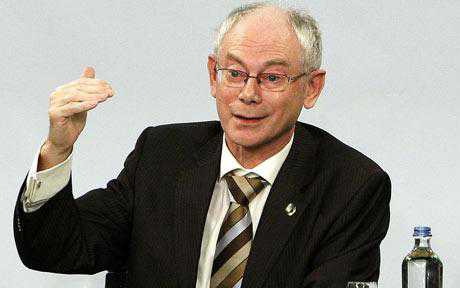
    The poetry-loving favourite to become the first president of Europe, Herman Van Rompuy, is also a hard-line opponent of Turkey’s bid to join the European Union because it is an Islamic country.

    Herman Van Rompuy

    Herman Van Rompuy, Belgium’s Prime Minister, has in the past spoken out against Turkish EU membership because, he warned, it would dilute Europe’s Christian heritage.

    His position on the issue is so strong that he has won the support of Vlaams Belang, the controversial far-right Flemishh anti-immigrant party in Belgium.

    Speaking five years ago, as an opposition politician, Mr Rompuy, a Christian Democrat, argued that Muslim Turkey could not be considered a candidate for EU membership.

    “Turkey is not a part of Europe and will never be part of Europe. An expansion of the EU to include Turkey cannot be considered as just another expansion as in the past,” he said.

    “The universal values which are in force in Europe, and which are fundamental values of Christianity, will loose vigour with the entry of a large Islamic country such as Turkey.”

    Filip Dewinter, a Vlaams Belang leader, said: “We are entirely in agreement with Van Rompuy over this question and are convinced he will defend this point of view as President of the EU. It is for this reason we openly support him.”

    Mr Van Rompuy’s opposition to Turkey is set to cement British and East European opposition to him during Thursday’s summit dinner to appoint a President and Eu foreign minister.

    The Telegraph

  • Turkish police catch sex attacker

    Turkish police catch sex attacker

    A Plymouth landlord who went on the run after he sexually assaulted two vulnerable teenage tenants has been arrested in Turkey.

    Alfred Palmer

    Alfred Palmer, 52, owner of letting agency Palmer and Co, was first arrested in 2005 for a number of sexual offences dating back to the mid 1980s.

    In 2006 he fled abroad with partner Daniel Tapper, 53.

    Palmer was jailed for five years and Tapper, a director of the agency, for three years, in their absence in 2007.

    The arrests follow an appeal on the BBC’s Crimewatch programme which led to sightings of the pair in Turkey.

    Sold houses

    Palmer will now appear in court in Turkey to face an extradition ordering bringing him back to the UK to start his jail sentence.

    The first trial in 2006 heard how Palmer abused two teenage boys just out of social services care.

    Palmer even threw one out of his flat and threatened to have him beaten up after he repeatedly refused Palmer’s sexual advances.

    The trial was halted when police admitted both men had “left the force area to evade arrest and prosecution”.

    At the trial in the absence of the pair in 2007, Palmer was convicted of four counts of indecent assault and Tapper of one indecent assault.

    In February 2009 an appeal on Crimewatch led to sightings of the pair among the expat community in Turkey.

    Investigators found the pair had taken £300,000 with them after selling two houses and their cars.

    An arrest warrant was issued in September 2009.

    Investigating officer Det Con Sarah Lovatt told BBC News she was “thrilled” at the arrest of Palmer by Turkish police and predicted that the arrest of Tapper was “only a matter of time”.

    She said: “It will bring closure to the victims.

    “They are still struggling with what happened to them all those years ago.”

    BBC

  • Soldiers of Fortune

    Soldiers of Fortune

    How the Israeli Army became the most prolific innovation engine on earth.

    Johnathan Torgovnik for Newsweek
    Soldier/Civilian: Israeli innovation benefits from the mix.
    By Dan Senor and Saul Singer | NEWSWEEK
    Published Nov 14, 2009
    From the magazine issue dated Nov 23, 2009
    How does Israel—with fewer people than the state of New Jersey, no natural resources, and hostile nations all around—produce more tech companies listed on the NASDAQ than all of Europe, Japan, South Korea, India, and China combined? How does Israel attract, per person, 30 times as much venture capital as Europe and more than twice the flow to American companies? How does it produce, for its size, the most cutting-edge technology startups in the world?
    There are many components to the answer, but one of the most central and surprising is the Israeli military’s role in breaking down hierarchies and—serendipitously—becoming a boot camp for new tech entrepreneurs.
    While students in other countries are preoccupied with deciding which college to attend, Israeli high-school seniors are readying themselves for military service—three years for men, two for women—and jockeying to be chosen by elite units in the Israeli military, known as the Israel Defense Forces, or IDF.
    As selective as the top Israeli universities are, certain commando, intelligence, Air Force, and high-tech IDF units are even more so. The prestige of these units makes them the national equivalent of Harvard, Stanford, and MIT for the Israeli tech world. Even outside the elite units, the military experience of Israeli job applicants tells prospective employers what kind of selection process they navigated, and what skills and relevant experience they may already possess.
    For Americans, the idea that military service can be great training for business is surprising. “Innovation” is hardly the first word most people associate with the military. “Improvisation” is even less likely to come to mind. And “flat”—as in anti-hierarchical and informal—would be completely counterintuitive. Yet these are exactly the attributes that employers have come to expect from young people emerging from their stint in the IDF.
    Talk to an Israeli Air Force pilot and you will see why. “If most air forces are designed like a Formula One race car, the Israeli Air Force is a beat-up jeep with a lot of tools in it,” one pilot told us. A U.S. Air Force “strike package” often consists of four waves of specialized aircraft: a combat air patrol to clear a corridor of enemy aircraft; a second wave to suppress enemy antiaircraft systems; a third wave of electronic-warfare aircraft, refueling tankers, and radar aircraft; and, finally, the strikers themselves—planes with bombs. In the Israeli system, almost every aircraft is a jack-of-all-trades. “You do it yourself,” one pilot noted. “It’s not as effective, but it’s a hell of a lot more flexible.”
    The Israeli business culture’s emphasis on multidisciplinary skills—on everyone being able to operate in many sectors—rather than an intense and narrow focus in one area flows directly from the military culture. It also produces mashups: the combination of radically different technologies and disciplines.
    Given Imaging, for example, is the Israeli startup behind the PillCam. The company’s founders took the miniaturized sensing systems from the nose cones of fighter jets to create a swallowable camera. The PillCam weighs 4 grams, and can beam a movie from inside a patient’s intestine out to a doctor’s monitor in the same room or across the globe. This is making some highly invasive and painful diagnostic surgeries all but obsolete. Given Imaging, listed on the NASDAQ, was the first company to go public after September 11, 2001.
    The three founders of biotech mashup Compugen—president Eli Mintz, chief technology officer Simchon Faigler, and software chief Amir Natan—met in the IDF. Twenty-five of the 60 mathematicians in the company joined through the founders’ network of Army contacts. While still in the Army, Mintz created algorithms for sifting through reams of intelligence data to find the nuggets that have been so critical to Israel’s successes in hunting terrorist networks. When his wife, a geneticist, described the problems they had in analyzing enormous collections of genetic data, Mintz and his partners sought to revolutionize the process of genetic sequencing.
    The American corporate giant Merck bought Compugen’s first sequencer in 1994, a year after the startup was founded and long before the human genome had been successfully mapped.
    The IDF also offers recruits another valuable experience: a unique space within Israeli society where young men and women work closely and intensely with peers from different cultural, socioeconomic, and religious backgrounds. A young Jew from Ethiopia, the son of an Iranian immigrant, a native-born Israeli from a swanky Tel Aviv suburb, and a kibbutznik from a farming family might all meet in the same unit. They’ll spend two to three years serving together full time, and then spend another 20-plus years of annual service in the reserves.
    Not surprisingly, many business connections are made during the long hours of operations, guard duty, and training. This gives young Israelis a tight-knit network with global reach. Two out of three Israelis are immigrants or the children of immigrants. The military is much better than college for inculcating young leaders with a sense of social range.
    But the military can also do something much more counterintuitive: it breaks down hierarchies. Normally, when one thinks of military culture, what comes to mind is unwavering obedience to superiors. But the IDF doesn’t fit that description. One way that the IDF exhibits a flat, non-hierarchical culture—more like a startup than a large corporation—is that it works to drill responsibility down to lower levels. “The IDF is deliberately understaffed at senior levels. It means that there are fewer senior officers to issue commands,” says Edward Luttwak, a military historian. “Fewer senior officials means more individual initiative at the lower ranks.”
    In the reserves, which are the backbone of the Israeli military in time of war, this flatness and dispersion of responsibility is most pronounced. Hierarchy is naturally diminished when taxi drivers can command millionaires and 23-year-olds can train their uncles. This helps to reinforce that chaotic, anti-hierarchical ethos that can be found in Israeli society, from war room to classroom to boardroom.
    It creates an openness to challenging, debating, and probing—even of one’s superiors—that permeates the Israeli startup scene; it helps produce unconventional solutions to tough business problems. Nati Ron is a lawyer in his civilian life and a lieutenant colonel who commands an Army unit in the reserves. “Rank is almost meaningless in the reserves,” he says. “A private will tell a general in an exercise, ‘You are doing this wrong; you should do it this way.’ “
    This is not to say that soldiers aren’t expected to obey orders. But, as Amos Goren, a venture-capital investor with Apax Partners in Tel Aviv and a veteran Israeli commando, says, “Israeli soldiers are not defined by rank; they are defined by what they are good at.”
    Innovation often depends on having a different perspective. Perspective comes from experience. Real experience also typically comes with age or maturity. But in Israel, you get experience, perspective, and maturity at a younger age, because the society jams in so many transformative experiences when its citizens are 18 to 21 years old. By the time they get to college, their heads are in a different place than those of their American counterparts.
    According to the Organization for Economic Cooperation and Development, 45 percent of Israelis are university-educated, which is among the highest percentages in the world. But is it really the university, or is it the fact that Israel is the only country where most university students have also had a crucible leadership experience before they even begin their post-secondary education? Or perhaps it’s that Israel’s university students get so much more out of the college classroom because—unlike American students—by the time they go to campus they are far more mature and grounded. By their early 20s, they know the true meaning of “life and death,” and—as one Israeli general told us—the “value of five minutes” when having to make high-stakes decisions in the fog of ambiguity. That’s a skill that’s just as valuable on the corporate battlefield as on a real one.

    Adapted from the book Start-Up Nation by Dan Senor and Saul Singer. Copyright © 2009 by Dan Senor and Saul Singer. Reprinted by permission of Twelve, a Division of Hachette Book Group, New York, N.Y. All rights reserved.

    __._,_.___

    __,_._,___

  • Turkish-Armenian Talks ‘Over For Now’

    Turkish-Armenian Talks ‘Over For Now’

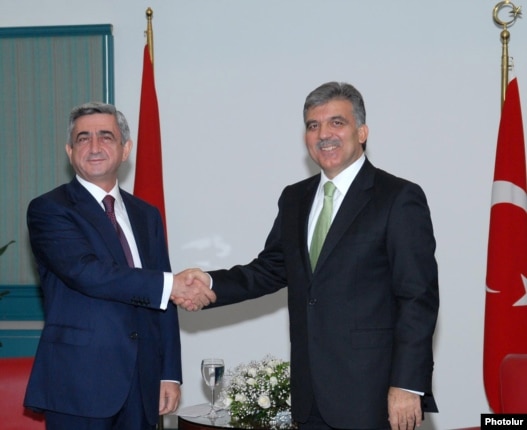
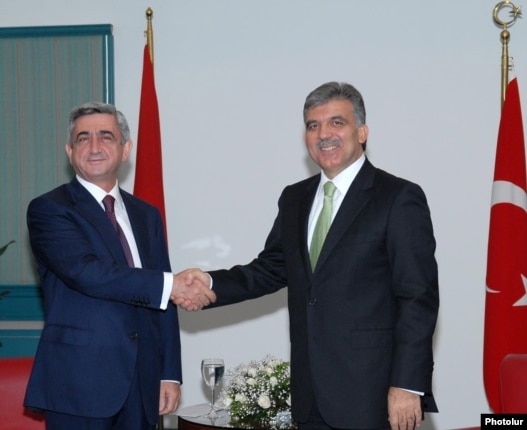
    Turkey – President Abdullah Gul greets his Armenian counterpart Serzh Sarkisian in Bursa, Turkey, 14Oct2009
    18.11.2009
    Tigran Avetisian

    Armenia and Turkey will hold no further major negotiations until the ratification of their recently signed agreements by their parliaments, the Armenian Foreign Ministry said on Wednesday.

    “No Turkish-Armenian negotiations are being held right now,” ministry spokesman Tigran Balayan told RFE/RL. “We are now waiting for the ratification. Each country has its own ratification procedures.”

    The Turkish and Armenian governments signed the two protocols envisaging the normalization of their relations in Zurich last month after more than a year of intensive negotiations mediated by the United States and Switzerland. They can not enter into force before being endorsed by the parliaments of both countries.

    “According to the timetable attached to the protocols, the next step is the ratification,” said Balayan.

    The deal sets no time frames for completing the ratification process. Armenia as well as the U.S. and other major foreign powers have expressed hope that that will be done within a “reasonable” period of time.

    However, Turkish leaders have made clear that Turkey’s parliament is unlikely to ratify the agreements without a breakthrough in international efforts to resolve the Nagorno-Karabakh conflict. Foreign Minister Ahmet Davutoglu on Tuesday again stressed the importance of a Karabakh settlement for Turkish-Armenian reconciliation.

    “Official Ankara attaches huge importance to preserving Azerbaijan’s territorial integrity,” the Anatolia news agency quoted him as saying. Davutoglu also opined that the Turkish-Armenian protocols could “pave the way for the liberation of Azerbaijani territories.”

    Davutoglu’s Armenian counterpart Eduard Nalbandian, meanwhile, again rejected on Wednesday any linkage between Karabakh peace and the Turkish-Armenian normalization. “The Turks may make such attempts but who is going to let them link the two issues?” he said during a question-and-answer session in the Armenian parliament. “Neither Armenia, nor Karabakh or the international community.”

    Nalbandian also assured Armenian lawmakers that Turkey will not assume any mediating role in the Armenian-Azerbaijani peace talks. “Turkey’s becoming the fourth co-chair [of the OSCE Minsk Group] is out of question because at least Armenia and Karabakh would have to agree to that,” he said, adding that the U.S., Russia and France are of the same opinion.

    https://www.azatutyun.am/a/1881710.html