Month: September 2009

  • Turkish Press Reacts to Turkish-Armenian Normalization

    Turkish Press Reacts to Turkish-Armenian Normalization

    Turkish Press Reacts to Turkish-Armenian Normalization

    Publication: Eurasia Daily Monitor Volume: 6 Issue: 163
    September 8, 2009
    By: Saban Kardas
     
    On August 31 a joint statement issued by Turkey and Armenia announced that both had agreed to start talks on the establishment of diplomatic ties and the development of bilateral relations. The parties initialed two protocols to regulate these issues, and the consultations on these will be finalized within six weeks before being forwarded to their national parliaments for ratification (www.mfa.gov.tr, August 31). The announcement generated a heated debate on the future of Turkish-Armenian relations as well as its implications for Azerbaijan and the involvement of other international actors.

    The content of the protocols show that the parties built on the progress they had achieved by April, which was interrupted by Prime Minister Recep Tayyip Erdogan’s intervention to allay the concerns of Azerbaijan. Following intense bilateral contacts, secret diplomacy and pressure from the United States and European countries, Turkey and Armenia announced a roadmap for normalization in April, the contents of which remained undisclosed. Due to mounting domestic opposition and protests from Azerbaijan, Erdogan reiterated unequivocally that the progress of Turkish-Armenian relations would be contingent upon Armenia’s constructive attitude in its dispute with Azerbaijan. To relieve Azeri concerns, Erdogan emphasized that Turkey would not proceed with normalization, without an end to the Armenian occupation of Karabakh (EDM, May 14). Although there were concerns that the normalization process might have come to a premature end, the parties maintained their secret dialogue facilitated by Switzerland (EDM, June 30).

    By reiterating their commitment to the peaceful resolution of regional disputes, the parties implicitly recognize the Karabakh issue, but the protocols make no mention of it, nor set it as a precondition for opening the Turkish-Armenian border. In taking this step despite this “missing element,” the Turkish government again raised concerns as to whether it might accelerate the rapprochement with Armenia by decoupling it from the Karabakh issue. Consequently, opposition both domestically and in Azerbaijan expressed discomfort with these developments. In response, Erdogan reconnected the two processes politically, by arguing that the ratification of the protocols would depend on the resolution of Karabakh issue, reflecting Ankara’s concern to keep Baku on board (Vatan, September 2).

    The leverage Azerbaijan exerts over Turkish foreign policy led to different interpretations from the Turkish press. The nationalist media continued to express their unconditional support for Azerbaijan’s position and criticized the government’s recent initiatives (Ortadogu, September 3)

    Many mainstream commentators, however, maintain that returning to the status quo ante might be difficult, and that instead of seeking to restore Karabakh through military means, Baku should focus on diplomatic measures to free the occupied Azeri territories, and in return grant greater autonomy to the area and open a corridor between Armenia and Karabakh (Milliyet, September 3). Although Erdogan might ideally prefer a maximalist position on the return of Karabakh, other actors within the Turkish government also seem to be ready to settle for such an arrangement recognizing the new reality in the region. In fact, Foreign Minister Ahmet Davutoglu and President Abdullah Gul are interested in seeing the process through and opening the border by the end of the year (Radikal, September 2), despite Erdogan’s occasional nationalistic outbursts.

    Other commentators view the rapprochement as a partly American project and believe that both Turkey and Azerbaijan are urged, if not pressured, by the Obama administration to solve their problems with Armenia. They even suggest that the mediation services provided by Swiss diplomats might only represent a cover for American facilitation between the Turkish and Armenian delegations, which is partly shared by the opposition parties, mainly the Republican People’s Party (Milliyet, September 4; Hurriyet, September 2). The pro-government press, in contrast, challenges these arguments and maintains that searching for foreign actors behind such initiatives reflects a problematic attitude on the part of the Turkish opposition. It presents these recent developments as an achievement of the AKP government and treats them as affirmation of Turkey’s expanding role in regional diplomacy (Star, September 4).

    Explaining the normalization with reference to the involvement of outside actors inevitably raises questions about the motivations of “outsiders.” At this juncture, the role of energy issues is emphasized by the Turkish media. There is a perception that the process is promoted by the West as part of its energy policies. They speculate that Turkish-Armenian normalization is promoted in order that Armenia might emerge as an alternative route to Georgia for the future transportation of Caspian basin resources (Milliyet, September 3).

    Such analyses inevitably ignore the issue of the Russian position. There is already a process underway between Azerbaijan and Armenia toward the resolution of the Karabakh dispute, facilitated by Russia and supported by the United States. Although the Russian side claims that it is playing a constructive role, the Turkish media maintains some skepticism toward Moscow’s intentions. There are media reports maintaining that Russian intelligence found out about the secret talks between Ankara and Yerevan and passed this information to Azerbaijan’s President Ilham Aliyev, which led him to distance himself from Turkey in April (Milliyet, September 3). If such reports are correct, they might indicate Russian efforts to sow seeds of distrust between Baku and Ankara, and undermine policies to integrate Yerevan into a Western orbit.

    It is unclear whether Aliyev was aware in advance of the signing of the recent protocols, but Ankara apparently made efforts to inform Baku. Indeed, it has been a growing concern for Ankara to comfort Baku about the secret talks with Yerevan, and regain Azeri confidence since the bitter episode in April. A few days before the recent announcement to sign the protocols, Erdogan spoke to Aliyev on the telephone and sent two special envoys to Baku to brief him on the progress in Turkish-Armenian talks (Zaman, August 28). Azerbaijan’s Ambassador in Ankara Zakir Hashimov said that Davutoglu reassured his Azeri counterpart that the border would not be opened before the resolution of the Karabakh issue (Hurriyet Daily News, September 6).

    In the days ahead, a new domestic and foreign policy challenge will confront the AKP government, as it seeks to refine the details of the normalization with Armenia. A breakthrough in Azeri-Armenian talks might untie the knot, but it remains to be seen whether the international and regional pressures on Baku and Yerevan will produce such an outcome.
    https://jamestown.org/program/turkish-press-reacts-to-turkish-armenian-normalization/
  • Azerbaijan and Turkey Protect  Armenia’s National Interest Inadvertently

    Azerbaijan and Turkey Protect Armenia’s National Interest Inadvertently

    Publisher, The California Courier

    After reviewing hundreds of articles in regional and international media outlets and scores of statements by various officials regarding the Protocols between Armenia and Turkey, it is clear that these agreements will not be ratified by the Turkish Parliament, unless the Armenian government first makes concessions on Karabagh (Artsakh).

    As expected, there was great agitation against the Protocols last week among opposition political parties in both Armenia and Turkey. Furthermore, some Azeri officials and analysts criticized Turkish leaders for appearing to go back on their repeated promises of not opening Turkey’s border with Armenia until the Karabagh conflict was resolved.

    On April 22nd, when Armenia and Turkey made public a “Roadmap” to regulate their contentious relations and open their mutual border, Azerbaijan strongly objected, threatening to retaliate against Turkey by taking a number of steps, including cutting off oil supplies. Turkish leaders immediately stopped the implementation of the “Roadmap” in order to appease their “Junior brother,” Azerbaijan. Turkish officials repeatedly announced that they would not open their country’s border with Armenia, unless the Karabagh conflict was settled to the satisfaction of Azerbaijan. Prime Minister Erdogan felt obligated to fly to Baku in May to make the same pledge in his address to the Azeri Parliament.

    But as international pressure mounted on both Armenia and Turkey to go forward with the frozen “Roadmap,” Turkish leaders were careful not to alienate Azerbaijan once again. This time around, they fully briefed Pres. Aliyev during every step of their discussions with Armenia, repeatedly assuring Azerbaijan that its interests would be protected and that nothing would be agreed upon with Armenia, unless the Karabagh conflict was first settled. Just before the two Protocols were announced on August 31, Prime Minister Erdogan briefed Pres. Aliyev by telephone and a high-level Turkish delegation flew to Baku for follow-up talks.

    A close reading of the lengthy text of the professionally crafted two Protocols and the appended Timetable indicates that the most critical detail – the date of their expected ratification – is left out! The documents spell out in great precision the terms of the agreements as well as the specific deadline for each of “the steps to be undertaken.” For example, they state that as of August 31, Armenia and Turkey have six weeks to complete “internal political consultations” before the Protocols are submitted to their respective Parliaments for ratification. The documents also specify the exact timeline for the opening of the border and the formation of various committees.

    However, all of these steps are contingent upon the crucial prerequisite of ratification of the Protocols by the two Parliaments, for which no date and no deadline is mandated. The joint announcement issued on August 31 by Armenia and Turkey, simply calls on both sides to “make their best efforts” for the “timely” ratification of the Protocols. The missing deadline is certainly not the result of an oversight!

    After securing Armenian officials’ agreement to Turkey’s two preconditions – the formation of a “historical” committee and recognizing its territorial integrity – Ankara found a clever solution for its third precondition. It made the opening of the border with Armenia contingent upon the resolution of the Artsakh conflict, without including a direct reference to this requirement in the Protocols.

    Since the ratification of the proposed agreement by the two Parliaments does not have a particular deadline, the Turkish government will probably apply its extensive diplomatic resources to pressure Armenia – via the OSCE Minsk Group of mediators on Artsakh, composed of France, Russia and the United States – into making concessions acceptable to Azerbaijan.

    Turkey could therefore be expected to delay the ratification of the Protocols by its Parliament until Azerbaijan’s conditions are met on Artsakh. In recent days, several Turkish commentators pointed out this gaping loophole in the Protocols, boasting that Turkey would not open its border until Armenia makes territorial concessions on Artsakh. Turkey’s Foreign Minister Ahmet Davutoglu made that same pledge practically on a daily basis since the August 31 announcement. Interestingly, Pres. Aliyev has not said one critical word about this agreement which calls for the opening of the border with Armenia – something he vehemently opposes. The reason is that he is assured by Ankara that nothing of that sort would take place until Artsakh is delivered to him on a silver platter!

    Armenia’s President and Foreign Minister, on the other hand, have been repeatedly stating that they would not accept any linkage between the Artsakh negotiations and the opening of the Turkish border. In order to preserve their own credibility and safeguard the country’s national interests, Armenia’s leaders should not make even the smallest concession on Artsakh and not ratify these Protocols, until the Turkish Parliament ratifies them first. But, since Turkey refuses to ratify them without the settlement of the Artsakh conflict, the whole agreement would collapse and the international community would then hold Turkey solely responsible for its failure!

  • ARMENIAN ASSEMBLY DISCUSSES ARMENIAN GENOCIDE

    ARMENIAN ASSEMBLY DISCUSSES ARMENIAN GENOCIDE

    September 3, 2009, 8:14 pm
    AT UNIVERSITY OF CALIFORNIA, SAN DIEGO

    San Diego, CA –  As part of the Armenian Assembly of America’s (Assembly) ongoing educational outreach regarding the Armenian Genocide, Assembly Western Region Director Yeghig Keshishian spoke to a class of freshman students at the University of California, San Diego (UCSD). Keshishian addressed the students at the request of Professor Fonna Forman-Barzilai who teaches the course, “Becoming Evil: How Ordinary People Commit Genocide and Mass Killing.” The course explores the psychological, cultural and social constructions surrounding the genocides of the 20th century. Professor Forman-Barzilai, is a faculty member at the Political Science Department and was an honored guest speaker at the 2009 April 24th Armenian Genocide Commemorative Vigil in San Diego.

    Keshishian discussed the genocide of minorities, such as the Armenians in the Ottoman Empire, and provided the students with an overview of the history of the Armenian Genocide in the context of James Waller’s book about perpetrators, titled: Becoming Evil: How Ordinary People Commit Genocide and Mass Killing. Keshishian also discussed Turkey’s ongoing campaign of genocide denial and how it plays out in the United States.

    “I appreciated this unique opportunity to discuss the Armenian Genocide with college students,” stated Keshishian, adding that “The Assembly appreciates Professor Forman-Barzalia’s commitment to apprise students of past genocides and for her commitment to education as an important medium for its humanizing effect on our collective humanity. California has played a leading role in genocide education and prevention and the Armenian Assembly is proud to play a positive role in this regard.”
    Keshishian closed with a brief discussion of the current state of relations between the Republics of Armenia and Turkey, and noted that Armenia has consistently offered to normalize relations without preconditions.
    Established in 1972, the Armenian Assembly of America is the largest Washington-based nationwide organization promoting public understanding and awareness of Armenian issues. The Assembly is a 501(c) (3) tax-exempt membership organization.

    ###

    NR#2009-065
    Photo Caption:
    Keshishian with Professor Forman-Barzalia

  • Scholar Backs Turkish-Armenian “Genocide” Study

    Scholar Backs Turkish-Armenian “Genocide” Study

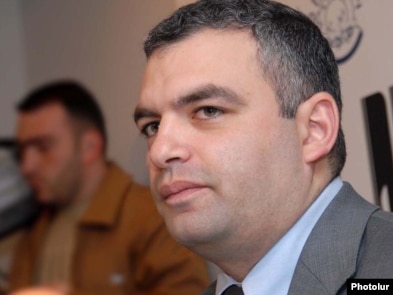
    Armenia — Hayk Demoyan, director of the Armenian Genocide Museum-Institute, speaks at a news conference on September 7, 2009.

     
    07.09.2009
    Sargis Harutyunyan

    A well-known Armenian genocide scholar voiced support on Monday for official Yerevan’s and Ankara’s plans to form a joint body tasked with looking into the mass killings of Armenians in Ottoman Turkey.

    The creation of such a body is a key provision of one of the two draft protocols on the normalization of Turkish-Armenian relations that were made public by the two governments last week. It is supposed to engage in an “impartial scientific examination of historical documents and archives” relating to the 1915-1918 massacres.

    The idea of such a study appears to be unpopular in Armenia and its worldwide Diaspora. Many Armenians — and political opponents of President Serzh Sarkisian in particular — view it as a Turkish ploy designed to discourage more countries from recognizing the deaths of more than one million Armenians as genocide.

    Hayk Demoyan, the director of the state-run Armenian Genocide Museum-Institute in Yerevan, dismissed these concerns, claiming that the Turkish-Armenian panel would only pose a threat to Turkey’s ruling establishment that vehemently denies that the massacres constituted a genocide. He said its Armenian members would gain access to Ottoman archives dating back to the First World War and thereby be able to uncover more evidence of what many international historians believe was the first genocide of the 20th century.

    Speaking at a news conference, Demoyan claimed that the purpose and format of the study is different from the one proposed by Turkish Prime Minister Recep Tayyip Erdogan in a 2005 letter to then President Robert Kocharian. “Reading the document and its formulations, we can see that this is not what the Turkish side meant,” he said.

    Government critics found Demoyan’s arguments unconvincing, however. Gegham Manukian, a historian affiliated with the Armenian Revolutionary Federation (Dashnaktsutyun), said they are at odds with pro-government politicians’ assurances that the genocide issue will not be the main focus of the Turkish-Armenian “sub-commission” of historians. “That means that the genocide issue will be discussed there after all,” he told RFE/RL.

    Manukian also stood by Dashnaktsutyun’s and other opposition parties’ that the Turks will now find it easier to keep foreign governments and parliaments from issuing Armenian genocide resolutions.

    https://www.azatutyun.am/a/1816784.html

  • EU and Turkey in ‘vicious circle,’ experts say

    EU and Turkey in ‘vicious circle,’ experts say

    VALENTINA POP

    Today @ 09:33 CET

    EUOBSERVER / BRUSSELS – European leaders must treat Turkey as any other EU candidate and stop suggesting alternatives to full membership, while Ankara for its part needs to re-engage in a democratic reform process, a panel of European experts has recommended.

    The EU’s relationship with Turkey has turned into a ‘vicious circle’, with growing distrust on both sides, the Independent Commission on Turkey, a panel of experts chaired by Nobel Peace Prize winner Martti Ahtisaari warns in a report issued Monday (7 September).

    The Bosphorus: Turkey’s geography is one of the arguments raised by some against EU membership. (Photo: wikipedia)


    “Continued negative comments by European political leaders, combined with growing public hesitation about further EU enlargement, have deepened resentment in Turkey and slowed the necessary reforms,” the document reads.

    French President Nicolas Sarkozy has publicly questioned Turkey’s right to become an EU member, pointing to its geography, which stretches from southeastern Europe to Asia Minor. The question of 70 million Muslims set to become EU citizens is also frequently invoked by opponents to Turkish membership in countries such as Austria, Germany or the Netherlands.

    “European governments must honour their commitments and treat Turkey with fairness and the respect it deserves. On its side, Turkey has to re-engage in a dynamic, broad-based reform process, thus confirming that it is willing and serious in its ambition to join the EU,” the report recommends.

    The experts warn against the use of alternative scenarios such as the ‘privileged partnership’ invoked in German circles and urge the EU to stick to the declared “common goal” of accession negotiations – EU membership.

    “To breathe new life into the negotiations, the EU must simply follow through on previous commitments to keep the path to membership open. No new promises are needed,” Mr Ahtisaari said.

    On the other hand, Ankara also needs to keep its promises on the reform side.

    “Two years without elections now lie ahead, and all sides must act now to prevent the country’s convergence with the EU from stalling. Comprehensive, consistent and sustained progress towards more democracy at home is the best way to persuade more Europeans of Turkey’s EU compatibility,” the report reads.

    One major opportunity for progress in the EU-Turkey negotiations will emerge later this month, as a new round of peace talks on the divided island of Cyprus resume. Ankara is the only capital to recognise the north of Cyprus as an independent country, while the Greek south is an EU member.

    “Turkey’s progress towards joining the European Union would get a major boost from resolving the division of Cyprus,” said Mr Ahtisaari. “The seductive idea that the status quo can go on forever is a delusion. The cost of inaction this time around is too high.”

    Speaking in Stockholm after the meeting with EU foreign ministers on Saturday, Turkish top diplomat Ahmet Davutoglu looked confident of his country’s future membership.

    “We have full confidence that our French, British and other colleagues will keep their commitment,” he said. “There is no need for convincing. It is already certain that Turkey and the European Union will integrate in the future.”

    Press Articles

    • Today’s Zaman

    Report

    • Independent Commission on Turkey

    https://euobserver.com/eu-political/28622

  • Ex-spy is BP’s Lawrence of Arabia

    Ex-spy is BP’s Lawrence of Arabia

    By Glen Owen
    Last updated at 3:48 AM on 06th September 2009

    He is the modern Lawrence of Arabia who used his relationship with Colonel Gaddafi to help to secure a £200,000-a-year job with BP.

    The career of ex-MI6 agent Sir Mark Allen, the driving force behind the suspected ‘deal’ to return Abdelbaset Al Megrahi to Libya, reads like an espionage novel, taking in Middle East spy schools, falconry and secret meetings in Pall Mall gentlemen’s clubs.

    Our investigation has discovered how Sir Mark, 59 – who resigned from MI6 to join BP in 2004 – used the contacts made during a life in the shadows to build a new career in business.


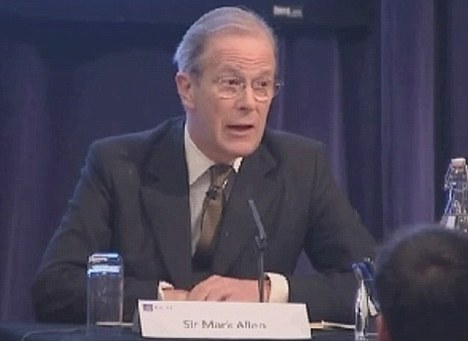
    adsiz-2Sir Mark Allan, a modern Lawrence of Arabia, was the driving force behind the suspected ‘deal’ to return Abedlbaset Al Megrahi to Libya

    It reveals that he:

    • Led the diplomatic drive to lift sanctions against Libya, teaming up with a top CIA agent for private meetings with Colonel Gaddafi.
    • Chaired a secret meeting with Gaddafi’s spy chief in The Travellers Club in London, which included discussion of the Megrahi case and led to the Libyan leader being allowed to trade again with the West.
    • Resigned from MI6 six months later to join BP and was cleared by the Cabinet Office to start working for the oil giant immediately.
    • Is a friend of Justice Secretary Jack Straw, who backed his unsuccessful attempt to head MI6.

    The Mail on Sunday tracked Sir Mark to his secure £1million apartment in Westminster but he refused to talk about the role he may have had in securing Megrahi’s return.

    Last week it was revealed that he lobbied Mr Straw to speed up an agreement over prisoner transfers – which had been expected to lead to Megrahi’s return – to avoid jeopardising a trade deal with Libya worth up to £15billion to BP.


    Allen’s book, Falconery In Arabia which was published in 1980

    Yesterday Mr Straw admitted the agreement had played a ‘very big part’ in his decision to include Megrahi in the transfer deal.

    In 2003, Sir Mark, then head of MI6’s counter-terrorism unit, joined forces with Steve Kappes, now deputy director of the CIA, to lead secret talks with Gaddafi’s regime to end international sanctions.

    The two men embarked on shuttle diplomacy, flying around the world to meet senior Libyan figures, including Gaddafi.

    Pulitzer prize-winning US author Ron Suskind, who has investigated British and American dealings with Gaddafi, said Sir Mark had several meetings with the Libyan leader in summer 2003.

    ‘He played a key role in charming Gaddafi out of his international isolation,’ he said. ‘His job was to make it clear to Gaddafi that anything could be put on the negotiating table, including Megrahi.’ At that point, Megrahi had been in a Scottish jail for two years.

    A deal to end sanctions was sealed in December 2003 at The Travellers Club, where Sir Mark thrashed out an agreement with Gaddafi’s external intelligence chief Musa Kousa.

    In return for the lifting of sanctions – and, sources say, assurances from Britain about Megrahi’s future – Gaddafi promised to abandon plans for weapons of mass destruction. Britain and America resumed relations the next month.

    In May 2004, Sir Mark was the favourite of Mr Straw, then Foreign Secretary, to succeed Sir Richard Dearlove as Head of MI6. But the following month, after it was announced that the job had gone to John Scarlett, Sir Mark resigned to take up a special adviser’s job with BP. 

    Unlike Sir Jeremy Greenstock, Britain’s special representative to Iraq who joined BP at the same time, Sir Mark was told by the Cabinet Office’s Advisory Committee on Business Appointments that he could start work immediately.

    Sir Mark, who was knighted in 2005, immediately used his Libyan contacts in BP’s drive to win gas and oil contracts in the country, flying with the then BP boss Lord Browne to meet Gaddafi in the desert.

    The BP deal with Libya was announced in May 2007. But by November it had still not been ratified because of delays in finalising prisoner transfers which had been arranged between Tony Blair and Gaddafi in tandem with the BP deal. The sticking point was debate in the British Government over whether to exclude Megrahi.

    Sir Mark made two calls to Mr Straw, asking for the agreement to be speeded up. Within six weeks of his second call in November 2007, Mr Straw had written to Scottish Justice Minister Kenny MacAskill to say Megrahi would be included.

    In the Seventies, Sir Mark studied at the Middle East Centre for Arabic Studies, a British ‘spy school’ in a village near Beirut.

    He was posted to Cairo in 1978, where he developed a love of falcon-hunting with Bedouins.

    In 1980 he published Falconry In Arabia, with a foreword and photos by Wilfred

    Thesiger, the late writer-explorer who devoted his life to roaming deserts in the spirit of Lawrence of Arabia.

    A BP spokeswoman refused to comment yesterday.