Month: September 2008

  • Turkey:Armenia ties could end genocide resolutions

    Turkey:Armenia ties could end genocide resolutions

    ANKARA, Turkey: If Turkey and Armenia forge diplomatic ties and are seen to have good relations, other countries could well stop passing resolutions that accuse Ottoman Turks of genocide against their Armenian population during World War I, Turkey’s foreign minister said Wednesday.

    Foreign Minister Ali Babacan said in a television interview that after the Turkish president’s breakthrough visit to Armenia on Saturday, the two countries had stepped up efforts to resolve their differences.

    Historians estimate that up to 1.5 million Armenians were killed in 1915-18 in Ottoman Turkey in what is widely regarded as the first genocide of the 20th Century. About 20 parliaments have passed resolutions to this effect. Turkey denies any genocide, saying the death toll has been inflated and the dead were victims of civil war and unrest.

    Turkey:Armenia ties could end genocide resolutions – International Herald Tribune.

  • Turkey to definitely finalize Nabucco: energy minister

    Turkey to definitely finalize Nabucco: energy minister

    Turkey will definitely finalize the Nabucco project and there are no problems regarding the safety of the Baku-Tbilis-Ceyhan (BTC) oil pipeline, the Turkish energy minister said on Wednesday. 

    Talks regarding the Nabucco project have progressed rapidly, and studies on the project were submitted to the European Union (EU) and other related institutions, Hilmi Guler said at a news conference at Turkey’s Embassy in Baku, in Azerbaijan, the Anatolian Agency reported.  

    Commenting on the BTC oil pipeline, Guler said safety of the pipelines was very important and there was no problem with the security systems. 

    The Nabucco pipeline is aimed at diversifying the EU’s energy supplies and decreasing its energy dependence on Russia. The EU-backed pipeline, a 3,300-kilometre (2,050-mile) pipeline is planned to run via Turkey, Bulgaria, Romania, and Hungary to Austria. 

    A consortium made up of Austria’s OMV, Germany’s RWE, Hungary’s MOL, Turkey’s Botas, Bulgaria’s Bulgargaz and Romania’s Transgaz will build and operate the pipeline. 

    Guler also said the security of the BTC oil pipeline was not risky and there were no problem about security systems. 

    The gendarmerie forces did not find any evidence of sabotage regarding the blast on the Turkey section of BTC, however added that an investigation was underway. 

    Turkey to definitely finalize Nabucco: energy minister.

  • Dogan Says He Won’t Back Down in Turkish Media Row With Erdogan

    Dogan Says He Won’t Back Down in Turkish Media Row With Erdogan

    By Firat Kayakiran and Ben Holland

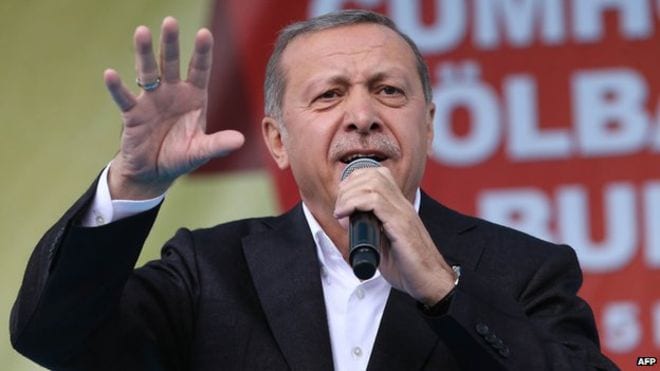
    Sept. 10 (Bloomberg) — Turkey’s biggest media owner Aydin Dogan attacked Prime Minister Recep Tayyip Erdogan for seeking to silence the press, and said he’s willing to seek legal redress if his company’s expansion plans are blocked after a row with the government.

    “This administration is very oppressive, they don’t like pluralism,” Dogan, 72, said in an interview at his company’s headquarters in Istanbul last night. “Nobody can take from me what’s rightfully mine. I’d go to court.”

    Erdogan on Sept. 7 accused Dogan of a smear campaign against his Justice and Development Party. Shares in Dogan companies sank the next day on concern the group’s projects, which include acquisition of state companies and applications to build an oil refinery with OMV AG and obtain a terrestrial license for news channel CNN Turk, may be hurt by the dispute.

    Dogan said his energy unit Petrol Ofisi AS, co-owned with OMV, will pursue its plan to build a refinery at Ceyhan on the Mediterranean coast, where oil arrives by pipeline from Azerbaijan. He said he “reserves the right” to apply to courts if regulators, who haven’t awarded a permit for the project, continue to block it.

    Bloomberg.com: Europe.

  • Turkish Migration to the United States: From Ottoman Times to the Present

    Turkish Migration to the United States: From Ottoman Times to the Present

    From: A DENIZ BALGAMIS <[email protected]>
    List Editor: Mark Stein <[email protected]>
    Editor’s Subject: H-TURK: New book [D Balgamis]
    Author’s Subject: H-TURK: New book [D Balgamis]
    Date Written: Mon, 8 Sep 2008 12:21:01 -0400
    Date Posted: Mon, 8 Sep 2008 12:21:01 -0400

     
    Dear Colleagues,

    The Center for Turkish Studies at the University of Wisconsin, Madison
    announces the publication of a new book titled “Turkish Migration to the
    United States: From Ottoman Times to the Present” edited by A. Deniz
    Balgamis and Kemal H. Karpat.

    You may order the book from the University of Wisconsin Press website
    at

    CONTENTS

    Introduction
    Kemal H. Karpat

    PART I SOURCES AND APPROACHES TO OTTOMAN/
    TURKISH MIGRATION TO THE UNITED STATES

    The History of Turkish Migrations: A Research Agenda
    Rudolph J. Vecoli

    Forging New Links in the Early Turkish Migration Chain: The U.S.
    Census and early Twentieth Century Ships’ Manifests
    John J. Grabowski

    PART II HISTORICAL OVERVIEW AND CASE STUDIES

    The Emigration from the Ottoman Empire to America
    Nedim İpek and K. Tuncer Çağlayan

    Reflections of the First Muslim Immigration to America in Ottoman
    Documents
    Mehmet Uğur Ekinci

    From Anatolia to the New World: The First Anatolian Immigrants to
    America
    Rıfat N. Bali

    Conflict and Cooperation: Diverse Ottoman Ethnic Groups in Peabody,
    Massachusetts
    Işıl Acehan

    “Home Away from Home: Early Turkish Migration to the United States
    Reflected in the Lives and Times of Bayram Mehmet and Hazım Vasfi”
    Emrah Şahin

    PART III RECENT IMMIGRATION

    New Migration, Old Trends: Turkish Immigrants and Segmented
    Assimilation in the United States
    Mustafa Saatçi

    A Profile of Immigrant Women from Turkey in the United States,
    1900-2000
    Ayşem R. Şenyürekli

    Migration from Giresun to the United States: The Role of Regional
    Identity
    Lisa DiCarlo

    Turkish Immigrants in the United States: Men, Women and Children
    Müzeyyen Güler

    The Turks Finally Establish a Community in the United States
    Kemal H. Karpat

    Turkish Islam (with Introduction by Kemal H. Karpat)
    Lloyd A. Fallers

    Contributors

    Bibliography

    Index

    ————-
    Deniz Balgamis, Ph.D.
    University of Wisconsin-Madison

  • Turkey seeks fence-mending meeting with Armenia, Azerbaijan

    Turkey seeks fence-mending meeting with Armenia, Azerbaijan


    ANKARA, (AFP) – Turkish Foreign Minister Ali Babacan Wednesday said he was trying to organize a meeting with counterparts from Armenia and Azerbaijan to discuss decades-old disputes plaguing ties between them.

    The idea, Babacan said, emerged during a historic visit to Yereven by President Abdullah Gul on Saturday, which raised hopes that Turkey and Armenia could overcome traditional enmity and establish diplomatic relations.

    “We have many reasons to be hopeful, the most important of which is the presence of a strong political will to improve ties,” the minister said in an interview with NTV television.

    Babacan and Armenian Foreign Minister Eduard Nalbandian are already scheduled to meet on the sidelines of the UN General Assembly in New York later this month.

    Babacan said he suggested that their Azeri counterpart also join the meeting and Nalbandian agreed.

    “We will now seek Azerbaijan’s consent… The problems between Turkey and Armenia and not independent from the problems between Azerbaijan and Armenia,” he said.

    The issue would be discussed when Gul visits Baku later Wednesday, he said.

    Turkey has refused to establish diplomatic ties with eastern neighbor Armenia because of Yerevan’s campaign for the recognition of the mass killings of Armenians under the Ottoman Empire during World War I as genocide.

    In 1993, Turkey dealt a heavy economic blow to its impoverished neighbor by shutting the border in a show of solidarity with its close ally Azerbaijan, then at war with Armenia over Nagorno-Karabakh — an Armenian-majority region in Azerbaijan which declared independence.

    Babacan said Gul’s visit to Armenia, the first by a Turkish head of state, had raised hopes that the two sides could mend fences.

    “In our talks in Yereven we decided to speed up the process (of reconciliation)… We are entering a period in which we will have frequent contacts,” he told NTV.

    Gul traveled to Yereven for several hours to watch a World Cup qualifying football match between Turkey and Armenia following an invitation by his counterpart Serzh Sarkisian.

  • NAVAL IMPLICATIONS OF THE SOUTH OSSETIAN CRISIS

    NAVAL IMPLICATIONS OF THE SOUTH OSSETIAN CRISIS

    By John C. K. Daly

    Wednesday, September 10, 2008


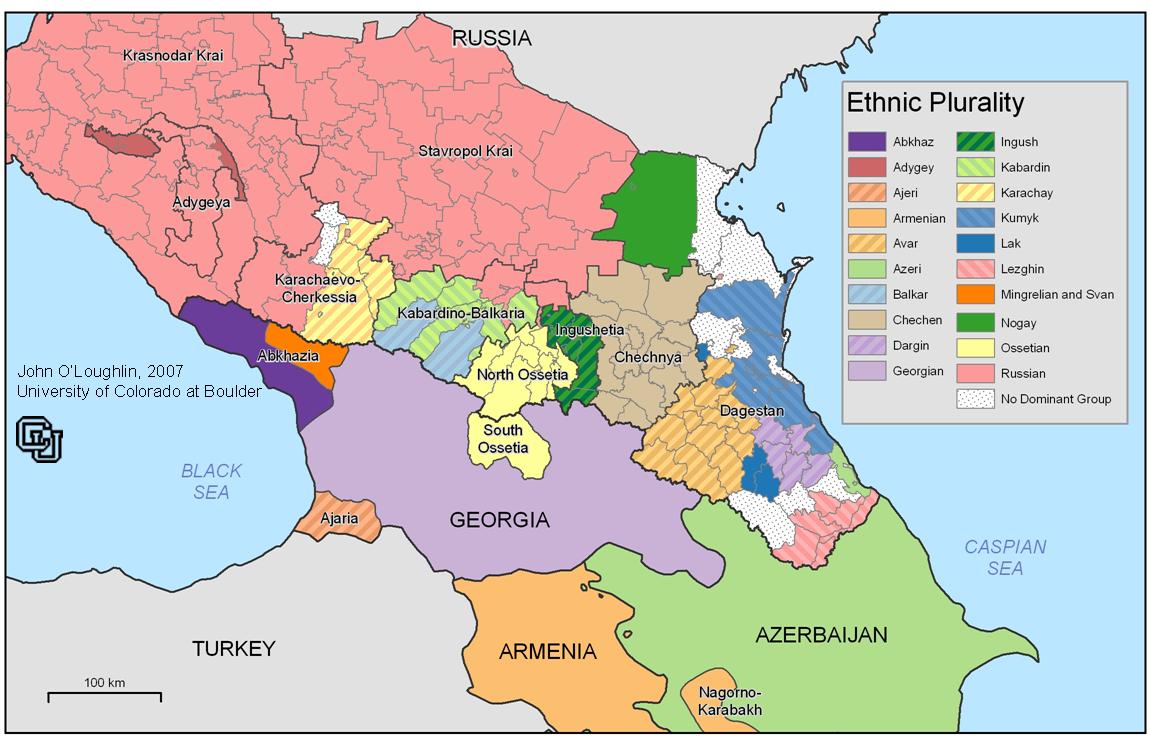
    Last month’s confrontation between Russia and Georgia over South Ossetia had a maritime dimension that continues to expand. Russia deployed elements of its Black Sea fleet to Georgia’s coast during its military operations and subsequently sank several Georgian naval vessels in Poti. During the clash Russia dispatched 10 vessels from Sevastopol to the Georgian coast.

    Following the conflict, the United States determined to send humanitarian relief to Georgia but found its efforts constrained by the 1936 Montreux Convention. Now Moscow, clearly irritated by Washington’s intrusion into what it regards as its southern maritime frontier, has announced that it is deploying significant naval forces next month to the Caribbean for joint naval exercises with Venezuela. Kremlin spokesman Andrei Nesterenko told reporters, “Before the end of the year, as part of a long-distance expedition, we plan a visit to Venezuela by a Russian navy flotilla” (Izvestia, September 8).

    The Caribbean deployment is not insignificant, as it includes the guided missile cruiser Peter Velikii, the largest surface vessel constructed by the Russian Federation since the collapse of the USSR, along with the anti-submarine ship Admiral Chabanenko (El Universal, September 8). Venezuelan Rear Admiral Salbatore Cammarata Bastidas said, “This is of great importance because it is the first time it is being done [in the Americas].” For Caracas, next month’s deployment is a timely riposte to the American administration’s announcement earlier this year that it was reactivating its Fourth Fleet, last deployed in southern hemisphere waters during World War Two.

    In the aftermath of the South Ossetian confrontation, when the U.S. decided to dispatch humanitarian aid by sea to Georgia, it found its initial efforts constrained by the 1936 Montreux Convention, whose 29 articles limit the number of foreign warships that non-Black Sea powers can send through the Turkish Straits to no more than nine vessels with a total of 45,000 aggregate tons. Moreover, they could remain there for no longer than three weeks. The United States had initially considered dispatching the hospital ships USNS Comfort and the USNS Mercy, both converted oil tankers, but as each displaced 69,360 tons, they fell outside the Montreux convention limits. While Washington chafed under the restrictions, there was little it could do.

    Last month NATO dispatched four ships from its Standing NATO Maritime Group 1 to the Black Sea for an exercise scheduled last October. The flotilla included Spain’s SPS Almirante Don Juan de Borbon, Germany’s FGS Luebeck, Poland’s ORP General Kazimierz Pulaski, and the USS Taylor. On August 22 the USS McFaul guided-missile destroyer loaded with humanitarian aid passed the Bosporus headed for Georgia with supplies such as blankets, hygiene kits and baby food, to be followed two days later by the USCGC Dallas cutter passing the Dardanelles. The USS Mount Whitney was also dispatched into the Black Sea with humanitarian aid, which it offloaded in Poti (Stars and Stripes, September 2).

    Before the Montreux Convention was negotiated, both Turkey and Russia had suffered from foreign naval intervention through the Turkish Straits during and after World War One. The Gallipoli campaign was preceded by a joint Anglo-French maritime effort in March 1915 to force the Dardanelles, and the Royal Navy subsequently occupied Constantinople after the war and dispatched vessels into the Black Sea to assist anti-Bolshevik forces.

    The Montreux Convention was intended to replace the 1923 Treaty of Lausanne, which had demilitarized the Bosporus and Dardanelles. Given their recent experience, both the Soviet Union and the Turkish Republic were interested in limiting foreign warships in the Black Sea; and for Ankara, the Montreux Convention was the first international agreement that fully acknowledged its sovereignty and position as successor to the “sick man of Europe,” the Ottoman Empire. Britain, Bulgaria, France, Greece, Japan, Turkey, the Soviet Union, and Yugoslavia ratified the Montreux Convention, which formally recognized Turkish sovereignty over the Turkish Straits. Given that Britain at the time was the predominant naval power in the Mediterranean, the United States was so uninterested in the diplomatic conference that produced the convention that it did not even send an observer to the negotiations.

    The Russian media is now reporting that Washington is negotiating with Georgia and Turkey to establish a naval base at one of Georgia’s Black sea ports in Batumi or Poti, but Ankara is reportedly carefully assessing its position in order to avoid further political tension with Moscow (Gruziya Online, September 7). In a replay of a dispute earlier this year, Russia has temporarily blocked the shipment of Turkish produce into Russia, citing sanitary concerns; and the dispute, which has cost Turkey an estimated $500 million in lost trade, has triggered speculation in the Turkish media that Russia is trying to punish Turkey for allowing U.S. warships to transit the Bosporus (Hurriyet, September 8).

    For those with a sense of history, a factor behind the 1962 Cuban missile crisis was Washington’s deployment of Atlas IRBMs in Italy and Turkey, which, in the wake of the confrontation, Washington quietly agreed to remove, as the development of ballistic missile submarines, the final component of Washington’s nuclear triad, obviated the need for forward basing of nuclear missiles off Russia’s southern shore. Forty years later, Turkey, sea power, and the Caribbean as subplots in rising U.S.-Russian tensions seem as interconnected as ever.