Month: September 2008

  • Turkey, Armenia In Groundbreaking Football Diplomacy

    Turkey, Armenia In Groundbreaking Football Diplomacy

    Turkish leader’s unprecedented visit to Yerevan raises hopes of better relations, but worries conservatives in Azerbaijan as well as Armenia.

    By Tatul Hakobian in Yerevan (CRS No. 459, 11-Sep-08)

    Turkish president Abdullah Gul’s landmark visit to Armenia has raised hopes that the two countries could at last be moving towards a better relationship after many years of antagonism.

    When Gul stepped smiling off an Airbus at Yerevan’s Zvartnots airport on September 6, with Mount Ararat towering in the background, it was undoubtedly a historic moment.

    For two months, Gul had given evasive answers whenever he was asked whether he would accept the invitation of his Armenian counterpart Serzh Sarkisian and come to Yerevan to watch the World Cup football qualifying match between the two countries.

    On September 3, he showed as much courage as Sarkisian by agreeing to visit Armenia.

    As Gul and Armenian foreign minister Eduard Nalbandian got into an armour-plated car brought in specially from Turkey, demonstrators from the Dashnaktsutiun party greeted the Turkish leader with whistles and shouts of “Recognition” – meaning that Turkey should admit the slaughter of Armenians in the early 20th century constituted genocide.

    The Armenian authorities made great efforts to shield the Turkish leader from the demonstration, which was mounted by a nationalist party that is part of the governing coalition.

    In the six hours he spent in Armenia, Gul was surrounded by exceptionally tight security. A team of 50 Turkish security specialists who arrived a few days beforehand had arranged for eight snipers to be posted around the Hrazdan football stadium, and the two presidents watched the match from behind bullet-proof glass.

    The last time a senior Turkish politician visited Armenia was in 1935, when the then prime minister Ismet Inonu crossed the frontier for a few hours and had breakfast in the Soviet republic of Armenia.

    In 1991, Ankara recognised the newly-independent state of Armenia, as it did with Azerbaijan and Georgia. The border between the two countries briefly re-opened, but it was closed again two years later as Turkey backed its ally Azerbaijan in the escalating conflict over Nagorny Karabakh.

    Relations between Ankara and Yerevan have been cool ever since, primarily because of the unresolved Karabakh conflict, but further complicated by rows over the genocide issue.

    The sense of excitement about the impending Turkish visit therefore came as little surprise.

    A huge advertising hoarding at the airport announced in Armenian and English, “Welcome, deeply respected President Abdullah Gul. A fair game lasts more than just 90 minutes. That is our wish.”

    Opposition to the visit came in the shape of several thousand Dashnaktsutiun supporters who mounted protests on Yerevan’s two main avenues, Mashtots and Baghramian, carrying placards bearing slogans such as “Turkey, recognise the genocide!”

    Anahit Berberian, whose forebears fled from Van in eastern Anatolia, held up a placard saying in English saying simply, “My homeland is near Lake Van.”

    “The pain of the genocide passes from generation to generation,” she said. “Unfortunately I’ve only see Van in photographs. I think if I go to Van, I will feel the pain of losing my homeland even more keenly.”

    Dashnaktsutiun leader Armen Rustamian told Turkish journalists that the demonstration was not against the visit by President Gul, but against Turkey’s policy of genocide denial.

    Rustamian said that the Armenian authorities were trying to suggest this was a meeting with a “lost brother”.

    “We don’t understand ourselves what steps are being undertaken – we are insulting our own dignity,” he said.

    A few days before the football match, Armenia’s national football federation changed its logo. The previous one bore an image of Mount Ararat, beloved by Armenians but located inside Turkish territory. The new one merely shows a football. Mount Ararat also disappeared from the national team’s shirts.

    In recent months, Armenian national television has refrained from broadcasting anti-Turkish programmes.

    Former president and opposition leader Levon Ter-Petrosian welcomed the visit, but Sarkisian’s predecessor Robert Kocharian said that if he were still president, he would not have invited the Turkish president.

    When he was in power, Kocharian had made it a cornerstone of his foreign policy to secure an admission of genocide. By contrast, Sarkisian barely mentions the topic and has said, “Without forgetting the past, we should look into the future.”

    The match, which Turkey won 2-0, was the last stop on Gul’s brief itinerary. Earlier in the day, he went to the presidential palace and met Sarkisian.

    Standing in the September sun in front of the Armenian tricolour and the Turkish crescent, the two leaders shook hands and smiled.

    Journalists, including 200 or so who had arrived from Turkey, had little to report on and were kept a long way away from the presidents. Only one television camera filmed the meeting, and the pictures were broadcast on all television channels.

    As the football stadium is situated right next to a hill where Armenia’s Genocide Memorial is located, the Turks insisted that no photographs of Gul be taken in the vicinity to avoid the memorial appearing in the background.

    According to the Armenian president’s press service, his discussion with Gul centred on establishing normal relations between their countries, and also on developments in the region as a whole.

    Gul invited Sarkisian to pay a return visit to Istanbul, where the two football teams are due to play each other again in October 2009.

    Sarkisian said that once a dialogue had been established, it would become possible to discuss even the most difficult questions. “We should strive to resolve existing problems sooner, and not leave this burden to future generations,” he said.

    On his return home, Gul told journalists he hoped his visit would contribute to resolving the Nagorny Karabakh conflict, which he described as “the most important issue in the Caucasus”.

    “We are also gratified that Armenia supports Turkey’s idea of a creating a platform for stability and cooperation in the Caucasus,” he said, in reference to Ankara’s proposal for a new “stability pact” in which Russia and Turkey would work with the three states of the South Caucasus to prevent conflict.

    In an interview with RFE/RL radio, Gul said he supported the current Karabakh peace process, but commented that it had “failed to achieve significant results”.

    “Now, in the Caucasus, the stones have been moved and we are also making an effort and we are making our move. If the move brings results, then we will all be happy,” said Gul.

    In a sign that Turkey is planning a more active role in the region, Gul visited Azerbaijan on September 10.

    In Azerbaijan, his visit to Armenia met with a mixed reaction.

    The radical Karabakh Liberation Organisation, which believes Azerbaijan should be prepared to use military force to end the impasse, condemned Gul, saying, “The leadership of Turkey is ready to sacrifice both Azerbaijan and Turkey for its own interests.”

    Rasim Musabekov, a political analyst in Baku, suggested that Turkey’s latest diplomatic drive was a reaction to the conflict between Russia and Georgia. It was, he said, a clear response to the “rather dangerous challenges and crisis in the region that resulted from the Russian intervention in Georgia and the de facto annexation of Abkhazia and South Ossetia”.

    Zardusht Alizade, a political analyst aligned with the opposition in Azerbaijan, compared the initiative Gul took by visiting Armenia to the period of “ping-pong diplomacy” between the United States and China in the 1970s and called it “a very wise step, a very bold step on the road to beginning an intensive dialogue”.

    “I think that Gul took a very positive step which will serve to improve relations between Armenia and Turkey and will increase the level of security and mutual understanding in the region,” he said.

    Tatul Hakobian is a commentator with the English-language Armenian Reporter newspaper, published in the United States. Shahin Rzayev in Baku contributed to this report.
  • The Enemy of My Friend

    The Enemy of My Friend

    by Gayane Abrahamyan
    11 September 2008

    Isolated Armenia plays a careful diplomatic dance with Georgia and Russia. From EurasiaNet.

    YEREVAN | The Georgia-Russia war has placed Armenia in a bind. Officials in Yerevan are feeling pressure to take sides, either supporting their country’s strategic partner, Russia, or its neighbor, Georgia, through which 70 percent of Armenian exports flow.

    Economic issues have so far driven Yerevan’s response. But a factor looming in the background of any geopolitical discussion is Russia’s decision to recognize the independence of Abkhazia and South Ossetia. This has upped the stakes for Yerevan, as Armenian officials do not want to do anything that could impede the realization of their desires to see the enclave of Nagorno-Karabakh break free from Azerbaijan.

    Currently, economics dictates that Armenia pay attention to its relations with Georgia. Under blockade by Turkey and Azerbaijan, Armenia’s only reliable outlet for exports and imports is through Georgia. The war, and its complicated aftermath, has thus inflicted a considerable amount of damage on the Armenian economy.

    Much of the harm can be traced to Russian efforts to close Georgia’s Black Sea ports, as well as a major railway. One of the consequences of this action was that some 107 train cars of wheat, 10 fuel containers, and 50 additional rail cars with miscellaneous goods were left in limbo, Gagik Martirosyan, an adviser to Prime Minister Tigran Sargsyan, said in a statement. The unloading of ships with goods meant for Armenia reportedly resumed only on 1 September, according to the government.

    The delays are stoking concern about a possible wheat shortage in Yerevan. Repairs on the railway were due to be finished this week, according to the Georgian government. An alternative railway line can handle only much smaller loads, Martirosyan said.

    The owner of one flour processing company said on 6 September that Armenia would face a continuing shortage of flour if the railway is not reopened soon. “[P]eople buy 50 sacks of flour instead of the 10 or 20 they used to get before,” said Vanik Musoian, owner of the Mancho Group, which also imports wheat. “Many villagers try not to sell their wheat.” Some 2,500 tons of wheat imported by the Mancho Group remain in Batumi, while another 7,000 tons are still in Russia. The company is attempting to import wheat from Iran.

    Gasoline has been another problem. Until late August, many stations countrywide posted “No gas” notices. Although the government declared that gas reserves were sufficient to withstand a temporary shortfall, drivers who were forced to wait in long lines to buy fuel scoffed at the assurances.

    Gagik Torosian, the executive director of Yerevan’s Center for Economic Development and Research, believes that if the war had lasted longer, “Armenian citizens would once again have experienced the hardships of the ’90s, when people stood in line for both gas and bread.”

    While the importance of Armenia’s relationship with Georgia has been highlighted in recent weeks, there are powerful factors favoring Russia. Russian companies control Armenia’s telecommunications sectors, are responsible for management of its railway network, and have sizeable interests in its energy industry. Russia in 2007 accounted for just over 37 percent of Armenia’s foreign investment or $500 million, according to government figures.

    FRIENDS ON ALL FRONTS

    For many Armenians, the situation underscores a need to enhance Yerevan’s long-time policy of complementarity — trying to maintain good ties with both the United States and Russia. Diversity in foreign relations could provide a hedge against any given geopolitical development in the future becoming a major source of domestic distress. “We will develop and enlarge our bilateral strategic partnership with Russia in every way and plan to enhance and strengthen our partnership with the United States,” said President Serzh Sargsyan at a 3 September meeting with diplomats.

    For now, Armenia is striving to avoid a choice and remain on friendly terms with both Russia and Georgia.

    Russia seems willing to allow Armenia and other formerly Soviet states to remain neutral. On 3 September, for example Russian Security Council Secretary Nikolai Patrushev issued a statement saying that “Russia will not impose pressure on any country to recognize the sovereignty of Abkhazia and South Ossetia.”

    For one analyst, the true test of Russia’s partnership with Armenia will be whether Moscow stays true to its pledge concerning Abkhazia and South Ossetia. “Armenia is in Russia’s hands,” said Stepan Grigorian, chairman of the Analytical Center for Globalization and Regional Cooperation in Yerevan. “But if Russia considers us partners, then it will not impose pressure.”

    Other Armenian analysts and politicians believe that, sooner or later, the Kremlin will indeed expect Yerevan to provide political support for Moscow’s actions. If this happens, it will be the Karabakh issue that weighs most heavily in the minds of Yerevan policy-makers. Armenia can’t ignore Abkhazia and South Ossetia, and then expect diplomatic help in any effort to win potential recognition of Karabakh, analysts say. “The fates of these two countries are much like the one of” Nagorno-Karabakh, analyst Levon Melik-Shahnazarian said. “If we don’t say that now, we will lose the moral and the political right to blame any other country that does not recognize the independence of [Karabakh] because of its own interests.”

    Opposition parliamentarian Larisa Alaverdian, a member of the Heritage Party, is advocating a way to recognize Abkhazia and South Ossetia, while still potentially preventing a diplomatic falling out with Tbilisi: only the Armenian parliament should recognize the independence of Georgia’s separatist territories. “The risks are high that relations with Georgia may be damaged. That is the reason I suggest that only the National Assembly recognize them, which is just an expression of popular will and can’t have consequences for the executive branch,” Alaverdian said.

    In his 3 September comments, Sargsyan set recognition of Karabakh as the precondition for any recognition of the independence of South Ossetia and Abkhazia. “Having the Nagorno-Karabakh conflict, Armenia can’t recognize another formation in the same situation until it recognizes the Nagorno-Karabakh Republic,” he said.

    Gayane Abrahamyan is a reporter for the ArmeniaNow.com weekly in Yerevan. A partner post from EurasiaNet.org.

  • Turkey, Armenia vow to end enmity after Gul’s visit

    Turkey, Armenia vow to end enmity after Gul’s visit

    YEREVAN (AFP) – Armenia and Turkey pledged to overcome decades of enmity over the massacre of Armenians by Ottoman forces after Turkish Pre­sident Abdullah Gul’s pathbreaking visit to Yerevan for a football match.

    Gul, the first Turkish president to visit Armenia, Saturday held talks with counterpart Serzh Sarkisian after which the two agreed there was the “political will” to improve ties frozen for decades over the 1915-1917 massacres by Turkish troops.

    Moscow News – World – Turkey, Armenia vow to end enmity after Gul’s visit.

  • Russia and Turkey tango in the Black Sea

    Russia and Turkey tango in the Black Sea

    By M K Bhadrakumar

    Amid the flurry of diplomatic activity in Moscow last week over the Caucasus, Foreign Minister Sergei Lavrov took time off for an exceptionally important mission to Turkey, which might prove a turning point in the security and stability of the vast region that the two powers historically shared.

    Indeed, Russian diplomacy is swiftly moving even as the troops have begun returning from Georgia to their barracks. Moscow is weaving a complicated new web of regional alliances, drawing deeply into Russia’s collective historical memory as a power in the Caucasus and the Black Sea.

    German poet and playwright Bertolt Brecht would have marveled

    at Lavrov’s diary, heavily marked with “Caucasian chalk circles” through last week, with intertwining plots and sub-plots – an Extraordinary European Council Meeting taking place in Brussels; a meeting of the foreign ministers of the Collective Security Treaty Organization (CSTO) in Moscow; three foreign counterparts to be hosted in Moscow – Karl de Gucht of Belgium, Franco Frattini from Italy and Azerbaijan’s Elmar Mamedyarov; visits by the presidents of the newly independent republics of South Ossetia and Abkhazia; and consultations with the visiting United Nations secretary general’s special representative for Georgia, Johan Verbeke.

    Asia Times Online :: Central Asian News and current affairs, Russia, Afghanistan, Uzbekistan.

  • Russia, Armenia discuss nuclear power

    Russia, Armenia discuss nuclear power

    YEREVAN, Armenia, Sept. 11 (UPI) — Armenia’s president met with Russia’s nuclear chief to discuss cooperation on nuclear energy.

    Armenian President Serzh Sargsyan discussed uranium exploration in Armenia as well as other areas of cooperation during his meeting with the director general of the Russian Atomic Energy Agency, Sergei Kiriyenko, Armenia’s state-run news agency ArmInfo reported.

    The two leaders discussed existing partnerships and each country’s varying expertise in fields related to the nuclear industry.

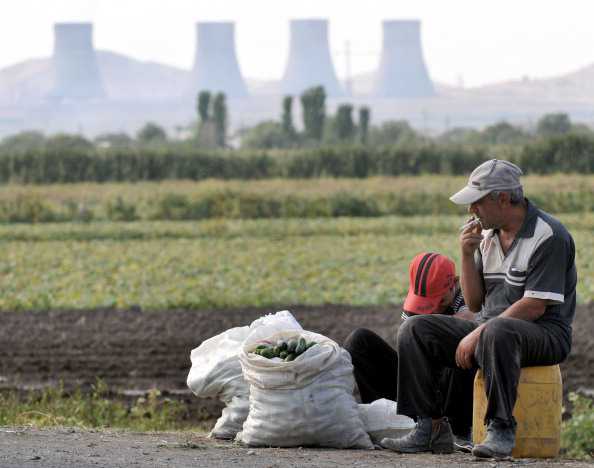
    They also reportedly discussed the operation of the Armenian Nuclear Power Plant, which Kiriyenko said is operating safely and reliably so far.

  • Possibilities for improving Azeri-Armenian relations

    Possibilities for improving Azeri-Armenian relations

    By JOHN C.K. DALY

    WASHINGTON, Sept. 11 (UPI) — Last month’s military conflict between Russia and Georgia over South Ossetia has cast a harsh spotlight on Western assumptions about exporting Azeri oil through neighboring Georgia and Turkey.

    While the military confrontation focused Western media attention on tensions between Russia and Georgia, Azerbaijan itself remains gripped by a “frozen conflict” dating back to even before the 1991 collapse of the Soviet Union. Azerbaijan’s clashes with Armenia over the enclaves of Nagorno-Karabakh and Nakhchivan broke out in February 1988; by the time a cease-fire was signed in May 1994 ending active hostilities, thousands had been killed and wounded, while hundreds of thousands of refugees were created on both sides and the Armenian armed forces were left occupying swaths of Azeri territory, including Nagorno-Karabakh and seven neighboring districts. The volatility of the situation was instrumental in the eventual decisions of the Western consortium members to build their proposed export pipeline for Azeri oil through Georgia rather than utilize a shorter route transiting Armenia.

    Now, however, there are some indications that there might yet again be movement toward a resolution of the issue. On Wednesday, after meeting with Turkish President Abdullah Gul, Azeri President Ilham Aliyev expressed hope that the Nagorno-Karabakh issue eventually could be settled. Gul’s comments had a strong economic undertone, as he told reporters, “If we settle this conflict, which I hope we will manage to do, all countries of the region will develop much faster.”

    A resolution of the disputes between Azerbaijan and Armenia could give Western investors yet another export route for Caspian energy, an issue of growing concern among Western investors because of Russia’s increasing assertiveness in the region, combined with the fragility of export routes through Georgia, as demonstrated by the recent conflict. The prize is certainly tempting: The Caspian’s 143,244 square miles and attendant coastline are estimated to contain as much as 250 billion barrels of recoverable oil, boosted by more than 200 billion barrels of potential reserves, quite aside from up to 328 trillion cubic feet of recoverable natural gas. From the outset Washington’s policy has been to construct, if possible, multiple export pipeline routes, bypassing both Russia and charter “axis of evil” member Iran.

    Because of the Nagorno-Karabakh dispute, however, export routes to Armenia were never considered as a viable option in 1994 after then-Azeri President Geidar Aliyev signed the “Contract of the Century” with Western energy concerns to develop Azerbaijan’s Caspian Azeri-Chirag-Guneshli fields. Consequently, the first Western export oil pipeline not under Russian control went westward through Georgia. In 1999 Baku’s export options broadened with the opening of the $600 million, 515 mile, 100,000-barrel-per-day Baku-Supsa pipeline. Azerbaijan was finally able to free itself completely from reliance on Russian export pipelines when, in May 2006, the $3.6 billion, 1,092-mile, million-barrel-per-day Baku-Tbilisi-Ceyhan pipeline opened.

    The Armenians and Azeris sought to influence Washington’s decisions on the region; political agitation by the Armenian-American lobby resulted in the inclusion in 1992 of Section 907 in the U.S. Freedom Support Act, which banned any direct U.S. aid to the Azerbaijani government as punishment for its blockade of Armenia. It was only in January 2002 that President George W. Bush waived the legislation as a reward for Azeri support of the United States following the Sept. 11, 2001, terrorist attacks.

    The Bush administration, in one of its first foreign policy initiatives, attempted to break the diplomatic impasse between the two Caucasian nations. In April 2001, even before the waiver of Section 907, Secretary of State Colin Powell’s first major foreign initiative was to try to resolve the Nagorno-Karabakh dispute during a summit in Key West, Fla., where he met with Azeri President Geidar Aliyev and Armenian President Robert Kocharyan. But the meetings, which were held by the Office for Security and Cooperation in Europe Minsk Group co-chairs France, Russia and United States, proved fruitless.

    There now seems to be a genuine chance for breaking the diplomatic logjam, especially as Turkey and Armenia are slowly edging toward restoring relations, as well, in the wake of last week’s “soccer diplomacy,” which saw Gul fly to Yerevan to attend a Turkish-Armenian football match, where he held talks with Armenian President Serzh Sargsyan.

    Gul is convinced that new opportunities have opened for settling the Nagorno-Karabakh dispute. He pragmatically informed journalists that a resolution of the issue could allow all countries of the region to get involved in major energy transportation projects, noting, “If the mood of cooperation prevails in the region over hostility, it will serve the interests of all countries in the Caucasus.” Ankara is certainly thinking big; Turkish Minister for Energy and Natural Resources Hilmi Guler, currently in Baku to attend a conference on “oil and gas potential in Azerbaijan and Turkmenistan” organized in Azerbaijan, held out optimism that one of the West’s most cherished projects, the Nabucco pipeline to bring Azeri natural gas westward, would go forward, telling reporters, “Turkey will definitely finalize the Nabucco project.”

    Turkey is also pressing to resolve the Russian-Georgian dispute; on Sept. 2 Gul telephoned Bush, whom he informed about Prime Minister Recep Tayyip Erdogan’s proposal for a Caucasus Stability Platform to restore peace and stability to the region. Rather than unilaterally pushing military aid to Georgia, Washington ought to listen closely to Turkey’s diplomatic initiatives, especially if it wants to prevent any further checkmates to its policies of developing Caspian energy projects: The Kremlin is less likely to feel threatened by a friendly soccer match than U.S. naval warships sailing in the Black Sea.