Month: September 2008

  • Muslims in Europe: A Short Introduction

    Muslims in Europe: A Short Introduction

    Justin Vaisse, Senior Fellow, Foreign Policy, Center on the United States and Europe

    The Brookings Institution

    Introduction

    This paper aims to briefly present the basic facts and issues concerning Muslims in Europe, from a political and sociological perspective, and to offer elements of comparison with the US.1 There will be a slight emphasis on France, due to author’s area of specialty – and to the fact that France is home to the largest Muslim population in Europe.

    A few popular myths about Islam in Europe should first be dispelled, in order to grasp the real issues and challenges:

    Myth #1: Being Muslim constitutes a fixed identity, sufficient to fully characterize a person.

    When it comes to Muslims, people wrongly assume that religion – rather than nationality, gender, social class, etc. – necessarily trumps other identities. To take just a few examples, the Washington Post, in an article on migration to the EU (June 2008), writes about “Muslims arriving from the Middle East and Africa, and Eastern Europeans moving west”, even though a) not all of the migrants from this region are Muslims, b) “Eastern Europeans” would never be labeled “Orthodox” or “Catholics”, and c) that is not the issue anyway, since the article is about immigration. For a couple of weeks in November 2005, the media used the term “Muslims riots in France” to describe the wave of urban violence that resulted in burnt cars and property damage. But these riots had nothing to do with Islam, and everything to do with the social and economic conditions of largely immigrant communities. Muslim groups, who tried to play a mediating role, discovered themselves to be irrelevant and powerless.

    Myth #2: Muslims in Europe are, in one way or the other, inherently foreign, the equivalent of visiting Middle-Easterners who are alien to the “native” culture.

    European culture, however, has always included Muslim elements, as early as the 8th century. Moreover, the approximately 15 to 17 million persons of Muslim background currently in the EU-27 countries (population: 500 million) include both citizens and non-citizens of European member states, but a majority of them hold French, British, German, etc. nationality. Many of them are proud of this fact and would never think of themselves as anything else than Europeans (even while honoring their heritage). Indeed, there is more difference in political culture and social codes between a French Muslim and a German Muslim than there is between a French Muslim and a French of other religious orientation.

    Myth #3: Muslims in Europe form a “distinct, cohesive and bitter group,” in the words of a 2005 Foreign Affairs article.

    In reality, they are anything but a cohesive group. Not only is there no unity to be found at the European level, but when one looks at the national level, what predominates is the profound divisions, either between countries of reference and their specific culture and brand of Islam (e.g., Belgians of Turkish origin vs. Belgians of Moroccan origin), between visions of religion and affiliation (e.g., German Turks associated with Milli Görüş vs. those affiliated with Diyanet), or between social status, political views, ethnicity, etc. In other words, to speak of “a Muslim community” is simply misleading.

    Myth #4: Muslims are demographically gaining on the “native” population.

    The implicit assumption behind this very widespread myth is that Muslims form a distinct demographic bloc defined by religion, a bloc which will never blend into the rest of society (another possible assumption is based on ethnicity, “Muslims” being surrogate for “people of color” vs. white people). This assumption is contradicted by the significant rates of intermarriage and conversions (in both directions) and, more importantly, by the reality of integration in many countries, where Muslims are simply patriotic, law-abiding citizens – in this case, worries about demography have no basis, why would one count them apart? But even accepting the assumption they are a demographic bloc, “Muslims” are not actually significantly gaining on “natives.” True, European birthrates are generally low, and birthrates among immigrant groups are often high. But in the latter group, they actually fall rapidly after their arrival and among subsequent generations, as they tend to conform to the national norm. And in some countries like France or Ireland, general fertility rates are comparable to that observed in the US, around 2 children per woman. Last but not least, immigration to the EU is more and more tightly controlled. It is doubtful that from about 15-17 million in the 500 million EU-27 today (3 to 4 %), potential Muslims could number more than 6 % in the coming decades.
  • Yerevan Hails Turkish Initiative for Caucasus

    Yerevan Hails Turkish Initiative for Caucasus


    By Karine Simonian

    Armenia welcomes the Turkish initiative aimed at establishing a stability and cooperation platform in the Caucasus, President Serzh Sarkisian told media as he visited the country’s northern Lori province late last week.

    “The Turks have said from the very outset that their initiative is not an alternative to any structure or format but is aimed at improving the atmosphere,” the Armenian leader stressed. “I consider it natural that we should welcome this initiative, we have no right to avoid any discussion, especially if it is aimed at strengthening our security.”

    The issue was reportedly discussed by the two countries’ leaders on September 6 as Turkish President Abdullah Gul made a historic trip to Armenia at the initiative of his Armenian counterpart.

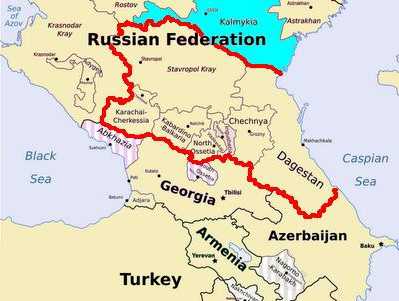
    Official Ankara announced plans to create a Caucasus Stability and Cooperation Pact that would include the three South Caucasus countries plus two regional heavyweights, Turkey and Russia, following the brief but devastating war between Russia and Georgia over the latter’s breakaway province of South Ossetia in August.

    In a recent interview with RFE/RL’s Azerbaijani service, Gul emphasized that the conflict between Armenia and Azerbaijan over Nagorno-Karabakh is not just a bilateral issue between the two Caucasus republics, but also affects the whole region.

    “Peace and stability is in the interest of everyone and to have that we have to resolve problems. But to resolve the problems we have to have discussion and dialogue,” Gul said.

    President Sarkisian expressed his satisfaction that the Turkish head of state also communicated the impressions of his Yerevan trip to the leader of neighboring Azerbaijan, with which Armenia is at loggerheads over the status of Nagorno-Karabakh, an ethnic Armenian enclave that declared itself independent from Baku after the collapse of the Soviet Union.

    He further appreciated the offer of assistance that Gul said Turkey was ready to render in the settlement of the Armenian-Azerbaijani relations, if need be.

    “I was glad to accept that offer because only someone not normal would reject assistance,” Sarkisian said, emphasizing the difference between ‘assistance’ and ‘mediation’.

    Sarkisian also said that any step that can help the Minsk Group of the Organization for Security and Cooperation in Europe (OSCE) in settling the Nagorno-Karabakh problem should be regarded as positive.

    Meanwhile, Armenia’s Foreign Minister Edward Nalbandian reiterated Yerevan’s position as he received a senior visiting U.S. diplomat on Saturday.

    During the meeting with U.S. Deputy Assistant Secretary of State Matthew Bryza, Nalbandian said Armenia welcomes the steps aimed at building confidence and developing cooperation in the region, the Armenian Foreign Ministry reported.

    He also gave a positive evaluation to the Turkish president’s visit to Armenia, describing it as a good stimulus to starting a ‘serious dialogue’.

    Bryza, who is the U.S. co-chair of the OSCE Minsk Group along with representatives of Russia and France, met with the Armenian minister as part of his regional tour to discuss the Nagorno-Karabakh peace process as well as the recent developments in the region, including the war in Georgia and Armenian-Turkish relations.

    Before meeting with Bryza, Nalbandian paid a visit to the Georgian capital where he also presented the latest developments in the Nagorno-Karabakh peace process and opportunities for normalizing relations between Armenia and Turkey.

    In Tbilisi Nalbandian was received by the country’s Prime Minister Lado Gurgenidze and President Mikheil Saakashvili.

    The Foreign Ministry’s press office quoted Nalbandian as stressing during his meeting with President Saakashvili that Armenia is one of the countries most interested in stability, security and peace in the neighboring republic. He reportedly said that apart from the fact that about 70 percent of Armenia’s foreign trade is made through Georgia, “two peoples have bonds of centuries-old friendship.”

  • 90 years ago Baku liberated from bloody regime

    90 years ago Baku liberated from bloody regime

    September 15th, 1918 became an important turning point in the short history of first Azerbaijani independence.


    On this day 90 years ago, allied forces of young and independent Azerbaijani Democratic Republic and Turkish detachments under the command of Nuri Pasha liberated the city of Baku from the evil and bloody regime of Baku Soviet and its temporary successor Central Caspian Dictatorship. September 15th, 1918 became an important turning point in the short history of first Azerbaijani independence. This event was also important in our history because it brought an end to months of horrible violence and massacre brought upon Azeri people by the Bolshevik gangs of Stepan Shaumyan and his Armenian Dashnak allies as well as eser Mensheviks in Baku, Shemakha, Quba, and other Azeri towns. Organized Armenian gangs under Soviet and Dashnak slogans murdered 10,000 Azeri civilians just in the city of Baku on March 31st, 1918, thus starting the history of first Azeri genocide committed by Armenians.


  • Holidaymakers stranded in Turkey

    Holidaymakers stranded in Turkey

    Up to 150 people have been left stranded in Turkey after the collapse of a north London-based tour operator.

    K&S Travel, which also trades under the name Travel Turkey, organises package tours to the country through flights chartered with Onur Air.

    A K&S Travel spokesman said the firm would organise flights for those abroad when their holidays were completed.

    It is thought more than 85,000 people have been left stranded abroad after Friday’s collapse of XL Leisure Group.

    XL is the UK’s third largest tour operator.

    The Civil Aviation Authority (CAA) said the holidaymakers were covered by the Atol protection scheme and will be entitled to a full refund.

    The CAA is understood to be rechartering planes from Onur to ensure the return of K&S passengers, most of whom are in the resort of Bodrum.

    But 460 people who have future holidays booked through K&S Travel will have their travel plans cancelled.

    BBC NEWS | UK | England | London | Holidaymakers stranded in Turkey

  • Investors to put 7 bln euros in Turkey's Karaman

    Investors to put 7 bln euros in Turkey's Karaman

    A businessmen group, including investors from Germany, Switzerland and Holland, are planning to invest 7 billion euros ($ 9.95 billion) in Turkey’s central province of Karaman, Dogan News Agecy (DHA) reported on Saturday.

    The businessmen, who visited Karaman, allocated a 7 billion euros total amount of budget to invest in wind energy, bio-energy, stock-breeding and agricultural projects, DHA reported.

    According to report, sunflower-seed processing factories and stock-breeding in 200 square kilometers are among the planned projects.

    “The screening talks are ongoing. But, especially the wind-power project investment is being considered as important. Nearly 60 percent of investment comprises of wind energy… I estimate the infrastructure works will take shape in 2009 regarding the investment issues, in Karaman,” DHA quoted Koksal Gor, a member of Holland state parliament, as saying.

    Officials from Zurich Royal Bank of Scotland and Firma WIPA Investment Credit Suisse Bank were also included in the businessmen group.

    Source : Hurriyet

  • Excavations stopped at ancient city in Turkey

    Excavations stopped at ancient city in Turkey

    KNIDOS RUINS, Turkey: The archaeological site of Knidos in Turkey was once a jewel of ancient Greek civilization — a major port that exported wine as far as India and Britain, the religious center of a confederacy of Greek cities, and site of a medical school that rivaled the legendary Hippocratic clinic.

    Its crowning glory was a statue of Aphrodite, the goddess of love, by Athenian sculptor Piraxitelles — which attracted admirers from across the Mediterranean basin.

    Archaeologists believe most of the city’s secrets lie hidden beneath the ground. But Turkey has suspended excavations — accusing the Turkish project leader of negligence leading to the collapse of a newly restored column.

    Professor Ramazan Ozgan is now fighting a legal battle at the country’s highest administrative court to overturn the government’s cancellation of his almost 20-year-old excavation permit. The government also suspended excavations by the British Museum and Germany’s Freiburg University, which had been digging under Ozgan’s permit and leadership.

    Excavations stopped at ancient city in Turkey – International Herald Tribune.