Month: November 2009

  • Besiktas fans reveal united front

    Besiktas fans reveal united front

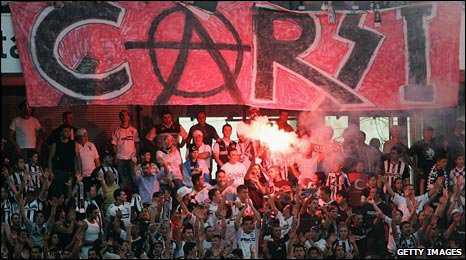
    Carsi

    “Football isn’t just a sport. Nowadays it’s an industry,” says Besiktas fan Ozan Ilhan ahead of his side’s clash with Manchester United on Wednesday.

    The smallest of Turkey’s “big three”, Besiktas are seen in their country as the halk takim, the people’s team.

    The team’s fan base is traditionally more working-class and left-wing than those of rivals Galatasaray and Fenerbahce, and their supporters’ club, Carsi, takes this history to heart.

    Formed by six teenagers in 1980, Carsi is now a thousands-strong organisation that, unusually, marries fanaticism for the team with political causes.

    Ozan is a 24-year-old student who lives in the German city of Koblenz, and works in the city’s car industry.

    He is one of the 1,000 or so Carsi members making the trip to Manchester.

    “My wife cannot understand me,” he complains. “She says: ‘Why fly to Manchester for Besiktas? You can watch it at home on the television.’”

    They are coming from all over Europe – 150 from Germany, 50 from Holland, 50 from London – for a match they probably won’t win and, even if they do, has no bearing on them qualifying for the next stage.

    “Carsi is like a spirit,” says Devrim Borcek, another fan from Germany.

    “Those living in Istanbul are close to Besiktas. I’m living 3000km away but I have to live the same as these guys.”

    But this is more than an ordinary supporters’ club trip.

    Carsi is a hive of activity, both at matches and away from the stadium.

    It has a changing cast of members but, for the core, the group is central to their lives.

    Together they take part in Labour Day marches, do charity work, produce placards for matches, and even protest against government nuclear policy – or just meet up to drink and talk about football.

    Fans are introduced to ideas like anarchism and socialism that don’t get an airing in traditional media, let alone most football stadia.

    By contrast, the fans they will encounter on Wednesday have been dubbed the “prawn sandwich brigade” for their corporate approach to supporting a team.

    So how do Carsi members feel about Manchester United fans?

    Ozan respects United’s history and success, if not their fans’ style of support.

    “They are a good example of people who like the football industry, who like to go to the stadium, watch the match and go home,” he says.

    “That’s not the culture of Besiktas. We have to scream whether we win or lose – all that matters is the atmosphere, the expectation that you are not only there but you are living it.

    “I cannot imagine Besiktas like Manchester. It’s not possible and I don’t want it.”

    But they do want to be successful. Although winners of the Turkish league last year, Besiktas are currently at the bottom of Champions League group B, yet to win a European match this season.

    Those in charge need to decide whether triumph on the European stage can be achieved without diluting the club’s identity, in an age in which success increasingly depends on money.

    The club’s efforts to boost revenue have seen Carsi lose out.

    Ticket prices have increased year on year, making it harder for the traditional fanbase to attend.

    Seats in Carsi’s section for last Saturday’s derby against Fenerbahce cost 250 Lira (£100) – more than all but the most expensive tickets at Old Trafford.

    “The three big clubs in Turkey – Besiktas, Galatasaray, Fenerbahce – their presidents don’t want these fans in the stadium,” a Turkish journalist tells me.

    “Like in England, they want rich fans.”

    Where next for Carsi, then, if the club no longer wants them?

    The globalisation of the game has brought the group opportunities and threats in equal measure.

    Some members worry its 1980s collectivist ideology doesn’t resonate with younger fans in an era of multi-million pound transfers and instant success.

    But televised games, the internet and cheap European flights have brought more people into the Carsi fold.

    Widespread publicity means the movement has become a magnet for those disenchanted with “typical” football fans, or even Turkish society in general.

    They are fighting for a vision of what it means to be a fan – an all-consuming relationship with the club that they believe is alien to most in English football.

    And so to Old Trafford, the 76,000-capacity, all-seated cathedral for the modern game.

    “It will be a hard match, I think,” says Ozan.

    “Our chances aren’t good. But remember the match in 2003 against Chelsea, when nobody expected Besiktas to win. It was wonderful, so why not again?”

    BBC

  • Slipping in Turkey

    Slipping in Turkey


    An Islamist government’s commitment to democratic principles is looking shaky.

    Monday, November 23, 2009
    WallStreet Journal

    RECEP TAYYIP ERDOGAN has been the protagonist of an epic liberalization of politics in Turkey. The victory of his mildly Islamist AK Party in a 2002 general election was itself a breakthrough; even more so was his government’s defeat of repeated attempts by the military and courts to remove it from power. Mr. Erdogan is pushing through historic reforms of Turkey’s treatment of its Kurdish minority and recently took a major step toward opening the country’s border with Armenia.
    Yet, as his tenure lengthens, it is becoming evident that Mr. Erdogan’s commitment to democratic principles and Western values is far from complete. As Turkey’s prospects of joining the European Union have dimmed, the government’s foreign policy has taken a nasty turn: Shrill denunciations of Israel have been accompanied by increasing coziness with the criminal rulers of Iran, Syria and Sudan. Mr. Erdogan recently declared that Sudanese President Omar Hassan al-Bashir, who has been indicted for war crimes in Darfur, was welcome in Turkey because “a Muslim can never commit genocide.”

    Even more concerning is Mr. Erdogan’s treatment of the Turkish media. Frustrated by hostility toward his government by media conglomerates that formed part of Turkey’s traditional secular establishment, the prime minister and his allies have resorted to increasingly heavy-handed measures. Two years ago a forced sale of the country’s second-biggest newspaper placed it in the hands of a company headed by Mr. Erdogan’s son-in-law. Once critical, it is now predictably pro-government.

    Now the government is threatening to destroy Turkey’s largest media company, Dogan Yayin. The conglomerate, which controls seven newspapers, 28 magazines and three television channels — including Turkey’s version of CNN — has been hit with an escalating series of tax bills based on questionable audits of past filings. The latest one, delivered in September, now stands at some $3.3 billion — a sum greater than the value of Dogan Yayin and its parent company.

    Faced with sharp criticism by the European Union, Mr. Erdogan and his foreign minister have insisted that the tax bills are a “technical matter”; in one interview the prime minister compared them to the tax case brought against gangster Al Capone. The parallel was unintentionally revealing. Mr. Erdogan’s real problem is not with the company’s supposed tax evasion but with its tough reporting on his government — beginning with reports about an Islamic charity that may have illegally funneled money to his party.
    Turkish journalists say that a pall of fear has fallen across their business. Editors practice self-censorship. Many journalists are believed to be among the more than 100,000 people whose phones have been tapped by the government in recent years. Some, including the chief executive of Dogan Yayin, have been swept up in a murky investigation of alleged coup plotting.
    Mr. Erdogan and his party were once seen by many in Washington as a model for how pious Muslims could practice democratic politics. That image is rapidly darkening. If it is not to be extinguished, Mr. Erdogan must stop coddling Muslim dictators — and stop following their practice of silencing domestic opposition.

  • Alleged Armenian Genocide memorial in Idaho

    Alleged Armenian Genocide memorial in Idaho

    12:40 / 11/24/2009

    Armenian Genocide memorial is put up in Twin Falls (Idaho), Times-News reports. The memorial was erected on Liyah Babayan’s initative, who came to Twin Falls from Armenia with her family at the age of 11.

    “She spent much of this year lobbying and raising money for the granite memorial that was placed at Twin Falls City Park on Saturday,” the source says.

    “It really means a lot to my parents and my grandparents,” said Babayan. Now expecting a baby, she knows her child will not experience atrocities as an American.

    The memorial is a reminder of the massacres of Armenians in Ottoman Empire.

    “We have rooted ourselves in this community. I grew up here. We own a business in Twin Falls,” Babayan said, adding that many Armenians who came in Twin Falls as refugees, are presently U.S. citizens.

    News from Armenia – NEWS.am
  • Ottoman mission

    Ottoman mission

    By Delphine Strauss

    Published: November 24 2009 02:00
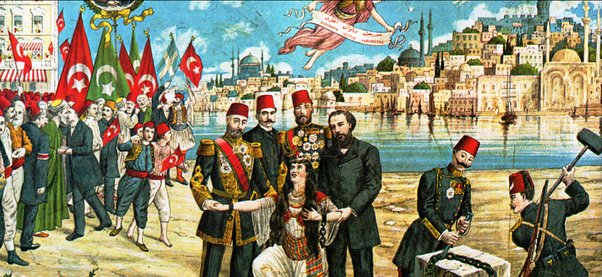
    osmanli

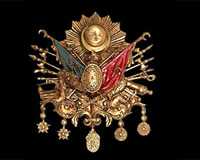
    In one of Istanbul’s artier quarters, a second-hand bookshop sells leaves torn from an old school atlas that depict the dominions of the Ottoman empire, all neatly labelled in a flowing script few Turks are now able to read.

    The faded pages are a reminder of the heritage long rejected by the modern Turkish state as it sought to forge a new national identity and survive on the frontline of 20th-century geopolitics. Just as the social reforms of Mustafa Kemal Atatürk, founder of the secular republic, presented European culture as the standard of civilised behaviour, so foreign policy became firmly west-facing as Turkey sought shelter from the Soviet power on its border.

    Now, however, the ruling Justice & Development (AK) party is reengaging with territories once ruled by the sultans, from the Balkans to Baghdad, in a drive to return Turkey to a place among the leadership of the Muslim world and the top ranks of international diplomacy.

    Ahmet Davutoglu, foreign minister and architect of the policy, rejects the expansionist tag of “neo-Ottoman” bandied about by AK critics, preferring his well-used slogan, “zero problems with neighbours”. The US and the European Union praise this unobjectionable aim: to act as a force for stability in an unstable region.

    Turkey has long mattered – as Nato ally, friend of Israel, EU applicant and energy route to the west. But its growing economic strength and diplomatic reach give it influence over some of the toughest issues facing Washington and other capitals: from frozen conflicts in the Caucasus to Iran’s nuclear ambitions to the threat of disintegration in Iraq. “We are neither surprised by nor disturbed by an activist Turkish agenda in the Middle East,” Philip Gordon, assistant secretary at the US state department, said in Ankara this month.

    Yet the speed and bewildering scope of Turkey’s diplomatic endeavours have left both Turkish and western observers wondering whether it can juggle all its new interests. In a month of frenetic activity, Mr Davutoglu has staged a show of new friendship with Syria, ending visa restrictions on a border once patrolled by Turkish tanks; paid a high-profile visit to Iraq’s Kurdistan region, long shunned as a threat to Turkish unity; and signed a landmark deal to mend relations with Armenia. “Today we, children of the Ottomans, are here to show interest in the development of Mosul just as our ancestors showed centuries ago,” Zafer Caglayan, trade minister, said as he opened a consulate in the northern Iraqi city last month. Turkish diplomats claim credit, in the last year alone, for mediating between Israel and Syria, hosting talks between Afghanistan and Pakistan, and liaising with Sunni militants in Iraq.

    But Recep Tayyip Erdogan, a prime minister who scorns diplomatic niceties, has shown the potential for new friendships to damage old ones.

    Israel, which long valued Turkey as its only Muslim ally, was already infuriated by his frequent condemnations of its Gaza offensive. In October, Mr Erdogan compounded the insult not only by ejecting Israel from joint military exercises but by renewing his criticisms while in Tehran standing beside Mahmoud Ahmadi-Nejad, Iranian president. He caused consternation by saying Omar al-Bashir, Sudan’s war crimes-indicted president, could not as a Muslim be capable of genocide, nor could his actions be compared with Israel’s.

    “Why is it that . . . a more prominent Turkey has, it seems, to come at the expense of its relations with Israel?” Robert Wexler, the US congressman, asked recently. US newspaper columnists went further, arguing that Ankara was undermining efforts to put pressure on Iran, or even that illiberal Islamists could no longer be trusted in Nato.

    The virulence of the reactions reflects the value attached to Turkish support. Although no longer a bulwark against Soviet power, the threat of radical Islam has given Turkey new weight as a partner to channel western values to the Muslim world – and, by its western alliances, show that a “clash of civilisations” is not an inevitable result of religious difference.

    Mr Davutoglu is touring European capitals this month, employing Ottoman-tinged rhetoric to persuade people that Turkey’s European vocation is unchanged. “You cannot understand the history of at least 15 European capitals without exploring the Ottoman archives,” he told an audience in Spain this week.

    For Ankara, there is no question of changing orientation. “We have one face to the west and one to the east,” Mr Erdogan said last month as he signed trade deals in Tehran. Yet it is natural for Turkey to keep its options open, given the manifest reluctance in some EU countries to admit it to membership.

    Ankara presents its new friendships as an asset to the EU, giving it a partner to promote western aims in the region. The European Commission’s latest report on Turkey’s accession process endorsed that view, with praise for its foreign policy. But Brussels also makes it clear that geostrategic importance cannot replace the domestic judicial, political and human rights reforms required to meet the criteria for membership.

    Ankara’s focus, however, is on grander projects than box-ticking compliance with European legislation. A lack of enthusiasm for Herman van Rompuy’s appointment last week as president of the European Council reflects not just worries over his past opposition to Turkey’s candidacy but a preference for a heavyweight leader who would want Europe to play a bigger part on the world stage.

    Ibrahim Kalin, Mr Erdogan’s chief foreign policy adviser, argues that Turkish activism is not a reaction to disappointments in the EU but simply “a fully rational attempt to seize new spaces of opportunity” – including the EU’s virtual absence from geopolitics.

    Frictions with the EU may worsen, however, if Turkey engages in rivalry with countries used to seeing it as a junior partner. Western diplomats have noted Mr Davutoglu’s reluctance to support a French attempt at conciliation between Israel and Syria, for example, and say Mr Erdogan’s grandstanding in Iran “is definitely causing irritation”.Turkey thus needs to ascertain how much influence it has, what it is based on, and where new policies may upset old alliances.

    Greater regional engagement is in part a response to changing balances of power. The coming American withdrawal from Iraq threatens a vacuum in which Turkey is one of the most plausible counterweights to Iranian influence – its credibility enhanced by its refusal to let the US use its territory to invade in 2003.

    Ian Lesser from the Washington-based German Marshall Fund notes that ideas of a “Middle East for Middle Easterners” have been circulating for some time. “The crucial difference is that Turkey is now a much more significant actor in both economic and political terms, and Turkey’s Middle Eastern choices are, rightly or wrongly, seen as linked to the country’s own identity crisis.”

    Foreign policy is certainly shaped by a growing affinity with the Islamic world, in a country where religious practice is becoming more visible and public opinion a greater force. Mr Erdogan’s comments on Gaza, or on Iran’s nuclear programme, appear both to recognise and reinforce views on the street: a survey by the GMF found that almost one-third of Turks – compared with only 5 per cent of Americans – would accept a nuclear-armed Iran if diplomacy failed.

    Chief AK weapon in its drive eastwards, though, is not religion but trade. Exports to what the country’s official Turkstat agency classifies as the Near and Middle East account for almost 20 per cent of the total so far in 2009, up from 12.5 per cent in 2004. Turkish conglomerates are also stepping up investment in a region where their presence is considered benign.

    “We don’t want a cultural bias against us,” says Sureyya Ciliv, chief executive of Turkcell, the mobile operator, which has interests in central Asia, Georgia and Moldova. Anadolu Efes, with almost 10 per cent of Russia’s beer market, wants to start producing non-alcoholic beer in Iran. Limak, a group centred on construction, is seeking projects in the Gulf, north Africa and Europe “east of Vienna”. “It’s a natural development,” says Ferruh Tunc, senior partner in Istanbul for KPMG, the consultancy. “Turkey’s position until the Soviet Union collapsed was unusual – it was like the last stop on a Tube line.”

    Yet a previous initiative, reaching out to the Turkic-speaking world after the central Asian states won independence, left Turkey with excellent trade links but limited influence compared with China and Russia. Morton Abramowitz, a former US ambassador to Turkey, warns in this month’s Foreign Affairs journal that in the AKP’s latest diplomatic push as well, “despite the acclaim it showers on itself . . . symbolic achievements have far exceeded concrete ones”. More-over, Turkey’s opposition this spring to Anders Fogh Rasmussen’s appointment as Nato chief “alienated many Europeans by seeming to favour Muslim sensibilities over liberal democratic values”.

    Can Ankara not reach out peacefully on all fronts, as it claims, without repercussions and a risk of overstretch? “You need very judicious fine tuning to be able to deliver this . . . The danger is of overplaying their hand,” says a western diplomat.

    Mending fences with Armenia won praise in the west, for instance, but in Azerbaijan nationalists tore down the Turkish flag, viewing the move as a betrayal of old alliances. Baku may yet take revenge by demanding higher prices to supply gas.

    The next test of Turkey’s new foreign policy will be Iran. The AKP claims its opposition to a nuclear-armed Iran is more effective because it delivers the message as a friend and trading partner. Turkey’s interests in trade with Iran are understood but Mr Erdogan may be pressed in Washington and Brussels to explain why he defends Iran’s nuclear programme as “peaceful and humanitarian” and lends the regime credibility rather than backing isolation.

    Katinka Barysch of the Centre for European Reform, a London think-tank, says: “As a long-standing Nato member and a country negotiating for EU membership, Turkey is expected to align itself with the US and Europe – or at least not do anything that undermines the west’s political objectives in the Middle East. As a regional power, Turkey will want to act independently and avoid antagonising its neighbours. It is not clear how long Ankara will be able to avoid tough choices.”

    Tricky legacy

    Ottoman analogies are a double-edged weapon in Turkish politics. Those urging more rights for Kurdish citizens, for example, might recall the Ottomans’ multicultural tolerance. But some view such nostalgia as a challenge to the principles of Mustafa Kemal Atatürk’s republic, with its emphasis on a distinctly Turkish language, culture and identity. Halil Inalcik, a historian at Ankara’s Bilkent university, warns: “We are not Ottomans . . . We’re a nation state. That was an empire.”

    ‘There is progress but it’s uneven’

    Turkey’s shift in foreign policy reflects its ambition to assume greater responsibility as a regional power. It may also reveal frustration over another ambition that has been delayed, if not thwarted: Istanbul’s bid to join the European Union.

    Officially, the EU has been committed to full membership since 2005. Yet eight of the 34 negotiating “chapters” remain blocked as a result of Turkey’s long-running conflict with Cyprus. Meanwhile enthusiasm is faint in France and Germany, the bloc’s traditional centres of power. “There is progress but it’s very uneven,” one Commission official says.

    The most recent update on negotiations came with the Commission’s mixed review of Turkey in last month’s annual enlargement report. Praise forits overtures to its Kurdish minority, and its agreement to reopen its border with Armenia, was tempered by concern over a fine imposed on one of Turkey’s leading media companies. Ostensibly for tax evasion, the $4bn (€2.7bn, £2.4bn) levy was likened by Olli Rehn, Europe’s enlargement commissioner, to “a political sanction”. European diplomats expressed surprise, too, at recent comments that seemed to lend support to Iran. Diplomats also say they do not expect breakthroughs from this week’s EU-Turkey ministerial meeting to discuss foreign affairs, which Mr Rehn will attend.

    If it is accepted, Turkey will become the first predominantly Muslim EU member and also the most populous, giving it a sizeable number of seats in the parliament and threatening the power of Paris and Berlin. Nicolas Sarkozy, French president, displayed his opposition at an EU-US summit in Prague in May. After Barack Obama, on the eve of his first visit to Turkey, urged his hosts to “anchor” the country more firmly in Europe, Mr Sarkozy promptly suggested the US president mind his own business. Angela Merkel, German chancellor, has been more diplomatic,suggesting Istanbul be addressed instead as a “privileged partner”.

    The creation of a full-time EU presidency and foreign policy chief seems unlikely to accelerate accession. In a 2004 speech, Herman Van Rompuy, the Belgian prime minister chosen as president, said Turkey “is not a part of Europe and will never be”. Those remarks proved awkward in the run-up to his selection last week but – as Istanbul no doubt noticed – they did not cost him the job.

    Financial Times
  • Armenia Submits Protocols to  Constitutional Court: What’s Next?

    Armenia Submits Protocols to Constitutional Court: What’s Next?

    SASSUN-2

    Armenia Submits Protocols to

    Constitutional Court: What’s Next?

    Publisher, The California Courier

    Pres. Serzh Sargsyan quietly submitted the Armenia-Turkey Protocols to the Constitutional Court on November 19, without a public announcement.

    Under Armenian law, all international agreements have to be submitted to the Constitutional Court, prior to their consideration by Parliament for ratification. The Protocols were signed by the Armenian and Turkish Foreign Ministers on October 10, after both sides publicly committed on August 31 to “make their best efforts” to ratify the Protocols in a “timely” manner.

    Given the fact that Foreign Minister Ahmet Davutoglu had already introduced the Protocols to the Turkish Parliament on October 21, the timing of Pres. Sargsyan’s submission to the Court may have been prompted by his wish to avoid accusations of foot-dragging by Prime Minister Recep Erdogan during his Washington visit on December 6. Indeed, over the weekend, a Turkish official accused Armenia of not taking any steps to ratify the Protocols. Hurriyet newspaper quoted a Senior Turkish Diplomat as stating: “I do not think that one could press Turkey at this moment when Armenia has still not submitted them to Parliament.”

    Forwarding the Protocols to the Constitutional Court, however, does not necessarily mean that Armenian officials intend to ratify them quickly, since they had announced that they are going to wait for Turkey to ratify them first. Moreover, Turkish leaders have repeatedly linked the ratification of the Protocols to the resolution of the Karabagh (Artsakh) conflict, thus making it questionable if the Protocols would be ratified at all.

    The Armenian Constitutional Court’s website indicates that after submission of a case to the Court, the first step is assigning one of its judges to conduct a preliminary review within 15 days, which could be extended by 10 days. In all, the Court has 90 days from date of submission to announcing its decision. The Constitutional Court’s mandate specifies that its decision will not be based on whether the Protocols are in compliance with the Constitution, but on whether the obligations deriving from such an international agreement are in conformity with the Constitution.

    Given the lack of public trust in Armenia’s courts in general, most Armenians, especially those who oppose the Protocols, are highly skeptical that the Constitutional Court would not rubber stamp the government’s position on these Protocols. Some members of the press questioned the appropriateness of Gagik Harutyunyan, the Constitutional Court’s Chair, accompanying Pres. Sargsyan on his recent overseas “consulting tour,” trying to convince Diaspora Armenians that the Protocols were in Armenia’s best interest.

    Given the critical nature of the proposed Protocols and their long-term impact on Armenia’s national interest, it is expected that the Constitutional Court would approach this case with the utmost seriousness and responsibility. While most Armenians would prefer that the Court disapprove the Protocols, it is more likely that it would approve them after adding several clarifications and interpretations that would be part and parcel of the agreement prior to submission to Parliament. Such clarifications would hopefully minimize the detrimental effects of the Protocols and not allow Turkey to misinterpret the agreement, particularly references to international treaties that may preclude future Armenian claims, and formation of a historical sub-commission that could question the facts of the Armenian Genocide.

    Another important issue that the Constitutional Court may consider is adding a provision that would give the Armenian government the right to unilaterally abrogate this agreement, should Turkey violate any of its provisions after ratification.

    During Pres. Sargsyan’s meeting with over 60   Armenian community leaders in Los Angeles on October 4, I suggested that the Armenian government add a formal reservation to the Protocols, giving itself the right to consider the agreement null and void, should Turkey, after ratification, not open the border with Armenia within the stipulated 60-day timeframe or if it closed the border after opening it. Significantly, Pres. Sargsyan publicly agreed with my suggestion and committed himself to adding such a provision.

    Since it appears that the Armenian government is intent on going through with these Protocols despite all objections, the Constitutional Court and the Armenian Parliament should attempt to minimize the damage they are sure to cause to the country’s national interests by adding specific reservations and clarifications prior to their eventual ratification.

  • Car Bomb Left Outside Belfast Police HQ

    Car Bomb Left Outside Belfast Police HQ

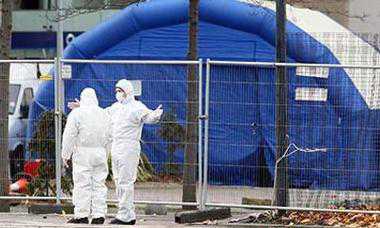
    A car bomb has been left outside the Policing Board headquarters in Belfast, though it has done no serious damage.

    Police HQ

    The 400lb car bomb partially exploded and the back of the vehicle caught fire, with two men seen escaping.

    Chief Constable Matt Baggott said: “It does appear to be a device that has partially exploded, around 400lb.

    “It is a reckless act not just in doing damage but also the potential loss of life.”

    A car was found burned out nearby in the staunchly Republican New Lodge area of the city and police are investigating whether there was any link.

    Mr Baggott added: “This attack is an attack on the well-being of everybody in Northern Ireland, this is not about an attack on policing or the Policing Board, this is an attack on young people and young people’s future.”

    Meanwhile, four people have been arrested after police exchanged gunfire with suspected dissident Republicans in County Fermanagh, Northern Ireland.

    The incident took place close to the border with the Irish Republic in Garrison. It is understood that the incident was an attempt to kill a police officer who lives in the village.

    Mr Baggott said that officers fired two warning shots, which are being investigated by Police Ombudsman Alan Hutchinson.

    He added that his officers had been fired at during the exchange.

    Northern Ireland Secretary Paul Goggins said: “When attacks like these happen it brings people together with the strong message that these dissidents will not succeed.

    “Policing will continue in Northern Ireland and progress will continue.”

    The Policing Board is made up of independent members of the community and politicians who hold police to account through regular public meetings.

    SKY Logo