Tag: United Nations

  • Uighur protests as China’s Xi Jinping visits Turkey

    Uighur protests as China’s Xi Jinping visits Turkey

    Activists from China’s Muslim Uighur minority burnt Chinese flags in Ankara on Tuesday where China’s leader-in-waiting Xi Jinping was holding talks with Turkish officials on regional issues.

    About 60 Turkic-speaking Uighurs from China’s northwestern Xinjiang province protested outside the hotel where Xi was staying in the Turkish capital on the last leg of a trip that also took him to the United States and Ireland.

    Xi, almost sure to succeed Hu Jintao as president in just over a year, praised Turkey’s role in trying to resolve issues such as the Iranian nuclear dispute and Middle East conflicts.

    Waving the flag of East Turkestan, pale blue with a white star and crescent, the protesters burnt a Chinese flag and a poster of Xi before police moved in to disperse them.

    Rights groups accuse China of abuses during a crackdown after Uighur riots in 2009 and Turkish Prime Minister Tayyip Erdogan then described the events as a “genocide”.

    Turkey is home to thousands of Uighurs who have fled Xinjiang since the Chinese Communists took over the region in 1949.

    Xi said China had made great strides to raise the living standards of all ethnic groups in Xinjiang.

    Turkey and China are at either end of a political and economic axis stretching along the old silk road though Central Asia, Iran and Afghanistan. Both have strong, sometimes competing economic interests in the region.

    Turkey, now the world’s 16th biggest economy and only second to China in growth last year, has projected itself as a stable Muslim democracy, making it a key player at a time of turmoil and unrest in the Middle East.

    “A member of the G20 with a growing economy and an important country in the Middle East, Turkey has for a long time tried to bring stability and development to the region and played an active role in trying to solve ‘hot’ issues,” Xi told Turkey’s Sabah newspaper listing Afghanistan, the Iranian nuclear and Middle East peace efforts.

    BILLION DOLLAR DEALS Turkey has sought to mediate between the West and Iran in a dispute over Iran’s nuclear programme and has broadly shared China’s opposition to stronger sanctions against Tehran.

    But on Syria their positions have been sharply at odds. While Turkey has taken a leading role in pressuring Syria’s President Bashar al-Assad to step down, China, along with Russia, this month blocked a draft U.N. Security Council resolution that backed an Arab plan urging him to quit.

    China has also not decided whether to accept an invitation to discuss Syria with other world powers this week in Tunisia, a meeting Turkey’s foreign minister will attend and Ankara hopes will keep up pressure for Assad to step down. Xi met President Abdullah Gul on Tuesday and signed seven bilateral economic agreements.

    The central banks of Turkey and China signed a three-year currency swap agreement worth $1.6 billion which will be effective for three years, both sides said. The two countries could discuss extending its maturity after that.

    China has signed a series of bilateral currency agreements with foreign countries as part of efforts to promote the use of the yuan in cross-boarder trade and investment.

    The Turkish energy ministry also said China’s Avic International and Turkey’s Hema Endustri, a Turkish engineering manufacturing company, will sign a $1 billion deal for power plant and coal production equipment.

    Energy Minister Taner Yildiz said the agreement could lead to cooperation with China on building Turkey’s first nuclear power plant. Xi later travelled to Istanbul for talks with Erdogan, who is recovering from surgery at home there. Citing prime ministerial officials, Turkish state media said the two men met for one hour where they agreed to increase economic cooperation.

    During the meeting, which was closed to the media, Erdogan accepted a formal invitation by Xi to visit China and said he would travel there in the coming months, state-run Anatolian news agency reported. On Wednesday, Xi attends a business forum in Istanbul, where he is likely to be assailed by exporters eager to try to bridge a gaping trade gap. China is Turkey’s 15th biggest export market with nearly $2.5 billion of Turkish goods sold there last year, a rise of 8.7 percent. But some $21.6 billion worth of Chinese goods were imported to Turkey in 2011, up 26 percent from 2010.

    via Uighur protests as China’s Xi Jinping visits Turkey – World – DNA.
  • UPDATE 3-Uighur protests as China’s Xi visits Turkey

    UPDATE 3-Uighur protests as China’s Xi visits Turkey

    * Turkish PM called 2009 Chinese crackdown on riots “genocide”

    * Uighur protesters burn Chinese flag, Xi poster

    * China is Turkey’s 15th biggest export market

    * Erdogan says will visit China in coming months (Adds meeting with Erdogan)

    By Tulay Karadeniz

    ANKARA, Feb 21 (Reuters) – Activists from China’s Muslim Uighur minority burnt Chinese flags in Ankara on Tuesday where China’s leader-in-waiting Xi Jinping was holding talks with Turkish officials on regional issues.

    About 60 Turkic-speaking Uighurs from China’s northwestern Xinjiang province protested outside the hotel where Xi was staying in the Turkish capital on the last leg of a trip that also took him to the United States and Ireland.

    Xi, almost sure to succeed Hu Jintao as president in just over a year, praised Turkey’s role in trying to resolve issues such as the Iranian nuclear dispute and Middle East conflicts.

    Waving the flag of East Turkestan, pale blue with a white star and crescent, the protesters burnt a Chinese flag and a poster of Xi before police moved in to disperse them.

    Rights groups accuse China of abuses during a crackdown after Uighur riots in 2009 and Turkish Prime Minister Tayyip Erdogan then described the events as a “genocide”. Turkey is home to thousands of Uighurs who have fled Xinjiang since the Chinese Communists took over the region in 1949.

    Xi said China had made great strides to raise the living standards of all ethnic groups in Xinjiang.

    Turkey and China are at either end of a political and economic axis stretching along the old silk road though Central Asia, Iran and Afghanistan. Both have strong, sometimes competing economic interests in the region.

    Turkey, now the world’s 16th biggest economy and only second to China in growth last year, has projected itself as a stable Muslim democracy, making it a key player at a time of turmoil and unrest in the Middle East.

    “A member of the G20 with a growing economy and an important country in the Middle East, Turkey has for a long time tried to bring stability and development to the region and played an active role in trying to solve ‘hot’ issues,” Xi told Turkey’s Sabah newspaper listing Afghanistan, the Iranian nuclear and Middle East peace efforts.

    BILLION DOLLAR DEALS

    Turkey has sought to mediate between the West and Iran in a dispute over Iran’s nuclear programme and has broadly shared China’s opposition to stronger sanctions against Tehran.

    But on Syria their positions have been sharply at odds.

    While Turkey has taken a leading role in pressuring Syria’s President Bashar al-Assad to step down, China, along with Russia, this month blocked a draft U.N. Security Council resolution that backed an Arab plan urging him to quit.

    China has also not decided whether to accept an invitation to discuss Syria with other world powers this week in Tunisia, a meeting Turkey’s foreign minister will attend and Ankara hopes will keep up pressure for Assad to step down.

    Xi met President Abdullah Gul on Tuesday and signed seven bilateral economic agreements.

    The central banks of Turkey and China signed a three-year currency swap agreement worth $1.6 billion which will be effective for three years, both sides said. The two countries could discuss extending its maturity after that.

    China has signed a series of bilateral currency agreements with foreign countries as part of efforts to promote the use of the yuan in cross-boarder trade and investment.

    The Turkish energy ministry also said China’s Avic International and Turkey’s Hema Endustri, a Turkish engineering manufacturing company, will sign a $1 billion deal for power plant and coal production equipment.

    Energy Minister Taner Yildiz said the agreement could lead to cooperation with China on building Turkey’s first nuclear power plant.

    Xi later travelled to Istanbul for talks with Erdogan, who is recovering from surgery at home there. Citing prime ministerial officials, Turkish state media said the two men met for one hour where they agreed to increase economic cooperation.

    During the meeting, which was closed to the media, Erdogan accepted a formal invitation by Xi to visit China and said he would travel there in the coming months, state-run Anatolian news agency reported.

    On Wednesday, Xi attends a business forum in Istanbul, where he is likely to be assailed by exporters eager to try to bridge a gaping trade gap.

    China is Turkey’s 15th biggest export market with nearly $2.5 billion of Turkish goods sold there last year, a rise of 8.7 percent. But some $21.6 billion worth of Chinese goods were imported to Turkey in 2011, up 26 percent from 2010. (Additional reporting by Jon Hemming, Orhan Coskun and Jonathon Burch; Writing by Jon Hemming; Editing by Maria Golovnina)

    via UPDATE 3-Uighur protests as China’s Xi visits Turkey | Reuters.

  • Clinton hosts summit on religious intolerance

    Clinton hosts summit on religious intolerance

    By Josef Kuhn| Religion News Service, Published: December 15

    WASHINGTON — Secretary of State Hillary Clinton wrapped up a summit of international leaders this week to explore specific steps to combat intolerance, discrimination and violence on the basis of religion or belief.

    The closed-door meeting on Wednesday (Dec. 14) was the first of an ongoing series called “The Istanbul Process.” Representatives came from 30 countries and international organizations, including Egypt, Indonesia, Saudi Arabia and Pakistan.

    “We are working together to protect two fundamental freedoms — the right to practice one’s religion freely, and the right to express one’s opinion without fear,” Clinton said in her closing remarks.

    The goal of the Istanbul Process is to produce a list of best practices for preventing religious discrimination and violence. Ambassador Michael Kozak, a deputy assistant secretary of state, acknowledged that the list would be helpful primarily for countries that already have the political will to protect religious freedom but need practical guidance to do so.

    Nevertheless, Kozak said, it could also put pressure on repressive regimes to loosen up.

    “By itself, this isn’t going to change their minds. But … the more countries you get starting to do things in a good way, the more isolated the others become, and then movements develop in their own countries,” Kozak said.

    The Istanbul Process grew out of a resolution adopted by the United Nations Human Rights Council in March and then by the U.N. General Assembly in November.

    Resolutions in the previous 10 years had supported legal measures restricting the “defamation of religions.” The more recent Resolution 16/18, however, broke with that tradition by calling for concrete, positive measures to combat religious intolerance rather than legal measures that restrict speech.

    “It is important that we recognize what we accomplished when this resolution ended 10 years of divisive debate where people were not listening to each other anymore. Now we are. We’re talking,” said Clinton.

    The new resolution has faced criticism from conservatives who think it amounts to a concession to Islamic countries, and will result in the curtailing of any speech that is critical of Islam.

    After Clinton’s speech, Andrea Lafferty, president of the Traditional Values Coalition, said her organization has been denied entrance to conferences and hotels for fear of “incitement to violence,” a phrase used in Resolution 16/18.

    “We remain concerned about the use of that language,” Lafferty said.

    Kozak tried to dispel her fears.

    “That whole issue of incitement got debated a lot, and we were clear all along that what we meant by incitement was when … the speech is part of an act,” he said. “It’s a very narrow concept.”

    via Clinton hosts summit on religious intolerance – The Washington Post.

  • D.C. Islamophobia Conference Was a Bad Idea

    D.C. Islamophobia Conference Was a Bad Idea

    By Nina Shea

    Yesterday marked the opening of the international conference announced by Secretary of State Hillary Clinton at a high-level meeting on Islamophobia that she co-chaired, held last July in Istanbul and hosted by the Saudi-based Organization of Islamic Cooperation (OIC). At the time, Secretary Clinton described this week’s conference as a move to implement U.N. Human Rights Council Resolution 16/18 on “combating [religious] intolerance, negative stereotyping and stigmatization.”

    This State Department conference, entitled “The Istanbul Process,” is proving to be a very bad idea. It remains to be seen whether speech limitations to protect religion generally and Islam specifically will be officially endorsed by the conference — similar recommendations have already been adopted by the OIC and by the EU conference participants — but, judging from the opening session, at least some of my misgivings seem well founded.

    The three-day conference was closed to the public, but I was invited to its opening session (as well as to the closing session to be held on Wednesday) by virtue of my being a commissioner on the official but independent U.S. Commission on International Religious Freedom. “Chatham House Rules,” which State directed us to abide by, forbid releasing anything about a specific delegation or quoting for attribution.

    To speak more generally, then: Legal and security officials of a delegation which will remain unnamed gave a sweeping overview of American founding principles on religious freedom and how they have been breached time and again in American history by attacks against a broad variety of religious minority groups — including now against Muslims. A raft of current cases were mentioned; America’s relative exemplary and distinctive achievement in upholding religious freedom in an emphatically pluralistic society was not. That same speaker reassured the audience, which was packed with diplomats from around the world, that the Obama administration is working diligently to prosecute American Islamophobes and is transforming the U.S. Justice Department into the conscience of the nation, though it could no doubt learn a thing or two from the assembled delegates on other ways to stop persistent religious intolerance in America.

    Across the room, smirking delegates from some of the world’s most repressive and intolerant regimes could be spotted, furiously taking notes.

    The Saudi Justice Minister was recently in the U.S. but unfortunately departed before the conference opened and won’t be making any presentation on how the Saudis stop religious intolerance. Nor will his delegation be making any apologetic mention of the Saudi ban on churches, its repression of its large indigenous Shiite population, its textbooks teaching that Jews should be killed, or its beheading yesterday of a woman for sorcery, in addition to another recent beheading of a Sudanese man for the same crime.

    Meanwhile, at U.N. headquarters in New York, a new resolution following on 16/18 has been introduced by the OIC and will soon be voted on by the General Assembly, where it will no doubt passed with U.S. approval. It singles out for praise regarding the promotion of religious tolerance one state — Saudi Arabia.

    — Nina Shea is director of Hudson Institute’s Center for Religious Freedom and co-author with Paul Marshall of Silenced: How Apostasy & Blasphemy Codes Are Choking Freedom Worldwide.

    via D.C. Islamophobia Conference Was a Bad Idea – By Nina Shea – The Corner – National Review Online.

  • Turkey Waltzes With Itself in Vienna

    Turkey Waltzes With Itself in Vienna

    By Goran Mijuk

    Vienna–It takes two to tango. But Turkey choose to waltz with itself at the World Policy Conference in Vienna, where political and industrial leaders stressed the need for increased partnerships around the globe.

    Emboldened by the country’s growing global economic importance and political levy in the fast-changing Arab world, Turkish President Abdullah Gül this weekend called for the European Union and United Nations to adapt to new realities.

    Embittered that talks to join the E.U. are being blocked by a number of countries, including France and Germany, Gül blamed the eurozone for having failed to play up to its own rules and called on the United Nations to reform its structure to reflect the growing importance of emerging economies.


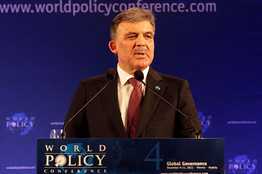
    Turkey’s President Abdullah Gül makes a speech at the opening of the World Policy Conference at the historic Hofburg palace in Vienna December 9, 2011.
    Turkey’s President Abdullah Gül makes a speech at the opening of the World Policy Conference at the historic Hofburg palace in Vienna December 9, 2011.


    All but pointing to Turkey as a potential new member of a revamped U.N. Security Council, Mr. Gül also offered the country as a role model and “inspiriation” for the Arab world, touting Turkey’s tradition of religious freedom, secularism and openness, much in line with the high-flung visions traded at the Vienna meeting.

    Mr. Gül failed, however, to impress. Amr Moussa, former Secretary General of the League of Arab States and presidential candidate in Egypt, said at the meeting that Turkey won’t serve as a role model for the Arab world. Instead, he called for a new vision of democracy in countries such as Tunisia, Egypt and Libya.

    Mr. Moussa defended the need for deep-rooted and serious change in the Arab world. But he invited Israel too to adapt to the new realities that are emerging out of the “Arab Spring”. Mr. Moussa stopped short of making concrete demands, in line with a cautious diplomatic tactic that tries to bring all interest to the negotiating table.

    Mr. Gül chose to be less diplomatic. Instead of joining a lunch with Israel’s Defense Minister Ehud Barak on Friday and mend broken ties with the country, Turkey’s president took a stroll through Vienna and visited a mosque in the city.

    According to media reports, Mr. Gül also took precautions to avoid meeting Mr. Barak in person in Vienna. The Israeli Minister retorted by leaving the Hofburg conference hall when Mr. Gül started his lament on the poor state of the E.U. and U.N.

    Mr. Gül’s attitude can be explained by recent politics. Ties between the two countries have worsened ever since nine Turks were killed in 2010 when they tried to break Israel’s naval blockage of Gaza. Nothing has improved since as Israel has refused to officially apologize for the 2010 incident.

    But a potential role model should act differently. Mr. Gül’s criticism of the E.U. and the U.N. would have carried more weight had he taken the opportunity to talk to Mr. Barak, especially during an informal lunch behind closed doors.

    Instead of adding credibility to Turkey’s claim of being a modern, open society that plays up to global standards and even exceeds them in many aspects, Mr. Gül’s chose to waltz with himself, risking to step on many feet in the process.

    This is simple power politics, not inspiration.

    via Turkey Waltzes With Itself in Vienna – Emerging Europe Real Time – WSJ.

  • Turbo State Turkey!

    Turbo State Turkey!

    This is how the German magazine Stern views Turkey on the 50th anniversary of the first arrival of (permanent) guest Turkish workers: Turbo-Staat Turkei. A vibrant economy and a remarkable transformation from the days of almost extreme poverty 50 years ago; the Bosporus now glittering with wealth and every other possible euphemism for the “Turkish miracle.”

    The Germans have always been good at making cars. I trust they should know that a turbo-speeding car does not always guarantee a safe and comfortable drive for its passengers, especially when its other mechanical parts suffer major faults. Nor does the size of the car matter for a happy ride – on a ceteris paribus scale, who would wish to live in extra-turbo state India and who, in the much smaller-engined and not-so-turbo Holland?

    With all due respect for the world-renowned German expertise in the motor industry, I shall try to complete the assessment of the “Turbo State Turkey” with independent facts and figures:

    According to the UNDP’s Human Development Report “Sustainability and Equity: A Better Future for All,” released last week, Turkey stands at a not-so-turbo 92nd out of 187 countries in its human development ranking. The report notes that Turkey’s human development index is below the average for countries in the high human development group and below the average for countries in Europe and Central Asia. Central Asia!

    UNDP’s gender inequality index puts Turkey at the 77th place out of 146 countries. In Turkey, the report notes, women hold 9.1 percent of parliamentary seats, and (as low as) 27.1 percent of adult women have reached a secondary or higher level of education compared to 46.7 percent of their male counterparts. Female participation in the labor market is 24 percent compared to 69.6 percent for men.

    Earlier this year, the World Economic Forum’s 2011 report had put Turkey at the 122nd place out of 134 countries – the lowest ranking in Europe in women’s access to education, economic participation and political empowerment. What other “turbo” effect?

    According to the World Press Freedom index issued by the Paris-based advocacy group Reporters Without Borders, Turkey ranks 138th out of 178 countries, sporting a record number of journalists in jail, higher than in China and Iran. The Freedom to Journalists Platform, a Turkish group, lists 68 journalists in jail on charges that it says violate freedom of expression, including charges about a book not even published.

    The economy may be turbo at speed, but it is not equally reliable in sustainability. Forget the huge current account deficit. According to the U.N.’s Economic Freedom Index, Turkey is the world’s 67th freest economy, and it ranks 30th out of 43 countries in the European region.

    And the turbo speed comes with some motor faking, too. According to Transparency International, a leading anti-corruption organization, Turkey’s corruption ranking is at the 56th place out of 91 countries measured. Turkey’s ranking is worse than Namibia, Oman, Brunei, Bhutan, China, Botswana and the United Arab Emirates.

    Not surprisingly, Freedom House has put Turkey at 116th place out of 153 countries, labeling the turbo democracy as “partly free.” And the Economist Intelligence Unit’s Democracy Index 2010 gave Turkey 89th ranking out of 167 countries. In this list, Turkey ranks behind Lebanon, Honduras, Ecuador, Albania, Bangladesh, Mali, Ghana, Lesotho, Guyana, Benin, Namibia, Mongolia, Papua New Guinea, Timor-Leste, China and Botswana.

    Turkey’s democratic credentials, coming under the tag “hybrid regime,” is one category below the tag “flawed democracy.” So, the turbo state is not even a flawed democracy. This is, sadly, the real motor quality behind the shining armor of the turbo state Turkey.

    All the same, the choice between extreme doses of economic instability and democratic malfunctioning is entirely personal. Today, I got a sad letter from a great friend who lives on the other side of the Aegean. “Where is it better to live?” the friend was asking, now having to choose between Greece and somewhere south across the Atlantic. “In a failed democracy that does well in the economy, or in a failed economy that manages somewhat better in democracy?” Difficult question. “Now I know the answer,” he wrote. I am not sure he does.

    via Turbo State Turkey! – Hurriyet Daily News.