Tag: Recep Tayyip Erdogan

12th president of Turkey

  • The FETULLAH is the key force supporting Turkey’s ruling AKP Party

    The FETULLAH is the key force supporting Turkey’s ruling AKP Party

    Gülen movement an enigmatic mix of Turkish nationalism, religion, education

    Tim Steller Arizona Daily Star

    Sunday, April 25, 2010

    American sociologist Joshua Hendrick stumbled into the U.S. branch of the Fethullah Gülen Movement by agreeing to attend a 2005 conference about the Turkish Muslim leader in Houston.

    Expecting a standard academic conference, what he found instead was a ‘two-day promotion of Fethullah Gülen and the schools and social network that associate with his teaching.’

    All the presenters’ expenses were covered, and each received a $500 honorarium. Awards of $1,000 were offered for the best graduate-student papers, and reporters were flown in from Istanbul to cover the event.

    Hendrick, now at the University of Oregon, went on to write a Ph.D. dissertation on the Gülen movement in Turkey, where the secretive preacher has over decades become one of Turkey’s most powerful political figures. The Gülen movement is the key force supporting Turkey’s ruling AKP Party, a conservative religious party that competes for power with the country’s strongest traditional force – the military.

    Along with the military and the AKP, the Gülen movement is Turkey’s “third force,” the major British consultancy IHS Jane’s reported last year.

    But defining the movement is difficult because it is “part spiritual, part commercial, part Islamic, part education, part political,” Bill Park, a lecturer in defense studies at King’s College London, said via e-mail.

    Gülen’s followers and the leader himself use “strategic ambiguity” in talking about the movement, Hendrick wrote in his 2009 dissertation, “Globalization and Marketized Islam in Turkey: The case of Fethullah Gülen.”

    “Gülen was born both in 1938 and in 1941 … Gülen is both the reason behind his schools and he has nothing whatsoever to do with them,” Hendrick wrote. And when asked about the connections between Gülen-supporting organizations and the movement itself, Hendrick repeatedly heard the same answer: “There is no organic connection between these institutions.”

    The ambiguity makes some sense in historical context. The Turkish state established by Mustafa Kemal Atatürk in the 1920s imposed secularity in the public sphere and put religion under state control. Today the struggle persists between a secularist military and religious forces, with the Gülen movement strongly on the religious side.

    The movement “would like to see Islam play a more dominant role in public life,” said Hakan Yavuz, a native of Turkey who is a professor of political science at the University of Utah. “The movement is today a religio-political movement similar to Opus Dei in the Catholic Church.”

    Yavuz continued, “The movement is not a fanatic movement. It’s also not a terrorist movement either. But it is a conservative communitarian (movement) and to some extent authoritarian.”

    The movement also celebrates the Turkish nation and culture, even in some foreign countries where it has established schools, posting portraits of Atatürk and teaching the Turkish national anthem, Park reported in a 2007 paper, “The Fethullah Gülen Movement as a Transnational Phenomenon.”

    “The movement’s philosophy fuses its brand of Islam with a Turkish nationalism,” he wrote in a 2007 paper.

    Gülen’s conflict with the military peaked in 1998, when he was charged with attempting to subvert the secular government. He fled to the United States, where he began living in exile on a retreat in eastern Pennsylvania.

    In the United States, Gülen began emphasizing interfaith dialogue, and his followers set up institutions dedicated to that pursuit throughout the country. One, the Foundation for Inter-Cultural Dialogue, is based in Phoenix and annually sends Arizonans on trips to Turkey.

    Gülen’s presence in the United States inspired some Turkish analysts to begin thinking of him as an American ally. However, the U.S. government has long had close relations with Turkey’s military.

    The multifaceted picture of Gülen’s relationship with the U.S. government became clearer in 2007. That year, Gülen sued the Department of Homeland Security (FBI), arguing that it should act on his application and award him permanent residence based on his extraordinary ability in education. The department fought him, arguing that he is not an expert in education.

    But eventually the department lost, and Gülen got his green card.

    Among those who wrote letters in support of Gülen were George Fidas and Graham Fuller, both former Central Intelligence Agency (CIA)officials.

    “The U.S. has accommodated Fethullah Gülen himself (a source of irritation to Kemalist/secularists in Turkey) and the movement’s schools, colleges, dialogue associations, as has the U.K. and other Western democracies,” Park said via e-mail. “This is though less the doing of the U.S. government, narrowly defined as of U.S. society, the U.S. way of doing things.”

    Contact reporter Tim Steller at 807-8427 or at [email protected]

  • UTAH CLOSES FETULLAH’S SCHOOL

    UTAH CLOSES FETULLAH’S SCHOOL

    Utah daki Charter okul incelemeye alinmis acik cikan (KAYIP) para yuzunden, FETULLAHIN BIR DENIZ FENERI DAHA.

    State charter board votes to close Beehive academy

    Money matters» State governing body concludes that the school is financially unstable.

    By Rosemary Winters

    The Salt Lake Tribune

    Updated: 04/30/2010 10:10:16 AM MDT

    For the first time in its six-year history, the Utah Charter School Board has voted to revoke an operational school’s charter.

    Beehive Science & Technology Academy in Holladay will close after this school year unless it files and wins an appeal. Any appeal would be heard by the Utah Board of Education.

    The charter board, which voted 6-0 on Thursday to close the school, said Beehive doesn’t have enough students to be financially viable and is burdened by debt. The enrollment currently is 199, but the school could accommodate 250 students.

    In an e-mail, Principal Murat Biyik said the board relied on outdated financial statements to make its decision and that the school plans to appeal.

    “All of us were totally shocked” by the board’s decision, Biyik wrote, noting he was denied permission to speak at the meeting. “We are very optimistic that we will save the school during [the] appeal process.”

    Beehive was placed on a one-year probation in February, and Biyik said the school has complied with or made “substantial improvements” on all the issues the board identified. For example, the school has addressed concerns with its special-education program.

    Charter board chairman Brian Allen said the decision made him “heart sick” because he knows Beehive’s students like their school, which has a good academic record.

    “At the end of the day, we had to weigh the impact to the students who go to the school against our responsibility that taxpayers are getting the best deal for their money,” Allen said. “The scale tipped toward taxpayers.”

    Beehive, which serves grades 7 through 12, was founded by a group of Turkish-American scholars. It opened in August 2005.

    Last fall, the charter board, after a months-long investigation, cleared Beehive of allegations the school existed to advance and promote Islamic beliefs but flagged it for poor financial management. Charter schools are tuition-free, tax-funded public schools so they must be nonsectarian.

    In November, records obtained by The Salt Lake Tribune showed that the school, operating on a $2 million annual budget, had a $337,000 deficit. The school renegotiated its building lease and laid off several staffers.

    On Thursday, Biyik said the deficit has shrunk substantially. Currently, the school has an income balance of $259,000 with $38,000 in the bank, he said. The difference has been used to pay off credit lines, a state revolving loan amount and other debts, Biyik said. The academy still owes money on the revolving loan, which originally was $184,000.

    But if the board’s decision sticks, Beehive students will have to find a new school for the 2010-11 school year.

    “It’s the most frustrating thing. I don’t know where to send my son,” said Marie Jess, whose son Jordan started at Beehive as a seventh-grader and now is finishing 11th grade. “I’ve never found a [public or charter] school that I felt compared to Beehive.”

    Jess called the board’s decision “unfair.” She hopes the school, which has achieved high scores on state academic tests, stays open.

    She likes the support she receives from Beehive’s faculty, who frequently send her e-mails to update her on how her son is doing.

    “I felt like they personally wanted my son to succeed,” she said, “and that’s a good feeling.”

    =========================

    From: FLTURK@yahoogroups. com  On Behalf Of Cuneyt Oskal

    Sorun Gulen hocada degil zaten.

    Sorun, “Parayi gordum” filminin senaristleri Fethullahci bazi abilerde.

    Topladiklari parayi istedikleri yere harcayabilmeyi zannetmelerinde.

    Utah daki Charter okul incelemeye alinmis acik cikan para yuzunden

    bakalim o sorusturmanin sonucu nasil olacak?

    insallah Fethullahci abiler yuzlerinin aki ile cikarlar isin icinden

    yoksa…….

    “Parayi gordum” filmini cekerler Fethullahci abilerinde

    (Mahsun in trilogy si olabilir belki, “gunesi gordum” den sonra:)

    Deniz Feneri olayina donerse is cok uzulurum.

  • How A Court Case Was Won In France Against A Dashnak

    How A Court Case Was Won In France Against A Dashnak

    Maxime Gauin
    Paris, May 2, 2010

    © This content Mirrored From  http://armenians-1915.blogspot.com © This content Mirrored From  http://armenians-1915.blogspot.com
    © This content Mirrored From  http://armenians-1915.blogspot.com © This content Mirrored From  http://armenians-1915.blogspot.com © This content Mirrored From  http://armenians-1915.blogspot.com

    “We live in fact for some moments, intense and special; the rest of the time, we wait these moments.”

    Edgar Faure (1908-1988), French lawyer and statesman.

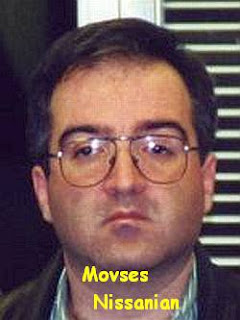
    On April 27, the Lyon’s tribunal declared Movsès Nissanian, municipal counselor of Villeurbanne (biggest city of Lyon’s suburb) member of Armenian Revolutionary Federation (ARF-Dashnak), guilty of “public insult against an individual” (me) and sentenced him. As a preliminary information, I have to say the following:

    — Lyon is comparable to Boston in USA for the influence of Armenian nationalism, and the ambiance in Villeurbanne could be compared, by some aspects, with New Jersey’s ambiance. The mayor and former MP, Jean-Paul Bret, has some common points with US Senator Robert J. Menendez.

    — I received no support from Lyon’s Turkish associations for the costs, or any other aspects, of my court case.

    — As a MA student in history, I sued Mr. Nissanian to defend my dignity and the freedom of speech, against the political misuse of history.

    I) Background: the facts, the procedure, the collateral incidents

    .

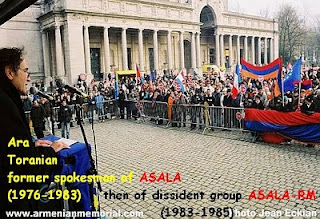
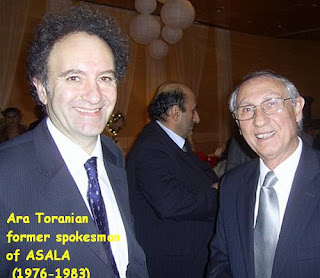
    February 15, 2008. During a meeting about the Sirma Oran affair, Movsès Nissanian says that I am exactly like “those who sent Jews to Auschwitz” during the WWII. He says that because I wrote an article, published on the Web, criticizing the mayor of Villeurbanne (who harassed Sirma Oran by his questions about the so-called “genocide”) and the ARF (for his crimes of the past, including terrorism and massacres of Muslims and Jews). I signed the article by initials only, to remain quiet, but my name was revealed on the free-access forum of armenews.com, first French-Armenian Web site. His editor-in-chief is Ara Toranian, former spokesman of ASALA (1976-1983) then of dissident group ASALA-RM (1983-1985).

    May 15, 2008. I file a complaint in Lyon’s tribunal.

    June 2008. The Lyon’s prosecutor opens a criminal investigation.

    October 21, 2008. I file a complaint in the police station of my Parisian district, against vitriolic messages who insult and defame me, on the forum of armenews.com. I sent before several e-mails to Mr. Toranian, but he did not respond, so I take my promise to complaint. Less than seven hours after that, Mr. Toranian destroys for ever his dear free-access forum. Even some of his friends asked to him, before my complaint, to close this forum, because it was full of racist, anti-Semitic and anti-homosexual messages, several with direct incitation to physical violence, including murder.

    December 2008 (I do not remember the precise date). I give to the chief of Lyon’s investigative magistrates, in charge of my complaint, the record of Mr. Nissanian’s statements during the meeting of February (Jean-Patrick Martz, husband of Sirma Oran, was in the room and recorded the speeches). The record is later authenticated by an expert, because a demand of Mr. Nissanian.

    July 31, 2009. The procedure is completely finished. Both the chief of investigative magistrates and the deputy prosecutor ask that Mr. Nissanian be sent in front of Lyon’s tribunal for “public insult against an individual”.

    September 9, 2009. The trial is fixed to November 3.

    End of October 2009. Mr. Nissanian’s lawyer, Xavier Vahramian, files his written conclusions: 18 pages, plus 33 pieces, mostly about the so-called “genocide”; Mr. Nissanian lawyer argues that since I “denied the genocide”, I am guilty of “provocation”, as defined by law, and that, as a result, Mr. Nissanian must be not sentenced. He adds that “ARF did never use terrorism” and even that “ARF has always condemned terrorism”. The defense lawyer filed nothing during more than one year of investigation. It is now too late to make an appropriate response. Me and my lawyer ask that the trial be postponed; the tribunal accepts and fixes the date to January 5.

    One can notice that the accusations of war crimes against Muslim and Jewish civilians, perpetrated by ARF members from 1914 to 1922, were never challenged, or even mentioned, by Mr. Nissanian or his lawyer, during the whole procedure.

    November 3, 2009. Oran vs. Bret trial. The ambiance is terrible. I am scolded upset when I am leaving the tribunal’s room, by fanatic young Dashnaks (it is fair to add that few others young Dashnaks were unaggressive and expressed their disapprobation to such an aggressive attitude). I prevent insult and assault only in asking: “Do you want take the place of Mr. Nissanian?” I file a “main courante” (complaint without legal consequence) in the police station of my Parisian district, in coming back to my home.

    November-December 2009. In French National Library, I search extensively in the archives of Haïastan, official newspaper of young Dashnaks and France-Arménie, monthly edited by Dashnaks of Lyon; I photocopy many articles supporting stridently terrorism. During the same time, I write a draft of response, about Dashnak crimes (terrorism of 1890’s and 1900’s years; terrorism of interwar period; collaboration with Nazism; terrorism of 1970’s and 1980’s; celebration of terrorism until today) and about the allegations of “genocide”, using writings of Feridun Ata, Donald Bloxham, Gwynne Dyer, Edward J. Erickson, Yusuf Halaçog(lu, Hilmar Kaiser, Guenter Lewy, S,inasi Orel and Sürreya Yuca, Stanford J. Shaw, Philip H. Stoddard, Malcom E. Yapp and others. My lawyer makes with this draft two appendixes for the revised version of his written conclusions (the first was established in October 2009). Written statements of Türkkaya Ataöv, Mumtaz Soysal and Norman Stone are also filed. I would like express my thanks to these professors.

    January 4, 2010. Ara Toranian publishes on his site armenews.com a defamatory article against me, saying that Movsès Nissanian was right in saying that I have the same mentality of those who sent Jews to Auschwitz. Immediately, I sent an e-mail to him, threatening to make a new court case. Less than one half-hour, he answers that to prevent any misunderstanding about his intentions, he is deleting the article (and keeps his promise).

    II) The trial of January 5, 2010, and its consequences

    The trial happens in front of the same tribunal than for Oran vs. Bret case. However, the ambiance is much more quiet for this trial that on November 3. Not a single young Dashnak, and less activists in general. All are calm — excepted one, expelled by the president in the beginning of my statement. I speak about terrorism: nobody screams. I say that Mr. Toranian was president of the “National Armenian Movement for ASALA” (I say that because Mr. Nissanian used one of his articles for his defense); Mr. Toranian is three or four meters behind me; he says absolutely nothing. The president asked to everybody to be short, so I say almost nothing about “genocide” claims, just quoting Hilmar Kaiser’s praising of Yusuf Halaçog(lu.

    Movsès Nissanian’s lawyer asks few question to me, but no one about history. My lawyer asks to his colleague of defense: “You asserted in your written conclusions that ‘ARF has always condemned terrorism’; did you file a single piece proving that?” No reply. My lawyers asks then to Mr. Nissanian if he regrets to have used such words against me. The defendant answers that yes.

    Later during the trial, the president says: “the tribunal has not to decide between historical thesis”.

    As usual in French procedure, the last word is for the defendant. In his short final declaration, Mr. Nissanian says: “I reprove these acts of terrorism” used by ARF and ASALA.

    Mid-January 2010. Clash in the staff of France-Arménie, which published my account of trial on its Web site. Readers are chocked by what Mr. Nissanian said about terrorism, and call him a “coward”, a “shame” for ARF. Both my account and the comments are finally deleted, and the editor-in-chief, the passionately anti-Turkish racist Laurent Leylekian is furious because this incident.

    III) The judgment: some commentaries

    It is pronounced on April 27. The full text is available here:

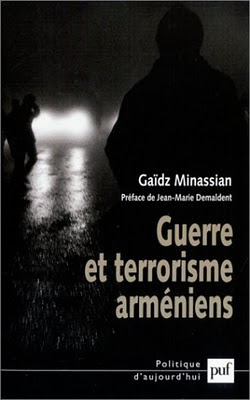
    Even more quiet ambiance than on January 5. No one Armenian media announced the date of the judgment. The tribunal rejects the excuse of provocation, arguing that such an excuse needs to be a direct and personal attack against the person who insult, and must be made few time before that the insult happens. No allusion to “genocide” claims in the discussion of the excuse of provocation. Mr. Nissanian is declared guilty of insult against an individual and sentenced. The president found a judgment of the Cour de cassation (French Supreme court) of April 1908 (!), saying that there is a difference between a “fault” of victim (excessive imprudence in the expression), which decreases the sentence, and the excuse of provocation, which prevents a sentence. In this case, the tribunal argues that it is an unneeded strident formulation to quote Gaïdz Minassian’s critical analysis about Dashnak terrorism (ARF “elevated terrorism until a saint method”, he writes in his book “Guerre et terrorisme arméniens”) in a context which concerns not ARF, but its Villeurbanne’s chapter, not involved in terrorism or in glorification of terrorism. I wanted not to libel this section, but to show the contrast between the repeated ask to Sirma Oran about “genocide” recognition (asks made by the Villeurbanne’s mayor) and the complete absence of ask of “recognition” about crimes perpetrated by ARF; but I did not insist of this point, before and during the tribunal, because I did not know the decision of 1908, and because my lawyer did not think to it.

    So, Mr. Nissanian is sentenced, but to slight punishment: 300 € of suspended fine; 90 € as costs of judgment’s registration; 500 € for me. The president says that “it is a warning” to him.

    Despite the slightness of the sentence, this judgment is terrible for ARF. The “genocide” claims are not accepted, not even discussed; the tribunal confirms by this way that he does not want “decide between historical thesis”.

    The basic accusation of terrorism against ARF is validated; the judgment says that I mentioned “the acts attributable to ARF”, referring, among others, to terrorism. Even the use of jurisprudential notion of “fault” is terrible for ARF: the fundamental contradiction between the Dashnak terrorism on one side, the Dashnak desire of respectability, not the say the Dashnak arrogance in pretending to say what is good, on the other side. Mr. Nissanian escaped to a severe sentence only in substantiating his claims to be not favorable to terrorism, i.e. in saying “I reprove these acts of terrorism”; so, he broken ties with a considerable part of Dashnak activists. But the worst is perhaps that this defeat happened in front of the same tribunal than Mr. Bret’s success against S?rma Oran.

    When I am writing this text, not a single Armenian Web site or forum has been mentioned the judgment; so, even is the sentence is slight, it seems sufficient for a strong symbolic effect.

    As a result of two years of I renounce to nothing and regret nothing; I express my thanks to the thirty persons who I did not know before the judgment, and who sent to me their congratulations for the success in front of Lyon’s tribunal.

    Many other people could make a successful court case, in France as well as in other countries of Western Europe, against Armenian nationalists who use insult or defamation as a political instrument — frequently with more viciousness and perseverance than Mr. Nissanian; one can hope, at least, that I will not remain alone to do that for a long time.

    Maxime Gauin
    Paris, May 2, 2010


    Google Translation Of Maxime gauin’s Article in

    The Theodor Mommsen Villeurbanne
    A misunderstood genius: Jean-Paul Bret
    By Mr. G, lundi11 February 2008

    “Hypocrisy is a tribute that vice pays to virtue. “

    Francois de La Rochefoucauld, Maxims.

    The mayor of Villeurbanne, Mr. Bret is an extraordinary perspicacity. He decided to joint list with the Greens. He asked one of the candidates nominated by the party to “recognize the genocide of Armenia. This person has a Turkish name, she would have called Jeannine Smith, the same question he asked was, no doubt. This person runs. It is not enough for Mr. Bret: he asks her to repeat the “Armenian community” of Villeurbanne. She runs again. It is still not enough for Mr. Bret, which then requires a “recognition” writing.

    Hunting “revisionist”

    For Mr. Bret, anyone denying that the plight of Armenians in 1915-1916 could be a genocide, he said, “Holocaust denier” – even if this dispute does not affect the individual suffering and the magnitude of various crimes. The slightest suspicion that subject can cause the most severe sanctions, the most exemplary. Mr. Guenter Lewy, professor emeritus of political science at the University of Massachusetts, who fled Nazi Germany as a teenager with his family in 1939, is “revisionist”.

    “The three pillars of the Armenian claims, to classify the losses suffered during the First World War as genocide fail to substantiate the charge that the Young Turk regime organized the massacres. Other alleged evidence of a plan of annihilation are no better.

    Apply or not the term genocide to events which occurred here nearly a century may seem unimportant to many historians, but this application – or not – keeps a great political importance. The Armenians and their supporters, such as Turkish nationalists have made claims and defended their cause at the cost of simplification of historical reality, complex, and by ignoring crucial evidence that would lead to a more nuanced view of the past. Scholars have based their professional position on previous work, often ignoring dishonest interpretations of primary sources as they behaved. Against the backdrop of major policy issues, both sides have sought to silence opponents of their views, and to prevent a confrontation of all arguments in this case [1]. “

    Historians specializing in Ottoman history, and whose fame is international, so all are “deniers”, including MM. Bernard Lewis (Jewish), Stanford Jay Shaw (of the Jewish faith), and Gilles Veinstein (born in 1945 in Paris, in a Jewish family).

    “During the rest of the [First World War], much of the Armenian population was killed or fled. […] The Armenians say that these deaths are the result of a policy of genocide implemented by the Ottoman government. […] The minutes of the council of ministers did not confirm this, rather they show great willingness to investigate and improve a situation where six million people (Turks, Greeks, Arabs, Armenians, Jews and others) were killed by a combination of rebellions, attacks by bandits, killings and massacres-cons, famine and diseases, compounded by sudden foreign invasions, in which all peoples of the empire, Muslim and non-Muslims, have counted the victims and criminals. […] After the Revolution [Russian], a truce was signed between the Republic and the Ottoman Empire, but the Armenian units then began a massacre of Turkish peasants generalized still resident in the South Caucasus and eastern Anatolia, where were more than 600,000 refugees, in addition to 2,295,705 Turks living in the provinces of Erzurum, Erzincan, Trabzon, Van and Bitlis after the war [2]. “

    “1) There was no hate campaign aimed directly at the Armenians, no demonizing comparable to European anti-Semitism.

    2) The deportation of the Armenians, although widespread, was not total, and in particular it did not apply to the two main cities of Istanbul and Izmir.

    3) The Turkish actions against Armenians, although disproportionate, were not born from nothing. The fear of a Russian advance into the eastern Ottoman provinces, knowing that many Armenians viewed the Russians as liberators against the Turkish regime and awareness of Armenian revolutionary activities against the Ottoman State, all contributed to create an atmosphere of anxiety and suspicion, aggravated by the situation becoming more desperate by the Empire and the neuroses – oh – usual time of war. In 1914, the Russians formed four large Armenian volunteer units and three others in 1915. These units accounted for many Ottoman Armenians, including some well-known public figures.

    4) The deportation for criminal reasons, strategic or otherwise, had been practiced for centuries in the Ottoman Empire [3]. “

    “Second point: there were also many casualties among Muslims throughout the war, the fighting but also by actions against them by Armenians, in a context of ethnic and national rivalry. If there are victims forgotten, are those, and the Turks of today are right to denounce the bias of Western opinion in this regard. Is it because there were only Muslims that are neglected, or because they implicitly consider that the ultimate success of their peers deprives them of the status of martyrs? What view would carry us so on the same facts, if things had turned out differently, if the Armenians were eventually based on the rubble Ottoman state in Anatolia sustainable?

    But the last point is crucial, debate, its legal and political implications, is whether the massacres perpetrated against the Armenians were the order of the Young Turk government, if the transfers have been a lure for systematic extermination company, implemented in different ways, but decided, planned, RC governmental level, or if the Young Turks were only guilty of recklessly triggered movements which ended in bloodshed. Merely asking the question may seem absurd and outrageous. It is true that state involvement is a prerequisite for the complete application to the Armenian tragedy of the term genocide, as it was coined in 1944 and defined by the Nuremberg Trials and the United Nations Convention of 1948.

    It must however admit that one has so far no evidence that government involvement [4]. “

    Similarly, are counted among the “deniers”, Professor Eberhard Jäckel, one of the leading names of Nazi [5], the UK government [6], the German government [7], the Spanish government, Israeli Parliament [8], the Bulgarian Parliament [9] and the Nobel Peace Shimon Peres. [10]

    Some disgruntled say that Mr. Bret has led a miserable political operation, whose methods disturbingly reminiscent of inquisitorial trials: the repentant heretic in public, and is excluded from the community if it persists in the heresy. Daring to proclaim the truth loud and clear: Mr. Bret is a genius – a misunderstood genius. Although he never made a study of history (like many other “specialists” self-appointed Ottoman history, such as Yves Ternon surgeon), he managed to unmask the “denial,” where is: in scientific research, recognized as such, and the governments of key allies of France. This genius can not be praised enough.

    Dear friends of Mr Bret
    Think! He is already struggling Turkish hydra, but it must also be wary of his friends. Mr. Bret indeed maintains the best relations with the local Armenian Revolutionary Federation (USA-Dashnaktsutiun). For, as amazing as it sounds, this foreign party (or to be absolutely correct its youth branch) has a section villeurbannaise, and also a section of Paris, Lyon, Marseille, Nice, and another in Décines, situated, as Villeurbanne, a suburb of Lyon. If a reader knows a European Turkey section of the PS in the suburbs of Munich, Milan, and Edinburgh, he would write to the association, which will transmit.

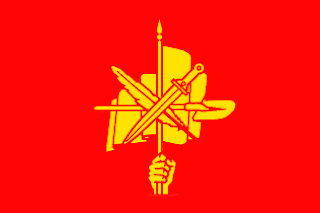
    The heroic and visionary Mr. Bret managed a tour de force: to remain an impeccable democrat, while the friend of the local members of the FRA. Indeed, the FRA has “elevated to the rank of terrorism sacrosanct practice [11]. The list of major terrorist acts in the ARF include:

    the first hostage of the contemporary era, which took place at the Ottoman Bank (Istanbul), August 26, 1896, the stated purpose (and succeeded, unfortunately, beyond all hope) promote violence antiarméniennes, a pretext for intervention further increased the great powers in the Ottoman Empire [12];

    the failed assassination attempt against Sultan Abdul Hamid II in 1905, which killed the founder of the Dashnaktsutyun, Christapor Mikaelian, who died while handling a bomb he was preparing [13];

    the assassination of Bedros Kapamaciyan Mayor Armenian Van, 10 December 1912 [14];

    the massacre of many Muslim civilians between 1914 and 1922 [15];

    the assassination of Archbishop Leon Tourian, head of the Armenian Church in the Americas, New York, December 24, 1933 [16];

    a series of attacks between 1973 and 1985, including the suicide bombing of Lisbon, July 27, 1983, commemorated each year by the FRA [17];

    the twin bombings of August 1, 1993, against Viktor Polianitchko (Russian officer) and General Ossetian Safonov [18] who won, the FRA to be prohibited in Armenia until the election of Mr. Kocharian, a of his friends, as President of the Republic [19].

    The long record of party Dashnak not limited to these terrorist activities, it also includes the pro-Nazi activism of some of its most prominent members, never disavowed activism, but rather glorified, until today, by the direction of FRA. Hairenik, party organ Dashnak United States, has shown its unwavering support and full support to Nazi ideology. The edition of September 17, 1936 states as follows:

    “Then came Adolf Hitler, after fighting worthy of Hercules. He spoke of race in the pulsing heart of the Germans, making the fountain spring of the national genius. “

    A month earlier, on August 19 exactly Hairenik not hesitate to write:

    “It is sometimes difficult to eradicate these harmful [Jews], when they have contaminated up to the root like a chronic illness, and when it becomes necessary for one people [in this case the Germans, or rather Nazis] to eliminate an uncommon method these attempts are regarded as revolutionary. During such surgery, it is natural that the blood flows. Under such conditions, a dictator emerges as a savior. “

    Other members of the FRA are not content to support the Third Reich by words: they gave him the gift of their person. Thus General Ganayan (or Kanayan, according to a transcript of the Armenian alphabet in Latin script), better known by his nickname, Dro, he formed and led the 812th battalion of the Armenian Wehrmacht, the main fact of weapon was the roundup of Jews in occupied Soviet Union [20]. Dro is in the mausoleum since 2000, inaugurated by President Kocharian [21]. In an editorial in April 2001, General Dro Hairenik ranks among the “heroes” of the Armenian people [22], thereby demonstrating his perfect continuity with the line of the 1930 pro-Nazi. Mr. Vahan Hovhannesian, candidate of the ARF in the presidential elections in Armenia, also believes Dro as a “hero” [23].

    It goes without saying that Mr. Bret has asked all his friends from the USA to recognize and condemn, orally then in writing, all of his crimes. It goes without saying that Mr. Bret is necessarily also “committed” to the “recognition” of the “Armenian genocide” as “recognition” of numerous crimes of the FRA, the 1890s to today.

    How? You have not read, heard or seen it in the media, but then not at all? This may be an omission on their part. Just think, a genius like Mr. Bret can not ignore such acts.

    [1] Guenter Lewy, “Revisiting the Armenian Genocide,” Middle East Quarterly, Winter 2005.

    [2] Stanford and Ezel Kural Shaw Jay Shaw, History of the Ottoman Empire and Modern Turkey, New York / London, Cambridge University Press, Volume II, revised edition, 1978, pp. 315-325 (according to Ottoman documents).

    [3] “The explanation of Bernard Lewis,” The World, 1 January 1994.

    [4] Gilles Veinstein, “Three questions about a massacre,” The History, April 1995.

    [5] “But if we take into account the fact that Turks and Kurds have also deplored the heavy loss, and certainly more than combat due to illness, approximately one third of British soldiers Indians and taken prisoner by the Turks in 1916 have died, all this strongly suggests that no genocidal intent existed. “Eberhard Jäckel,” Genozid oder nicht? “Frankfurter Allgemeine Zeitung, March 22, 2006.

    [6] “The evidence is insufficient evidence to convince us that the events should be classified as genocide under the terms of the UN Convention on Genocide of 1948 which, anyway, is not to retroactive application. The interpretation of events in Eastern Anatolia in 1915-1916 is still the subject of genuine debate among historians. “Lady Scott (Foreign Office), statement on behalf of the British Government in the House of Lords, 2001.

    [7] “The federal government believes that consideration of massacres in 1915-1916 can not be by definition a matter of history and that it therefore applies only to historical research and both countries are interested in ascertaining the Turkey and Armenia. Response from the German Minister of Foreign Affairs to a parliamentary question in March 2001.

    [8] “Israeli Parliament Rejects Alleged Genocide Bill”, Turkish Daily News, March 16, 2007.

    [9] “Bulgarian Lawmakers reject Armenian” genocide “claims”, Turkish Daily News, January 18, 2008.

    [10] “We reject attempts to create a similarity between the Jewish Holocaust and the Armenian allegations. Nothing comparable to the Holocaust has taken place. What the Armenians suffered a tragedy but not a genocide. Shimon Peres interview with the Turkish Daily News, April 10, 2001.

    [Eleven] Gaïdz Minassian, Armenian War and Terrorism, Paris, Presses Universitaires de France, 2002, p. 262.

    [12] Francis Georgeon, Abdulhamid II, Sultan Caliph, Paris, Fayard, 2003, pp. 299-300, Stanford and Ezel Kural Shaw Jay Shaw, History of the Ottoman Empire and Modern Turkey, op. cit., pp. 203-205.

    [13] Gaïdz Minassian, Armenian War and Terrorism, op. cit., p. 2.

    [14] Justin McCarthy, Esat Arslan, Ömer Cemalettin TASKIRAN and Turan, The Armenian Rebellion at Van, Salt Lake City, Utah University Press, 2006, pp. 164-165.

    [15] Justin McCarthy et al, The Armenian Rebellion at Van, op. cit., pp. 233-251.

    [16] Michael M. Gunter, “Pursuing the Just Cause of Their People. A Study of Contemporary Armenian Terrorism, Connecticut, Greenwood Press, 1986, p. 55.

    [17] Gaïdz Minassian, Armenian War and Terrorism, op. cit., pp. 21-114, especially pp. 88-93 on the attack in Lisbon.

    [18] “A representative of Boris Yeltsin killed in the North Caucasus”, Le Monde, August 3, 1993; Gaïdz Minassian, Armenian War and Terrorism, op. cit., p. 262. It is true that the two victims have not breached the global humanism, is the least we can write, but they deserved a trial, not an ambush.

    [19] The ban was also motivated by the relations between the USA and part of the Russian extreme right, one led by Mr. Zhirinovsky: Gaïdz Minassian, Armenian War and Terrorism, op. cit., p. 241.

    [20] Sedat Laçiner, “The Second World War: Armenian-Nazi Collaboration? “The Journal of Turkish Weekly, May 21, 2005. id = 1133

    [21] “Dro, became pro-Nazi hero,” L’Humanite, 19 April 1999. See also the official website of the FRA:

    [22]

    [23]
    URL for this article: http://www.turquieeuropeenne.org/article2455.html

    © 2004 European Turkey. All rights reserved
  • Nancy Pelosi: “We are all Armenians!”

    Nancy Pelosi: “We are all Armenians!”


    House Speaker pledges to fight on for Genocide recognition

    by Emil Sanamyan

    Published: Wednesday April 21, 2010

    Speaker Pelosi speaking at April 21 congressional commemoration. The Armenian Reporter

    Washington – “Tonight we are all Armenians!” House Speaker Nancy Pelosi (D-Calif.) declared as she began her address at the annual congressional commemoration of the Armenian Genocide on April 21.

    “We are tired of the story being told [about why Congress should not adopt an Armenian Genocide resolution] but we are not tired of fighting for the truth,” Pelosi insisted as she spoke in front of some 200 people, mostly Armenian Americans.

    Speaker noted the importance of last month’s House Foreign Affairs Committee vote on the Armenian Genocide resolution that “insisted on the truth” and expressed hope that the vote was “of some comfort” to Armenian Americans.

    Pelosi added that she and other supporters of affirmation would not rest until the federal government clearly recognizes the Armenian Genocide, but she made no commitments about bringing the House resolution to vote, a move that is opposed by the Obama Administration.

    She also referred to last year’s court decision in California that used the U.S. government position as justification to deny Armenian Americans an opportunity to collect on WWI-era insurance policies of their ancestors.

    The event organized by co-chairs of the Armenian caucus Frank Pallone (D-N.J.) and Mark Kirk (R-Ill.), included House Majority leader Steny Hoyer (D-Md.) and Chair of the House Foreign Affairs Committee Howard Berman (D-Calif.) and more than a dozen other members of Congress, including two members of Armenian descents Reps. Anna Eshoo (D-Calif.) and Jackie Speier (D-Calif.)

    The event also featured remarks by Armenia’s Ambassador to U.S. Tatoul Markarian, Artsakh’s Representative Robert Avetisyan, and invocations by the Armenian Church clergy, including Archbishop Oshagan Choloyan who offered an opening prayer for the House of Representatives earlier in the day.

  • FIRST RESPONCE TO TURKISH FORUM FROM FETULLAH’S REPORTERS

    FIRST RESPONCE TO TURKISH FORUM FROM FETULLAH’S REPORTERS

    Is Fethullah Gulen a dangerous Islamist or a moderate visionary?

    His critics perceive Gülen’s benign face as a mask — one disguising an Islamist wolf in a moderate sheep’s clothing. But who is Fethullah Gulen, really?

    For more than a decade, one of the world’s most influential and controversial Muslim leaders has been convalescing on 26 acres in the Pocono Mountains.

    In Ross Township — not far from the Blue Ridge flea market, a giant corn maze dubbed Mazezilla and a go-kart speedway — you will find a small metal sign bearing the name of the Golden Generation Worship and Retreat Center.

    It is here that Fethullah Gülen, 68, lives.

    Gülen is an ailing Turkish cleric whose vision of an Islam that embraces science, education and interfaith dialogue has earned him millions of followers — and the suspicion of many in Turkey’s secular establishment.

    To his supporters, Gülen is the face of a more contemporary and tolerant Islam.

    But his critics perceive Gülen’s benign face as a mask — one disguising an Islamist wolf in a moderate sheep’s clothing.

    “To his detractors,” wrote Piotr Zalewski, a journalist who lives in Turkey, “he is the second coming of Ayatollah Khomeini, his avowedly peaceful movement hiding a nefarious secret agenda to transform secular Turkey into another Iran.”

    But does Gülen truly pose a threat to national security? And what is so prominent a figure — he was named one of the most influential Muslims alive by the Royal Islamic Strategic Studies Center and the world’s leading public intellectual by the readers of Foreign Policy magazine — doing in northeastern Pennsylvania?

    ‘Most Dangerous Islamist?’

    Gülen’s idyll in the obscurity of the Poconos was shaken by a recent online broadside.

    Bearing the headline, “Exclusive: World’s ‘Most Dangerous Islamist’ Alive, Well, and Living in Pennsylvania,” the article alleged several incendiary details about Gülen.

    Gülen, warned the writer, Paul Williams, lived in an “Islamic armed fortress” in Saylorsburg, had amassed billions of dollars to foment dissent and topple governments and founded madrasahs worldwide to lay the groundwork for “the Islamization of the world.”

    The article, on the website Family Security Matters and on Williams’ blog, The Last Crusade, flew around the Internet, alternately baffling and shocking the center’s neighbors and local officials.

    Though it recycled several longstanding controversies about Gülen, many of its fresher claims are false.

    For example, the article described visits from the FBI. The bureau had been there, but several residents of the center said it was many years ago, during Gülen’s immigration dispute (after a lawsuit, a federal judge granted Gülen status as an “alien of exceptional ability”). The FBI has not been there in years, according to Special Agent J.J. Klaver.

    Williams also quoted unnamed neighbors and business owners complaining of “the incessant sounds of gunfire — including the rat-tat-tat of fully automatic weapons — coming from the compound and the low flying helicopter that circles the area in search of all intruders.”

    None of the neighbors with whom the Pocono Record spoke said they had ever heard or seen what Williams described.

    Instead, they said they’d shared picnics with the center’s residents, and had received visits from them after the terrorist attacks of Sept. 11, 2001.

    The Gülenists had knocked on their doors to apologize for what had been inflicted on innocents in the name of Islam.

    “You couldn’t meet a nicer bunch of people,” said Howard Beers Jr., a Ross Township supervisor who lives next door and enters the property six or seven days a week, often unannounced and not through the front gate, to do construction work.

    “If anyone would walk in on something, it would be me,” Beers said. “As long as I have ever been there, I have never, ever, seen a gun or heard a shot. All this stuff is totally, totally unfounded.”

    Efforts to reach Williams through the Web site and his blog were unsuccessful.

    A recent visit to Golden Generation revealed tranquil surroundings — a retreat, not a compound — landscaped with old-growth trees, a pond, basketball court, soccer field and several residences under construction.

    Middle-aged, mild-mannered, mustached men in modern dress strolled on the grounds, apart from groups of children and hijab-wearing women.

    They bore no weapons — just ornately designed plates and boxes of Turkish desserts, which they offered to American visitors.

    “We are the very opposite of what that man says,” said Bekir Aksoy, president of the center.

    And yet, Gülen is still seen by some as a threat to the established order of the Muslim world. But it is not quite for the reasons Williams described.

    To understand why, the reclusive cleric must be placed in the context of the world’s 1 billion Muslims.

    A threat to orthodoxy

    “The West looks at Islam and says it’s a monolith,” said Akbar Ahmed, a professor at American University’s School of International Service and author of the book, “Journey into America: The Challenge of Islam,” who is supportive of Gülenism.

    But like all large groups of people, Muslims can hold disparate beliefs, observe their faith to different degrees, and embody varying cross-currents and complexities.

    In broad terms, a large number of Muslims belong to the literalist camp. It is typified by the Wahhabi sect of the religion and hard-core Islamic governments like Saudi Arabia’s, which recoil from the influence of the West and see the Koran, the Muslim holy book, as the literal truth.

    At the other end of the spectrum are secular Muslims, such as the Turkish government, who are suspicious of Islam, and see it as a force to be subordinated to the state or kept to the confines of one’s home.

    Between these two poles are other groups, including a small cluster called Sufis, out of whose mystical tradition Gülen arises.

    The Gülenist interpretation of Islam publicly preaches the virtues of being outward looking, peaceful and respectful of religious diversity. If Gülenists are known for anything, it is for their abiding faith in inter-religious dialogue.

    “The Gülen Institute rigorously and, I think very rightly, advocates prayer and interfaith dialogue and the role that they can play in helping ease tensions between peoples in our very complicated world,” James Baker, the former secretary of state, said to a Houston gathering of the institute in 2008.

    They also promote engagement in science and education. While their work has a political aspect — in the sense that many Gülenists are concerned with social justice and communal responsibility — they profess to remain divorced from the hurly-burly of partisan politics.

    “Power’s dominance is transitory; while the dominance of truth and justice is eternal,” Gülen wrote. “Sincere politicians should align themselves and their policies with truth and justice.”

    Gülenism disturbs both poles of the Islamic spectrum — the secular and the fundamentalist.

    “Modern Turkey is self-consciously secular,” said Ahmed. “To them, anyone talking about religion, like Gülen, and appearing to be an attractive and alternative paradigm would be a threat. He would seem to undermine secularism.”

    Ahmed put this threat in starker terms when describing Gülen’s effect on the literalist wing of Islam.

    “If the Taliban had Gülen and George W. Bush in the same room, they’d go for Gülen first,” said Ahmed. “He’d change their society.”

    David Cuthell, executive director of the Institute of Turkish Studies at Georgetown University, went further, saying Gülen was trying to reconcile both poles of thought.

    “If there’s going to be a Reformation in Islam,” Cuthell said, “this is where it’s going to be coming from.”

    The road to Saylorsburg

    Gülen’s popularity in Turkey grew over several decades, through the 1990s. He harnessed the tools of mass communication — television, radio, and now, the Internet — to spread his message of education and engagement, often to well-educated elites, said Muhammed Çetin, a Gülenist, author and sociologist who lives in Wind Gap.

    “He was sending people to learn,” Çetin said, “not to be trapped by terrorists and limited views.”

    Though his influence grew — he is thought to have more than 5 million followers — television proved to be his undoing. Gülen was quoted as urging his followers to weave themselves into the fabric of the power structure.

    “Every method and path is acceptable (including) lying to people,” he allegedly said. Gülen critics have cited these words as evidence that he is orchestrating a shadow conspiracy to seize control and elevate religion.

    Gülen has said the footage was manipulated and that he has no political aspirations.

    Turkey accused Gülen of attempting to undermine the secular regime. His supporters described it as a trumped-up effort to discredit him. The case has never been proven or disproven.

    Tensions mounted. The Welfare Party, which, like Gülen, was pro-religious, held power. But it clashed with Turkey’s military and was dissolved in 1998.

    “Gülen felt like if he stuck around he’d end up in jail,” said Cuthell of the Institute of Turkish Studies.

    At around the same time, Gülen was in Minnesota being treated for ill health. He suffers from diabetes, heart disease and high blood pressure, said Aksoy, president of Golden Generation. Recently, Gülen’s lungs have begun to fill with fluid.

    Golden Generation had already been established in Saylorsburg on the grounds of a former summer camp. Kemal Ozgur, a microbiologist and Gülenist, met Gülen in Minnesota and invited him to stay in Pennsylvania. The cleric has remained there ever since.

    Gülen seldom speaks publicly or appears outside his room. He will leave only to visit a group room in a chalet in the center, where he leads prayers five times daily.

    “He doesn’t want to be in the limelight, and Pennsylvania works for him quite well,” said Cuthell.

    But Gülen’s continued influence is reflected in a decentralized global network of schools, newspapers and think tanks that are supportive of his views.

    Those who run the center refer to Gülen as their guest, and say the entrance is monitored to keep Gülen from being flooded by visiting Turks.

    “He liked it so much, he never left,” Aksoy said. “It was an accident of history that he came here.”

    By Dan Berrett, Pocono Record Writer

  • FETULLAH : ISLAMIC SOLDIERS INVADE SAYLORSBURG PA.

    FETULLAH : ISLAMIC SOLDIERS INVADE SAYLORSBURG PA.

    FETULLAHIN GELISINI MUHAFAZAKAR  BIR HIRISTIYAN AMERIKA VE LAIK  TURKIYE  ICIN BUYUK BIR TEHLIKE OLARAK GOREN  BIR ORGANIZASYONUN WEB SITESINDEN ALINMISDIR. YAZININ ICINDE, BU WEB SITESI,  GORUSLERINI TURK ALEYHINE IRKCI YORUMLARA KADAR UZATMISDIR. BILGILERINIZE……

    ISLAMIC SOLDIERS INVADE SAYLORSBURG PA.

    COMMUNITY UNDER SARACEN SURVEILLANCE

    OBAMA TURNS BLIND EYE TO MUSLIM FOREIGN MILITIA IN PENNSYLVANIA

    by

    Paul L. Williams, Ph.D.

    Christian militias have been raided in Michigan and Ohio. Its members rounded up and tossed in prison. Its cache of weapons confiscated.

    But a well-armed Muslim militia – – composed not of American citizens but foreign militants – – operates under the noses of federal and state law enforcement officials.

    If you doubt it, pay a visit to Saylorsburg, PA, in the heart of the Pocono Mountains.

    “These guys use fully automatic weapons – – AK-47s – – for target practice,” one local businessman says. “We called the FBI but nothing has been done to stop them.”

    “The Muslims have been here for years,” another resident says. “They’ve been engaged in training for guerilla warfare.”

    The Muslims in question are Turks who occupy a 45 acre compound that is owned and operated by Fethullah Gulen.

    Entrance to the compound is forbidden to outsiders.

    Sentries remain on duty – – day and night – – at a hut before the wide metal gate. Within the hut are high definition televisions that project images from security cameras.

    Residents complain of a low flying helicopter that circles their community in search of any un-wanted intruders to the property.

    At the heart of the compound is a massive chalet that serves as Gulen’s residence.

    Gulen has been identified as one of the world’s richest and most powerful Muslims – – and also as the most dangerous.

    From his base in Pennsylvania, he has been responsible for the replacement of the secular government in Turkey with an Islamic regime.

    With assets in excess of $30 billion, he has wielded political allegiances in Washington that have resulted in the placement of Turkish Muslims in the CIA, NSA, FBI, and other national security organizations.

    He has created well-heeled lobbies to promote the cause of Islam and to develop Islamic candidates for political office.

    He has formed close friendships with Bill and Hillary Clinton, former Secretaries of State James Baker and Madeleine Albright, and George W. Bush.

    He has also established over 90 Islamic schools (madrassahs) throughout the United States, where students are indoctrinated in the tenets of political Islam. These charter schools are funded by American taxpayers.

    One school – – Tarek ibn Zayed Academy (TiZA) in Minnesota – – has been so radically Islamic and subversive in nature that the Minnesota Department of Education issued two citations against it and the American Civil Liberties Union is suing it.

    The purpose of every Gulen school, according to the Middle East Media Research Institute, is train Muslim students to become lawyers, accountants, and political leaders so that they can take an active part in the restoration of the Ottoman Empire and the Islamization of the Western World.

    Gulen also imports thousands of graduate students from Turkey – – at the expense of U.S. taxpayers – – to study at American universities. More foreign graduate students in the U.S. hail from Turkey than from any other country.

    Several of these students live at the compound and serve as guards and paramilitary officials. They do not wear skullcaps or Islamic garb but rather business suits with white shirts and ties.

    One, encountered by this reporter on a recent visit, attended Marywood University in Scranton, PA; another studied at East Stroudsburg University, several miles from the compound.

    Gulen’s stated dream is to restore the Ottoman Empire and a universal caliphate.

    He fled Turkey in 1999 to escape arrest for creating a terrorist organization – – the Fethullah Gulen Community.

    He received protection from high-ranking officials of the Clinton and Bush Administrations, who believed that Gulen could play a decisive role in the struggle over Central Asia’s oil and gas wealth. This belief was based on the premise that Muslims within the newly created Russia republics could be swayed away from the influence of Iran and Shiia Islam by Gulen’s doctrine of Sufi Ottomanism.

    With CIA aid, Gulen established hundreds of madrassahs and cemaats (Islamic communities) not only in his native Turkey but such places as Uzbekistan and Turkmenistan.

    Gulen’s triumph over his secularTurkish foes came with the election of November 3, 2002, when the Justice and Development Party (a party which he created from his base in Pennsylvania) gained control of the Turkish government.

    Turkey’s Prime Minister Recep Tayyip Erdogan is a Gulen disciple – – as is Turkey’s President Abdullah Gul.

    Thanks to such Islamists, Turkey has transformed from a secular state into an Islamic country with 85,000 active mosques – – one for every 350- citizens – – the highest number per capita in the world, 90,000 imams, more imams than teachers and physicians – – and thousands of state-run Islamic schools.

    Despite the rhetoric of European Union accession, Turkey has transferred its alliance from Europe and the United States to Russia and Iran. It has moved toward friendship with Hamas, Hezbollah, and Syria and created a pervasive anti-Christian, anti-Jewish, and anti-America animus throughout the populace.

    Gulen presents himself as a humanitarian, a moderate Muslim, and a proponent of interfaith dialogue.

    But a visit to the compound provides an opposite impression. The property is off-limits to all visitors and intruders; it is guarded by radical Turks who seek to establish a universal caliphate whose jurisdiction will include the USA, and the Golden Generation Worship and Retreat Center, which supports interfaith relations, is a sentry hut.

    But Gulen is a master of deception.

    In one of his directives to his followers, Gulen proclaimed that in order to reach the ideal Muslim society ‘every method and path is acceptable, [including] lying to people.’”

    In the past five years, several attempts have been made by The Department of Homeland Security to deport him. But in 2008 a federal court ruled that Gulan was an individual with “extraordinary ability in the field of education” who merited permanent residence status in the U.S.

    Strange to say, Gulen lacks any formal education and three of the letters attesting to his “extraordinary ability” came from CIA agents.

    Fethullah Gulen has powerful friends in the West. Tyranny is always better organized than Freedom.


    From Babbazee:

    Also mentioned is the interesting connection with Fethullah Gulen. It says that the Gulen Gang and the Ihlas Gang have close, insider connections. This would mean that Grossman, as a consultant to Ihlas, and a vice-chairman of The Cohen Group, is that much closer to Gulen and his Nurcular. If you don’t know about the Nurcular, there’s an excellent little backgrounder on Gulen and his gang here, by Aland Mizell.

    From Mizell’s article, Gulen operates way behind the scenes, something that he began at least as far back as Turgut Ozal’s time. Ozal, the guy who negotiated the Turkish-Islamic synthesis with the Turkish general staff, was a member of  Gulen’s Gang. You might ask, why would the official gatekeepers charged with maintaining the purity of Kemalism go along with the creation of this synthesis? Simple. They thought they could control it, kind of like they thought they could control their creation of Turkish Hezbollah. Their attitude is that if there will be communism in Turkey, they will bring the communism. Ditto on Islamism. When it became clear that Gulen was intent on taking control of the state from the Turkish general staff, the pashas were willing to do whatever was necessary to maintain their power.

    With that, Gulen high-tailed it to the US, where he sits now, in control of the same network that spreads the same ideology that has turned Turkey into a highly anti-American place (as well as highly anti-semitic). Let’s not forget that Gulen’s network is worldwide. Given the connections that we are digging up on the Deep State in America, it is no longer so surprising to see Gulen safe and sound under the sheltering wing of his American protectors.


    Isn’t it fascinating about all the good dirt that never makes it into the American media? Again, why is that?

    I wonder what Sibel Edmonds would say?

    Tags: Barack Hussein Obama, Creeping Sharia, Fethullah Gulen, Homegrown Jihad, Illegal Immigration, Islamic Conquest, Post-America, SAYLORSBURG PA.

    22 Responses to “ISLAMIC SOLDIERS INVADE SAYLORSBURG PA.”