Tag: Recep Tayyip Erdogan

12th president of Turkey

  • In Turkey, military’s power over secular democracy slips

    In Turkey, military’s power over secular democracy slips


    Sunday, April 11, 2010

    PHOTOS
    Previous        Next
    A power struggle between Turkey's Islamic-rooted government and  its secular military presents a defining moment for a key Washington  ally.
    A power struggle between Turkey’s Islamic-rooted government and its secular military presents a defining moment for a key Washington ally. (Burhan Ozbilici/associated Press)
    Mustafa Kemal Ataturk, the founder of modern Turkey, set its  military-political order.
    Mustafa Kemal Ataturk, the founder of modern Turkey, set its military-political order. (Associated Press)

    By Janine Zacharia
    ISTANBUL -- Since the Turkish republic's founding 87 years ago, the military has stood as unquestioned guardian of secular democracy, intervening when it deemed necessary to keep religion out of politics in this overwhelmingly Muslim nation. But now, battered by allegations of corruption and scandal, the authority of the once-unchallenged military is being whittled away by an increasingly assertive and confident public. The critics are a diverse array of democracy advocates, head-scarf-wearing Muslim women, journalists and others who complain that the military's grip on power has largely benefited wealthy and secular elites. Old taboos are collapsing amid the new questioning of a military-political order established by revered national founder Mustafa Kemal Ataturk. Ceren Kenar, 25, a graduate student in Istanbul, recalled marching in the streets of Ankara to protest against a blunt military foray into domestic politics in 2007. She said that when she wasn't detained, "that was the moment I knew Turkey had changed." Turks now freely discuss and criticize the military. Most remarkably, senior officers, once immune from any kind of prosecution, have been arrested in an alleged conspiracy to oust Prime Minister Recep Tayyip Erdogan's party from power. A secret organization The officers are accused of taking part in an underground organization, known as Ergenekon, that allegedly plotted to overthrow Erdogan after he was elected in 2002. The arrests have deeply demoralized and rattled the military upon which Washington depends. The United States wants Turkey to continue with democratic reforms, but it also wants its military to remain a strong, reliable ally in the region. President Obama signaled the importance of Turkey -- which borders Iran, Iraq and Syria -- a year ago when he made it his first international destination as president. After visiting Ataturk's tomb, Obama told the Turkish parliament that the founder's "greatest legacy is Turkey's strong and secular democracy.'' That legacy is at the heart of Turkey's current power struggle.
    Erdogan is pushing a major overhaul that would amend the country's 28-year-old military constitution with reforms including changes to statutes covering the prosecution of military officers. In a recent poll, 58 percent of respondents said Turkey needs a civilian constitution compared with 20 percent who said it doesn't. Three months ago, a law was passed limiting the military's role to guard against external threats rather than perceived domestic ones. The Turkish military is not clearly controlled by civilian leaders -- unlike that of the United States, where the president is commander in chief of the armed forces. "The Turkish army chief of staff doesn't consider himself subordinate to the minister of defense. He does not consider himself subordinate to the prime minister, either,'' said Yasemin Congar, 43 and editor of Taraf, the two-year-old Turkish newspaper that has broken most of the Ergenekon stories. "In Turkey, the elected governments have never been the real power,'' she said. "That's what's changing now. It's kind of an unwritten law that they always abide by the military. It's the founder of the republic, guardian of the regime, guardian of secularism. Now it's changing a bit. But it's a very, very hard process." Because of her dangerous central role publicizing the Ergenekon plot, Conger travels with bodyguards. She is careful not to take the ferry to work across the Bosporus, the beautiful strait that splits Istanbul and separates Europe from Asia, presumably for fear that she could be assassinated and dumped overboard. Ergenekon is maddeningly complex and filled with pulp-fiction plots such as alleged plans by the military to blow up mosques to create chaos. Some Turks say the stories sound too fantastical to be real. But many others say that they ring true in a nation where the military has a history of orchestrating coups to oust governments it doesn't like. For many, the most startling aspect of Ergenekon is that it is discussed at all, and that the military has not been able to quash it. "The significant thing about Ergenekon isn't that it's happening -- because there's some amount of truth behind some of these allegations,'' said a Western diplomat in Ankara who spoke on the condition of anonymity. "The significant thing about this is that they've managed to resolve these things up until now without any kind of crisis.'' Beyond more open criticism of the military, society is shifting in more subtle ways. Symbolic change Ataturk's image is still just about everywhere, but when Turkey issued a new currency last year, the founder of the republic was put on only one side of the bill rather than both. The military no longer guards the parliament building, a symbolic change. Still, the military has many fans who believe it has nobly guarded against religion undermining the nation's secular character. Many here suspect, for example, that Erdogan wants to turn Turkey into an Islamic state. Critics cite Erdogan's push to allow women to wear head scarves at state universities -- a major political issue here -- and to make adultery illegal. He failed at both. His advocacy of taxes on tobacco and alcohol, both prohibited under Islam, also raised red flags. Erdogan's biggest political problem may be that he has failed to convince much of the traditional elite that he won't take away their secular freedoms. One prominent critic, retired Brig. Gen. Haldun Solmazturk, said he doesn't trust Erdogan to make decisions that will preserve Turkey's secularism. Still, many Turks are questioning whether Ataturk's vision is appropriate in modern, diverse Turkey, a burgeoning economic and regional power with aspirations to join the European Union. Kenar, the Ankara graduate student, predicted that protests against the military's dominant role in society would continue to grow. "The overuse of Ataturk created a generation like mine,'' she said.
  • Turkish EU Minister on the Armenian Genocide Controversy

    Turkish EU Minister on the Armenian Genocide Controversy

    ‘We Are Very Sensitive About This Issue’

    Photo Gallery: 3 Photos
    DPA

    In a SPIEGEL interview, Ankara’s Minister for European Affairs Egemen Bagis discusses Turkey’s journey to the West and his country’s dispute with the United States over a resolution on the genocide of the Armenians recently passed by Congress.

    SPIEGEL: Mr. Bagis, why does Turkey still need a minister for European Union affairs? Isn’t Europe a dead issue in your country?

    Bagis: Absolutely not. My government is investing more energy in the reform process than any other government. In 2013 we will be ready for accession.SPIEGEL: But do Turks share your enthusiam? Three out of four Turks believe that the EU wants to divide your country and spread Christianity.

    Bagis: I have other figures: If Turkey held a referendum today on accession, 60 percent would vote for it. On the other hand, only 40 percent of Turks believe that accession will definitely take place. In Europe it is the other way round: Forty percent want to take Turkey in, but 60 percent believe the country will join the EU one day.

    SPIEGEL: In other words: There is skepticism on both sides.

    Bagis: Let’s put it this way: Some countries like Malta apply for membership and are in the next day. Others need a little more time. I have no problem with the fact that some Europeans say they want negotiations with an open-ended outcome. Today everything has an open-ended outcome, even Catholic marriages.

    SPIEGEL: Turkey has been seeking EU membership since 1959. Is it not humiliating to be held at bay for so long?

    Bagis: No, because we also made mistakes. There have been three military coups since 1959, and many Turkish government’s didn’t have a clear vision or idea of Europe. It was the Justice and Development Party (AKP) government of Prime Minister Recep Tayyip Erdogan that first made the necessary constitutional amendments between 2002 and 2004 so that we could finally start accession negotiations.

    SPIEGEL: Only 17 percent of Germans support Turkish membership in the EU.

    Bagis: Believe me, one day Europeans will have to appeal to the Turkish public to support EU membership. Europe has many problems. Tell me, for example, how the EU plans to solve its energy crisis without Turkish help? A large part of the future energy resources Europe needs will flow through Turkey. And tell me how you are going to solve your economic and demographic problems? The average age in Europe is 40, while in Turkey it is 28. Where are you going to get your work force from? Who is supposed to pay your pensions?

    SPIEGEL: As long as declared opponents of Turkish accession like German Chancellor Angela Merkel and France President Nicolas Sarkozy are in office, you won’t get very far with such arguments.

    Bagis: I am very thankful that German Foreign Minister Guido Westerwelle has publicly stated that he wants accession talks to continue. With regards to President Sarkozy: He used this horrible, insulting phrase, “privileged partnership” …

    SPIEGEL: … a term that was actually coined by Germany’s conservative Christian Democratic Union party.

    Bagis: But Sarkozy repeated it often enough. My government has only one answer: We will only accept full membership — nothing more, nothing less. We want the same chances as every candidate country.

    SPIEGEL: Atatürk, the founder of modern Turkey, said: “The Turks have only ever gone in one direction — towards the West.”

    Bagis: And that is still true. But at the same time, we are also a bridge and have four strong pillars, one in each direction …

    SPIEGEL: … of which you recently pulled out two by recalling your ambassadors to the United States and Sweden. The move was triggered by the decision of a Congressional committee to pass a resolution recognizing the death of more than a million Armenians in 1915-16 as genocide. A similar resolution was passed by Sweden’s parliament.

    Bagis: With this decision, Sweden has become slave to a thesis that, unfortunately, is based on falsehoods. The voting in the US on the so-called genocide was a success for Turkey. The Congressman from California, who got support from the Armenian lobby, made a fool out of himself. He tried to scratch the back of every Representative in the corridors of Congress in order to get their vote. But then he only won by a single vote.

    SPIEGEL: Still, a Congressional committee approved the resolution.

    Bagis: Secretary of State Hillary Clinton later declared that the resolution will not be passed by the entire House of Representatives. As you know, the French parliament passed a similar law on the so-called Armenian genocide in 2006. Afterwards there was a ban on French airforce flights over Turkey. We are very sensitive about this issue.

    SPIEGEL: What options do you have if the Americans do, in the end, recognize the genocide officially? Would you want to close the Incirlik airbase? Leave NATO?

    Bagis: I will leave that up to your readers’ imagination. But allow me to remind you of one thing: Seventy percent of the logistical support for the Iraq deployment comes through Incirlik.

    SPIEGEL: Why is it so difficult for Turkey to recognize the genocide of the Armenians?

    Bagis: It is up to the historians, not politicians, to judge what happened in the past. Politicians look into the future. We have offered to create a joint commission of historians together with the Republic of Armenia — so far without success. Besides, you should know that the Ottoman Empire was an ally of the German Reich. Nothing that happened back then happened without consultations with the Germans.

    SPIEGEL: If you dont accept the word “genocide,” then how can you have a “Genocide Museum” in the city of Igdir in eastern Turkey, dedicated to the Turks who died in 1915?

    Bagis: That’s very easy: Every action leads to a reaction. But I don’t want to rule out the possibility that, someday, this museum could be transformed into a “Museum of Coexistance” or a “Museum of Mutual Pain.” I do not want to deny that the Armenians went through very difficult times …

    SPIEGEL: You call it “difficult times”? We are taking about 1.5 million Armenians who perished between 1915 and 1917.

    Bagis: According to American historian Justin McCarthy, 600,000 Armenians died at the time — and at the same time, 2 million Kurds and Turks. There was a civil war in Turkey, right in the middle of World War I.

    SPIEGEL: The interior minister at that time, Talat Pascha, told the then US ambassador, Henry Morgenthau, that the “physical extermination” of the Amernians was a necessary goal of the war.

    Bagis: According to McCarthy, this quote isn’t entirely accurate. But I am not a historian. I wasn’t there, you weren’t there. Why don’t we leave this question to a mutual commission of historians comprised of Armenians and Turks?

    SPIEGEL: There was a time when Turkey seemed further along the road toward confronting its past. In 1919, the three men mainly responsible for the Armenian genocide — Talat Pasha, Enver Pasha and Cemal Pasha — were all sentenced to death in absentia. Atatürk wanted nothing to do with them. Nevertheless, there are still three large, magnificent tombstones for these men in Istanbul.

    Bagis: It is traditional in our culture to commemorate the dead. Like all of us, these men surely did some good and some bad things in their lives and for their country.

    SPIEGEL: Is Turkey worried the Armenians will demand reparations?

    Bagis: You know, there are an estimated 100,000 illegal Armenian immigrants in our country, who work here providing care for the elderly and children. For me, this shows that there is no hate between our people. On the contrary: We are attempting to achieve rapprochement, there is a peace process between our countries …

    SPIEGEL: … which is stagnating at the moment.

    Bagis: That is not our fault. We have attempted to bridge our differences; we want to open all archives. But when you see that the other side is blocking all your attempts, it makes you skeptical.

    SPIEGEL: This issue represents one of the few on which the AKP government, the military and the secular elite are all on the same page. Doesn’t that bother you?

    Bagis: No. My government focuses on solving problems. We want good neighborly relations, also with Armenia.

    SPIEGEL: Turkey’s new foreign policy earned considerable praise, but the country’s domestic policies have been enigmatic for some people in the West. Isn’t your government overplaying its hand in its power struggle with the army? You are no longer arresting only potential putschists, but also critics of the government.

    Bagis: The investigations in the so-called Ergenekon case, where men are suspected of having planned a putsch against the government, are an issue for the judiciary. In the latest progress report, the European Union assesses the investigation as an opportunity for Turkey to further democratize itself.SPIEGEL: Others see signs of continuing Islamization. Restaurants are losing their alcohol licenses, young people are being harassed for holding hands in public and Family Minister Aliye Kavaf has described homosexuality as a “disease.”

    Bagis: I do not agree with her, I do not consider homosexuality to be a disease. But I am neither a historian nor a doctor. Besides, I really don’t think that Turkey has become more conservative. It just so happens that the conservatives are a lot more visible today than they were previously.

    Interview conducted by Bernhard Zand and Daniel Steinvorth
    https://www.spiegel.de/international/world/turkish-eu-minister-on-the-armenian-genocide-controversy-we-are-very-sensitive-about-this-issue-a-683701.html

    __._,_.___
  • BOOK: The Gulen Movement by Muhammed Cetin

    BOOK: The Gulen Movement by Muhammed Cetin

    The Gulen Movement: Civic Service without Borders
    See larger image
    Publisher: learn how customers can search inside this book.

    The Gulen Movement: Civic Service without Borders (Hardcover)

    ~ Muhammed Cetin (Author)


    List Price: $18.95
    Price: $12.78 & eligible for FREE Super Saver Shipping on orders over $25. Details
    You Save: $6.17 (33%)
    Pre-order Price Guarantee. Learn more.
    This title has not yet been released.
    You may pre-order it now and we will deliver it to you when it arrives.
    Ships from and sold by Amazon.com. Gift-wrap available.


    Special Offers and Product Promotions

    • Pre-order Price Guarantee! Order now and if the Amazon.com price decreases between your order time and the end of the day of the release date, you'll receive the lowest price. Here's how (restrictions apply)

    Frequently Bought Togethe

    + +
    Total List Price: $63.85 Price For All Three: $49.90 Some of these items ship sooner than the others. Show details
    • This item: The Gulen Movement: Civic Service without Borders by Muhammed Cetin This title has not yet been released. You may pre-order it now and we will deliver it to you when it arrives. Ships from and sold by Amazon.com. Eligible for FREE Super Saver Shipping on orders over $25. Details
    • The Gülen Movement: A Sociological Analysis of a Civic Movement Rooted in Moderate Islam by Helen Rose Ebaugh In Stock. Ships from and sold by Amazon.com. This item ships for FREE with Super Saver Shipping. Details
    • New Turkish Republic: Turkey As a Pivotal State in the Muslim World (Pivotal State Series) by Graham Fuller In Stock. Ships from and sold by Amazon.com. Eligible for FREE Super Saver Shipping on orders over $25. Details

    Customers Who Bought This Item Also Bought

    Page 1 of 1 (Start over) Back
    • The Gülen Movement: A Sociological Analysis... by Helen Rose Ebaugh 4.6 out of 5 stars (10) $26.95
    • New Turkish Republic: Turkey As a Pivotal State... by Graham Fuller 5.0 out of 5 stars (4) $10.17
    • Crescent and Star: Turkey Between Two Worlds by Stephen Kinzer 4.0 out of 5 stars (92) $10.88
    • Who Speaks For Islam?: What a Billion Muslims... by John L. Esposito 3.8 out of 5 stars (29) $15.61
    • Contemporary Islamic Conversations: M. Fethulla... by Nevval Sevindi 5.0 out of 5 stars (1) $44.50
    Next

    Editorial Reviews

    Product Description

    This book seeks to develop an appropriate discourse for studying the Gulen Movement and phenomena like it. The established discourse concerns itself with social movements as protest, as challenge to the System, as contentious actors looking to alter or even overturn existing structures and/or policies in some field, usually political or economic. Approaching the matter from social movement theory and taking an insider's perspective, the author argues that the Gulen Movement is, as it has always been, non-contentious' it is not a marginalized actor working on the System from the outside. On the contrary, it has always worked within the System - within the boundaries of the laws and public norms that obtain in the different local and national settings where it has set up institutions.

    Product Details

    • Hardcover: 344 pages
    • Publisher: Blue Dome Press (May 16, 2010)
    • Language: English
    • ISBN-10: 1935295012
    • ISBN-13: 978-1935295013
    • Shipping Information: View shipping rates and policies
    • Amazon.com Sales Rank: #602,122 in Books (See Bestsellers in Books)
    • Would you like to update product info or give feedback on images?

    Customers Viewing This Page May Be Interested in These Sponsored Links

    (What's this?)    Inspired by F. Gulen opens new browser window www.idcnj.org -   Interfaith Dialog Center organizes diverse interfaith activities Advertise on Amazon See a problem with these advertisements? Let us know
    What problem did you find?(close)
    With which advertisement did you find a problem?
    Comments
    If you need help or have a question, please contact Customer Service.

    What Do Customers Ultimately Buy After Viewing This Item?

    69% buy The Gülen Movement: A Sociological Analysis of a Civic Movement Rooted in Moderate Islam 4.6 out of 5 stars (10) $26.95
    31% buy the item featured on this page: The Gulen Movement: Civic Service without Borders $12.78
    Explore similar items

    Suggested Tags from Similar Products

    (What's this?) Be the first one to add a relevant tag (keyword that's strongly related to this product). Check a corresponding box or enter your own tags in the field below.
    islam(16) dialogue(11) gulen movement(7) clash of civilizations(9) turkey(9) fethullah gülen(11) hip hop(6) humanism(8) amazing new read(3) midd

  • Turkish PM Erdogan says Israel is ‘threat to peace’

    Turkish PM Erdogan says Israel is ‘threat to peace’

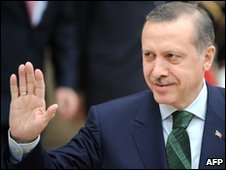
    Recep Tayyip Erdogan at the Elycee Palace in Paris 7 April 2010
    Erdogan’s comments will further deepen mistrust

    Turkey’s Prime Minister has described Israel as the “main threat to peace” in the Middle East.

    Recep Tayyip Erdogan was speaking during a visit to Paris.

    Israeli Prime Minister Benjamin Netanyahu responded saying he regretted Turkey’s “repeated attacks” on Israel.

    Relations between the two countries have been worsening since the Israeli incursion into the Gaza Strip in 2009, made worse by a recent diplomatic row.

    Mr Erdogan was speaking to journalists before meeting the French President Nicolas Sarkozy.

    “It is Israel that is the main threat to regional peace,” he said.

    “If a country uses disproportionate force, in Palestine, in Gaza, uses phosphorus bombs we are not going to say ‘well done.'”

    Both Israel and Hamas, which control the Gaza Strip, have been accused by the UN of war crimes during the 22-day offensive in December 2008 and January 2009.

    Humiliation

    Mr Netanyahu said he regretted the Turkish prime minister’s comments.

    Israeli Deputy Foreign Minister Danny Ayalon meeting Turkish Ambassador Ahmet Oguz Celikkol, captioned "the height of humiliation" in Israeli newspaper Israel Hayom [Image: Lior Mizrahi/Israel Hayom]
    The Turkish envoy was made to sit lower than the Israeli deputy minister

    “We are interested in good relations with Turkey and regret that Mr Erdogan chooses time after time to attack Israel,” he told reporters in Israel.

    The countries have been allies in the past.

    But earlier this week, the Turkish ambassador to Israel was recalled by Ankara, weeks after being humiliated in public by the Israeli deputy foreign minister.

    Ambassador Oguz Celikkol was called into the Israeli foreign ministry in January and rebuked over a Turkish television series that showed Israeli intelligence agents kidnapping children.

    Mr Celikkol was made to sit on a low chair while being lectured by Deputy Foreign Minister Danny Ayalon.

    Mr Ayalon later apologised for the rebuke.

    Israeli Foreign Minister Avigdor Lieberman has compared Mr Erdogan to Presidents Hugo Chavez of Venezuela and Libya’s leader Muammar Gaddafi.

    BBC

  • Soyak: Armenian Diaspora Ready for Cooperation with Turkey

    Soyak: Armenian Diaspora Ready for Cooperation with Turkey


    SATURDAY, 03 APRIL 2010 10:38
    Giving an interview to TurkishNY, Co-chairman of the Turkish-Armenian Business Development Council Kaan Soyak said that contribution that bilateral trade between Turkey and Armenia can make should not be ignored in the process of normalization of relations.

    Stressing that there is political will towards normalization of relations both in Armenia and Turkey, Soyak said, “The most important factors for normalization of relations between two countries are considered as genocide resolutions and Nagorno-Karabakh problem. We want the economical dimension of the ties to come to the surface in shaping the relations between two countries.”
    Pointing out that the volume of trade between two countries is about $200 mln despite closed borders, Soyak implied that Armenian diaspora is ready to cooperate with Turkey and said, “It is important that a big part of Armenian diaspora supports opening of borders. In that case, businessmen of Anatolia will be able to cooperate with Armenian diaspora in Russia, Middle Asia, Arabian countries, Europe, North and South America and even Far East without having any communication problem.” Stressing that volume of trade between Turkey and Armenia might reach to $1 bln with opening of state border, Soyak said, “It would be inevitable for the region to turn into a trade center with the opening of borders. Commercial relations will be the factor that provides reconciliation between two communities.”
    Underscoring that Turkey should not ignore influence of Russia over Armenia and Azerbaijan in its efforts towards resettlement of Nagorno-Karabakh problem, Soyak said, “In my opinion, resettlement of Nagorno-Karabakh problem may be achieved in two years. Russia may solve the problem in some extent to relieve Turkish community on Nagorno-Karabakh problem, which would make normalization of relations between Turkey and Armenia possible. On the other hand, even if such formula can be implented, the comprehensive solution to the problem will be dependent to the other developments in Caucasus, especially to the resolution of S. Ossetia and Abkhazia issues. Such a temporary solution for Nagorno-Karabakh is towards the interests of Russia as investments of Russia in Armenia cannot be operated because of closed borders.”
    The full text of the interview of Co-chairman of the Turkish-Armenian Business Development Council Kaan Soyak can be found in Turkishny.com in Turkish language.
  • Desperate Turkish Tactics to Woo  Diaspora on the Eve of April 24

    Desperate Turkish Tactics to Woo Diaspora on the Eve of April 24

    [[email protected]]

    The Turkish government has been receiving a succession of bad news in recent weeks. Its persistent policy of denial of the Armenian Genocide suffered serious setbacks when the Foreign Affairs Committee of the U.S. House of Representatives, the Swedish Parliament, and Catalonia’s regional Parliament in Spain adopted resolutions acknowledging the Armenian Genocide.

    Turkish denialists are terrified by these official acknowledgments on the eve of the 95th anniversary of the Armenian Genocide. They are even more alarmed by the fact that the Parliaments of Bulgaria, Israel, Serbia, Spain, and Great Britain are about to consider similar resolutions in April.

    The Turkish leadership was under the mistaken impression that the Protocols signed with Armenia six months ago would end any further action on the Armenian Genocide by the international community. In fact, Turkey had viewed these Protocols as a last ditch effort to stem the tide of such acknowledgments in the future. Its devious strategy almost worked, as the genocide resolutions in both Spain and the U.S. Congress were adopted by a mere one vote majority. The opponents of these resolutions specifically cited the “reconciliation” between Armenia and Turkey as their reason for voting against them.

    Alarmed by these developments, and distracted by serious internal problems, the Turkish government has initiated, perhaps a little too late, a series of actions, hoping to prevent further defeats on the Armenian Genocide issue.

    These actions range from using harsh, bullying tactics against countries that dare to acknowledge the Armenian Genocide, and a soft approach to mislead the international community into thinking that the Turkish government is being more accommodating towards Armenians.

    Among the Turkish bullying tactics against countries acknowledging the genocide are:

    — Recalling its ambassador;

    — Canceling military contracts; and

    — Boycotting the purchase of consumer goods.

    Last week, Turkish officials added a new twist, threatening to sue the more than 20 countries that have already acknowledged the Armenian Genocide. This is one of the many bluffs Turkish leaders use from time to time to discourage additional countries from acknowledging the Genocide. I truly hope that Turkey would carry out this threat, as it would create worldwide publicity for the mass crimes committed against Armenians. Any fair-minded non-Turkish court would immediately dismiss such a frivolous lawsuit!

    Turkey’s more clever tactics, using soft gloves at the advice of western public relations agents, include:

    — Renovating a couple of historic Armenian churches, while thousands of others are converted to mosques, stables, residences or simply ruined.

    — The “gracious” gesture of allowing religious services to be performed once a year for a limited number of people and limited duration to be determined by Turkish authorities, at the 10th century Holy Cross Armenian Church at Akhtamar Island, on Lake Van. This world famous house of worship is officially designated as a touristic site, not a church!

    — Reviewing the possibility of lifting the ban on children of refugees from Armenia to attend private Armenian schools in Istanbul.

    — A “show” meeting held last week between Prime Minister Erdogan and the head of Istanbul’s Sourp Prgich Armenian hospital, who was wrongly named as the leader of Turkey’s Armenian community. This meeting was more akin to a slave being summoned by his master. Afterwards, Bedros Shirinoglu dutifully told the Turkish media that “1915” was nothing more than a feud between two loving friends, instigated by third parties! He said that his grandfather was among the victims, but so were many Turks! Shirinoglu blamed himself and asked for Erdogan’s forgiveness for the latter’s threat to deport 100,000 Armenian refugees, saying that the inflated figure was his own fault, not the Prime Minister’s.

    — Finally, Foreign Minister Davutoglu came up last week with a new ploy to divide the Armenian Diaspora, after having limited success in his attempt to split the Diaspora from Armenia with the Protocols. Davutoglu announced that the Turkish authorities will initiate “dialog” with “reasonable Diaspora Armenians,” meaning Armenians who do not mind selling out the Armenian Cause for their own ego and personal gain. The Turkish Foreign Minister stated that contacts will be established with Armenian “intellectuals, universities, and civil societies.”

    Clearly, Turkish officials are resorting to all possible means, including the continued exloitation of the defunct Protocols, to discourage additional countries from acknowledging the Armenian Genocide.

    Armenia and the Diaspora must remain vigilant and united, especially in the weeks leading up to the 95th anniversary of the Armenian Genocide, in order not to fall victim to Turkish machinations, inducements and entrapments.