Tag: Recep Tayyip Erdogan

12th president of Turkey

  • Turkey opposition gains ground amid eastward drift

    Turkey opposition gains ground amid eastward drift

    By SUZAN FRASER (AP) – 23 hours ago

    ANKARA, Turkey — Turkey rallied behind Prime Minister Recep Tayyip Erdogan in his blistering condemnation of Israel after its commando raid on an aid ship to Gaza.

    But as dust settles from the May 31 attack, Turkey’s resurgent opposition seems to be gaining traction by articulating fears that Erdogan is steering NATO’s only Muslim member away from the West, jeopardizing EU membership efforts, and even undermining a long-running battle against separatist Kurds.

    The views of the Republican People’s Party — which considers itself a guarantor of secular values and enjoys a power base among Western-leaning urban elites — are increasingly important.

    The movement has a popular new leader following the resignation of its chairman over a sex scandal and many have high hopes that he can rejuvenate the party, presenting a viable alternative to Erdogan and anchoring Turkey firmly back in its Western orientation.

    Kemal Kilicdaroglu made a name for himself by exposing corruption within Erdogan party’s that led to two senior officials stepping down.

    While condemning the Israeli assault that killed eight Turks and a Turkish-American and calling on Jerusalem to end its Gaza blockade, Kilicdaroglu’s party has also criticized Erdogan’s confrontational style against Israel and accused the prime minister of trying to use outrage to win elections due next year.

    “We are witnessing a serious crisis of confidence between (Erdogan’s party) and the West … This crisis must end immediately,” Kilicdaroglu said in a speech.

    A recent opinion poll shows that the Republican People’s Party has made gains since Kilicdaroglu took the party reins, although Erdogan’s Justice and Democracy Party remains more popular.

    The survey, conducted by the Konsensus research company for Haberturk newspaper and published Saturday, shows 38.8 percent backing Erdogan’s party against 31.3 percent for Kilicdaroglu’s Republicans — up from the 25 percent support for the party under the previous leadership. No margin of error was given.

    “The belief that there is no alternative to (Erdogan’s party) has ended with Kilicdaroglu becoming chairman,” Konsensus general manager Murat Sari was quoted as saying.

    The survey, however, showed that Kilicdaroglu gained support from a nationalist party, not from Erdogan’s ruling party, suggesting that skepticism about the opposition remains widespread.

    The Republican Party has long projected a strict — and some say intolerant — form of secularism that has opposed among other things, young women wearing Islamic-style headscarves at universities.

    It claims to be the heir to the legacy of Turkey’s modernizing founding father, Mustafa Kemal Ataturk. But its coziness with the military, elitist attitudes toward rural Turkey, and opposition to some reforms designed to boost Turkey’s EU membership chances have driven many liberal supporters away. Many also accept that Erdogan’s party, in power since 2002, has been a better steward of economic and social reforms.

    For his part, Erdogan has alarmed liberals with his threats to scuttle Turkey’s longstanding alliance with Israel, his questioning of Washington’s international leadership, and his willingness to cultivate friendships with hardline Islamic nations like Iran and Syria.

    Increasingly, analysts who praised Erdogan for raising Turkey’s standing in the Middle East are now warning that the government is acting out of emotion not reason in its dealings with Israel and the West.

    “Unless someone says stop, the present atmosphere threatens to marginalize Turkey in the long term,” wrote Asli Aydintasbas, a columnist for liberal Milliyet newspaper.

    Overwhelming support for Erdogan in elections in 2007 “were not for Hamas but for a ‘western Muslim’ Turkey that increased its global weight both in the East and in the West,” Aydintasbas said.

    Military analysts have voiced concerns that Turkey’s new foreign policy is harming its interests, undermining its fight against autonomy-seeking Kurdish rebels.

    The United States has been providing intelligence on Kurdish rebel movements in northern Iraq, where a bulk of the rebels are in hiding, while Turkey uses drones recently purchased from Israel to spy on the guerrilla group.

    On Saturday, about 60 rebels attacked a military outpost on the Turkish-Iraqi border, killing nine soldiers, according to the military.

    The attack raised questions as to how they were able to reach the outpost undetected and some speculated that the United States may have withheld crucial intelligence.

    But Maj. Gen. Ferit Guler, secretary-general of the Turkish military, insisted that a successful intelligence cooperation with the United States was still in place.

    The military has long supported Turkey’s military alliance with Israel, which has provided crucial military equipment, such as the drones and modernized Turkish fighter jets and tanks.

    Erdogan insists it is committed to its alliance with the United States and NATO and that his government still seeks EU membership, although he has also accused European countries of having a “secret agenda” to keep Turkey out.

    Related articles

    • Turkey’s New Diplomacy
      International Herald Tribune – 1 day ago
    • Turkey: no Blue Stream gas to Israel for now
      Industrial Fuels and Power (blog) – 1 day ago
    • Turkish energy minister says no gas transportation to Israel via Blue Stream
      Trend News Agency – 2 days ago
    • More coverage (1) »
  • Wait and See Game for Turkey’s Enforcement of UN Sanctions on Iran

    Wait and See Game for Turkey’s Enforcement of UN Sanctions on Iran

    Dorian Jones | IstanbuL

    21 June 2010

    Photo: AFP

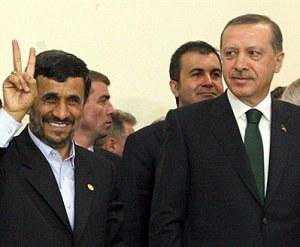
    Iran’s President Mahmoud Ahmadinejad flashes the V-sign for victory as Turkish Prime Minister Recep Tayyip Erdogan looks on after the Islamic republic inked a nuclear fuel swap deal in Tehran (File Photo – 17 May 2010)

    Related Articles

    • Turkey Troops, Kurdish Rebels Clash Near Iraq Border
    • US Defense Secretary: Europe Pushing Turkey ‘Eastward’
    • Israel Moves to Repair Relations With Turkey

    This month, Turkey voted against the United Nations Security Council’s fourth round of sanctions against Iran. With Turkey’s Islamic rooted government increasing its economic ties with Iran in the past few years, fears are arising that the pivotal Western ally is in danger of swinging eastward because of resistance in Europe to its bid for membership of the European Union.

    Despite growing international tensions over Iran’s nuclear energy program, the Turkish government has forged ahead with energy deals with Iran, expanding its dependency on energy with the nation.

    These deals put Turkey in a precarious situation: to enforce or not to enforce the UN sanctions imposed on its neighbor Iran.

    Turkey has long been seen as a bridge between East and West. But its belief that sanctions are ineffective and that there are dangers in pushing the Islamic republic into a corner is likely to change its relationship with Western nations.

    Earlier this month Turkish foreign minister Ahmet Davutoglu expressed concern over the existing sanctions against Iran.

    AP

    “Turkey and Iran’s trade volume is around $10 billion,” he says. “And it can rise to $30 billion if sanctions are lifted.”

    Iran’s energy resources are seen as important by Ankara to break its dependency on Russian energy.

    Iran expert Gokhan Cetinsayar of Sehir University says that in addition to its dependency on gas, there are other trade initiatives with Iran that are economically key to Turkey.

    “75,000 trucks going on between Turkey and Iran every year,” said Cetinsayar. “Now there are energy deals. You know how important the Iranian natural gas and all other agreements and initiatives are economically important for Turkey.

    With large families usually depending for their livelihoods on cargo trucks, its estimated as many a million Turkish people depend on Iranian trade.

    With its increasing economic ties with Iran, there are growing fears that Turkey will balk at enforcing the UN sanctions against Iran.

    Turkish foreign minister spokesman Burak Ozugergin says Turkey has already paid a heavy economic price for UN policies with another of its neighbors, Iraq.

    “At the beginning of the 90’s, the Turkish volume of trade with Iraq was around the 15 to 20 percent mark of our total volume of trade. The next year, after the imposition of sanctions, this trickled down to almost zero,” said Ozugergin. “Money is not everything. But at least if it did work then we might be able to say to our public, ‘look it was for a good a cause.’ But can we really honestly say that looking back? For Iran again we don’t think it will help to solve the nuclear issue and perhaps may work against it.”

    The new sanctions on Iran are expected to cut into the present $10 billion trade volume. It could possibly undermine its energy policy as well. But political scientist Nuray Mert of Istanbul University say some western nations may now not be able to depend on Turkey.

    “I was inclined to think that at the end of the day Turkey will join the club when it comes to realization of these sanctions,” she said. “But nowadays I can see the government is planning to avoid these sanctions. Because now we have Turkey signing a lot of economic agreements, against the policy of sanctions.”

    For now Turkey has remained circumspect over enforcing new sanctions. One foreign ministry official said “you will have to wait and see.” Analysts say Iran would probably reward any breaking of sanctions with lucrative energy deals. But the political cost could be high because of Turkey’s aspirations for joining the EU. The coming weeks will see Ankara facing a difficult a choice.

  • VIDEO: Turkey’s PM Erdogan vows to ‘annihilate’ PKK rebels

    VIDEO: Turkey’s PM Erdogan vows to ‘annihilate’ PKK rebels

    https://www.bbc.co.uk/news/10371678

    Page last updated at 21:23 GMT, Monday, 21 June 2010 22:23 UK

    Turkey’s president has held an emergency security meeting to discuss how to rein in violence in the country’s mainly Kurdish south-east.

    Eleven soldiers were killed over the weekend in an attack by the banned Kurdish Workers Party, the PKK. Recent weeks have seen a sharp increase in armed clashes between the PKK and the Turkish military.

    Jonathan Head reports.

    READ MORE: Turkey to fight PKK ‘to the end’

    See also

    • Turkish troops ‘killed by rebels’

      (00.55) minutes long

    • Lessons to be learned from Turkey?

      (02.41) minutes long

  • ADL, B’nai B’rith boycott Turkey meeting

    ADL, B’nai B’rith boycott Turkey meeting

    June 16, 2010

    WASHINGTON (JTA) — At least two Jewish groups are boycotting a meeting requested by Turkey’s ruling party.

    Top lawmakers and administration officials affiliated with the AKP Party were in Washington on Wednesday to meet with Obama administration officials and U.S. lawmakers. They added a meeting with Jewish organizational leaders, but at least two declined: the Anti-Defamation League and B’nai B’rith International.

    Other groups invited, including the American Israel Public Affairs Committee and the American Jewish Committee, did not return calls from JTA.

    Jewish groups are furious with Turkish Prime Minister Recep Tayyip Erdogan, who heads the AKP, for his recent broadsides against Israel. These have increased since May 31, when Israeli commandos raided a Turkish-flagged aid ship aimed at breaching Israel’s blockade of the Gaza Strip. Nine Turkish passengers, including one Turkish American, died in violence after the Israelis boarded the ship, and seven Israeli troops were injured.

    In a speech last week, Erdogan likened the Star of David to a swastika. Abraham Foxman, the ADL’s national director, said he also was outraged that Turkey had withdrawn participation from a teachers’ conference in Israel on teaching the Holocaust.

    “That’s it, this has nothing to do with the boat, foreign policy,” Foxman told JTA, speaking of the teachers’ conference. “If they cancel that, why should I go?”

    Turkey’s government has relied traditionally on Jewish groups in Washington to help represent its interests.

    One pending matter of concern is a resolution under consideration in the U.S. House of Representatives that would recognize the Ottoman massacres of Armenians in 1915-16 as a genocide, as most historians already do.

  • Erdogan’s Troubling Friends

    Erdogan’s Troubling Friends

    This article first appeared at FrontPage Magazine.

    In 1974, when Turkish Prime Minister Tayyip Erdogan was president of the Istanbul youth group of the MSP (the Islamist National Salvation Party), he wrote, directed, and starred in a play called Mas-Kom-Ya, which addressed subversive elements in Turkish society: masons, communists and yahudi (Jews). This very same performer has managed to convince gullible Western politicians that Turkey is committed to EU membership. Equally convincingly, he has played to the Arab gallery since his AKP (Justice and Development Party) came to power in 2002.

    Erdogan’s tirade against Shimon Peres during a panel discussion at last year’s World Economic Forum in Davos – “you know very well how to kill” – earned plaudits all around the Arab world. The Lebanese daily Dar A-Hayatsuggested that Erdogan should restore the Ottoman Empire and be the Caliph of all Muslims. By some accounts, this has been identified as the driving force behind Turkey’s expansionist foreign policy, which has been dubbed “neo-Ottoman.”

    This new course obviously played out in Turkey’s role in the Gaza flotilla incident. According to Debka (an open source intelligence website) the flotilla was personally sponsored by Erdogan, and according to the same source, he is even prepared to sail aboard the next flotilla himself. Some awareness of the consequences must have been know, as a week before the flotilla sailed, Ankara threatened Israel with reprisals if it was impeded.

    The connection between the flotilla’s organizer, the Turkish-based IHH (Foundation for Human Rights and Freedoms and Humanitarian Relief), and Hamas is well documented, and it created a stir when Hamas leader Khaled Mashal was officially invited to Ankara in 2006.

    Ankara’s support for Iran’s nuclear program, ostensibly for peaceful purposes, is likewise a cause for concern in the Western world, and President Abdullah Gül has admitted in an interview with Forbes magazine that “it is their final aspiration to have a nuclear weapon in the end.”

    Turkey and Syria have agreed on a long-term strategic partnership and Erdogan continues to defend Sudan’s president, Omar al-Bashir (who is on the International Criminal Court’s wanted list) with the claim that “a Muslim can never commit genocide.”

    Also alarming is the secret meeting between Prime Minister Erdogan and a Sudanese financier, Dr. Fatih al-Hassanein, during an Arab League summit in Khartoum in 2006. Dr. al-Hassanein is believed to have ties with al-Qaeda and other Islamist movements (e.g. in Bosnia).

    What has caused another stir is the friendship between Prime Minister Erdogan and a Saudi businessman, Yassin al-Qadi, who, according to the U.S. Treasury and the United Nations Security Council, is a major financier of Islamic terrorism. Erdogan’s advisor and co-founder of the AKP, Cüneyd Zapsu, was also al-Qadi’s partner.

    Erdogan defended al-Qadi publicly on Turkish television, declaring: “I trust him the same way I trust my father.” And a case against al-Qadi was dropped when in 2006 the Chief Public Prosecutor decided: “Al-Qadi is a philanthropic businessman and no connection has been found between him and terrorist organizations.”

    The truth is beginning to catch up with Erdogan. Last week, in an interview given to the Wall Street Journal, Fethullah Gülen, who, although a resident in the USA, is reckoned to be Turkey’s most influential religious leader, criticized the Gaza flotilla. He also commented: “.. some people in the United States consider Turkey as sitting at the epicenter of radicalism.”

    It is now up to the hot-tempered Mr. Erdogan and his government to dispel this image — or to continue confirming it.

    Robert Ellis is a regular commentator on Turkish affairs in the Danish and international press.

  • Possible Challange to Israels blockade by Erdogan

    Possible Challange to Israels blockade by Erdogan

    Israel’s intelligence report
    Turkish troops deployed in Cyprus, top intelligence ranks Islamized
    DEBKAfile Special Report June 6, 2010, 1:55 PM (GMT+02:00)
    Dr. Hakan Fidan, new Turkish MIT chief

    Turkish Prime Minister Recep Erdogan is clearly spoiling for more trouble with Israel. This is manifested by the steps which are revealed here by debkafile’s military and intelligence sources. The peaceful outcome of the Rachel Corrie incident Saturday, June 5, and Israel’s efforts to keep the crisis under control have had no effect on his determination to raise rather than de-escalate Turkish-Israeli friction.
    Friday, Erdogan made sure his close aides leaked word to the media that he was preparing a large wave of flotillas to challenge Israel’s blockade, to be escorted next time by armed Turkish warships with himself possibly on board.

    To this, our sources add:
    1. The prime minister’s office in Ankara is forking out millions of dollars to the IHH (Insani Yardim Vakfi), the Istanbul-based terrorist group linked to al Qaeda and Hamas, with orders to purchase 8-10 large ships for a formidable fleet to challenge the Israeli Navy and its enforcement of the 20-mile blockade of the Gaza Strip.
    This is the second time he is recruiting the IHH terrorists who assaulted Israeli commandos boarding the Mavi Marmara on May 31, leaving nine people dead and 45 injured in consequence.

    The Washington Post Sunday called for the Erdogan’s government’s ties to the IHH to be one focus of any international investigation into the Marmara incident, pointing to its support for Hamas, which the United States has named as a terrorist entity. The paper called foreign minister Ahmet Davutogolu’s statement that the Israeli attack “is like 9/11 for Turkey” obscene.

    2. Last week, ahead of the Marmara incident, Erdogan began deploying at the Turkish end of Cyprus air, naval and marine units, holding them ready to combat Israeli takeovers of Gaza-bound vessels. He was only restrained from sending them into action by the last-minute intervention of President Barack Obama’s NSA James Jones and President Nicolas Sarkozy’s chef de bureau who, according to debkafile’s Washington and Paris sources, threatened him with isolation in NATO and Europe if he went ahead.
    Saturday, the Turkish leader had his aides leak to the media that he was seriously thinking of leading the next flotilla in person to dramatize his confrontation with Israel.
    3. At home, the Turkish prime minister shored up his intelligence ranks ahead of his planned showdown with Israel, replacing professional directors for the first time in modern Turkish history with civilians, radical Muslims close to him personally.
    debkafile names them for the first time here as Hakan Fidan, the former head of TIKA, the Turkish International & Development Agency, who is appointed head of the Central Turkish Intelligence Agency – MIT, the equivalent of the Israel Mossad; and Istanbul Governor Muammer Guler, who is the new Undersecretary for Public Order and Security, who in fact directs Turkey’s special operations against terrorists.
    By these appointments, the Turkish prime minister put paid to any lingering hopes still cherished by some circles in Israel of preserving the long-held back channels to Ankara.

    And finally, Turkey’s state prosecutors are instructed to prepare charges of murder and piracy on the high seas against Israeli prime minister Binyamin Netanyahu, defense minister Ehud Barak and chief of staff Lt. Gen. Gaby Ashkenazy.